
Neubauer A., Freudenberger J., Kuhn V. Coding theory: algorithms, architectures and applications
Подождите немного. Документ загружается.

126 CONVOLUTIONAL CODES
notice that with increasing memory the free distance improves while the slope α decreases.
Tables of codes with good slope can be found elsewhere (Jordan et al., 2004b, 2000).
3.3.3 Weight Enumerators for Terminated Codes
Up to now we have only considered code sequences or code sequence segments of minimum
weight. However, the decoding performance with maximum likelihood decoding is also
influenced by code sequences with higher weight and other code parameters such as the
number of code paths with minimum weight. The complete error correction performance
of a block code is determined by its weight distribution. Consider, for example, the weight
distribution of the Hamming code B(7, 4). This code has a total of 2
k
= 16 code words:
the all-zero code word, seven code words of weight d = 3, seven code words of weight
4 and one code word of weight 7. In order to write this weight distribution in a compact
way, we specify it as a polynomial of the dummy variable W , i.e. we define the Weight
Enumerating Function (WEF) of a block code B(n, k) as
A
WEF
(W ) =
n
w=0
a
w
W
w
,
where a
w
is the number of code words of weight w in B. The numbers a
0
,...,a
n
are the
weight distribution of B. For the Hamming code B(7, 4) we have
A
WEF
(W ) = 1 + 7W
3
+ 7W
4
+ W
7
.
With convolutional codes we have basically code sequences of infinite length. Therefore, we
cannot directly state numbers of code words of a particular weight. To solve this problem,
we will introduce the concept of path enumerators in the next section. Now, we discuss a
method to evaluate weight distributions of terminated convolutional codes which are in fact
block codes. Such weight enumerators are, for instance, required to calculate the expected
weight distributions of code concatenations with convolutional component codes, as will
be discussed in Chapter 4.
Consider the trellis of the convolutional code B(2, 1, 2) as given in Figure 3.14, where
we labelled the branches with input and output bits corresponding to a particular state
transition. Similarly, we can label the trellis with weight enumerators as in Figure 3.23, i.e.
every branch is labelled by a variable W
w
with w being the number of non-zero code bits
corresponding to this state transition. Using such a labelled trellis, we can now employ the
forward pass of the Viterbi algorithm to compute the WEF of a terminated convolutional
code. Instead of a branch metric, we compute a weight enumerator A
(j)
i
(W ) for each node
in the trellis, where A
(j)
i
(W ) denotes the enumerator for state σ
j
at level i. Initialising the
enumerator of the first node with A
(0)
0
(W ) = 1, we could now traverse the trellis from left
to right, iteratively computing the WEF for all other nodes. In each step of the forward
pass, we compute the enumerators A
(j)
i+1
(W ) at level i + 1 on the basis of the enumerators
of level i and the labels of the corresponding transitions as indicated in Figure 3.23. That
is, we multiply the enumerators of level i with the corresponding transition label and sum
over all products corresponding to paths entering the same node. The enumerator A
(0)
L+m
(W )
of the final node is equal to the desired overall WEF.
CONVOLUTIONAL CODES 127
Calculating the weight enumerator function
i
i + 1
1
1
W
2
W
2
W
W
W
W
σ
0
= 00
σ
1
= 01
σ
2
= 10
σ
3
= 11
W
2
1
A
(0)
i
A
(1)
i
A
(2)
i+1
= W · A
(0)
i
+ A
(1)
i
■ A trellis module of the (75)
8
convolutional code. Each branch is labelled
with a branch enumerator.
■ We define a 2
ν
× 2
ν
transition matrix T. The coefficient τ
l,j
of T is the weight
enumerator of the transition from state σ
l
to state σ
j
, where we set τ
l,j
= 0
for impossible transitions.
■ The weight enumerator function is evaluated iteratively
A
0
(W ) = (10 ··· 0)
T
,
A
i+1
(W ) = T · A
i
(W ),
A
WEF
(W ) = (10 ··· 0) · A
L+m
(W ).
Figure 3.23: Calculating the weight enumerator function
Using a computer algebra system, it is usually more convenient to represent the trellis
module by a transition matrix T and to calculate the WEF with matrix operations. The
trellis of a convolutional encoder with overall constraint length ν has the physical state
space S ={σ
0
,...,σ
2
ν
−1
}. Therefore, we define a 2
ν
× 2
ν
transition matrix T so that the
coefficients τ
l,j
of T are the weight enumerators of the transition from state σ
l
to state σ
j
,
where we set τ
l,j
= 0 for impossible transitions. The weight enumerators of level i can
now be represented by a vector
A
i
(W ) = (A
(0)
i
A
(1)
i
···A
(2
ν
−1)
i
)
T
with the special case
A
0
(W ) = (10 ··· 0)
T
128 CONVOLUTIONAL CODES
for the starting node. Every step of the Viterbi algorithm can now be expressed by a
multiplication
A
i+1
(W ) = T · A
i
(W ).
We are considering a terminated code with k · L information and n · (L + m) code bits,
and thus the trellis diagram contains L + m transitions and we have to apply L + m mul-
tiplications. We obtain the WEF
A
WEF
(W ) = (10 ··· 0) ·
τ
0,0
... τ
1,1
.
.
.
.
.
.
τ
0,2
ν
−1
... τ
2
ν
−1,2
ν
−1
L+m
·
1
0
.
.
.
0
,
where the row vector (10 ··· 0) is required to select the enumerator A
(0)
L+m
(W ) of the final
node. The WEF may also be evaluated iteratively as indicated in Figure 3.23. An example
of iterative calculation is given in Figure 3.24.
The concept of the weight enumerator function can be generalized to other enumerator
functions, e.g. the Input–Output Weight Enumerating Function (IOWEF)
A
IOWEF
(I, W ) =
k
i=0
n
w=0
a
i,w
I
i
W
w
,
where a
i,w
represents the number of code words with weight w generated by information
words of weight i. The input–output weight enumerating function considers not only the
weight of the code words but also the mapping from information word to code words.
Therefore, it also depends on the particular generator matrix. For instance, the Hamming
code B(7, 4) with systematic encoding has the IOWEF
A
IOWEF
(I, W ) = 1 + I(3W
3
+ W
4
) + I
2
(3W
3
+ 3W
4
) + I
3
(W
3
+ 3W
4
) + I
4
W
7
.
Note that by substituting I = 1 we obtain the WEF from A
IOWEF
(I, W )
A
WEF
(W ) = A
IOWEF
(I, W )
|
I =1
.
To evaluate the input–output weight enumerating function for a convolutional encoder,
two transition matrices T and T
are required. The coefficients τ
i,j
of T are input–output
enumerators, for example τ
0,2
= IW
2
for the transition from state σ
0
to state σ
2
with the
(75)
8
encoder. The matrix T
regards the tailbits necessary for termination and therefore
only contains enumerators for code bits, e.g. τ
0,2
= W
2
. We obtain
A
IOWEF
(I, W ) = (10 ··· 0) · T
L
T
m
· (10 ··· 0)
T
.

CONVOLUTIONAL CODES 129
Calculating the weight enumerator function – example
■ For the (75)
8
convolutional code we obtain
A
i+1
(W ) =
A
(0)
i+1
(W )
A
(1)
i+1
(W )
A
(2)
i+1
(W )
A
(3)
i+1
(W )
=
1 W
2
00
00WW
W
2
100
00WW
·
A
(0)
i
(W )
A
(1)
i
(W )
A
(2)
i
(W )
A
(3)
i
(W )
.
■ Consider the procedure for L = 2:
1
0
0
0
i=1
−→
1
0
W
2
0
i=2
−→
1
W
3
W
2
W
3
i=3
−→
1 + W
5
W
3
+ W
4
W
2
+ W
3
W
3
+ W
4
i=4
−→
1 + 2W
5
+ W
6
W
3
+ 2W
4
W
2
+ W
3
+ W
4
+ W
7
W
3
+ 2W
4
+ W
5
.
■ This results in the weight enumerating function
A
WEF
(W ) = A
0
L+m
(W ) = A
0
4
(W ) = 1 +2W
5
+ W
6
.
Figure 3.24: Calculating the weight enumerator function – example
3.3.4 Path Enumerators
At the beginning of this section we have introduced the notion of an error event, i.e. if an
error occurs, the correct sequence and the estimated sequence will typically match for long
periods of time but will differ for some code sequence segments. An error event is a code
sequence segment where the transmitted and the estimated code sequence differ. Without
loss of generality we can assume that the all-zero sequence was transmitted. Therefore, we
can restrict the analysis of error events to code sequence segments that diverge from the all-
zero sequence and remerge at some later time. Such a code sequence segment corresponds
to a path in the trellis that leaves the all-zero state and remerges with the all-zero state. A
weight distribution for such code sequence segments is typically called the path enumerator.
In this section we will discuss a method for calculating such path enumerators. Later
on, we will see how the path enumerator can be used to estimate the decoding performance
for maximum likelihood decoding.
130 CONVOLUTIONAL CODES
We will assume that the error event starts at time zero. Hence, all code sequence seg-
ments under consideration correspond to state sequences (0,σ
1
,σ
2
,...,σ
j
, 0,...). Note
that j is greater than or equal to m, because a path that diverges from the all-zero state
requires at least m + 1 transitions to reach the zero state again. Once more, we will discuss
the procedure to derive the path enumerator for a particular example using the (75)
8
con-
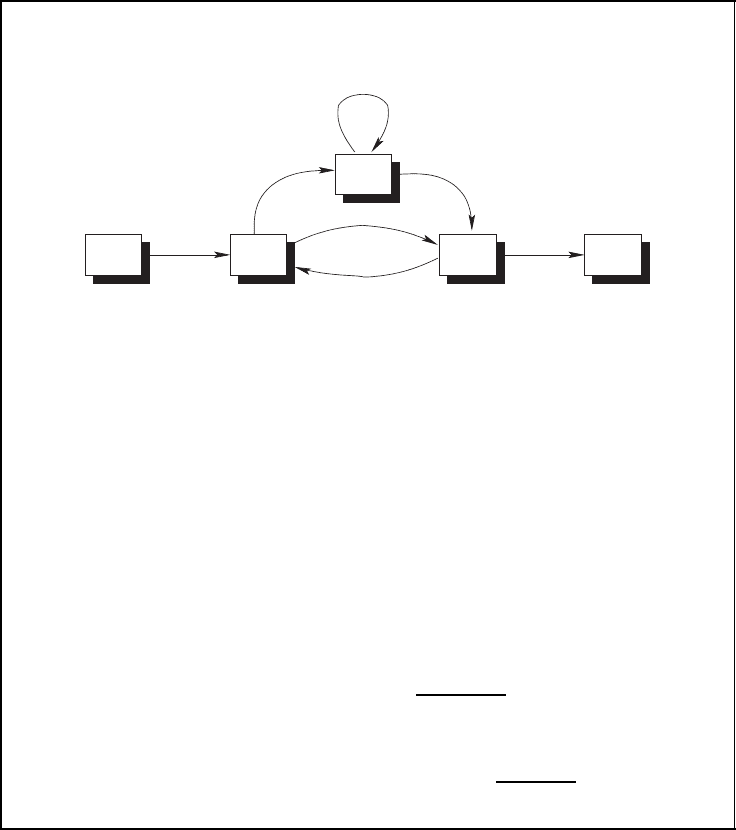
volutional code. Consider, therefore, the signal flow chart in Figure 3.25. This is basically
the state diagram from Figure 3.6. The state transitions are now labelled with enumerators
Path enumerator function
01
11
00 0010
I
W
W
WI
WI
W
2
W
2
I
■ Path enumerator function can be derived from a signal flow chart similar to
the state diagram. State transitions are labelled with weight enumerators,
and the loop from the all-zero state to the all-zero state is removed.
■ We introduce a dummy weight enumerator function for each non-zero state
and obtain a set of linear equations
A
(1)
(I, W ) = WA
(2)
(I, W ) + WA
(3)
(I, W ),
A
(2)
(I, W ) = IA
(1)
(I, W ) + IW
2
,
A
(3)
(I, W ) = WIA
(2)
(I, W ) + WIA
(3)
(I, W ),
A
IOPEF
(I, W ) = A
(1)
(I, W )W
2
.
■ Solving this set of equations yields the path enumerator functions
A
IOPEF
(I, W ) =
W
5
I
(1 − 2WI)
and
A
PEF
(I, W ) = A
IOPEF
(I, W )
|
I =1
=
W
5
(1 − 2W)
.
Figure 3.25: Path enumerator function

CONVOLUTIONAL CODES 131
for the number of code bits (exponent of W ) and the number of information bits (expo-
nent of I ) that correspond to the particular transition. Furthermore, the loop from the
all-zero state to the all-zero state is removed, because we only consider the state sequence
(0,σ
1
,σ
2
,...,σ
j
, 0,...) where only the first transition starts in the all-zero state the last
transition terminates in the all-zero state and there are no other transitions to the all-zero
state in between. In order to calculate the Input–Output Path Enumerator Function (IOPEF),
we introduce an enumerator for each non-zero state, comprising polynomials of the dummy
variables W and I. For instance, A
(2)
(I, W ) denotes the enumerator for state σ
2
= (10).
From the signal flow chart we derive the relation A
(2)
(I, W ) = IA
(1)
(I, W ) + IW
2
. Here,
A
(2)
(I, W ) is the label of the initial transition IW
2
plus the enumerator of state σ
1
multi-
plied by I , because the transition from state σ
1
to state σ
2
has one non-zero information bit
and only zero code bits. Similarly, we can derive the four linear equations in Figure 3.25,
which can be solved for A
IOPEF
(I, W ), resulting in
A
IOPEF
(I, W ) =
W
5
I
(1 − 2WI)
.
As with the IOWEF, we can derive the Path Enumerator Function (PEF) from the input–
output path enumerator by substituting I = 1 and obtain
A
PEF
(W ) = A
IOPEF
(I, W )
|
I =1
=
W
5
(1 − 2W)
.
3.3.5 Pairwise Error Probability
In Section 3.3.1 and Section 3.3.2 we have considered error patterns that could lead to a
decoding error. In the following, we will investigate the probability of a decoding error with
minimum distance decoding. In this section we derive a bound on the so-called pairwise
error probability, i.e. we consider a block code B ={b, b
} that has only two code words
and estimate the probability that the minimum distance decoder decides on the code word
b
when actually the code word b was transmitted. The result concerning the pairwise error
probability will be helpful when we consider codes with more code words or possible error
events of convolutional codes.
Again, we consider transmission over the BSC. For the code B ={b, b
},wecan
characterise the behaviour of the minimum distance decoder with two decision regions (cf.
Section 2.1.2). We define the set D as the decision region of the code word b, i.e. D is the
set of all received words r so that the minimum distance decoder decides on b. Similarly,
we define the decision region D
for the code word b
. Note that for the code with two
code words we have D
= F
n
\D.
Assume that the code word b was transmitted over the BSC. In this case, we can define
the conditional pairwise error probability as
P
e|b
=
r/∈D
Pr{r|b}.
Similarly, we define
P
e|b
=
r/∈D
Pr{r|b}

132 CONVOLUTIONAL CODES
and obtain the average pairwise error probability
P
e
= P
e|b
Pr{b}+P
e|b
Pr{b
}.
We proceed with the estimation of P
e|b
. Summing over all received vectors r with r /∈ D
is usually not feasible. Therefore, it is desirable to sum over all possible received vectors
r ∈ F
n
. In order to obtain a reasonable estimate of P
e|b
we multiply the term Pr{r|b} with
the factor
Pr{r|b
}
Pr{r|b}
%
≥ 1 for r /∈ D
≤ 1 for r ∈ D
This factor is greater than or equal to 1 for all received vectors r that lead to a decoding
error, and less than or equal to 1 for all others. We have
P
e|b
≤
r/∈D
Pr{r|b}
Pr{r|b
}
Pr{r|b}
=
r/∈D
'
Pr{r|b}Pr{r|b
}.
Now, we can sum over all possible received vectors r ∈ F
n
P
e|b
≤
r
'
Pr{r|b}Pr{r|b
}.
The BSC is memoryless, and we can therefore write this estimate as
P
e|b
≤
r
1
···
r
n
(
)
)
*
n
i=1
Pr{r
i
|b
i
}Pr{r
i
|b
i
}=
n
i=1
r
+
Pr{r|b
i
}Pr{r|b
i
}.
For the BSC, the term
#
r
'
Pr{r|b
i
}Pr{r|b
i
} is simply
+
Pr{0|b
i
}Pr{0|b
i
}+
+
Pr{1|b
i
}Pr{1|b
i
}=
%
√
ε
2
+
'
(1 − ε)
2
= 1 for b
i
= b
i
2
√
ε(1 − ε) for b
i
= b
i
.
Hence, we have
P
e|b
≤
n
i=1
r
+
Pr{r|b
i
}Pr{r|b
i
}=
2
'
ε(1 −ε)
dist
(b,b
)
.
Similarly, we obtain P
e|b
≤
2
√
ε(1 −ε)
dist
(b,b
)
. Thus, we can conclude that the pairwise
error probability is bounded by
P
e
≤
2
'
ε(1 −ε)
dist
(b,b
)
.
This bound is usually called the Bhattacharyya bound, and the term 2
√
ε(1 −ε) the Bhat-
tacharyya parameter. Note, that the Bhattacharyya bound is independent of the total number
of code bits. It only depends on the Hamming distance between two code words. Therefore,
CONVOLUTIONAL CODES 133
Bhattacharyya bound
■ The pairwise error probability for the two code sequences b and b
is
defined as
P
e
= P
e|b
Pr{b}+P
e|b
Pr{b
}
with conditional pairwise error probabilities
P
e|b
=
r/∈D
Pr{r|b} and P
e|b
=
r/∈D
Pr{r|b}
and the decision regions D and D
.
■ To estimate P
e|b
, we multiply the term Pr{r|b} with the factor
Pr{r|b
}
Pr{r|b}
%
≥ 1 for r /∈ D
≤ 1 for r ∈ D
and sum over all possible received vectors r ∈ F
n
P
e|b
≤
r
'
Pr{r|b}Pr{r|b
}.
■ For the BSC this leads to the Bhattacharyya bound
P
e
≤
2
'
ε(1 −ε)
dist
(b,b
)
.
Figure 3.26: Bhattacharyya bound
it can also be used to bound the pairwise error probability for two convolutional code
sequences. The derivation of the Bhattacharyya bound is summarised in Figure 3.26.
For instance, consider the convolutional code B(2, 1, 2) and assume that the all-zero
code word is transmitted over the BSC with crossover probability ε = 0.01. What is
the probability that the Viterbi algorithm will result in the estimated code sequence
ˆ
b =
(11 10 11 00 00 ...)? We can estimate this pairwise error probability with the Bhattacharyya
bound. We obtain the Bhattacharyya parameter 2
√
ε(1 −ε) ≈ 0.2 and the bound P
e
≤
3.2 · 10
−4
. In this particular case we can also calculate the pairwise error probability. The
Viterbi decoder will select the sequence (11 10 11 00 00 ...) if at least three channel errors
occur in any of the five non-zero positions. This event has the probability
5
e=3
5
e
ε
e
(1 − ε)
5−e
≈ 1 ·10
−5
.
134 CONVOLUTIONAL CODES
3.3.6 Viterbi Bound
We will now use the pairwise error probability for the BSC to derive a performance bound
for convolutional codes with Viterbi decoding. A good measure for the performance of
a convolutional code is the bit error probability P
b
, i.e. the probability that an encoded
information bit will be estimated erroneously in the decoder. However, it is easier to derive
bounds on the burst error probability P
B
, which is the probability that an error event will
occur at a given node. Therefore, we start our discussion with the burst error probability.
3
We have already mentioned that different error events are statistically independent for
the BSC. However, the burst error probability is not the same for all nodes along the correct
path. An error event can only start at times when the estimated code sequence coincides
with the correct one. Therefore, the burst error probability for the initial node (time i = 0)
is greater than for times i>0. We will derive a bound on P
B
assuming that the error event
starts at time zero. This yields a bound that holds for all nodes along the correct path.
Remember that an error event is a path through the trellis, that is to say, a code sequence
segment. Let b denote the correct code sequence and E(b
) denote the event that the code
sequence segment b
causes a decoding error starting at time zero. A necessary condition
for an error event starting at time zero is that the corresponding code sequence segment
has a distance to the received sequence that is less than the distance between the correct
path and r. This condition is not sufficient, because there might exist another path with an
even smaller distance. Therefore, we have
P
B
≤ Pr{∪
b
E(b
)},
where the union is over all possible error events diverging from the initial trellis node. We
can now use the union bound to estimate the union of events Pr{∪
b
E(b
)}≤
#
b
Pr{E(b
)}
and obtain
P
B
≤
b
Pr{E(b
)}.
Assume that dist(b, b
) = w. We can use the Bhattacharyya bound to estimate Pr{E(b
)}
Pr{E(b
)}≤
2
'
ε(1 −ε)
w
.
Let a
w
be the number of possible error events of weight w starting at the initial node. We
have
P
B
≤
∞
w=d
free
a
w
2
'
ε(1 −ε)
w
.
Note, that the set of possible error events is the set of all paths that diverge from the
all-zero path and remerge with the all-zero path. Hence, a
w
is the weight distribution of
the convolutional code, and we can express our bound in terms of the path enumerator
function A(W )
P
B
≤
∞
w=d
free
a
w
2
'
ε(1 −ε)
w
= A
PEF
(W )
|
W =2
√
ε(1−ε)
.
This bound is called the Viterbi bound (Viterbi, 1971).
3
The burst error probability is sometimes also called the first event error probability.
CONVOLUTIONAL CODES 135
Viterbi bound
■ The burst error probability P
B
is the probability that an error event will occur
at a given node.
■ For transmission over the BSC with maximum likelihood decoding the burst
error probability is bounded by
P
B
≤
∞
w=d
free
a
w
2
'
ε(1 −ε)
w
= A
PEF
(W )
|
W =2
√
ε(1−ε)
.
■ The bit error probability P
b
is the probability that an encoded information
bit will be estimated erroneously in the decoder.
■ The bit error probability for transmission over the BSC with maximum
likelihood decoding is bounded by
P
b
≤
1
k
∂A
IOPEF
(I, W )
∂I
I =1;W =2
√
ε(1−ε)
.
Figure 3.27: Viterbi bound
Consider, for example, the code B(2, 1, 2) with path enumerator A
PEF
(W ) =
W
5
1−2W
.
For the BSC with crossover probability ε = 0.01, the Viterbi bound results in
P
B
≤ A
PEF
(W )
|
W ≈0.2
≈ 5 ·10
−4
.
In Section 3.3.5 we calculated the Bhattacharyya bound P
e
≤ 3.2 ·10
−4
on the pairwise
error probability for the error event (11 10 11 00 00 ...). We observe that for ε = 0.01
this path, which is the path with the lowest weight w = d
free
= 5, determines the overall
decoding error performance with Viterbi decoding.
Based on the concept of error events, it is also possible to derive an upper bound on
the bit error probability P
b
(Viterbi, 1971). We will only state the result without proof
and discuss the basic idea. A proof can be found elsewhere (Johannesson and Zigangirov,
1999). The bit error probability for transmission over the BSC with maximum likelihood
decoding is bounded by
P
b
≤
1
k
∂A
IOPEF
(I, W )
∂I
I =1;W =2
√
ε(1−ε)
.
The bound on the burst error probability and the bound on the bit error probability are
summarized in Figure 3.27. In addition to the bound for the burst error probability, we
require an estimate of the expected number of information bits that occur in the event