
Neubauer A., Freudenberger J., Kuhn V. Coding theory: algorithms, architectures and applications
Подождите немного. Документ загружается.


96 ALGEBRAIC CODING THEORY
Algebraic decoding algorithm for erasure correction
Notation
received word r(z) ∈ F
q
[z]/(z
n
− 1);
decoded code word
ˆ
b(z) ∈ F
q
[z]/(z
n
− 1);
number of erasures w;
Algebraic decoding algorithm
calculate syndromes S
j
= r(α
j
) =
n−1
#
i=0
r
i
α
ij
for 1 ≤ j ≤ 2t;
calculate syndrome polynomial S(z) =
2t
#
j=1
S
j
z
j−1
;
calculate error locators X
j
= α
i
j
;
calculate error locator polynomial λ(z) =
w
$
j=1
(1 − X
j
z);
calculate error evaluator polynomial ω(z) ≡ S(z) λ(z) modulo z
2t
;
calculate error values Y
j
=−
ω(X
−1
j
)
λ
(X
−1
j
)
for 1 ≤ j ≤ w;
calculate error polynomial ˆe(z) =
w
#
j=1
Y
j
z
i
j
;
calculate code polynomial
ˆ
b(z) = r(z) −ˆe(z);
Figure 2.63: Algebraic decoding algorithm for erasure correction for narrow-sense BCH
codes
algebraic decoding algorithms became applicable for practical applications (Berlekamp,
1984; Massey, 1969). Further details about important applications of these classical codes,
as well as codes discussed in the following chapters, can be found elsewhere (Costello
et al., 1998).

3
Convolutional Codes
In this chapter we discuss binary convolutional codes. Convolutional codes belong, like
the most practical block codes, to the class of linear codes. Similarly to linear block codes,
a convolutional code is defined by a linear mapping of k information symbols to n code
symbols. However, in contrast to block codes, convolutional codes have a memory, i.e.
the current encoder output of the convolutional encoder depends on the current k input
symbols and on (possibly all) previous inputs.
Today, convolutional codes are used for example in Universal Mobile Telecommuni-
cations System (UMTS) and Global System for Mobile communications (GSM) digital
cellular systems, dial-up modems, satellite communications, 802.11 wireless Local Area
Networks (LANs) and many other applications. The major reason for this popularity is
the existence of efficient decoding algorithms. Furthermore, those decoding methods can
utilise soft-input values from the demodulator which leads to significant performance gains
compared with hard-input decoding.
The widespread Viterbi algorithm is a maximum likelihood decoding procedure that can
be implemented with reasonable complexity in hardware as well as in software. The Bahl,
Cocke, Jelinek, Raviv (BCJR) algorithm is a method to calculate reliability information for
the decoder output. This so-called soft output is essential for the decoding of concatenated
convolutional codes (turbo codes), which we will discuss in Chapter 4. Both the BCJR
algorithm and the Viterbi algorithm are based on the trellis representation of the code. The
highly repetitive structure of the code trellis makes trellis-based decoding very suitable for
pipelining hardware implementations.
We will concentrate on rate 1/n binary linear time-invariant convolutional codes. These
are the easiest to understand and also the most useful in practical applications. In Section
3.1, we discuss the encoding of convolutional codes and some of their basic properties.
Section 3.2 is dedicated to the famous Viterbi algorithm and the trellis representation of
convolutional codes. Then, we discuss distance properties and error correction capabilities.
The concept of soft-output decoding and the BCJR algorithm follow in Section 3.5.
Finally, we consider an application of convolutional codes for mobile communication
channels. Section 3.6.2 deals with the hybrid Automatic Repeat Request (ARQ) protocols
as defined in the GSM standard for enhanced packet data services. Hybrid ARQ protocols
Coding Theory – Algorithms, Architectures, and Applications Andr
´
e Neubauer, J
¨
urgen Freudenberger, Volker K
¨
uhn
2007 John Wiley & Sons, Ltd
98 CONVOLUTIONAL CODES
are a combination of forward error correction and the principle of automatic repeat request,
i.e. to detect and repeat corrupted data. The basic idea of hybrid ARQ is that the error
correction capability increases with every retransmission. This is an excellent example of
an adaptive coding system for strongly time-variant channels.
3.1 Encoding of Convolutional Codes
In this section we discuss how convolutional codes are encoded. Moreover, we establish
the notation for the algebraic description and consider some structural properties of binary
linear convolutional codes.
3.1.1 Convolutional Encoder
The easiest way to introduce convolutional codes is by means of a specific example.
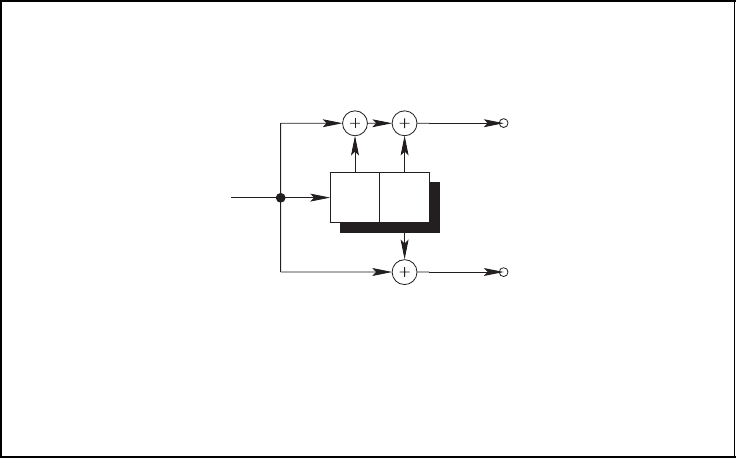
Consider the convolutional encoder depicted in Figure 3.1. Information bits are shifted into
a register of length m = 2, i.e. a register with two binary memory elements. The output
sequence results from multiplexing the two sequences denoted by b
(1)
and b
(2)
. Each output
bit is generated by modulo 2 addition of the current input bit and some symbols of the
register contents. For instance, the information sequence u = (1, 1, 0, 1, 0, 0,...) will be
encoded to b
(1)
= (1, 0, 0, 0, 1, 1,...) and b
(2)
= (1, 1, 1, 0, 0, 1,...). The generated code
sequence after multiplexing of b
(1)
and b
(2)
is b = (1, 1, 0, 1, 0, 1, 0, 0, 1, 0, 1, 1,...).
A convolutional encoder is a linear sequential circuit and therefore a Linear Time-
Invariant (LTI) system. It is well known that an LTI system is completely characterized
ArateR = 1/2 convolutional encoder with memory m = 2
b
(2)
b
(1)
u
■ Each output block is calculated by modulo 2 addition of the current input
block and some symbols of the register contents:
b
(1)
i
= u
i
+ u
i−1
+ u
i−2
,
b
(2)
i
= u
i
+ u
i−2
.
Figure 3.1: Example of a convolutional encoder
CONVOLUTIONAL CODES 99
by its impulse response. Let us therefore investigate the two impulse responses of this
particular encoder. The information sequence u = 1, 0, 0, 0,... results in the output b
(1)
=
(1, 1, 1, 0,...) and b
(2)
= (1, 0, 1, 0,...), i.e. we obtain the generator impulse responses
g
(1)
= (1, 1, 1, 0,...) and g
(2)
= (1, 0, 1, 0,...) respectively. These generator impulse res-
ponses are helpful for calculating the output sequences for an arbitrary input sequence
b
(1)
i
=
#
m
l=0
u
i−l
g
(1)
l
↔ b
(1)
= u ∗ g
(1)
,
b
(2)
i
=
#
m
l=0
u
i−l
g
(2)
l
↔ b
(2)
= u ∗ g
(2)
.
The generating equations for b
(1)
and b
(2)
can be regarded as convolutions of the input
sequence with the generator impulse responses g
(1)
and g
(2)
. The code B generated by
this encoder is the set of all output sequences b that can be produced by convolution of
arbitrary input sequence u with the generator impulse responses. This explains the name
convolutional codes.
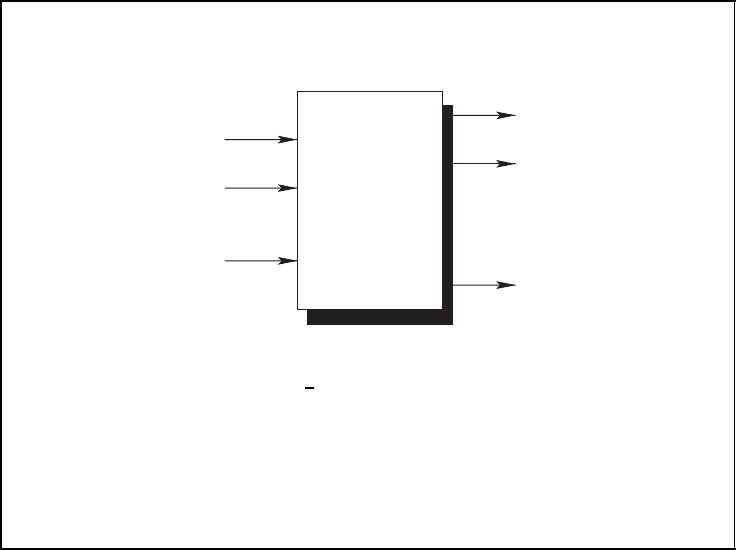
The general encoder of a rate R = k/n convolutional code is depicted in Figure 3.2.
Each input corresponds to a shift register, i.e. each information sequence is shifted into
its own register. In contrast to block codes, the ith code block b
i
= b
1
i
,b
2
i
,...,b
n
i
of a
convolutional code sequence b = b
0
, b
1
,... is a linear function of several information
blocks u
j
= u
1
j
,u
2
j
,...,u
k
j
with j ∈{i − m,...,i} and not only of b
i
. The integer m
Convolutional encoder with k inputs and n outputs
Encoder
u
(1)
u
(l)
u
(k)
b
(1)
b
(j)
b
(n)
.
.
.
.
.
.
.
.
.
.
.
.
■ k and n denote the number of encoder inputs and outputs respectively.
Thus, the code rate is R =
k
n
.
■ The current n outputs are linear combinations of the present k input bits
and the previous k × m input bits, where m is called the memory of the
convolutional code.
■ A binary convolutional code is often denoted by a three-tuple (n,k,m).
Figure 3.2: Convolutional encoder with k inputs and n outputs

100 CONVOLUTIONAL CODES
denotes the memory of the encoder. The k encoder registers do not necessarily have the
same length. We denote the number of memory elements of the lth register by ν
l
. The n
output sequences may depend on any of the k registers. Thus, we require k × n impulse
responses to characterise the encoding. If the shift registers are feedforward registers, i.e.
they have no feedback, than the corresponding generator impulse responses g
(j)
l
are limited
to length ν
l
+ 1. For this reason, ν
l
is often called the constraint length of the lth input
sequence. The memory m of the encoder is
m = max
l
ν
l
.
The memory parameters of a convolutional encoder are summarised in Figure 3.3. A binary
convolutional code is often denoted by a three-tuple B(n,k,m). For instance, B(2, 1, 2)
represents the code corresponding to the encoder in Figure 3.1.
The reader is probably familiar with the theory of discrete-time LTI systems over the
real or the complex field, which are sometimes called discrete-time real or complex filters.
Similarly, convolutional encoders can be regarded as filters over finite fields – in our case
the field F
2
. The theory of discrete-time LTI systems over the field F
2
is similar to the
theory for real or complex fields, except that over a finite field there is no notion of
convergence of an infinite sum. We will observe that a little linear system theory is helpful
in the context of convolutional codes. For example, we know different methods to construct
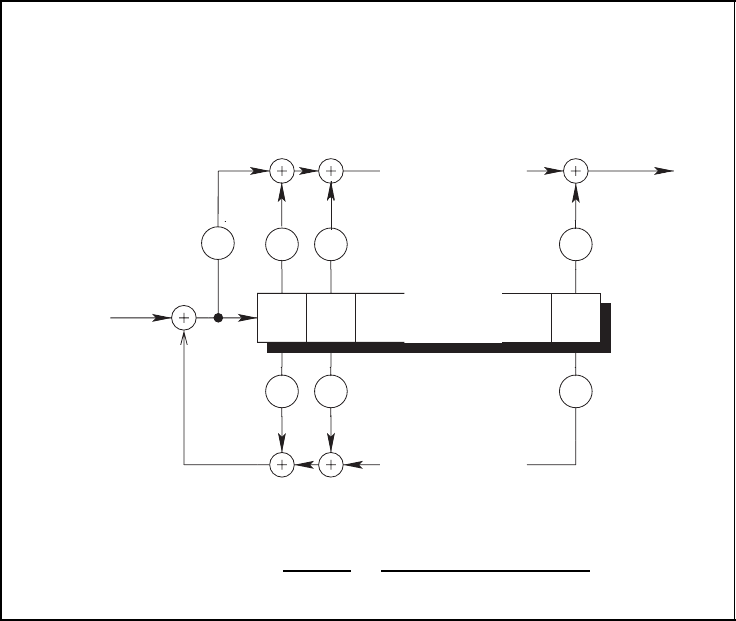
filters for a given transfer function from system theory. The structure depicted in Figure 3.4
is a canonical form of a transversal filter, where usually the forward coefficients p
l
and
the backward coefficients q
l
are real numbers. In case of a convolutional encoder, these
coefficients are elements of the field F
2
.
With convolutional codes it is possible to construct different circuits that result in the
same mapping from information sequence to code sequence, i.e. a particular encoder can be
implemented in different forms. However, as the particular implementation of an encoder
plays a certain role in the following discussion, we will restrict ourselves to the canonical
construction in Figure 3.4, the so-called controller canonical form. Our example encoder
depicted in Figure 3.1 is also realised in controller canonical form. It has no feedback from
the register outputs to the input. Therefore, this encoder has a finite impulse response. In
Memory parameters of a convolutional encoder
As the numbers of memory elements of the k encoder registers may differ, we
define
■ the memory m = max
l
ν
l
of the encoder
■ the minimum constraint length ν
min
= min
l
ν
l
,
■ and the overall constraint length ν =
#
k
l=1
ν
l
.
Figure 3.3: Memory parameters of a convolutional encoder
CONVOLUTIONAL CODES 101
Rational transfer functions
■ Shift register in controller canonical form
. . .
. . .
. . .
u
(l)
b
(j)
p
0
p
1
p
2
p
m
q
1
q
2
q
m
■ A realisable rational function:
G
l,j
(D) =
P
l,j
(D)
Q
l,j
(D)
=
p
0
+ p
1
D +···+p
m
D
m
1 + q
1
D +···+q
m
D
m
.
Figure 3.4: Rational transfer functions
general, an encoder may have feedback according to Figure 3.4 and therefore an infinite
impulse response.
3.1.2 Generator Matrix in the Time Domain
Similarly to linear block codes, the encoding procedure can be described as a multiplication
of the information sequence with a generator matrix b = uG. However, the information
sequence u and the code sequence b are semi-infinite. Therefore, the generator matrix
of a convolutional code also has a semi-infinite structure. It is constructed from k × n
submatrices G
i
according to Figure 3.5, where the elements of the submatrices are the
coefficients from the generator impulse responses.
For instance, for the encoder in Figure 3.1 we obtain
G
0
= (g
(1)
0
,g
(2)
0
) = (11),
G
1
= (g
(1)
1
,g
(2)
1
) = (10),
G
2
= (g
(1)
2
,g
(2)
2
) = (11).

102 CONVOLUTIONAL CODES
Generator matrix in the time domain
■ The generator matrix is constructed from k × n submatrices
G
i
=
g
(1)
1,i
g
(2)
1,i
... g
(n)
1,i
g
(1)
2,i
g
(2)
2,i
... g
(n)
2,i
.
.
.
.
.
.
.
.
.
g
(1)
k,i
g
(2)
k,i
... g
(n)
k,i
for i ∈ [0,m].
■ The elements g
(j)
l,i
are the coefficients from the generator impulse responses
g
(j)
l
, i.e. g
(j)
l,i
is the ith coefficient of the impulse response from input l to
output j .
■ The generator matrix is then
G =
G
0
G
1
... G
m
00...
0G
0
G
1
... G
m
0 ...
00G
0
G
1
... G
m
...
000
.
.
.
.
.
.
.
.
.
,
where a bold zero indicates an all-zero matrix.
Figure 3.5: Generator matrix in the time domain
Finally, the generator matrix is
G =
G
0
G
1
... G
m
00...
0G
0
G
1
... G
m
0 ...
00G
0
G
1
... G
m
...
000
.
.
.
.
.
.
.
.
.
=
11 10 11 00 00 ...
00 11 10 11 00 ...
00 00 11 10 11 ...
00 00 00
.
.
.
.
.
.
.
With this generator matrix we can express the encoding of an information sequence, for
instance u = (1, 1, 0, 1, 0, 0,...), by a matrix multiplication
b = uG = (1, 1, 0, 1, 0, 0,...)
11 10 11 00 00 ...
00 11 10 11 00 ...
00 00 11 10 11 ...
00 00 00
.
.
.
.
.
.
= (11, 01, 01, 00, 10, 11, 00,...).
CONVOLUTIONAL CODES 103
3.1.3 State Diagram of a Convolutional Encoder
Up to now we have considered two methods to describe the encoding of a convolutional
code, i.e. encoding with a linear sequential circuit, a method that is probably most suitable
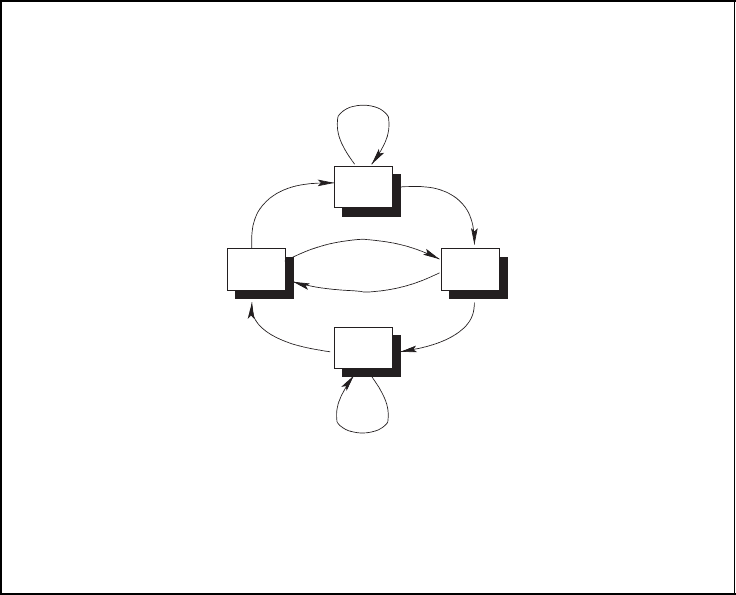
for hardware implementations, and a formal description with the generator matrix. Now we
consider a graphical representation, the so-called state diagram. The state diagram will be
helpful later on when we consider distance properties of convolutional codes and decoding
algorithms.
The state diagram of a convolutional encoder describes the operation of the encoder.
From this graphical representation we observe that the encoder is a finite-state machine.
For the construction of the state diagram we consider the contents of the encoder registers
as encoder state σ . The set S of encoder states is called the encoder state space.
Each memory element contains only 1 bit of information. Therefore, the number of
encoder states is 2
ν
. We will use the symbol σ
i
to denote the encoder state at time i. The
state diagram is a graph that has 2
ν
nodes representing the encoder states. An example
of the state diagram is given in Figure 3.6. The branches in the state diagram repre-
sent possible state transitions, e.g. if the encoder in Figure 3.1 has the register contents
State diagram of a convolutional encoder
10 01
11
00
1 / 10
0 / 01
0 / 111 / 11
1 / 01
0 / 00
1 / 00
0 / 10
■ Each node represents an encoder state, i.e. the binary contents of the
memory elements.
■ Each branch represents a state transition and is labelled by the corres-
ponding k input and n output bits.
Figure 3.6: State diagram of the encoder in Figure 3.1

104 CONVOLUTIONAL CODES
σ
i
= (00) and the input bit u
i
at time i is a 1, then the state of the encoder changes from
σ
i
= (00) to σ
i+1
= (10). Along with this transition, the two output bits b
i
= (11) are
generated. Similarly, the information sequence u = (1, 1, 0, 1, 0, 0,...) corresponds to the
state sequence σ = (00, 10, 11, 01, 10, 01, 00,...), subject to the encoder starting in the
all-zero state. The code sequence is again b = (11, 01, 01, 00, 10, 11, 00,...). In gen-
eral, the output bits only depend on the current input and the encoder state. Therefore, we
label each transition with the k input bits and the n output bits (input/output).
3.1.4 Code Termination
In theory, the code sequences of convolutional codes are of infinite length, but for practical
applications we usually employ finite sequences. Figure 3.7 gives an overview of the three
different methods to obtain finite code sequences that will be discussed below.
Assume we would like to encode exactly L information blocks. The easiest procedure to
obtain a finite code sequence is code truncation. With this method we stop the encoder after
L information blocks and also truncate the code sequence after L code blocks. However,
this straightforward approach leads to a substantial degradation of the error protection for
the last encoded information bits, because the last encoded information bits influence only
a small number of code bits. For instance, the last k information bits determine the last n
code bits. Therefore, termination or tail-biting is usually preferred over truncation.
In order to obtain a terminated code sequence, we start encoding in the all-zero encoder
state and we ensure that, after the encoding process, all memory elements contain zeros
again. In the case of an encoder without feedback this can be done by adding k · m zero
bits to the information sequence. Let L denote the number of information blocks, i.e. we
Methods for code termination
There are three different methods to obtain finite code sequences:
■ Truncation: We stop encoding after a certain number of bits without any
additional effort. This leads to high error probabilities for the last bits in a
sequence.
■ Termination: We add some tail bits to the code sequence in order to ensure
a predefined end state of the encoder, which leads to low error probabilities
for the last bits in a sequence.
■ Tail-biting: We choose a starting state that ensures that the starting and
end states are the same. This leads to equal error protection.
■ Note, tail-biting increases the decoding complexity, and for termination
additional redundancy is required.
Figure 3.7: Methods for code termination

CONVOLUTIONAL CODES 105
encode kL information bits. Adding k · m tail bits decreases the code rate to
R
terminated
=
kL
n(L + m)
= R
L
L + m
,
where L/(L + m) is the so-called fractional rate loss. But now the last k information bits
have code constraints over n(m + 1) code bits. The kL × n(L + m) generator matrix now
has a finite structure
G =
G
0
G
1
... G
m
0 ... 0
0G
0
G
1
... G
m
... 0
00
.
.
.
.
.
.
.
.
.
00... G
0
G
1
... G
m
.
The basic idea of tail-biting is that we start the encoder in the same state in which it will
stop after the input of L information blocks. For an encoder without feedback, this means
that we first encode the last m information blocks in order to determine the starting state
of the encoder. Keeping this encoder state, we restart the encoding at the beginning of the
information sequence. With this method the last m information blocks influence the first
code symbols, which leads to an equal protection of all information bits. The influence
of the last information bits on the first code bits is illustrated by the generator matrix of
the tail-biting code. On account of the tail-biting, the generator matrix now has a finite
structure. It is a kL × nL matrix
G =
G
0
G
1
... G
m
0 ... 0
0G
0
G
1
... G
m
... 0
00
.
.
.
.
.
.
.
.
.
00... G
0
G
1
... G
m
G
m
000
.
.
.
.
.
.
.
.
.
.
.
.
0 ... 0G
0
G
1
G
1
... G
m
0 ... 0G
0
.
For instance, the tail-biting generator matrix for the specific code B(2, 1, 2) is
G =
11 10 11 00 ... 00
00 11 10 11 ... 00
00 00
.
.
.
.
.
.
.
.
.
00 00 ... 11 10 11
11 00 00 00
.
.
.
.
.
.
10 11 00 ... 00 11
.
From this matrix, the influence of the last two information bits on the first four code bits
becomes obvious.
Code termination and tail-biting, as discussed above, can only be applied to convolu-
tional encoders without feedback. Such encoders are commonly used when the forward error
correction is solely based on the convolutional code. In concatenated systems, as discussed