
Orzoff Andrea. Battle for the Castle: The Myth of Czechoslovakia in Europe, 1914-1948
Подождите немного. Документ загружается.

126 Battle for the Castle
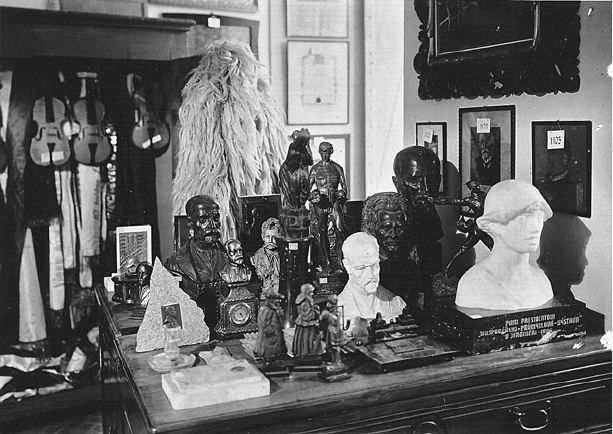
Figure 3.2. Taken in the Museum of Gifts in 1930, this picture shows various busts of
Masaryk, as well as busts of others given to the president. Several violins hang in the
cabinet at the back. Source: AÚTGM fotografické odd
ˇ
elení, VIII/47/2*411/10, 4823.
Prague.
134
Schoolchildren could also read juvenile fiction about Masaryk—
lightly “improved” historical depictions of his boyhood—as well as accounts
of Masaryk’s growth from boy to man, emphasizing his morally superior
qualities and his devotion to family and country.
135
Schoolbooks often presented Castle ideology as history. The most popular
text used to teach high school history was written by Josef Peka
ˇ
r, known for
publicly challenging Masaryk’s romantic-nationalist interpretation of Czech
history. Yet Peka
ˇ
r’s book could have been written by Castle publicists. Its
1921 edition described the medieval German colonization of Bohemia as an
“especially great danger for the Czech future.”
136
Peka
ˇ
r’s depiction of the
Great War emphasized the importance of Masaryk and Beneš for Czechoslo-
vak independence; they and their allies and colleagues abroad are almost
the only independent actors discussed in Peka
ˇ
r’s text until the fall of 1917.
The Czech politicians who remained home hardly appear in the book. Peka
ˇ
r
disingenuously described all Czechs of the time as “almost without exception
[being] aware that a German-Hungarian victory would without question
make their lives more difficult and extinguish all hopes for achieving their
national goals,” an obvious recasting of the Castle’s present back into the
nation’s past.
137
Battles of the Legend Makers 127
The president energetically helped create the visual imagery presented
to the public. Masaryk never refused artists’ requests and posed for least
sixty-four different artists; the president sat for the artist V. Hynais ninety-
four times. He did not object to film, or to “acting” in repeated takes; “in
the archives of the Plze
ˇ
n firm Škoda, there are clips of Masaryk posing
in a Škoda-Hispano-Suiza car the firm had given him. ...The president
was aware...of the effect of his person, and he had no inhibitions about
using it.”
138
Among the books Masaryk crafted with Karel
ˇ
Capek was a
souvenir book of presidential photographs, Masaryk ve fotografii (Masaryk
in Photographs, 1931). The book presents Masaryk in various mythologized
guises: as a man of the people, marching through fields of wheat in his
customary black suit and speaking with a kind smile to the usual Slovak
and Moravian peasants; deep in thought in his libraries at Lány and in the
Castle; the great statesman, meeting with foreign leaders and diplomats; the
family man, hoisting laughing, naked grandchildren on his shoulders. In
every setting Masaryk is uniformly dapper, dignified, kind, and reserved
(figures 3.3–3.6). One theme is strikingly absent from the book, and from
most of the visual depictions of Masaryk as president: there are few pictures
of Masaryk on the floor of Parliament or voting.
139
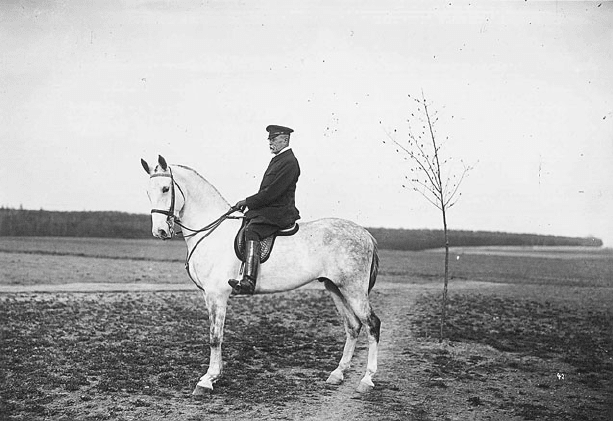
Figure 3.3. Masaryk on the country’s tenth anniversary (October 28, 1928), on a white
horse at the charged site of Bílá hora, the hillside outside Prague where Czech forces lost
to the Habsburgs in 1620. Masaryk took other publicity shots at this same site on a black
horse. Source: AÚTGM fotografické odd
ˇ
elení, VIII/47/2*396/8, 4087.
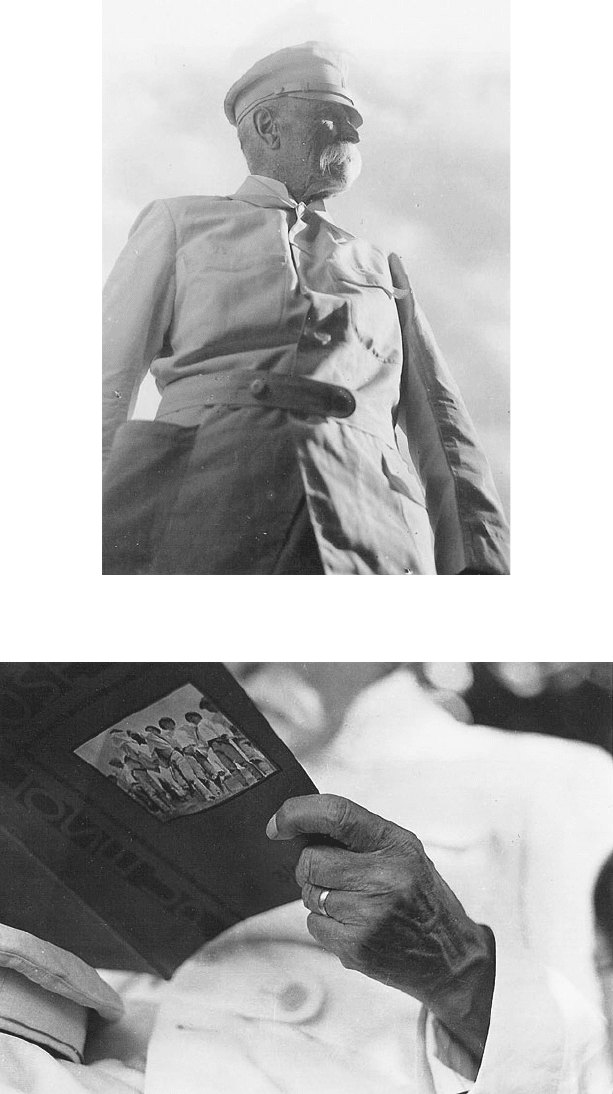
Figure 3.4. Masaryk photographed from below, at Židlochovice in Slovakia, July 15, 1931.
Source: AÚTGM fotografické odd
ˇ
elení, VIII/47/2*145/19–20, 1203.
Figure 3.5. Masaryk’s body was part of the cult: here, the beloved president’s hands.
Source: AÚTGM fotografické odd
ˇ
elení, VIII/47/2*105/14, 801.
Battles of the Legend Makers 129
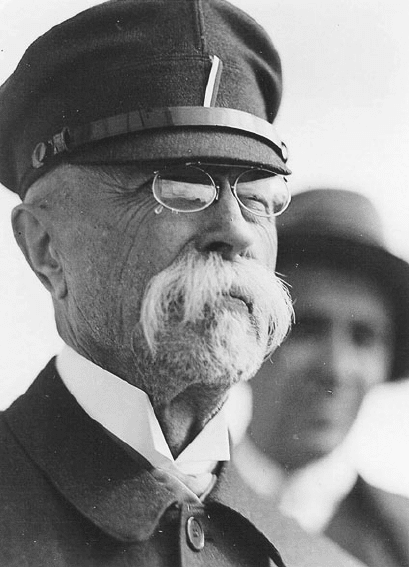
Figure 3.6. Three-quarter profile of Masaryk, in his dark winter suit, taken in September
1931. Source: AÚTGM fotografické odd
ˇ
elení, VIII/47/2*1081/17, 839.
Masaryk’s visual iconography was often deliberately militarized, thus visu-
ally linking him to the Legionnaires. In fact, the Masaryk cult rested at least
in part on the correlated cult of the Legionnaires and their brave national
service during the Great War. Masaryk and the Castle drew on Legionnaire
support to buttress the presentation of Masaryk as military hero, adored
by all soldiers who served him. Meanwhile, the Legionnaires energetically
crafted and promoted their own cult, abetted by the president in his writings,
in public rituals, and in novels, films, and memorials written, designed, and
planned by Legionnaires, to which the Castle lent support.
140
The two cults
used similar language and imagery, for example comparing Legionnaires
to the fifteenth-century Taborites; but much Legionnaire writing was anti-
semitic, unlike the Masaryk myth.
141
Legionnaires published popularizing
pamphlets and photograph books about their wartime exploits.
142
But non-
Legionnaires also contributed to the Legionnaire cult, as in composer Leoš
Janá
ˇ
cek’s composition Osvoboditel˚um (To the Liberators, 1918), which set
to music a poem by Antonín Horák.
143
Many souvenir picture books of
130 Battle for the Castle
the president, including Masaryk in Photographs, include photographs of
Masaryk’s participation in military parades or smilingly shaking soldiers’
hands.
144
Castle promotion of the Legionnaire cult and the Masaryk cult
went hand in hand, reminding citizens at regular and public intervals of the
basis of Castle power and the importance of continued Castle predominance
within Czechoslovak politics (figure 3.7).
The cult also relied on words, not just images: its basis in the 1930swas
various longer works of political prose. Masaryk himself was one of the most
important propagators of his cult, particularly through text. His wartime
pamphlet The New Europe,his1925 war memoir World Revolution, and the
1933–1936 The Path of Democracy series, a collection of his writings and
speeches, all communicated the cult’s (i.e., the Castle’s) main ideological
tenets and availed themselves of any opportunity to bolster Masaryk’s and
Beneš’s reputations. Masaryk’s considerable body of anonymous journalism
did the same. Also important to the cult were the many Masaryk biographies,
often published by Orbis,
ˇ
Cin, and other Castle-friendly publishing houses,
which tended to bathe the Czechoslovak state and its leaders in a rosy light.
These biographies were written by Czechs as well as foreigners; the foreign
writers were often hosted by the Castle-sponsored Social Club and given
translated copies of Czech-language Masaryk biographies. Hence a certain
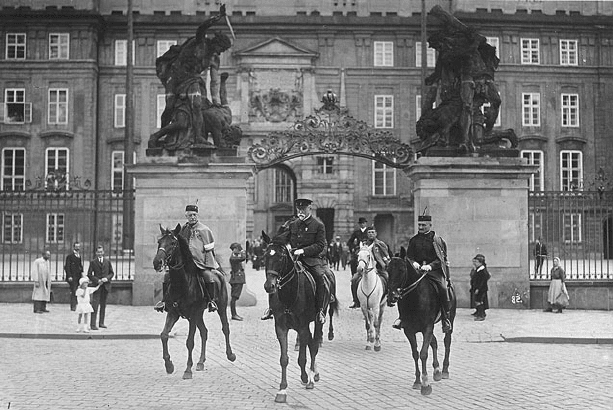
Figure 3.7. Masaryk riding out of the Castle gates to participate in the July 1926 Sokol
slet. Riding with him are three Legionnaires. Note the different uniforms, each represent-
ing a different fighting front. Source: AÚTGM fotografické odd
ˇ
elení, VIII/47/2*396/6,
4074.
Battles of the Legend Makers 131
uniformity of presentation and information prevails in these texts, from
Jan Herben’s 1926 three-volume T.G. Masaryk to British propagandist Cecil
J. C. Street’s 1930 Thomas Masaryk of Czechoslovakia to German journalist
Emil Ludwig’s slightly more critical 1936 Defender of Democracy: Masaryk of
Czechoslovakia.
The Masaryk cult’s evidentiary remains are ubiquitous; this discussion has
treated only a fraction of the available materials, translated into at least eight
languages. But while we know much about the cult’s production, historians
can only generalize about its reception or public function. Since cults,
like political myths, “offer charters, warrants, validations, legitimations, and
authoritative precedents for beliefs, attitudes, and practices,” the Masaryk
cult can be understood as an attempt to legitimate the Castle and its inter-
pretation of the country’s history.
145
Akin to leader cults in the rest of Eastern
Europe, Masaryk’s cult was “intended as cement, to cover over ...divisions,
to reinforce a sense of purpose and unity.” The cult positioned Masaryk to
represent various transcendent ideas: he embodied the Czechoslovak state,
the very notion of democracy, and a tolerant, cosmopolitan Czechness.
146
This last element helps emphasize the extent to which the cult was Czech first
and foremost, implicitly equating the Czech national legacy with Czechoslo-
vak citizenship. Through Masaryk’s cult, Czech leadership of the Czechoslo-
vak state and a supposedly ideal democracy were symbolically joined.
The Masaryk myth in fact was both a signifier of Czechoslovak democ-
racy and somewhat distant from it. The myth was vigorously rejected or
contested by Czechoslovakia’s national minorities and some Czechs as well,
particularly Catholics, National Democrats, and Communists. While influ-
ential, Masaryk’s cult was never equivalent to leader cults in totalitarian
states, buttressed by censorship and an obedient mass media.
147
Yet mythic
politics and leader cults are to be found in all states, whether dictatorial or
democratic. The existence of a Masaryk cult in the interwar republic did
not make the state less democratic; the cult’s insistence on the primacy of
democracy did not make the state more so. However, the kingly emphases
in the cult might have legitimated the speedy dismantling not just of
Masaryk’s republic but of its democratic structure in 1938–1939, under the
Nazi-collaborationist Second Republic.
148
Masaryk’s cult was part of the Castle’s engagement in mythic politics,
linking the Castle, its leaders, and its ideas to the best in the Czech and
European traditions. Despite being constructed as a set of symbols, the
Masaryk cult, and Castle mythic politics more generally, was always related
to the direct exercise of real political power. Masaryk himself understood his
cult this way. In a May 1927 letter to Edvard Beneš, he wrote, “Švehla is
correct in telling the parties that I [personify the state]; this is how I have
regarded my election [to the presidency] since the beginning. . . . Any party
132 Battle for the Castle
against my [re]election cannot be in the government. In other words: either
I am the representative of the state, or the parties are.”
149
The Masaryk cult shifted over time, reaching out to different groups
within Czechoslovak society (including émigrés) during and after the inter-
war period. This ability to appeal to all onlookers is a characteristic of the
most successful leader cults, which embody elements of different national or
popular traditions, the better to speak to disparate groups. E. A. Rees notes
that the Stalin cult in the Soviet Union
drew on Russian traditions, the tradition of authoritarian leadership,
a deep étatist tradition with its own bureaucratic culture, and even a
tradition of popular monarchism. . . . [I]t may also have drawn on the
strong patriarchal peasant culture with its respect for the elder
[starosta]....[Thecult also] sought to link itself with the popular
classes....Fortheeliteitcould be seen as a guarantee of their power.
For the disadvantaged the Stalin cult offered the hope of redress. .. .
[T]he cult came to symbolize the new social order that had been
created.
150
The parallels with the Masaryk cult are by now clear. The husbandman,
the father of the nation and state; the humble man of the people; the man
of ideas, or philosopher-king; the great democratic statesman; the family
man; the military leader: within the cult, Masaryk was all these things and
more. Particularly, he was Czech—Czechness itself—embodying Czechoslo-
vak virtue, truth, and national identity, not just within a particular historical
moment but for the ages.
Conclusion
Castle conflicts tended to focus on three themes: the consolidation of con-
crete power; efforts at integrating the state, primarily by promoting the
Masaryk cult and hoping to use him to draw each citizen into a greater
personal commitment to the republic; and finally, more abstractly, the nature
of legitimate political authority in the postwar era. Those conflicts played out
in part within the expected arenas of Parliament, personal relationships, and
the press. But they also operated symbolically as competing interpretations
of Czech history, from the fifteenth century to the First World War. Taken
cumulatively, these conflicts can represent the Castle’s agenda at home:
defang the political Right, claim the mantle of liberator, and associate itself
inextricably with the Czechoslovak state as well as the Czech nation. The
Castle lauded Masaryk, Beneš, and the Legionnaires as Czechoslovakia’s
Battles of the Legend Makers 133
founding fathers and symbolic representatives. Parliamentary leaders (some
of them, at any rate) strove for similar status, but never acquired it.
The Battle of the Legend Makers exemplified the basic arguments
between the Castle and the Czech Right, its most significant opponent
mythologically, if not quite politically (the anti-Castle right wing of the
Agrarian party was a more direct threat). The Dyk-Masaryk and Kramá
ˇ
r-
Beneš polemics crystallized the conflicts growing between the Castle and the
Right for the republic’s first decade: the direction of the country’s foreign
policy, Beneš’s closeness to Masaryk and his position as anointed successor,
the creation of the Castle and Masaryk’s politically active presidency, the
Castle’s attempt to claim the mantle of liberator and limit the historical
credit granted to the domestic resistance, and the Castle’s open efforts to
counter the P
ˇ
etka and silence the political Right. These same issues played
out in the creation of the National Labor Party, the Gajda and St
ˇ
ríbrný trials,
and the creation of leader or hero cults for Masaryk and the Legionnaires.
Particularly in the last, the Castle attempted to present its own form of civic
patriotism, different from the Right’s integral nationalism. In every case,
the Castle worked to disseminate its own values and narrative, the basic
postulates of Castle ideology.
The Boj legendist˚u debates and correspondence also helped articulate the
fiercely loyal relationship between Masaryk and Beneš. As in his letters to
Dyk, Masaryk’s letters to Beneš bluntly rejected criticism of his protégé:
“The main thing: You will remain as [foreign] minister; not just the interna-
tional, but also the domestic, situation demand[s] that. It is pure nonsense
[to generalize] from the internal [political] crisis to a crisis in the foreign
ministry.”
151
Masaryk helped corral leading politicians on Beneš’s behalf; in
1933 he wrote that he had spoken to allies of ambassador to Paris Štefan
Osuský, and that Osuský was now “100 percent for you, that you become
the second president.”
152
In addition to political strategizing, the letters
reveal more personal concerns: Masaryk worried often about Beneš’s health,
repeatedly suggesting that he consult doctors and take vacations.
153
The Castle’s conflicts with the right emerged during a period in which
political consensus seemed to have broken down. From 1919 to 1925,the
established parties had done their share of squabbling, and occasionally
aimed sallies at Minister Beneš. But after 1925, these arguments became
more direct, more public, and far more shrill. Prime Minister Antonín Švehla
had been the only politician who could convince the Prague partisan press
to keep its gloves on. Even his brief return to politics from 1926 through
1928 did not change matters; Masaryk, by nature a fighter rather than a
conciliator like Švehla, did not calm the situation. An increasingly sharp
polarization and fractiousness came to characterize Czechoslovak political
life, even as the Castle became increasingly powerful and active behind
134 Battle for the Castle
the political scenes, where Masaryk and his chancellery frequently brokered
conflict.
154
Both inside and beyond the political elites, there was a shared
sense of crisis in 1925–1927, arising again in 1928 and 1929. Yet the basically
conservative nature of interwar Czech politics meant that the established
parties and leaders were able to fight off challenges to the status quo, such as
the National Labor Party and the fascists. And F. Gregory Campbell notes
that no domestic politician could truly confront the Castle.
[I]t soon became apparent that Masaryk’s personal prestige and
popularity—and hence his political power—was so great that no
group could openly and effectively oppose him and his
supporters. ...[T]heoppositionwasnotunitedbehindanymanor
program that offered a viable alternative to the logically conceived
and executed policies of “the Castle.” ...Tobesure,therewere
alienated elements among Kramá
ˇ
r’s National Democrats, Hlinka’s
Slovak populists, the Communists, or the extreme nationalists from
the national minorities, but ...Masaryk’spowerlayinthefactthat
the majority of citizens of diverse social stations revered him as the
liberator of the country.
155
Thus the Castle’s contestation over historical legacy had direct political
ramifications.
These internal Czech political disputes echoed beyond Czechoslovak
borders. The Western powers’ warm wartime reception of the Czechs had
stemmed from their seeming Westernness—their rationalism, their high-
mindedness, their dedication to the values animating the postwar era—
and the unity of the resistance abroad with Prague political leaders, at least
for the war’s final year. If Czechoslovakia were seen abroad as a hotbed of
fascism or an inefficient government dedicated to maintaining sinecures,
rather than as a hardworking democracy; if internecine squabbling prevented
sane policy from being enacted; if Castle opponents won the upper hand
at home, and then succeeded in redirecting Czechoslovak foreign policy;
Czechoslovakia’s enemies would be heartened, and its Western guarantors
alienated. The Castle feared, and worked to prevent, these scenarios from
coming to fruition.
At the heart of Castle conflicts lay propaganda and the media. Elec-
tion sloganeering, managing of newspapers and message, the creation of a
personality cult, and mudslinging via pamphlet and anonymous editorials
were all crucial elements of Castle strategy. Moreover, Castle allies in the
media were central in battling the chaos of the late 1920s.
ˇ
Capek helped
strategize and mediate differences among high-ranking officials and tried to
form a Castle-friendly press bloc. Masaryk published freelance editorials in
Battles of the Legend Makers 135
Castle-friendly journals. Stránský and Bou
ˇ
cek tried, through the NLP, to
create another Castle-friendly parliamentary grouping and to oppose the
growth of the Right. Stránský’s journals became a crucial arena for Castle
propaganda, mythmaking, and defense during the political trials of Gajda,
St
ˇ
ríbrný, and the other far-Right leaders, not to mention the Battle of the
Legend Makers. These were only the most prominent; other journalists and
newspapers allied with the Castle were no less active during these years.
The domestic Battles of the Legend Makers had their parallels abroad.
Just as the Castle struggled for moral legitimacy at home, so in the eyes
of Europe the Castle and its allies also conducted an argument about his-
tory, moral worthiness, and contemporary political power. This time its
enemies were other post-Habsburg states and Nazi Germany. Once again,
the weapons were propaganda and cultural diplomacy, testing the Castle’s
contacts and resources. It is to that parallel set of battles that we now turn.