
Orzoff Andrea. Battle for the Castle: The Myth of Czechoslovakia in Europe, 1914-1948
Подождите немного. Документ загружается.

116 Battle for the Castle
When the libel trial began in early January 1927,St
ˇ
ríbrný denied that
Stránský could possibly have any kind of proof: “neither [I] alone, nor
with deputy Vojna, neither directly nor indirectly approached the military
governor’s office in Prague on such matters.” Pointing to the timing of the
article, St
ˇ
ríbrný emphasized that Stránský was obviously attempting to ruin
his political career.
91
Stránský proudly concurred:
I noticed that deputy St
ˇ
ríbrný, and especially his party, had long been
supporters of the new regime [the postwar Czechoslovak state] and
the leaders of the revolution abroad, but that increasingly he was
coming to the side of those who set themselves in opposition. .. . And
inthis...,Isawhisharmfulness and [the] danger [he posed] for our
state and national interests. ...Igrewtobeconvinced that he is a
dangerous enemy of this new regime and I said to myself that my
duty...wastoengageinbattle with him, ...andatanopportune
moment strike a blow against him.
92
The trial’s highlight was Stránský’s and St
ˇ
ríbrný’s mutual cross-examination.
Both men knew one another personally from their years in Parliament, and
their closeness to Masaryk and the Castle. Stránský, trained as a lawyer,
skillfully questioned St
ˇ
ríbrný and defended the Castle in heroic cadence.
St
ˇ
ríbrný, flamboyant by nature and at ease before a crowd, blithely defended
himself and missed no opportunities to jab at the Castle along the way. The
burden of proof was on Stránský, and St
ˇ
ríbrný’s evasions were masterful. If
proving that St
ˇ
ríbrný had approached the governor was in fact impossible,
Stránský asked, how was it that he could produce these documents? St
ˇ
ríbrný
replied:
The history of our documents has a peculiar character. Both true and
false documents exist. [As for the real documents,] after Austria, we
[Czechs] were given five carloads of documents ...tobehandedout
to the individual ministries. However, the Ministry of Foreign Affairs
hastened to take all five carloads. On the way many truthful
documents were lost. .. .
93
In other words, Beneš’s ministry had begun the postwar era with theft,
making both minister and ministry untrustworthy. St
ˇ
ríbrný continued with
an artful suggestion:
Then there are also false documents. In Vienna and in Lvov exist[ed]
entire offices where for a mere trifle—from 100–200 crowns—it was
possible to obtain documents with official stamps and forms. ...Ihad
Battles of the Legend Makers 117
the impression that in my case [the issue concerns] false documents.
This could also [account for] some changes in the names.
94
That is, Stránský, like his benefactor Beneš, played fast and loose with the
evidence. St
ˇ
ríbrný then produced several witnesses, all of whom swore that
they had spoken or eaten with him at his summer residence in provincial
Bohemia on the day mentioned in the documents. Stránský’s only eyewitness
was the Czech staff member at the governor’s office, who did not remember
having seen St
ˇ
ríbrný or Vojna, although he mentioned that he did not
usually see every visitor who passed through the governor’s office. But the
specter of doubt had been raised, and Stránský could not prove his case
definitively. St
ˇ
ríbrný simply, effectively outmaneuvered him.
And yet Stránský did not quite lose his case, which dragged on until
1929. The court clearly shared the Castle’s dislike of St
ˇ
ríbrný; it awarded
no punitive damages to St
ˇ
ríbrný other than repayment of legal costs. Nor
did it ask Stránský to publish a retraction of his initial charges or any other
admission of error. Rather, he was instructed to publish the court’s verdict,
praising Stránský and the Castle and casting aspersions on St
ˇ
ríbrný. The
court implicitly dismissed St
ˇ
ríbrný’s complaint that Stránský’s documents
ruined his political career. It defended Stránský’s decision to publish the
documents until just before the National Socialist party congress.
[The court] can only agree with the opinion of the defendant
Dr. Stránský that it is not the journalist’s duty—and Dr. Stránský is
without question a journalist—to publish immediately every matter
he discovers. This is the habit only of another kind of journalism,
desirous of any [kind of] sensation, perhaps even those it plans itself.
...[This]hasnothing to do with the common good.
95
The journalism “desirous of sensation” named by the verdict was clearly that
of St
ˇ
ríbrný himself, who published several tabloid newspapers through his
firm Tempo. All in all, the St
ˇ
ríbrný-Stránský cause célèbre ended in a draw—
or, given St
ˇ
ríbrný’s ouster from the party, a win for the Castle.
Ji
ˇ
rí St
ˇ
ríbrný was far from finished with Czech politics. When he left
the National Socialists, he took his financial backers and attracted sym-
pathy from some National Democrats, although others viewed St
ˇ
ríbrný
as a dangerous rival for the allegiance of rightist voters. St
ˇ
ríbrný also
had important journalistic allies, including Ferdinand Kahánek, editor of
the weekly magazine Pondˇelník, whose anti-Castle prejudice extended to
printing Hungarian propaganda. Kahánek’s extensive contacts throughout
Czech politics included anti-Castle Agrarians (including Venkov editor Josef
Vraný and Milan Hodža) and Zamini’s ambassador in Rome. St
ˇ
ríbrný’s
118 Battle for the Castle
tabloids—particularly Polední list—and printing firm Tempo guaranteed
him a political platform.
96
He soon began collaborating with Gajda,
attempting to make the leaders of the domestic resistance into the “martyrs
of October 28” and to attract a force of dissatisfied voters behind them.
In late 1927 and early 1928,St
ˇ
ríbrný contemplated creating a new movement
called “neofascism,” under which he hoped to unite voters from all the fascist
factions as well as from the party he was trying to strengthen, his Radical
National Socialist Party.
97
The party’s cofounder, Karel Pergler, had been
Masaryk’s assistant in America during the Great War and had wanted to be
the Czechoslovak ambassador to the United States after the war; Masaryk
sent his son Jan instead. St
ˇ
ríbrný’s party joined Gajda’s NOF to form the
National League just before the October 1929 elections.
98
St
ˇ
ríbrný, Gajda,
and Pergler won three seats in Parliament, funded secretly by the anti-Castle
right wing of the Agrarian party.
99
In 1931, the Castle tried once again to use the courts to rid themselves of
the Fascist irritant. Karel Pergler was found to be an American citizen and
thus ineligible to serve in the Czechoslovak Parliament; he was expelled from
Parliament and summarily deported. Gajda was convicted of libel and also
lost his seat. St
ˇ
ríbrný, however, managed to survive. Accused once again by
Stránský of corruption, this time during his tenure on the cabinet in the
early 1920s—of which, historians have concluded, he was no doubt guilty—
he threatened to publish embarrassing information about his accusers.
100
He went free. The 1929 electoral victory remained St
ˇ
ríbrný’s, and fascism’s,
most notable achievement between 1928 and 1934.St
ˇ
ríbrný remained loudly
aggrieved until the republic’s very end: in the spring of 1938,St
ˇ
ríbrný
published TGM a 28.
ˇ
Ríjen (TGM and the 28th of October), reiterating his
complaints about Svˇetová revoluce and Masaryk’s alleged lies.
101
The 1926 Castle efforts against St
ˇ
ríbrný kept the National Socialists in the
Castle camp, where they steadfastly remained through 1948. But Stránský’s
cause célèbre against St
ˇ
ríbrný did not win him the Castle’s trust. His con-
tinuing desire to best Castle enemies frequently exceeded that of the Castle
leaders, and sometimes his own abilities. In late summer 1926, for example,
just before the St
ˇ
ríbrný trial, Stránský accused Milan Hodža of corruption.
Here, too, Stránský could not make his case stick; this time, a court forced
him to print a lengthy apology to Hodža along with a correction. When this
ran in Lidové noviny, presidential chancellor P
ˇ
remysl Šámal told Masaryk
that many in Prague thought the NLP had been weakened by Stránský’s
actions. The president responded tersely that he had never hidden his
opinion: Dr. Stránský did not have the qualities necessary to lead a political
party.
102
A year later, Masaryk noted in a letter to Beneš that he had spoken
with Karel
ˇ
Capek and Antonín Švehla about the possibility of creating a
cooperative that would take over Lidové noviny, limiting Stránský’s influence
Battles of the Legend Makers 119
on the paper.
103
In April 1928 Masaryk wrote Beneš, “That Brno professor
who works for you is polit[ically] naïve and, I hear, impossible tactically.
You’re going to have to choose someone else.”
104
The significance of St
ˇ
ríbrný’s trial, and his ongoing public antipathy with
Stránský and the Castle, lay in the trial’s outcome and arguments. The judge
publicly supported the Castle and Stránský’s effort to eliminate St
ˇ
ríbrný
from national politics. St
ˇ
ríbrný accused the Castle of deception and theft,
implying that Beneš had stolen documents or created false ones. Stránský,
meanwhile, accused St
ˇ
ríbrný, and by implication the rest of the men of
October 28, of outright collusion with Austria during the war. Stránský also
tried on the role of Castle knight, tilting at the domestic resistance in the
name of ensuring the Castle leaders’ historical legacy.
The Husbandman: Masaryk’s Leader Cult
During his lifetime and long after, Masaryk was one of the most famous
Czechs in world history. He was nominated at least twice for a Nobel Prize
and lionized by noteworthies across the globe. However, that esteem paled
compared to the adoration expressed for him at home. During and after
his lifetime, Masaryk was held up for Czechs as the embodiment of moral
rectitude, cosmopolitan erudition, and democratic egalitarianism. By the
end of the 1930s, Masaryk’s association with the state he had helped found
was impressively total. But it was not accidental. Many different groups and
factors conspired to position Masaryk as the only man capable of superseding
Czechoslovakia’s ethnic and political divisions, a devoted democrat to lead
Europe’s self-styled ideal new democracy.
In fact, admiration for Masaryk rapidly became a complex and expansive
personality cult. The cult, intended to integrate Czechoslovakia’s diverse
nationalities and to legitimate the young state, also constituted a central ele-
ment of the national mythology crafted by Masaryk, Beneš, and other Castle
personalities. The Masaryk cult, like the Castle’s version of the Czechoslovak
national myth, was a useful political tool both at home and internationally.
Public devotion to Masaryk strengthened his political position, and that of
the Castle, particularly against the leading Czech political parties. Abroad,
the cult situated Masaryk as the quintessential representative of his state and
the values it supposedly manifested, such as a love of liberty, dedication
to truth and justice, and adherence to Wilsonian democratic ideals. His
international reputation in turn greatly strengthened his hand at home.
Many historians have noted the cult’s existence, but less is known about
its creation and propagation.
105
120 Battle for the Castle
Leader cults are ancient, and some scholars argue their origins can be
found in sacred myth. Many religious myths feature a “culture hero,” gener-
ally not a god but a human whose brave deeds make the world habitable.
106
Joseph Campbell’s analysis of comparative mythology presents the archetype
of a hero “who ventures forth from the common world into a region of super-
natural wonder; fabulous forces are there encountered and a decisive victory
is won; the hero comes back from this mysterious adventure with the power
to bestow boons on his fellow men,” and to awaken or recreate his society.
107
Masaryk’s writing and political work under the Habsburgs, and especially
his wartime activity abroad on behalf of an independent Czechoslovakia,
certainly made him a persuasive candidate for drawing on universal symbols
and narratives like these. But Masaryk’s cult was predominantly civic rather
than sacred, although his ecumenical Christian faith comprised an element
of it. The cult’s main purpose was to create an emotional bond between the
inhabitants of Czechoslovakia’s fractious new polity and their new president.
The other new postwar East and Central European states faced similar
challenges and similarly tried to persuade their publics to identify with their
new leaders and governments, to approve of their regimes’ policies and goals,
and to take pride in their regimes’ achievements. Leader cults were central
in almost all cases, most obviously in the elaborately constructed cults of
Vladimir Lenin and Joseph Stalin in the Soviet Union.
108
Leader cults reach beyond simple glorification. Cults require the leader’s
involvement in public ritual; the use of the leader’s image on stamps, coins,
and everyday objects; the public celebration of dates or events from the
leader’s life or achievements (birthdays, liberation, etc.); the public display of
the leader’s image; a leader-sanctioned version of the state’s history, presented
in text and ritual; and the participation of the state’s mass media in help-
ing create, disseminate, and comment on the leader’s cult.
109
Leader cults
also manifest the functions of power. Texts and rituals surrounding leaders
personalize the state’s abstract power, simplifying the inherent complexity
of a government and bureaucracy into a mythologized presentation of that
government’s leader or president.
110
The cult most frequently presented Masaryk in a role alluded to in this
section’s title, taken from a poem by Vit
ˇ
ezslav Nezval: the “husbandman” of
a grateful nation. That term lends itself to multiple interpretations: master of
the estate, father of the family, caretaker of the nation. In fact, Masaryk was
frequently referred to as “Tatí
ˇ
cek,” for which the closest English translation
is “Daddy.” Within the Czech political context, Masaryk’s cult drew on
Palacký’s, and paralleled the cult of Austrian Emperor Franz Josef. Like
these other cults, Masaryk’s cult contained biblical or religious references
and historical allusions to previous great Czechs as well as to early modern
folk beliefs about kingship. At the same time, much about the Masaryk
Battles of the Legend Makers 121
cult—above all its twinning Masaryk with democracy—was unique to the
First Republic.
Likenesses between the Masaryk cult and that of Emperor Franz Josef,
in the waning years of the Habsburg Empire, helped maintain a sense of
continuity between the old empire and the new state. Echoes of Franz Josef
were probably not deliberate: the Castle viewed Czechoslovak democracy
as entirely displacing, not replicating, the imperial order. Nevertheless, the
two men possessed common habits and personalities; the cults featured these
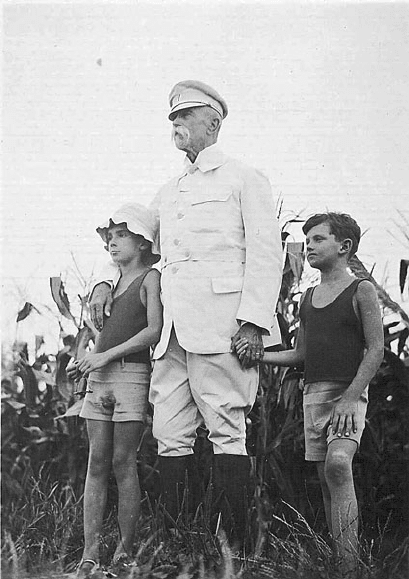
characteristics in similar ways. For example, the emperor was always depicted
in military uniform, even when at home in the imperial palace. Masaryk’s
“uniform” was the stylized garb of the country gentleman: riding jodhpurs,
a plain fully buttoned equestrian-style jacket, and a peaked hunting cap,
black in winter, white in summer.
111
His fondness for military parades and
his frequent public appearances on horseback at an advanced age mirrored
the imagery of the emperor in his last years. Also like the emperor, Masaryk
was famed for his ascetic lifestyle, rising early to work for the good of the
people, practicing regular physical exercise, and abstaining from rich food
and alcohol.
112
Souvenir photograph books of both men posed them at their
writing desks (the emperor’s a baroque glory of gilt, beveled edging, and
black lacquer; Masaryk’s of simple wood) and holding lovable grandchildren,
thereby crafting images of servants to the state as well as of devoted family
men (figure 3.1).
113
Public expectations and governing style also linked Masaryk to the
emperor. One Prague newspaper characterized Masaryk’s elaborate welcome,
on his return to Prague in December 1918, as “a royal welcome for our first
president.”
114
In 1919 prominent National Socialist Emil Franke criticized the
National Democrats, who then led Parliament, for refusing to treat Masaryk
as a “son of the people” upon his return. Rather than inviting the president
to the Parliament, to be welcomed by the people’s representatives, Franke
complained, “we all had to go to the Castle, as if to [visit the] monarch.”
115
This effect was enhanced by the complex, minutely articulated interwar
presidential ritual crafted by KPR personnel. For example, the members
of Masaryk’s entourage were directed how to respond if, when leaving the
Castle, they might encounter a working-class family, whose small child
might happen to run toward the president.
116
Masaryk’s civic apotheosis was initially a collective effort, building on a
largely spontaneous popular outpouring of jubilation and gratitude at the
end of the war. Those who had admired Masaryk’s reputation before the
war were still more inclined to salute him after it, as in these verses from a
poem by Karel
ˇ
Capek that ran in the magazine Nebojsa on January 2, 1919,
comparing Masaryk to St. Nicholas, who in early December brings Czech
children small presents—in this case, national independence:
122 Battle for the Castle
Figure 3.1. A complement to the family photographs in Masaryk ve fotografii: this 1931
Castle publicity still shows Masaryk (in his summer suit) with his grandsons, Herbert
and Leonard Revilliod. Source: AÚTGM fotografické odd
ˇ
elení, VIII/47/2*145/19–20,
1210.
Thomas’s blessed day
Merrier than Christmas
What you wanted, what you prayed for,
nation mine, you have it here!
Thomas here! Four years gone
Now come from apostolic paths
bringing in your (yellow) bag
a new blessedness.
117
In 1919,
ˇ
Capek was a noted young journalist and author, not yet the
Castle intimate he would become by 1926. The themes of this poem,
linking Masaryk to St. Nicholas and other saints (“apostolic paths”), were
common.
Battles of the Legend Makers 123
Masaryk was frequently portrayed as the culmination of Czech history
and a means of linking that history to biblical or European greatness. In
the 1920 poem “President Masaryk. Song for His Seventieth Birthday,” Jan
Rokyta compared Masaryk to Moses (and not coincidentally, the Czechs
to the Jews, the ultimate martyred people), Jan Hus, Jan Žižka, fifteenth-
century king of Bohemia Ji
ˇ
rí z Pod
ˇ
ebrad (George of Podebrady), and Jan
Amos Komenský. In Rokyta’s poem, Masaryk “enters the castle of Czech
kings as if it were his home.”
118
Other contributors to the cult invoked the
nineteenth century, while still others drew on the Bible. In 1926, a self-
identified worker from Osík u Litomyšl sent a poem, titled “To Our Dear
President,” to the presidential chancellery; all six verses begin with “Our
Tatí
ˇ
cek, Mr. President,” and compare Masaryk to Christ.
119
But whatever his great predecessors, Masaryk was the greatest of all. Many
of these comparisons, after the early years of the republic, were made by
Castle adherents in Castle-loyal journals. For example, in a 1930 article
for Národní osvobozeni (National Liberation), František Kubka imagined a
future Czechoslovak president addressing schoolchildren in an assembly at
the Castle in the year 2000. Kubka’s imaginary future president recalled, as
a schoolchild himself, seeing Masaryk speak at the Castle: “he was as simple
and kind as one’s own grandfather, but at the same time he was a hero from
a real-life fairy tale about the miraculous resurrection of the nation. . . . After
Jan Hus and Komenský he was the greatest man of our history. And indeed
he was greater than those two martyrs, because he had luck and success. Jan
Hus only hoped that the truth would prevail; Masaryk’s truth prevailed!”
120
Masaryk’s cult emphasized his humble origins and his connections to
the lid, or people, thus drawing on a powerful element of Czech romantic
nationalism dating back to the nineteenth century. The cult also tried to
establish Masaryk, with a Slovak father and Moravian, German-speaking
mother, as the literal embodiment of Czechoslovakism. Masaryk’s souvenir
photograph books always included pictures of him in discussion with timid,
smiling Moravian or Slovak peasants, often in folk costume. His many
biographers dwelt on his humble childhood home, and his youthful appren-
ticeship as a blacksmith.
Masaryk’s cult always had detractors. The National Democrats, for exam-
ple, tried to promote a similar cult for Kramá
ˇ
r.
121
The Czech Populists tried
to substitute Czech Catholic tradition, such as the medieval missionaries
Cyril and Methodius and Saint Václav/Wenceslas, for Masaryk’s preferred
ecumenical Protestantism and celebration of the “national” religious martyr
Hus. Many Slovaks were also alienated, while Germans viewed Hus as anti-
German; both groups were frustrated with Masaryk for promoting what
they saw as a cult of Hus.
122
Some Germans actively resisted the Masaryk
cult, scrawling graffiti on empty pedestals that had once held statues of
124 Battle for the Castle
Habsburg Emperor Joseph II: “Kaiser Joseph steht auf und regiere, dummer
Masaryk liegt da nieder und krepiere! [Emperor Joseph, stand up and rule;
stupid Masaryk, lie down and die!]”
123
In December 1920, Germans in Cheb
shot a portrait of the president.
124
In short, the Castle myth’s reference to
Czechoslovaks did little to cement over the very real national divides that
continued to characterize public life in the new republic.
Resistance notwithstanding, the esteem granted the office of the pres-
idency anchored and magnified Masaryk’s personality cult. Just as the
emperor’s image had adorned public institutions and private homes,
Masaryk’s visage gazed benevolently throughout the new republic, hang-
ing in stores, homes, schools, and government buildings. On state hol-
idays, “[Masaryk’s] busts and portraits...somewhat kitschily looked out
from between goods in shop windows at the customers and grocers.”
125
Even émigré Czechs displayed Masaryk’s image. Religious historian Jaroslav
Pelikan, whose parents emigrated to the United States in 1923,recalledthat
“we used to observe two Independence Days in our home, the Fourth of
July and the twenty-eighth of October; and the photograph of Masaryk
hung like an icon alongside the usual Christian images.”
126
The president’s
public presence involved his name, not just his august personage. “Military
troop units, streets, squares, the largest Czech battleship, public institutions,
but also for example the wheezing paddle-wheel tourist steamship on the
Vltava...wereallnamedafter him.”
127
Even Brno’s university renamed itself
Masaryk University—while Masaryk was still in office—as did many other
schools, ranging from elementary to high schools, all over the republic.
The presidency helped maintain another aspect of the Masaryk cult.
Interwar workers, among many other groups in Czechoslovak society, viewed
Masaryk as the “good king” who would enact justice. This understanding
of Masaryk was widespread, as the interwar Czechoslovak presidency main-
tained imperial traditions regarding personal appeals to the state’s highest
authority. Ordinary citizens could walk into the Castle and ask to see the
president; they also wrote him asking for help, whether it was financial
assistance or appeals for judicial clemency. Workers sent a steady stream
of “petitions, appeals, and memoranda,” not to mention workers’ delega-
tions, into the presidential chancellery, requesting help with various kinds of
conflicts.
128
In fact, the vast majority of letters entering the Castle chancellery
requested financial support; their writers ranged from the indigent to former
Legionnaires and even former senators. The Castle chancellery seems to have
written to regional police and social organizations to verify claims, as a basis
for awarding financial assistance.
129
Both the Castle and private citizens promoted and produced Masaryk-
iana. Czechs could buy books, pamphlets, brochures, commemorative
plates, cups, and ashtrays bearing the president’s likeness, and of course
Battles of the Legend Makers 125
portraits abounded. Many publishers hastened to produce short, cheap
works on the president for a mass public. One such piece was Arnošt
Caha’s 1921 brochure “Tatí
ˇ
cek Masaryk—Osvoboditel [Daddy Masaryk—
Liberator],” part of a series titled Svˇedomím ˇceských dˇejin: Sbírka rozprav
pro nejširší vrstvy lidové (With an Awareness of Czech History: A Collection
of Treatises for People from All Walks of Life). Printed quickly on a low-
quality machine (many letters are unclear or almost doubled), the pamphlet
provides many pictures of Masaryk from his early years, as well as the area
where he grew up. Words of Western derivation are defined in the margins,
such as akademický as opposed to vysokoškolský.
130
Ordinary citizens crafted
presidential folk art for Masaryk’s birthday or for other symbolic occasions.
Journalist Ivan Herben recounted an outpouring of such goods for Masaryk’s
eightieth birthday in 1930.
Along the wall stand countless presidential pictures and ...portraits.
...Inone, painted by a simple worker, the president stands holding
his grandson on his shoulders, exactly as in the famous photograph
[taken at the family villa in] Topol’
ˇ
cianky. But behind the president
stands not the Topol’
ˇ
cianky villa, but the Alps. Beneath it is the
symbolic caption: the great one among the great ones. A barber with
artistic inclinations sent ...aportraitofthepresidentcreatedoutof
hair of all colors. ...Abakeryworkermanagedtoplaceina
bottle ...atinycakewitheightycandlessurrounding a bust of the
president in the center.
131
So much of this folk art poured into the presidential chancellery that
the Masaryk Institute, founded in the early 1930s, opened a Museum of
Gifts. This collection was divided up in the 1950s, and most of it was
destroyed. The few photographs that remain show rooms overflowing with
busts, portraits, collages, watercolors, and other artistic representations of
the president, among gifts as varied as embroidered textiles and violins
(figure 3.2).
132
A version of the Masaryk cult was directed at children, in the spirit of
Mircea Eliade’s “exemplar history,” in which a myth and its main protago-
nists are paradigms, “both a model of and a model for reality.”
133
Masaryk’s
portrait adorned each school and sometimes individual classrooms. Classes
put on patriotic tableaux to celebrate state holidays, with Masaryk promi-
nently featured; typical is Josef Koudelák’s juvenile patriotic drama T. G .
Masaryk, which portrays a hungry family with two young children at the
end of the Great War. The father, a Czech Legionnaire and survivor of
the Battle of Zborov, comes home, and the happy children are chosen to
welcome President Masaryk as he visits their village on his way back to