
Samarskii A.A., Vabishchevich P.N. Numerical Methods for Solving Inverse Problems of Mathematical Physics
Подождите немного. Документ загружается.


136 Chapter 5 Solution methods for ill-posed problems
Theorem 5.3 If one chooses an optimal value of regularization parameter by the
rule (5.22) in the class (5.16) of exact solutions or by the rule (5.23) in the class (5.17)
of such solutions, then for the approximate-solution inaccuracy we have:
z=O(δ
β
), β =
1/2, A
−1
u≤M,
1/3, u
A
−1
≤ M.
(5.24)
An optimum value of regularization parameter can be chosen provided that the in-
accuracy level in the right-hand side (the constant δ in (5.2)) and the class of a priori
constraints on the exact solution (the constant M in the estimate (5.16) or (5.17)) are
known. In solving practical problems, such a priori information can be partially or
even fully lacking. That is why in such cases we have to use another choice of regu-
larization. Consider some possibilities available along this line.
5.3.2 Discrepancy method
In choosing the regularization parameter from the discrepancy , the master equation is
Au
α
− f
δ
=δ. (5.25)
This choice of regularization parameter, or, in other words, the convergence of the ap-
proximate solution u
α
with α = α(δ) to the exact solution of (5.1) with δ → 0was
considered for many classes of problems. Note some specific features in the computa-
tional implementation of this method in choosing the regularization parameter.
The difference between the approximation and the exact solution, or the discrep-
ancy, somehow depends on α. We introduce the notation
ϕ(α) =Au
α
− f
δ
;
then, to find the regularization parameter, we must solve, in line with the discrepancy
principle (5.25), the equation
ϕ(α) = δ. (5.26)
Under rather general conditions, the function ϕ(α) is a non-decreasing function, and
equation (5.26) has a solution.
Equation (5.26) can be approximately solved using various computational proce-
dures. For instance, we can use the succession
α
k
= α
0
q
k
, q > 0. (5.27)
Here, the calculations are to be made starting from k = 0 and going to a certain
k = K at which equality (5.26) becomes fulfilled to an acceptable accuracy. With
so defined regularization parameter, we need K + 1 calculations of the discrepancy
(for the solutions of variational problems of type (5.4), (5.5) or for the solutions of the
Euler equations (5.13)).

Section 5.3 Choice of regularization parameter 137
In finding the approximate solution of (5.26), more rapidly converging iterative
methods can also be used. It was found that the function ψ(β) = ϕ(1/β) is a de-
creasing convex function. Hence, in solving the equation
ψ(β) = δ
one can use the Newton iterative method, in which
β
k+1
= β
k
−
ψ(β
k
) − δ
ψ
(β
k
)
.
This method converges for any initial approximation β
0
> 0. To avoid the calculation
of the derivative of ψ(β), we can use the iterative secant method, in which
β
k+1
= β
k
−
β
k
− β
k−1
ψ(β
k
) − ψ(β
k−1
)
(ψ(β
k
) − δ).
The use of such iterative procedures reduces the computational cost in the determina-
tion of α.
5.3.3 Other methods for choosing the regularization parameter
With no reliable estimates for the inaccuracy in the input data (of type (5.2)) at hand,
the use of the well-accepted discrepancy method meets serious difficulties. As an al-
ternative, many other methods for choosing the regularization parameters have gained
widespread use in the computational practice.
The choice of the quasi-optimal value of regularization parameter is never directly
related with the level of δ. We choose a value of α>0 that minimizes
χ(α) =
α
du
α
dα
. (5.28)
The quasi-optimal value is most frequently found using the sequence (5.27). Min-
imization of (5.28) with such values of the regularization parameter corresponds to
searching for the minimum of
˜χ(α
k+1
) =u
α
k+1
− u
α
k
.
Hence, it is required to estimate just the norm of the difference between approximate
solutions at two neighboring points.
There exist other methods to choose the regularization parameter. It is worth not-
ing that a good choice of regularization parameter allows considerable computational
savings and, to this or that extent, can be made iteratively. For each particular value
of an iteration parameter, we solve problem (5.4), (5.5) or equation (5.13). Of course,
at intermediate values of the regularization parameter there is little point in very accu-
rate solution of such problems. That is why we can combine the determination of the
solution of problem (5.13) with optimization of the value of the regularization param-
eter. In fact, a closely related idea is implemented in iterative solution methods using
integrated iteration-parameter and regularization-parameter functions.

138 Chapter 5 Solution methods for ill-posed problems
5.4 Iterative solution methods for ill-posed problems
In solving ill-posed problems, iteration methods are successfully used. In this case,
as a regularization parameter, the number of iterations is used. With the example of
problem (5.1), (5.2), below we discuss specific features in the application of iteration
methods.
5.4.1 Specific features in the application of iteration methods
Let us discuss specific features of iteration methods as applied to the solution of ill-
posed problems. Consider the model problem (5.1), (5.2) with a self-adjoint, positive
operator A. The ill-posedness of the problem is related with the fact that the eigenval-
ues of A, taken in decreasing order (λ
1
≥ λ
2
≥···≥λ
k
≥···> 0), tend to zero as
k →∞.
The general two-layer iteration solution method for equation (5.3) with approxi-
mately given right-hand side can be written as
B
u
k+1
− u
k
τ
k+1
+ Au
k
= f
δ
, k = 0, 1,... . (5.29)
Here, B : H → H and the operator B
−1
does exist.
If the operator in the initial problem (5.1), (5.2) is not a self-adjoint positive operator,
then preliminary Gaussian symmetrization must be applied. The use of the iteration
method for the symmetrized problem corresponds to the use of the equation
B
u
k+1
− u
k
τ
k+1
+ A
∗
Au
k
= A
∗
f
δ
, k = 0, 1,... . (5.30)
Depending on a particular context, the iteration method (5.30) can be interpreted as an
iteration method for solving the variational problem on minimization of the discrep-
ancy functional
J
0
(v) =Av − f
δ
2
.
The iteration method (5.29) and its rate of convergence are characterized by the
choice of the operator B and by the values of the iteration parameters τ
k+1
, k =
0, 1,.... This matter as applied to the solution of difference problems that arise in
difference solution methods for elliptic boundary value problems was discussed in
Chapter 3. Yet, the direct use of previous results concerning the rate of convergence of
the iteration methods gives little in the consideration of iteration methods for solving
the ill-posed problem (5.3).
Dwell first on the case of explicit iteration methods, a constant iteration parameter
(simple-iteration method), and B = E. Here, we have
u
k+1
− u
k
τ
+ Au
k
= f
δ
, k = 0, 1,... . (5.31)

Section 5.4 Iterative solution methods for ill-posed problems 139
The rate of convergence of the iteration method (5.31) (see Theorem 3.5) is defined
by the constants γ
1
and γ
2
in the inequality
γ
1
E ≤ A ≤ γ
2
E. (5.32)
In the case of γ
1
> 0, the iteration method (5.31) converges in H, H
A
for all values
of τ in the interval
0 <τ <
2
γ
2
, (5.33)
and for the number n of iterations required for an accuracy ε to be achieved the fol-
lowing estimate holds:
n ≥ n
0
(ε) =
ln ε
ln ρ
0
,
with
ρ
0
=
1 − ξ
1 + ξ
,ξ=
γ
1
γ
2
.
In the case of (5.3), with the adopted assumptions about A for the constants in (5.32)
we have γ
2
= λ
1
, γ
1
= 0 and, hence, ξ = 0. By virtue of this, we cannot render more
concrete the rate of convergence of the iteration method.
A second specific feature in the application of iteration methods for the approximate
solution of ill-posed problems is related with the stopping criterion. In the solution of
elliptic difference equations the iterations are to be continued unless the initial differ-
ence has decreased by the factor of ε
−1
. The parameter ε has to be given based on this
or that reasoning. In the iteration solution of the ill-posed problem (5.3) with regard
for the right-hand side inaccuracy (estimate (5.2)) we can choose a condition for ter-
minating the iterations considering the level of the inaccuracy, i.e., the iterations are to
be continued unless some n(δ) is reached.
5.4.2 Iterative solution of ill-posed problems
Let us formulate now conditions under which the iteration method (5.31) gives the
approximate solution of problem (5.1), (5.2).
Theorem 5.4 Let in the iteration method (5.31)–(5.33) the number of iterations
n(δ) →∞and n(δ)δ → 0 as δ → 0. Then, u
n(δ)
− u→0 provided that δ → 0.
Proof. We denote the inaccuracy at the nth iteration as z
n
= u
n
− u. From (5.31), we
readily obtain:
u
n
= (E − τ A)
n
u
0
+
n−1
k=0
(E − τ A)
k
τ f
δ
, (5.34)
where u
0
is some initial approximation.

140 Chapter 5 Solution methods for ill-posed problems
To obtain an exact solution, we can use a similar representation
u = (E − τ A)
n
u +
n−1
k=0
(E − τ A)
k
τ f.
This representation corresponds to the iteration solution of equation (5.1) in which the
initial approximation coincides with the exact solution of the problem.
With equality (5.34) taken into account, for the inaccuracy we obtain the expression
z
n
= z
(1)
n
+ z
(2)
n
, (5.35)
where
z
(1)
n
= (E − τ A)
n
z
0
, z
(2)
n
=
n−1
k=0
(E − τ A)
k
τ(f
δ
− f ),
with z
0
= u
0
−u being the initial inaccuracy. The first term z
(1)
n
in (5.35) is a standard
one in iteration methods, and the term z
(2)
n
in the right-hand side of (5.35) is related
with the inaccuracy in the right-hand side of (5.1).
Under the above (see (5.33)) constraints on τ ,wehave
E − τ A≤1. (5.36)
To prove this inequality, we pass from inequality (5.36) to the equivalent inequality
(E − τ A
∗
)(E − τ A) ≤ E.
With the properties of self-adjointness and positiveness of A, and with the estimate
A ≤ γ
2
E (see (5.32)), taken into account, we obtain
(E − τ A
∗
)(E − τ A) − E = τ A
1/2
(τ A − 2E) A
1/2
≤ τ A
1/2
(τ γ
2
−2) A
1/2
≤ 0
provided that inequality (5.33) is fulfilled.
Taking inequality (5.36) into account, we have
z
(2)
n
≤
n−1
k=0
E − τ A
k
τ f
δ
− f ≤nτδ. (5.37)
The estimate z
(1)
n
deserves a more detailed consideration.
To begin with, assume that z
0
∈ H. Such a situation is met, for instance, with the
initial approximation u
0
= 0 taken in the solution of problem (5.1), (5.2) in the class
(5.7). Let us show that s(n) =z
(1)
n
→0asn →∞. We use the representation
s
2
(n) =
∞
i=1
(1 − τλ
i
)
2n
(z
0
,w
i
)
2
.

Section 5.4 Iterative solution methods for ill-posed problems 141
For any small ε>0, there can be found a sufficiently large N such that
∞
i=N +1
(z
0
,w
i
)
2
≤
ε
2
.
Taking the fact into account that |1 − τλ
i
| < 1, we have:
s
2
(n) ≤
N
i=1
(1 − τλ
i
)
2n
(z
0
,w
i
)
2
+
∞
i=N +1
(z
0
,w
i
)
2
.
In the case of sufficiently large n, for the first term we have:
N
i=1
(1 − τλ
i
)
2n
(z
0
,w
i
)
2
≤
ε
2
.
Substitution of (5.37) into (5.35) yields the estimate
z
n
≤nτδ + s(n), (5.38)
where s(n) → 0asn →∞. From the obtained estimate (5.38), the desired statement
readily follows.
In the iteration method (5.31)–(5.33), it is the number of iterations, matched with
the right-hand side inaccuracy, which serves the regularization parameter. The first
term in the right-hand side of (5.38) grows in value with the number of iterations,
whereas the second term decreases. For the inaccuracy to be minimized, the number
of iteration must be chosen not too large, nor too small.
5.4.3 Estimate of the convergence rate
Like in the proof of Theorem 5.1, we have established the convergence without finding
its rate. On narrowing the class of a priori constraints on the solution, we can derive
(see Theorem 5.2) the approximate-solution inaccuracy as an explicit function of the
inaccuracy in the right-hand side. A similar situation is also observed in using iterative
solution methods for ill-posed problems. Let us formulate a typical result along this
line.
Consider the iteration method (5.31), (5.32) under constraints on the iteration pa-
rameter tighter than (5.33),
0 <τ ≤
1
γ
2
. (5.39)
Theorem 5.5 Suppose that the exact solution of problem (5.3) belongs to the class
A
−p
u≤M, 0 < p < ∞. (5.40)
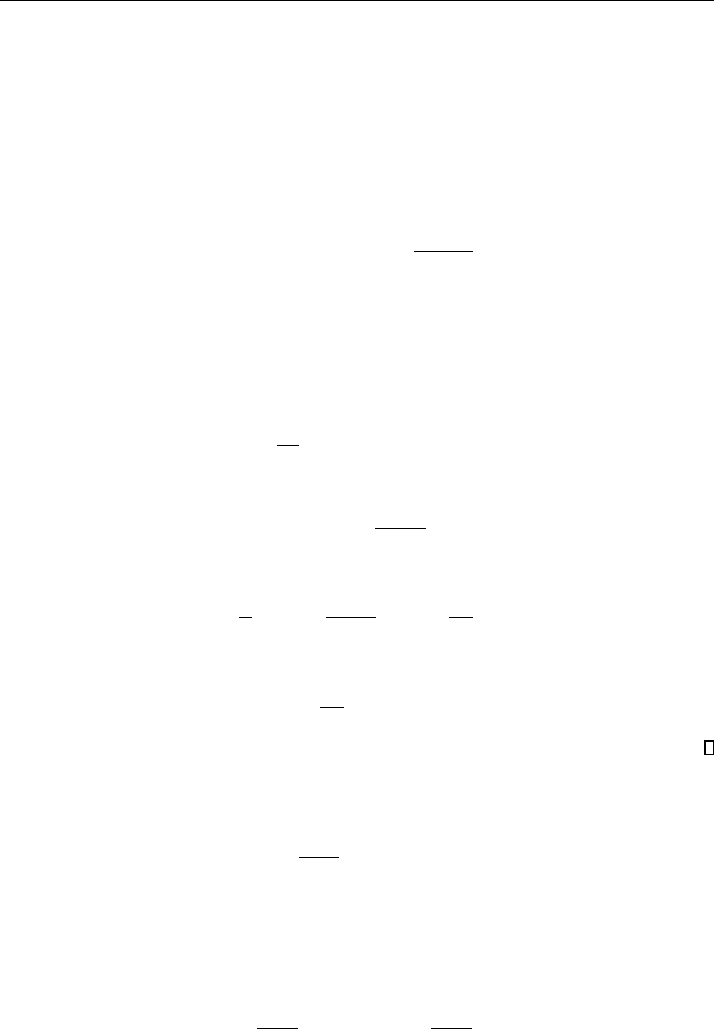
142 Chapter 5 Solution methods for ill-posed problems
Then, for the inaccuracy of the iteration method (5.31), (5.32), (5.39) with u
0
= 0
there holds the estimate
z
n
≤nτδ + M
1
n
−p
, M
1
= M
1
(τ, p, M). (5.41)
Proof. Under the conditions of (5.40), it is necessary to find how the quantity s(n) in
the estimate (5.38) depends on the number of iterations n.
With u
0
= 0, we have z
0
= u and, using the above notation, obtain that
z
(1)
n
=
∞
i=1
λ
p
i
(1 − τλ
i
)
n
(u,w
i
)
λ
p
i
w
i
.
Then, in view of (5.40), we obtain:
s(n) ≤ max
λ
i
λ
p
i
|1 − τλ
i
|
n
A
−p
u. (5.42)
Under the constraint (5.39) on the iteration parameter we have 0 <τλ
i
≤ 1 and,
hence,
max
λ
i
λ
p
i
|1 − τλ
i
|
n
≤
1
τ
p
max
0<η<1
χ(η), χ(η) = η
p
(1 − η)
n
.
The function χ(η) attains its maximum at the point
η = η
∗
=
p
p + n
and, in addition,
χ(η
∗
) =
p
n
p
1 −
p
p + n
p+n
<
p
p
n
p
exp (−p).
Substitution into (5.42) results in the estimate (5.41), in which the constant
M
1
=
p
p
τ
p
exp (−p)M
depends on p,τ and M, but does not depend on n.
Minimization of the right-hand side of (5.41) allows us to formulate the termination
criterion for the iterations:
n
opt
=
pM
1
τ
1/( p+1)
δ
−1/( p+1)
, (5.43)
i. e., n(δ) = O(δ
−1/( p+1)
). Here, for the approximate-solution inaccuracy we obtain
the estimate
z
n
opt
≤M
2
δ
p/( p+1)
(5.44)
with the constant
M
2
= τ
pM
1
τ
1/( p+1)
+ M
1
pM
1
τ
−p/( p+1)
.
Estimate (5.44) demonstrates the direct dependence of the rate of convergence of
the approximate solution to the exact solution on the right-hand side inaccuracy δ and
on the smoothness of the exact solution (parameter p).

Section 5.4 Iterative solution methods for ill-posed problems 143
5.4.4 Generalizations
Above, the possibility to optimally choose the number of iterations in the case of
known class of a priori constraints on the exact solution was noted (the constant M
in (5.40)). In the practical use of iteration methods for solving ill-posed problems, one
often fails to explicitly specify the class of a priori constraints. That is why, instead
of (5.43), they often choose the number of iterations from the discrepancy, so that the
iterative process is to be continued unless the following inequality becomes fulfilled:
Au
n(δ)
− f
δ
≤δ. (5.45)
In the discussion of iteration methods for solving elliptic difference equations,
variation-type iteration methods were isolated. In these methods, explicit calcula-
tion formulas for iteration parameters are used. For instance, in the steepest descend
method the following formula is used:
u
k+1
− u
k
τ
k+1
+ Au
k
= f
δ
, k = 0, 1,..., (5.46)
where
τ
k+1
=
(r
k
, r
k
)
(Ar
k
, r
k
)
, r
k
= Au
k
− f
δ
. (5.47)
In this connection, the conjugate gradient method deserves to be mentioned. This
method belongs to the class of three-layer iteration methods, when in the solution of
problem (5.3) we use the formulas
u
k+1
= α
k+1
(E − τ
k+1
A)u
k
+ (1 − α
k+1
)u
k−1
+ α
k+1
τ
k+1
f
δ
,
k = 1, 2,...,
u
1
= (E − τ
1
A)u
0
+ τ
1
f
δ
.
(5.48)
For the iteration parameters α
k+1
and τ
k+1
, we use the calculation formulas
τ
k+1
=
(r
k
, r
k
)
(Ar
k
, r
k
)
, k = 0, 1,...,
α
k+1
=
1 −
τ
k+1
τ
k
(r
k
, r
k
)
(r
k−1
, r
k−1
)
1
α
k
−1
, k = 1, 2 ..., α
1
= 1.
(5.49)
We will not dwell here on the regularizing properties of such iteration methods,
inviting the interested reader to the special literature. Note only that for the variational
iterative solution methods (5.46), (5.47) and (5.48), (5.49) for the ill-posed problem
(5.1), (5.2) similar results were obtained as for the simple iteration method (5.31).
The problem of using implicit iteration methods for solving ill-posed problems de-
serves special mention. Here, we mean, for instance, iteration methods of type (5.29),
(5.30), in which B = E. In the general context, there is a problem concerning the
choice of the operator B in solving ill-posed problems.

144 Chapter 5 Solution methods for ill-posed problems
In the solution of difference problems for well-posed mathematical physics prob-
lems, the choice of B should be made considering primarily the demand for improved
rate of convergence in the iteration method. In the solution of ill-posed problems the it-
erative process should be terminated on the achievement of a discrepancy whose value
is defined by the input-data inaccuracy. We are interested not only in the rate at which
the iterative process converges in this domain of decreasing, but also in the class of
smoothness on which this iterative process converges and in the norm in which the
desired level of discrepancy can be achieved. The most important feature of the ap-
proximate solution of ill-posed problems by iteration methods consists in the fact that
an appropriate approximate solution can be isolated from the necessary smoothness
class through the choice of B.
5.5 Program implementation
and computational experiments
As a routine ill-posed problem, the first-kind integral equation is normally considered.
Following the common practice, we consider here the points that arise in the numerical
solution of an integral equation used to continue anomalous gravitation fields given on
the earth surface towards disturbing masses. The program implementation is based on
the use of iteration methods in solving problems with random input-data inaccuracies.
5.5.1 Continuation of a potential
In gravimetrical and magnetic prospecting, and in direct-current geoelectrical
prospecting, most important are problems in which it is required to continue a po-
tential fields from the earth surface deep into the earth. The solution of such problems
is used to identify, to this or that extent, the position of gravitational and electromag-
netic anomalies. Here, we restrict ourselves to the formulation of the gravitational-field
continuation problem.
We designate as U the gravitational potential of an anomaly located in depth of the
earth. Let x be a horizontal coordinate and the axis Z be directed upward so that at
the earth surface we have z = 0. We consider a problem in which it is required to
determine the gravity potential in the zone z < 0 down to anomalies whose depth
is H .
We consider a problem in which it is required to continue the gravitational potential
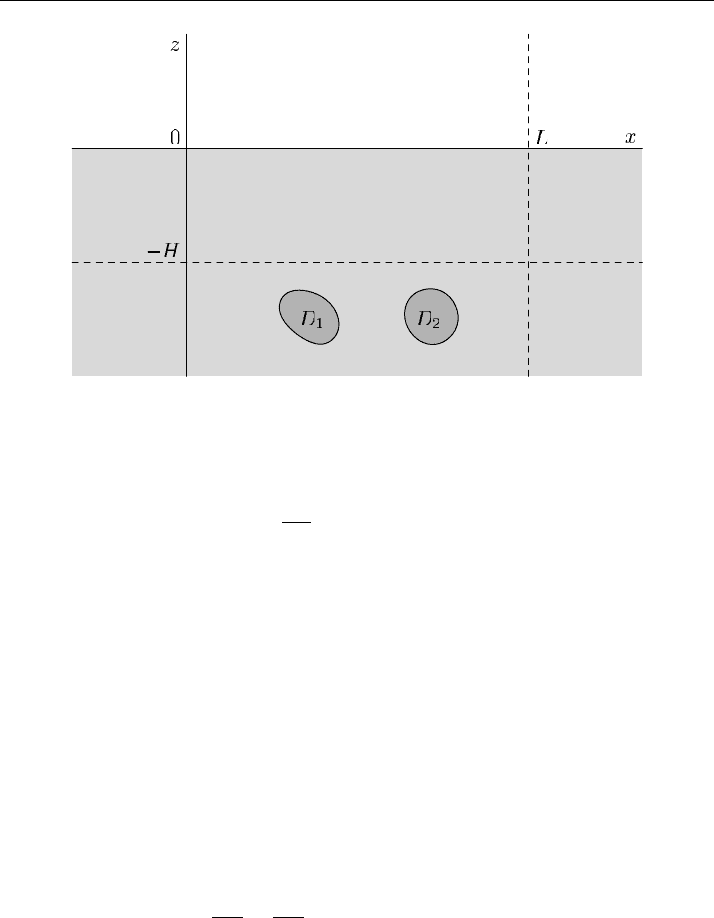
from two disturbing masses (D
1
and D
2
in Figure 5.1). This potential U (x, z) satisfies
the Laplace equation in the zone outside the anomalies, so that
∂
2
U
∂x
2
+
∂
2
U
∂z
2
= 0, z > −H. (5.50)
At the earth surface (according to field observations measured in which is the first
Section 5.5 Program implementation and computational experiments 145
Figure 5.1 Schematic illustrating the continuation problem
vertical derivative of the potential) the following conditions are posed:
∂U
∂z
(x, 0) = ϕ(x). (5.51)
One more boundary condition is
U (x, ∞) = 0. (5.52)
On the behavior of ϕ(x) with |x|→∞, natural constraints are posed which provide
for solution boundedness.
The problem (5.50)–(5.52) considered in the zone z > 0) is an ordinary boundary
value problem. We pose a continuation problem for the solution of this well-posed
problem into the adjacent zone −H < z < 0.
The continuation problem (5.50)–(5.52) is not quite convenient to examine because
it involves boundary condition (5.52) with angled derivative. This problem can be
reformulated as a continuation problem for u = ∂U/∂z:
∂
2
u
∂x
2
+
∂
2
u
∂z
2
= 0, z > −H, (5.53)
u(x, 0) = ϕ(x), (5.54)
u(x, ∞) = 0. (5.55)
In the case of (5.53)–(5.55), we have a continuation problem for the solution of the
Dirichlet problem for the Laplace equation.
Let us give some simple reasoning concerning the necessity to solve the continua-
tion problem for gravitational fields toward anomalies. In the performed calculations,