
Samarskii A.A., Vabishchevich P.N. Numerical Methods for Solving Inverse Problems of Mathematical Physics
Подождите немного. Документ загружается.

146 Chapter 5 Solution methods for ill-posed problems
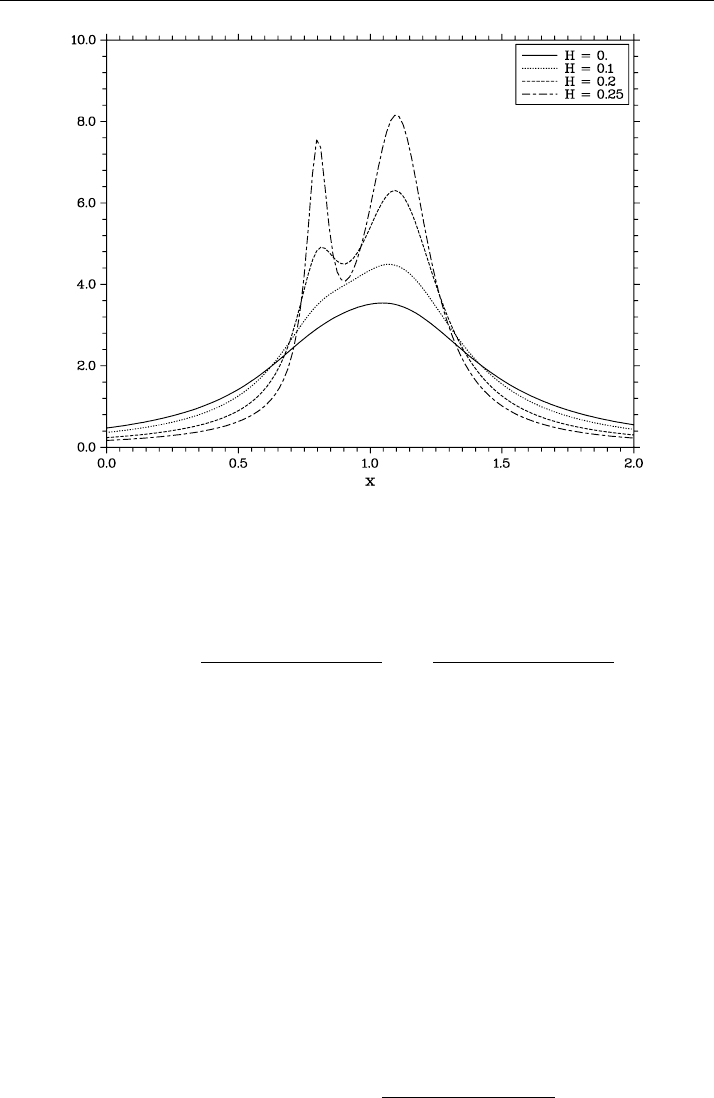
Figure 5.2 Solution of the direct problem at various depths
we consider a model problem with two anomalies, circular in cross-section, with cen-
ters at (x
1
, z
1
) = (0.8, −0.3) and (x
2
, z
2
) = (1.1, −0.4). The exact solution of prob-
lem (5.53)–(5.55) is
u(x, z) = c
1
z − z
1
(x − x
1
)
2
+ (z − z
1
)
2
+ c
2
z − z
2
(x − x
2
)
2
+ (z − z
2
)
2
.
Suppose that c
1
= 0.3 and c
2
= 1.2, i. e., the deeper anomaly has fourfold greater
power.
The exact solution of the problem at various depths H is shown in Figure 5.2. From
the measured data, at H = 0 and H = 0.1 two sources of gravitational perturba-
tions can be suspected. At larger depths (as we approach the sources), two individual
anomalies can be identified (at H = 0.2 and especially at H = 0.25). It is this cir-
cumstance that necessitates the continuation of potential fields towards anomalies.
5.5.2 Integral equation
To find an approximate solution of the continuation problem (5.53)–(5.55), one can
use many computational algorithms. We will dwell here on the use of the integral
equation method. We approximate the gravitational potential produced by anomalies
with a potential generated by an elemental bed with a carrier located at the segment
0 ≤ x ≤ L and at the depth z =−H . Accurate to a multiplier, we have
U (x, z) =
L
0
ln r μ(s) ds, r =
(x − s)
2
+ (z + H)
2
, z > −H.

Section 5.5 Program implementation and computational experiments 147
For the derivative with respect to the vertical variable we obtain:
u(x, z) =
L
0
z + H
(x − s)
2
+ (z + H)
2
μ(s) ds, z > −H. (5.56)
For the unknown density, from (5.54) and (5.56) we obtain the first-kind integral equa-
tion
L
0
K (x, s)μ(s) ds = ϕ(x) (5.57)
with the symmetric kernel
K (x, s) =
H
(x − s)
2
+ H
2
.
We write equation (5.57) as the first-kind equation
Aμ = ϕ (5.58)
in which
Aμ =
L
0
K (x, s)μ(s) ds.
The integral operator A : H → H , where H = L
2
(0, L), is a self-adjoint operator
(Aμ, ν) = (μ, Aν). Besides, this operator is a bounded operator because
(Aμ, μ) =
L
0
L
0
K (x, s)μ(s)μ(x) ds dx
≤
L
0
L
0
K
2
(x, s) ds dx
1/2
L
0
L
0
μ
2
(s)μ
2
(x) ds dx
1/2
≤ γ
2
μ
2
,
where γ
2
< L/H.
The integral operator under consideration is a self-adjoint, bounded operator. Yet,
the iteration method cannot be directly applied to (5.58) because, generally speaking,
the operator A here is not a positive (non-negative) operator. Hence, symmetrization
of (5.58) is to be applied:
A
∗
Aμ = A
∗
ϕ, (5.59)
which we can finally use in the iteration method.
5.5.3 Computational realization
In the numerical solution of the integral equation (5.59), we use a uniform grid
¯ω ={x | x = (i − 0.5)h, i = 1, 2,...,N, Nh = L}.
We designate the approximate solution as y
i
= y(x
i
), i = 1, 2,...,N .

148 Chapter 5 Solution methods for ill-posed problems
We put into correspondence to the integral operator A the difference operator
(A
h
y)(x
i
) =
N
j=1
K (x
i
, s
j
)y
j
h. (5.60)
This approximation corresponds to the use of the rectangle quadrature formula. The
difference analogue of (5.59) is the equation
Ry = f, R = A
∗
h
A
h
, f = A
∗
h
ϕ. (5.61)
To approximately solve equation (5.61), we use the iteration method
y
k+1
− y
k
τ
k+1
+ Ry
k
= f, k = 0, 1,... . (5.62)
Two choices of iteration parameters were considered:
1. Simple iteration method, in which τ
k
= τ = const;
2. Steepest descend method, in which
τ
k+1
=
(r
k
, r
k
)
(Rr
k
, r
k
)
, r
k
= Ry
k
− f.
To model the input-data inaccuracy, we perturbed the exact solution at the grid nodes
by the law
ϕ
δ
(x) = ϕ(x) + 2ζ(σ(x) − 1/2), x = x
i
, i = 1, 2,...,N,
where σ(x) is a random quantity normally distributed over the interval from 0 to 1.
The parameter ζ defines the inaccuracy level in the right-hand side of (5.58), and
ϕ
δ
(x)) − ϕ(x)≤δ = ζ
√
L.
The iterative process is to be terminated considering the discrepancy. Some other
specific features of the computational algorithm will be noted below.
5.5.4 Program
To approximately solve the model two-dimensional continuation problem for gravita-
tional fields, we used the program presented below.
Program PROBLEM4
C
C PROBLEM4 - CONTINUATION OF ANAMALOUS GRAVITATIONAL FIELD
C
PARAMETER ( HH = 0.225, DELTA = 0.1, ISCHEME = 1, N = 100 )

Section 5.5 Program implementation and computational experiments 149
DIMENSION Y(N), X(N), PHI(N), PHID(N), F(N), A(N,N)
+ ,V(N), R(N), AR(N), U(N), UY(N), UY1(N)
C
C PARAMETERS:
C
C XL, XR - LEFT AND RIGHT END POINTS OF SEGMENT;
C HH - CARRIER DEPTH;
C H0 - CONTINUATION DEPTH;
C ISCHEME - SIMPLE-ITERATION METHOD (ISCHEME = 0),
C QUICKEST DESCEND METHOD (ISCHEME = 1);
C N - NUMBER OF GRID NODES;
C Y(N) - SOLUTION OF THE INTEGRAL EQUATION;
C U(N) - EXACT ANOMALOUS FIEKD AT THE DEPTHZ=H0;
C UY(N) - CALCULATED FIELD AT THE DEPTHZ=H0;
C UY1(N) - CALCULATED FIELD AT THE EARTH SURFACE;
C PHI(N) - EXACT ANOMALOUS FIELD AT THE EARTH SURFACE;
C PHID(N) - DISTURBED FIELD AT THE EARTH SURFACE;
C DELTA - INPUT-DATA INACCURACY LEVEL;
C A(N,N) - PROBLEM MATRIX;
C
XL=0.
XR=2.
C
OPEN ( 01, FILE = ’RESULT.DAT’ ) ! FILE TO STORE THE COMPUTED DATA
C
C GRID
C
H = (XR - XL)/N
DOI=1,N
X(I) = XL + (I-0.5)
*
H
END DO
C
C DATA AT THE EARTH SURFACE
C
C1 = 0.3
X1 = 0.8
Z1 = - 0.3
C2 = 1.2
X2 = 1.1
Z2 = - 0.4
DO I = 1,N
PHI(I) = - C1/((X(I)-X1)
**
2+Z1
**
2)
*
Z1
*
- C2/((X(I)-X2)
**
2+Z2
**
2)
*
Z2
PHID(I) = PHI(I) + 2.
*
DELTA
*
(RAND(0)-0.5)/SQRT(XR-XL)
END DO
C
C EXACT IN-EARTH DATA
C
H0 = 0.2
DO I = 1,N
U(I) = - C1/((X(I)-X1)
**
2 + (H0+Z1)
**
2)
*
(H0+Z1)
*
- C2/((X(I)-X2)
**
2 + (H0+Z2)
**
2)
*
(H0+Z2)
END DO
C
C RIGHT-HAND SIDE
C
DO I = 1,N
SUM=0.
DO J = 1,N
SUM = SUM + AK(X(I),X(J),HH)
*
PHID(J)

150 Chapter 5 Solution methods for ill-posed problems
END DO
F(I) = SUM
*
H
END DO
C
C MATRIX ELEMENTS
C
DO I = 1,N
DO J = 1,N
SUM=0.
DO K = 1,N
SUM = SUM + AK(X(I),X(K),HH)
*
AK(X(K),X(J),HH)
END DO
A(I,J) = SUM
*
H
**
2
END DO
END DO
C
C ITERATIVE PROCESS
C
IT=0
ITMAX = 100
DO I = 1,N
Y(I) = 0.
END DO
100 IT = IT+1
C
C CACULATIONV=RY
C
DO I = 1,N
SUM=0.
DO J = 1,N
SUM = SUM + A(I,J)
*
Y(J)
END DO
V(I) = SUM
END DO
C
C ITERATION PARAMETER
C
DO I = 1,N
R(I) = V(I) - F(I)
END DO
IF ( ISCHEME.EQ.0 ) THEN
C
C SIMPLE-ITERATION METHOD
C
TAU = 0.1
END IF
IF ( ISCHEME.EQ.1 ) THEN
C
C QUICKEST DESCEND METHOD
C
DO I = 1,N
R(I) = V(I) - F(I)
END DO
DO I = 1,N
SUM=0.
DO J = 1,N

Section 5.5 Program implementation and computational experiments 151
SUM = SUM + A(I,J)
*
R(J)
END DO
AR(I) = SUM
END DO
SUM1 = 0.
SUM2 = 0.
DO I = 2,N-1
SUM1 = SUM1 + R(I)
*
R(I)
SUM2 = SUM2 + AR(I)
*
R(I)
END DO
TAU = SUM1/SUM2
END IF
C
C NEXT APPROXIMATION
C
DO I = 1,N
Y(I) = Y(I) - TAU
*
R(I)
END DO
C
C ITERATION LOOP EXIT
C
SUM0 = 0.
DO I = 1,N
SUM=0.
DO J = 1,N
SUM = SUM + AK(X(I),X(J),HH)
*
Y(J)
END DO
SUM0 = SUM0 + (SUM
*
H - PHID(I))
**
2
*
H
END DO
SL2 = SQRT(SUM0)
WRITE ( 01,
*
) IT, TAU, SL2
IF (SL2.GT.DELTA .AND. IT.LT.ITMAX) GO TO 100
CLOSE ( 01 )
C
C CALCULATION OF THE FOUND FIELD AT THE DEPTHZ=H0
C
DO I = 1,N
SUM=0.
DO J = 1,N
SUM = SUM + AK(X(I),X(J),HH-H0)
*
Y(J)
END DO
UY(I) = SUM
*
H
END DO
C
C CALCULATION OF THE FOUND FIELD AT THE EARTH SURFACE
C
DO I = 1,N
SUM=0.
DO J = 1,N
SUM = SUM + AK(X(I),X(J),HH)
*
Y(J)
END DO
UY1(I) = SUM
*
H
END DO
STOP
END
FUNCTION AK(X,S,HH)
C
152 Chapter 5 Solution methods for ill-posed problems
C INTEGRAL-EQUATION KERNEL
C
AK = HH/((X-S)
**
2+HH
**
2)
RETURN
END
5.5.5 Computational experiments
Consider several examples for the solution of the continuation problem in the case of
H = 0.225. We use a computation grid whose total number of nodes is N = 100.
The most interesting dependence here is the accuracy in reconstructing the anomalous
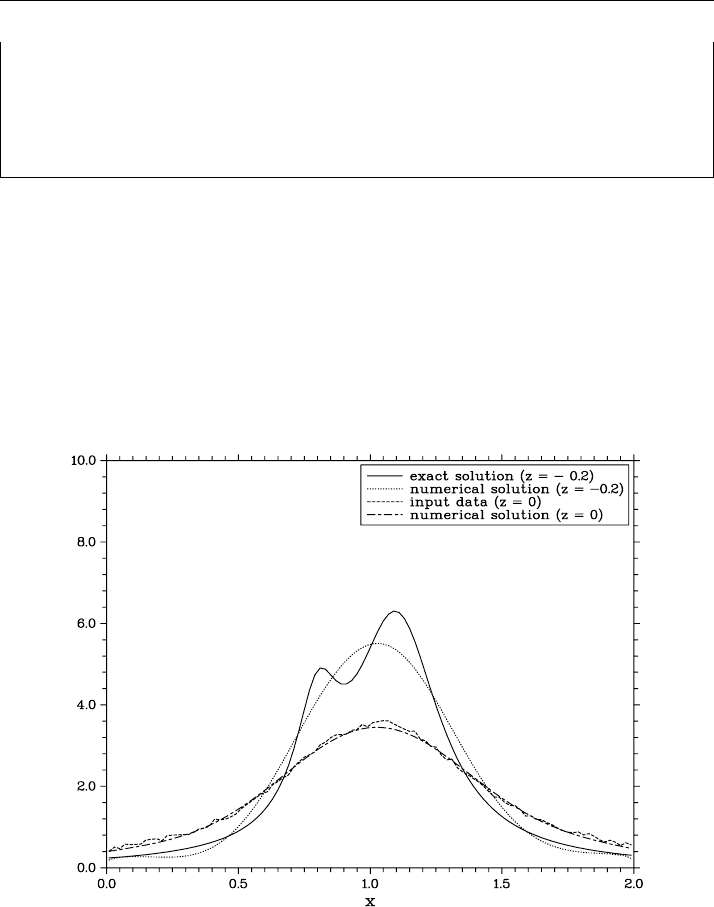
gravitational field versus the input-data inaccuracy δ. Figure 5.3 shows data obtained
by solving the problem with the input-data inaccuracy δ = 0.1 (in setting the field at
the earth surface z = 0). Presented are the exact and found fields at the depth z =−2.
Figure 5.3 Solution of the continuation problem obtained with δ = 0.1
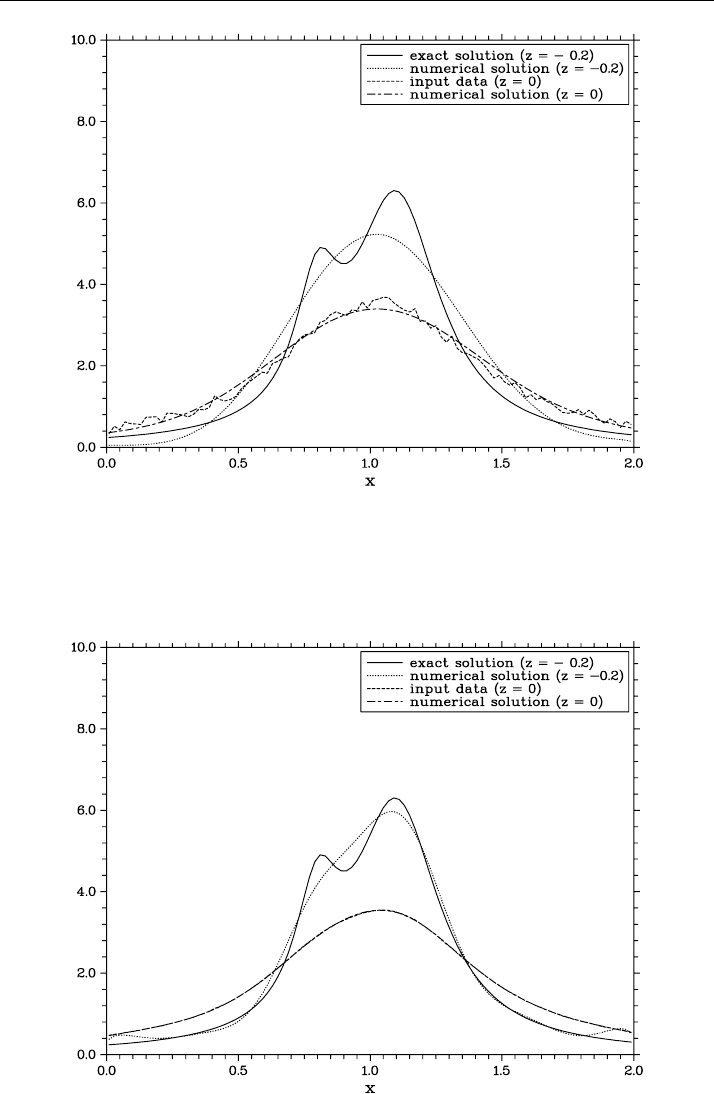
Similar data obtained at a larger inaccuracy level (δ = 0.2) are shown in Figure 5.4.
At the latter inaccuracy level, two individual anomalies are hard to identify (here, no
two-peak configuration is observed). Even a decrease of δ down to δ = 0.01 little
saves the situation (see Figure 5.5).
Section 5.5 Program implementation and computational experiments 153
Figure 5.4 Solution of the continuation problem obtained with δ = 0.2
Figure 5.5 Solution of the continuation problem obtained with δ = 0.01

154 Chapter 5 Solution methods for ill-posed problems
We now provide a few statements concerning the use of these or those iteration
methods. In the program PROBLEM4, the possibility to use either the simple-iteration
method (constant iteration parameter) or the steepest descend method is provided.
A slight modification allows one to implement the iterative conjugate gradient method,
to be used in the case of problems with small right-hand side inaccuracies, in which
the steepest descend method fails to provide a desired rate of convergence.
The number of iterations necessary for solving the problem with δ = 0.1bythe
steepest descend method is n = 6. The total number of iterations in the simple-
iteration method versus the iteration parameter is illustrated by the data in Table 5.1.
τ 0.05 0.1 0.15 0.2 0.25 0.3
n 43 21 14 11 9 32
Table 5.1 Total number of iterations in the simple-iteration method
In the iterative solution of (5.59), the optimal iteration parameter is τ = τ
0
= 2/ ¯γ
2
,
where
A
∗
A ≤¯γ
2
E,
can be estimated invoking the estimate ¯γ
2
< L
2
/H
2
.
5.6 Exercises
Exercise 5.1 Show that in the Tikhonov regularization method for the solution there
holds the a priori estimate
u
α
≤
1
2
√
α
f
δ
that expresses stability with respect to the right-hand side.
Exercise 5.2 Formulate conditions for convergence (analogue to Theorem 5.1, 5.2) of
the approximate solution in H
D
, D = D
∗
> 0 found by minimization of the functional
J
α
(v) =Av − f
δ
2
+ αv
2
D
.
Exercise 5.3 Construct an example illustrating the necessity of condition δ
2
/α(δ) →
0 with δ → 0 (Theorem 5.1) for convergence of the approximate solutions to the exact
solution in the Tikhonov method.
Exercise 5.4 Suppose that the exact solution of problem (5.1) is
A
−2
u≤M,
where M = const > 0, and for the right-hand side inaccuracy the estimate (5.2) holds.
Then, for the approximate solution u
α
found as the solution of problem (5.4), (5.5)
there holds the a priori estimate
z≤
δ
2
√
α
+ αM.

Section 5.6 Exercises 155
Exercise 5.5 Obtain an estimate for the rate of convergence in the Tikhonov method
under the a priori constraints
A
−p
u≤M, 0 < p < 2
posed on the exact solution of problem (5.1), (5.2).
Exercise 5.6 Let u
α
be the solution of problem (5.4), (5.5) and
m(α) =Au
α
− f
δ
2
+ αu
α
2
,
ϕ(α) =Au
α
− f
δ
2
, ψ(α) =u
α
2
.
Show that in the case of f
δ
= 0 and 0 <α
1
<α
2
there hold the inequalities
m(α
1
)<m(α
2
), ϕ(α
1
)<ϕ(α
2
), ψ(α
1
)>ψ(α
2
).
Exercise 5.7 Show that for any δ ∈ (0, f
δ
) there exists a unique solution α = α(δ)
of the equation
ϕ(α) =Au
α
− f
δ
2
= δ
2
,
such that α(δ) → 0 and u
α(δ)
− u→0asδ → 0 (substantiation of the choice of
regularization parameter based on the discrepancy).
Exercise 5.8 In solving problem (5.1), (5.2) with A = A
∗
> 0, the algorithm of
simplified regularization uses the equation
Au
α
+ αu
α
= f
δ
(5.63)
for finding the approximate solution. Formulate the related variational problem.
Exercise 5.9 Prove that in the case of
u
A
−1
≤ M
for the inaccuracy in the approximate solution of problem (5.1), (5.2) found from
(5.63) there holds the priori estimate
z
2
≤
δ
2
α
+
α
2
M
2
.
Exercise 5.10 Suppose that for the approximate solution of problem (5.1), (5.2) one
uses the iteration method
B
u
k+1
− u
k
τ
+ Au
k
= f
δ
, k = 0, 1,...
with B = B
∗
> 0 and
γ
1
B ≤ A ≤ γ
2
B,γ
1
> 0, 0 <τ <
2
γ
2
.
Show that in the iteration method (5.31)–(5.33) u
n(δ)
− u
B
→ 0asδ → 0 provided
that n(δ) →∞and n(δ)δ → 0asδ → 0.