
Samarskii A.A., Vabishchevich P.N. Numerical Methods for Solving Inverse Problems of Mathematical Physics
Подождите немного. Документ загружается.


16 Chapter 1 Inverse mathematical physics problems
1.4.4 Evolutionary inverse problems
The direct problem for nonstationary mathematical physics problems consists in set-
ting some initial conditions (see, for instance, (1.48)). We assign to evolutionary in-
verse problems inverse problems in which initial conditions (lacking in formulation of
the problem as a direct problem) need to be identified.
As applied to the direct problem (1.46)–(1.48), a simplest evolutionary inverse prob-
lem can be formulated as follows. Initial conditions (1.48) are not specified; instead,
the solution at the end time t = T is known:
u(x, T ) = u
T
(x), 0 < x < l. (1.52)
It is required to find the solution of equation (1.46) at preceding times (retrospective
inverse problem).
One can pose an inverse problem in which it is required to identify the initial state
using additional information about the solution at internal points (additional condition
of type (1.50)).
1.5 Exercises
Exercise 1.1 On the function set v(0) = 0, v(l) = 0, we define the operator
Au =−
∂
∂x
k(x)
∂u
∂x
, 0 < x < l.
Establish positive definiteness of A, i.e., derive the estimate (Av, v) ≥ δ(v,v), where
δ>0.
Exercise 1.2 Prove the Friedrichs inequality, which states that
u
2
(x) dx ≤ M
0
2
α=1
∂u
∂x
α
2
dx,
provided that u(x) = 0, x ∈ ∂.
Exercise 1.3 Prove the Gronwall lemma (Lemma 1.1).
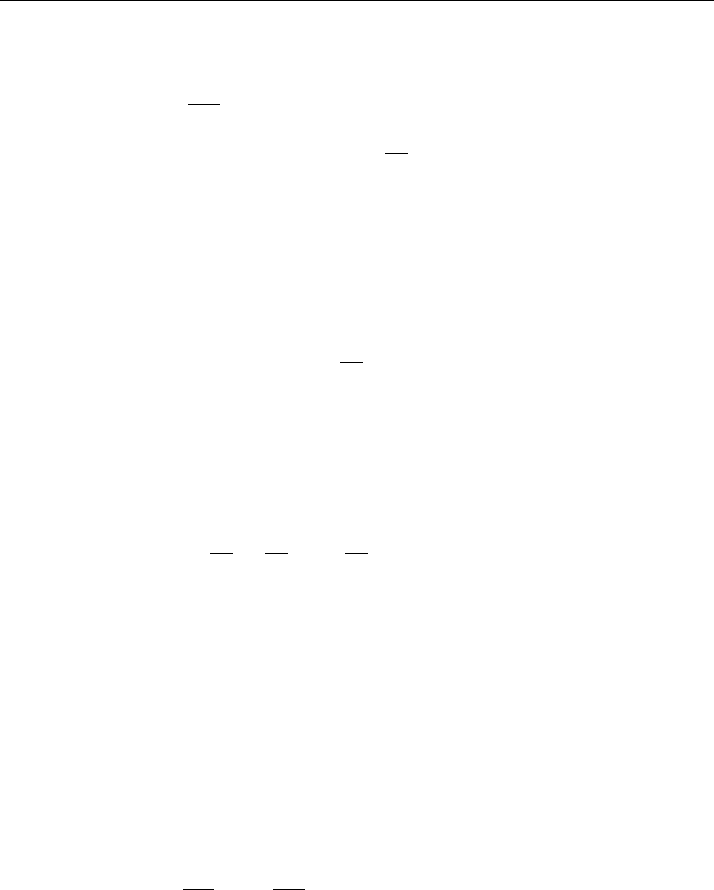
Exercise 1.4 Show that for the solution of problem (1.18)–(1.20) the following a priori
estimate holds:
u(t)
2
≤ exp(t)
u
0
2
+
t
0
exp(−θ)f (θ)
2
dθ.
Exercise 1.5 Let A ≥ δ E, δ = const > 0. Then, for the solution of problem (1.19),
(1.20) we have
u(t)≤exp(−δt)
u
0
+
t
0
exp(δθ) f (θ)
dθ.
Section 1.5 Exercises 17
Exercise 1.6 Consider the Cauchy problem for the second-order evolution equation
d
2
u
dt
2
+ Au = f (t), 0 < t ≤ T,
u(0) = u
0
,
du
dt
(0) = u
1
,
with A = A
∗
> 0. Obtain the following estimate of solution stability with respect to
initial data and the right-hand side:
u(t)
2
∗
≤ exp(t)
u
0
2
A
+v
0
2
+
t
0
exp (−θ) f (θ )
2
dθ
,
where
u
2
∗
=
du
dt
2
+u
2
A
and v
2
D
= (Dv,v) for the self-adjoint, positive operator D.
Exercise 1.7 Prove the maximum principle (Theorem 1.5).
Exercise 1.8 Prove the maximum principle for the parabolic equation, which states
that the solution of the boundary value problem
∂u
∂t
=
∂
∂x
k(x)
∂u
∂x
, 0 < x < l, 0 < t ≤ T,
u(0, t) = μ
0
(t), u(l, t) = μ
1
(t), 0 < t ≤ T ,
u(x, 0) = u
0
(x), 0 ≤ x ≤ l
assumes its maximum and minimum values either at boundary points or at the initial
time, i.e.,
min
0<x <l, 0<t≤T
{μ
0
(t), μ
1
(t), u
0
(x)}≤u(x, t)
≤ max
0<x <l, 0<t≤T
{μ
0
(t), μ
1
(t), u
0
(x)}.
Exercise 1.9 Consider the boundary value problem
−
2
α=1
∂
∂x
α
k(x)
∂u
∂x
α
+ q(x)u = f (x), x ∈ ,
u(x) = 0, x ∈ ∂,
where
k(x) ≥ κ>0, q(x) ≥ 0, x ∈ .
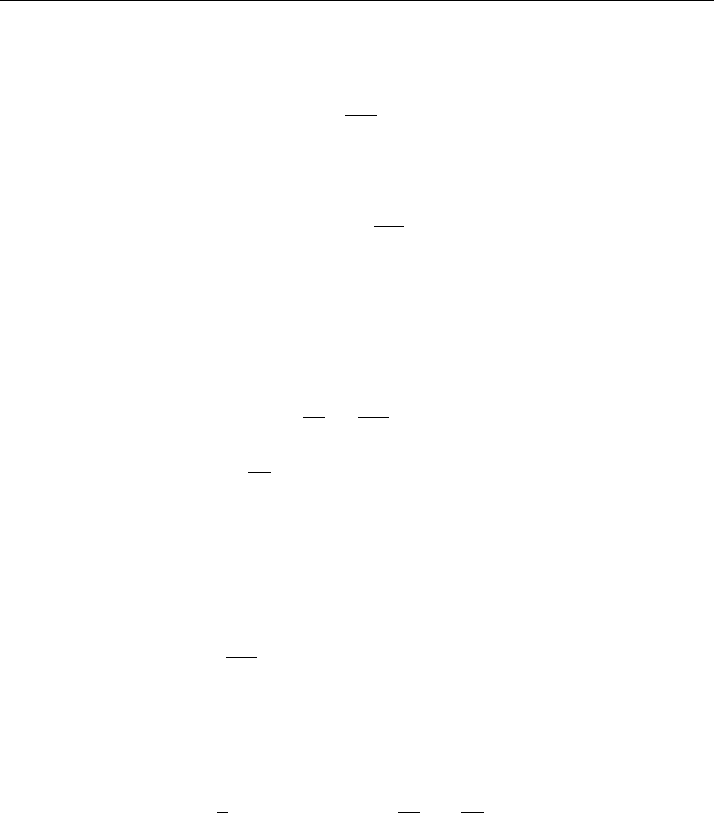
Invoking the Friedrichs inequality (Exercise 1.5.2), derive the following estimate for
solution stability with respect to the right-hand side:
u≤M
1
f , u
2
=
u
2
(x) dx.
18 Chapter 1 Inverse mathematical physics problems
Exercise 1.10 Taken the problem
−
2
α=1
∂
2
u
∂x
2
α
= 0,
u(0, x
2
) = 0, u(l, x
2
) = 0,
u(x
1
, 0) = u
0
(x
1
),
∂u
∂x
2
(x
1
, 0) = u
1
(x
1
)
as an example, show that the Cauchy problem for elliptic equations is ill-posed (exam-
ple by J. Hadamard).
Exercise 1.11 Examine whether the boundary inverse problem for the parabolic equa-
tion
∂u
∂t
=
∂
2
u
∂x
2
, 0 < x < l, 0 < t ≤ T,
u(0, t) = μ
0
(t),
∂u
∂x
(0, t) = μ
1
(t), 0 < t ≤ T ,
u(x, 0) = u
0
(x), 0 ≤ x ≤ l
is a well- or ill-posed problem.
Exercise 1.12 Prove that for any solution of the equation
d
2
u
dt
2
− Au = 0, 0 ≤ t ≤ T
with a self-adjoint operator A there holds the estimate
u(t)
2
≤ exp(2t(T − t))(u(T )
2
+ χ)
t/ T
(u(0)
2
+ χ)
1−t/ T
− χ,
χ =
1
2
(Au(0), u(0)) −
∂u
∂t
(0),
∂u
∂t
(0)
,
which simultaneously proves that the Cauchy problem for this equation is a condition-
ally well-posed problem in the class of bounded solutions.

2 Boundary value problems for ordinary differ-
ential equations
We start discussing the matter of numerical solution of mathematical physics problems
with the boundary value problem for the second-order ordinary differential equation.
Various approaches are used in approximation of the differential problem, primary
attention being paid to finite-difference approximations. Based on an estimate of sta-
bility of the finite-difference solution with respect to the right-hand side and boundary
conditions, we examine the convergence of approximate solution to the exact solu-
tion. In solving finite-difference problems arising on discretization of one-dimensional
problems, direct linear algebra methods are used. We present a FORTRAN 77 program
that solves boundary value problems for the second-order ordinary differential equa-
tion and give computation data obtained for several model problems.
2.1 Finite-difference problem
Below, the approaches to the approximation of boundary value mathematical physics
problems are illustrated with the example of a boundary value problem for the second-
order ordinary differential equation.
2.1.1 Model differential problem
As a basic equation, consider the second-order ordinary differential equation
−
d
dx
k(x)
du
dx
+ q(x)u = f (x), 0 < x < l (2.1)
with variable coefficients
k(x) ≥ κ>0, q(x) ≥ 0.
Elliptic equations of second order, prototyped by equation (2.1), simulate many
physico-mechanical processes.
For the unknown function u(x) to be uniquely found, equation (2.1) must be sup-
plemented with two boundary conditions given at the end points of the segment [0, l].
Here, the function u(x) (first-kind boundary condition), the flux w(x) =−k(x)
du
dx
(x)
(second-kind boundary condition), or a linear combination of the above conditions
(third-kind boundary condition) can be considered:
u(0) = μ
1
, u(l) = μ
2
, (2.2)
−k(0)
du
dx
(0) = μ
1
, k(l)
du
dx
(l) = μ
2
, (2.3)

20 Chapter 2 Boundary value problems for ordinary differential equations
−k(0)
du
dx
(0) + σ
1
u(0) = μ
1
, k(l)
du
dx
(l) + σ
2
u(l) = μ
2
. (2.4)
In the case of problems with discontinuous coefficients (contact of two media), ad-
ditional conditions need to be formulated. Of such additional conditions, a simplest
one (ideal-contact condition) for equation (2.1) is given by the requirement that the
solution and the flux both must be continuous at the contact point x = x
∗
:
[u(x)] = 0,
k(x)
du
dx
= 0, x = x
∗
.
Here, we use the setting
[g(x)] = g(x + 0) − g(x − 0).
Worthy of being considered at length here are problems with a non-self-adjoint op-
erator; in one of such cases, for instance, we have:
−
d
dx
k(x)
du
dx
+ v(x)
du
dx
+ q(x)u = f (x), 0 < x < l. (2.5)
The convection-diffusion-reaction equation (2.5) is a model one in consideration of
processes dealt with in continuum mechanics.
In the description of deformed plates and shells, and also in hydrodynamic prob-
lems, mathematical models involve fourth-order elliptic equations. The consideration
of such models can be started with the boundary value problem for the fourth-order
ordinary differential equation. A simplest such problem is the problem for the equation
d
4
u
dx
4
(x) = f (x), 0 < x < l. (2.6)
Here, two pairs of boundary conditions are considered at the end points of the segment.
For instance, equation (2.6) is supplemented with first-kind conditions:
u(0) = μ
1
, u(l) = μ
2
, (2.7)
du
dx
(0) = ν
1
,
du
dx
(l) = ν
2
. (2.8)
In other statements of boundary value problems for equation (2.6) boundary conditions
at the end points can also involve the second and/or third derivative.
2.1.2 Difference scheme
We denote as ¯ω an uniform grid, with a step size h over the interval
¯
= [0, l]:
¯ω ={x | x = x
i
= ih, i = 0, 1,...,N, Nh = l}.
Here, ω is the set of inner nodal points, and ∂ω is the set of boundary nodal points.
Section 2.1 Finite-difference problem 21
For a sufficiently smooth function u(x), the Taylor series expansion in a vicinity of
an arbitrary internal node x = x
i
yields:
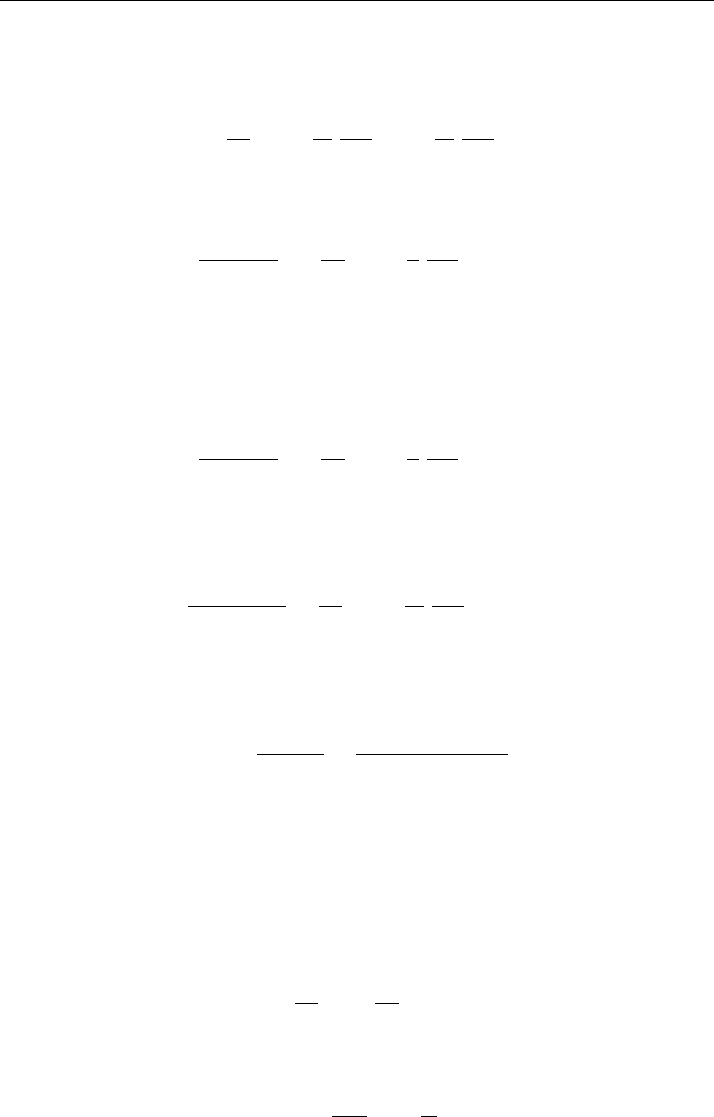
u
i±1
= u
i
± h
du
dx
(x
i
) +
h
2
2
d
2
u
dx
2
(x
i
) ±
h
3
6
d
3
u
dx
3
(x
i
) + O(h
4
).
Here we use the setting u
i
= u(x
i
). Hence, for the left difference derivative we have:
u
¯x
≡
u
i
− u
i−1
h
=
du
dx
(x
i
) −
h
2
d
2
u
dx
2
(x
i
) + O(h
2
). (2.9)
The subscript i is omitted here. In this way, the left difference derivative u
¯x
approx-
imates the first derivative du/dx accurate to O(h) at each of the internal nodes if
u(x) ∈ C
(2)
().
In a similar manner, for the right difference derivative we obtain:
u
x
≡
u
i+1
− u
i
h
=
du
dx
(x
i
) +
h
2
d
2
u
dx
2
(x
i
) + O(h
2
). (2.10)
With a three-point approximation pattern (involving the nodes x
i−1
, x
i
, and x
i+1
), one
can use the central difference derivative
u
◦
x
≡
u
i+1
− u
i−1
2h
=
du
dx
(x
i
) +
h
2
3
d
3
u
dx
3
(x
i
) + O(h
3
) (2.11)
that approximates the derivative du/dx accurate to the second order if u(x) ∈ C
(3)
().
For the second derivative d
2
u/dx
2
, similar manipulations yield:
u
¯xx
=
u
x
− u
¯x
h
=
u
i+1
− 2u
i
+ u
i−1
h
2
.
The latter difference operator approximates the second derivative accurate to the sec-
ond order at the node x = x
i
if u(x) ∈ C
(4)
().
Difference schemes for problem (2.1), (2.2) with sufficiently smooth coefficients
can be constructed based on immediate replacement of differential operators with their
difference analogues.
Dwell now at greater length on the approximation of the one-dimensional operator
Au =−
d
dx
k(x)
du
dx
+ q(x)u. (2.12)
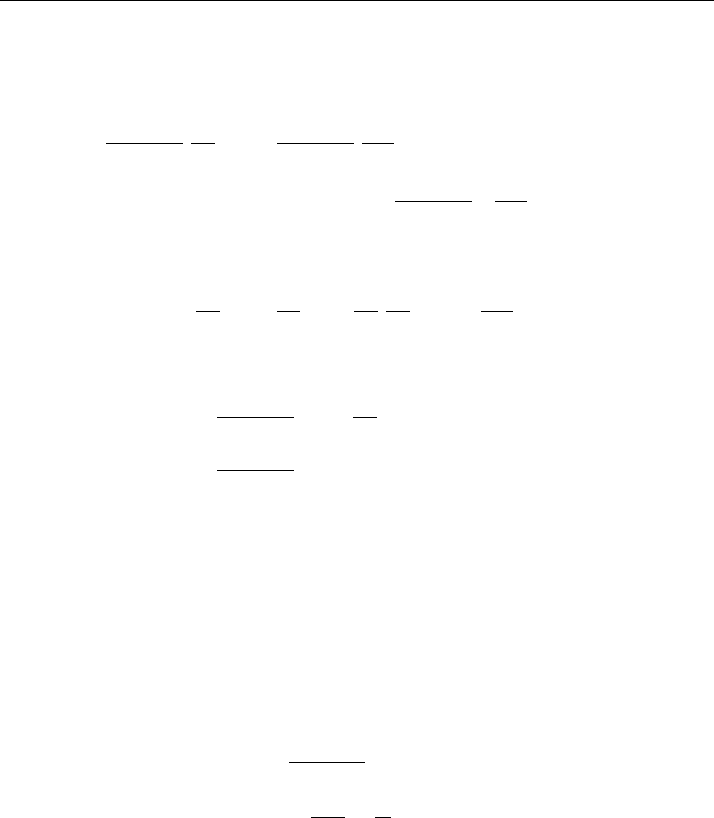
Consider the difference expression
(au
¯x
)
x
=
a
i+1
h
u
x
−
a
i
h
u
¯x
.
22 Chapter 2 Boundary value problems for ordinary differential equations
Taking into account the representations (2.9), (2.10) for the local approximation inac-
curacy of first derivatives with directed differences, we obtain:
(au
¯x
)
x
=
a
i+1
− a
i
h
du
dx
(x
i
) +
a
i+1
+ a
i
2
d
2
u
dx
2
(x
i
)
+
a
i+1
− a
i
6
h
d
3
u
dx
3
(x
i
) + O(h
2
). (2.13)
To find the coefficients a
i
, compare (2.13) with the differential expression
d
dx
k(x)
du
dx
=
dk
dx
du
dx
+ k(x)
d
2
u
dx
2
.
It seems reasonable to choose the coefficients a
i
so that we have
a
i+1
− a
i
h
=
dk
dx
(x
i
) + O(h
2
), (2.14)
a
i+1
+ a
i
2
= k(x
i
) + O(h
2
). (2.15)
In this case, the difference operator
Ay =−(ay
¯x
)
x
+ cy, x ∈ ω (2.16)
with, for instance, c(x) = q(x), x ∈ ω, approximates the difference operator (2.12)
accurate to O(h
2
).
In particular, conditions (2.15) and (2.16) are satisfied with the following formulas
for the coefficients a
i
:
a
i
= k
i−1/2
= k(x
i
− 0.5h),
a
i
=
k
i−1
+ k
i
2
,
a
i
= 2
1
k
i−1
+
1
k
i
−1
.
(2.17)
Alternative (other than (2.16) and (2.17)) possibilities in constructing the difference
operator A will be outlined below.
To the differential problem (2.1), (2.2), we put into correspondence the difference
problem
−(ay
¯x
)
x
+ cy = ϕ, x ∈ ω, (2.18)
y
0
= μ
1
, y
N
= μ
2
, (2.19)
with c(x) = q(x), ϕ(x) = f (x), x ∈ ω, for instance.
Boundary value mathematical physics problems can be conveniently considered
with homogeneous boundary conditions. The same in full measure applies to finite-
difference problems. The transition from inhomogeneous to homogeneous boundary

Section 2.1 Finite-difference problem 23
conditions itself is not always obvious in differential problems. For finite-difference
problems, the situation is simpler in a sense: inhomogeneous boundary conditions can
be included into the right-hand side of the finite-difference equation at near-boundary
nodes. By way of example, consider the finite-difference problem (2.18), (2.19).
We consider the set of mesh functions vanishing at boundary nodes, i.e. such that
y
0
= 0, y
N
= 0. Hence, we have to do with a mesh function y(x) that approximates
the function u(x) only at internal nodes of the calculation grid. For x ∈ ω, instead of
the difference problem (2.18), (2.19), we use the operator equation
Ay = ϕ, x ∈ ω. (2.20)
At near-boundary nodes, we use approximations of type
−
1
h
a
2
y
2
− y
1
h
− a
1
y
1
− μ
1
h
+ c
1
y
1
= f
1
.
Hence,
(Ay )
1
= ϕ
1
,
where
ϕ
1
= f
1
+
a
1
μ
1
h
2
.
Thus, the difference problem (2.20) with the operator A defined by (2.16) and act-
ing on the set of mesh functions vanishing at ∂ω is put into correspondence to the
differential problem (2.1), (2.2). Here, the right-hand side of (2.20),
ϕ(x) =
⎧
⎪
⎪
⎪
⎪
⎪
⎨
⎪
⎪
⎪
⎪
⎪
⎩
f
1
+
a
1
μ
1
h
2
, x = x
1
,
f (x), x = x
i
, i = 2, 3,...,N − 2,
f
N −1
+
a
N −1
μ
2
h
2
, x = x
N −1
,
looks unusual only at near-boundary nodes.
2.1.3 Finite element method schemes
Stationary mathematical physics problems can be discretized using the finite element
method (FEM). For the model one-dimensional equation (2.1) with the homogeneous
boundary conditions
u(0) = 0, u(l) = 0, (2.21)
we construct a finite element scheme based on the Galerkin method. Using simplest
piecewise linear elements, we represent the approximate solution as
y(x) =
N −1
i=1
y
i
w
i
(x), (2.22)
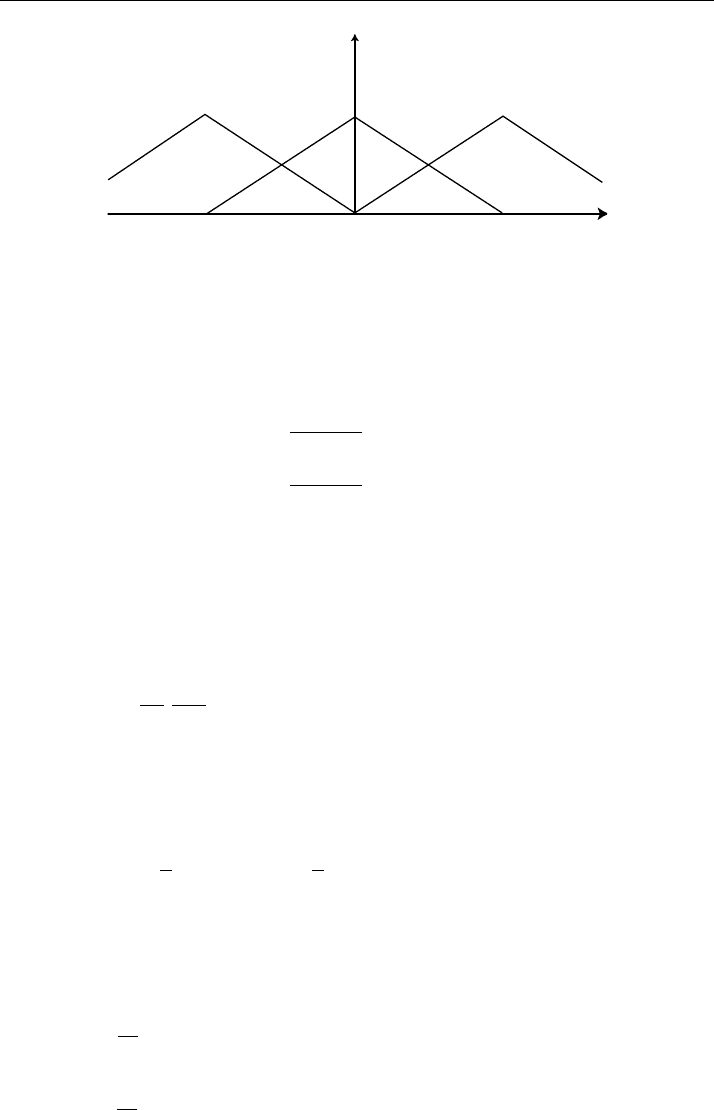
24 Chapter 2 Boundary value problems for ordinary differential equations
w
i
(x)
xx
i+1
x
i_1
x
i
Figure 2.1 Piecewise linear trial functions
where the trial functions w
i
(x) have the form (see Figure 2.1)
w
i
(x) =
⎧
⎪
⎪
⎪
⎪
⎪
⎪
⎪
⎪
⎨
⎪
⎪
⎪
⎪
⎪
⎪
⎪
⎪
⎩
0, x < x
i−1
,
x − x
i−1
h
, x
i−1
≤ x ≤ x
i
,
x
i+1
− x
h
, x
i
≤ x ≤ x
i+1
,
0, x > x
i+1
.
The expansion coefficient can be found from a system of linear equations obtained
by multiplying the initial equation (2.1) by a verifying function w
i
(x) and integrating
the resulting equation over the entire domain. In view of the finiteness of the trial
functions, we obtain:
x
i+1
x
i−1
k(x)
dy
dx
dw
i
dx
dx +
x
i+1
x
i−1
q(x)y(x)w
i
(x) dx =
x
i+1
x
i−1
f (x)w
i
(x) dx.
Substitution of (2.22) yields the three-point difference equation (2.20). For A,we
obtain representation (2.16) with a mesh function a
i
that depends not only on k(x),but
also on q(x):
a
i
=
1
h
x
i
x
i−1
k(x) dx −
1
h
x
i
x
i−1
q(x)(x − x
i−1
)(x
i
− x) dx. (2.23)
For smooth coefficients k(x), application of simplest quadrature formulas yields
(2.17).
For the right-hand side and for the coefficient c
i
in (2.16) we obtain:
c
i
=
1
h
2
x
i
x
i−1
q(x)(x − x
i−1
) dx +
x
i
x
i−1
q(x)(x
i+1
− x) dx
, (2.24)
ϕ
i
=
1
h
2
x
i
x
i−1
f (x)(x − x
i−1
) dx +
x
i
x
i−1
f (x)(x
i+1
− x) dx
. (2.25)

Section 2.1 Finite-difference problem 25
Even in the simplest case of constant coefficients k(x) and q(x), we arrive at an un-
usual approximation of the lowest term in A.
Difference schemes with basis functions chosen in the form of piecewise polyno-
mials of higher degree (quadratic, cubic, etc.) can be constructed in a similar manner.
In the treatment of convection-diffusion problems (see equation (2.5)), FEM schemes
based on the Petrov–Galerkin method have gained acceptance, in which trial and ver-
ifying functions differ from each other. Along this line, in particular, finite element
analogues of ordinary difference schemes with directed differences can be constructed.
2.1.4 Balance method
Normally, differential equations reflect one or another law of conservation for elemen-
tary volumes (integral conservation laws) on contraction of the volumes to zero. In
fact, construction of a discrete problem implies a reverse transition from a differential
to an integral model. One can reasonably demand that, upon such a transition, the con-
servation laws remained fulfilled. Difference schemes expressing conservation laws
on a grid are called conservative difference schemes.
Construction of conservative finite-difference schemes can be reasonably started
from conservation laws (balances) for individual meshes of the difference scheme.
This construction method for conservative difference schemes received the name
integro-interpolation method (balance method). This approach is also known as finite-
volume method. The integro-interpolation method was proposed by A. N. Tikhonov
and A. A. Samarskii in the early 50ths.
Consider the integro-interpolation method as applied to construction of a difference
scheme for the model one-dimensional problem (2.1), (2.2). Let us consider Q(x) =
−k(x)du/dx. We choose the control volumes as the segments x
i−1/2
≤ x ≤ x
i+1/2
,
where x
i−1/2
= (i − 1/2)h. Integration of (2.1) over the control volume x
i−1/2
≤ x ≤
x
i+1/2
yields:
Q
i+1/2
− Q
i−1/2
+
x
i+1/2
x
i−1/2
q(x)u(x) dx =
x
i+1/2
x
i−1/2
f (x) dx. (2.26)
The balance relation (2.26) reflects a conservation law for the segment x
i−1/2
≤
x ≤ x
i+1/2
. The quantity Q
i±1/2
is the flux through the section x
i±1/2
. Unbalance
between these fluxes is caused by distributed sources (right-hand side of (2.26)) and
by additional sources (integral in the left-hand side of the equation).
To derive a difference equation from the balance relation (2.26), one has to use
some completion of mesh functions. We seek the solution itself at integer nodes (y(x),
x = x
i
), and fluxes, at half-integer nodes (Q(x), x = x
i+1/2
). We express the fluxes
at half-integer nodes in terms of the values of u(x) at nodal points. To this end, we