
Samarskii A.A., Vabishchevich P.N. Numerical Methods for Solving Inverse Problems of Mathematical Physics
Подождите немного. Документ загружается.

36 Chapter 2 Boundary value problems for ordinary differential equations
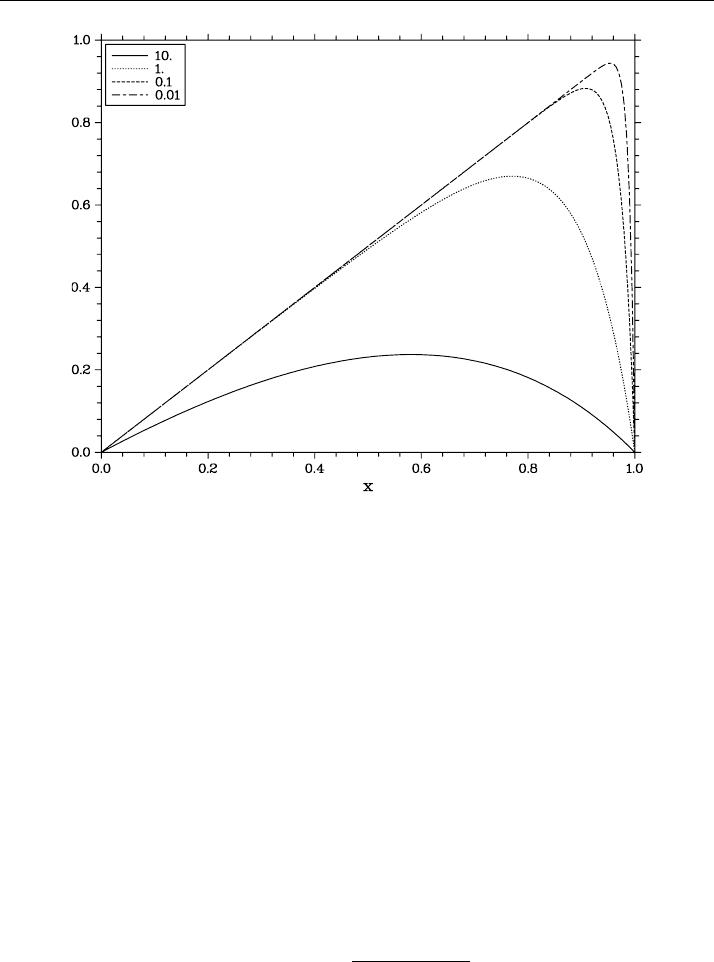
Figure 2.2 Exact solution of the convection-diffusion problem
In the case of Pe 1, we have a process with dominating diffusion, whereas in the
case of Pe 1 convection prevails. In the former case, we arrive at regularly per-
turbed problems (small parameter Pe
−1
at low-order derivatives), whereas in the case
of strongly dominating convection, we obtain singularly perturbed problems (small
parameter Pe
−1
at hogh-order derivatives). Typical for singularly perturbed problems
is the occurrence of regions where the solution displays considerable variations, such
regions, for instance, being boundary layers and internal transition layers.
Computational algorithms for approximate solution of convection-diffusion prob-
lems can be understood considering the problem with constant coefficients and homo-
geneous boundary conditions:
k(x) = κ, v(x) = 1, f (x) = 1,μ
1
= 0,μ
2
= 0. (2.67)
The exact solution of problem (2.64), (2.65), (2.66) is
u(x) = x −l
exp (x/κ) − 1
exp (l/κ) − 1
.
Specific features inherent to the problem with dominating convection (low diffusion
coefficients) can be figured out considering Figure 2.2 that shows the solution of the
problem with l = 1 and κ = 1, 0.1, and 0.01. As the diffusion coefficient decreases,
near the right boundary there forms a boundary layer (region with large solution gra-
dients).

Section 2.4 Program realization and computational examples 37
2.4.2 Difference schemes
In consideration of one-dimensional convection-diffusion problems (2.64), (2.65), we
choose using difference schemes written at the internal nodes in the form (2.51), (2.52).
Consider the difference schemes (2.51), (2.52) in which
α
i
> 0,β
i
> 0,γ
i
> 0, i = 1, 2,...,N − 1. (2.68)
Let us formulate a criterion for monotonicity of the difference scheme or, in other
words, formulate conditions under which the difference scheme (2.51), (2.52) satisfies
the difference principle of maximum.
Theorem 2.5 (Maximum principle) Let in the difference scheme (2.51), (2.52),
(2.68) μ
1
≥ 0, μ
2
≥ 0 and ϕ
i
≥ 0 for all i = 1, 2,...,N − 1 (or, alternatively,
μ
1
≤ 0, μ
2
≤ 0 and ϕ
i
≤ 0 for i = 1, 2,...,N − 1). Then, provided that
γ
i
≥ α
i
+ β
i
, i = 1, 2,...,N − 1, (2.69)
we have: y
i
≥ 0,i = 1, 2,...,N − 1 (y
i
≤ 0,i = 1, 2,...,N − 1).
Proof. Let us follow the line of reasoning assuming the opposite. Let conditions (2.69)
be fulfilled, but the difference solution of problem (2.51) with non-negative right-hand
side and non-negative boundary conditions be not non-negative at all nodes of the grid.
We designate as k the grid node at which the solution assumes the least negative value.
If such a value is attained at several nodes, then we choose the node where y
k−1
> y
k
.
We write the difference equation at this node:
−α
k
y
k−1
+ γ
k
y
k
− β
k
y
k+1
= ϕ
k
.
The right-hand side is non-negative, and for the left-hand side, in view of (2.68) and
(2.69), we have:
− α
k
y
k−1
+ γ
k
y
k
− β
k
y
k+1
= α
k
(y
k
− y
k−1
) + (γ
k
− α
k
− β
k
)y
k
+ β
k
(y
k
− y
k+1
)>0.
The obtained contradiction shows that y
i
≥ 0 at all nodes i = 1, 2,...,N − 1.
To approximately solve the problem (2.64), (2.65), we use the simplest difference
scheme with central-difference approximation of the convective term. At the inter-
nal nodes of the computational grid, we approximate the differential equation (2.64),
accurate to the second order, with the difference equation
−(ay
¯x
)
x
+ by
◦
x
= ϕ, x ∈ ω, (2.70)
where, for instance, a(x) = k(x − 0.5h) and b(x) = v(x) in problems with smooth
coefficients.

38 Chapter 2 Boundary value problems for ordinary differential equations
We write the difference scheme (2.52), (2.70) in the form (2.51), (2.52) with
α
i
=
v
i
2h
+
1
h
2
k
i−1/2
,β
i
=−
v
i
2h
+
1
h
2
k
i+1/2
,
γ
i
=
1
h
2
(k
i−1/2
+ k
i+1/2
), i = 1, 2,...,N − 1.
The sufficient conditions for monotonicity (2.68), (2.69) (conditions for the max-
imum principle) for the scheme with the convection term approximated with cen-
tral differences will be fulfilled only in the case of sufficiently small grid steps (low
convective-transfer coefficients). Disregarding the sign of velocity, we write the con-
straints as
Pe
i
≡
|v
i
|h
min{k
i−1/2
, k
i+1/2
}
< 2. (2.71)
Here Pe
i
is the mesh Peclet number. Hence, to obtain a monotone difference scheme,
we have to use a sufficiently fine computation grid. With constraints (2.71), we may
speak only of conditional monotonicity of the difference scheme (2.52), (2.70).
Absolutely monotone difference schemes for convection-diffusion problems can be
constructed using first-order approximations of the convection term with directed dif-
ferences. We use the settings
b(x) = b
+
(x) + b
−
(x),
b
+
(x) =
1
2
(b(x) +|b(x)|) ≥ 0, b
−
(x) =
1
2
(b(x) −|b(x)|) ≤ 0
for the non-positive and non-negative parts of the mesh function b(x), x ∈ ω. Instead
of (2.70), we use the difference scheme
−(ay
¯x
)
x
+ b
+
y
¯x
+ b
−
y
x
= ϕ, x ∈ ω. (2.72)
For scheme (2.52), (2.72), we have representation (2.5), (2.52) with coefficients
α
i
=
v
+
i
h
+
1
h
2
k
i−1/2
,β
i
=−
v
−
i
h
+
1
h
2
k
i+1/2
,
γ
i
=
|v
i
|
h
+
1
h
2
(k
i−1/2
+ k
i+1/2
), i = 1, 2,...,N − 1.
We see immediately that, here, sufficient conditions for monotonicity (conditions
(2.68) and (2.69)) are fulfilled.
The scheme with directed differences is monotone with any grid steps. Its defi-
ciencies are related with the fact that, unlike the scheme with central differences, this
scheme has first approximation order.

Section 2.4 Program realization and computational examples 39
2.4.3 Program
Realization of the difference schemes (2.52), (2.70) and (2.52), (2.72) implies numer-
ical solution of a system of linear algebraic equations with a tridiagonal matrix. As it
was noted previously, such problems can be solved using the sweep algorithm. This
algorithm is correct under the condition of diagonal prevalence (see Lemma 2.4). For
non-monotone difference schemes of type (2.52), (2.70), one has to use more general
algorithms. Here we speak of non-monotone sweep, which can be considered as the
Gauss method with the choice of major element in solving the tridiagonal system of
linear algebraic equations.
We use the subroutine SGTSL from the well-known linear algebra package LIN-
PACK.
SUBROUTINE SGTSL (N, C, D, E, B, INFO)
C
***
BEGIN PROLOGUE SGTSL
C
***
PURPOSE Solve a tridiagonal linear system.
C
***
LIBRARY SLATEC (LINPACK)
C
***
CATEGORY D2A2A
C
***
TYPE SINGLE PRECISION (SGTSL-S, DGTSL-D, CGTSL-C)
C
***
KEYWORDS LINEAR ALGEBRA, LINPACK, MATRIX, SOLVE, TRIDIAGONAL
C
***
AUTHOR Dongarra, J., (ANL)
C
***
DESCRIPTION
C
C SGTSL given a general tridiagonal matrix and a right hand
C side will find the solution.
C
C On Entry
C
C N INTEGER
C is the rank of the tridiagonal matrix.
C
C C REAL(N)
C is the subdiagonal of the tridiagonal matrix.
C C(2) through C(N) should contain the subdiagonal.
C On output, C is destroyed.
C
C D REAL(N)
C is the diagonal of the tridiagonal matrix.
C On output, D is destroyed.
C
C E REAL(N)
C is the superdiagonal of the tridiagonal matrix.
C E(1) through E(N-1) should contain the superdiagonal.
C On output, E is destroyed.
C
C B REAL(N)
C is the right hand side vector.
C
C On Return
C
C B is the solution vector.
C
C INFO INTEGER
C = 0 normal value.
C = K if the Kth element of the diagonal becomes

40 Chapter 2 Boundary value problems for ordinary differential equations
C exactly zero. The subroutine returns when
C this is detected.
C
C
***
REFERENCES J. J. Dongarra, J. R. Bunch, C. B. Moler, and G. W.
C Stewart, LINPACK Users’ Guide, SIAM, 1979.
C
***
ROUTINES CALLED (NONE)
C
***
REVISION HISTORY (YYMMDD)
C 780814 DATE WRITTEN
C 890831 Modified array declarations. (WRB)
C 890831 REVISION DATE from Version 3.2
C 891214 Prologue converted to Version 4.0 format. (BAB)
C 900326 Removed duplicate information from DESCRIPTION section.
C (WRB)
C 920501 Reformatted the REFERENCES section. (WRB)
C
***
END PROLOGUE SGTSL
INTEGER N,INFO
REAL C(
*
),D(
*
),E(
*
),B(
*
)
C
INTEGER K,KB,KP1,NM1,NM2
REAL T
C
***
FIRST EXECUTABLE STATEMENT SGTSL
INFO = 0
C(1) = D(1)
NM1=N-1
IF (NM1 .LT. 1) GO TO 40
D(1) = E(1)
E(1) = 0.0E0
E(N) = 0.0E0
C
DO30K=1,NM1
KP1=K+1
C
C FIND THE LARGEST OF THE TWO ROWS
C
IF (ABS(C(KP1)) .LT. ABS(C(K))) GO TO 10
C
C INTERCHANGE ROW
C
T = C(KP1)
C(KP1) = C(K)
C(K) = T
T = D(KP1)
D(KP1) = D(K)
D(K) = T
T = E(KP1)
E(KP1) = E(K)
E(K) = T
T = B(KP1)
B(KP1) = B(K)
B(K) = T
10 CONTINUE
C
C ZERO ELEMENTS
C
IF (C(K) .NE. 0.0E0) GO TO 20
INFO = K
GO TO 100
20 CONTINUE

Section 2.4 Program realization and computational examples 41
T = -C(KP1)/C(K)
C(KP1) = D(KP1) + T
*
D(K)
D(KP1) = E(KP1) + T
*
E(K)
E(KP1) = 0.0E0
B(KP1) = B(KP1) + T
*
B(K)
30 CONTINUE
40 CONTINUE
IF (C(N) .NE. 0.0E0) GO TO 50
INFO = N
GO TO 90
50 CONTINUE
C
C BACK SOLVE
C
NM2=N-2
B(N) = B(N)/C(N)
IF (N .EQ. 1) GO TO 80
B(NM1) = (B(NM1) - D(NM1)
*
B(N))/C(NM1)
IF (NM2 .LT. 1) GO TO 70
DO 60 KB = 1, NM2
K=NM2-KB+1
B(K) = (B(K) - D(K)
*
B(K+1) - E(K)
*
B(K+2))/C(K)
60 CONTINUE
70 CONTINUE
80 CONTINUE
90 CONTINUE
100 CONTINUE
C
RETURN
END
Below we present a program solving the difference convection-diffusion problem in
which the convective term in (2.64) is approximated in two ways.
Program PROBLEM1
C
C PROBLEM1 - ONE-DIMENSIONAL STATIONARY
CONVECTION-DIFFUSION PROBLEM
C
REAL KAPPA
PARAMETER ( KAPPA = 0.01, ISCHEME = 0,N=20)
DIMENSION Y(N+1), X(N+1), PHI(N+1)
+ ,ALPHA(N+1), BETA(N+1), GAMMA(N+1)
C
C PARAMETERS:
C
C XL, XR - LEFT AND RIGHT END POINTS OF SEGMENT;
C KAPPA - DIFFUSIVITY
C ISCHEME - CENTRAL-DIFFERENCE APPROXIMATIONS (ISCHEME = 0),
C SCHEME WITH DIRECTED DIFFERENCES;
C N + 1 - NUMBER OF NODES;
C Y(N+1) - EXACT SOLUTION
C

42 Chapter 2 Boundary value problems for ordinary differential equations
XL=0.
XR=1.
C
OPEN ( 01, FILE = ’RESULT.DAT’ ) ! FILE TO STORE
THE COMPUTED DATA
C
C MESH
C
H = (XR - XL)/N
DOI=1,N+1
X(I) = XL + (I-1)
*
H
END DO
C
C BOUNDARY CONDITION AT THE LEFT END
C
GAMMA(1) = 1.
BETA(1) = 0.
PHI(1) = 0.
C
C BOUNDARY CONDITION AT THE RIGHT END
C
ALPHA(N+1) = 0.
GAMMA(N+1) = 1.
PHI(N+1) = 0.
C
C ELEMENTS OF THE TRIDIAGONAL MATRIX
C
IF (ISCHEME.EQ.0) THEN
C
C SCHEME WITH CENTRAL-DIFFERENCE APPROXIMATIONS
C
DO I = 2,N
ALPHA(I) = V(X(I))/(2.
*
H) + KAPPA/(H
*
H)
BETA(I) = - V(X(I))/(2.
*
H) + KAPPA/(H
*
H)
GAMMA(I) = ALPHA(I) + BETA(I)
PHI(I) = F(X(I))
END DO
ELSE
C
C SCHEME WITH DIRECTED DIFFERENCE APPROXIMATIONS
C
DO I = 2,N
VP = 0.5
*
(V(X(I)) + ABS(V(X(I))))
VM = 0.5
*
(V(X(I)) - ABS(V(X(I))))
ALPHA(I) = VP/H + KAPPA/(H
*
H)
BETA(I) = - VM/H + KAPPA/(H
*
H)
GAMMA(I) = ALPHA(I) + BETA(I)
PHI(I) = F(X(I))
END DO
END IF
C
C SOLUTION OF THE DIFFERENCE PROBLEM
C
DO I = 1,N+1
ALPHA(I) = - ALPHA(I)
BETA(I) = - BETA(I)
END DO

Section 2.4 Program realization and computational examples 43
CALL SGTSL (N+1, ALPHA, GAMMA, BETA, PHI, INFO)
IF (INFO.NE.0) STOP ! POOR MATRIX
C
C EXACT SOLUTION
C
AL=XR-XL
DO I = 1,N+1
Y(I) = X(I) - AL
*
EXP((X(I)-AL)/(2.
*
KAPPA))
*
+ SINH(X(I)/(2.
*
KAPPA)) / SINH(AL/(2.
*
KAPPA))
END DO
C
C APPROXIMATE-SOLUTION INACCURACY
C
EC = 0.
EL2=0.
DO I = 1,N+1
AA = ABS(PHI(I) - Y(I))
IF (AA.GT.EC) EC = AA
EL2=EL2+AA
*
AA
END DO
EL2 = SQRT(EL2
*
H)
WRITE (01,
*
) KAPPA
WRITE (01,
*
) N+1, EC, EL2
WRITE (01,
*
)X
WRITE (01,
*
)Y
WRITE (01,
*
) PHI
CLOSE (01)
STOP
END
FUNCTION F(X)
C
C RIGHT-HAND SIDE OF THE EQUATION
C
F=1.
RETURN
END
FUNCTION V(X)
C
C CONVECTIVE-TRANSFER COEFFICIENT
C
V=1.
RETURN
END
2.4.4 Computational experiments
Let us illustrate convergence of the above difference schemes with computational data
obtained on a sequence of consecutively refined grids. The calculations were per-
formed for problem (2.64), (2.65) with parameters given as in (2.67). The approximate
solution is compared with the exact solution in the mesh norms in L
2
(ω) and C(ω).
44 Chapter 2 Boundary value problems for ordinary differential equations
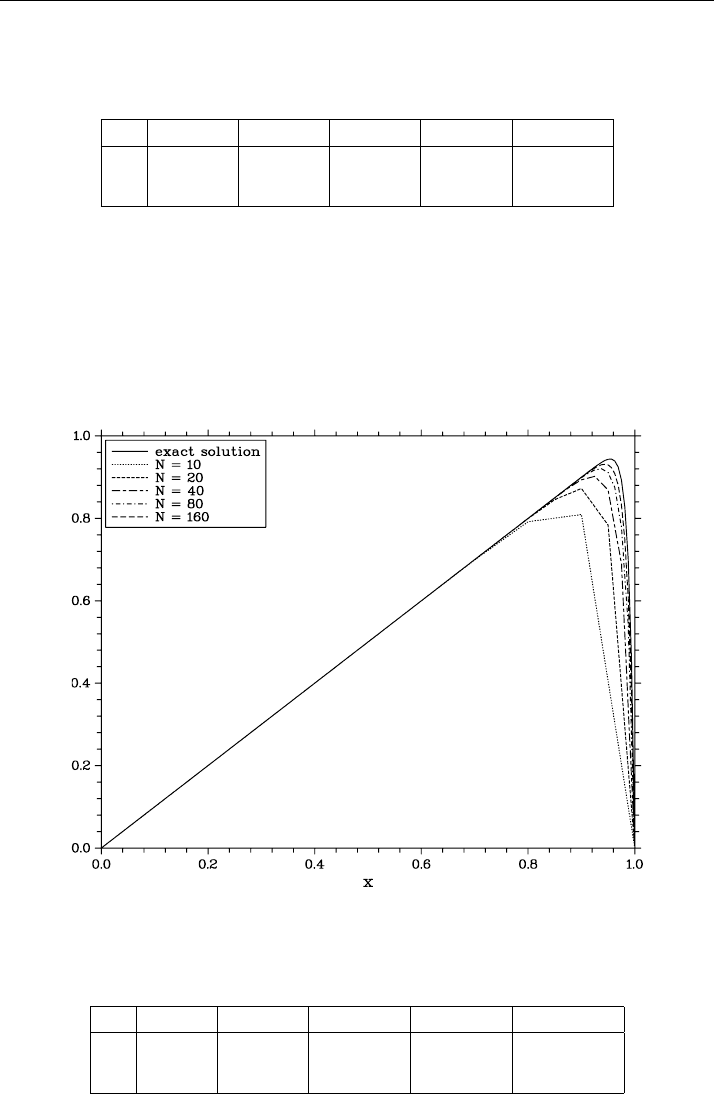
Table 2.1 shows data obtained for the convection-controlled problem (κ = 0.01)
solved by scheme (2.72).
N 10 20 40 80 160
C 0.1599 0.2036 0.1579 0.09219 0.05070
L
2
0.03631 0.03451 0.02339 0.01340 0.007199
Table 2.1 Accuracy of the scheme with directed differences
Theoretical conclusions about the convergence behavior of the schemes with the
grid step tending to zero find confirmation here. The scheme with directed differences
converges with the first order but, in the case of interest, this asymptotic convergence
is achieved with sufficiently fine grids (starting from the grid with N = 80). Figure 2.3
shows plots of the approximate solution.
Figure 2.3 Approximate solution (scheme with directed differences)
Analogous data obtained for scheme (2.70) are given in Table 2.2.
N 10 20 40 80 160
C 0.4353 0.1932 0.05574 0.01212 0.003003
L
2
0.1074 0.03056 0.007142 0.001677 0.0004062
Table 2.2 Accuracy of the scheme with central-difference approximations
Section 2.5 Exercises 45
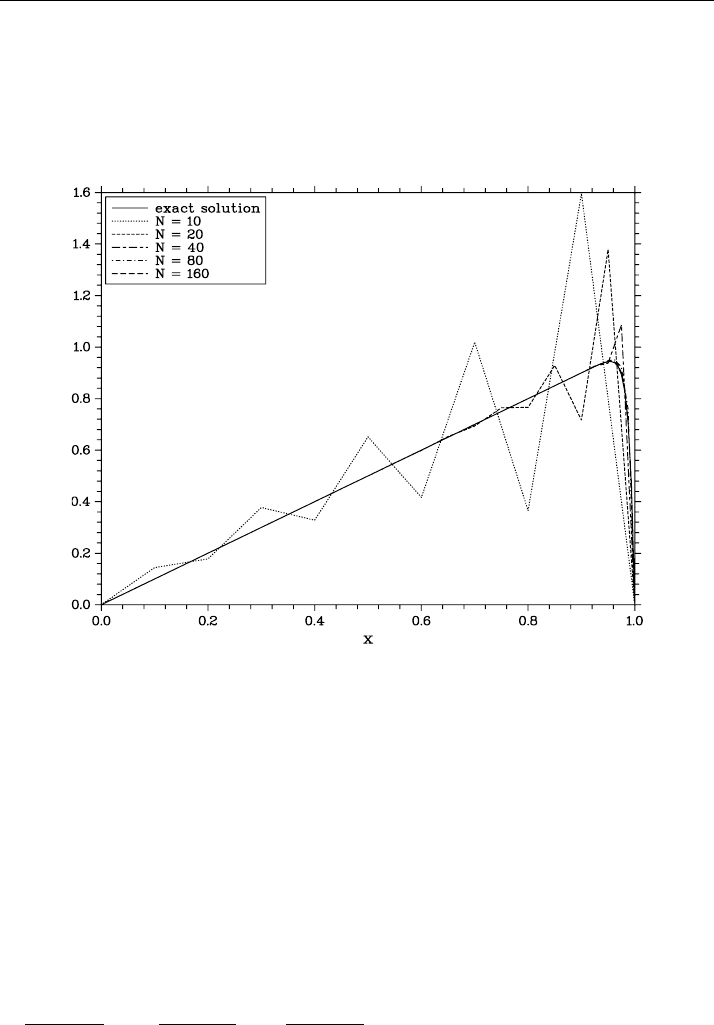
The inaccuracy decreases approximately fourfold on the twofold refined grid
(second-order convergence). It should be noted that, in this example, the condition
for monotonicity (2.71) becomes violated on grids with N = 10, 20, 40. Violation
of this condition results in a substantially distorted solution behavior (see Figure 2.4).
We may even say that, here, non-monotone schemes cannot be used.
Figure 2.4 Scheme with central-difference approximations
2.5 Exercises
Exercise 2.1 On the solutions of equation (2.1), approximate the third-kind boundary
conditions (2.4) accurate to the second order.
Exercise 2.2 On the non-uniform grid
¯ω ={x | x = x
i
= x
i−1
+ h
i
, i = 1, 2,...,N , x
0
= 0, x
N
= l}
construct and examine the difference scheme
−
2
h
i+1
+ h
i
a
i+1
y
i+1
− y
i
h
i+1
− a
i
y
i
− y
i−1
h
i
+ c
i
y
i
= ϕ
i
, i = 1, 2,...,N − 1,
y
0
= μ
1
, y
N
= μ
2
making it possible to solve approximately problem (2.1), (2.2).