
Ahmed S.N. Physics and Engineering of Radiation Detection
Подождите немного. Документ загружается.


536 Chapter 9. Essential Statistics for Data Analysis
quoting h and h might not be sufficient and one should present the distribution
function plot as well.
Up until now we have assumed that the likelihood function is described by a
single variable h.Ifwehavek number of parameters instead, we will have to solve
the following k simultaneous equations to find the maximum likelihood solution.
∂ ln L(h
1
,h
2
, ..., h
k
)
∂h
i
h
i
=h
∗
i
= 0 (9.3.23)
Now that we know what maximum likelihood function is, what do we do with it?
Well, to do any Maximum likelihood analysis we first need a probability distribution
function. In the next section we will look at some commonly used distribution
functions and employ the Maximum likelihood methodology to draw inferences about
them.
9.3.D Some Common Distribution Functions
D.1 Binomial Distribution
The binomial distribution can be used to determine the probability of r successes
out of N outcomes of an experiment and is defined by
f(r; N,p)=
N!
r!(N − r)!
p
r
(1 − p)
N−r
, (9.3.24)
with r =0, 1, ..., N and 0 ≤ p ≤ 1.
The events must be random, mutually exclusive, and independent, which in sim-
ple terms essentially means that the occurrence of one event should not influence
the outcome of the next. The outcome of an experiment describable by binomial
distribution has only two possible outcomes, such as getting head or tails when a
coin is flipped or detecting or failing to detect a particle when it passes through the
active medium of a detector. This means that if the probability of getting an event
is p then probability of not seeing the event would simply be (1 − p).
Let us now write the likelihood function for the occurrence of an event and then
try to calculate its most probable value and the corresponding error. The likelihood
function for a continuous variable p that follows binomial distribution can be written
as
L(p)=
N!
r!(N − r)!
p
r
(1 − p)
N−r
. (9.3.25)
To compute the most probable value p
∗
of p, we take the derivative of its natural
logarithm with respect to p and then equate it to zero (see equation 9.3.21). First
we take the logarithm of the function keeping in view that we are only interested in
evaluating terms that explicitly contain p.
ln L(p)=ln
N!
r!(N − r)!
p
r
(1 − p)
N−r
= r ln(p)+(N − r)ln(1−p)+ln
N!
r!(N − r)!
(9.3.26)
The derivative of this with respect to p is
∂ ln(L)
∂p
=
r
p
−
N − r
1 − p
. (9.3.27)

9.3. Probability 537
Hence maximum of ln(L)atp
∗
is
r
p
∗
+
N − r
1 − p
∗
=0
⇒ p
∗
=
r
N
. (9.3.28)
Now in order to evaluate the error in p
∗
we differentiate again equation 9.3.27 with
respect to p to get
∂
2
ln(L)
∂p
2
=
r
p
2
−
N − r
(1 − p)
2
(9.3.29)
According to equation 9.3.22, the error in p
∗
is then given by
p =
−∂
2
ln(L)
∂p
2
−1/2
=
r
p
∗2
+
N − r
(1 − p
∗
)
2
−1/2
=
p
∗
(1 − p
∗
)
N
1/2
, (9.3.30)
where we have used r = p
∗
N.
D.2 Poisson Distribution
Poisson distribution represents the distribution of Poisson processes and is in fact
a limiting case of the Binomial distribution. By Poisson processes we mean the
processes that are discrete, independent and mutually exclusive.
The p.d.f. of a Poisson distribution is defined as
f(x; µ)=
µ
x
e
−µ
x!
, (9.3.31)
with x =0, 1, .... represents the discrete random variable, such as ADC counts
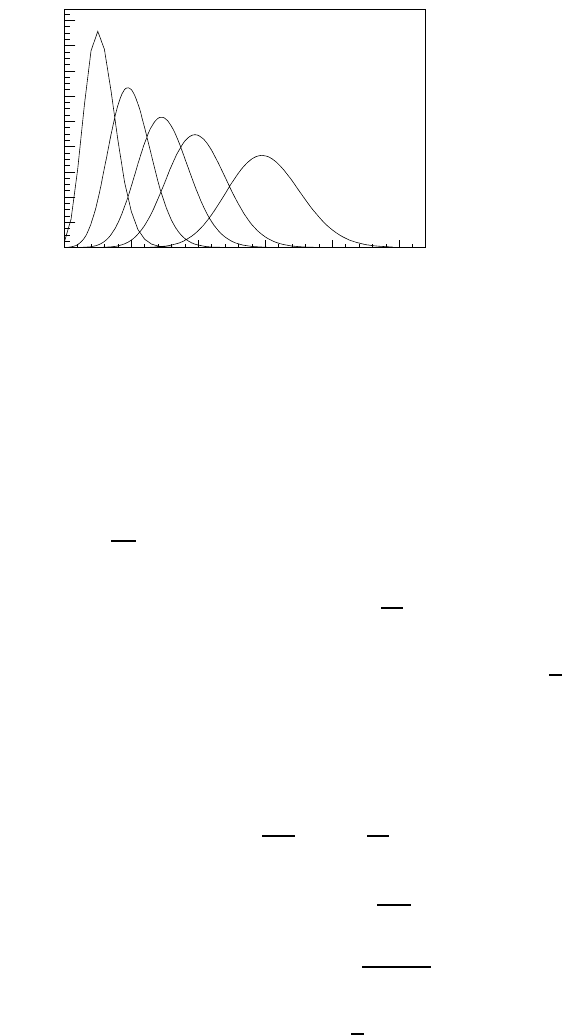
obtained from a detection system and µ>0 is the mean. Fig.9.3.3 depicts this
distribution for different values of µ. It is apparent that the width of the distribution
increases with µ, which indicates that the uncertainty in measurement increases with
an increase in the value of x.
Let us now apply the maximum likelihood method to determine the best estimate
of mean of a set of n measurements assuming that the underlying process is Pois-
son in nature. The best way to do this is to use the maximum likelihood method
we outlined earlier and applied in the previous section while discussing the Bino-
mial distribution. Since Poisson distribution is a discrete probability distribution
therefore its likelihood function for a set of n measurements can be written as
L(µ)=
n
#
i=1
f(x
i
,µ)
=
n
#
i=1
µ
x
i
e
−µ
x
i
!
=
µ
P
x
i
e
−nµ
x
1
!x
2
!...x
n
!
(9.3.32)
538 Chapter 9. Essential Statistics for Data Analysis
x
0 1020304050
f
0
0.02
0.04
0.06
0.08
0.1
0.12
0.14
0.16
0.18
=5.5µ
=10µ
=15µ
=30µ
=20µ
Figure 9.3.3: Poisson probabil-
ity density for different values of
µ. The width of the distribu-
tion, a reflection of the uncer-
tainty in the measurement, in-
creases with increase in µ.
The log likelihood function of L(µ)is
l ≡ ln(L)=
n
i=1
x
i
ln(µ) − nµ − ln(x
1
!x
2
!...x
n
!). (9.3.33)
Following the maximum likelihood method (∂l/∂µ =0)weget
∂
∂µ
n
i=1
x
i
ln(µ) − nµ − ln(x
1
!x
2
!...x
n
!)
=0
1
µ
∗
n
i=1
x
i
− n =0
µ
∗
=
1
n
n
i=1
x
i
. (9.3.34)
This shows that the simple mean is the most probable value of a Poisson distributed
variable. To determine the error in µ, we fist take second derivative of the log
likelihood function and then substitute it in equation 9.3.22.
∂
2
l
∂µ
2
= −
1
µ
2
n
i=1
x
i
µ =
−
∂
2
l
∂µ
2
−1/2
=
µ
∗2
$
n
i=1
x
i
1/2
=
1
n
n
i=1
x
i
1/2
(9.3.35)
This is one of the most useful results of the Poisson distribution. It implies that if
we make one measurement, the statistical error we should expect in it would simply

9.3. Probability 539
be the square root of the measured quantity. For example, if we count the number of
γ-ray photons coming from a radioactive source using a GM-tube and get a number
N, the statistical error we should expect will simply be
√
N. Fortunately, most of
the processes we encounter in the field of radiation detection and measurement, such
as activity of a radioisotope, photoelectric effect, and electron multiplication in a
PMT tube, can all very well be described by Poisson statistics.
D.3 Normal or Gaussian Distribution
The normal distribution was originally developed as an approximation to the bi-
nomial distribution. Its usefulness was soon recognized by scientists and soon it
became one of the most commonly used probability distributions in not only these
fields but also in other sciences. The utility of normal distribution can be appre-
ciated by noting an amazing property of most of the physical processes that their
random variables can be safely approximated to be distributed normally. Therefore
a common practice is to assume that a random variable having unknown distribu-
tion can be defined by a normal distribution. This property of random variables
is actually the result of the so called central limit theorem, which states that the
mean of any set of variables with any distribution tend to the normal distribution
provided their mean and variance are finite. Although the term normal distribution
is very commonly used, still some scientists prefer to call it Gaussian distribution.
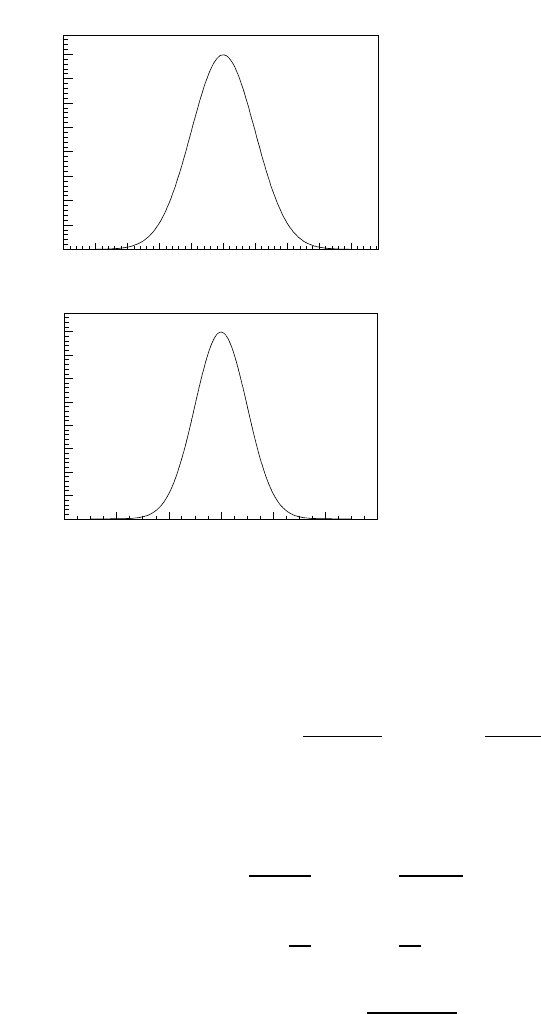
Gaussian distribution has a bell-shaped curve (see Fig.9.3.4) and is defined for a
variable x in the domain x ∈ (−∞, ∞)by
f(µ; x)=
1
σ
√
2π
e
−(x−µ)
2
/2σ
2
, (9.3.36)
where µ and σ are the mean and standard deviation of the distribution respectively.
Both µ and σ are finite for a normally distributed variable.
If we substitute µ =0andσ
2
= 1 in the above equation, we obtain the so called
standard normal distribution with a probability density function given by
P (x)=
1
√
2π
e
−x
2
/2
. (9.3.37)
This is simply a special kind of Gaussian distribution having a symmetric bell shaped
curve centered at x = 0 (see Fig.9.3.4). In fact by changing the variables, any
normal distribution can be easily converted into a standard normal distribution (see
Example below).
Let us now apply our maximum likelihood method to compute the most probable
value and its accuracy assuming the variable to be Gaussian distributed. Suppose
we make N measurements of a variable and represent the result by x
i
.Eachofthese
measurements will have its own error σ
i
. Then according to equation 9.3.19, the
likelihood function is given by
L(µ)=
N
#
i=1
1
σ
i
√
2π
e
−(x
i
−µ)
2
/2σ
2
i
(9.3.38)
In order to apply the condition 9.3.23, we rewrite the above equation in the form
L(µ)=
N
#
i=1
(e
−(x
i
−µ)
2
/2σ
2
i
)(σ
−1
i
)(2π)
−1/2
(9.3.39)
540 Chapter 9. Essential Statistics for Data Analysis
x
0 5 10 15 20 25 30 35 40 45
f
0
0.01
0.02
0.03
0.04
0.05
0.06
0.07
0.08
x
-4 -2 0 2 4
f
0
0.05
0.1
0.15
0.2
0.25
0.3
0.35
0.4
Figure 9.3.4: (a) Gaussian dis-
tribution for µ =25andσ =
5. (b) Standard normal distri-
bution having µ =0andσ =
1. With proper change of scale,
any Gaussian distribution can be
transformed into a standard nor-
mal distribution.
Taking the natural logarithm of both sides of this equation gives
ln(L)=
N
i=1
−
(x
i
−µ)
2
2σ
2
i
− ln(σ
i
) −
ln(2π)
2
. (9.3.40)
The maximum likelihood solution is then obtained by differentiating this equation
with respect to µ and equating the result to zero. Hence we get
∂ ln(L)
∂µ
∗
=
N
i=1
x
i
− µ
∗
σ
2
i
= 0 (9.3.41)
⇒
N
i=1
µ
∗
σ
2
i
=
N
i=1
x
i
σ
2
i
⇒ µ
∗
=
$
N
i=1
w
i
x
i
$
N
i=1
w
i
, (9.3.42)
where w
i
=1/σ
2
i
. Hence the most probable value is simply the weighted mean with
respective inverse variances or errors as weights. If we assume that each measure-
ment has the same amount of uncertainty or error then using σ
i
= σ the maximum

9.3. Probability 541
likelihood solution will become
µ
∗
=
$
N
i=1
x
i
/σ
$
N
i=1
(1/σ)
=
1
N
N
i=1
x
i
, (9.3.43)
which is nothing but the expression for calculating simple mean. Hence we have
found that calculating mean by this method require that the variable is distributed
normally and that each measurement has the same error associated with it. Measur-
ing activity of a radioactive source falls into this category provided all the conditions
including the state of the detector does not change with time.
Let us now try to calculate the error in the calculation of the solution we just
obtained. Note that we are interested in finding out the spread of µ about µ
∗
and not
the errors in individual measurements. To do this we make use of the argument that
for large number of measurements (N →∞), L(µ) approaches a normal distribution.
Hence we can write
L(µ)=
1
σ
t
√
2π
e
−(µ−µ
∗
)
2
/2σ
2
t
(9.3.44)
.
Here the subscript t in σ
t
is meant to differentiate the standard deviation of µ from
that of x. Again the condition 9.3.23 can be used to obtain the maximum likelihood
solution for this distribution. We first take the natural logarithm of both sides of
the above equation to obtain
ln(L)=ln
e
−(µ−µ
∗
)
2
/2σ
2
t
(σ
t
)
−1
(2π)
−1/2
= −
(µ − µ
∗
)
2
2σ
2
t
−ln(σ
t
) −
ln(2π)
2
. (9.3.45)
Differentiating this twice with respect to µ
∗
gives
∂ ln(L)
∂µ
∗
=
µ − µ
∗
σ
2
t
⇒
∂
2
ln(L)
∂µ
∗2
= −
1
σ
2
t
. (9.3.46)
Hence the error in calculation of µ,isgivenby
µ = σ
t
=
−
∂
2
ln(L)
∂µ
∗2
−1/2
. (9.3.47)
This general expression for computing errors is of central importance in likelihood
method and is extensively used in data analysis. Let us now use this expression to
derive the expression for the total error in measurements when each measurement
is characterized by its own error σ
i
. This can be done by differentiating equation

542 Chapter 9. Essential Statistics for Data Analysis
9.3.41 again with respect to µ
∗
and substituting the result in the above expression.
∂
2
L
∂µ
2
= −
N
i=1
1
σ
2
i
⇒
1
σ
2
t
=
N
i=1
1
σ
2
i
(9.3.48)
This expression represents the law of combination of errors, which states that for
repeated measurements of a normally distributed variable having errors σ
i
,thein-
verse of the total error in the calculation of mean is equal to the sum of inverse of
individual measurement errors.
Unfortunately, in a number of practical problems, an analytic determination of
µ is not possible. In such cases one tries to find the value of the likelihood function
at each point by iterating µ (or more accurately, by trying different values of µ).
The points thus obtained are then plotted and the likelihood function is obtained
by performing the best fit through the points. In most cases with large number of
data points the likelihood function is Gaussian like. If it isn’t, one must perform a
weighted average to determine the error function, that is
%
∂
2
ln(L)
∂µ
2
&
=
∂
2
ln(L)
∂µ
2
Ldµ
Ldµ
. (9.3.49)
This is an important relation since it can be used to show that (see problems at the
end of the chapter) the maximum likelihood error in µ can be evaluated from
µ =
1
N
1
L
∂L
∂µ
2
dx
1/2
, (9.3.50)
where N is the number of measurements. An interesting aspect of this result is
that it allows one to determine the number of measurements necessary to obtain a
particular value of the parameter µ with a certain accuracy, that is
N =
1
(µ)
2
1
L
∂L
∂µ
2
dx. (9.3.51)
D.4 Chi-Square (χ
2
) Distribution
χ
2
-distribution is one of the most extensively used probability distributions to per-
form goodness-of-fit tests, which we will discuss later in the chapter. It is defined as
f(x; n)=
x
n/2−1
e
−x/2
2
n/2
Γ(n/2)
, (9.3.52)
where in order to avoid confusion due to the exponent 2 of χ
2
we have represented it
by x. Γ() is the gamma function and x ≥ 0. The tables as well as analytical forms of
gamma functions can be found in standard texts of statistics and mathematics. The
parameter n in the above definition is called the degrees of freedom of the system.
The meaning of this term can be understood by looking at the definition of x or χ
2
.
9.3. Probability 543
Suppose we have m independent normally distributed random variables u
i
having
theoretical means µ
i
and variances σ
2
i
. χ
2
is then defined as
χ
2
≡ x =
m
i=1
(u
i
− µ
i
)
2
σ
2
i
. (9.3.53)
The parameter n in the definition of the χ
2
probability distribution is then related to
the number of independent variables in this equation. For large n the χ
2
distribution
reduces to the Gaussian distribution with mean µ = n and variance σ
2
=2n.
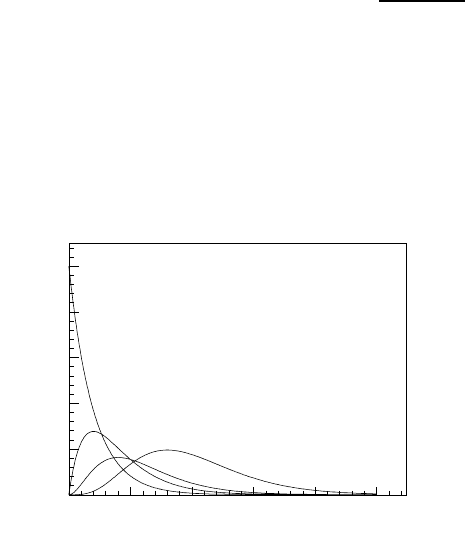
Fig.9.3.5 shows the shapes of the chi-square distribution for different degrees of
freedom. As n increases, the distribution assumes a shape that becomes more and
more like a Gaussian or normal distribution.
x
0 5 10 15 20 25
f
0
0.1
0.2
0.3
0.4
0.5
n=2
n=5
n=7
n=10
Figure 9.3.5: χ
2
probability den-
sity functions for different degrees
of freedom n. The shape of the
distribution approaches that of
a Gaussian distribution with in-
creasing n.
To understand the utility of this distribution function, let us have a closer look
at the definition 9.3.53. The numerator in this equation represents the deviations of
the normally distributed variable u
i
from its theoretical means at each data point
while the denominator represents its expected standard deviations. In other words
the numerator and denominator are the actual and expected deviations respectively.
If the data u
i
is really Gaussian distributed, then ideally the actual deviation should
be equal to the expected one. However in real data there are always fluctuations
and consequently these deviations are not equal. The χ
2
probability density function
9.3.52 actually tells us how the probability of this deviation is distributed. Hence
this distribution function can be used to judge the data against a hypothetical mean.
We will learn more about this when we discuss the goodness-of-fit tests later in the
chapter.
D.5 Student’s t Distribution
Student’s t distribution is a widely used probability distribution. It forms the ba-
sis of Student’s t-test, which we will discuss later in the chapter. To define this
544 Chapter 9. Essential Statistics for Data Analysis
distribution, let us first write
z =
n
i=1
x
2
i
and t =
x
z/n
,
for n independent Gaussian variables having 0 mean and 1 variance. The variable
z in this expression follows the χ
2
-distribution we defined above and the variable t
follows Student’s t distribution with n degrees of freedom defined by
f(t; n)=
1
√
nπ
Γ[(n +1)/2]
Γ(n/2)
1+
t
2
n
−(n+1)/2
, (9.3.54)
where Γ is the familiar gamma function, the variable t can take any value (−∞ <
t<∞), and n can be a non-integer.
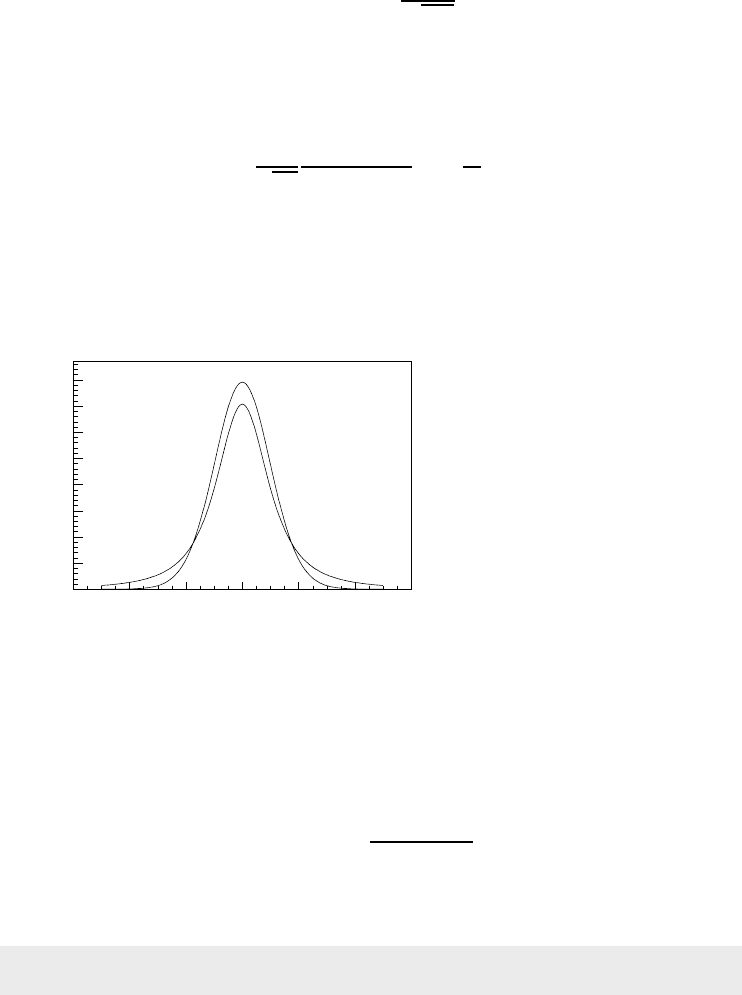
The Student’s t distribution looks very similar to Gaussian distribution. For
small n, however it has wider tails, which approach that of a Gaussian distribution
with increasing n.
x
-4 -2 0 2 4
f
0
0.05
0.1
0.15
0.2
0.25
0.3
0.35
0.4
n=2
n=30
Figure 9.3.6: Student’s t distri-
bution for two values of degrees
of freedom n.Asn increases
the tails of the distribution ap-
proaches that of a Gaussian dis-
tribution.
D.6 Gamma Distribution
For a Poisson process the distance in x from any starting point to the k
t
h event
follows Gamma distribution given by
f(x; λ, k)=
x
k−1
λ
k
e
−λx
Γ(k)
, (9.3.55)
with 0 <t<∞ and k can be a noninteger.
For λ =1/2andk = n/2 it reduces to the χ
2
-distribution we defined above.
Using Maximum Likelihood Method

9.3. Probability 545
Now that we have learned all the basics of maximum likelihood methodology, we
are ready to use it in practical situations. By practical situations we mean the real
cases corresponding to distributions that are not perfectly described by the standard
distribution functions we just studied. Let us suppose we have a variable x,whose
probability distribution function can be written as
p(x, k)=ke
−kt
,
where k is a constant. Suppose we take 4 measurements of the parameter t: t =
12, 14, 11, 12. What we want to do is to use the maximum likelihood method to
compute the value of the constant k. To do this we first need to determine the
maximum likelihood function. According to equation 9.3.19, this is give by
L(k)=
4
#
i=1
ke
−kt
i
= e
−k
4
(t
1
+t
2
+t
3
+t
4
)
= k
4
e
−49k
.
Now we take the natural logarithm of this function.
ln(L)=4ln(k) − 49k
According to the maximum likelihood method, differentiating the above function
with respect to k and equation the result to zero gives the required maximum like-
lihood estimate of k.
∂ ln(L)
∂k
=0
⇒
4
k
− 49 = 0
⇒ k =
4
49
.
Let us now look at another example. This time we want to know how many
measurements we must make so that the parameter k =0.21 of the distribution
f(x, k)=kx ; x ∈ (0, 1),
can be determined with an accuracy of 5%. That is, the relative error in k =0.21
is
k
k
=0.05. (9.3.56)
This can easily be done by using equation 9.3.51, which for our case becomes
N =
1
(k)
2
1
0
1
f
∂f
∂k
2
dx.