
Alkauskas A., Deak P., Neugebauer J., Pasquarello A., Van de Walle Ch.G. (Eds.) Advanced Calculations for Defects in Materials: Electronic Structure Methods
Подождите немного. Документ загружается.

is difficult to achieve anion site shallow acceptors for the oxides. Recent experiments,
however, have demonstrated good p-type conductivity for As, as well as p-doped ZnO.
However, theoretical studies revealed that As impurities actually occupy Zn antisites,
forming As
Zn
þ 2V
Zn
complexes [36]. The real contribution to the p-type conduc-
tivity is from V
Zn
. The ionization energy is reduced due to the interaction between
V
Zn
and As
Zn
.
According to the above discussion, Group-Ia (Li, Na) and Group-Ib (Cu, Ag)
elements may be better choices for producing p-type ZnO. So far, only doping with
Group-Ia elements has been studied extensively. There are very few studies on doping
of ZnO with Group-Ib elements. However, very few p-type ZnO films have been
achieved using Group-Ia elements as dopant. Theoretical studies have revealed the
possible reasons for the difficulty. Substitutional Group-Ia elements (Li and Na) at T
d
sites are indeed shallow acceptors [33]. However, when the Fermi energy is close to
the VBM, Group-Ia elements prefer to occupy the interstitial sites in ZnO, which are
electron donors. As a result, Group-Ia elements fail to dope ZnO p-type. The reason
why Li and Na prefer the interstitial sites rather than substitutional sites is largely due
to the low ionization energies of the valence s electron and large size mismatch of ions
of the Group-Ia elements. Such mismatches are much less for Group-Ib elements.
Thus, Group-Ib elements may be better candidates than Group-Ia elements for p-type
ZnO doping. Therefore, we have studied the doping effect with Group-Ib elements in
ZnO.
Our electronic structure calculations have revealed that Cu, Ag, or Au occupying
a Zn site creates a single-acceptor state above the VBM of ZnO. Our calculated GGA
transition energies e (0/) are at about 0.7, 0.4, and 0.5 eV above the VBM for Cu
Zn
,
Ag
Zn
, and Au
Zn
, respectively [20]. These results indicate that (i) the acceptor level
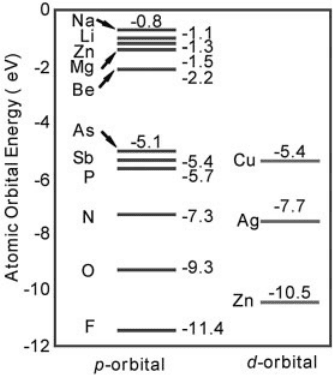
Figure 13.10 (online colour at: www.pss-b.com) LDA-calculated valence p and d energy levels of
neutral atom to show the general chemical trends.
13.5 Approaches to Overcome the Doping Limit
j
227
created by Ag
Zn
is shallower than the acceptor levels created by Cu and Au and (ii) the
transition energies for the substitutional Group-Ib elements are much deeper than
that of the substitutional Group-Ia elements. The reason for (ii) can be understood
as the following: The substitutional elements induced acceptor level is derived mostly
from the VBM state, which has the anion p and cation d characters. For Group-Ib
elements, their occupied d orbital energies are near the oxygen p level. Because both
the O, p and the Group-Ib d orbitals have the same t
2
symmetry in the tetrahedral
environment, there is strong p–d repulsion between the two levels, pushing the
acceptor levels higher. On the other hand, Group-Ia elements have no active valence d
orbitals, so their defect levels are shallower than the Group-Ib substitutional defects.
Among the three Group-Ib elements, Ag has the largest size and lowest atomic d
orbital energy, so the p–d repulsion is the weakest. This explains why Ag
Zn
has the
lowest transition energy level among the three Group-Ib elements.
As we discussed above, although the Group-Ia substitutional acceptor levels are
shallower, the Group-Ia elements prefer to occupy interstitial sites in p-type ZnO
samples, forming shallow donors. In this case, p-type ZnO cannot be realized due to
strong self-compensation. Thus, we have also calculated the formation energy of the
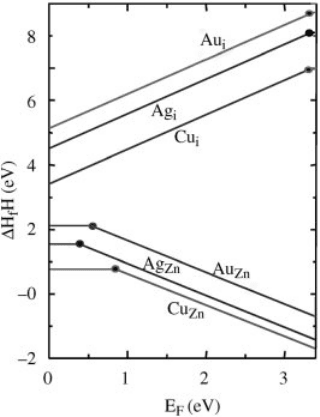
Group-Ib dopants at interstitial sites. Figure 13.11 shows the defect formation
energies as a function of the Fermi level calculated under the oxygen-rich condition
for Group-Ib elements at different sites. The solid dots indicate the transition energy
level positions for substitutional Cu, Ag, and Au. We find that the self-compensation
is very small with Group-Ib elements in ZnO. This is because Group-Ib elements do
not prefer to occupy the interstitial sites, even when the Fermi level is close to the
Figure 13.11 (online colour at: www.pss-b.com) Calculated formation energies as a function of
Fermi level for Group-Ib elements in ZnO.
228
j
13 Overcoming Bipolar Doping Difficulty in Wide Gap Semiconductors
VBM. Our calculations reveal that Group-Ib elements may be better candidates than
the Group-Ia elements for p-type doping of ZnO.
Our calculations revealed that the acceptor levels created by Group-Ib elements are
not very shallow. However, because the formation energies of the substitutional
Group-Ib elements in ZnO are very low at the O-rich conditions, a high concentration
of dopants can be easily achieved. At this growth condition, the compensation by
intrinsic donor defects can be effectively suppressed. Therefore, p-type doping
in ZnO could still be achieved with these elements, especially for Ag doping. It is
important to point out that the calculated (0/) transition energy level for Ag
Zn
is
comparable to the calculated (0/) transition energy for N
O
, which is currently one of
the most favorable dopants for p-type doping in ZnO. For N doping, ZnO thin films
should be grown under an O-poor condition to incorporate N efficiently at O sites.
This growth condition also promotes the formation of hole-killer defects, such as O
vacancies and Zn and N interstitials. On the other hand, for incorporating Ag at Zn
sites, the growth should be done at an O-rich condition, which suppresses the
formation of major hole-killer defects. In addition, self-compensation can also be
avoided for Ag doping. Therefore, our results suggest that Ag may be a better dopant
than N for p-type doping in ZnO, especially when it is combined with passivating
donors to form defect complexes (see Section 13.5.5 below). Our conclusion is
supported by recent experiment results on p-type ZnO thin films with Ag and Cu
dopants [37].
13.5.5
Reduction of Transition Energy Levels
To reduce the acceptor transition energy level in ZnO, co-doping or cluster doping has
been proposed [38]. In conventional co-doping, two single acceptors (e.g., N
O
) are
combined with a single donor (e.g., Ga
Zn
) to form an acceptor defect complex. It is
expected that through donor–acceptor level repulsion, shallow acceptor levels can be
created. However, detailed theoretical analyses show that for direct-band gap semi-
conductors such as ZnO, the reduction of this type of conventional co-doping on the
ionization energy is rather small. This is because the donor and acceptor levels
usually have different symmetries and wave-function characters: the donor state has
the s-like a
1
character, whereas the acceptor has the p-like t
2
character. Furthermore,
in the case of two acceptors plus one donor (e.g., 2N
O
þ Ga
Zn
), because the two
acceptors are forced to be fcc (or hcp in the wurtzite structure) nearest neighbors, the
acceptor–acceptor level repulsion can even raise the ionization energy [23].
To avoid the problem discussed above, we have explored a different and novel idea
in which a fully occupied deep donor is used to attract a second partially occupied
donor to lower its ionization energy [16]. In particular, we studied a double donor
(either Si, Ge, or Sn on the Zn site) paired with a single donor (either F, Cl, Br, or I on
the Te site) in ZnTe. Different from the Coulomb binding that exists in charged
donor–acceptor complexes in the co-doping approach the binding between the two
donors results from the level repulsion between the two donor states (Figure 13.12).
The level repulsion significantly reduces the energy of the fully occupied lower level,
13.5 Approaches to Overcome the Doping Limit
j
229
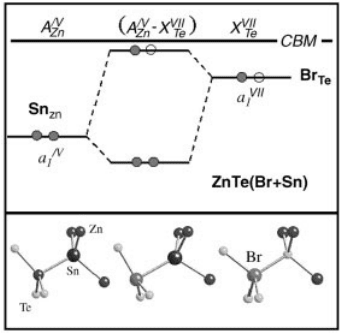
stabilizing the donor–donor pair, while it increases the energy of the partially
occupied upper level, thus reducing the ionization energy. Notice that because the
doubly occupied a
1
IV
-derived state is charge neutral, there is no Coulomb repulsion
between the two nominally donor impurities. Furthermore, because the two donor
states have the same symmetry and atomic character the level repulsion is very
efficient. For example, we find that the formation of a Br
Te
–Sn
Zn
pair in ZnTe is
exothermic with a binding energy of 0.9 eV. It lowers the electron ionization energy of
Br
Te
by a factor of more than three from 240 to 70 meV, resulting in an effective
shallow donor. Similar idea has also been proposed to enhance n-type doping in
diamond [17]. Recently Kim and Park [18] have also suggested that the same idea can
be applied to explain oxygen vacancy assisted n-type doping in ZnO by forming
Zn
i
–V
O
paire to lower the formation energy and transition energy levels of Zn
i
in ZnO.
We have also proposed two approaches to reduce the ionization energy in p-type
doping of ZnO [21]. The proposals are based on the following considerations: (i) as
discussed in the previous section, to lower the ionization level, one should find
a dopant with low valence p orbital energy (more electronegative), preferably at
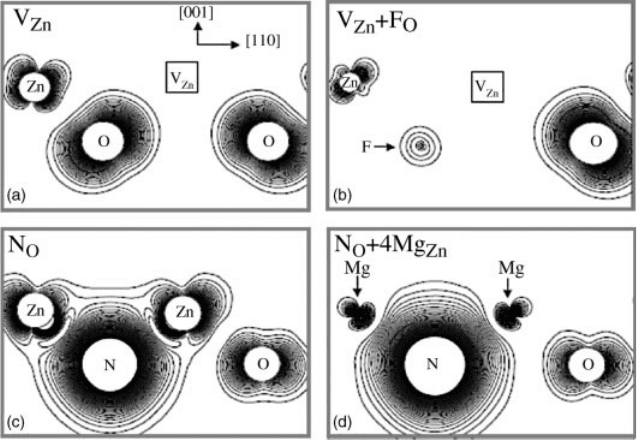
the anion site. Because the wave function of the V
Zn
has a large distribution on the
neighboring O atomic sites (Figure 13.13a), replacing one of the neighboring O
atoms by the more electronegative F (the F 2p level is 2.1 eV lower in energy than the
O 2p level, see Figure 13.10) is expected to reduce the energy level of V
Zn
. The binding
energy between the F
O
single donor and the V
Zn
double acceptor is also expected to be
large. Furthermore, this defect complex pair V
Zn
þ F
O
contains only one acceptor, so
there will be no acceptor–acceptor repulsion to raise the ionization level; and (ii) we
notice that one of the reasons that the N
O
defect level is deep in ZnO is because the
N 2p level strongly couples to the nearest-neighbor Zn 3d orbitals (Figure 13.13c),
Figure 13.12 (online colour at: www.pss-b.com) Illustration of the interaction between the single
donor and the double donor states associated with Br
Te
and Sn
Zn
in the formation of complexes
Br
Te
–Sn
Zn
in ZnTe.
230
j
13 Overcoming Bipolar Doping Difficulty in Wide Gap Semiconductors
which both have t
2
symmetry in this tetrahedron environment. If we can replace the
Zn atom by an isovalent Mg atom that has a similar atomic size as Zn but no occupied
d orbital, the defect transition energy level of N
O
þ nMg
Zn
should be lower than that
of N
O
in ZnO. The effect should be most efficient for n ¼4, when the tetrahedral
environment around N
O
is preserved and no level splitting occurs.
Figure 13.13b shows the charge density plot of the V
Zn
þ F
O
defect level. When F
is introduced, it creates defect levels inside the valence band, removing one of the
oxygen dangling-bond contributions to the acceptor level and making the transition
energy lower. The calculated (0/) transition energy level of V
Zn
þ F
O
is 0.16 eV,
which is much smaller than the corresponding (/2) transition energy level of V
Zn
at 0.34 eV. It is also lower in energy than the (0/) transition energy level of V
Zn
at
0.18 eV. The calculated V
Zn
þ F
O
binding energy is 2.3 eV, indicating that the
defect pair is very stable with respect to the isolated defects. This large binding energy
can be understood by noticing that to form the defect complex, F
O
donates one of its
electrons to V
Zn
, which results in a large Coulomb interaction between V
Zn
and F
þ
O
.
Based on this study, we believe that adding a small amount of F in ZnO to form
aV
Zn
þ F
O
defect pair is beneficial to p-type doping in ZnO. However, we also want
to point out that F
O
itself is a donor, so too much F
O
(more than the amount of V
Zn
)in
the sample can over compensate the acceptors.
Figure 13.13d shows the defect level charge density of N
O
þ 4Mg
Zn
. Compared to
N
O
þ 4Zn
Zn
, we see that the cation d character is removed and the defect level is
more localized on the N atomic site. The calculated (0/) transition energies are
0.29 eV for N
O
þ Mg
Zn
and 0.23 eV for N
O
þ 4Mg
Zn
eV, shallower than that for N
O
.
Figure 13.13 (online colour at: www.pss-b.com) Charge density plot of defect levels in ZnO:
(a) V
Zn
, (b) V
Zn
þ F
O
, (c) N
O
, and (d) N
O
þ 4Mg
Zn
.
13.5 Approaches to Overcome the Doping Limit
j
231
However, the calculated binding energy for N
O
þ Mg
Zn
is positive at 0.3 eV,
indicating that N does not like to bind with Mg in ZnO. This is because the NZn
bond is stronger than the NMg bond. Our calculations show that both NZn and
MgO bonds are shorter than the ZnO bond, but the NMg bond length is longer
than the ZnO bond length. However, for ZnMgO alloys with relatively high Mg
concentrations, the opportunity to form N
O
þ nMg
Zn
is reasonably high due to the
entropy contribution. Furthermore, the VBM of the ZnMgO alloys is similar to that
of ZnO, because the wave function is more localized on the ZnO region. This may
explain why some ZnMgO alloys can be doped p-type [39]. Further lowering of the
acceptor transition energy level is expected if we replace Mg by Be, because the Be
2p orbital energy is much lower than the 3p orbital of Mg (Figure 13.10). Indeed, we
find that the (0/) transition energy levels of N
O
þ Be
Zn
and N
O
þ 4Be
Zn
are at 0.22
and 0.12 eV, respectively.
Other successful co-doping schemes include the one demonstrated by
Limpijumnong et al. [36] who show that As
Zn
–2V
Zn
in ZnO creates relatively shallow
acceptor levels. In this complex, the shallow acceptor level is realized because the two
V
Zn
acceptors are connected by the As
Zn
(or P
Zn
) antisite donor through a cation
sublattice; so the separation between the two V
Zn
is large and the level repulsion
between them is weak.
13.5.6
Universal Approaches Through Impurity-Band Doping
We recently proposed a universal approach to overcome the long-standing doping
polarity problem for WBG semiconductors [22]. The approach is to reduce the
ionization energies of dopants and the spontaneous compensation from intrinsic
defects by creating a passivated impurity band, which can be achieved by introducing
passivated donor–acceptor complexes or isovalent impurities. In this case, the
ionization energy is reduced by shifting the band edge through the impurity band,
which is higher than the VBM or lower than the CBM, rather than through the
shifting of defect energy levels. When the same element is used to create the impurity
band and as dopant, the ionization energy is always small. Furthermore, due to
a smaller Fermi level shift, charge compensation is also reduced. Our density-
functional theory calculations demonstrate that this approach provides excellent
explanations for the available experimental data of n-type doping of diamond and
p-type doping of ZnO, which could not be understood by previous theories. In
principle, this universal approach can be applied to any WBG semiconductors, and
therefore, it will open a broad vista for the use of these materials. Our concept agrees
well with the observation by Kalish et al. [40], who suggested that impurity bands
could play a role in co-doped diamond.
We first demonstrate our approach for n-type doping in diamond. It is known that
n-type doping of diamond is extremely difficult because the donor levels are usually
0.6 eV or deeper below the CBM for most dopants such as N and P [41, 42]. Some
n-type diamonds have been reported by using N and P as dopants and the mechanism
has been studied theoretically. However, the most exciting n-type doping of diamond
232
j
13 Overcoming Bipolar Doping Difficulty in Wide Gap Semiconductors
in the last few years is the co-doping of B with deuterium. It is reported that through
this co-doping, n-type diamond has been realized with an activation energy of about
0.2–0.3 eV [3].
We now explain how and why our new concept can explain the experimental
results of n-type doping by deuteration of B-doped diamonds. It is reported that the
deuteration of B-doped diamond undergoes two clear steps: (i) the passivation of
B acceptors by deuterium and (ii) the excess deuterium doping that leads to the
formation of shallow donors. The experiments suggest strongly that (B, D) complexes
are responsible for the shallow donors; here, D indicates deuterium. In our
calculation, we use H for deuterium. Our calculation shows that the ionization
energy level for an isolated H in diamond is about 2.8 eV below the CBM, which is
consistent with the calculated results reported by others [43]. Isolated B þ 2H
complexes in diamond have also been found theoretically to be deep donors [44].
Our calculations reveal that the passivated (B þ H) complexes generate fully unoc-
cupied impurity bands, which lie about 1.0 eV below the host CBM. An isolated H
atom in diamond has two low-energy sites: bond center (CHC) or anti-bond
(CCH) sites. When B atoms are available in diamond, H atoms preferentially
bond to B atoms, because in their mutual presence, B atoms are negatively charged
and H atoms are positively charged. The energy of the bond-center configuration is
lower than the anti-bond configuration because an H
þ
ion prefers to sit at a high
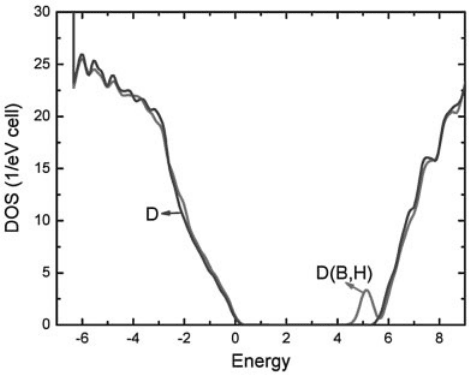
electron-density site. Figure 13.14 shows the calculated total density of states (DOS)
for pure diamond host (green curve) and a supercell containing a (B þ H) complex
(red curve), with the B–H–C configuration. It reveals clearly that the formation of
a passivated (B þ H) complex does not change the basic electronic structure, but
only generates an unoccupied impurity band below the CBM. Our results, therefore,
Figure 13.14 (online colour at: www.pss-b.com) Calculated DOS for pure diamond host (green
curve) and a supercell containing a (B þ H) complex (red curve), with the B–H–C configuration.
13.5 Approaches to Overcome the Doping Limit
j
233
suggest that the first step of the deuteration of B-doped diamonds is to passivate the B
acceptors, and create the fully unoccupied impurity bands below the CBM.
When excess deuterium/H atoms are available after the first step, they will start
to dope the passivated system, i.e., they effectively dope the new host with the
unoccupied impurity band, rather than the original conduction band. Thus, in
calculating the ionization energy, the term e
C
CBM
(host) in Eq. (13.4) should now be
replaced by the impurity-band minimum (IBM), e
C
IBM
. In other words, the transition
now occurs between the H defect levels and the unoccupied impurity bands, rather
than the original conduction bands. As a result, the transition energy can be reduced
dramatically.
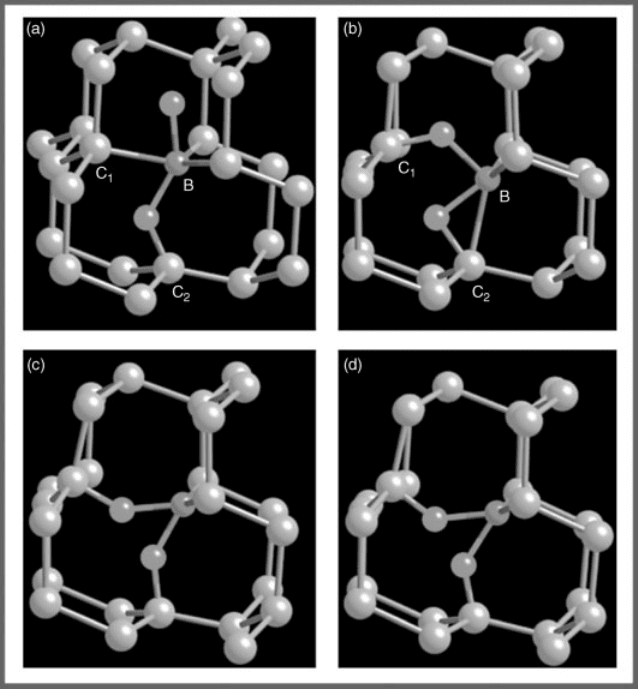
For H doping in the (B þ H)-passivated diamonds, the excess H atoms bind to
the (B þ H) complexes, forming (H–B–H) triplets. For charge-neutral H atoms, the
lowest energy configuration is shown in Figure 13.15a, where the excess H is at the
B antibonding site. We call this configuration (H–B–H)–AB. When the excess H
atom is positively charged (q ¼þ1), the fully relaxed structure is shown in
Figure 13.15b. We see in Figure 13.15b that the H
þ
ion at the antibonding site
becomes energetically unstable, and it moves to a bond-center site with high
electron density to lower the Coulomb energy. This atomic displacement results
in significant bond rearrangements and a large energy lowering of the charged
defect (1.8 eV), which leads to significant reduction of the ionization energy [see
Eq. (13.4)]. The calculated e(0/ þ) transition energy level is 0.3 eV below the
unoccupied impurity-band edge. We also studied a metastable (H–B–H)–BC triplet
defect, where both H atoms are at the puckered B–C bond-center sites. The atomic
configurations for neutral and charged defect complexes are shown in Figure 13.15c
and d, respectively. This configuration is about 0.6 eV higher in energy than the
(H–B–H)–AB complex due to strong H
þ
–H
þ
Coulomb repulsion; but the calcu-
lated transition energy level is 0.2 eV, which is 0.1 eV lower than that for the
(H–B–H)–AB complex due to less crystal-field splitting.
The calculated transition energies agree very well with the experimentally mea-
sured ionization energies, suggesting that the second step of deuteration of B-doped
diamond is to effectively dope the (B þ H) impurity bands. This new concept,
therefore, explains why (B, H) co-doping can create shallow donors in diamonds.
It should be noted that to form the impurity bands and have reasonable transport
properties, a critical concentration threshold is needed. Furthermore, the edge of the
impurity band depends on the concentration of B atoms. The higher B concentration
results in a more-broadened (B þ H) impurity band. Consequently, the ionization
energy will be reduced. This explains another experimental observation, i.e.,
diamonds with a higher B concentration exhibit shallower donor levels.
Our approach can also be applied to explain p-type doping of ZnO. As discussed
above, p-type doping of ZnO is difficult. However, Ga and N co-doping has produced
good p-type ZnO [8, 9]. The doping mechanism is not well understood. Most reliable
theoretical calculations predicted that the ionization energy for N acceptors in ZnO is
about 0.4 0.1 eV above the VBM [21, 33, 42]. But the experimentally measured N
acceptor ionization energy in p-type ZnO is much shallower, only 0.1–0.2 eV above
the VBM [6, 7]. The conventional co-doping concept cannot explain the discrepancy
234
j
13 Overcoming Bipolar Doping Difficulty in Wide Gap Semiconductors
because the calculated ionization level of an isolated Ga þ 2N impurity is still deep, at
about 0.4 eV.
Here, we show that to successfully use Ga and N co-doping to obtain p-type ZnO,
the first step is to form passivated stoichiometric (Ga þ N) complexes, and create
a fully occupied impurity band above the VBM of ZnO. Ga and N bind together
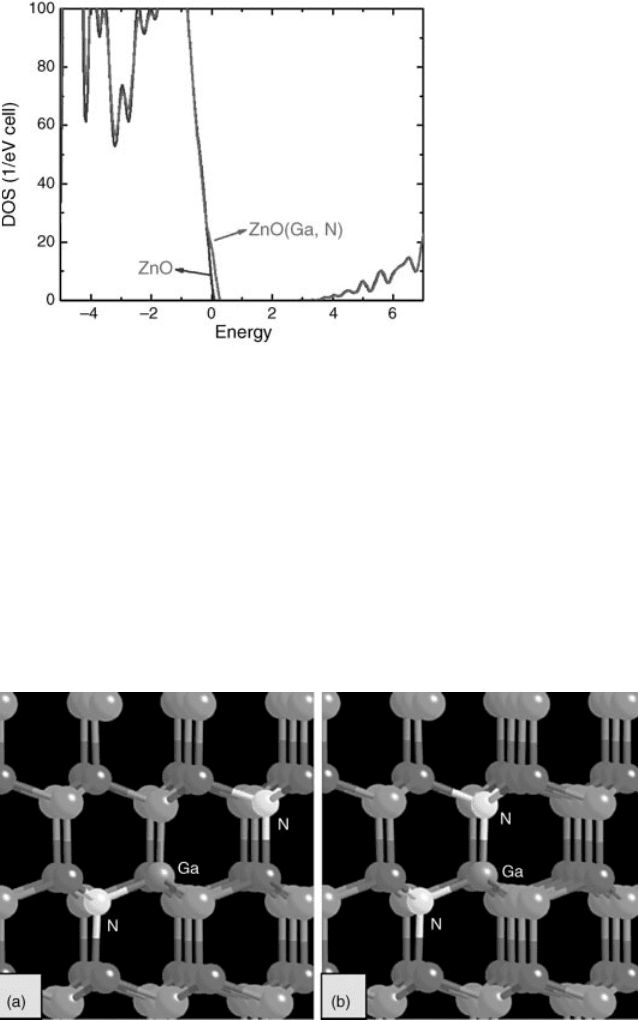
strongly in ZnO because they passivate each other. Figure 13.16 shows the calculated
total DOS for pure ZnO host (blue curve) and a system containing a (Ga þ N)
complex (red curve). It reveals clearly that the formation of a passivated (Ga þ N)
complex does not change the basic electronic structure, but only generates an
additional fully occupied band above the VBM. When excess N atoms are available,
Figure 13.15 (online colour at: www.pss-b
.com) Relaxed structures for B þ 2H complexes
in diamond with charge-neutral and þ1
charged states. The blue balls are C atoms. The
red balls are B atoms. The green balls are H
atoms. (a) Neutral state for complex
(H–B–H)–AB, (b) þ1 charged state for
complex (H–B–H)–AB, (c) neutral state
for complex (H–B–H)–BC, and (d) þ1
charged state for complex (H–B–H)–BC.
13.5 Approaches to Overcome the Doping Limit
j
235
they will dope the passivated system. The transition will occur between the N defect
levels and the fully occupied impurity bands, rather than the original valence bands.
Thus, the term e
C
VBM
(host) in Eq. (13.3) should now be replaced by the impurity-band
maximum, e
C
IBM
.
Previous calculations suggested that for the Ga þ 2N complexes, the first N
occupies the first nearest-neighboring O site of the Ga, which occupies a Zn site [34].
The second N occupies the second nearest-neighboring O site. This N atom does not
bind directly to the Ga atom. We call this configuration (N–Ga–N)–A. However, our
calculations reveal that the excess N atoms bind to the (Ga þ N) sites, forming
Figure 13.16 (online colour at: www.pss-b.com) Calculated DOS for pure ZnO (green curve) and a
supercell containing a (Ga, N) complex.
Figure 13.17 (online colour at: www.pss-b.com) Relaxed structures for (a) configuration A and (b)
configuration B.
236
j
13 Overcoming Bipolar Doping Difficulty in Wide Gap Semiconductors