
Alkauskas A., Deak P., Neugebauer J., Pasquarello A., Van de Walle Ch.G. (Eds.) Advanced Calculations for Defects in Materials: Electronic Structure Methods
Подождите немного. Документ загружается.

secondary ion mass spectrometry (SIMS), but some impurities (such as hydrogen)
are hard to detect in low concentrations. Point-defect concentrations are even harder
to determine. Electron paramagnetic resonance is an excellent tool that can provide
detailed information about concentrations, chemical identity, and lattice environ-
ment of a defect or impurity, but it is a technique that requires dedicated expertise and
possibly for that reason has few practitioners [12]. Other tools, such as Hall
measurements or photoluminescence, can provide information about the effect of
point defects or impurities on electrical or optical properties, but cannot by them-
selves identify their nature or character. For all these reasons, the availability of first-
principles calculations that can accurately address atomic and electronic structure of
defects and impurities has had a great impact on the field.
Obviously, to make the information obtained from such calculations truly useful,
the results should be as reliable and accurate as possible. Density functional theory
(DFT) [13, 14] has proven its value as an immensely powerful technique for assessing
the structural properties of defects [1]. (In the remainder of this article, we will use
the term defects to generically cover both native point defects and impurities.)
Minimization of the total energy as a function of atomic positions yields the stable
structure, including all relaxations of the host atoms, and most functionals
[including the still most widely used local density approximation (LDA)] all yield
results within reasonable error bars [15]. Quite frequently, however, information
about electronic structure is required, i.e., the position of defect levels that are
introduced in the band gap of semiconductors or insulators. Since DFT in the LDA or
generalized gradient approximation (GGA) severely underestimates the gap, the
position of defect levels is subject to large error bars and cannot be directly compared
with experiment [16–18]. In turn, this affects the calculated formation energy of the
defect, which determines its concentration. This effect on the energy is still not
generally appreciated, since it is often assumed that the formation energy is a
ground-state property for which DFT should give reliable results. However, in the
presence of gap levels that can be filled with varying numbers of electrons
(corresponding to the charge state of the defect), the formation energy becomes
subject to the same type of errors that would occur when trying to assess excitation
energies based on total energy calculations with N or N þ 1 electrons. Recently,
major progress has been made in overcoming these inaccuracies, and the
approaches for doing so will be discussed in Section 1.2.
Another type of error that may occur in defect calculations is related to the
geometry in which the calculations are performed. Typically, one wishes to address
the dilute limit in which the defect concentration is low and defect–defect interac-
tions are negligible. Greens functions calculations would in principle be ideal, but in
practice have proven quite cumbersome and difficult to implement. Another
approach would be to use clusters, but surface effects are almost impossible to
avoid, and quantum confinement effects may obscure electronic structure. Nowa-
days, point defect calculations are almost universally performed using the supercell
geometry, in which the defect is embedded within a certain volume of material which
is periodically repeated. This has the advantage of maintaining overall periodicity,
which is particularly advantageous when using plane-wave basis sets which rely on
2
j
1 Advances in Electronic Structure Methods for Defects and Impurities in Solids
Fast Fourier Transforms to efficiently move between reciprocal- and real-space
representations. The supercells should be large enough to minimize interactions
between defects in neighboring supercells. This is relatively straightforward to
accomplish for neutral defects, but due to the long-range nature of the Coulomb
interaction, interactions between charged defects are almost impossible to eliminate.
This problem was recognized some time ago, and a correction was suggested based
on a Madelung-type interaction energy [19]. It had been observed, however, that in
many cases the correction was unreliable or overcorrected, making the result less
accurate than the bare values [20]. Recently, an approach based on a rigorous
treatment of the electrostatic problem has been developed that outlines the condi-
tions of validity of certain approximations and provides explicit expression for the
quantities to be evaluated [21]. Issues relating to supercell-size convergence are
addressed in detail in the article by Freysoldt et al. [22] in this volume.
We note that it is not the intent of the present paper to provide a comprehensive
review of the entirety of this large and growing field. Rather, we attempt to introduce
the main concepts of present-day defect calculations illustrated with a few select
examples, and do not aspire to cover the countless important contributions to the field
by many different research groups.
1.2
Formalism and Computational Approach
The key quantities that characterize a defect in a semiconductor are its concentration
and the position of the transition levels (or ionization energies) with respect to the
band edges of the host material. Defects that occur in low concentrations will have a
negligible impact on the properties of the material. Only those defects whose
concentration exceeds a certain threshold will have observable effects. The position
of the defect transition levels with respect to the host band edges determines the
effects on the electrical and optical properties of the host. Defect formation energies
and transition levels can be determined entirely from first principles [1], without
resorting to any experimental data for the system under consideration.
1.2.1
Defect Formation Energies and Concentrations
In the dilute limit, the concentration of a defect is determined by the formation
energy E
f
through a Boltzmann expression:
c ¼ N
sites
expðE
f
=E
f
k
B
TÞ: ð1:1Þ
N
sites
is the number of sites (including the symmetry-equivalent local configura-
tions) on which the defect can be incorporated, k
B
is the Boltzmann constant, and T
the temperature. Note that this expression assumes thermodynamic equilibrium.
While defects could also occur in nonequilibrium concentrations, in practice most of
1.2 Formalism and Computational Approach
j
3
the existing bulk and epitaxial film growth techniques operate close to equilibrium
conditions. Equilibration of defects is actually unavoidable if the diffusion barriers
are low enough to allow easy diffusion at the temperatures of interest. In addition,
even if kinetic barriers would be present, Eq. (1.1) is still relevant because obviously
defects with a high formation energy are less likely to form.
Defect formation energies can be written as differences in total energies, and these
can be obtained from first principles, i.e., without resorting to experimental para-
meters. The dependence on the chemical potentials (atomic reservoirs) and on the
position of the Fermi level in the case of charged defects is explicitly taken into
account [1, 5]. This is illustrated here with the specific example of an oxygen vacancy
in a 2 þ charge state in ZnO. The formation energy of V
2 þ
O
is given by:
E
f
ðV
2 þ
O
Þ¼E
tot
ðV
2 þ
O
ÞE
tot
ðZnOÞþm
O
þ2E
F
; ð1:2Þ
where E
tot
ðV
q
O
Þis the total energy of the supercell containing the defect, and E
tot
ðZnOÞ
is the total energy of the ZnO perfect crystal in the same supercell. E
F
is the energy of
the reservoir with which electrons are exchanged, i.e., the Fermilevel. The O atom that
is removed is placed in a reservoir, the energy of which is given by the oxygen chemical
potential m
O
. Note that m
O
is a variable, corresponding to the notion that ZnO can in
principle be grown or annealed under O-rich, O-poor, or any other condition in
between. It is subject to an upper bound given by the energy of an O atom in an O
2
molecule. Similarly, the zinc chemical potential m
Zn
is subject to an upper bound given
by the energy of a Zn atom in bulk Zn. The sum of m
O
and m
Zn
corresponds to the
energy of ZnO, which is the stability condition of ZnO. An upper bound on m
Zn
, given
by the energy of bulk Zn, therefore leads to a lower bound on m
O
, and vice versa. The
chemical potentials thus vary over a range given by the formation enthalpy of the
material being considered. Formation enthalpies are generally well described by first-
principles calculations. For instance, the calculated formation enthalpy of 3.50 eV
for ZnO [8] is in a good agreement with the experimental value of 3.60 eV [23].
Note that it is, in principle, the free energy that determines the defect concentration,
and one should in principle take into account vibrational entropy contributions in
Eq. (1.1). Such contributions are usually small, on the order of a few k
B
, and there is
often a significant cancellation between vibrational contributions in the solid and in
the reservoir [1]. In rare instances, inclusion of vibration entropy has a distinct impact
on which configuration is most stable for a given defect or impurity [24], but it hardly
ever has a significant effect on the overall concentration. The reader is referred to
Ref. [1] for a detailed discussion on the calculation of defect formation energies from
first principles.
1.2.2
Transition Levels or Ionization Energies
Defects in semiconductors and insulators can occur in different charge states. For
each position of the Fermi level, one particular charge state has the lowest energy for a
given defect. The Fermi-level positions at which the lowest-energy charge state
4
j
1 Advances in Electronic Structure Methods for Defects and Impurities in Solids

changes are called transition levels or ionization energies. The transition levels are
thus determined by formation energy differences:
eðq=q
0
Þ¼
E
f
ðD
q
; E
F
¼ 0ÞE
f
ðD
q
0
; E
F
¼ 0 Þ
ðq
0
qÞ
; ð1:3Þ
where E
f
ðD
q
; E
F
¼ 0Þis the formation energy of the defect D in the charge state q for
the Fermi level at the valence-band maximum (E
F
¼0). These are thermodynamic
transition levels, i.e., atomic relaxations around the defect are fully included; for
Fermi-level positions below eðq=q
0
Þ the defect is stable in charge state q, while for
Fermi-level positions above eðq=q
0
Þ, the defect is stable charge state q
0
. The thermo-
dynamic transition levels are not to be confused with the single-particle Kohn–Sham
states that result from band-structure calculations for a single charge state. They are
also not to be confused with optical transition levels derived, for example, from
luminescence or absorption experiments. In this case, the final state may not be
completely relaxed, and the optical transition levels may significantly differ from the
thermodynamic transition levels, as discussed in Ref. [1].
For a defect to contribute to conductivity, it must be stable in a charge state that is
consistent with the presence of free carriers. For instance, in order to contribute to n-
type conductivity, the defect must be stable in a positive charge state and the transition
level from the positive to the neutral charge state should occur close to or above the
conduction-band minimum (CBM). A defect is a typical shallow donor when the
transition level for a positive to the neutral charge state [e.g., the eðþ=0Þ level], as
defined based on formationenergies, lies abovethe CBM. In this case, a neutral charge
state in which the electron is localized in the immediate vicinity of the defect cannot be
maintained if the corresponding electroniclevel is resonant with the conduction band;
instead, the electron will be transferred to extended states, but may still be bound to the
positive core of the defect in a hydrogenic effective-mass state. Similarly, shallow
acceptors are defects in which the transition level from a negative to the neutral charge
state [e.g., the eð=0Þ level] is near or below the VBM. If the latter, the hole can be
bound to the negative core of the defect in a hydrogenic effective-mass state [1, 25].
1.2.3
Practical Aspects
The total energies in Eq. (1.2) are often evaluated by performing DFT calculations
within the LDA or its semi-local extension, the GGA [26, 27]. Defects are typically
calculated by using a supercell geometry, in which the defect is placed in a cell that is a
multiple of the primitive cell of the crystal. The supercell is then periodically repeated
in three-dimensional space. The use of supercells also has the advantage that the
underlying band structure of the host remains properly described, and integrations
over the Brillouin zone are replaced by summations over a discrete and relatively
small set of special k-points. Supercell-size corrections for charged defects are
addressed in Refs. [21] and [22]. Convergence with respect to the supercell size,
number of plane waves in the basis set, and the number of special k-points should
1.2 Formalism and Computational Approach
j
5
always be checked, to make sure that the quantities that are derived are representative
of the isolated defect.
The number of atoms or electrons in the calculations is limited by the available
computer power. Fortypical defect calculations, supercells containing 32, 64, 128, 216,
and 256 atoms are used for materials with the zinc-blende structure, whereas super-
cells containg 32, 48, 72, and 96 atom cells are used for materials in the wurtzite
structure. These fairly large cell sizes call for efficient computational approaches.
Ultrasoft pseudopotential [28–30] and projector-augmented-wave [31] methods to
separate the chemically active valence electrons from the inert core electrons have
proven ideal for tackling such large systems. First-principles methods based on plane-
wave basis sets have been implemented in many codes such as the Vienna Ab initio
Simulation Program (VASP) [32–34], ABINIT [35, 36], and Quantum Expresso [37].
1.3
The DFT-LDA/GGA Band-Gap Problem and Possible Approaches to Overcome It
The LDA and the GGA in the DFT are plagued by the problem of large band-gap
errors in semiconductors and insulators, resulting in values that are typically less
than 50% of the experimental values [38–42]. It has often been assumed that the band-
gap problem is not an issue when studying defects in semiconductors, since each
individual calculation for a specific charge state of the defect could be considered to be
a ground-state calculation. However, this notion is not correct, in the same way that
the assumption that LDA calculations could yield reliable total-energy differences
between N-electron versus (N þ 1)-electron systems is not correct [16]. Indeed, the
change in the number of electrons elicits the issue of the lack of a discontinuity in the
exchange-correlation potential, which is at the root of the band-gap problem [38–42].
Similarly, the formation energy expressed in Eq. (1.2) involves changes in the
occupation of defect-induced states. In other words, if a specific charge state of a
defect involves occupying a state in the band gap, and the band gap is incorrect in
DFT–LDA/GGA, then the position of the defect state and hence the calculated total
energy will suffer from the same problem [8, 16]. Careful practitioners have always
been aware of this problem and refrained from drawing conclusions that might be
affected by these uncertainties. The problem is exacerbated, of course, in the case of
wide-band-gap semiconductors in which the band-gap errors can be particularly
severe; for example, in ZnO the LDA band gap is only 0.8 eV, compared to an
experimental value of 3.4 eV.
In the remainder of this section we address several approaches that have been, or
are being, developed to overcome these problems.
1.3.1
LDA þU for Materials with Semicore States
Many of the wide-band-gap materials of interest have narrow bands, derived from
semicore states, that play an important role in their electronic structure [43]. For
6
j
1 Advances in Electronic Structure Methods for Defects and Impurities in Solids
example, in ZnO narrow bands derived from the Zn 3d states occur at 8 eV below
the valence-band maximum (VBM) and strongly interact with the top of the valence
band derived from O 2p states. Inclusion of the Zn d states as valence states (as
opposed to treating them as core states) is therefore important for a proper
description of the electronic structure of ZnO, as it affects structural parameters,
band offsets, and deformation potentials [44, 45]. The DFT–LDA/GGA does not
properly describe the energetic position of these narrow bands due to their higher
degree of localization, as compared to the more delocalized s and p bands. One way to
overcome this problem is to use an orbital-dependent potential that adds an extra
Coulomb interaction U for these semicore states, as in the LDA þU (or GGA þU)
approach [46, 47].
In the LDA þU the electrons are separated into localized electrons for which the
Coulomb repulsion U is taken into account via a Hubbard-like term in a model
Hamiltonian, and delocalized or itinerant electrons that are assumed to be well
described by the usual orbital-independent one-electron potential in the LDA.
Although this approach had been developed and applied for materials with partially
filled d bands [46, 47], it has been recently demonstrated that it significantly improves
the description of the electronic structure of materials with completely filled d bands
such as GaN and InN, as well as ZnO and CdO [44, 45].
An important issue in the LDA þU approach is the choice of the parameter U.It
has often been treated as a fitting parameter, with the goal of reproducing either the
experimental band gap or the experimentally observed position of the d states in the
band structure. Neither approach can be justified, because (a) LDA þU cannot be
expected to correct for other shortcomings of DFT-LDA, specifically, the lack of a
discontinuity in the exchange-correlation potential, and (b) experimental observa-
tions of semicore states may include additional (final state) effects inherent in
experiments such as photoemission spectroscopy. An approximate but consistent
and unbiased approach has been proposed in which the calculated U for the isolated
atom is divided (screened) by the optical dielectric constant of the solid under
consideration [44]. Tests on a number of systems have shown that applying LDA þU
effectively lowers the energy of the narrow d bands, thus reducing their coupling with
the p states at the VBM; simultaneously, it increases the energy of the s states that
compose the CBM, due to the improved screening by the more strongly bound d
states, leading to further opening of the band gap. Such improvements have been
described in detail in the case of ZnO, CdO, GaN, and InN [44, 45].
One can take advantage of the partial correction of the band gap by the LDA þU to
study defects. Based on an extrapolation of LDA and LDA þU results, one can obtain
transition levels and formation energies that can be directly compared with experi-
ments. Such extrapolation schemes have been applied in other contexts as well; they
are based on evaluation of defect properties for two different values of the band gap
followed by a linear extrapolation to the experimental gap. A number of empirical
extrapolation approaches were described by Zhang et al. [48], for instance based on
use of different exchange and correlation potentials or different plane-wave cutoffs.
Such extrapolation schemes are most likely to be successful if the calculations that
produce different band gaps are physically motivated, ensuring that the shifts in
1.3 The DFT-LDA/GGA Band-Gap Problem and Possible Approaches to Overcome It
j
7
defect states that give rise to changes in formation energies reflect the underlying
physics of the system.
An extrapolation based on LDA and LDA þU calculations, as described in Refs. [8]
and [17], has been shown to be particularly suitable for describing defect physics in
materials with semicore d states. The LDA þU produces genuine improvements in
the electronic structure related to the energetics of the semicore states; one of these
effects is an increase in the band gap. The shifts in defect-induced states between
LDA and LDA þU reflect their relative valence- and conduction-band character, and
hence an extrapolation to the experimental gap is expected to produce reliable results.
Such an approach has led to accurate predictions for point defects in ZnO, InN, and
SnO
2
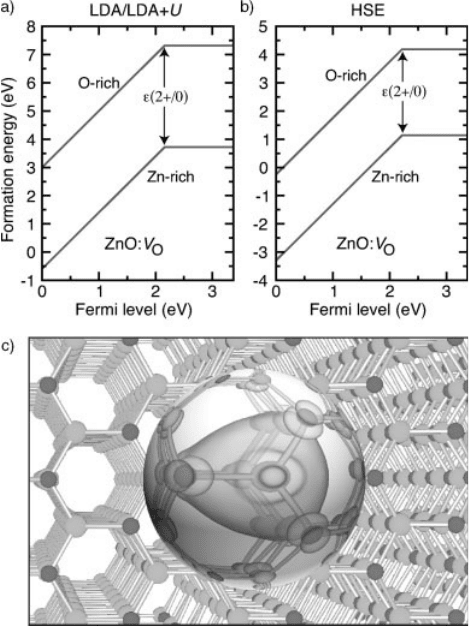
[8, 49, 50]. Figure 1.1(a) shows the result of this extrapolation scheme for the
Figure 1.1 (online color at: www.pss-b.com)
Formation energy as a function of Fermi level for
an oxygen vacancy (V
O
) in ZnO. (a) Energies
according to the LDA/LDA þU scheme
described in Section 1.3.1. (b) Energies
according to the HSE approach [51].
The lower curve in each plot indicates
Zn-rich conditions, and the upper curve O-rich
conditions. The position of the transition level
e(2 þ/0) is also indicated. (c) Charge density of
the V
0
O
gap state, which is occupied with two
electrons. The isosurface corresponds to 10% of
the maximum.
8
j
1 Advances in Electronic Structure Methods for Defects and Impurities in Solids
case of oxygen vacancy in ZnO. The success of this approach can be attributed to the
fact that the defect states can in principle be described as a linear combination of host
states, under the assumption that the latter form a complete basis. A defect state in the
gap region will have contributions from both valence-band states and conduction-
band states. The shift in transition levels with respect to the host band edges upon
band-gap correction reflects the valence- versus conduction-band character of the
defect-induced single-particle states. In the case of a shallow donor, the related
transition level is expected to shift with the conduction band, i.e., the variation of the
transition level is almost equal the band gap correction. For a shallow acceptor, the
position of the transition level with respect to the valence band is expected to remain
unchanged.
1.3.2
Hybrid Functionals
The use of hybrid functionals has been rapidly spreading in the study of defects in
solids. In particular, hybrid functionals have proven reliable for describing the
electronic and structural properties of defects in semiconductors. The method
consists of mixing local (LDA) or semi-local (GGA) exchange potentials with the
non-local Hartree–Fock exchange potential. The correlation potential is still
described by the LDA or GGA. Hybrid functionals have been successful in describing
structural properties and energetics of molecules in quantum chemistry, with
Beckes three-parameter exchange functional (B3) with the Lee, Yang, and Parr (LYP)
correlation (B3LYP) being the most popular choice [52]. However, the use of B3LYP
for studying defects in solids has been limited due to its shortcomings in describing
metals and narrow-gap semiconductors [53]. This issue is particularly important
since formation enthalpies of metals usually enter the description of the chemical
potential limits in the defect-formation-energy expressions (cf. Eq. (1.2)).
The introduction of a screening length in the exchange potential by Heyd, Scuseria,
and Ernzerhof (HSE) [54, 55] and its implementation in a plane-wave code [56] have
been instrumental in enabling the use of hybrid functionals in the study of defects in
semiconductors. In the HSE the exchange potential is divided in short- and long-
range parts. In the short-range part, the GGA exchange of Perdew, Burke, and
Ernzerhof (PBE) [27] potential is mixed with non-local Hartree–Fock exchange
potential in a ratio of 75/25. The long-range exchange potential as well as the
correlation is described by the PBE functional. The range-separation is implemented
through an Error function with a characteristic screening length set to 10 A
[55], the
variation of which can also affect band gaps [57]. The screening is essential for
describing metals and insulators on the same footing. The HSE functional has been
shown to accurately describe band gaps for many materials [56, 58]. We should note,
however, that since the Hartree–Fock potential involves four-center integrals its
implementation in plane-wave codes results in a high computational cost, and
currently hybrid functional calculations take at least an order of magnitude more
processing time than standard LDA calculations for systems with the same number
of electrons.
1.3 The DFT-LDA/GGA Band-Gap Problem and Possible Approaches to Overcome It
j
9
As an example of hybrid functional calculations for defects in semiconductors, we
show in Figure 1.1(b) the formation energy as a function of Fermi level for the oxygen
vacancy (V
O
) in ZnO using the HSE functional [51]. These calculations were
performed by setting the mixing parameter to 37.5% so to reproduce the experi-
mental value of the band gap of ZnO. We note that the position of the transition level
e(2 þ/0) with respect to the band edges is in remarkably good agreement with the
value obtained using the LDA/LDA þU approach in Figure 1.1(a). On the other hand,
the absolute values of the formation energies are quite different, with the HSE results
being more than 2 eV lower than the LDA/LDA þU results. This difference can be
attributed to the effects of the HSE on the absolute position of the VBM in ZnO. In the
LDA/LDA þU approach, U is applied only to the d states and the gap is corrected due
to the effects of the coupling between the O 2p Zn d states, and the improved
screening of the Zn 4s by the d states. Within this approach, it was assumed that the
LDA þU would result in a correct position of the VBM. The HSE results show,
however, that the position of the VBM on an absolute energy scale is affected by the
inclusion of Hartree–Fock exchange [59]. That is HSE also corrects (at least in part)
the self-interaction error in the LDA or GGA, which is still present in the LDA þU
results, and this correction is significant for the O 2p bands that make up the VBM in
ZnO. In Ref. [59] it was found that the VBM in ZnO is shifted down by 1.7 eV in HSE
calculations, compared to PBE.
Other examples of the use of HSE include calculations for Si and Ge impurities in
ZnO, which revealed that these impurities are shallow double donors when substi-
tuting on the Zn sites in ZnO, with relatively low formation energies [59]. Si can occur
as a background impurity in ZnO, and these results indicate that it may give rise to
unintentional n-type conductivity. Another example relates to p-type doping in ZnO.
It has been long believed that incorporating N on the O site would lead to p-type ZnO.
However, the effectiveness of N as a shallow acceptor dopant has never been firmly
established. Despite many reports on p-type ZnO using N acceptors, the results have
been difficult to reproduce, raising questions about the stability of the p-type doping
and the position of the N ionization energy. Recent calculations for N in ZnO have
shown that N is actually a very deep acceptor with a transition level at 1.3 eVabove the
VBM [60]. Therefore, it has been concluded that N cannot lead to p-type ZnO. For
comparison and as a benchmark, HSE calculations correctly predicted that N in ZnSe
is a shallow acceptor when substituting on Se sites, in agreement with experimental
findings.
Hybrid functional calculations have also been performed for oxygen vacancies in
TiO
2
. Despite the fact that oxygen vacancies have frequently been invoked in the
literature on TiO
2
, their identification in bulk TiO
2
has remained elusive. First-
principles calculations based on LDA or GGA suffer from band-gap problems and are
unable to describe the neutral or the positively charged vacancy (V
þ
O
)inTiO
2
[61, 62].
In LDA or GGA, the Kohn–Sham single-particle states related to V
O
are above the
CBM, causing the electron(s) from V
0
O
or V
þ
O
to occupy the CBM. Calculations based
on the HSE, on the other hand, show that locally stable structures of V
0
O
and V
þ
O
exist,
in which the occupied single-article states lie within the band gap and the defect wave
10
j
1 Advances in Electronic Structure Methods for Defects and Impurities in Solids
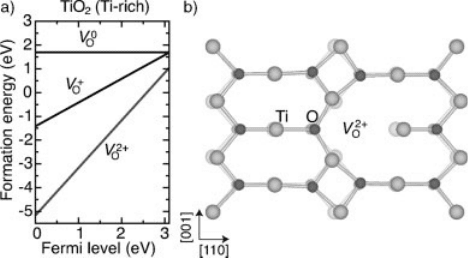
functions are localized within the vacancy. However, the formation energies of V
0
O
and V
þ
O
are always higher in energy that of V
2 þ
O
[62] as shown in Figure 1.2(a); The
atoms around V
2 þ
O
relax outward as indicated in Figure 1.2(b). Thus, oxygen
vacancies are predicted to be shallow donors in TiO
2
. This is in contrast to GGA þU
calculations which indicate that V
O
is a deep donor with transition levels in the
gap [63]. The problem with GGA þU calculations for TiO
2
is that the conduction
band in TiO
2
is derived from the Ti d states. The LDA/GGA þU approach was
designed to be applied to narrow bands with localized electrons; hence its success
when applied to semicore d states. The d states that constitute the conduction band of
TiO
2
, in contrast, are fairly delocalized, as evidenced by the high conductivity of this
material. Applying LDA/GGA þU will always lead to an energy lowering of the
occupied states, since that was what the approach was designed to do. Therefore,
when the LDA/GGA þU approach is applied to a case in which electrons occupy the
conduction band of TiO
2
, localization will result. However, it is hard to distinguish
whether this is a real physical effect or an artefact due to the nature of the
LDA/GGA þU approach. We therefore feel that LDA/GGA þU should not
be applied in cases where the states are intrinsically extended states, such as the
d states that make up the conduction band of TiO
2
.
An important issue regarding the use of hybrid functionals is the amount of
Hartree–Fock exchange potential that is mixed with the GGA exchange [64]. Although
a value of 25% was initially proposed, there is no a priori justification for this amount
and this single value is not capable of correctly describing all semiconductors and
insulators. For instance, in ZnO the experimental value of the band gap is obtained
with HSE only when a mixing parameter of 37% is used. In GaN, a mixing parameter
of 31% is necessary, and for MgO 32%. Since the position of transition levels in the
band gap depends on the band-gap value, quantitative predictions require that the
functional accurately describes band gaps, and an adjustment of the mixing param-
eter is the most straightforward way to achieve this.
Figure 1.2 (online color at: www.pss-b.com) (a) Formation energy as a function of Fermi level for
an oxygen vacancy (V
O
) in TiO
2
in the Ti-rich limit, according to Ref. [62]. (b) Local lattice relaxations
around V
2 þ
O
. The positions of the atoms in the perfect crystal are also indicated (faded).
1.3 The DFT-LDA/GGA Band-Gap Problem and Possible Approaches to Overcome It
j
11