
Alkauskas A., Deak P., Neugebauer J., Pasquarello A., Van de Walle Ch.G. (Eds.) Advanced Calculations for Defects in Materials: Electronic Structure Methods
Подождите немного. Документ загружается.

3
Electronic Properties of Interfaces and Defects from Many-body
Perturbation Theory: Recent Developments and Applications
Matteo Giantomassi, Martin Stankovski, Riad Shaltaf, Myrta Gr
€
uning, Fabien Bruneval,
Patrick Rinke, and Gian-Marco Rignanese
3.1
Introduction
Almost all electronic and optoelectronic devices (such as MOS transistors,
photovoltaic cells, semiconductor lasers, etc.) contain metal–semiconductor,
insulator–semiconductor, insulator–metal, and/or semiconductor–semiconductor
interfaces. The electronic properties of such heterojunctions determine the device
characteristics [1, 2]. The band gaps of the participating materials are usually
different, hence, at least one of the band edges is different. The energy of charge
carriers must then change when passing through the heterojunction. Most often,
there will be discontinuities in both the conduction and valence bands. These
so-called band offsets (BOs) are the origin of most of the useful properties of
heterojunctions.
Defects also play a critical role for the functionality of devices [3–5]. They can have
both positive as well as detrimental effects. As dopants they provide charge carriers in
semiconductors, which can contribute to a current, but these carriers can also
recombine at defect sites and are then lost. Problems like flat-band and threshold
voltage shifts, carrier mobility degradation, charge trapping, gate dielectric wear-out,
and breakdown, as well as temperature instabilities are believed to mainly originate
from defects forming at (or close to) the heterojunction interface. A deep under-
standing of the defects concerned is thus highly desirable for the enhancement of
device performance.
However, experimental characterization of defect energy levels at interfaces is
often very difficult to achieve, so theoretical simulation can provide extremely
useful information for further improvement of devices. In this framework,
density functional theory (DFT) has been, and still is, widely used to investigate
the electronic properties of various defective interfaces. Unfortunately, the semi-
local approximations to DFT – such as the local density approximation (LDA) or
the generalized-gradient approximation (GGA) – suffer from a well-known
Advanced Calculations for Defects in Materials: Electronic Structure Methods, First Edition.
Edited by Audrius Alkauskas, Peter Deák, Jörg Neugebauer, Alfredo Pasquarello, and Chris G. Van de Walle.
Ó 2011 Wiley-VCH Verlag GmbH & Co. KGaA. Published 2011 by Wiley-VCH Verlag GmbH & Co. KGaA.
j
33

substantial underestimation of band gaps, which hinders a precise prediction
of the energy-level alignment at interfaces. For this reason, hybrid density
functionals have recently increase d in popularity [6–11]. These functionals, which
incorporate a fraction of Hartree-Fock (HF) exchange, lead to higher accura-
cies [12] and improved band gaps [13, 14] compared to corresponding results
using semilocal functionals. The fraction of HF exchange to be included cannot be
known in advance for all materials and its optimal value could even be property
dependent [15, 16]. Therefore the reliability of hybrid density functionals cannot
be assessed apriori[17].
In contrast, many-body perturbation theory (MBPT) [18–22] offers an approach for
obtaining quasiparticle (QP) energies in solids which is controlled and amenable to
systematic improvement. However, the cost of such calculations is generally higher
than that of their DFTcounterparts. Recently, considerable effort has been devoted to
finding reliable techniques to speed up MBPT calculations and make them tractable
for the larger systems needed to simulate defects and interfaces.
In this chapter, we will review the recent developments in MBPT calculations and
the results obtained for interfaces and defects. Section 3.2 is devoted to the theoretical
basis of MBPT. Hedins equations are presented in Section 3.2.1. The GW approx-
imation is introduced in Section 3.2.2, while approximations going beyond GW are
discussed in Section 3.2.3. Section 3.3 focuses on the practical implementation and
the recent developments of MBPT. In Section 3.3.1, we describe the perturbative
approach, that is usually employed to obtain QP energies. The methods used to take
into account the frequency dependence of the self-energy operators are presented in
Section 3.3.2. In order to allow for a reduction of the number of unoccupied states that
need to be included explicitly in the calculations, the extrapolar method is introduced
in Section 3.3.3. We discuss the combination of MBPTwith the projector-augmented
wave (PAW) method in Section 3.3.4. Sections 3.4 and 3.5 are dedicated to MBPT
results obtained for BOs at interfaces and for defects, respectively. Special emphasis
is put on the caveats of the methods.
3.2
Many-Body Perturbation Theory
3.2.1
Hedins Equations
A rigorous formulation for the properties of QPs is based on a Greens function
approach [18]. The QP energies E
QP
i
and wavefunctions y
QP
i
are obtained by solving
the QP equation:
1
2
r
2
þV
ext
ðrÞþV
H
ðrÞ
y
QP
i
ðrÞþ
ð
S
r; r
0
; E
QP
i
y
QP
i
ðr
0
Þdr
0
¼ E
QP
i
y
QP
i
ðrÞ;
ð3:1Þ
34
j
3 Electronic Properties of Interfaces and Defects from Many-body Perturbation Theory

where V
ext
and V
H
are the external and Hartree potentials, respectively. In this
equation, the exchange and correlation effects are described by the electron self-
energy operator Sðr; r
0
; E
QP
i
Þ which is non-local, energy dependent, and non-
Hermitian. Hence, the eigenvalues E
QP
i
are generally complex: their real part is
the energy of the QP, while their imaginary part gives its lifetime.
The main diffi culty is to find an adequate approximation for the self-energy
operator S. Hedin [23] proposed a perturbation series expansion in the ful ly
screened (as opposed to bare) Coulomb interaction. The Greens function, G
0
,
of a zeroth-order system of non-interacting electrons is first constructed
from the one-particle wavef unct ions y
i
and energies E
i
of the zeroth-order
Hamiltonian, as:
G
0
ðr; r
0
; EÞ¼
X
i
y
i
ðrÞy
i
ðr
0
Þ
EE
i
þigsg nðE
i
mÞ
; ð3:2Þ
where m is the chemical potential and g is a positive infinitesimal. The exact one-
body Greens function G is thus written using the Dyson equation:
1)
Gð12Þ¼G
0
ð12Þþ
ð
G
0
ð13ÞSð34ÞGð42Þdð34Þ: ð3:3Þ
Here, the self-energy S is obtained by self-consistently solving Hedins closed set of
coupled integro-differential equations:
Cð12; 3Þ¼dð12Þdð13Þ
þ
ð
dSð12Þ
dGð45Þ
Gð46ÞGð75ÞCð67; 3Þdð4567Þ;
ð3:4Þ
Pð12Þ¼i
ð
Gð23ÞGð42
þ
ÞCð34; 1Þdð34Þ; ð3:5Þ
Wð12Þ¼vð12Þþ
ð
Wð13ÞPð34Þvð 42Þdð 34Þ; ð3:6Þ
Sð12Þ¼i
ð
Gð14ÞWð1
þ
3ÞCð42; 3Þdð34Þ; ð3:7Þ
where P is the polarizability, W the screened and v the unscreened Coulomb
interaction and C the vertex function, which describes higher-order corrections to
1) In Section 3.1, Hedins simplified notation 1 ðx
1
; s
1
; t
1
Þ is used to denote space, spin, and time
variables and the integral sign stands for summation or integration of all of these where appropriate.
1
þ
denotes t
1
þg where g is a positive infinitesimal in the time argument. Atomic units are used in
all equations throughout this paper.
3.2 Many-Body Perturbation Theory
j
35
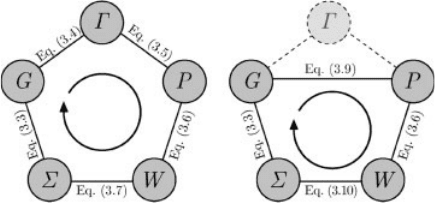
the interaction between quasiholes and quasielectrons. The self-consistent iterative
process is illustrated in the left panel of Figure 3.1.
The most complicated term in these equations is C, which contains a functional
derivative and hence cannot in general be evaluated numerically. The vertex is the
usual target of simplification for an approximate scheme.
3.2.2
GW Approximation
Hedins GW method [23] is the most widely used approximation for the self-energy,
S. The approximation is defined by neglecting the variation of the self-energy with
respect to the Greens function dSð12Þ=dGð45Þ¼0 in Eq. (3.4), leading to:
Cð12; 3Þ¼dð12Þdð13Þ: ð3:8Þ
Thus, the polarizability in Eq. (3.5) is given by:
Pð12Þ¼iGð12
þ
ÞGð21Þ; ð3:9Þ
which corresponds to the random phase approximation (RPA) for the dielectric
matrix. The self-energy in Eq. (3.7) becomes simply a product of the Greens function
and the screened Coulomb interaction:
Sð12Þ¼iGð12ÞWð1
þ
2Þ; ð3:10Þ
where the Greens function used is consistent with that returned by Dysons
equation.
Since the self-energy depends on G, this procedure should be carried out
iteratively, beginning with G ¼ G
0
, until the input Greens function equals the
output one. This yields the self-consistent GW approximation, in which the self-
consistent cycle is restricted to Eqs. (3.3), (3.9), (3.6), and (3.10), as illustrated in the
right panel of Figure 3.1.
Figure 3.1 Graphical illustration of the self-
consistent process required to solve the
complete set of Hedins equations (left panel)
and the four coupled integro-differential
equations resulting from the GW approximation
(right panel). The so-called G
0
W
0
approximation consists of performing the loop
only once starting from G ¼ G
0
.
36
j
3 Electronic Properties of Interfaces and Defects from Many-body Perturbation Theory
In practice , it is customary to use the first iteration only, often called one-shot
GW or G
0
W
0
, to approximate the self-energy operator. Here, W
0
is perhaps the
simplest possible screened interaction, which in terms of Feynman diagrams
involves an infinite geometric series over non-interacting electron–hole pair
excitations as in the usual definition of the RPA.
2)
This approximation for W,
although tremendously successful for weakly correlated solids, is not free of self-
screening errors [24, 25].
When using only a single iteration, it is important to make that one as accurate as
possible, so an initial G
0
calculated using Kohn–Sham DFT is normally used. The
logic is that the Kohn–Sham orbitals should produce an input G
0
much closer to the
self-consistent solution, thus rendering a single iteration sufficient. This choice of G
0
has in the past produced accurate results for QP energies (i.e., the correct electron
addition and removal energies, in contrast to the DFT eigenvalues [26]) for a wide
range of s–p bonded systems [27]. However, because this choice of G
0
corresponds to
a non-zero initial approximation for S
0
, there is no longer a theoretical justification
for the usual practice of setting the vertex to a product of delta functions before the
decoupling. Also, different choices for the exchange-correlation functional may lead
to different Greens functions [28, 29], making G
0
W
0
results dependent on the
starting point.
3.2.3
Beyond the GW Approximation
Since G
0
is often constructed from DFTorbitals, the self-energy and its derivative are
not zero for the first iteration. Using the static exchange-correlation kernel, K
xc
,
(which is the functional derivative of the DFT exchange-correlation potential, V
xc
,
with respect to density, n) Del Sole et al. [30] demonstrated how G
0
W
0
may be
modified with a vertex function to make S consistent with the DFT starting point.
They added the contribution of the vertex – decoupled after the first evaluation of
dSð12Þ=dGð45Þ in Eq. (3.4) – into both the self-energy, S (3.7), and the polarization,
P (3.5). The result is a self-energy of the form G
0
W
0
C. Instead, the G
0
W
0
approx-
imation is obtained when the vertex function is included in P only. As commented by
Hybertsen and Louie [31] and Del Sole et al., both these results take the form of GW,
but with W representing the Coulomb interaction screened by the test-charge-
electron dielectric function and the test-charge-test-charge dielectric function,
respectively, and with electronic exchange and correlation included through a
time-dependent DFT (TDDFT) kernel.
Using the LDA for the exchange-correlation potential and kernel, Del Sole et al.
found that G
0
W
0
C yields final results almost equal to those of G
0
W
0
for the band gap
of crystalline silicon and that the equivalent results from G
0
W
0
were shown to close
the gap slightly compared to standard G
0
W
0
. However, in this previous study the
2) In contrast to the common use of the RPA, there is no integration over the interaction strength, since
the perturbation expansion itself takes care of the switching on of interactions.
3.2 Many-Body Perturbation Theory
j
37

PPM approximation was utilized for modeling the frequency-dependence of W,
which may have affected the resulting QP energies.
3.3
Practical Implementation of GW and Recent Developments Beyond
3.3.1
Perturbative Approach
Often, it is more efficient to obtain the QP energies from Eq. (3.1) rather than solving
the Dyson equation (Eq. 3.3) and searching for the poles of the Greens function. The
approach consists of using perturbation theory with respect to the results of DFT.
Despite some fundamental differences, the formal similarity is striking between the
QP equation and the Kohn–Sham equation:
1
2
r
2
þV
ext
ðrÞþV
H
ðrÞ
y
DFT
i
ðrÞþV
xc
ðrÞy
DFT
i
ðrÞ¼E
DFT
i
y
DFT
i
ðrÞ;
ð3:11Þ
where V
xc
is the DFT exchange-correlation potential.
3)
In many cases, the DFT
energies E
DFT
i
already provide a reasonable estimate of the band structure and are
usually in qualitative agreement with experiment. Furthermore, in the simple
systems for which the true QP amplitudes y
QP
i
have been calculated, it was found
that the DFT wave functions y
DFT
i
are usually very close to the QP results [31, 32].
In silicon, for instance, the overlap between DFT-LDA and QP wave functions has
been reported to be close to 99.9%, but for certain surfac e [33, 34] and cluster
states [35, 36] the overlap is far less (see also Ref. [37] for comments and
criticisms). This indicates that in the basis of Kohn–Sham wave functions, the
self-energy can be considered a diagonally dominant matrix with negligible off-
diagonal elements.
Hence, E
DFT
i
and y
DFT
i
for the i
th
state are used as a zeroth-order approximation for
their QP counterparts. The QP energy E
QP
i
is then calculated by adding to E
DFT
i
the
first-order perturbation correction which comes from replacing the DFT exchange-
correlation potential V
xc
with the self-energy operator S:
E
QP
i
¼ E
DFT
i
þ
y
DFT
i
jSðE
QP
i
ÞV
xc
jy
DFT
i
: ð3:12Þ
To solve Eq. (3.12), the energy dependence of S must be known analytically, which
is usually not the case. Under the assumption that the difference between QP and
DFT energies is relatively small, the matrix elements of the self-energy operator can
3) Note that V
xc
can be seen as a static, local, and hermitian approximation to Sð12Þ.
38
j
3 Electronic Properties of Interfaces and Defects from Many-body Perturbation Theory
be Taylor expanded to first-order around E
DFT
i
in order to be evaluated at E
QP
i
:
S
E
QP
i
S
E
DFT
i
þ
E
QP
i
E
DFT
i
qSðEÞ
qE
E¼E
DFT
i
:
ð3:13Þ
In this expression, the QP energy, E
QP
i
, can be solved for:
E
QP
i
¼ E
DFT
i
þZ
i
y
DFT
i
jSðE
DFT
i
ÞV
xc
jy
DFT
i
; ð3:14Þ
where Z
i
is the renormalization factor de fined by:
Z
1
i
¼ 1
y
DFT
i
j
qSðEÞ
qE
E¼E
DFT
i
jy
DFT
i
: ð3:15Þ
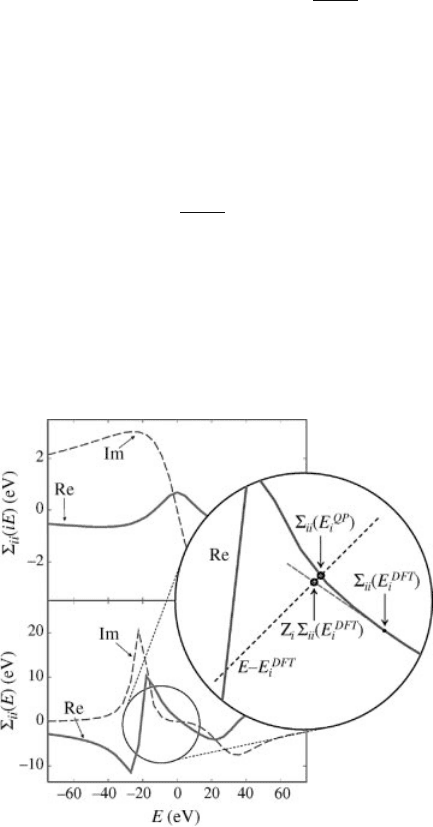
The principle is illustrated in Figure 3.2.
Figure 3.2 (online color at: www.pss-b.com)
Schematic illustration (adapted from Ref. [38])
of the perturbative approach to finding the QP
correction. In principle, the self-energy matrix
element, S
ii
ðEÞ¼hy
DFT
i
jSðEÞV
xc
jy
DFT
i
i, and
the true QP correction, SðE
QP
i
Þ, is found from
the solution of EE
DFT
i
¼ S
ii
ðEÞ, i.e., at the
crossing of the dashed black line and S
ii
ðEÞ in
the circular zoom-in. In practice, the
perturbative approach exploits the fact that it is
more computationally feasible to use the Taylor
expansion around SðE
DFT
i
Þ [Eqs. (3.14)
and (3.15)], and find an approximate value for
the QP correction at the crossing of the red and
black dashed lines.
3.3 Practical Implementation of GW and Recent Developments Beyond
j
39

3.3.2
QP Self-Consistent GW
The procedure described above has proven very efficient [27], but several questions
inevitably arise: How much does the G
0
W
0
result depend on the starting point? What
happens if the starting DFT band structure is qualitatively wrong
4)
? A self-consistent
GW self-energy calculation should be free of such concerns.
However, performing self-consistency in GW is everything but straightforward,
since S, being non-Hermitian and energy-dependent, should have non-orthogonal
and energy-dependent left and right eigenvectors. In practice, for large systems, the
solution of this Hamiltonian is not tractable without approximations. Furthermore,
fully self-consistent GW calculations have been shown to worsen results compared to
the standard one-shot G
0
W
0
method [39–41].
A different solution to the self-consistency issue is the so-called QP self-consistent
GW approximation (QSGW) developed by Faleev et al. [42] and co-workers [43, 44].
For a set of trial QP energies and amplitudes fE
i
; y
i
g(for instance, the eigensolutions
of the DFTor Hartree problem), the one-particle Greens function, G, and in turn the
GW self-energy can be calculated. These authors proposed to constrain the dynamical
GW self-energy to be static and Hermitian and as close as possible to the one-shot self-
energy (G
0
W
0
) of a non-interacting reference system. Their model QSGW self-
energy S
reads:
y
i
jS
jy
j
DE
¼
1
2
H½hy
i
jSðE
i
Þjy
j
iþhy
j
jSðE
j
Þjy
i
i; ð3:16Þ
where H means that only the Hermitian part of the matrix is considered.
The approximated self-energy matrix, S
, is diagonalized yielding a new set of
orthogonal QP amplitudes and real-valued QP energies. From this new set of orbitals,
a new density nðrÞ and the corresponding Hartree potential is generated, a new S
is
constructed and the procedure is iterated to self-consistency. Ideally, the final result
should not depend on the initial Hamiltonian, though no firm mathematical proof for
this has been reported so far. The QSGWapproach improves the G
0
W
0
results, giving
band gaps very close to experiments with errors that are small and highly
systematic [43].
Following the same spirit, Bruneval et al. [37] proposed using an alternative
Hermitian and static approximation to the GW self-energy: the COHSEX approx-
imation, derived by Hedin in 1965 [23]. COHSEX is a simple approximation which
consists of two terms, the COulomb Hole part and the Screened EXchange part:
S
COHSEX
ðr; r
0
Þ¼S
COH
ðr; r
0
ÞþS
SEX
ðr; r
0
Þ
S
COH
ðr; r
0
Þ¼dðr; r
0
Þ½Wðr; r
0
; v ¼ 0Þvðrr
0
Þ
S
SEX
ðr; r
0
Þ¼
X
v
y
v
ðrÞy
v
ðr
0
ÞWðr; r
0
; v ¼ 0Þ:
ð3:17Þ
4) For example, if DFT erroneously predicts a system to be metallic, when it is not.
40
j
3 Electronic Properties of Interfaces and Defects from Many-body Perturbation Theory

These terms do not involve any summation over empty states (v runs only over
occupied states). Performing self-consistency for the COHSEX approximation is
hence more tractable than for the QSGW self-energy of Faleev and coworkers,
although S
COHSEX
may be a cruder approximation than S
.
An alternative is to constrain the QP amplitudes in S
to their DFTcounterparts and
only update the QP energies until convergence. This method is referred to as the
eigenvalue-only QSGW (e-QSGW).
3.3.3
Plasmon Pole Models Versus Direct Calculation of the Frequency Integral
In the frequency domain, the GW self-energy is given by the convolution
Sðr; r
0
; vÞ¼
i
2p
ð
e
iv
0
g
Gðr; r
0
; v þv
0
ÞWðr; r
0
; v
0
Þdv
0
;
ð3:18Þ
where g is a positive infinitesimal. Evaluating this expression requires, in principle,
the knowledge of the full frequency dependence of Wðr; r
0
; v
0
Þ. Moreover a fine
frequency grid would be required, since Gðr; r
0
; vÞ and Wðr; r
0
; vÞ exhibit a fairly
complex and rapidly changing frequency dependence on the real axis. There are,
however, two different and more efficient techniques to evaluate Eq. (3.18): (i)
integration with a PPM and (ii) integration through contour deformation (CD). In
the former case, the frequency dependence of e
1
ðvÞ is modeled with a simple
analytic form, and the frequency convolution is carried out analytically.
In the latter approach, the integral is evaluated numerically by extending the
functions into the complex plane, where the integrand is smoother. Since the fine
details of Wðr; r
0
; vÞ are integrated over in Eq. (3.18), it is reasonable to expect that
approximated models, able to capture the main physical features of Wðr; r
0
; vÞ,
should give sufficiently accurate results at considerably reduced computational
effort. This is the basic idea behind the PPM, in which the frequency dependence
of Wðr; r
0
; v
0
Þ is modeled in terms of analytic expressions. The coefficients of the
model are derived from first principles, i.e., without any adjustable external para-
meters, either by enforcing exact relations or by anchoring the scheme on quantities
that are calculated ab initio.
It is more convenient to Fourier transform all quantities to a frequency and wave-
vector basis using the following convention:
Wðr; r
0
; vÞ¼
X
qGG
0
e
iðq þGÞr
W
GG
0
ðq; vÞe
iðq þG
0
Þr
0
; ð3:19Þ
where G is a reciprocal lattice vector and q is a vector in the first Brillouin zone. The
screened interaction is related to the dielectric matrix by:
W
GG
0
ðq; vÞ¼e
1
GG
0
ðq; vÞvðq þG
0
Þ; ð3:20Þ
3.3 Practical Implementation of GW and Recent Developments Beyond
j
41

where the Fourier transform of the bare Coulomb interaction takes the usual form
vðqÞ¼4p=ðVjqj
2
Þ, V being the crystal volume. Adopting this formalism, the
components with G 6¼ G
0
generate the local fields.
Finally, when the vertex is neglected as in Eq. (3.8), the dielectric matrix is related to
the polarizability, P,by:
e
GG
0
ðq; vÞ¼d
GG
0
vðq þGÞP
GG
0
ðq; vÞ; ð3:21Þ
which is nothing but the usual RPA when Eq. (3.9) is used to compute P.
In the PPMs of Godby and Needs [45] (GN) and Hybertsen and Louie [31] (HL), the
imaginary part of e
1
GG
0
ðq; vÞ is approximated in terms of a delta function centered at
the plasmon frequency v
GG
0
ðqÞ with amplitude A
GG
0
ðqÞ, i.e.:
`½e
1
GG
0
ðq; vÞ ¼ A
GG
0
ðqÞ½dðvv
GG
0
ðqÞÞdðv þv
GG
0
ðqÞÞ:
ð3:22Þ
The real part can then obtained by means of a Kramers–Kronig relation, and
becomes:
´½e
1
GG
0
ðq; vÞ ¼ d
GG
0
þ
V
2
GG
0
ðqÞ
v
2
v
GG
0
2ðqÞ
: ð3:23Þ
where V
2
GG
0
ðqÞ¼A
GG
0
ðqÞv
GG
0
2
ðqÞ.
The approximation given by Eq. (3.22) is quite reasonable, since experiments and
first-principles analysis reveals that `½W
G;G
0
ðq; vÞ is generally characterized by a
sharp peak in correspondence to a plasmon excitation at the plasmon frequency, at
least for low momentum transfers, q.
At this point, one defines a set of physical constraints to determine the parameters
entering Eqs. (3.22) and (3.23). The GN and HL PPMs differ in the choice of the
particular physical properties or exact relations they aim to reproduce.
In the GN approach, the parameters of the model are derived so that e
GG
0
ðq; vÞ
is correctly reproduced at two different freque ncies: the static limit ( v ¼ 0) and an
additional imaginary point located at the Sommerfeld plasma frequency iv
p
,
where v
p
¼
ffiffiffiffiffiffiffiffiffi
4pr
p
with r the number of electrons per volume [46]. After some
algebra, the following set of equations defining the plasmon-pole coefficients can
be derived:
A
GG
0
ðqÞ¼e
1
GG
0
ðq; v ¼ 0Þd
GG
0
v
GG
0
2
¼ v
2
p
A
GG
0
ðqÞ
e
1
GG
0
ðq; v ¼ 0Þe
1
GG
0
ðq; iv
p
Þ
1
2
4
3
5
V
2
GG
0
ðqÞ¼A
GG
0
ðqÞv
GG
0
2
ðqÞ
:
8
>
>
>
>
>
<
>
>
>
>
>
:
ð3:24Þ
In the HL model, the PPM parameters are calculated so as to reproduce the static
limit exactly and to fulfill a generalized f-sum rule relating the imaginary part of the
42
j
3 Electronic Properties of Interfaces and Defects from Many-body Perturbation Theory