
Alkauskas A., Deak P., Neugebauer J., Pasquarello A., Van de Walle Ch.G. (Eds.) Advanced Calculations for Defects in Materials: Electronic Structure Methods
Подождите немного. Документ загружается.

93 Baranov, P.G., Ilin, I.V., Mokhov,
E.N., v on Bardeleben, H.J., and
Cantin, J.L. (2002) Phys.Rev.B,
66, 165206.
94 Pinheiro, M. V. B., Greulich-Weber, S.,
and Spaeth, J.-M. (2003) Physica B,
340–342, 146.
95 Rauls, E., Pinheiro, M. V. B., Greulich-
Weber, S., and Gerstmann, U. (2004) Phys.
Rev. B, 70, 085202.
96 Heißenstein, H. (2002) Dissertation,
Universit
€
at Erlangen, Germany.
97 Gali, A., De
ak, P., Briddon, P.R., Devaty,
R.P., and Choyke, W.J. (2000) Phys. Rev. B,
61, 12602.
98 Bockstedte, M., Heid, M., and Pankratov,
O. (2003) Phys. Rev. B, 67, 193102.
99 Umeda, T., Isoya, J., Morishita, N.,
Ohshima, T., and Kamiya, T. (2004) Phys.
Rev. B, 69, 121201(R).
References
j
339
18
Time-Dependent Density Functional Study on the Excitation
Spectrum of Point Defects in Semiconductors
Adam Gali
18.1
Introduction
Density functional theory (DFT) has been proven to be extremely powerful method
to study defects in solids. Nowadays, this is a standard tool to investigate their
concentration in thermal equilibrium, their interaction with each other, their
vibration modes or their hyperfine tensors [1–5]. All these properties are associated
with the ground state of the defect. The success of the DFTcalculations are based on
the well-developed approximate (semi)local functionals [6–9] that made possible to
study relatively large systems at moderate computational cost with a surprisingly
good accuracy. We mention here that the commonly used (semi)local functionals
suffer from the self-interaction error [7] which results in the underestimation of the
band gap of semiconductors. Nevertheless, for many semiconductors the (semi)
local DFT calculations could predict qualitatively well the adiabatic (thermal)
ionization energies of defects [1]. However, in pathological cases (semi)local
functionals could fail to describe the nature of the defect states correctly due to
the self-interaction error. Recent studies have shown [10–14] that non-local hybrid
functionals could improve the results at large extent, and could provide quantita-
tively good results for the thermal ionization energies of point defects [15]. The
effect of hybrid functionals is discussed in detail in another chapter in this book. We
claim that hybrid density functionals provide relatively accurate quasi-particle
energies and states compared to (semi)local functionals but these quasi-particle
energies are still within the mean field approximation. In order to calculate the
excitation spectrum properly one must go beyond the mean field approximation.
Time-dependent DFT (TD-DFT) goes beyond this approximation. TD-DFT method
has been successfully applied recently to calculate the excitation spectrum of
molecules and semiconductor nanocrystals [16]. In some earlier studies efforts
have been made to address the excitation of defect states in solids by TD-DFT
method where solids were modeled by extremely small finite clusters including
5–50 host atoms [17–21]. However, it is very questionable whether the electron
Advanced Calculations for Defects in Materials: Electronic Structure Methods, First Edition.
Edited by Audrius Alkauskas, Peter Deák, Jörg Neugebauer, Alfredo Pasquarello, and Chris G. Van de Walle.
Ó 2011 Wiley-VCH Verlag GmbH & Co. KGaA. Published 2011 by Wiley-VCH Verlag GmbH & Co. KGaA.
j
341
states associated with the defect in a solid are properly described in such small
clusters, and no thorough study has been carried out so far even for a single defect
to address this very important issue.
We note that TD-DFT excitation spectrum obtained by (semi)local functionals is
reliable only for finite structures [16]. In a very recent study it has been shown that
hybrid density functional in the TD-DFT kernel provides appropriate excitation
spectrum for infinite semiconductors [22]. Here, we restrict ourselves into finite
structures where both the local and non-local functionals can be consistently applied
and validate the results for bulk systems. We study two representative defects in wide
gap semiconductors: nitrogen-vacancy (NV) center in diamond and divacancy in
silicon carbide (SiC). A common behavior of these defects is that they produce
characteristic transition in the photoluminescence (PL) spectrum. We briefly sum-
marize the known properties of these defects below.
18.1.1
Nitrogen-Vacancy Center in Diamond
Nitrogen-vacancy center in diamond has attracted a lot of attention in recent years,
since it has been detected at a single defect level [23, 24] and provides a quantum bit
for quantum computing applications [25–30]. Besides providing a single photon
source for quantum cryptography [31, 32], the NVcenter is also a promising candidate
as an optically coupled quantum register for scalable quantum information proces-
sing, such as quantum communication [33] and distributed quantum computa-
tion [34]. In addition, it has been recently demonstrated that proximal nuclear spins
can be coherently controlled via hyperfine interaction [35] and used as quantum
memory with an extremely long coherence time [36].
The electronic structure of the NV center in diamond has been discussed in detail
in a recent paper [37]. The NV center was found many years ago in diamond [38].
The model of the NV center consists of a substitutional nitrogen atom near a vacancy
in diamond [38–42] as Figure 18.1a shows. The NV center has a strong optical
transition with a zero phonon line (ZPL) at 1.945 eV (637 nm) accompanied by a
vibronic band at higher energy in absorption with the largest intensity at about
2.20 eV and lower energy in emission (see also Figure 18.4). Detailed analysis of the
ZPL revealed that the center has trigonal, C
3v
symmetry [39]. Previous ab initio
calculation clearly supported the negatively charged NV defect for 1.945 eV ZPL
center [43–45] as was originally proposed by Loubser and van Wyk [40]. In the NV
defect three carbon atoms have sp
3
dangling bonds near the vacancy (with three back
bonds in the lattice) and nitrogen atom has also three back bonds with one dangling
bond pointing to the vacant site. Since nitrogen has five valence electrons the
negatively charged NV defect has altogether six electrons around the vacancy. One
can use the defect-molecule picture [46] together with group theory to find the
canonical orbitals of this system. According to this analysis there are two fully
symmetric one-electron states (a
1
) and one doubly degenerate e state which should be
occupied by six electrons [44]. It was found that the two a
1
states is deeper in energy
than the e state. As a consequence, four electrons occupy the a
1
states and two
342
j
18 Time-Dependent Density Functional Study on the Excitation Spectrum
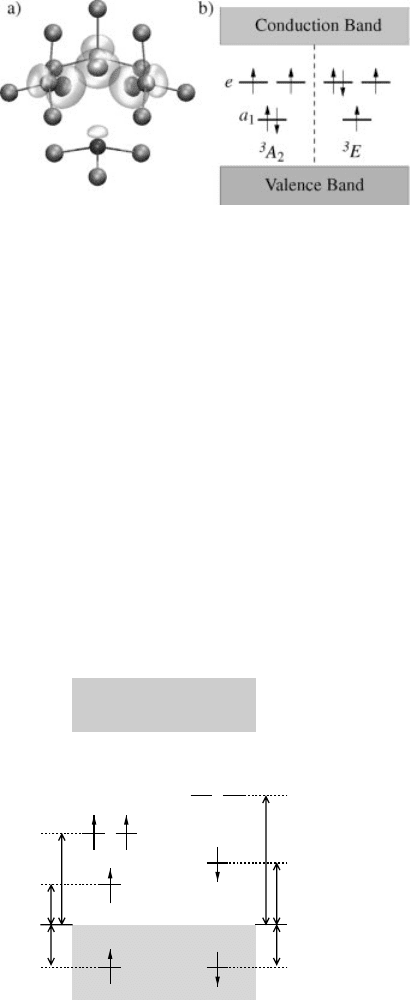
electrons remain for the e state. Our calculated one-electron levels obtained by ab
initio supercell (sc) calculations are shown in Figure 18.2.
As can be seen in Figure 18.2, the natural choice is to put the two remaining
electrons parallel to the e level forming an S ¼1 state (in analog to satisfy the Hund-
rule for the p-orbitals of the isolated group IV elements in the periodic table). In the
C
3v
point group this total wave function has
3
A
2
symmetry, where 3 ¼2 S þ 1 with
S ¼1. In our special case, we chose the M
S
¼1, so both electrons are spin-up electrons
on the e level. As can be seen, again in Figure 18.2, the lowest a
1
level is relatively deep
in the valence band, so it seems to be a good approximation to assume that it does not
contribute to the excitation process, and we do not consider it further. However, the
next a
1
level in the gap is not very far from the e level. If one electron is excited from
Figure 18.1 (online color at: www.pss-b.com)
(a) The structure of N–V
center in diamond;
only first- and second-neighbor C (cyan
spheres) and N (blue sphere) atoms to the
vacant site are shown. The yellow and red lobes
are contours of the calculated spin-density. (b)
Schematic diagram of the defect states in the
gap and their occupation in the
3
A
2
(ground)
and
3
E (excited) states.
x
e
y
a (1)
1
e
x
e
y
Conductio
n
Valence
VBMVBM
1.2 eV
0.9 eV
2.2 eV
1.2 eV
1.4 eV
3.2 eV
a
a
1
(2)
1
e
(2)
Figure 18.2 (online color at: www.pss-b.com) The calculated one-electron levels with respect to the
valence band maximum in the ground state of the NV defect. The results obtained in a 512-atom
supercell by applying the DFT within LDA functional in Ref. [44].
18.1 Introduction
j
343
the this a
1
level into the e level then one will arrive at
3
E state (see Figure 18.1b). The
3
E
is a doubly degenerate many-electron state, so it comprises two orthogonal many-
electron states with the same eigenenergy. Both of them can be described by a single
Slater-determinant: if the electron from a
1
level is promoted to e
x
then the symmetry
of the resulted many-electron state will be E
x
, if it is promoted to e
y
then the resulted
many-electron state will be E
y
. Thus, Figure 18.1b shows one of the true M
S
¼1
eigenstates of the excited state under C
3v
symmetry (see Ref. [44] and references
therein).
The only allowed transition is
3
A
2
!
3
E in the first order. Thus, the excitation of
this system may be explained by promoting an electron from the a
1
single particle
state to the e state resulting in the
3
E excited state. This is certainly a simplified picture
since the excited electron feels the presence of the hole left behind as a result of the
Coulomb interaction between them, so they cannot be treated separately. Corre-
spondingly, the wave function in the excited state, which should describe the motion
of the correlated electron-hole pair, is principally not given by a simple product of
electron and hole wave functions but requires a more general representation to
account for energetic and spatial correlation between the two particles. Thus, we
examine the excitation of NV center by TD-DFT theory which is able to address this
complex phenomena. Before turning to the results we introduce another defect
under consideration.
18.1.2
Divacancy in Silicon Carbide
Divacancies are common defects in semiconductors with consisting of neighbor
isolated vacancies. The divacancy has been recently identified in hexagonal SiC
polytypes [4]. The defect possesses C
3v
symmetry in cubic SiC and also at on-axis
configurations in hexagonal polytypes. The silicon vacancy part of the defect (C
1–3
atoms) introduces three carbon dangling bonds while the carbon vacancy part of the
defect (Si
1–3
atoms) contributes with three silicon dangling bonds (see Figure 18.3).
Again, group theory analysis revealed us [47] that the six dangling bonds will build
two a
1
and two e defect levels in C
3v
symmetry. Six electrons can occupy these states.
According to our ab initio sc calculations [47] the two a
1
levels are lowest in energy and
then the doubly degenerate e levels follow them in the hierarchy. Four electrons will
occupy the a
1
states and the two remaining electron will occupy the degenerate e level.
Again, by following the Hund-rule the natural choice is to place the electrons with
parallel spins. Indeed, the ground state of the neutral divacancy is a high spin S ¼1
state [4, 47]
A PL spectrum of about 1.0 eV is associated with this defect which can be also
detected at low temperature infrared absorption [48]. The nature of the excitation is
not well-understood. The position of the defect levels may reveal the possible
excitation mechanism of the defect. The two doubly degenerate e defect levels occur
in the fundamental band gap [47]. In the ground state, only the lowest e level is
occupied by parallel spin-electrons. Two a
1
defect levels are in the valence band where
the highest a
1
state is resonant with the valence band edge according to our ab initio sc
344
j
18 Time-Dependent Density Functional Study on the Excitation Spectrum
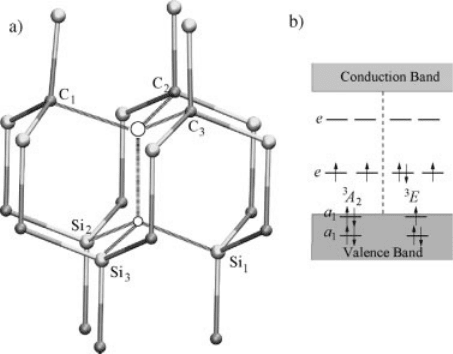
calculations [47]. One possible model to explain the excitation is to promote an
electron from the resonant a
1
state to the lowest e level in the fundamental gap [47]
(Figure 18.3b). This will result in
3
A
2
!
3
E excitation. The sharp excitation between a
resonant state and a defect state in the fundamental gap is a well-known process in
semiconductors, e.g., similar process takes place for the isolated vacancy in dia-
mond [49]. Other excitations may also occur for divacancy in SiC, for instance,
between the e defect levels in the gap. We examine the lowest excitation energies of
divacancy by TD-DFT calculations.
18.2
Method
18.2.1
Model, Geometry, and Electronic Structure
We embed the defects into a nanocrystal that contains 147 host crystal atoms and
100 hydrogen atoms for termination. The results are strictly valid for these
nanocrystals but we discuss whether the obtained results could be valid in
crystalline environment. We applied PBE [9] functional to optimize the geometry
while the excitation spectrum is calculated both by the semi-local PBE and non-local
hybrid PBE0 functionals. In PBE0 functional the Hartree–Fock exchange is mixed at
25% extent into PBE functional [50]. The optimization of the geometry has been
done with numerical atomic basis set for diamond nanocrystal at double f polarized
Figure 18.3 (online color at: www.pss-b.com)
(a) The optimized geometry of the divacancy in
the ground state. Cyan and yellow balls
represent C and Si atoms, respectively. The open
circles depict the vacant sites. (b) Schematic
diagram about the defect states in crystalline
environment in the
3
A
2
ground and
3
E excited
states.
18.2 Method
j
345
(DZP) level which provided good results in scs compared to plane wave calcula-
tions [44]. We used the SIESTA code for this purpose [51]. Troullier–Martins
pseudopotentials have been applied to model the effect of nuclei together with
the core electrons in SIESTA calculations [52]. We used the relatively computa-
tionally expensive VASP code with plane wave basis set [53, 54] to study the
divacancy in SiC. In the VASP calculations, we use a plane wave basis set of
420 eV (30 Ry) which is highly convergent with the applied projected augmen-
tation wave (PAW) projectors for carbon, hydrogen, and silicon atoms [55, 56].
In the VASP calculations we applied the appropriate symmetry, and the energy of
the ground state and the excited states are calculated by setting the appropriate
occupation of the defect states in the gap as explained below. In the geometry
optimization calculations, all the atoms were allowed to relax until the forces were
below 0.01 eV/A
. In VASP code it is possible to set the occupation number of single
particle states. This may be used to study the geometry change upon electronic
excitation [12, 44]. In this scheme the excited state is described by promoting an
electron from an occupied Kohn–Sham defect level to an unoccupied Kohn–Sham
defect level of the ground state with allowing the nuclei to relax to find the optimum
geometry with the charge density obtained from this fixed occupation of orbitals.
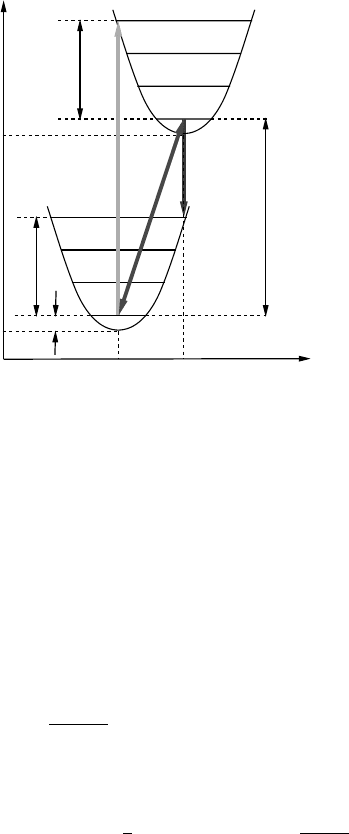
This method is called constrained DFT briefly. The constrained DFT method is a
computationally cheap method to find the ZPL transition energy within the
Franck–Condon approximation as shown in Figure 18.4. In our experience this
methodology under special circumstances provides reliable results regarding the
relaxation energy due to electronic excitation [12] which is the Stokes-shift shown
in Figure 18.4. The constrained DFT method may provide reliable results for the
Stokes-shift upon the following conditions:
1) The excited state can be well-described by a single Slater-determinant and the
symmetry of the ground and excited states are different with avoiding possible
hybridization of states.
2) The nature of the excited and ground states is similar; for instance, they are
originated from similar well-localized defect states.
As we show below we considered such defects here that can fulfill these criteria.
Nevertheless, this statement cannot be proven by DFT based methods alone. We
studied the nature of excitation by TD-DFT method that is capable of studying the
above mentioned criteria. Next, we summarize the TD-DFT theory in nutshell with
focusing on the approximations that make possible to use this method in practice.
18.2.2
Time-Dependent Density Functional Theory with Practical Approximations
In the TD-DFTwithin the Kohn–Sham formalism the system subject to a TD external
potential:
^
v
ext
ðr; tÞ¼
^
v
stat
ðrÞþ
^
v
t
ðrÞf ðtÞ; ð18:1Þ
346
j
18 Time-Dependent Density Functional Study on the Excitation Spectrum
is mapped onto a effective one-particle (non-interacting) system (e.g., Refs. [57, 58]):
ih
qj
i
ðr; tÞ
qt
¼
^
H
eff
ðtÞj
i
ðr; tÞ; ð18:2Þ
where
^
H
eff
ðtÞ¼
1
2
r
2
þ
^
v
ext
ðr; tÞþ
ð
d
3
r
0
rðr
0
; tÞ
jr r
0
j
þ
^
v
xc
½rðr; tÞ: ð18:3Þ
Here
^
v
ext
ðr; tÞ is the external potential,
Ð
d
3
r
0
ðrðr
0
; tÞ=jr r
0
jÞ the Hartree term, and
^
v
xc
½rðr; tÞ is the functional derivative of the TD exchange-correlation functional with
respect to the TD density.
In the usual adiabatic approximation memory effects are neglected, i.e.,
^
v
xc
½rðr; tÞ
is approximated as:
^
v
xc
½rðr; tÞ¼
^
v
xc
ðrðr; tÞÞ. This approximation is proven to be very
successful in many cases and easy to implement. By using Eq. (18.2), one can
propagate the wave function in real time and calculate the full spectrum of the system
driven by Eqs. (18.1–18.3).
e
q
g
E
g
E
e
AS
ZPE
S
q
A
C
E
q
n=0
m=0
B
D
ZPL
Figure 18.4 (online color at: www.pss-b.com)
The energy (E) vs. configuration coordinate (q)
diagram for the excitation process of a defect in
the Franck–Condon approximation: E
g
and E
e
are the minima in the quasi-parabolic potential
energy surfaces of the defect in the ground and
excited states, respectively, and q
g
and q
e
are the
corresponding coordinates. ZPE is the zero
point energy (indicated only for the ground
state). The energy ladders show the phonon
energies with the phonon ground states at n ¼0
(ground state of the defect) and m ¼0 (excited
state). At elevated temperatures the high-energy
phonon states can be occupied by inducing
transition A ! B (vertical absorption, green
arrow) and C ! D (vertical emission, red
arrow). Transition A $C corresponds to the
zero-phonon line (ZPL, blue double arrow) both
in absorption and emission. The energy of the
Stokes-shift (S) and anti-Stokes-shift (AS) are
also shown.
18.2 Method
j
347

In many cases the excitation can be taken as a perturbing potential where the
density response (r
(1)
(r,t)) is proportional to the perturbing potential (i.e., linear
response theory):
r
ð1Þ
ðr; tÞ¼
ð
d
3
r
0
dt
0
xðt; t
0
; r; r
0
Þ
^
v
t
ðr
0
Þf ðt
0
Þ; ð18:4Þ
where x(t,t
0
,r,r
0
) is the full response function. It can be shown that the density
response in the Kohn–Sham picture takes the following form (see Ref. [58]):
r
ð1Þ
ðr; tÞ¼
ð
d
3
r
0
dt
0
x
KS
ðt; t
0
; r; r
0
Þ
"
^
v
t
ðr
0
Þf ðt
0
Þþ
ð
d
3
r
00
r
ð1Þ
ðr
00
; t
0
Þ
jr
0
r
00
j
þ
ð
d
3
r
00
d
2
E
xc
drðr
0
Þdrðr
00
Þ
rðr
00
; t
0
Þ
#
;
ð18:5Þ
where x
KS
(t,t
0
,r, r
0
) is just the response function built from Kohn–Sham orbitals. Note
that now the potential is not simply the TD part of Eq. (18.1), instead it also includes
the Hartree-term and TD exchange-correlation potential, furthermore this equation
has to be solved self-consistently since r
(1)
(r,t) appears on both sides.
Now taking the Fourier transform of both sides (f(v) ¼
Ð
e
ivt
f(t)dt), we arrive at the
equation:
r
ð1Þ
ðr; vÞ¼
ð
d
3
r
0
x
KS
ðv; r; rÞ
"
^
v
t
ðr
0
Þf ðvÞþ
ð
d
3
r
00
r
ð1Þ
ðr
00
; vÞ
jr
0
r
00
j
þ
ð
d
3
r
00
d
2
E
XC
drðr
0
Þdrðr
00
Þ
rðr
00
; vÞ
#
ð18:6Þ
In Fourier space the form of the response kernel is (where we also introduced spin
dependence):
x
KS;ss
0
ðv; r; r
0
Þ¼d
ss
0
X
i;a
j
is
ðrÞj
as
ðrÞj
is
ðr
0
Þj
as
ðr
0
Þ
vðe
as
e
is
Þþi0
þ
2
4
j
as
ðrÞj
as
ðrÞj
is
ðr
0
Þj
as
ðr
0
Þ
v þðe
as
e
is
Þþi0
þ
#
: ð18:7Þ
In Eq. (18.7) j
is
(r)s are ground-state Kohn–Sham orbitals. From now on, i,j and a,b
indices denote occupied and virtual (unoccupied) orbitals, respectively. k,l,m,n
indices stand for general orbitals.
348
j
18 Time-Dependent Density Functional Study on the Excitation Spectrum

In order to solve Eq. (18.6), let us parameterize the density response as follows:
r
ð1Þ
s
ðr; vÞ¼
X
i;a;s
½P
ias
ðvÞj
as
ðrÞj
is
ðrÞ:
þP
ais
ðvÞj
as
ðrÞj
is
ðrÞ: ð18:8Þ
Using Eqs. (18.7) and (18.8) we arrive at the following coupled matrix equations for
P
ias
(v) and P
ias
(v):
½d
st
d
ij
d
ab
ðe
as
e
is
þvÞþK
ias; jbt
P
jbt
þK
ias; bjt
P
bjt
¼ð
^
vtÞias; ð18:9Þ
½d
st
d
ij
d
ab
ðe
as
e
is
vÞþK
ais;bjt
P
bjt
þK
ais; jbt
P
jbt
¼ð
^
vtÞais; ð18:10Þ
where we introduced the following short notation: ð
^
vtÞ
ias
¼
Ð
d
3
rj
is
ðrÞ
^
v
t
ðrÞj
as
ðrÞ,
and the K kernel:
K
kls;mnt
¼
ð
d
3
rd
3
r
0
j
ks
ðrÞj
ls
ðrÞ
1
jrr
0
j
þ
d
2
E
xc
dr
s
ðr
0
Þdr
t
ðr
00
Þ
0
@
1
A
j
nt
ðr
0
Þj
mt
ðr
0
Þ:
ð18:11Þ
Note that the kernel consists of two parts: the Hartree part is local in time (it causes
the so-called local field effects), however the second part of the kernel is generally non-
local both in space and time. In the adiabatic approximation derived above it is time
independent but still space dependent. If the xc kernel is set to zero then this
approximation is called the random phase approximation. Neglecting both terms in
the kernel yield transitions between Kohn–Sham states.
Using X
ias
¼P
ias
(v), Y
ias
¼P
ias
(v), and V
ias
¼ð
^
v
t
Þ
ias
we arrive at the following
matrix equation:
"
LM
M
L
v
10
01
#
X
Y
¼f ðvÞ
V
V
; ð18: 12Þ
where
L
ias;jbt
¼ d
st
d
ij
d
ab
ðe
as
e
is
ÞþK
ias;jbt
; ð18:13Þ
M
ias;jbt
¼ K
ias;bjt
: ð18:14Þ
In response theory, excitation energies are the poles of response function, thus by
taking f(v) ¼0wefind the following non-Hermitian eigenvalue problem:
18.2 Method
j
349