
Alkauskas A., Deak P., Neugebauer J., Pasquarello A., Van de Walle Ch.G. (Eds.) Advanced Calculations for Defects in Materials: Electronic Structure Methods
Подождите немного. Документ загружается.

detected by (optical detected) electron nuclear double resonance (OD)ENDOR. A
detailed comparison with experimental data [37] shows a close agreement already for
the interactions that had been calculated without taking into account a lattice
relaxation. Nevertheless, the agreement is substantially improved if the lattice
relaxation is included.
Since the hf interactions both with the central As nucleus and with the first shell of
As ligands are strikingly similar for all members of the As
Ga
family, it can be excluded
that the experimentally observed paramagnetic states of any member of the As
Ga
family are subject to a major lattice relaxation of the As
Ga
nucleus. In Ref. [44] it has
been furthermore shown that for the technologically important EL2 defect the
As
Ga
–As
i
model can be excluded based on this argument and high-field OD(ENDOR)
experiments [51]. Since a slight but de finite deviation from tetrahedral symmetry is
observed in these experiments, it appears that the thermally most stable defect in the
As
Ga
family is some defect aggregate. This at first view paradox observation has been
proposed as the most likely solution, in which near room temperature the EL2
transforms to an isolated tetrahedral defect and that the deviations from tetrahedral
symmetry observed experimentally are caused by the pairing with some other mobile
defect, e.g., shallow acceptors or donors, which occur while cooling the sample.
17.4
Shallow Defects: Effective Mass Approximation (EMA) and Beyond
In the last section we have seen that shallow dopants, acceptors as well as donors can
form complexes with intrinsic defects. In these complexes, the dopant levels appear
in ionized form, so that the resulting complex form again a deep defect. Also the
ionized charge state of an isolated donor is a deep defect, and the defect-induced
change of the DOS is well localized. In the neutral charge state of the defect, however,
the additional electron is rather extended. Only weekly bound, the do nor elect ron
provokes a hydrogen-like series of bound states with binding energies small
compared to the fundamental band gap and with an effective Bohr radius that
may exceed 100 A
. Whereas now a days supercell calculations of up t o 1000 atoms
nicely describe the ionization energies, the quantitative description of t he spatial
distribution of the wave function still remains a challenge. We will illustrate this
problem taking conduction electrons in 4H-SiC as an example: Here, the delocal-
ization of the electron wave function can be characterized by an effective Bohr
radius of about 13 A
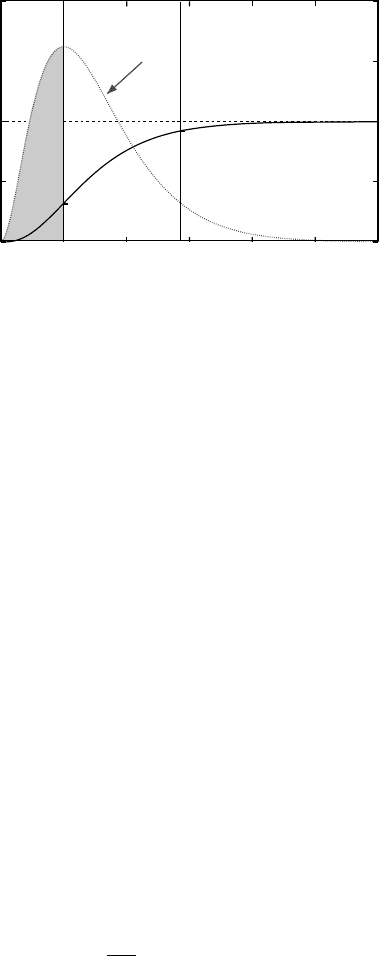
[52]. As a consequence, only 30% of the donor electron are
found in a region containing 750 atoms around the donor atom (Figure 17.6). This
is also demonstrated by recent 576-atom supercel l calculations [53] where in
comparison with experiment the localization of the donor wave function at a
central P nucleus and the four neighboring ligands is overestimated by a factor of
three ( 2.1% instead of 0.8%). In other words, the usual ab initio meth ods still cannot
be used straightforward to treat the sh f structure of these strongly delocalized
defect states. Instead, we fall back on the empirical EMA as a standard t ool to
describe the wave function of shallow defects.
17.4 Shallow Defects: Effective Mass Approximation (EMA) and Beyond
j
319
The EMA predicts ionization energies and in addition the hydrogen-like series of
bound states that agree sufficiently well with experimental data (for a review, see the
classical article by Kohn [4] or the more recent article by Ramdas and Rodriguez [54]).
The comparison with experimental EPR data, however, shows the EMA results for
the shf interactions to be at most qualitatively correct. In the following, this apparent
failure of the EMA is discussed in comparison with results of an empirical
pseudopotential calculation that provides accurate donor binding energies and
corrected wave functions. Finally, we show that a Greens function based method
allows an ab initio description of the magnetization density of shallow defects,
including the resulting hf and shf splittings.
17.4.1
The EMA Formalism
The problem of a shallow defect can be divided into two parts: D
0
¼D
þ
þ e
–
.
Providing a deep defect, the ionized donor D
þ
can generally be treated using the
standard methods for localized states. This deep defect gives rise to some potential
DV
þ
that apart from a local part DV
local
asymptotically approaches the potential of a
screened point charge:
DV
þ
ðrÞ¼
e
2
e
1
r
þDV
local
ðrÞ: ð17:36Þ
The extra electron e
present in the neutral charge state D
0
is delocalized and moves
within this potential, hardly disturbing the electron density of the deep state D
þ
.
Number of atoms
2
B
Included part of the EMT−electron [%]
radius of the supercell [r *]
*
B
( r = 13º A)
2
| (r)| r
384 00048 0006 000
50
100
0
6 5 4 3 2 1 0
φ
29%
90%
750
Figure 17.6 (online color at: www.pss-b.com)
Delocalization of EMA-like donors: The radial
probability distribution jWðrÞj
2
r
2
becomes
maximum at the effective Bohr radius r
B
. But
only 29% of the electron are found in a sphere of
radius r
B
(solid curve). For 4H-SiC with
r
B
¼13 A
[52] e.g., huge supercells with more
than 40 000 atoms would be necessary to reduce
the artificial overlap of the periodic images of
the wave functions to a more or less acceptable
value below 10%.
320
j
17 Ab Initio Greens Function Calculation of Hyperfine Interactions

Thus, the electron density for the extra electron is expected to coincide with the
magnetization density of the donor state. Within the EMA [4] the extra electron is
described by a single-particle wave function YðrÞ which obeys the Schr
€
odinger
equation
h
2
2m
e
r
2
þV
host
ðrÞþDV
þ
ðrÞE
YðrÞ¼0: ð17:37Þ
We expand YðrÞ into a complete orthonormal set of Bloch functions j
n;k
ðrÞ¼
u
n;k
ðrÞe
ik r
leading to
YðrÞ¼
X
n;k
f
n;k
j
n;k
ðrÞ: ð17:38Þ
Moreover, only states near the minimum of the conduction bands are assumed to
contribute to the expansion Eq. (17.38). Hence, the Bloch states obey u
n;k
ðrÞu
n;k
0
ðrÞ
and their energies can be expanded around this extremum. For the simplest case of a
non-degenerate conduction band edge at the C point of the Brillouin zone, we assume
E
c;k
¼ E
c;k
0
þ
h
2
2m
ðkk
0
Þ
2
; ð17:39Þ
with an isotropic conduction band mass m
.
This brings us to an equivalent problem for the hydrogenic envelope function
~
WðrÞ: the effective mass equation (EME) reads
h
2
2m
r
2
þDV
þ
ðrÞðEE
c;k
0
Þ
~
WðrÞ¼0; ð17:40Þ
with m
absorbing the periodic part of the potential. To proceed further we specify the
potential DV
þ
. Far away from the impurity DV
þ
is approximated by the potential of a
point charge screened by the dielectric constant e
1
. Anticipating that most of the
particle density is delocalized, we approximate DV
þ
by its asymptotic form
e
2
e
1
1
r
and neglect the specific local part of the potential completely.
With these approximations the eigenvalue problem (17.40) is identical to the
elementary quantum mechanics textbook problem of the hydrogen atom. The
solution for a particle of mass m
¼b m
e
moving in the screened Coulomb-potential
can be written as
~
W
n;l;m
ðrÞ¼
b
e
1
3=2
R
n;l
b
e
1
jrj
Y
l;m
r
jrj
;
E
n;l
¼
c;k
0
b
e
1
2
Ry
n
2
: ð17:41Þ
With e
1
10 and m
0:1m
e
we obtain an effective Rydberg energy of
Ry
¼10
3
Ry and an effective Bohr radius r
B
¼ 10
2
r
B
. All approximations made
appeartobevalidundertheseconditions,exceptforthecentralcell,whichcontainsavery
17.4 Shallow Defects: Effective Mass Approximation (EMA) and Beyond
j
321

smallfractionoftheextraelectrondensityonly.Forthecomputationofhfinteractionsthe
hydrogenic envelope function
~
W must be replaced by the true wave function Y.
In disagreement with the values of 53.73 meV, 45.53 meV, and 42.73 meV deter-
mined experimentally for As, P, and Sb in silicon [55], the best EMA predicts
31.27 meV for all the group V donors. This failure is of course a consequence of
the neglect of the local part DV
local
of the potential that would be necessary to distinct
between different atomic species. A suitable central cell correction must be found to
account for the so-called chemical shift within the binding energies.
17.4.2
Conduction Bands with Several Equivalent Minima
Besides the shollow electron centers in the silver halides AgCl and AgBr [56], we are
not aware of experimental shf interaction data for shallow donors in a direct
semiconductor with a conduction band minimum at the C point. EPR and ENDOR
data are available for donors in the more conventional semiconductors Si and SiC.
These have several equivalent conduction band minima far off the C point of the
Brillouin zone. For silicon e.g., the conduction band has six minima at
k
ð1Þ
0
¼ 0:854
2p
a
ð1; 0; 0Þ, along the so-called D axis near the boundary of the Brillouin
zone. The solutions for the i different conduction band minima (the valleys) are
degenerate. In order to construct realistic wave functions, symmetrical linear
combinations of the single-valley wave functions from all equivalent valleys
are required.
Whereas the single-valley solutions
~
W
ðiÞ
1;0;0
ðrÞ decay exponentially without nodes,
the symmetrized wave function
~
W
ðA
1
Þ
1;0;0
ðrÞ¼
X
6
i¼1
1
ffiffiffi
6
p
~
W
ðiÞ
1;0;0
ðrÞ; ð17:42Þ
describing the ground state and transforming according to the A
1
irreducible
representation of the group T
d
is oscillatory because of the e
ik
ðiÞ
0
r
factors in Eq. (17.38).
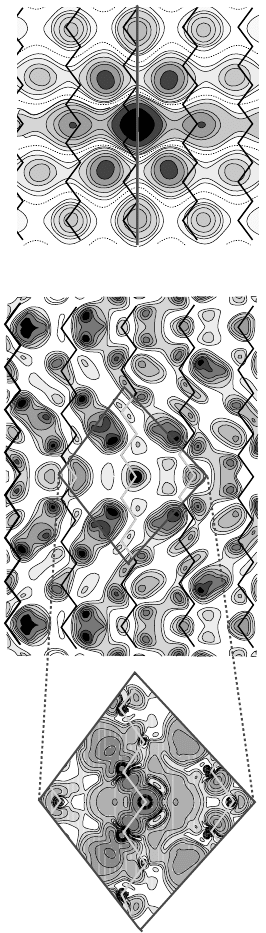
Except at the donor site, the resulting magnetization density appears to be hardly
related to the lattice structure (see right part of Figure 17.7). It shows an additional
artificial mirror symmetry with respect to the horizontal (001) plane through the
donor which is absent in the atomic positions. In addition, the first node of
~
W
1;0;0A
1
ðrÞ
nearly coincides with the nn ligand nucleus and, therefore, the isotropic shf
interaction with the
29
Si nn nuclei (which one would naively assume to be largest)
virtually vanishes.
17.4.3
Empirical Pseudopotential Extensions to the EMA
There were several attempts to find a central cell potential correction. Baldereschi [57]
has pointed out that intervalley potential matrix elements are of particular impor-
tance. These are screened by the dielectric function eðq ¼ k
ðiÞ
0
k
ðjÞ
0
Þrather than by the
322
j
17 Ab Initio Greens Function Calculation of Hyperfine Interactions
2.0
10.0
5.0
3.0
1.5
1.0
0.50
0.25
Figure 17.7 (online color at: www.pss-b.com) Contour plot of the electron density in the (1
1
0) plane for As
0
Si
in Si calculated via the LMTO-GF scheme (left part). Right:
Contour plot of the impurity electron density in the (1
1
0) plane for a shallow donor in silicon according to the EMT of Hale and Mieher [64] (the donor atom is indicated by
the black dot) and the same according the empirical pseudopotential theory Ivey and Mieher [60] (central).
17.4 Shallow Defects: Effective Mass Approximation (EMA) and Beyond
j
323
full dielectric constant e
1
. Several empirical pseudopotential schemes have been
developed giving reliable ground state donor binding energies (for a review, see
Pantelides [58]). Among these calculations, the calculation of Ivey and Mieher [59, 60]
for group V donors in Si undertakes a calculation of the shf interactions. A model
pseudopotential screened by the dielectric function is fitted to reproduce the
experimental binding energy. In contrast to the EMA calculations, all k points
throughout the Brillouin zone are sampled and u
n;k
ðrÞ is not approximated by some
u
n;k
0
ðrÞ. If compared to the EMA density, the resulting density of the donor electron
has lost the mirror symmetry, retaining only the desired A
1
symmetry of the atomic
structure (see also central part of Figure 17.7). The shf interaction of the nearest
neighbors, however, are still by about two orders of magnitude too small. In
consequence of this failure of the EMA and its extensions, the wealth of information
contained in the shf interaction data for shallow donors is completely obscured. In
the best case we need an ab initio calculation to unravel the experimental data.
Without such a calculation we cannot identify a single ligand shell from its shf
interaction data.
17.4.4
Ab Initio Green s Function Approach to Shallow Donors
In section 17.3.3 we have shown, that the Greens function method allows an accurate
description of the hf interaction, already if the perturbed region contains only 10% of
the magnetic moment of a deep defect. It is this observation that brings us to the idea
that the same should also be possible in the case of shallow states where up to 90% of
the delocalized electron are found outside the largest conceivable perturbed region.
Hence, the basic idea is now to substitute the empirical part of the EMA, the central
cell correction, by a first-principle description in which DV
local
in Eq. (17.36) is
calculated self-consistently and embedded via a Greens function approach into an
otherwise periodic, EMT-like background [61].
Similar to the case of the As-antisite in GaAs, we solve Dysons equation within a
perturbed region that contains the donor and five shells of ligands (47 atoms in
total) and six shells with 42 empty spheres to reduce the overlap of the ASA spheres.
In the ENDOR experiments for group-V donors in Si no symmetry-lowering lattice
distortions have been detected [62]. Minimizing the LMTO-ASA total energy by a
symmetry-conserving relaxation of the nearest neighbor distances we find a min-
imum for a nearest neighbor distance that is decreased by 1% for P
0
Si
, and increased
by 3% As
0
Si
and by 6% for Sb
0
Si
, respectively with respect to the distance in a perfect Si
crystal. For P
0
Si
and As
0
Si
, these values are reproduces by 216-atom supercell calcula-
tions [63]. For Sb
0
Si
, however, a considerably larger outward relaxtion of 9% is
predicted. We are of course more confident to the supercell geometry where all
atoms are allowed to relax freely. Hence, in all what follows we use the 9% supercell-
value for Sb
0
Si
. By this, we obtain considerably improved values if compared with the
values given in our original work [61].
Since in our approach we ignore the long-range tail of the Coulomb-potential for
that part of the induced density that is not contained within the perturbed region, we
324
j
17 Ab Initio Greens Function Calculation of Hyperfine Interactions
do not find a shallow gap state but rather a resonance just above the onset of
the conduction band. Thus, we cannot hope to obtain meaningful donor energies by
this approach.
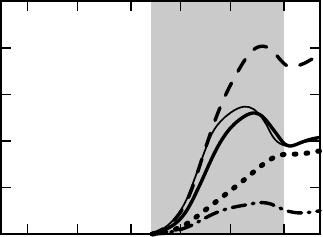
Figure 17.8 shows the change of the density of states (DOS) introduced by the
defect (the induced DOS) for the three group-Vdonors in comparison with the DOS
of the unperturbed crystal. In our approach we separate densities that arise from
states transforming according to the different irreducible representation of the group
T
d
. In Figure 17.8 we display the a
1
-like densities only, suppressing the t
2
and e-like
resonances that are ascribed to excited states. The induced DOS for P
0
Si
and As
0
Si
show
a relatively well-defined minimum near 1.6 eV above the valence band edge, for Sb
0
Si
the resonance is much less pronounced. Starting from an effective one-particle
picture, we shall consider the induced DOS below this minimum as a substitute for
the shallow gap state. It contains about 15% of an electron within the perturbed
region for P
0
Si
and As
0
Si
, while for Sb
0
Si
we find as little as 8% of an electron. Identifying
the resonance below the minimum with the extra electron, we calculate the spin
polarization of all electrons within the LSDA. The resulting magnetization density
plotted for As
0
Si
in Figure 17.7 (left) is qualitatively different from the EMT result
(right), in that it does not show the spurious inversion symmetry characteristic for the
EMT. Instead it has some similarities with the envelope function obtained by Ivey and
Mieher (central), with the clear distinction that there is no well-defined minimum at
the nearest neighbors. A more detailed comparison of the different approaches is,
however, possible via hf and shf data of ENDOR spectra, showing that our present
approach is superior to the Ivey and Mieher (I-M) and the EMT methods (see
Tables 17.2 and 17.3):
For the central donor nuclei the experimental values for the hf splitting are nicely
reproduced within 5% for all donors – P, As, as well as Sb. Also for the nearest
neighbor (1,1,1) shell, the isotropic and anisotropic shf interactions of our resonance
DENSITY OF STATES (eV
−1
)
0.20
0.05
0.10
0.15
0.6 0.8 1.0
ENERGY (eV)
1.61.41.2
Figure 17.8 Density of states per impurity
(DOS) that transform according the a
1
irreducible representation of the point group T
d
for group-V donors in silicon. The (bold) full line
denotes the induced density of the (un)relaxed
As
0
Si
, the dashed line is for P
0
Si
, and the dash-
dotted line is for the Sb
0
Si
donors. The dotted line
represents the a
1
density of the unperturbed Si
crystal. The grey area denotes the energy interval
of the a
1
resonance.
17.4 Shallow Defects: Effective Mass Approximation (EMA) and Beyond
j
325

states compare favorably with the experimental data. The agreement is in fact much
closer than for the I–Mand EMTresults for this shell. This becomes in particular clear
if analyzing the ratio b=a which characterizes the hybridization at the (111) ligand
shell (See also Table 17.3). For P and As, the values are rather insensitive to lattice
relaxations. In case of Sb however, the 9% outward relaxation is necessary to predict a
correct hybridization, b=a ¼1.09 in comparison with the experimental ratio ðb=aÞ
exp
¼0.89. Note that for a reduced relaxation of 6% a much too small ansiotropy ratio of
0.12 is obtained [61]. The next two neighbor shells have not been identified exper-
imentally, presumably because the isotropic shf constant is below about 600 kHz, the
continuum of many overlapping ENDOR lines. This explanation is in line with our
results. Note that for the (2,2,0) shell both I–M and EMTpredict hf interactions that in
contrast should be readily observed. For the (0,0,4) shell the isotropic shf data are
predicted too small by a factor of 2. For the outermost (3,3,1) shell in the perturbed
region our results compare again quite well with the experimental data.
Table 17.2 Isotropic hf and shf interactions (in
MHz) for group-V donors in Si. Experimental
values from Ref. [62] are compared with
theoretical results of the present LMTO-GF
approach, the pseudopotential approach from
Ivey and Mieher (I-M), and an EMT approach.
All data shown
have a negative sign. For Sb the values in
parenthesis belong to a smaller ligand
relaxation (6% instead of 9%).
shell donor exp. this work I-M EMT
(0,0,0)
31
P 117.5 121.4 71.2 448.
75
As 198.3 198.6 120.0 850.
121
Sb 186.8 175.4 89.4 548.
(66.8)
(1,1,1) P 0.540 0.518 0.036 1.524
As 1.284 1.168 0.060 2.424
Sb 0.586 0.405 0.090 1.232
(2.053)
(2,2,0) P – 0.115 0.608 0.861
– 0.193 0.788 1.216
Sb – 0.312 0.532 0.734
(0.587)
(1,1,
3
)P – 0.053 ––
As – 0.179 ––
Sb – 0.025 ––
(0.001)
(0,0,4) P 5.962 2.963 5.484 8.414
As 7.720 3.160 7.606 11.400
Sb 6.202 3.725 6.202 7.324
(2.923)
(3,3,1) P 1.680 1.461 1.776 0.988
As 2.242 2.351 2.590 1.290
Sb 1.008 0.910 1.212 0.872
(0.848)
326
j
17 Ab Initio Greens Function Calculation of Hyperfine Interactions

Altogether, the oscillating behavior of the shf splitting is qualitatively correct
described. In contrast, the one-particle theories are by no means able to describe the
correct order of the contribution of the different shells. Ivey and Mieher [60] have
suggested that the discrepancy in their pseudopotential approach is due to the neglect
of the lattice relaxations, an explanation that at least for P and As is not supported by
our results. More important, according our Greens function calculation, the shf
interactions are only to a small part due to the conduction band resonance: more than
75% of the isotropic shf is caused by the spin polarization of the valence band states.
Such polarizations are not included in the one-electron approach of I–M, which may
explain in part the striking discrepancy between the experimental data and the results
of the one-electron theories.
The agreement between theoretical and experimental hf and shf data, confirms
that the resonance is a valid representative of the ground state of the shallow defect
state. One may wonder whether these interferences can be found in an approach
where the Coulomb-potential that extends outside of the perturbed region has to be
cut. However, we have to note again that there is a clear distinction between the long-
ranged wave function and the long-range part of the Coulomb-tail of the potential,
although the two quantities are of course not completely independent. Whereas the
latter determines predominantly the ionization levels, it is the spatial distribution of
the wave function that gives rise to the shf splittings. It is the specific benefit of the
Greens function approach that it allows to describe the wave function of a defect
Table 17.3 Anisotropic hf and shf interactions
(the axial component b in MHz) for group-V
donors in Si. In contrast to the pseudopotential
approach from Ivey and Mieher (I-M) [60], our
LMTO-GF values compare reasonably well with
the experimental hybridization ratio b=a [62].
For Sb the values in parenthesis belong to a
smaller ligand relaxation (6% instead of 9%).
shell donor exp. this work I-M
bb=ab b=abb=a
(1,1,1) P 0.70 1.296 0.66 1.274 0.49 13.611
As 1.26 0.981 1.14 0.976 0.93 15.500
Sb 0.52 0.887 0.44 1.086 0.35 3.844
(0.25 0.122)
(2,2,0) P –– 0.01 0.087 0.03 0.049
As –– 0.02 0.104 0.03 0.038
Sb –– 0.01 0.025 0.02 0.038
(0.06 0.102)
(0,0,4) P 0.02 0.003 0.02 0.007 0.02 0.004
As 0.03 0.004 0.02 0.006 0.02 0.003
Sb 0.02 0.003 0.02 0.005 0.02 0.003
(0.05 0.017)
(3,3,1) P 0.06 0.036 0.05 0.034 0.04 0.023
As 0.08 0.036 0.09 0.038 0.08 0.031
Sb 0.03 0.030 0.04 0.040 0.03 0.025
(0.03 0.035)
17.4 Shallow Defects: Effective Mass Approximation (EMA) and Beyond
j
327
correctly, although some parts of the long-ranged Coulomb-tail of the potential are
ignored or approximated in a simple way. In order to prove that our shf results really
do not suffer from termination errors we have calculated Greens functions for
different perturbed regions. When decreasing the size of the perturbed region, the
maximum of the resonance slightly shifts to higher energies, thereby decreasing the
moduli of all hf and shf data monotonously. This decrease is not dramatic and
amounts to less than 10% if we come down to a perturbed region that consists of the
donor and 2 shells of ligands.
17.5
Phosphorus Donors in Highly Strained Silicon
Several approaches to built up solid-state based quantum computing hardware are
actively pursued. The possible integration with existing microelectronics and the
long decoherence times [65–67] are particular advantages if using the nuclear or
electronic spins of phosphorus donors in group-IV semiconductors as qubits [68–71].
These concepts require gate-controlled exchange coupling between neighboring
donors. However, to control the exchange coupling in semiconductors, the donor
atoms have to be positioned with atomic precision [72] since the strength of the hf
interaction, decisive for the rate at which two-qubit operations can be performed,
varies strongly at the atomic scale due to Kohn–Luttinger oscillations of the donor
wave function [69, 73, 74], already discussed in the last section. Under uniaxial
compressive strain in [001]-direction, two conduction band minima are lowered in
energy which is expected to suppress the oscillatory behavior in the (001) lattice
plane [73].
In a recent work [75], the hf interaction of phosphorus donors in silicon was
studied as a function of uniaxial compressive strain in thin layers of Si on virtual SiGe
substrates, extending the regime investigated by Wilson and Feher [76] by a factor of
20 to higher strains. Fully strained 15 nm-thin P-doped (½P’1 10
17
cm
3
Þsilicon
epilayers were grown lattice matched on virtual relaxed Si
1x
Ge
x
substrates with
Ge-contents x ¼ 0:07; 0 : 15; 0:20; 0:25, and 0.30. The Si
1x
Ge
x
layer determines the
strain of the Si epilayer: The higher lattice constant of SiGe alloys with respect to Si
leads to biaxial tensile strain, accompanied by a compensating uniaxial compressive
strain in growth direction (cf. inset in Figure 17.9), whereby the substrate with the
highest Ge-content leads, of course, the largest strain. By high-resolution X-ray
diffraction (XRD) it was shown that the compression in growth direction indeed
follows linear elasticity theory.
To observe the P donors with high sensitivity, electrically detected magnetic
resonance (EDMR) was used which monitors spin resonance via the influence of
spin selection rules on charge transport processes [77–79]. The unstrained silicon
layer provides the expected fingerprint of an isolated P-donor [80, 81] with an
isotropic g-factor of g ¼1.9985, whereby the characteristic hf-split satellite lines with
a separation of A
hf
¼ 117:5 MHz are clearly resolved. For the strained epilayers, in
contrast, the hf splitting decreases monotonously with the applied strain. Simulta-
328
j
17 Ab Initio Greens Function Calculation of Hyperfine Interactions