
Alkauskas A., Deak P., Neugebauer J., Pasquarello A., Van de Walle Ch.G. (Eds.) Advanced Calculations for Defects in Materials: Electronic Structure Methods
Подождите немного. Документ загружается.

E
contact
¼
8p
3
m
B
hW
L
jSðrÞm
I
sdðrÞjW
L
i
þhW
L
j
1
r
4
qS
qr
½m
I
sr
2
ðm
I
rÞðs rÞjW
L
i; ð17:13Þ
E
orb
¼
e
mc
m
I
hW
L
j
L
r
3
jW
L
i; ð17:14Þ
E
dip
¼ m
B
hW
L
j
1
r
5
½s m
I
r
2
3ðs rÞðm
I
rÞjW
L
i: ð17:15Þ
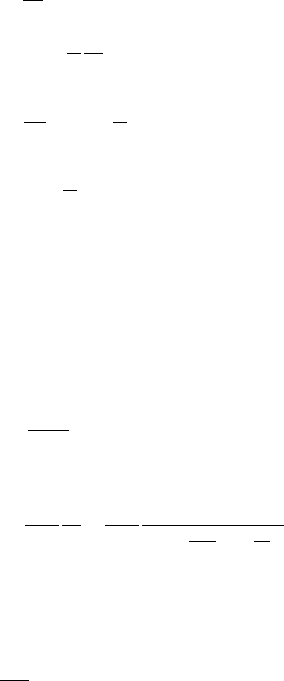
In the non-relativistic limit, since SðrÞ!1; only the first term in Eq. (17.13)
contributes to the isotropic contact term E
contact
. By this, we obtain the results of
the classical theory given by Fermi [13], that only the probability amplitude at the
nucleus contributes. In the relativistic case, however, this first term does not
contribute at all. It is the second term in Eq. (17.13) which is the relativistic analog
to the contact interaction. For a pure Coulomb-potential around a given nucleus we
obtain
V
eff
ðrÞ
Ze
2
r
; ð17:16Þ
and the derivative qSðrÞ=qr is similar to a broadened d-function
d
Th
ðrÞ¼
1
4pr
2
qS
qr
¼
1
4pr
2
r
Th
=2
1 þ
E
2mc
2
r þ
r
Th
2
2
: ð17:17Þ
In other words, the magnetization density of the electron in the relativistic theory is
not simply evaluated at the origin, where it would be divergent for s-electrons, but is
averaged over a sphere of radius
r
Th
¼
Ze
2
mc
2
; ð17:18Þ
which is the Thomson radius, about ten times the nuclear radius. As a result, the
divergence of the s-electrons presents no problem. Also if we approximate the nuclear
potential by that of a charged volume rather than that of a point charge [16], the
divergence already disappears. However, it is important to note, that we would obtain
divergent contact terms mixing the approximations, e.g., using (scalar)
1)
relativistic
orbitals in a non-relativistic formula.
If the ground state of the defect is a single determinantal orbital singlet state
with total spin S, we have the simple case where the orbital angular momentum
1) In the scalar relativistic treatment W
L
is calculated solving Diracs equation but thereby ignoring
spin-orbit interactions. This leaves the electron spin as a good quantum number. Already in a scalar
relativistic treatment, s-like wave functions diverge at the nuclear site (if the nucleus is taken to be a
point charge).
17.2 From DFT to Hyperfine Interactions
j
309
is quenched [17]. The orbital state transforms like an angular momentum
eigenfunction with quantum number l ¼ 0. Hence, the expectation value of the
angular momentum operator vanish, and there are no orbital contributions E
orb
to the hf interactions. Writing the N-particle wave function jW
L
i¼jS; M
S
i as a
single Slater determinantal in real space representation, the hf interaction is then
fully described by the matrix elements hS; M
S
jH
HF
jS; M
0
S
i with respect to the
spin Hamiltonian
H
HF
¼
X
k
fa
k
S I
k
þS B
k
I
k
g: ð17:19Þ
It is important to note that the matrix elements (r
k
¼rR
k
)
a
k
¼
1
2S
8p
3
c
k
ð
mðrÞd
TH
ðr
k
Þd
3
r; ð17:20Þ
B
k
¼
1
2S
c
k
ð
mðrÞ
3r
k
r
k
r
2
k
1
r
5
k
d
3
r; ð17:21Þ
can be expressed as a sum over single-particle matrix elements with respect to the
magnetization density without the need to construct many-body wave functions first.
We have simply to insert the magnetization densities obtained from the self-
consistent LSDA calculation and obtain the hf interactions with the central nucleus
as well as with the ligands (ligand hf interactions or shf interactions). Since each of the
B
k
is traceless, its diagonal elements can be parametrized by two parameters b
k
and
b
0
k
, describing the axial and non-axial part of the anisotropy.
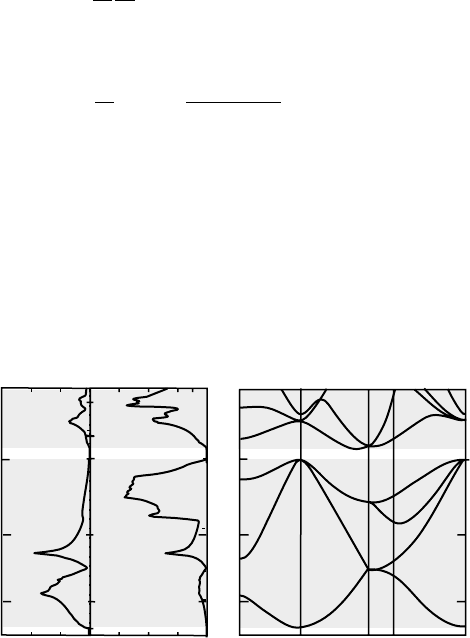
L
ΓΛ
X
∆
K
Σ
Γ
Energy (eV)
density of states
t
2
a
1
0
−10
−5
5
Figure 17.1 The density of states (DOS) distribution for the silicon crystal broken up into states
transforming according to a
1
(left) and to t
2
(right), is compared with the energy bands plotted along
the high-symmetry directions.
310
j
17 Ab Initio Greens Function Calculation of Hyperfine Interactions
17.3
Modeling Defect Structures
17.3.1
The Greens Function Method and Dysons Equation
By introducing a point defect into the otherwise perfect crystal we break the
translational symmetry, and the periodicity of the ideal crystal is lost. Nevertheless,
the method most frequently used for the computation of point defects in solids is the
supercell method: instead of an isolated system with a single point defect one
considers a three-dimensional lattice of clusters, each with a single point defect. This
crystal can be treated theoretically by the known methods of energy band theory,
however, with the cluster as the supercell unit cell.
The Greens function method [18–20] embeds a single defect into an otherwise
perfect crystal (cf. Figure 17.2). For this system the effective potential V
eff
is split into
the effective potential V
0
eff
of the undisturbed crystal plus some short-ranged
impurity-related potential DV
V
eff
¼ V
0
eff
þDV: ð17:22Þ
DV can be quite large at the defect site but will decay rapidly with the distance from
the defect center. The Greens function, G
0
, for a perfect crystal characterized by the
Hamiltonian H
0
is defined as [21]
Figure 17.2 (online color at: www.pss-b.com)
Dysons equation: A perturbation DV is
embedded into a reference system
characterized by the unperturbed Greens
function G
0
. Within the perturbed region
(colored) the Greens function G of the
perturbed system is determined via
Eq. (17.29):G ¼ð1G
0
DVÞ
1
G
0
. Outside this
region, G remains unchanged and matches G
0
.
17.3 Modeling Defect Structures
j
311
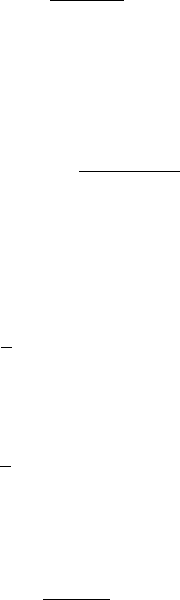
G
0
ðEÞ¼ lim
e !0
þ
1
EieH
0
: ð17:23Þ
A small imaginary part added to the energy prevents a singularity forE ¼ E
n;k
, i.e.,
within the valence and conduction bands (cf. Figure 17.1). G
0
can be expressed in
terms of Bloch functions jj
n;k;s
i for the spin state s, which solve the Kohn–Sham
equations for the perfect crystal:
G
0
ðEÞ¼ lim
e !0
þ
X
n;k;s
jj
n;k;s
ihj
n;k;s
j
EieE
n;k;s
: ð17:24Þ
The sum in Eq. (17.24) includes all states f n; k; sg, not just the occupied states.
Vice versa, the Greens function G for a given system includes all electronic ground
state properties of this system. The full information of the density of states
distribution (DOS)
DðEÞ¼
1
p
ImTrfGðEÞg ð17:25Þ
and most important the (spin-polarized) electron densities are obtained by summing
up the occupied bands only
n
s
ðrÞ¼
1
p
Im
ð
occ:
G
s
ðE; r; rÞdE
: ð17:26Þ
For a crystal containing a deep defect, the Greens function G corresponding to the
full Hamiltonian H reads
GðEÞ¼ lim
e !0
þ
1
EieH
; ð17:27Þ
where the Hamiltonian now contains the full effective potential V
eff
. The Greens
function G is related to G
0
by a Dyson equation
G ¼ G
0
þG
0
DVG; ð17:28Þ
which can be solved iteratively
G ¼ð1G
0
DVÞ
1
G
0
: ð17:29Þ
The solution of Eq. (17.29) is possible if we have to invert ð1G
0
DVÞ only in the
vicinity of the defect, the perturbed region, where DV is non-negligible. In contrast,
the Greens functions G
0
and G extend outside this perturbed region. Despite the
localized shape of the perturbation DV, the approach via Dysons equation is very
flexible. Nowadays, it is a standard tool to describe transport properties in micro-
scopic nanostructures [22], whereby DV is determined by the conductance electrons.
One result of a self-consistent calculation of Dysons equation for a defect is
the electron density n(r). It can, of course, also be decomposed into contributions
from different spin directions n
s
(r). For the hf interactions we will need the
magnetization density
312
j
17 Ab Initio Greens Function Calculation of Hyperfine Interactions

mðrÞ¼
1
p
Im
ð
occ:
½G
"
ðE; r; rÞG
#
ðE; r; rÞdE
: ð17:30Þ
We have already noted in Section 17.2.1 that in fully converged LDA calculations
the fundamental band gap turns out to be too small. For silicon, this difference is
about 0.5 eV and for wide band gap semiconductors like GaAs, GaN, or SiC, the error
is in the range of 1 eV or even larger. In some cases, defect-induced gap states, which
should be located in the upper part of the gap, are calculated to be resonances in the
conduction band. Also if this worst case scenario is not given, the hf interaction can be
affected [23]. The Greens function method provides a way to circumvent this
problem by a rigid shift of the crystalline conduction bands by some amount DE
shift
with respect to the valence bands, before calculating G
0
. This formalism, called
scissor operator ScfEg¼E þDE
shift
, was introduced by Baraff and Schl
€
uter [24].
Hence, by substituting Eq. (17.24) by
G
0
ðEÞ¼ lim
e !0
þ
X
n;k;s
jj
n;k;s
ihj
n;k;s
j
EieScfE
n;k;s
g
; ð17:31Þ
we are able to adjust the fundamental gap to a given experimental value. It is
important to note here that this has to be done only once, namely if calculating
the Greens function of the ideal crystal. Afterwards, since the Greens function
approach is applied in real space without the need of periodic images, the band
edges are retained, and each one-particle level is corrected automatically in a self-
consistent way.
17.3.2
The Linear Muffin-Tin Orbital (LMTO) Method
For a periodic system like a crystal, one might consider a plane wave expansion to
be the simplest computational method. And indeed, most supercell calculations use
the pseudopotential method for which the inclusion of short-ranged lattice relaxa-
tions is relatively straightforward. Since by construction the pseudo-wave functions
do not include the rapid oscillations in the core region, the resulting spin pseudo-
wave densities are not directly applicable for the computation of hf interaction matrix
elements, determined in the vicinity of the nuclei. Van de Walle and Bl
€
ochl [25] used a
projector formalism to reconstruct the original wave function from the pseudo-
functions. Alternatively, in the muffin-tin methods, V
eff
is assumed to be spherically
symmetrical within atomic spheres around R
j
,
VðrR
j
Þ¼
VðjrR
j
jÞ if jrR
j
js
j
const: else;
ð17:32Þ
and the Kohn–Sham orbitals are expanded into spherical harmonics times a radial
solution. Different muffin-tin methods are in use which differ in the technical
procedure used to construct a regular Bloch wave from the partial wave solutions
obtained within the atomic spheres: the Korringa–Kohn–Rostocker (KKR) method
17.3 Modeling Defect Structures
j
313
[26, 27], the linear muffin-tin orbital (LMTO) method [28, 29], and the linearized
augmented plane wave (LAPW) method [30]. Compared with the pseudopotential
method the muffin-tin methods have the advantage that the correct electron and
magnetization density in the nuclear region can be directly and very accurately
obtained, which is decisive for the hf interaction. All muffin-tin methods, however,
share the disadvantage that they are technically difficult and, due to the use of atomic
spheres, less flexible with respect to larger lattice relaxations, although there are full-
potential versions of all the muffin-tin methods, FP-KKR [31], FP-LMTO [32], and
F-LAPW [33].
In this work, we use the LMTO-ASA method since it provides perhaps the easiest
and straightforward way to realize the Greens function method via a muffin-tin
approach [20]. In the atomic spheres approximation (ASA) the sphere radii for the
integrals are chosen such that the unit cell volume equals to the sum of the ASA
sphere volumes. In this approximation, the ASA spheres overlap slightly and the
contribution of the neglected regions are assumed to be cancelled by the double-
counted overlap. For open structures like semiconductors, additional empty
spheres centered around the highly symmetrical interstitial sites of the lattice have
to be inserted in order to optimize the volume-filling.We have extended the LMTO-
ASA Greens function approach to include moderate lattice relaxations. For the
resulting distorted structures the concept of space-filling ASA spheres is no more
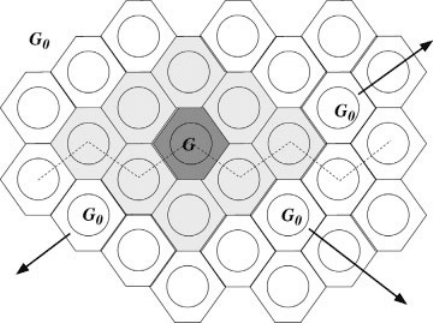
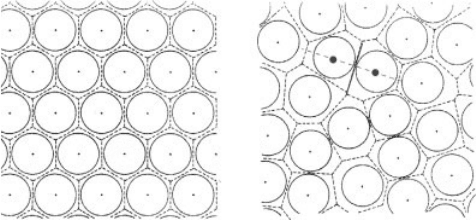
straightforward. Here, the concept of a Voronoi tessellation is very helpful
(cf. Figure 17.3), whereby the decomposition of a metric space is determined by
distances to a discrete set of points, the center of the Voronoi cells (either given by a
nucleus or the center of an empty cell) [34]. The concept can be easily extended to
hetero-atomic structures using a weighted decomposition. Here, we use the so-called
Bragg–Slater radii [35], whereby the ASA condition of space-filling spheres can be
easily fulfilled by constructing an ASA sphere S
j
with radius s
j
to each Voronoi cell Z
j
:
VðS
j
Þ¼VðZ
j
Þ: ð17:33Þ
Using the in this way extended ASA approximation, we solve Dysons equation in
LMTO matrix representation [20]
Figure 17.3 (online color at: www.pss-b.com) Wigner–Seitz cells of a two-dimensional regular
structure (left) and in comparison a disordered structure divided into Voronoi cells (right). Possible
non-overlapping muffin-tin radii are also given.
314
j
17 Ab Initio Greens Function Calculation of Hyperfine Interactions

f1 þg
0
ðEÞ½DPðEÞDSggðEÞ¼g
0
ðEÞ; ð17:34Þ
within a perturbed region large enough to allow a proper description of DS and DP.
Here, DP ¼ PP
0
is the localized, diagonal perturbation of the so-called potential
function [20] describing the electronic structure of the investigated atomic structure,
and ensuring that the partial waves from the muffin-tin spheres fulfill the correct
bounding conditions. DS ¼ S
R
0
L
0
;RL
S
R
0
0
L
0
;R
0
L
is the relaxation-induced change of the
LMTO-ASA structure constants
S
R
0
L
0
;RL
¼ð1Þ
l þ1
8p
X
l
00
l!l
0
!ð2l
00
Þ!
ð2lÞ!ð2l
0
Þ!l
00
!
a
d
RR
0
l þl
0
þ1
X
m
00
C
LL
0
L
0
Y
L
00
ðd
^
RR
0
Þ;
ð17:35Þ
whereby C
LL
0
L
00
:¼
Ð
V
Y
L
ðr
^
ÞY
L
00
ðr
^
ÞY
L
00
ðr
^
ÞdV and Y
L
ðr
^
Þ as spherical harmonics with
L ¼ðl; mÞ. The calculation of the rather extended matrix DS is more elaborate: the
long-ranged tails of the matrix elements are split up and treated by generalized Ewald
sums [36], whereas the short-ranged contribution are calculated in a next-nearest
neighbor approximation.
In the general case, the atomic position {R} of the relaxed structure can be taken
from pseudopotential calculations. The electronic structure to the relaxed structures
can then be calculated via Eq. (17.34), including the (s)hf parameters of paramagnetic
states. We will see, however, that in some cases with rather moderate relaxation,
the extended LMTO-ASA GF approach is also able to predict at least the nearest
neighbor relaxation.
17.3.3
The Size of The Perturbed Region
Using a Greens function method, the spin densities arising from the defect states are
not completely contained in the rather limited volume of the perturbed region.
Surprisingly, this does not cause a problem as will be shown in the following, taking
the isolated As
þ
Ga
antisite in GaAs as a reference system (Table 17.1 where also well
established experimental data is available):
The gap state, that mainly gives rise to the magnetization density (See Figure 17.4)
and, thus, to the hf interaction of the paramagnetic As
þ
Ga
charge state, transforms
according to the a
1
irreducible representation of the group T
d
. For the neutral and the
two-fold positive, diamagnetic charge states, this state is unoccupied. The total
energies, E
tot
, and the single particle eigenvalues of this gap state, E(a
1
), also shown
in Table 17.1 seem to depend on N
atoms
in a rather unsystematic manner. However,
the variation of E
tot
for the E
2þ
and E
0
charge states is practically identical with that for
E
þ
, and therefore, the charge transfer energies are essentially independent of N
atoms
.
In Table 17.1 we also show the convergence of the corresponding hf interactions,
calculated using perturbed regions of different sizes. The magnetization density is
mainly concentrated on the central antisite atom, where it gives rise to the largest
nearly isotropic hf splitting, and on its four nearest neighbors, where it is predom-
17.3 Modeling Defect Structures
j
315
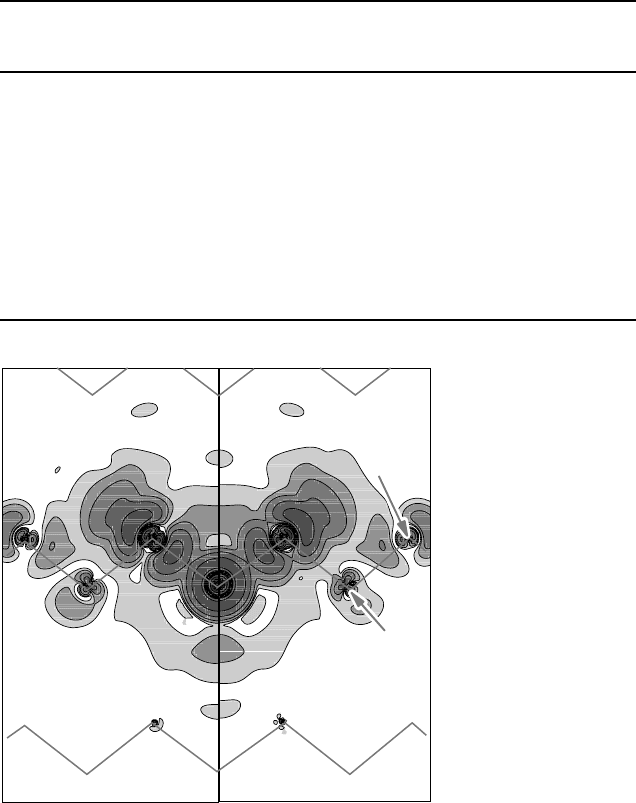
Table 17.1 The influence of the size of the
perturbed region on the total energy, E
tot
, the
gap state energy E(a
1
), the magnetic moment of
the gap state m
gap
and the total magnetic
moment m
pert
within the perturbed region, as
well as the hf interactions (MHz) (upper line for
a, lower line for b) for the 3% outward relaxed
isolated As
þ
Ga
antisite in GaAs. Beside the hf
values for the central As
þ
Ga
nucleus, the shf
splittings due to several neighbor shells of the
crystal host are also given. N
atoms
is the number
of atomic ASA spheres in the perturbed region.
Experimental data taken from Refs. [37, 38].
N
atoms
E
tot
E(a
1
) m
gap
m
pert
As
þ
Ga
As Ga As As
(0,0,0) (1,1,1) (2,2,0) (1,1,3) (3,3,1)
1 107.83 1.478 0.097 0.113 2811.
5 107.47 0.988 0.469 0.499 2778. 187.7
46.1
11 108.09 1.080 0.572 0.598 2846. 175.3 8.8
45.8 1.5
23 108.04 1.063 0.614 0.638 2839. 175.8 7.4 0.3
45.7 1.5 0.2
47 107.82 0.995 0.817 0.840 2879. 173.2 3.9 0.1 22.3
46.6 1.4 1.9 4.2
exp. 2650. 169.3 ––21.5
53.2 ––2.2
As(1,1,3)
_
As(3,3,1)
Ga(2,2,0)
Figure 17.4 (online color at: www.pss-b.com)
Contour plot of the magnetization density for
the isolated As
þ
Ga
antisite in a ð1
1
0Þ plane in
GaAs (taken from Ref. [44]). The left panel
shows the contribution of the gap state, the right
part gives the total magnetization density. The
Ga (As) lattice sites are at the lower (upper) side
of the zig-zag chain of nearest neighbor bonds,
respectively.
316
j
17 Ab Initio Greens Function Calculation of Hyperfine Interactions
inantly p-like. The smallest conceivable perturbed region consisting of the defect ASA
sphere alone contains about 10% of the magnetic moment of the defect. Yet, we
obtain a central contact hf interaction at the As
Ga
antisite nucleus which is only 2%
smaller than the value obtained for the largest perturbed region with 47 atoms. It is
obvious and quite impressive that via the Greens function approach the defect is
really embedded in an infinite background. Even if we do not present the data
explicitly, the reader should believe that this procedure also works in the case of a
vacancy: only an empty sphere is then necessary to obtain at least rough estimates.
From Table 17.1 we see that for different sizes of the perturbed region the hf
interactions with the nuclei at the surface of the perturbed region is slightly
overestimated. With a further increase of N
atoms
the corresponding values are
reduced to better values. For the contact hf interactions of the more distant Ga
(2,2,0) and As(1,1,
3
) ligands the convergence apparently is quite poor, but here the
magnetic moments for the ligand ASA shells are extremely small. The value of 4 MHz
for the contact interaction with a [69] Ga nucleus corresponds to 2 10
4
of a single
s-like spin only.
17.3.4
Lattice Relaxation: The As
Ga
-Family
Experimentally well understood, the isolated As
Ga
antisite is only one member of the
technologically very important As
Ga
-family: At least four different As
Ga
-related
defects with almost identical hf structure have been detected by magnetic reso-
nance [37–39]. Their thermal stability is quite puzzling: the well established isolated
As
Ga
defect is obtained by low-temperature electron irradiation of semi-insulating
GaAs and disappears at room temperature [40], when in electron-irradiated material
the so-far unidentified As
Ga
-X
1
defect is observed. At T ¼520 K the As
Ga
-X
1
defect
disappears and the so-called EL2 becomes dominant. The latter defect is quite stable.
It is the dominant defect in semi-insulating GaAs [41, 42] where it determines the
position of the Fermi level. The EL2 can be eliminated by a rapid quench from
1100
C [43] and is recovered by annealing the sample above 750
C. Its paramagnetic
properties strongly suggest the EL2 to be a nearly tetrahedral defect. If the EL2 is not
the isolated antisite it should be, thus, at least some pair or complex with some other
partners. However, the exact microscopic structure of the EL2 defect is still contro-
versial (for a review, see Refs. [39, 44]).
Another interesting aspect of the members of the family of As
Ga
-related defects is
their metastability. Theoretical ab initio calculations [45–47] have shown that a lattice
relaxation around the As
Ga
antisite atom is responsible for the defect metastability.
We have, thus, investigated the influence of the lattice relaxation onto the hf
interaction (See Table 17.1 for the largest perturbed region). For the isolated
tetrahedral point defects a symmetry-conserving relaxation of the nearest neighbors
was included to determine the lattice relaxation from the minimum of the total
energy. For the neutral isolated As
0
Ga
point defect we find a minimum of the total
energy if the distance to the nearest neighbors is increased by 4.7% with respect to the
bond-length in the unperturbed crystal. The energy gained by this relaxation is
17.3 Modeling Defect Structures
j
317
0.32 eV. A very similar relaxation (4.0%, 0.33 eV energy gain) was reported by
Dabrowski and Scheffler [45] for a 54-atom supercell calculation. For the defect in
the singly positive, paramagnetic charge state the relaxation reduces to 3% (1.4% for
the double positive charge state). For the relaxed defects the calculated charge
transition energies are E
2 þ=þ
¼ E
v
þ 0.98 eV and E
þ=0
¼ E
v
þ 1.18 eV, if the band
gap is adjusted to the experimental value by the Scissor operator, somewhat smaller
than the results (1.25 and 1.5 eV, respectively) obtained by Baraff and Schl
€
uter [48]
and by Delerue [49]. Without such an adjustment of the gap, the charge transition
energies would be E
v
þ 0.37 eV and E
v
þ0.55 eV, respectively.
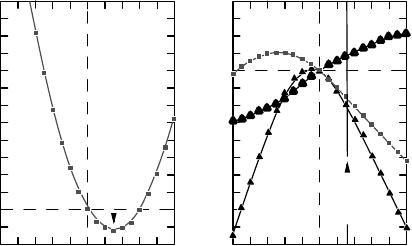
Figure 17.5 shows the calculated total energy for the isolated As
þ
Ga
defect as a
function of the nearest neighbor distance d for a relaxation that does not alter the
tetrahedral defect symmetry. Also shown is the dependence of the hf interactions
with the antisite nucleus and of the shf interactions with the nearest neighbors. As is
the case for all deep donor states, the hf interaction with the donor nucleus is quite
sensitively dependent on the nearest neighbor distance. In our case, the moderate 3%
outward relaxation obtained for the minimum of the total energy leads to a 7%
decrease of the hf interaction with the central nucleus (the same relaxation leads to a
9% decrease of the isotropic shf interaction and a 5% increase of the anisotropic shf
interaction with the nearest neighbor nuclei).
Similar to the case of elemental semiconductors [50], the magnetization density is
the subject of strong oscillations (See also Table 17.1): The shf splittings are rather
small at the (2,2,0) and ð1; 1;
3
Þneighbors, but again much larger at the more distant
(3,3,1) neighbor, the fifth shell of neighbors. In particular, there are no larger
interactions with the Ga nuclei, in agreement with the fact that these have not been
0
0
1
1.1
0.9
0.8
0.7
0.6
1.1
1
0.9
0.8
0.7
0.6
0.5
0.9 0.94 0.98
1.02
1.06
1.1
0.5
1.2
1.2
a/a
b/b
0.9 0.94 0.98
1.02
1.06
1.1
d/d
0
d/d
0
1.2
1.0
0.8
0.6
0.4
0.2
0
−0.2
0
Energy (eV)
Figure 17.5 (online color at: www.pss-b.com)
Calculated total energy for the As
þ
Ga
antisite as a
function of the nearest neighbor distance d
(left). d
0
is the nearest neighbor distance for the
unrelaxed GaAs crystal. The right panel shows
the relative change of the hf interactions upon
relaxation normalized to its respective
unrelaxed values a
0
and b
0
: Contact interaction
with the antisite nucleus (square) and contact
(full triangle) and dipolar (open triangle)
interactions with the nearest neighbor nucleus.
318
j
17 Ab Initio Greens Function Calculation of Hyperfine Interactions