
Antliff Allan. Anarchy and Art: From the Paris Commune to the Fall of the Berlin Wall (ENG)
Подождите немного. Документ загружается.

Antliff, Allan (Author). Anarchy and Art : From the Paris Commune to the Fall of the Berlin Wall.
Vancouver, BC, CAN: Arsenal Pulp Press, 2007. p clx.
http://site.ebrary.com/lib/dominicanuc/Doc?id=10308829&ppg=160
160 ANARCHY AND ART
SHEEPS MEA
cu .. �
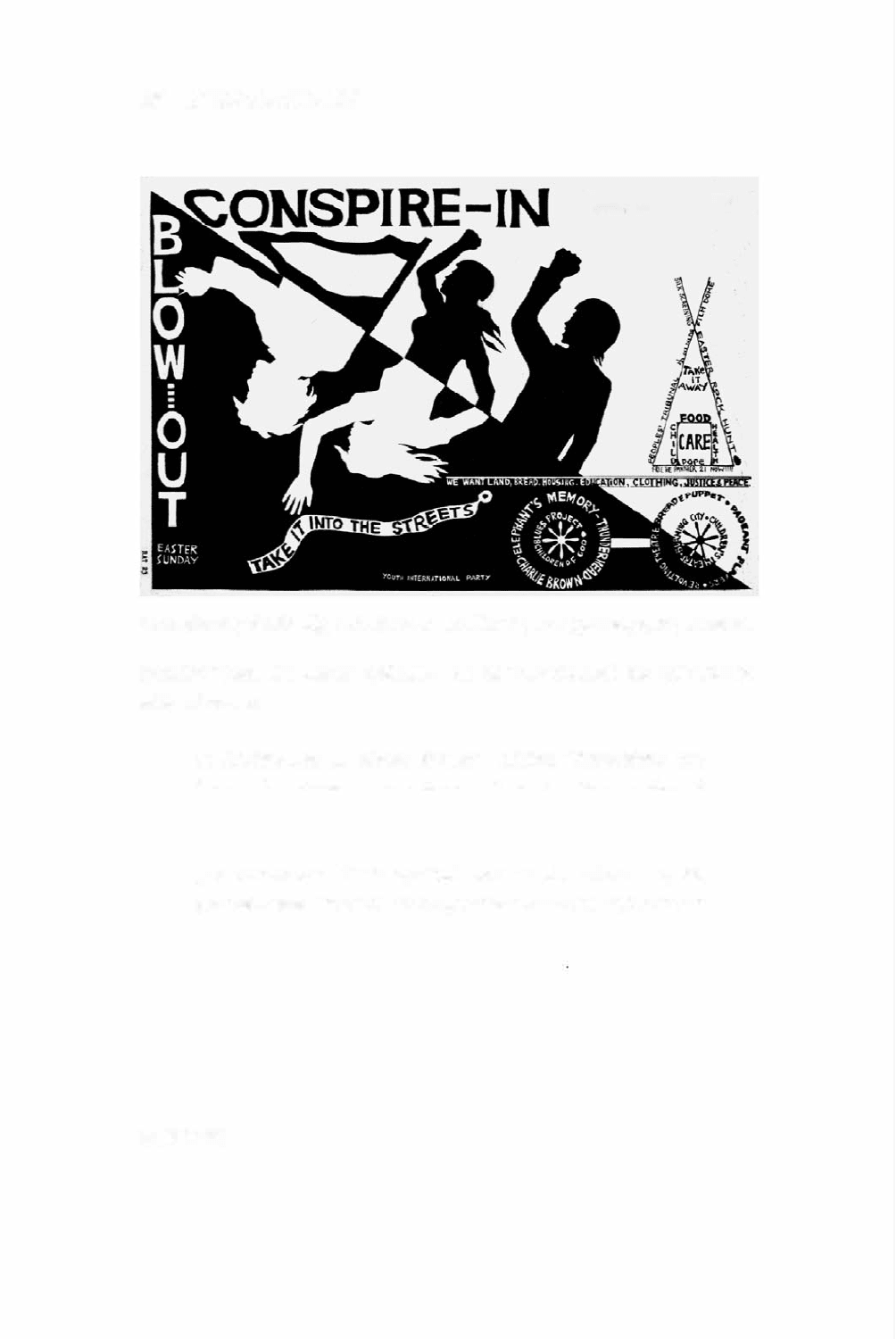
SIISa71 Si1esky Bielifa, Yipp Be-/7I Pleli Ral, March 7-21, 1970. elll pape pm ad i"k.
Francisco] and the lower East Side." He also emphasizes the importance
of the Provos:
In Amsterdam ... street players dubbed themselves the
Provos (short for provocateurs). Practicing the politics of
'free' they opened parks to free concerts, established crash
pads [free housing], and ladled out soup to moneyless hun
gry customers. Their symbol became the white bicycle.
Second-hand wheelies were painted white and left around
the city. Whoever needed one could take one, pedal away,
and leave it at another location for the next ... (They] estab
lished a
community ambience that would be held up as a
model by all of us. Dana Beal picked up on the Provos and
founded a chapter on the lower East Side.
That's Hoffman's recollection-can you say more about anarchism in
New York?

Antliff, Allan (Author). Anarchy and Art : From the Paris Commune to the Fall of the Berlin Wall.
Vancouver, BC, CAN: Arsenal Pulp Press, 2007. p clxi.
http://site.ebrary.com/lib/dominicanuc/Doc?id=10308829&ppg=161
BrtaKo/lt fr om tbt Prin H/it oIModtmiml
161
In my exploration of the political world, I came across the Free
University in 1965-66. This school was started by Allen Krebs and
then run by Sharon Krebs, and classes were taught by a member of the
anarchist Fugs rock band and by Murray Bookch in. I never attended
classes! but I went there to hang out and it fueled my imagination.
Here is what Roy Lisker, one of the instructors, wrote about the Free
University when you were attending:
The people that Allen Krebs engaged to set up the Free
University of New York represented every shade of opinion
across the New Left: poets
and writers, disaffected scholars,
union organizers, activists, free-lance journalists, and pub·
li�hp, crpativp individlJal� of pvpry �ort. Our goal from thp
beginning was to establish a forum in which every direction
of contemporary political activism would be represented.
Courses were to be taught by persons actually involved in
bringing about the changes they were ad
vocating.
The curriculum for the first two terms contained, in addition
to those on leftist politics, courses ranging from hallucinato
ry
drugs to sexual liberation to astrology. Important courses
were offe red that were not available,
or even imaginable, at
many main-stream universities: History of the American Left
(Staughton Lynd); History of the Labor Movement (Stanley
Aronowitz); Cuba To day; Training in non-violent tactics;
History of the National Liberation Front. Paul Krassner {a
Yippie], editor of the scathing and satiric political magazine,
The Realist,
gave a course entitled "Why the New York Times
is funnier than
Mad Magazine.� The enthusiasm that pre
vailed in the first term of the Free University of New York,
from November
'65 to February '66, carried over into the
spring. It was an inspiring time for all concerned.lS

Antliff, Allan (Author). Anarchy and Art : From the Paris Commune to the Fall of the Berlin Wall.
Vancouver, BC, CAN: Arsenal Pulp Press, 2007. p clxii.
http://site.ebrary.com/lib/dominicanuc/Doc?id=10308829&ppg=162
162 ANARCHY AND ART
The Free University was one place where anarchists made themselves
known. I h
ave been told that anarchists were also a real presence at
anti-Vietnam War demonstrations.
In terms of actions, anarchist afnity groups for street demonstra
tions were into satire and self-satire. Wearing motorcycle helmets and
leather jackets, our sts in the air, we played the role of militant dem
onstrator, but knew that it was more theatrical,
in opposition to other
segments
of the anti-war movement who were in essence begging,
pleading, and lobbying those same politicians responsible for the war
in the rst place. Demonstrators were relegated to being, in essence,
little more than numbers used as lobbying capital by mainstream Iib
ral laurs-a futile and d
e
p
rssing strategy. Ntwor of anti-illlp
rialist afnity groups went on "vote in the streets, vote with your fe et"
split
-ofs from every
Tlljor demonstrtion. 'h ile the big ntiwr
co
alitions were demanding the gradual withdrawal of American troops
from Vietnam-USupport our troops, Br
ing them home"-we were
calling for "victory to the Vietnamese!" and admission that the war
was wrong in the rst place. I remember one such split-off from a very
large picket of a Democratic Party event at an upscale midtown hotel.
""'ord was passed to disperse and converge on Wa ll Street, the power
behind the war-makers. Thousands of demonstrators went downtown
by subway and ran a gauntlet ahead of mounted police to the sound
of crashing plate glass. This kind of action declared, "no
business
as-usual." Radical scholars kept tabs on
the war-proteering corpora
tions and made the locations of the military industrial complex com
mon knowledge, opening them up to exposure for complicity during
demonstrations.
I
should also mention there were a lot of street anarchists at the
Guardian. They weren't only the writers and editors; they were the de
livery people, people in the art department, and the typists-young,
like me. It was pretty much an anarchist youth culture. There were
also plenty of what would now be called anarchist
afnity groups and
collectives that were active
on the Lower East Side.
More importantly,
I had become part of a movement that was be-

Antliff, Allan (Author). Anarchy and Art : From the Paris Commune to the Fall of the Berlin Wall.
Vancouver, BC, CAN: Arsenal Pulp Press, 2007. p clxiii.
http://site.ebrary.com/lib/dominicanuc/Doc?id=10308829&ppg=163
Brmkot [rol lhf PriiOll HOif of Modfiml 163
coming "articulate"- working in groups which operated by consen
sus and where ideas were developed collectively. Every organization
I was involved with had a "bottom up" (anarchist) ethic-decision by
consensus, encouraging participation in decision-making on an equal
basis-as a matter of principle. My politics were clearly anarchist, but
not identied as such during the 1960s, because the poli
tical divid
i
ng
line in the movements of that time, anti-Vietnam War, black libera
tion, women's liberation, etc., was between anti-imperialist radical so
cial change and reformism.
I was also becoming more class-conscious
and identied anarchism as mainly inuential in terms of cultural
expression-despite reading Emma Goldman's autobiography,
Living
My L, as well as Labor's Un told St [by Richard Boyer and Herbert
MoraisJ during that time.
People I knew in SDS who identied as anarchist included Shero
from A\lstin sns (t
h
e. "Texs nrchists''), who t\lrned me Wy from
the Rat when I asked to do artwork there. Unfortunately, other self
identied anarchists in New York, all of them male, came across as in
tensely chauvinist. Many of them were associated with the 1950s Beat
poets who were as infamous as the male artists among the abstract
expressionists for treating women like dirt. So
I did not really identi
with anarchism as a contemporary movement.
So sexism, a generational disconnect, and your own prioritizing of
uclass
struggle" over "culture"-in retrospect a false dichotomy, obvi
ously-were factors: was there anything else?
At the Gum-dian, how people labeled themselves politically often bore
little connection to how they behaved. Pockets of anarchist ideas
about decision-making existed in various departments. ork styles
and networks within the staff deed political self-denitions as anar
chist, socialist, new left, fe minist.
The "anarchists" at the
Guanlio were in afnity groups that car
ried National Liberation Front ags at anti-war demonstrations and
actual pigs' heads on pikes labeled with the names of prominent liber
als, like Bobby Kennedy.3? J marched with them on more than a few oc-

Antliff, Allan (Author). Anarchy and Art : From the Paris Commune to the Fall of the Berlin Wall.
Vancouver, BC, CAN: Arsenal Pulp Press, 2007. p clxiv.
http://site.ebrary.com/lib/dominicanuc/Doc?id=10308829&ppg=164
164 ANARCH Y AND ART
casions,
but kept my distance because of their uncritical hero worship
of the Black Panther Party and loyalty to "fearless leaders" like "" alter
Te ague and his Committee to Aid the National Liberation Front:fO
Te ague was a one-man "organization" who recruited younger, blindly
loyal kids work for him. There was no consciousness of working
collectively there whatsoever. My position was that the best thi
n
g that
people could do was to continue to build a powerful movement against
the government and
limit its ability to conduct unjust wars like the
one in Vietnam in the future. Idolizing the Vietnamese "liberation
ghters" was nOt the way to actua
lly help people in Vietnam.
Not the typical activist position-there was a lot of messy thinking back
then that, in the absence of an anarchist critique, led to some serious
contradictions. Marxists and the movements influenced by them argued
for ocil lihprtion vi lJthnritrin prty org;i7ing ;lnd thp pthlih
ment of state dictatorships.
"Dictatorships of the proletariat" to overthrow capitalism-dictator
s
hips which were supposed eventually wither away. At the GU'dian,
most of the staff, including the outspoken anarchists, were uncritical
toward the hierarchical structures ofthe Black Panther Party and the
L I certainly supported both, but not as a "true believer" look
ing for a perfect leader. Many among the afnity groups were jus
t
as eager as the We athermen prove to the Panthers that they were
"heavies" and "down" for the revolution which they expected to hap
pen momentarily.4!
I was vocal in criticizing these ideas as being out
of touch with reali
t
y, but few were listening. A lo
t
of "revolutionaries"
were driven by guilt about their own "white privilege" and did not
want recognize [thatl class oppression existed among white people.
I had a few close friends who also came from blue-collar backgrounds
who
had similar criticisms of these trends and had less patience than
I
did, or less incentive to engage in the argument at all. were often
a distinct afnity group at demonstrations.

Antliff, Allan (Author). Anarchy and Art : From the Paris Commune to the Fall of the Berlin Wall.
Vancouver, BC, CAN: Arsenal Pulp Press, 2007. p clxv.
http://site.ebrary.com/lib/dominicanuc/Doc?id=10308829&ppg=165
Brkot l lhf PrisI HOSf olModfrllis 165
What about the Rat during this time?
Wo rking on Rot became more and more contentious by the week.
The collective members had diverse political views. Some had been in
SDS, and among them were women aligned with opposite sides ofthe
divide when
SDS split into the Revolutionary Youth Movement fac
tions, some aligned with the eathermen and others with the groups
looking to organize the working class. Then there were women who
were in New York Radical Wo men and Redstockings-the feminist
theorists involved
in "consciousness-raising" groups."! There were
lesbian activists who were to soon be part of the fo rmation of the Gay
Liberation Front (founded in New York in 1969] and women from
Thinl oriu support movements, ,ti-imperialist anu radical move
ments. any of us were in anti-imperialist circles as well as feminist
onsiO\lsneSs-rising gro\lps.
My disaffection with the Rot came with the rst wave of identity
politics. By August 1970, there was pressure to have an editorial quota
system-so many pages of the paper devoted to women of color, so
many to lesbians, etc. l believed that there ought to be a unied move
ment to ght against all oppression and saw identity politics as divisive
and depressing. Many of the women at the
Rat came to believe that
working exclusively within the women's movement was the only revo
lutionary path, and accused women who gravitated toward activism
in other movements as lacking adequate political consciousness and
being traitors, rather than simply having a different analysis of how
to change society. So
I left the Rat collective before the divisiveness
became even morc demoralizing.
Returning to art, how was visual art looked upon during that time In
relation to radical social change?
That's a whole other can of worms, I would say. On the one hand,
there were artists who were doing political work, but in the main
stream of the political movement, art was an afterthought. The big

Antliff, Allan (Author). Anarchy and Art : From the Paris Commune to the Fall of the Berlin Wall.
Vancouver, BC, CAN: Arsenal Pulp Press, 2007. p clxvi.
http://site.ebrary.com/lib/dominicanuc/Doc?id=10308829&ppg=166
166 ANARCHY AND ART
political debates were about the war and US imperialism, that sort
of thing. The general values enacted in the dynamics of SDS and the
publications, even fe minist publications, were that days and sleepless
nights were spent haggling over wording.
During your last year at cotiege, you exhibited your political artwork,
but it was not well-received.
I recall having no real preparation for my thesis show, which took
place in late 1968. It seemed a spur-of-the-moment thing. ! was work
ing at the
Gluwdian, with a weekly thirty-six-hour marathon to pro
duce each issue, carrying a full course load of very facile education
dass�s
with th id�a of tcaching high school art, and dating a jazz
musician who was playing clubs until two a.m. There was no one to
dvise
me ho\lt how to mO\mt show.
The exhibition was in La Guardia Hall. Art was hung on mov
able display structures with panels. It was
dimly lit-the only light
source came from the ceiling towering above. I had one or two of
these panels on which to hang my work. I deliberately chose work
from the
Gliarditm. I also exhibited my prints, which were gurative
but without obvious narrative. All these prints would be
publish
ed
in
the
GU-dia, Rat, or Libemtion Magazine over the next three years_
Most prominently displayed was the photo-collage
and painted
Guardial1 cover with the presidential heads. This was obviously an in
tentional protest against the separation of politics and art, but even
more directly a deance of the prohibition against exactly the kind of
work which the fa culty dened as
0t ne art-art with topical nar
rative, art with intent to communicate, art with an obvious political
message_ The quality of art I displayed didn't matter; the cant was,
"political art isn't fine art"-any art which commented on contem
porary events would be obsolete the next day whereas "real" art, "ne
art,"
"high art"-is eternal.
To my best recollection, the most hostile reaction to my art was
from Jimmy Ernst, who refused to talk to me at the exhibition open-

Antliff, Allan (Author). Anarchy and Art : From the Paris Commune to the Fall of the Berlin Wall.
Vancouver, BC, CAN: Arsenal Pulp Press, 2007. p clxvii.
http://site.ebrary.com/lib/dominicanuc/Doc?id=10308829&ppg=167
Brfnkout rm/ thf Prison HO o! ModfrllisI 167
ing. He looked very angry. r came across several documents which shed
light on Ernst's thoughts on art and politics at the time. There are two
articles, one titled "A Letter to Artists of the Soviet Union," published
in the
ATt JQUl after Ernst was sent on a tour of the Soviet Union
by the State Department in 1961Y His mission was to condemn so
cialist realism and promote the virtues of abstraction-abstraction
i
s
equated with "freedom.�� Quite the Cold arrior. He also wrote a
manifesto for UNESCO, "Freedom of Expression in the Arts," pub
lished in a 1965 issue ofthe
ATt JOW710lY
He repeats many principles with which I would strongly agree in
theory, but in his context are highly questionable. He is against art
ists being "forced to serve a 'revolution' which was lost long ago to
those who far the open mind
amI n comfort only in the various
practices of anti-intellectualism." His statement is a thinly veiled dia
trihe
g
inst the Soviet Union t tim. when identicl criticisms of
McCarthyite censorship in America were long overdue. He writes:
Art
is indeed a means of communication which knows no bor
der and is above the barrier of the linguistic .... No society or
state has ever been able to hide its own shortcomings behind
the screen of
a carefully nurtured and directed culture .... A
state that fe ars and represses its own intellectual minority can
ill
afford to stand before the world as a champion of intea
tional p
eace.
He advocates a "world community" of artists and asserts that "Art as a
cohesive core of culture ... [is] at all times the open enemy of political
or intellectual intolerance." He writes this but then a few years later,
he is fu ming over art which takes aim at the very forces he claims
oppose. The party line at Brooklyn College-the denigration of po
litically charged art and the elevation of so-called "ne art" devoid of
socially-engaged import-strikes me as an ethical dead end, riddled
with inconsistencies.
Reinhardt and Ernst had both painted themselves into very con-

Antliff, Allan (Author). Anarchy and Art : From the Paris Commune to the Fall of the Berlin Wall.
Vancouver, BC, CAN: Arsenal Pulp Press, 2007. p 1.
http://site.ebrary.com/lib/dominicanuc/Doc?id=10308829&ppg=168
168 ANARCHY AND ART
icted positions, no pun intended. And there r was, supposedly the
"star" pupil, seeing the hypocrisy and stied by it. The thesis show
was a declaration of my own identity as well as an attempt to fo rce
some sort of truth out into the open. Compulsory abstraction in art
and the separation of "ne art" from "poster art" was the opposite pole
of the same stupidity dominating the arts in the Soviet Union-the
Cold Wa r in art theory_ I was looking for a way to express my anger
and make art which spoke to the present world situation. At the time,
I knew little of the history of the betrayal of the anarchist movement
in Spain by the Communists and its effect on the intellectual left in
New Yo rk, which was of course a major inuence on the politics of
abstract expressionism. But I knew a lot about McCarthyism and felt
that this was thc cause of the Art DpartIllnt's xtrIIlC narrowness of
discourse. The
Guordia l1 artwork in my senior thesis was no doubt art
serving the. revohTtion, �Ibeit �n �Itogethe.r diffe rent kind of "re.vohT
tion."
The line had been drawn in the sand and I crossed it.
So that was the treatment you received from the Brooklyn College
based art establishment. How was your art treated at the
Guardian, the
Rat, and by activists generally?
"'hen I started doing art for publications, there was little understand
ing that there was any importance to it, and no understanding of my
idea that you could have political discussions about imagery. Art work
itself came
way after the debate of the issues and the politics, rather
than being part of
a single fabric, whereas I had an image in my mind
of a real synthesis of politics and art-that there could be a language
of imagery that was meant to communicate. Using metaphor, the his
tory of ima
g
es, referencing the history of art, I would come up with
powerful art that could be read and understood.
There was no sophisticated discussion of your art in the radical scene?
It never happened at the Guardian or at the Rat. There were groups

Antliff, Allan (Author). Anarchy and Art : From the Paris Commune to the Fall of the Berlin Wall.
Vancouver, BC, CAN: Arsenal Pulp Press, 2007. p 2.
http://site.ebrary.com/lib/dominicanuc/Doc?id=10308829&ppg=169
BrrnKt tbe Priso HO of Modenl I 169
who were thinking about literature and theater critically, but visual
art was a kind of stepchild of it all.
Your work for the Rat is really distinctive and has an incredible energy
to it. I'd like to learn more about some of your specific illustrations. In
the "Conspire-In" poster for the Yippie Y8e-ln" at the Sheeps Meadow,
Central Park gathering of Easter Sunday, 1970, reproduced in one of
Rat's March 1970 issues, I see various symbols with text incorporated
into it, along with an interesting negative/positive dichotomy involving
clenched sts and open hands. Then there are the "Trading Cards" fea
turing political Youtlaws� of the era, which were reproduced in the
Rat
and intended to be cut out and passed around like trading cards.
It's really hard to remember what was going
t
hrou
gh my mind when
T WS doing the "Conspire-Tn" poster or the "Trding Crds" pgc.
What I can say with certainty was that I was asked to do the Yippee's
poster for their Central Park Be-In by one of the guys in the loose
afnity group network on the Lower East Side. There was no par
ticular request as
the imagery, and I thought that cut-outs would
provide a stark eye-catching device. The demonstrators' posture and
dress was an accurate rendering of how we looked when we went to a
demonstration. The tepee emblem [which later served as a
squatters'
symbol in the 1980s1 was likely lifted from whatever sheet of informa
tion
I was given with the text needed on the poster. lt was not my own
creation.
The "Outlaws of America Trad ing Cards" was a group project at
the Rat.
I did most of the drawings, but the text and selection of char
acters was
t
h
e result of free
-
ranging discussion into the late nigh
t by
any and all participants during the layout of the issue. The general
process was that the collective would meet to decide on the stories
for each issue. The Rat women and some male friends would return
with their articles
at the arranged time, which they would type Out
on manual typewriters. Each woman do
in
g
layout would be given the
blank layout boards for two facing pages and the columns of the arti-