
Antliff Allan. Anarchy and Art: From the Paris Commune to the Fall of the Berlin Wall (ENG)
Подождите немного. Документ загружается.


Antliff, Allan (Author). Anarchy and Art : From the Paris Commune to the Fall of the Berlin Wall.
Vancouver, BC, CAN: Arsenal Pulp Press, 2007. p x.
http://site.ebrary.com/lib/dominicanuc/Doc?id=10308829&ppg=10

Antliff, Allan (Author). Anarchy and Art : From the Paris Commune to the Fall of the Berlin Wall.
Vancouver, BC, CAN: Arsenal Pulp Press, 2007. p xi.
http://site.ebrary.com/lib/dominicanuc/Doc?id=10308829&ppg=11
INTRODUCTION
As its title indicates, this book was written in part to call attention to
and encourage the development of an emerging field in art history:
the study of anarchism in art. Though there are many monographs on
artists who have identified as anarchists, to date broader surveys of the
rdationship between anarchism ami art afC few anti far utwn. In
part, this is because anarchist art has been perceived generally as one
fce.t in hrge.r
p
roject-"Ieftist" rt-with th. res\Tlt tht differ ences
between it and other traditions have often been glossed over or ignored
altogether. This book, therefore, is a step toward the foregrounding
of art production as it relates to historical, philosophical, social, and
political issues from an anarchist perspective.
From European anarchism's beginnings in the nineteenth century,
the arts have been an integral part of the movement, as evidenced by
Pierre-Joseph Proudhon's willingness in the 1860s to write an entire
book in defense of the anarchist artist Gustave Courbet. In similar
fashion, Peter Kropotkin's pamphlet "Appeal to the Young" (1880)
counted artists as key players in the social revolution, and addressed
them with this stirring call:
... if your heart really beats in unison with that of humanity, if
l
ike a true poet you have an ear for Life, then, gazing Out upon
this sea of sorrow whos e tide sweeps up around you, face to
face with these people dying of hunger, in the presence of these
many corpses piled up in these mines, and these mutilated bod
ies lying in heaps on the
barricades, in full view of the despera te
battle which is being fou ght, amid the cries of pain fr om the
11

Antliff, Allan (Author). Anarchy and Art : From the Paris Commune to the Fall of the Berlin Wall.
Vancouver, BC, CAN: Arsenal Pulp Press, 2007. p xii.
http://site.ebrary.com/lib/dominicanuc/Doc?id=10308829&ppg=12
12 ANARCHY AND ART
conquered and the orgies of the victors, of heroism in conAict
with
cowardice, of noble determination fa ce to fa ce with con
temptible cunning-you cannot remain neutral. You
will
come
and take the side of the oppressed because you
know that the
beautiful, the sublime, the spirit of life itself are on the side of
those who ght for light, for humanity, for justice!1
These positive views regarding the importance of art carry forward
into the early twentieth century, when American anarchist Emma
Goldman asserted: "Any mode of creative work which with truc per
ception portrays social wrongs earnestly and boldly is a greater men
ace ... and a more powerful inspiration than the wildest harangue of
th soapbox orator."!
Ami we no this anituc choeu by anan:hist
theorists and activists up to the present day.
Why, then, hs the :mrhist movement urib\lted s\lh impor
tance
to art? To answer this question, we need to examine the role
of the individual in anarchist theory. In 1900, Goldman closed her
essay, "Anarchism: "Vhat It Really Stands For," with the following
reections:
Anarchism, then, really stands for the liberation of the hu
man mind from the domination of religion; the liberation
of the human body from the domination of property; lib
eration from the shackles and restraint of government. An
archism stands for a social order based on the fr ee group
ing of individuals for the purpose of producing real social
wealth, an order that will guarantee to every human be
ing free access to the earth and full enjoyment of the ne
cessities of life, according to individual desires, tastes, and
incl i nations. j
Goldman's statement points to how anarchism widens the field
of political action far beyond the economic and class-based focus of
Marxism and the socialist currents inuenced by it." She critiques re
ligion for oppressing us psychologically, capitalist economics for en-

Antliff, Allan (Author). Anarchy and Art : From the Paris Commune to the Fall of the Berlin Wall.
Vancouver, BC, CAN: Arsenal Pulp Press, 2007. p xiii.
http://site.ebrary.com/lib/dominicanuc/Doc?id=10308829&ppg=13
1ntctio 13
dangeringour corporal well-being, and fo rms of government that shut
down our freedoms. She also asserts that the purpose of anarchism is
to liberate humanity from these tyrannies. And most importantly for
our purposes, she predicts that in an anarchist social order, individu
als will differentiate endlessly, according to their "desires, tastes and
inclinations."
Goldman counted Kropotkin amongst her most important in
uences, so it is appropriate we turn to him for further insight. For
Kropotkin, anarchism is
synonymous with "variety, conict."s In an
anarchist societ
"anti-social" behavior would inevitably arise, as it
does at present; the difference being this behavior, if judged as repre
hensible, would be dealt with
accor
d
ing to anarchist principles.6 More
positively, th rdusal
to "motld intlividuals according to an abstract
idea" or "mutilate them
by religion, law or government" allowed for
spcifilly nThist
P. of
et
hics to AO�
l
Tish.7 This entiled the
unceasing interrogation of existing social norms in recognition that
morals are social constructs, and that there are no absolutes guid
ing ethical
behavior. Kropotkin characterized anarchist ethics as "a
superabundance of life, which demands to be exercised, to give itself
... the consciousness of power."He continued: "Be strong. Overow
with emotional and intellectual energy, and you will spread your in
telligence, your love, your energy of action broadcast among others !"?
In sum, the anarchist subject's power, situated socially, is not reactive;
it is generative. Kropotkin wants power to "overflow";
it has if a free
social order is to be realized.
nd the same perspective articulate
d
in the early 1870s by ichael Bakunin-who most fa mously declared
"the destructive urge is also a
creative urge"-in his reections on
freedom and equality:
I
am free only when all human beings surrounding me-men
and women alike-are equally free. The freedom of others, far
from limiting or negating my liberty,
is
on the contrary its
nec
essary condition and conrmation. 1 become free in the true
sense on
ly by virtue of the
li
berty of others, so much so that the
greater the number of free people surrounding me the deeper

Antliff, Allan (Author). Anarchy and Art : From the Paris Commune to the Fall of the Berlin Wall.
Vancouver, BC, CAN: Arsenal Pulp Press, 2007. p xiv.
http://site.ebrary.com/lib/dominicanuc/Doc?id=10308829&ppg=14
14 ANARCHY AND ART
and greater and more extensive their liberty, the deeper and
larger becomes my
libert
y.lo
Anarchist social theory develops out of this perspective. Bakunin
goes on to theorize the necessity of socializing property in the name
of individual
li
berty. Rejecting both state-adjudicated socialism and
capitalism, he declares, "we are convinced that freedom without so
cialism is privilege and injustice,
and that socialism without fr eedom
is slavery and brutality."
ll
Kropotkin similarly argued for the neces
sity of socializing property, while Proudhon supported the institution
of private ownership on a small scale on the condition that it never
become an instrument of domination.
l
l
Cunguring art within
this tradition, it follows that, a�sthcti
cally speaking, diversity is inevitable: after all, the artist's creative
freedom goes h:md in hnd with
p
olitics tht re
l
ses
powe.r ov e.r
others or hierarchical relations that would dictate what is and is not
acceptable. The artist is also radically reexive, because anarchists
create art in tandem with the transformation of society anarchically,
and they interrogate it with this aspiration in mind, giving rise to
creative activity that enriches the eld of art production and the lib
ertarian social project.
This, then, is the terrain we will be exploring. Adopting an epi
sodic approach, I discuss European and American art from the era
of the Paris Commune
through Wo rld Wa rs I and II to the fa ll of
the Berlin wall. Each chapter examines the engagement of anarchist
artists with a range of issues, including aesthetics, war and violence,
sexual liberation, ecological crisis, militarism, state authoritarianism,
and fe minism. Throughout, the interface of art production and anar
chism as a catal
y
st for social liberation has been my main preoccupa
tion.
In the spirit that gave rise the art under examination, I have
tried to ensure my reections are accessible to the general reader as
well as specialists.

Antliff, Allan (Author). Anarchy and Art : From the Paris Commune to the Fall of the Berlin Wall.
Vancouver, BC, CAN: Arsenal Pulp Press, 2007. p xv.
http://site.ebrary.com/lib/dominicanuc/Doc?id=10308829&ppg=15
introdllctio/l 15
NOTES TO THE INTRODUCTION
Peter Kropotkin, "Appeal to the You ng," in KnJPlkill's Rcvo/miollmy Pa mphlets,
Roger N. Baldwin, ed. (New York: Dover Press, 19iO): 17
3
.
2
Emma Gol{lan, Tb Social Sigllcallce of il'lodw 1 (New York: Applause
Theater Book Publishers,
1
9
8i
)
: 1-
2
.
3
Emma Goldman, "Anarchism: \.vhat it Really Stands For," in Aarchism alld Oth
EslYs, with a new introduction by Richanl Drinnon (New York: OO\'cr Pre�s,
1%9): 62.
4
This aspect of anarchism has been noted by a number of eontcmporary theorists.
Scc, for cxample, Richard Day,
Gmmsri is Dead: Anarchist Crrlts in the Newest
Social Movements
(London: Pluto Press, 2005): 15-1
6
and Todd May, The Political
Philohy of tstrlfctllmlist 11I1Thism (Univrsity Park, PA: Pennsylvania State
University Press,
1
99
4
)
: SO.
5
Peter Kropotkin, "Anarchism: Its Philosophy and Ideal" (1896), in Kropotkill's
Revolfftio PampbletJ, 143.
6
Pclcr KroOlkin, "Anarchist l"lorality" (1891), in Kroptki Revoilltionary
Pmllphlets, 106.
7 Ibid., 11
3
.
8 Ibid., 108.
9
Ibid., 109.
10 Michael Bakunin,
The Political Philosop] of Bakllllill, G.P. Maximoff, ed. (New
York: The Free Press,
1
953)
: 267.
11
Ibid., 269.
12
On Kropotkin and Prohon, sec Allan Antliff, Allanbist N1/rism: A"f, Politiu
alld thr First American Avallt-Gard (Chicago: University of Chicago Press, 2001):
3
-5.

Antliff, Allan (Author). Anarchy and Art : From the Paris Commune to the Fall of the Berlin Wall.
Vancouver, BC, CAN: Arsenal Pulp Press, 2007. p xvi.
http://site.ebrary.com/lib/dominicanuc/Doc?id=10308829&ppg=16

Antliff, Allan (Author). Anarchy and Art : From the Paris Commune to the Fall of the Berlin Wall.
Vancouver, BC, CAN: Arsenal Pulp Press, 2007. p xvii.
http://site.ebrary.com/lib/dominicanuc/Doc?id=10308829&ppg=17
CHAPTER I
A BEAUTIFUL DREAM
Co",-bet� Realism and the Pm-is Cone of 1871
The 1871 Paris Commune, which pitted the armed populace of Paris
against the armies of an an.:h-conservative guvrnment nscoIH.:U in
Ve rsailles, is a much studied episode in the history of European radi
:llism. Th:lt nrhist dehtes conerningft
p
b
y
ed rol. in the .vent
is rarely acknowledged. But art was an issue. In the preceding years,
government attacks against Gustave Courbet-painter, anarchist, and
future communard-had inspired philosopher and economist Pierre
Joseph Proudhon to pen his last major statement,
D pricipe de l1"t et
de sa de stil1ation social
(1865). In Du p1·il1cipe, Proudhon praised Courbet
for e
xte ndin
g
the dialectical interplay between anarchist social criti
cism and society's transformation into the artistic realm.' The same
year the book was published, Proudhon's position was countered by
the young jour
nalist (and future novelist) Emile Zola, who argued
that anarchism and art was an aesthetic issue, not a social
one.1 How
this debate found its resolution is the subject of this chapter
.
The story begins in the 1840s, when Paris became a haven for a
small collection of political refugees known as the "radical Hegelians."
This group of activists were then transforming the German academic
Wilhelm Hegel's philosophy of history into a radical
theory of social
change which challenged the sanctity of the church, the system of mo
narchical rule, and capitalist property relations. Principal among them
were the Russian Michael Bakunin, who arrived in France to avoid
fo rcible extradition to Russia, and the Germans Karl Marx and Karl
17
Antliff, Allan (Author). Anarchy and Art : From the Paris Commune to the Fall of the Berlin Wall.
Vancouver, BC, CAN: Arsenal Pulp Press, 2007. p xviii.
http://site.ebrary.com/lib/dominicanuc/Doc?id=10308829&ppg=18
18 ANARCHY AND ART
Griin, who had been fo rced Out
of Germany for their journalistic
activities. In Paris, they all sought
out and befriended Proudhon,
then a French working-class econ
omist in his mid-thirties who had
only recently settled in the capital
himself, in 1838. Proudhon had
come
Paris under the auspices
of a grant from the Academie
de Besam;on to study languages
and political economy; however,
ac:adcmic spunsurship c:amc to an
abrupt halt after he published his
stinging ritiql1e of �pit1islll :lnd
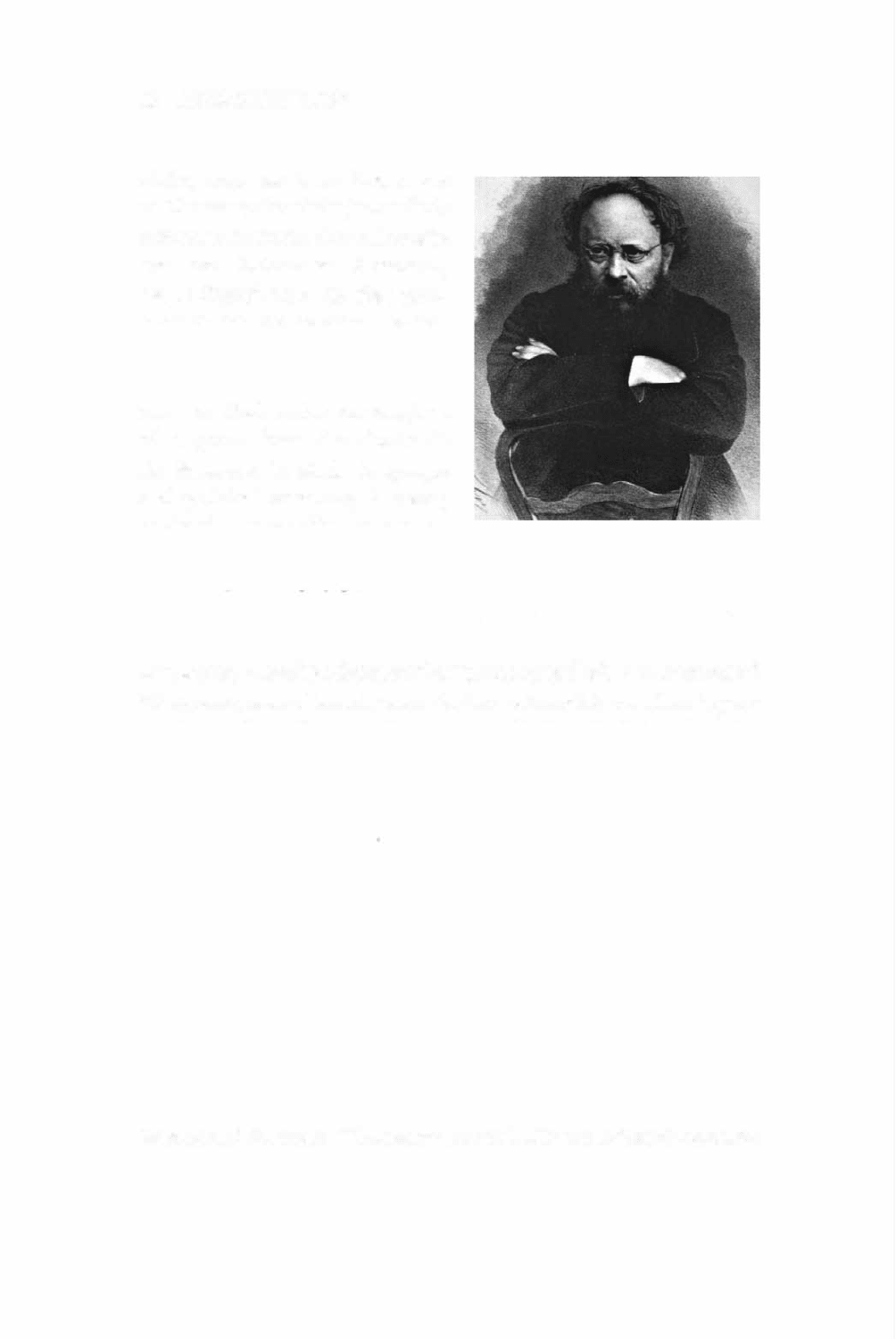
Pinn-Josrph ProJbO. Litbogmph n
a photogph by }/ix Nad
the state entitled What is PToprty? Al1 /llqUi1)1 imo the Pn'l1ciple of Right
aud ofGoverml1eut
in 1840. Answering his leading query in no uncer
tain terms, Proudhon declared that "property is theft" and denounced
"the government of man by man" in favor of a society based on "equal
ity, law, independence, and proportionality"-principles which he
argued fo und their highest perfection in the social union of "order
and anarchy."3 In one simple and compelling statement the anarchist
movement was born, delivered in a message that rang as a clarion call
throughout leftist Europe."
Proudhon and his new friends met in the humble apartments,
ale houses, and coffeehouses of working-class Paris, where they en
gaged in passionate discussions that turned on two issues: the critique
of idealism mounted by the radical Hegelian philosopher Ludwig
Feuerbach, and the related concept of dialectics, which was central to
the Hegelian theory of historical change.j Briefly, Hegel had posited
that world history was driven by an unfolding process of alienation in
which a divine "world spirit" manifested itself in partial and incom
plete forms of self-knowledge, objectied in human consciousness as
Reason and Freedom. This spirit was gradually emerging to complete

Antliff, Allan (Author). Anarchy and Art : From the Paris Commune to the Fall of the Berlin Wall.
Vancouver, BC, CAN: Arsenal Pulp Press, 2007. p xix.
http://site.ebrary.com/lib/dominicanuc/Doc?id=10308829&ppg=19
B(lltiflli Dr(1 19
self-consciousness and self-denition through a dialectical process
in which incomplete fo rms of self-consciousness manifest in human
history were fo rmulated, negated, and then reconciled in successively
higher and more inclusive syntheses-syntheses that in turn were
destined to themselves be negated and subsumed. History progressed
alo
ng
this dialectical path until
the world spirit achieved total self
knowledge, at which time its own objectication and self-alienation
would cease. In this scheme of dialectical progress, humanity played
a key but sublimated role in the world spirit's development. "Man,"
wrote Hegel, "is an object of existence in himself only in virtue of the
divine in him-that which is at the outset reason and which, in view
of its activity and power of self-determination, [is} called freedom.''
Society created institutions such as the stat, and pral!tices such as
art, religion, and philosophy, in order to objectify these principles of
spirit in th. world, th\ls prep:lring the wy for the reoncililtion of the
world spirit with itself through historical progress.7
Hegel argued that the dialectical manifestation of the world spirit's
self-consciousness could only be recognized in retrospect, and that the
future fo rms of reason and freedom could not be predicted. In other
words, this was a philosophy ofthe status quo in which the current so
cial state of affairs was justied as the latest manifestation of the world
spirit's unfolding self-consciousness. Thus, in Hegel's treatment, the
dialectic of human history was driven by a force external to it-the
world spirit-which paradoxically ensured that history's development
was Out of humanity's hands.8
The radical Hegelians questioned this notion by utilizing the
principles of reason and freedom to critically distinguish "the actual
and rational features of the universe from the illusionary, irrational
ones."9
In Germany, fo r example, they rejec
t
e
d the prevailing mon
archist political order and argued fo r the adoption of the bourgeois
democratic and republican principles of the French Revolution.1O The
radical Hegelians also introduced human agency into the dialectical
process, equating their social critique with the dialectic of negation.
In Lesek Ko lakowski's words, they believed "the dialectic of negation