
Antliff Allan. Anarchy and Art: From the Paris Commune to the Fall of the Berlin Wall (ENG)
Подождите немного. Документ загружается.

Antliff, Allan (Author). Anarchy and Art : From the Paris Commune to the Fall of the Berlin Wall.
Vancouver, BC, CAN: Arsenal Pulp Press, 2007. p 18.
http://site.ebrary.com/lib/dominicanuc/Doc?id=10308829&ppg=185
COOR PLAT[ 14=
Book v�r image Fr�ie 8an;r
Against the Nlelchine: E. ss on Empire and its
Enemies, David l, 1998. 6" x 9�.

Antliff, Allan (Author). Anarchy and Art : From the Paris Commune to the Fall of the Berlin Wall.
Vancouver, BC, CAN: Arsenal Pulp Press, 2007. p 19.
http://site.ebrary.com/lib/dominicanuc/Doc?id=10308829&ppg=186
COLOR PLATE 15:
Ricburd ck, {l1ltitlrd, 1995. O oll llrll, 24" x 22".
Antliff, Allan (Author). Anarchy and Art : From the Paris Commune to the Fall of the Berlin Wall.
Vancouver, BC, CAN: Arsenal Pulp Press, 2007. p 20.
http://site.ebrary.com/lib/dominicanuc/Doc?id=10308829&ppg=187
COLOR PTE 16:
Ricbard Mock, Sike Zone. 1991. Lioem m, 20" X 15 ".

Antliff, Allan (Author). Anarchy and Art : From the Paris Commune to the Fall of the Berlin Wall.
Vancouver, BC, CAN: Arsenal Pulp Press, 2007. p 21.
http://site.ebrary.com/lib/dominicanuc/Doc?id=10308829&ppg=188
CHAPTER 8
WITH OPEN EYES
AnThis and the Fa of the Be,./in Wa
I tbik tbe curret em bas 0li0l pOI'lent-oud sns of
gret hope. Vht 1"CHtit mmes depends UI what we 1ke oJ
the OPP0tflities.
-No:llll Choms
ky
, lQQ'
On November 9, 1989, Communist Pany rule in eastern Europe
and the Soviet Union came to a dramatic end with the breaching of
the Berlin wall, leaving many leftists in the capitalist west perplexed
and disoriented.? Some argued that a "genuinely new and emancipa
tory" fo rm of socialism-to quote Nancy Fraser-might miraculously
emerge from "the wreak," while others framed the historical moment
as a stark choice between "socialism or barbarism"-with barbarism
coming out on top in the absence of a "left opposition" calling for
"workers' democracy, a working class state, and a political revolution
that would restore the possibility of Communism."l The prevailing
position was summed up by Fred Halliday in
New Left Review: "An
essential precondition for any viable socialism in the We st," he wrote,
"is
a degree of combativity towards the very system it's challenging.
hatever their other faults, the traditional Communist parties em
bodied that quality"-butnow, with the collapse of Communism in the
east, they had ceased to do so.+The solution? Return to Communism's
"point of origin," namely "the critique of, and challenge to, capitalist
political economy" initiated by Marx.' Of course, from an anarchist
181

Antliff, Allan (Author). Anarchy and Art : From the Paris Commune to the Fall of the Berlin Wall.
Vancouver, BC, CAN: Arsenal Pulp Press, 2007. p 22.
http://site.ebrary.com/lib/dominicanuc/Doc?id=10308829&ppg=189
181 ANARCHY AND ART
perspective, going back Marx was hardly the place from which [0
build a libertarian movement. [n the years leading up to the fa ll of the
wall, anarchists were otherwise engaged in the development of strate
gies that were distinctly anti-authoritarian and true
[0 a critique of
oppression in all its guises.
Anarchist-pacism was one such strategy, expressed rst and fore
most in the art of Gee Va ucher, illustrator for the punk rock band
Crass. Originating out of the British music scene in the mid-1970s,
punk was loosely associated with anarchism from its inception, thanks
to the Sex Pistols. Songs like "Anarchy in the UK" (1976), which the
group's manager Malcolm McLaren described as "a statement of self
assertion, of ultimate self-rule, of do-it-yourself," inspired thousands
uf fa ns
explure anarchist pulitics.6 uwver, tll Sex Pistols' prupa
gation of anarchism was more a publicity stunt than a political act,
nd thei r egerness to sign on with COlllllle.rci) record COlllpnies W:lS
generally viewed as a betrayal of anti-capitalist principles.7 This left
Crass to point the way forward.8
Formed in 1977 by Penny Rimbaud and run as a collective, Crass
(the core membership of nine was occasionally augmented by others)
created its own not-for-prot record company and committed itself
to promoting anarchism in whatever way it could. The band nanced
activist publications, organized benets for squatters and rape crisis
centers, raised money for anarchists accused of plotting a bombing
campaign, and helped found an Anarchist Centre in London. The
group's resident artist, Va ucher, was a talented illustrator, collage art
ist, and fo rmer member of the London-based performance art collec
tive,
EXIT (1968-1972).10 Between 1978 and 1984 (the year the group
disbanded), Vaucher produced artwork for a slew of Crass record cov
ers, ve issues of an illustrated political joual entitled Ime1ltionoI
Al1them,
and numerous posters.
The cornerstone of Crass's anarchism was a combination of class
war and pacism. In a March 1981 interview for the punk journal
Flipside, band members condemned statist politics in the capitalist and
Communist spheres on the grounds that both were violent and coer-

Antliff, Allan (Author). Anarchy and Art : From the Paris Commune to the Fall of the Berlin Wall.
Vancouver, BC, CAN: Arsenal Pulp Press, 2007. p 23.
http://site.ebrary.com/lib/dominicanuc/Doc?id=10308829&ppg=190
With Opfll YtS 183
cive. "Anarchism," they related, "is the only fo rm of political thought
that does not seek to control the individual through fo rce .... Anarchy
is the rejection of state control and represents a demand by the indi
vidual to live a life of personal choice, not one of political manipula
tion .... By refusing to be controlled you are taking your own life into
your own hands and that
is, rather than the popular idea of anarchy
as chaos, the start of personal order."
l
1 However, the rejection of state
violence was not a blanket renunciation of the right to resist. The
members of Crass were careful
emphasize that they stood "against
organized militarism, believing that the use of power to control peo
ple is a violation of human dignity"; however, when "power threatened
to directly violate" an individual, one had the right to "stand against it
in whatev:r way was n:cessary
prevent it/' indng "the pussibil
ity of force."
1
1
When pe.rforming, CrSS dispbyed three h:mners: the cirded A
anarchy symbol; the peace symbol; and the Crass logo, which attacked
the pillars of oppression in Britain-the patriarchal fa mily, church, and
state. "Part national ag, part cross, part swastika," writes Rimbaud,
the logo's "circular design broke on its own edges into serpents' heads,
suggesting that the power it represented was about to consume itself."'3
An insert poster for the Crass single "Nagasaki Nightmare" (1980)
(see color plate 13) illustrates the band's stance towards state power
in its Communist and capitalist guises. Vaucher depicts leaders of the
world's ve great nuclear powers (China, Britain, France, Russia, and
the United States) and aspiring members to this elite "club" (Cuban
dictator Fidel Castro, for example), grouped together as if for a "pho
to op" amid the attened ruins of Nagasaki. Three Japanese atomic
bomb victims and the bomb itself exploding in the distance add to
rhe
horror. The politicians' shared willingness to "do ir again" -as
rhe song relates-is symbolized by the jovial demeanor of American
President Ronald Reagan and Soviet leader Leonid Brezhnev
as they
reach out to shake hands over the charred corpse of a child.'+
The visceral impact of "Nagasaki Nightmare" was matched by
Va ucher's productions during the Falklands War. In spring 1982, an

Antliff, Allan (Author). Anarchy and Art : From the Paris Commune to the Fall of the Berlin Wall.
Vancouver, BC, CAN: Arsenal Pulp Press, 2007. p 24.
http://site.ebrary.com/lib/dominicanuc/Doc?id=10308829&ppg=191
184 ANARCHY AND ART
Argentinian military dictatorship went to war with Britain over the
Falklands, a small grouping of islands off the coast of South America
(the islands were claimed by Britain in 1690 and formally designated
as a colonial holding in the early twentieth century). The war lasted
from March to June, when Argentinian forces surrendered uncondi
tiona
ll
y after suffering heavy losses at the hands of the British navy
and air fo rce. In Britain, the unpopular Conservative Party govern
ment of Margaret Thatcher successfully renewed its prospects for
reelection the following year by rallying the population behind pro
war jingoism. This development stunned Crass, given the actions of
the government up to that point. As Rimbaud relates, after coming
to power in 1979, Thatcher had "set about dismantling everything
that was worthwhil about th far Stat. In th ncw 'ntcrpris
culture' compassion would become a dirty word as entrepreneurs
licked their lips nd Th:ltcher's rse like in their nlsh to b\l
y
\lP the
country's assets. Just as working-class values would be derided, so the
poor would be accused of having brought about their own fate .... To
Thatcher and her cronies they were wasters, layabouts, and good-for
nothings who deserved no more than the blow of her iron st or the
toe of a policeman's boot."15 And yet once Thatcher declared war, the
masses had fallen in lock-step.
In a post-war essay adapted into lyrics for Crass's 1983 album, "Yes
Sir,
I Will," Rimbaud underlined the paradox: "Tory policies required
massive unemployment, bur it was they who demanded that 'we should
support our lads in the Falklands,' those very same lads, who if they
were at home, would be jobless in the streets."16 "Yes Sir, I Will" ends
with a plea for the working class to wake up to their own oppression
and rise up against the state and the ruling class it served: "It is you,
the passive
ob
s
erver, who has given them their power. It is you, and
only you, who can withdraw it. You are being used and abused, and
will be discarded as soon as they've bled what they want from you. You
must learn to live with your own conscience, your own morality, your
own decisions, and your own self. You alone can do it. There is no au
thority but yourself."17 This is followed by an addendum: "A squaddy
Antliff, Allan (Author). Anarchy and Art : From the Paris Commune to the Fall of the Berlin Wall.
Vancouver, BC, CAN: Arsenal Pulp Press, 2007. p 25.
http://site.ebrary.com/lib/dominicanuc/Doc?id=10308829&ppg=192
With Opw YtS 185
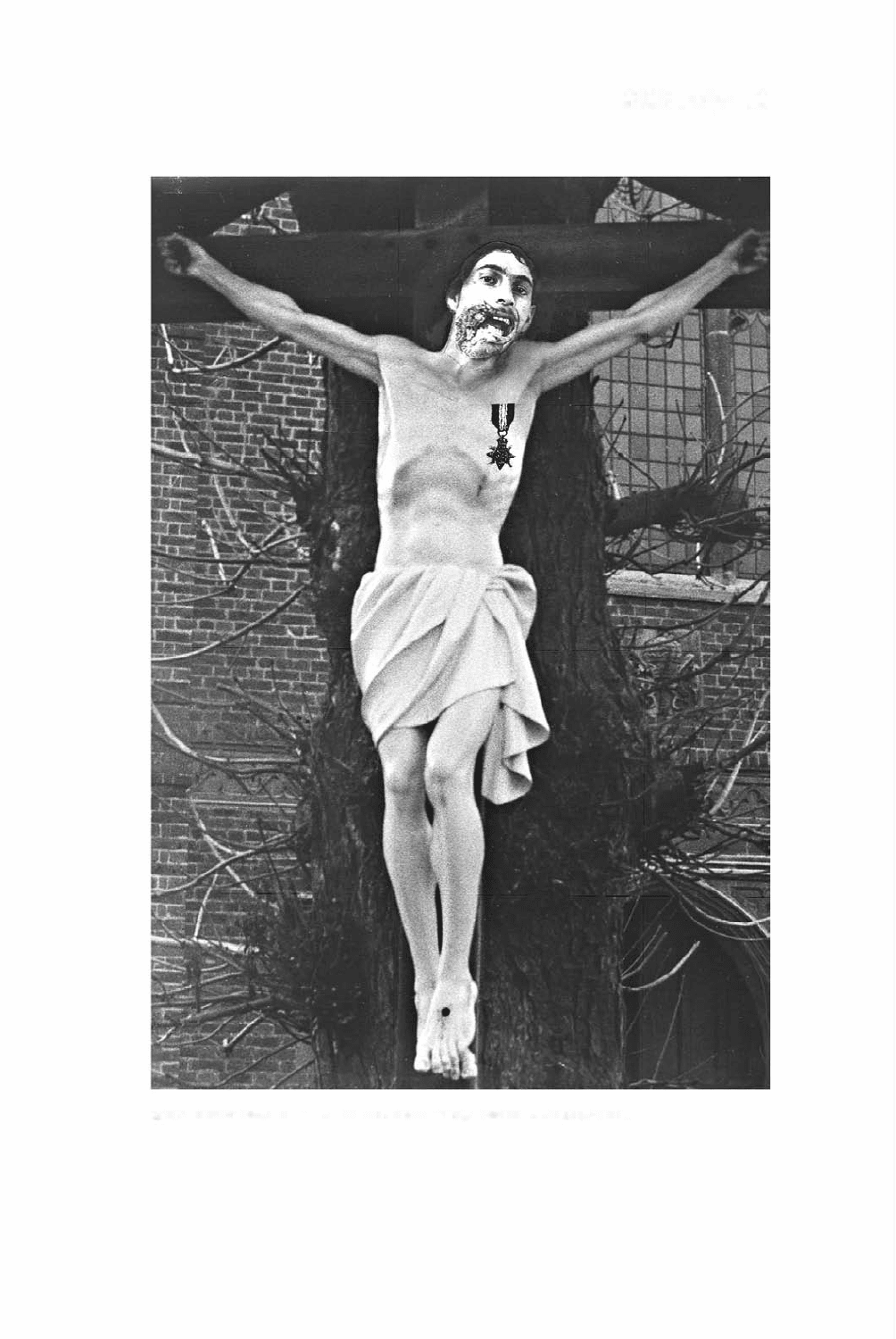
Gee Va llcber, Yes Sir, I ill /bll cotler, 199;. Col/age, p x lj l.
Antliff, Allan (Author). Anarchy and Art : From the Paris Commune to the Fall of the Berlin Wall.
Vancouver, BC, CAN: Arsenal Pulp Press, 2007. p 26.
http://site.ebrary.com/lib/dominicanuc/Doc?id=10308829&ppg=193
186 ANARCHY D ART
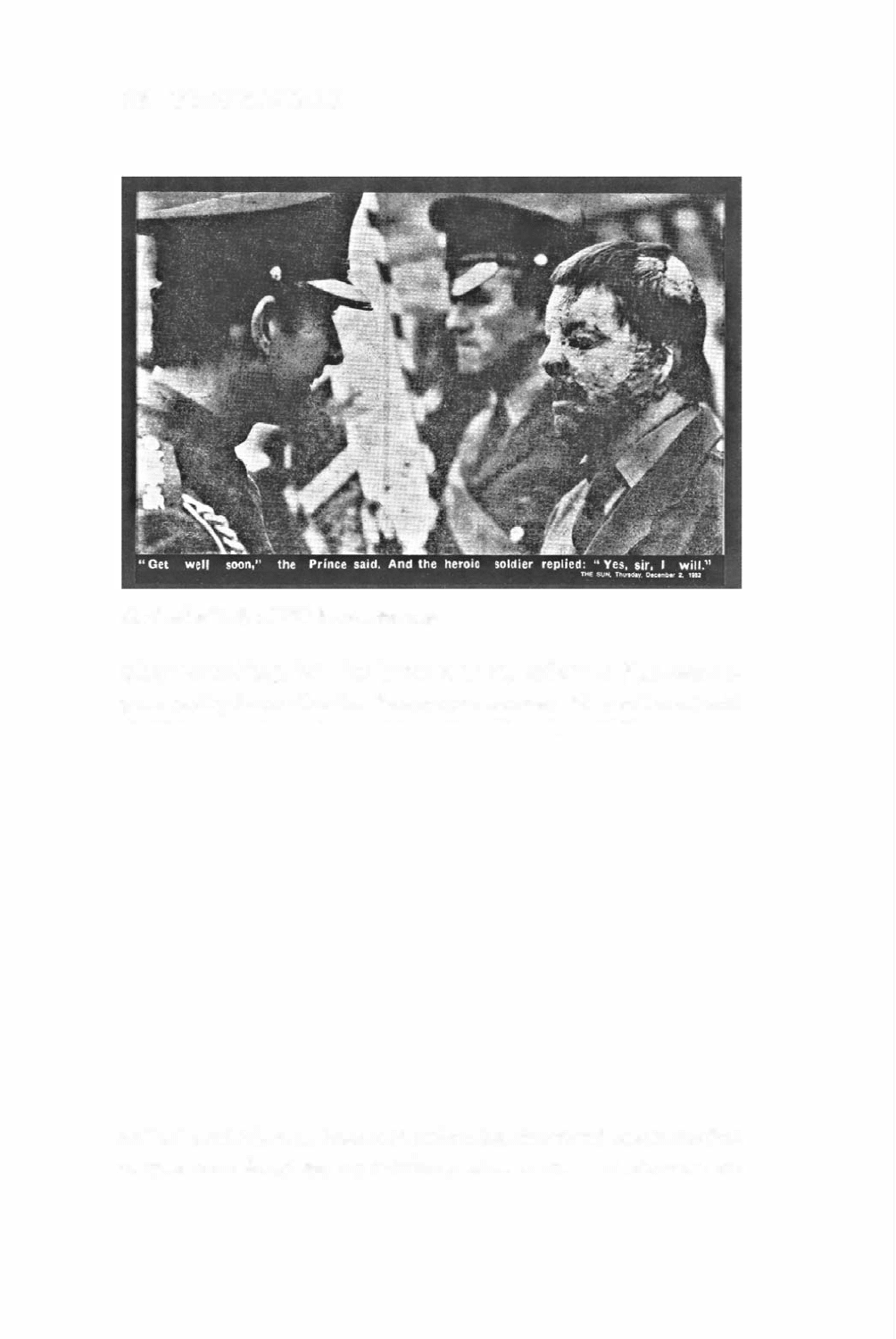
Grr V Ch; Yes Sir, 1 V/ill illserl PQstrr, 1
9
83.
[slang for soldier], horrically but in the Falklands ar, was ap
proached by Prince Charles during a presentation. 'Get well soon' said
the Prince, to which the squaddy replied, 'Yes Sir, I will.'"
Vaucher's poster for the album, "Yes Sir, I Will," reproduced the
text of this exchange and a tabloid newspaper photograph of the inci
dent. The spectacle of the horribly disgured soldier spoke volumes
about the grotesque inanity of a dutiful working-class war victim ac
quiescing to authority by indulging "his" Prince in the comforting
ction that he would ever "get well." The theme of self-sacrice and
submission also graced the album cover, where Va ucher collaged the
gure of an emaciated soldier, war medal pinned to his chest, crucied
against
a bleak industrial backdrop.
The soldier's face-a gaping wound, half ripped away, revealing
his teeth and jaw bone-was taken from an anti-war photo book,
Wm - Against Wm -!, published by the German anarchist-pacist Ernst
Friedrich in 1924.16 In this book, Wo rld Wa r I-era photographs of
self-satised ofcers, kings, and politicians, destroyed towns, rotting
corpses, mass hangings, rape victims, and mutilated war veterans were

Antliff, Allan (Author). Anarchy and Art : From the Paris Commune to the Fall of the Berlin Wall.
Vancouver, BC, CAN: Arsenal Pulp Press, 2007. p 27.
http://site.ebrary.com/lib/dominicanuc/Doc?id=10308829&ppg=194
With Opm t) 187
captioned with statements of outrage, satirical commentaries, belli
cose pro-war declarations, patriotic songs, and mili
taristic slogans.
Friedrich was one of Germany's most outspoken radicals whose oppo
sition
to militarism was part-and-parcel of his opposition to the state.
In
f
act, the class-based call to consciousness at the end of "Yes Sir,
I Will" echoed the preface of Wa r Against Wa r!, in which Friedrich
a
rgued:
... it is not the state power and force alone that compels all "sub
jects" to protect the throne and the money-bags, and to die for
them. Capital has not only economic power in its hands; it has,
equal measure and with equal power, subjected the proletariat
also intellectually. This fa ct is easily overlooked and there still
remains, therefore, so much bourgeois ideology in the prole
tri:lt! I, th.rJn�, lwys SY t
my
hrth�r.", th prlrins,
I say to the class-war ghters: "Free yourselves from bourgeois
prejudices! Fight against capitalism within yourselves! In your
thoughts
and in your actions there still lurks unspeakably much
of the philistine and the soldier, and almost in every one there
is hidden a drilled subaltern, who wishes only to dominate and
command, even if it be over his own comrades and over his wife
and children in his fa mily!" But
I also say to those bourgeois
pacists, who seek to ght against war by mere hand caresses
and tea-cakes and piously up-turned eyes: "Fight against c
api
talism-and you ght
a
g
ainst every war! The battle-field in the
ctories and the mines, the hero's death in the inrmaries, the
mass graves in the barracks, in short, the war, the apparently
eternal war, of the exploited aga
inst the exploiters!"19
Incorporating Friedrich's masterful satire of Wo rld War I-era pro
paganda into h
er ironic tribute tothe Fa lklands adventure, Vauchersig
naled that Crass's
anarchism was rmly rooted in history, with all that
implied by way of a well-thought our, socially engaged perspective.20
While Va ucher and Crass attacked the institution of the state,
both Soviet a
nd capitalist, from an anarchist-pacist stance, in the