
Antliff Allan. Anarchy and Art: From the Paris Commune to the Fall of the Berlin Wall (ENG)
Подождите немного. Документ загружается.


Antliff, Allan (Author). Anarchy and Art : From the Paris Commune to the Fall of the Berlin Wall.
Vancouver, BC, CAN: Arsenal Pulp Press, 2007. p xx.
http://site.ebrary.com/lib/dominicanuc/Doc?id=10308829&ppg=20
20 ANARCH Y AN D ART
...
must address itself to the future, being not merely a clue
under
standing the world but an instrument of active criticism; it must proj
ect itself into unfullled historical possibilities, and be transformed
from thought into action."
ll
Feuerbach's critique completed the radicals' revision of Hegel's
grand scheme. Fe uerbach argued that the divine world spirit was a
ction, and that the real dialectic driving history hitherto had been
a process of human estrangement from our essence in which ideals
born of human experience were continuously objectied in the form
of metaphysical concepts attributed
otherworldly deities, such as
goodness, justice, and love.'2 Humanity's self-negation through objec
tication could only be overcome by recognizing that such metaphysi
cal principles
wen: an illusiun, since no ideals existed apart froIll hu
manity. "The species," wrote Feuerbach, "is the last measure of truth
... wh:n is tn is wht is in grecmcnt with the essen.. of the species,
what is false is what disagrees with it."13 Freedom, therefore, resided
in our ability to realize these humanized ideals in the world. Once hu
manity recognized that the principles that constituted its essence were
inseparable from its sensuous, historical experience, humanity could
unite existence with essence, and life with truth.'� Feuerbach charac
terized his philosophy as "anthropological" to signal that, nally. our
metaphysical ideals had been brought down to earth and subsumed
into humanity's sensuous, historical essence.
Proudhon was introduced to Feuerbach's critique by Karl Griin
in the fa ll of 1844.1' In
Tbe Socialist NJovemeut il1 ·al1ce (1845), Griin
described his meetings with Proudhon and the French anarchist's ea
gerness to discuss German philosophy. Proudhon had already gained
a cursory grasp of Hegel and was greatly relieved when Griin told
him how Feuerbach's criticism dissolved the Hegelian "bombast."16
Griin outlined Feuerbach's revision of Hegel for Proudhon and ended
the conversation declaring his "anthropology" was "metaphysics in
action,"
which Proudhon excitedly replied, "1 am going to show
that
political economy is metaphysics in action."I?
Feuerbach provided Proudhon with the philosophical basis for

Antliff, Allan (Author). Anarchy and Art : From the Paris Commune to the Fall of the Berlin Wall.
Vancouver, BC, CAN: Arsenal Pulp Press, 2007. p xxi.
http://site.ebrary.com/lib/dominicanuc/Doc?id=10308829&ppg=21
A H(lltill Dr(1 21
sweeping the metaphysical ethics of religion and philosophy aside
in favor of moral principles logically "synthesized" from experience.
In his 1858 publication,
Justice i tbe Revolution and ill tbe Cburcb,
Proudhon wrote, "metaphysics of the ideal taught by Fiche, Schelling,
and Hegel
is nothing: when these men, whose philosophy has rightly
gained distinction, fa ncied they were deducing an
a priori they were
only, unknown to themselves, synthesizing e
xpe
r
ience."18 Proudhon
described his method of arriving at moral judgments as human-cen
tered and anti-metaphysical:
As
far as 1 am concerned morality exists for itself; it is not de
rived from any dogma, or from any
theor
y
. ith man con
sciousness/conscience is
the dominant faculty, the sovereign
power, and the others are useful
to it as instruments or ser
Vnts ... it is ntt11 frln ny ltphysir_ , frm ny ptry
or from any theodiey that I deduce the rules of my life o
r my
sociability; on the contrary, it is from the dictates of my con
sciousness/conscience that
I should rather deduce the laws of
my understanding.
I
Feuerbach's dialectical and anthropological nco-Hegelianism,
which unde
rpinned Proudhon's concept of critical synthesis, led the
French anarchist to justify revolutions as the supreme attempt to
realize moral goals through social change. In his 1851 publication,
Tbe Gel1cml ldea of tbe Revolution ill tbe N; l1etee11tb Celltll1Y, Proudhon
called revolution "an act of sovereign ju
stice, in the order of moral
fa cts, springing out of the necessity of things, and in consequence car
rying with it its own justication."20
"Sp
ringing out of the necessity of
things," moral imperatives changed as society changed: in this critical
method, "justice" took on a radically contingent, historical, and social
character.
Apart from Feuerbach, Proud han was also indebted to the theory
of dialectics espoused by the German philosopher Immanuel Kant'!'
In
Tbe c,'it;que Pure Reason (1781), Kant claimed he had proved the

Antliff, Allan (Author). Anarchy and Art : From the Paris Commune to the Fall of the Berlin Wall.
Vancouver, BC, CAN: Arsenal Pulp Press, 2007. p xxii.
http://site.ebrary.com/lib/dominicanuc/Doc?id=10308829&ppg=22
n ANARCHY AND ART
inability of human reason to know the world as it is, meaning the
world conceived apart from the perspective of the knower.
n Reason,
he argued, could not transcend the boundaries of the sensible, and the
dialectical nature of human reason was proof of this fa ct. Kant held
that from any premise we could derive both a proposition and its ne
gation. This dialectical opposition exposed the fa lsehood of the pre
m
ise which gave birth to it, leading him to conclude that we could never
attain the transcendental knowledge necessary for knowing the world
in its totality. Kant called these dialectical constructs "antinomies."l3
In Proudhon's anti-metaphysical reformulation ofthe Kantian di
alectic, the social critic, guided by the imperatives of reason, deduced
moral syntheses from dialectical contradictions found in society. The
means
uy whidl a synthesis was transformed fwm a llloral-uase de
duction of social contradictions to a resolution of those contradictions
WS rhrO\lgh so(,;1 rrnsforTlltion, PrO\ldhon rg\lcd sOi1 contr-
dictions, and the moral solutions the social critic deduced from these
contradictions, were historically contingent and ever-changing.1+ In
Proudhon's system, the free exercise of human reason in every social
sphere came to the fore as the progressive force in history, a position
which led him to argue that freedom from all coercion was the neces
sary prerequisite for realizing a just society. In James Rubin's words,
"Proudhon held that anarchy (that is an-archy, the absence of author
ity) was the only possible condition for social progress."!S Proudhon's
anarchist philosophy of art followed from this critique of metaphysi
cal idealism. He codied his position in
Du p1'iucipe de "m't, which was
published the year of his death in 1865.
In the opening chapter, Proudhon informed his readers that the
book was inspired by the French government's refusal to exhibit
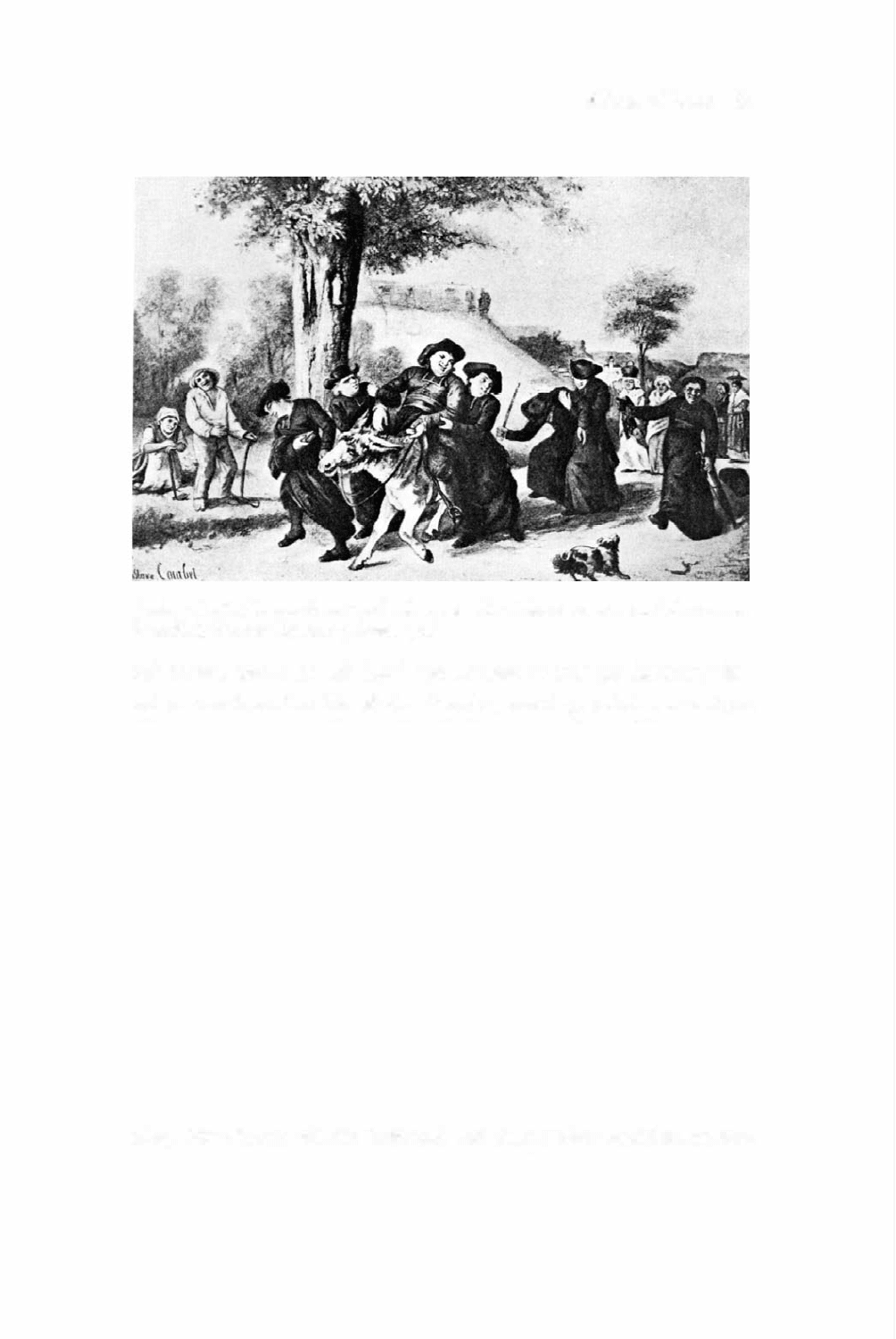
Gustave Courbet's painting, Ret171 f1'o1 The Conference, at the official
state art exhibition of 1863.26 Courbet was an old friend of Proudhon
and a long-standing participant in the radical culture of Paris, His ar
tistic notoriety stemmed from the years 1848-1851, when the French
monarchy was overthrown and a Republican government was briefly
instituted. In 1851, Courbet created a scandal at the state's annual art
Antliff, Allan (Author). Anarchy and Art : From the Paris Commune to the Fall of the Berlin Wall.
Vancouver, BC, CAN: Arsenal Pulp Press, 2007. p xxiii.
http://site.ebrary.com/lib/dominicanuc/Doc?id=10308829&ppg=23
A Bralilififl Drram
23
GsV
COllrl, Rerum from the Conference, ,862-,86;, dstroyrd '945. O 011 C11VS.
Fl Rail. Gustave Courbct, peintrc, '9Q6.
exhibition, where he exhibited twO immense paintings depicting ba
nal scenes from the life of the French peasantry, painted in a style
akin to popular woodblock printsY The upper-class public were ac
customed to works such asJean-Leon Gerome's
Greek Interior of 1850,
which offered slickly painted "classical" titillations far removed from
the social realities of the day. Courber's
Stoneb1-eake1"s (see color plate
1) and
B1Wii at Omans (both painted in 1849-50 and exhibited in
1851), therefore, came as a shock. Displayed in the state salon where
elite culture was traditionally celebrated, these paintings shattered the
artistic boundaries between rich and poor, cultured and uncultured,
and as a result they were roundly condemned for their rude subject
maner, rough and "unnished" brushwork, shallow perspectives, and
overall lack of painterly decorum.18
But artistic crudity was not the sale reason for the heated objec
tions to Courber's work. During the short-lived Republic, the work
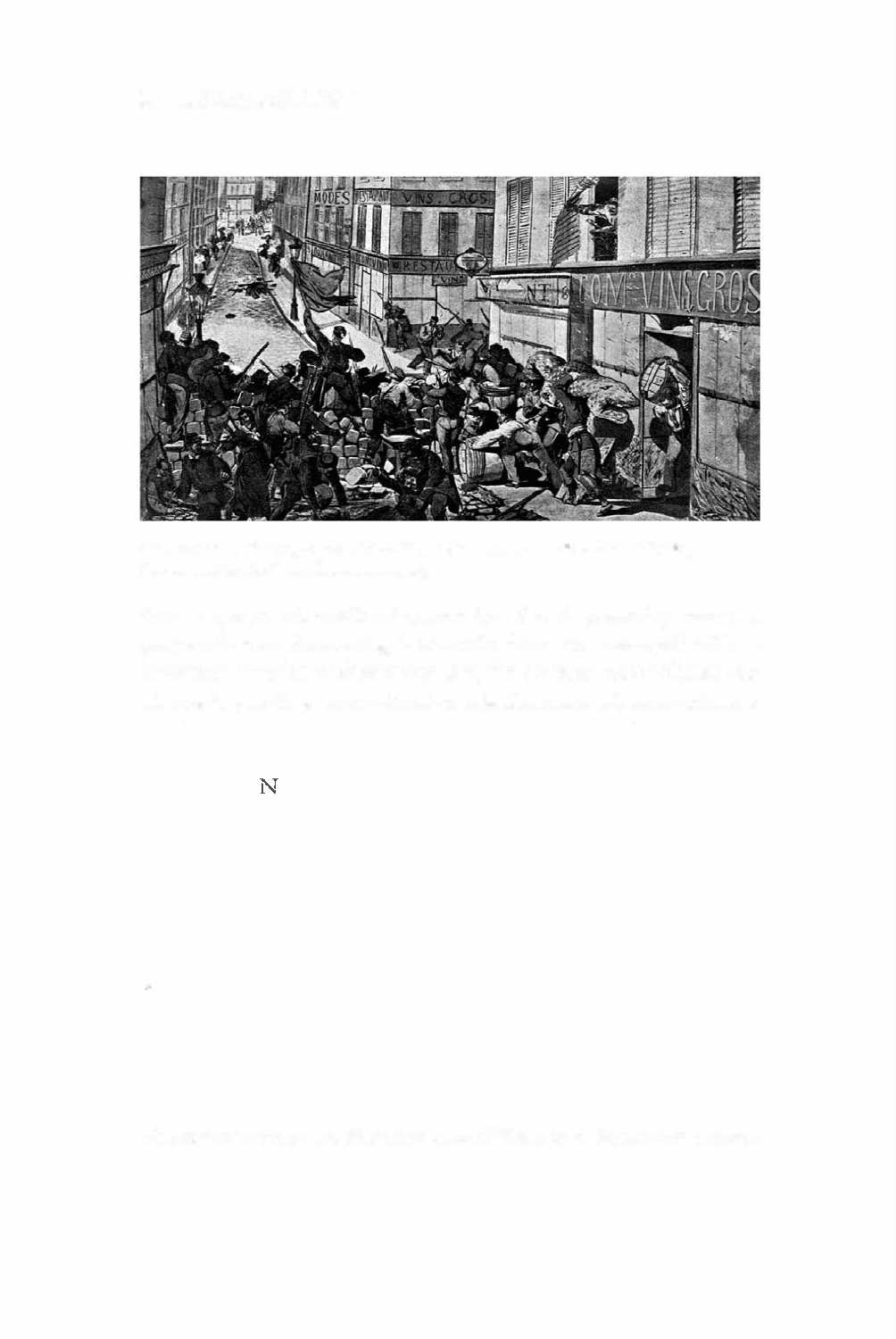
ers of Paris and Lyon engaged in violent agitation for the state to
adopt Proudhon's call for "national workshops" that would guarantee
Antliff, Allan (Author). Anarchy and Art : From the Paris Commune to the Fall of the Berlin Wall.
Vancouver, BC, CAN: Arsenal Pulp Press, 2007. p xxiv.
http://site.ebrary.com/lib/dominicanuc/Doc?id=10308829&ppg=24
2 ANARCYAND ART
A
Barricade at Neuilly, Pris, 187'. titbogpb.
m Emuf lljuJ Vi�dly, My
Ad\·enlurcs in the Paris Commune, '9J4.
them employment, and the impoverished French peasantry were in
a
perpetual state of unrest against landlords in the countryside. Beset
by growing working-class radicalism, the Parisian upper classes saw
Courbet's paintings as an affront to establishment values in art
and a
political provocation against their power. Eventually they solved the
problem of social unrest by throwing their lot in with the dictator
ship of Louis apoleon ITl, nephew of Napoleon Bonaparte, who pro
claimed himself emperor after a coup d'etat in 1851. 29
The
Republic may have been defeated; however, throughout
Napoleon Ill's reign, from 1851 to 1870, Courbet continued to paint
in the same uncompromising manner. He called his new style "real
ism," and paid tribute to himself and his accomplishment in a huge
retrospective painting in 1855 entitled
The Pime1·'s Sdio: A Rl
Alleg In the center, Courbet depicted himself painting a landscape,
observed by an admiring nude model. The model is "real,"
but also an
allegorical figure of the painter's muse (nature). Behind the artist are
the patrons, comrades, writers, and philosophers who inspired him
notably Charles Baudelaire on
the far left (reading) and Proudhon,
who surveys the scene from the back of the room. Facing the painter

Antliff, Allan (Author). Anarchy and Art : From the Paris Commune to the Fall of the Berlin Wall.
Vancouver, BC, CAN: Arsenal Pulp Press, 2007. p xxv.
http://site.ebrary.com/lib/dominicanuc/Doc?id=10308829&ppg=25
A Bllll Dream 25
are the products of the corrupt and degenerate society he critiqued,
including destitute workers, a businessman, and Napoleon III himself,
with his hunting dog and gun.30
Courbet's
Ret1'1J m tbe C0l1llCe, which depicted drunken c1er�
ics on their way home from a religious gathering, was another realist
tour de force, in this instance directed against the degenerate institu�
tion of the church, Refused a showing in the
1863 state exhibition
and maligned by establishment critics, the painting provoked a tre�
mendous storm of indignation, leading Courbet, who regarded the
work as the artistic equivalent to Proud han's own critical "synthesis"
of society's wrongs, to ask the anarchist philosopher to defend it,31
In Du
p1'incipe de I'm't, which is based in part on a lively corre�
spuntknce between painter ami philusupher, PruUlJhun recuunted
Courbet's rebuke of the establishment critics who vilied
Rem
the Q1J,·el1�.
The rtist hd ondemned them "for misrepresenting
... the high mission of art, for moral depravity, and for prostituting
[art] with their
idisI." "ho is wrong," Proudhon asked, "the so�
called
t'/ist Courbet, or his detractors, the champions of the ideal?"J!
His purpose was to critically resolve this question.
First, he turned his attention to the issue of idealism. Proudhon,
fo llowing Feuerbach, viewed metaphysical knowledge as an impossi�
bility, and this informed his critique of artistic idealism, in which he
attacked the idea that metaphysical ideas could spring, fully�formed,
from the imagination of the artist. Art, Proudhon argued, was made
up of specic forms, subjects, and images. The idealized subject in
art, therefore, was inseparable from the real objects it represented.H
Thus, there was no metaphysical "separation ofthe real and the ideal"
as Courbet's "idealist" critics maintained.H
Proudhon then took up the question of realism. By the early 1860s,
other artists were also painting in a realist style; however, they tended
to temper the aesthetic crudeness associated with Courbet and chose
subject matter from everyday life that, though "real," would not of�
fe nd. Proudhon criticized the artists of this "realist" camp, accusing
them of maintaining that art should slavishly imitate reality. This, he
Antliff, Allan (Author). Anarchy and Art : From the Paris Commune to the Fall of the Berlin Wall.
Vancouver, BC, CAN: Arsenal Pulp Press, 2007. p xxvi.
http://site.ebrary.com/lib/dominicanuc/Doc?id=10308829&ppg=26
26 ANARCHY AND ART
Emile 2o1n, .d. Photograph.
argued, was a fa lsication of what
art was.
H A photograph, for ex
ample, could capture an image, but
it could not replicate the power of
the artist to magnify the qualities
of
character residing in a subject
or imbue an inanimate object with
meaning. Any "realist" aesthet
ic that imitated the photograph
was "the death of art," Proudhon
concluded.l6
In his earlier writings,
Prouuhon
ositcu an anti-lIlta
physical, moral critique as the ba
sis for s0c11 ovement. Tn On
p1-incipe de lit,
he argued that art could, potentially, become a vehicle
for such a critique. Art was a product of idealism, albeit idealism in
a Proudhonian sense, because the creative imagination of the artist,
like art's subject matter, was inseparable from the real world. Combet
not
only recognized this facti h realism turned art to critical ends
in the interest of social advancement, bringing realism into line with
Proudhon's prognosis for social reconstruction through critiques de
duced from the material conditions of contemporary society. As such,
Courbet's painting stood in stark contrast to both "photographic re
alism" and the "metaphysical" art of Gerome and his ilk, wherein ir
rational and self-indulgent pursuit of otherworldly "chimeras" such as
"beauty" elevated artistic contemplation to an ideal in-and-of- itself,
rendering the critical power of human abstraction and reason "use
less."37 "Our idealism," wrote Proudhon, "consists of improving hu
manity ... not according to types deduced a priori ... but according to
the givens supplied continuously from experience.",8
Recognition of art's relationship to society, therefore, was
the
prerequisite for the free exercise of the artist's critical reason. In
Feuerbachian terms, the artist gained freedom from the condition of

Antliff, Allan (Author). Anarchy and Art : From the Paris Commune to the Fall of the Berlin Wall.
Vancouver, BC, CAN: Arsenal Pulp Press, 2007. p xxvii.
http://site.ebrary.com/lib/dominicanuc/Doc?id=10308829&ppg=27
Bllfi[lIf Dream 27
self-alienation engendered by a metaphysical world-view by taking up
the cause
of improving society through art. "Art," wrote Proudhon,
is "an idealist
representation of nature and of ourselves, whose goal is
the physical and moral perfection of our species."wlt would "progress
as reason and humanity progress,'40
revealing, "at last
,
"
... man, the citizen and scientist, the producer, in his true dig
nity, which
has too long been ignored; from now on art will
work for the
phys
i
cal and moral improvement of the species,
and it will do this, not by means of obscure hieroglyphics,
erotic gu
res, or useless ima
g
es of spirituality, but by means of
vivid, intelligent representations of ourselves. The task of art, I
say, is to warn us, praise S, to teach LIS, to make us blush by
confronting us
with
a mirror of our own conscience. Innite
in its rbt, innit in it.� nv1pmnt, sl
I
h n rt will h ."f
from all spontaneous corruption. Such an art cannot possibly
degenerate
or
p
er
i
sh.�l
Proudhon's public defense ofCourbet in a lengthy book set the stage
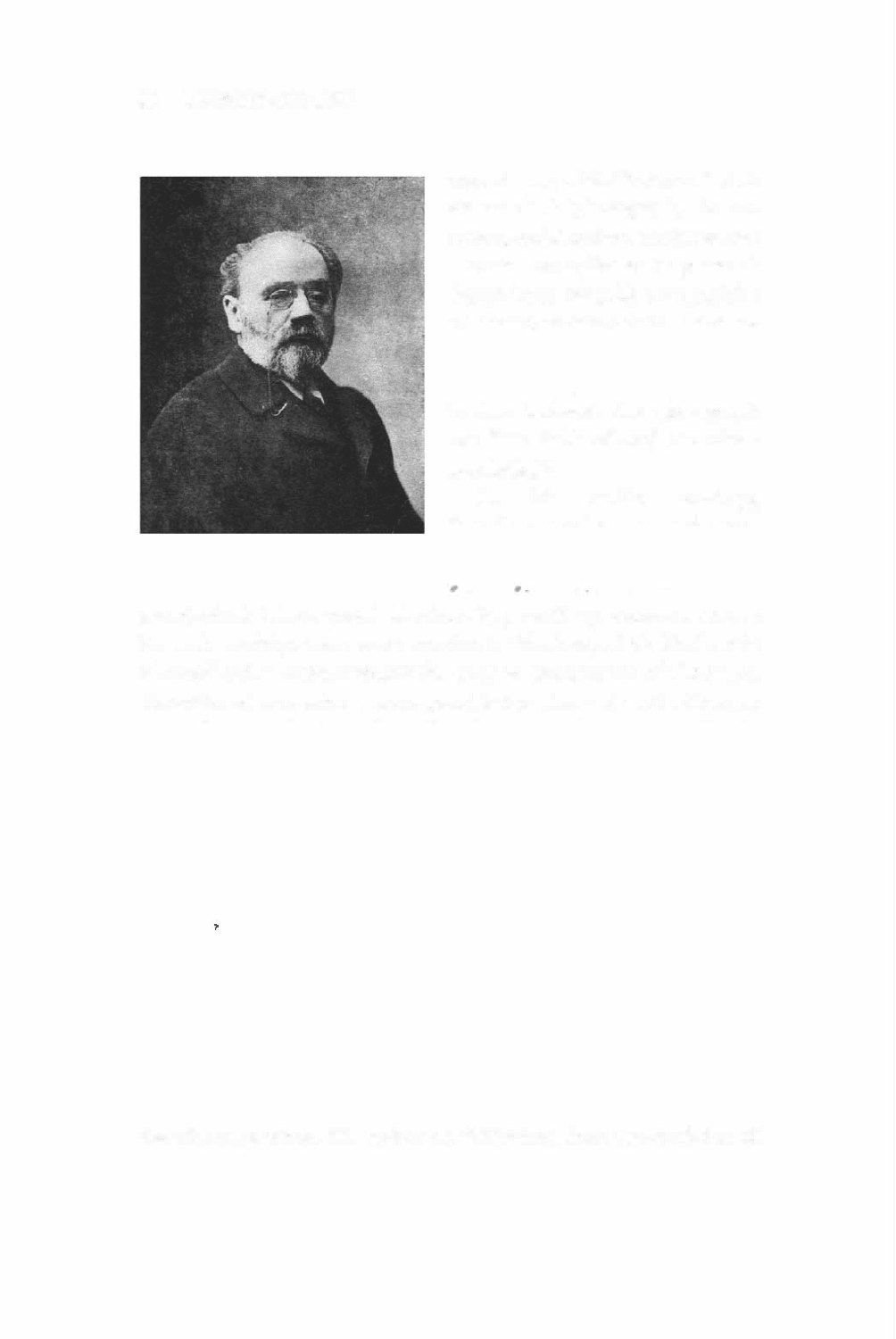
for the ambitious Parisian journalist Emile Zola to make his entrance.
Zola was then establishing his
reputation as a ercely independent
champion of radica
l
po
litics and artistic independence_�! And his criti
cal rejoinder to Proudhon's thesis-a book review entitled "Proudhon
and Courbet"-was nothing if not audacious. Zola opened his review
declaring that he
O supported "the free manifestation of individual
thoughts-what Proudhon calls anarchy."·u
But here, the simibrities
ended:'" Proudhon, Zola argued, was trapped by his method, which
proceeded from a desire for the
reign of equality and liberty in society
to a logical deducrion of the type of art that wou ld bring about such a
society:u The rigors of "logic" determined that Proudhon could only
imag
i
n
e one kind of artist: an artist who contributed to the anarchist
struggle through the exercise of critical reason in the service of the
social good:�6 The result was an impoverished denition of art. The
author of
Du principle de l1'! dened art as "an idealization of nature
Antliff, Allan (Author). Anarchy and Art : From the Paris Commune to the Fall of the Berlin Wall.
Vancouver, BC, CAN: Arsenal Pulp Press, 2007. p xxviii.
http://site.ebrary.com/lib/dominicanuc/Doc?id=10308829&ppg=28
28 ANARCHY AND ART
Burning the Guillotine on the Place Voltaire,
Paris, [87[. LifbQapb. Fm Emesf
Arrd ul, My
Adventures in the Paris Commune, 1914.
and ourselves, whose goal is the physical and moral perfection of our
species."47 But this was an oppressive tautology which could broach
no unruly deviation on the part of the artist from art's stated goal.
Proudhon, concluded Zola:
Poses this as his general thesis. I pub lic, I humanity, I have the
right to guide the artist and to require of him what pleases me;
he is not to be himself, he must be me, he mllst think only as
I do and work only for me. The artist himself is not hing, he
is everything through humanity and for humanity. In a
word,
individual feeling, rhe free expression of a personality, are
forbiddel1.�8
Here, Zola's support for "rhe free expression of the personal
ity" came head-to-head with the Feuerbach-derived underpinnings
of Proudhon's notion of artistic anarchism. In
D principe de I'art,

Antliff, Allan (Author). Anarchy and Art : From the Paris Commune to the Fall of the Berlin Wall.
Vancouver, BC, CAN: Arsenal Pulp Press, 2007. p xxix.
http://site.ebrary.com/lib/dominicanuc/Doc?id=10308829&ppg=29
alltl D,.m 29
Proudhon had reasoned, step by step, from a repudiation of photo
graphic realism and metaphysical idealism in art to a reformulation
which tied art inextricably to the improvement of society. Individual
freedom only entered the realm of art to the degree that the art
ist mounted a moral critique. Zola quite rightly pointed out that
Proudhon's
concept of artistic liberty
was tied to a hisrical mission,
and thus found its sole libertarian legitimation in relation to it.
For Zola, on the other hand, the locus of freedom was the autono
mous individual. In his words, "My
art is a negation of society, an
afrmation of the individual, independent of all rules and all social
obligations.'9 Proudhon argued that moral imperatives derived from
the study of society should shape art, and that 20la parried by mar
shaling a radical subjectivism in which the imagination of the artist
stood in for the metaphysical realm of the ideal. "T will have Proudhon
note," 7. ob wrote, "tht O\lr ides re hsohlte .. .. chieve
p
erfec
tion in a single bound; in our imagination, we arrive at the ideal state.
Consequently it can be understood that we have little care for the
world.
are fully in heaven and we are not coming down."50
"A work of art," he continued, "exists only through irs original
ity.";'
Content in a work of art was of secondary importance because
it always derived from something else-either the external world or
traditional subject matter. The true measure of artistic freedom was
style, and in this regard the artist's manipulation of formal elements
such as
color, texture, light, etc. was the only aspect of a painting that
was unique-original-in a word, individual.
These are the terms in which 20la appreciated CourbetY "My
Courbet is an individual," he wrote, while praising the artist's youth
ful decision to cease imitating "Flemish and Renaissance masters" as
the mark of his "rebellious narure."5J Even realism was transformed
into an extension of the artist's individualism. Courber had become
a realist because he "felt drawn through his physical being ... toward
the material world surrounding him." 20la drove
the point home in
a vivid description of a
studio visit: