
Antliff Allan. Anarchy and Art: From the Paris Commune to the Fall of the Berlin Wall (ENG)
Подождите немного. Документ загружается.


Antliff, Allan (Author). Anarchy and Art : From the Paris Commune to the Fall of the Berlin Wall.
Vancouver, BC, CAN: Arsenal Pulp Press, 2007. p l.
http://site.ebrary.com/lib/dominicanuc/Doc?id=10308829&ppg=50
50 ANARCHY AND ART
with an anarchist critique of contemporary American culture and the
distinctive type of modernity it embodied.
Picabia was a Paris-based painter who had rst visited the United
States in the company of his wife, Gabrielle Buffet-Picabia, in 1913
to attend the opening of a large-scale exhibition of European an
d
American modeism known as the Armory Show. The exhibition
began in New Yo rk (February 17-March 15) and then traveled to
Chicago (March 24-ApriI 16) before closing in Boston (April 28-May
19). The Pica bias arrived in New York on January 20 and stayed on
through February and March before departing home for France on
April 10. In New Yo rk, the couple met with the photographer Alfred
Steiglitz, who ran a small non-commercial gallery (known as "291,"
,Ifter its Fifth Avenue rcss) ami
joual-Cll771 WU 1"k-w show
case the latest experiments in European and American modernism.
n'lring their st�y, the Pi(':lbbs grew dose to Steiglit7. nd mnyothe.rs
in his circle, notably the Mexican caricaturist Marius de Zayas, the
anarchist journalist Hutchins Hapgood, and Paul Haviland, a wealthy
art collector and photographer.3
Prior to his New York visit, Picabia had been exhibiting for just
under two years with a group of Parisian cubists (the "salon cubists")
led by painter and theorist Albert Gleizes, who co-authored the semi
nal statement,
Cubism (1912), with fe llow painter Jean Metzinger.
Gleizes was the group's organizational dynamo who arranged exhibi
tions, promoted the movement in the press, and discouraged any aes
thetic deviations." The group's successes in Paris ensured that when
the American organizers of the Armory Show went to France in a
quest for mode art, they would return with a substantial list of cu
bist paintings and sculpture. At the Armory Show, Picabia exhibited
four paintings, includin
g
Dances at tbe Spring (1912) (see color plate 4),
alongside work by Gleizes, Marcel Duchamp, Raymond Duchamp
Villan, Roger de La Fresnaye, Fernand Leger, and Jacques Villon.5
Picabia's paintings were textbook examples of the cubist aesthetic
circa 1912, which followed the metaphysical tenets of the French phi
losopher Henri Bergson. Briey, Bergson argued that the conventional

Antliff, Allan (Author). Anarchy and Art : From the Paris Commune to the Fall of the Berlin Wall.
Vancouver, BC, CAN: Arsenal Pulp Press, 2007. p li.
http://site.ebrary.com/lib/dominicanuc/Doc?id=10308829&ppg=51
Obscenity 51
Fncis Picabin, Portrait d'unc Jcunc Fillc Amcricainc dans l'etat de Nudite. 291, OS
5-6, J/y-AgSt 1915. © Estn ofFcis Picnbin / SODRAC (2 006).
Antliff, Allan (Author). Anarchy and Art : From the Paris Commune to the Fall of the Berlin Wall.
Vancouver, BC, CAN: Arsenal Pulp Press, 2007. p lii.
http://site.ebrary.com/lib/dominicanuc/Doc?id=10308829&ppg=52
51 ANARCHY AND ART
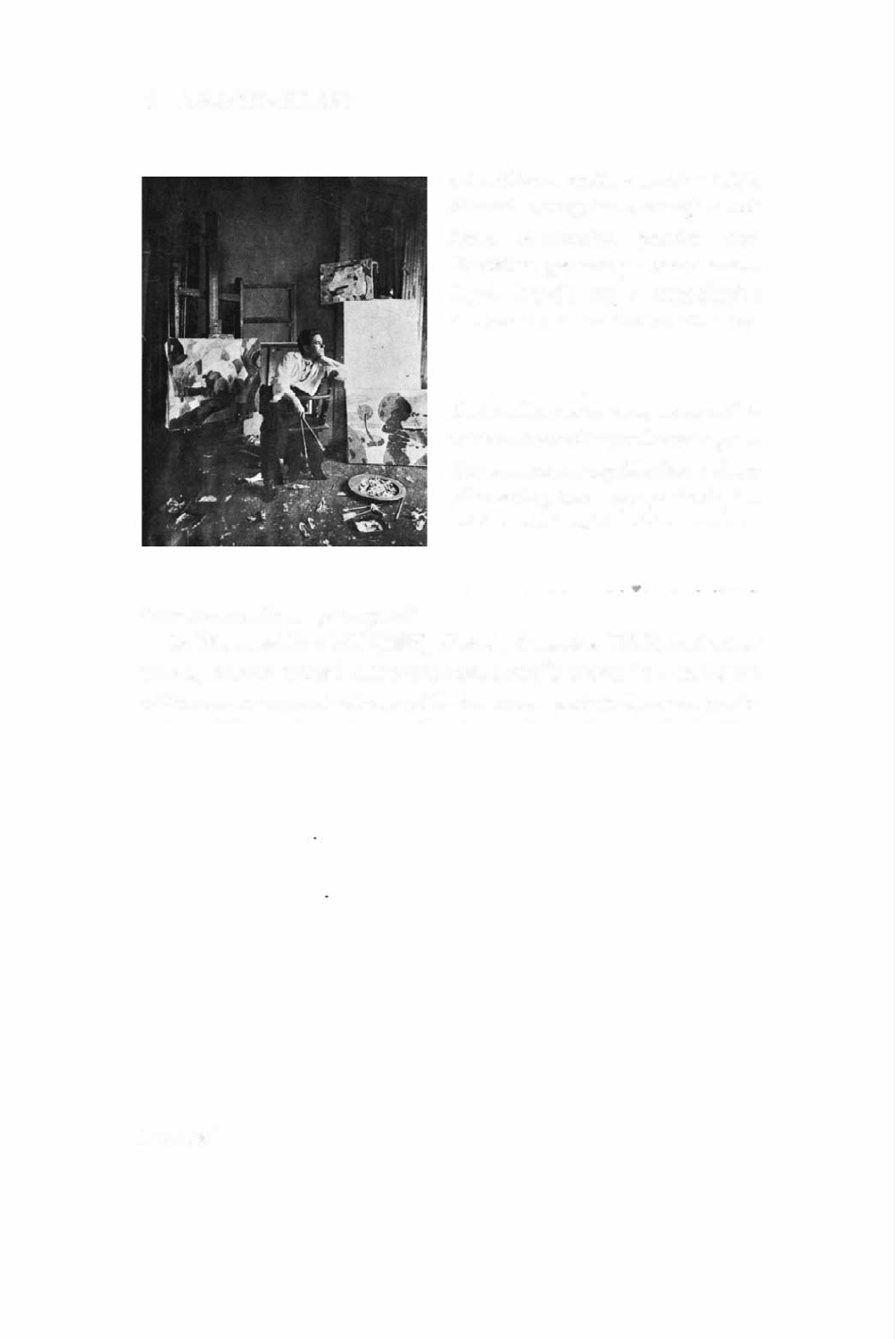
Frnl/cis Picllbin, 191]. Pbologrnpb.
their style on these principles.6
scientic view of the world-which
ltered perception through clock
time, Newtonian physics, and
Euclidian geometry-was a fa lse
hood. Developing a metaphysics
to counter it, he posited that the
true state of matter could only be
grasped through a suspension of
the intellect so as to open us to in
tuition. Accord ing
Bergson, art
ists were more capable than others
of entering into a sympathetic, in
ruitiv rdatiunship with th wurld,
a
claim that was also trumpeted by
Glei7.es and the llhists,
who
hase
In Time ud Free Wi (1889), Cretive Evolution (1907), and other
works, Bergson argued that matter was actually energy in a condition
of ux and interpenetration and that each moment in time was quali
tatively different from the last, like the condition of matter itself. This
was the reality that cubism depicts. Tn Picabia's
Donces ot the Spring,
for example, the dancers' bodies appear to break up and merge with
their surroundings because the painter is trying to represent the dy
namism of matter
I space and time as ltered through his artistic
intuition.1
So
things stood In
1912. However, upon arriving in New Yo rk,
Picabia made a dramatic break with the cubist movement. As recorded
by Hutchins Hapgood in an interview for the
Globe newspaper, Picabia
argued that the artist's role was not to "mirror the external world" but
rather "to make real, by plastic means, internal mental states."s Picabia
explained that he could no longer fo llow cubism because the cubists
were "slaves to the strange desire to reproduce" the external world,
just like the old masters whose works hung in the dusty halls of the
Louvre.9

Antliff, Allan (Author). Anarchy and Art : From the Paris Commune to the Fall of the Berlin Wall.
Vancouver, BC, CAN: Arsenal Pulp Press, 2007. p liii.
http://site.ebrary.com/lib/dominicanuc/Doc?id=10308829&ppg=53
Obscfllity 53
While his cubist paintings were on exhibit in the Armory Show, he
began working in a new "post-cubist" style.
to This was an "unfettered,
spontaneous, ever-varying means of expression in form and color
waves," painted "according to the commands, the needs, the inspi
ration of the impression, the mood received."11 The results-sixteen
watercolors\
including New Yo rk Perceived Tbrongb tbe Body (1913)
were exhibited at a one-man show (with catalogue) which opened at
Steiglitz's 291 gallery on March 17, two days after the New York leg of
the Armory Show c10sedY In a special catalogue statement summing
up his new aesthetic, Picabia claimed to be unleashing
"the mysterious
fe elings of his ego." An article on "The Latest Evolution in Art and
Picabia" published in Stieglitz's in
-house joual, Ca me 'k, wem
furth
r. Here, his styl was charac terizeu as "the re,II Anarchy, neuu
and foreseen."!}
Wht
p
r
ompt
ed Picbb reject C\lhism in flYor of hstrction?
The
impetus can be traced to a second ex-cubist, Marcel Duchamp.
In the summer of 1912, Duchamp left Paris for Munich, where he
studied Max Stirner's anarchist-individualist manifesto,
The Ego and
its Own,
a materialist critique of metaphysics and an assertion of liber
tarian individualism.!" Stirner argued that the metaphysical thinking
und
erpinning religion and notions of truth laid the fo undation for the
hierarchical division of society into those with knowledge and those
without. From here, an entire train of economic, social, and politi
cal inequalities ensued, all of which were antithetical to anarchismY
Combatting metaphysics, Stirner countered that ideas are indelibly
grounded in our corporal being. The egoist, therefore, recognized
no metaphysical realms or absolute truths separate from experience.
Indeed, Stirner deemed the very notion of an "I" to be a fo rm of meta
physical alienation from the self. Libertarian "egoism," Stirner wrote,
"is not that the ego is all, bur the ego
destys all. Only the self-dissolv
ing ego ... the Uitf ego, is really
1. [The philosopher] Fichte speaks
of the 'absolute' ego, but
I speak of me, the transitory ego."16 Once
conscious of its freedom, this self-determining, value-creating ego in
evitably came to a "self-consciousness
against the state" and its oppres-

Antliff, Allan (Author). Anarchy and Art : From the Paris Commune to the Fall of the Berlin Wall.
Vancouver, BC, CAN: Arsenal Pulp Press, 2007. p liv.
http://site.ebrary.com/lib/dominicanuc/Doc?id=10308829&ppg=54
54 ANARCHY AND ART
sive laws and regulat
i
onsY As Stirner put it, "there exists nOt even one
truth, not right, not freedom, humanity, etc., that has stability before
me, and to which I subject myself."18 He concluded:
I am the owner of my might, and I am so when I know myself
as unique. In the uiqlle one the owner himself returns into his
creative nothing, out of which he is born. Every higher essence
above me, be it God, be it human, weakens the feeling of
my
uniqueness,
and pales before the sun of this consciousness. If
J concern myself for myself, the unique one, then my concern
rests on its transitory, mortal creator, who consumes himself,
and I may
say: I have set my affair on nothing,l?
Ye ars later, Duchamp related that reading Stirner 1 Munich
hro\lght :lhmlt his "com
p
lte lihertion."2D H, nd Pichb
w
er,
very
close,
and upon
returnin
g to Paris that fall, they likely discussed
Stirner's ideas at length.21 In any event, scarcely three months later,
Picabia was introducing New Yorkers to "the mysterious fe elings of
his ego" in free-flowing expressions "cut loose" from cubist "conven
tion" and its "established body of laws and accepted values."n
IfStirnerist egoism pushed Picabia
to adopt a new expressive style,
it also, evidently, reinforced his
p
red
i
lect
i
o
n for challenging the stat
ist and religious mores of his day: Picabia was an archhedonist who
engaged in numerous extra-marital affairs and excessive drug taking.
"He went to smoke opium almost every night," Duchamp later re
called, "[and] I knew that he drank enormously toO."23 This hedonism
would take a decidedly political tu after Picabia returned from New
Yo rk.
For
example, in 1913, he lent his name to anarchist-led protests
in Paris against the censorship of a newly unveiled monument at the
fa mous Pere Lachaise cemetery honoring the era's most notorious ho
mosexual, Oscar ilde (1854-1900). Objecting to the monument's
prominent genitalia and the very idea that a disgraced homosexual
merited any memorial, officials had covered the statue with a tarpaulin

Antliff, Allan (Author). Anarchy and Art : From the Paris Commune to the Fall of the Berlin Wall.
Vancouver, BC, CAN: Arsenal Pulp Press, 2007. p lv.
http://site.ebrary.com/lib/dominicanuc/Doc?id=10308829&ppg=55
Oblity 55
and xed a metal plate over the offending organ. Tn response, a group
of Parisian-based anarchist-individualist artists who called themselves
the Artistocrats mounted a campaign in defence of the monument.
Writing in their journal
ActiQl1 diwt, they celebrated Wilde's sexual
ity as a healthy expression of egoist anarchism and condemned the
censors as sex-negative perverts
wh
ose prudery went against the laws
of nature. They also published a fu ll-page anti-censorship statement
with Picabia's name listed among its signatories.2"
Picabia was shortly
marshal his own protest against the same
censorious forces besieging the Wilde monument. His rst fu ll-scale
exercise in artistic "egoism" upon returning from New Yo rk was an
attack on the repression of sexual impulses under the moral regime of
Catholicism. Th imposing canvas, th nigmatically titlJ
EdulQl
cclesinsti
(see color plate 5), was exhibited at the Autumn Salon of
Nov.mher 1911. The p�inting's s\lbjcct WS nominic�n priest whom
Picabia had witnessed during the sea voyage to New Yo rk furtively
watching the rehearsals of a Parisian exotic dancerY
Asked to explain his painting, Picabia related that he had fused im
pressions of the "rhythm of the dancer, the beating heart of the cler
gyman, the bridge [of the ocean-liner] ... and the immensity of the
ocean."26 Here, Picabia echoed a central tenet of Stirner's philosophy:
that the idealist notion of a "soul" separate from the body fo stered self
alienation and the suppression of our natural desires and pleasuresY
Rooted in sensation, his painterly critique of alienation played havoc
with artistic conventions, metaphysical idealism, and the priest's vow
of chastity. Thus, he brought the moral cornerstone of Catholicism
into disrepute while at the same time leaving critics dumbstruck be
fore one of modeism's earliest examples of full-blown abstraction.
1
s
When Wo rld ar I
began in August 1914, Picabia was conscripted,
bur initially avoided the trenches by arranging enlistment as a chauf
fe ur for a French cavalry general behind the lines, rst at Bordeaux
and then Paris. Increasingly endangered by the war's progression (he
was deemed fit for the infantry), he next secured an assignment as an
army purchasing agent and was sent overseas in the summer of 1915

Antliff, Allan (Author). Anarchy and Art : From the Paris Commune to the Fall of the Berlin Wall.
Vancouver, BC, CAN: Arsenal Pulp Press, 2007. p lvi.
http://site.ebrary.com/lib/dominicanuc/Doc?id=10308829&ppg=56
56 ANARCHY AND ART
to procure supplies in the Caribbean.19 Promptly abandoning his mis
sion upon reaching New York in June 1915, he reconnected with de
Zayas, who had just launched the satiric avant
-rde monthly 291 that
March. While still in Paris, Picabia had contributed
Gi1"i B07"11 Witbout
n otbe,' (ca 1915),
a loosely sketched depiction of rods and springs
erupting in ill-dened activity! to 291'sJune 1915 issue. This was fo l
lowed in the July-August edition by the ve meticulously executed
"object portraits," including the drawing of a spark plug,
P01·tnlit of a
Young American Girl ill a State of Nudity
(1915), mentioned at the be
ginning
of this chapter
.3
o
Read sequentially, the portraits are witty and sometimes caustic
commentaries on the personalities associated with de Zayas
' journal.
The purtrait graing the uvcr uf
291, fur example, is a bruh:n (m
era with lens extended, whose bellows has become detached from the
fm\lfe nd is colbpsing. Atch. to the side of the Cmer;l is n
automobile brake set in park, and a gearshift resting in neutral. The
lens strains toward the word "Ideal" printed above it in Gothic script;
beside the apparatus is
stenciled, He1'e, Tbis is Steiglitz / Fa itb and Love
(1915). Steiglitz, whom Picabia had befriended during his rst New
York excursion in
1913, had a long history of opposing modern art's
commercialization, which he fe ared would compromise the artist's
creative integrity. For over a decade he had run his gallery as a non
commercial venue where New Yo rkers could gain exposure to modern
photography, sculpture, and painting and, if Steiglitz deemed them
sincere in their admiration, purchase a work at prices that varied wide
ly
according
the means of the admirer and other considerations.31
Picabia had exhibited at this gallery and was intimately familiar with
its workings, as was de Zayas. Indeed, de Zayas had named his joual
after Steiglitz's gallery signal his allegiance the latter's ideals;
however, by the summer of 1915, he was rethinking his position.
De Zayas saw a need for a more conventional approach, believ
ing modernists of quality could maintain their independence regard
less of commercial pressures if their art was effectively promoted by
sympathetic professionals who respected their freedom and paid them

Antliff, Allan (Author). Anarchy and Art : From the Paris Commune to the Fall of the Berlin Wall.
Vancouver, BC, CAN: Arsenal Pulp Press, 2007. p lvii.
http://site.ebrary.com/lib/dominicanuc/Doc?id=10308829&ppg=57
ObscfI/;ty 57
well for sales. When Picabia arrived in New York, he joined the de
bate on the side of de Zayas and as a result, a rift developed. By July,
de Zayas had decided to usurp the preeminence of Steiglitz's project
and embark on a new venture,
be located in midtown Manhattan
and christened the "Modern Gallery" (the gallery eventually opened
in
October 1915),32 Exasperated by Steiglitz's cont
i
nuing hostility,
Picabia and de Zayas evidently called him to account. TheJuly-August
cover of
291 suggested Steiglitz's efforts to popularize modernism on
his terms were as exhausted as a broken camera. It was also a potshot
at propriety: the sagging bellows resemble a slackened and impotent
penis, incapable of achieving an erection.H
Inside the journal were fo ur more drawings. The rst, a self-por
trait, was a l!ar ho entitleu
The S"im of S"ims-This PU11mit
About
lWe (1915).
The horn is positioned against what appears to be an
\Iomobi1. cylind.r nd sp:lrk
ph
l
g
depicted in cross-section
;
Pihi
loved fa st cars and here he is, blowing his own ho as the avant-garde
artist who is more "advanced" than anyone else. The horn was fol
lowed by the spark plug rendering
Portmit of a YO llllg Cit in a State
of Nudity,
which referred to artist Agnes Ernst Meyer's role as the
"spark"
that had started the journal by agreeing to bankroll it behind
the scenes. The next portrait,
De Zas, De Zayas.' (1915), plays on the
editor's vision in founding a journal devoted to satire. It consists of
electrical wiring linking an improbable ensemble of objects-a corset,
automobile headlights, an electrical post, and a gyrating mechanical
device-all of which "work" to create illumination. The nal portrait,
ila Hilolld the Poct as He Sees Hi1Jlse(1915), depicts his friend Paul
Haviland as an electric lamp with no plug; earlier, in June of that year,
the Franco-American Haviland had been forced to "unplug" himself
from participating in 291 following a summons from his father at
tend to the fa mily business in France. These insular references would
have eluded most of 291's readers; they have only come to light thanks
to painstaking art historical research.H
In an interview for the
New Yo rk Tribune in October 1915, Picabia
described his new portrait style as revelatory, relating that upon dis-

Antliff, Allan (Author). Anarchy and Art : From the Paris Commune to the Fall of the Berlin Wall.
Vancouver, BC, CAN: Arsenal Pulp Press, 2007. p lviii.
http://site.ebrary.com/lib/dominicanuc/Doc?id=10308829&ppg=58
58 ANARCHY AND ART
embarking in New York, he had been struck by America's "vast me
chanical development."
"1 have enlisted the machinery ofthe modern
world, and introduced it into my studio," he provocatively argued, be
cause "the machine" is "more than a mere adjunct to life. It is really a
part of human life-perhaps its very soul."H
Ascribing such signicance to machines underlines the multifac
eted complexity of Picabia's new style, in which he furthered his rejec
tion of cubism and his hostility toward censorious social institutions
in a critique with America as its cipher. This was a remarkable exercise
in artistic iconoclasm, but to grasp its ramications, we need to exam
ine
YO Ul1g Ame1-il1 Girl more closely from a cubist perspective.
As we have seen, the cubists trumpeted their style as the prod
uct of an
intuitive, anti-intdlcctual, ami qualitative cxpericnc of
reality. They even went so far as to equate a cubist artwork, born
of Q\lliti
v
e cxp.rienc, to living
or
nism.36 The ;lntith.sis of
qualitative perception was the utilitarian state of mind, which quan
tied, ordered, and standardized nature. According to Bergson, this
type of thinking was unartistic, but could nonetheless provide occa
sion for a distinctive kind of artistry, namely the comic; this is the
theme of his book
Lnughu1' (l900), which analyzed humor's relation
to our lesser utilitarian minds.
Bergson's thesis focused on moments of disjuncture when manifes
tations of living, organic, qualitative being get mixed up with the in
organic, quantitative, and lifeless. He characterized the type of being
that is the antithesis of a living entity as "readymade" and "mechani
cal."
"The attitudes, gestures, and movements of the human body,"
he wrote, become laughable in "exact proportion as the body reminds
us of a mere machine."J7 Contrasts of automatism with natural move
ment, "the rigid, ready-made, and mechanical" with "the supple, ever
changing, and living," were "the defects that laughter singles out."38
Here, we nd one of the satirical themes in
ung Ameri11 Gid and
the other object portraits; Picabia drew on Bergson's thesis concern
ing humor to mount what was, in effect, a parody of cubism.
A cubist portrait was understood to be an artistic exercise of pro-

Antliff, Allan (Author). Anarchy and Art : From the Paris Commune to the Fall of the Berlin Wall.
Vancouver, BC, CAN: Arsenal Pulp Press, 2007. p lix.
http://site.ebrary.com/lib/dominicanuc/Doc?id=10308829&ppg=59
Obsnity 59
fo und sympathy, in which the artist captured the sitter's unique per
sonality through a process of intuition attuned to the life force of the
subject, right down to her material dynamism. To quote Gleizes and
Metzinger in
Cubism, by circumnavigating the intellect, the artist cre
ated a "sensitive passage between two subjective spaces" in which "the
personality of the sitter" was "reRected back upon the understanding
of the spectator."39 As such, the painting was a unique expression of
a unique moment in the creative evolution of both the artist and the
subject.
Picabia's
YO Ul1g Auu:rico Gid is the antithesis of this. It is, in cubist
terms, completely art-less, lacking in emotion, empathy, or original
ity: or rather, it is a parodic inversion of Bergsonian cubist values, an
cxercis in lIlilllicry that aps th painwrly ideali�lIl it critiques in its
guise as a humorous joke. To cite Bergson:
hether we nd reciprocal interference of series, inversion,
or rep
etiti
on, we see that the objective in comedy is always the
same-to obtain what we have called a mechanization of life.
YOli take a set of actions and relations and repeat it as it is, or
turn it up side down, or transfer
it bodily to another set with
which it partially coincides-all these being processes that
consist in looking upon life as a repeating mechanism, with re
versible action and interchangeable parts.
Cubism is made fun of, but this is not the only target. hat, for in
stance, was Picabia saying about the United States when he represent
ed Americans, including a "young girl," as machines? I
would argue he
was passing judgment, and that his assessment is less than attering.
Ta king his
comments the Nr Y0 Tr ibune reporter as our starring
point, Picabia suggests that Americans are distinguished as a nation
by an advam:ed state of industrialism, which dominates them to such
a degree that machine qualities have invaded their very souls, so to
speak. Thus, Picabia inverts cubism's metaphysical reading of what it
is
be human in order clear the ground for addressing the culture