
Carson Ph., Mumford C. Hazardous Chemicals Handbook (Справочник по опасным химическим веществам)
Подождите немного. Документ загружается.


Bromine is a dark red volatile liquid with a pungent odour. The vapour attacks the eyes and
mucous membranes. It combines spontaneously and with deflagration with phosphorus, arsenic
and potassium and with many other elements when warmed. It bleaches litmus and turns starch
paper orange/yellow.
Iodine is a dark grey solid which is easily vaporized to a deep blue/violet vapour. It is sparing
soluble in water but dissolves in aqueous potassium iodide to give a brown solution. It combines
directly with many elements.
Metals
A metal is an electropositive element. There are over 70 metals in the earth’s crust. Examples
include copper, gold, iron, platinum, silver and tungsten. Chemically, in solution, a metal atom
releases an electron to become a positive ion. In bulk metals are solids and tend to have high
melting and boiling points (an exception is mercury). They are lustrous, relatively dense, malleable,
ductile, cohesive and highly conductive to both electricity and heat.
Metals are crystalline in structure and the individual crystals contain positive metal ions. The
outer valency electrons appear to be so loosely held that they are largely interspersed amongst the
positive ions forming an electron cloud which holds the positive ions together. The mobility of
this electron cloud accounts for the electrical conductivity. The crystal structure also explains the
hardness and mechanical strength of metals whereas the elasticity is explained by the ability of
the atoms and ions to slide easily over each other. Metals can be blended with other metals to
produce alloys with specific properties and applications. Examples include:
• Brass (alloy of copper and zinc) used for ship’s propellers, screws, wind instruments.
• Bronze (alloy of copper and tin) used for coins, medals, statues, church bells.
• Duralumin (alloy of aluminium, magnesium, copper and manganese) used for structural purposes,
e.g. in aircraft construction.
• Nichrome (alloy of nickel, iron and chromium) used for heating elements.
• Solder (alloy of tin and lead) used for joining metals, e.g. in electrical circuits.
• Stellite (alloy of cobalt, tungsten, chromium, and molybdenum) used for surgical instruments.
(Variations in physical properties occur with changes in relative proportions.)
Group I metals are good conductors of heat and electricity and are so soft that they can be cut
with a knife. As a result of their low specific gravities, Li, Na, and K float on water. They react
vigorously with electronegative elements such as O, S and Cl. Indeed the ease with which the
outer electron is detached from the atom explains their highly-reactive nature. This is exemplified
by sodium which can only be handled if air is excluded, e.g. by nitrogen blanketing, or under
vacuum, or submersed in oil.
Group IIA metals include Be, Mg, Ca, Sr, Ba and Ra which are grey, moderately-hard, high
melting-point substances. Like the alkali metals they attack water to liberate hydrogen but with
less vigour. The salts of the alkaline earths are generally less stable towards heat and water than
those of alkali metals, and less water soluble.
Group IIB includes Zn, Cd and Hg. Zinc has some resemblance to magnesium but the other
metals in the group have little in common. At room temperature mercury is unaffected by air,
water or non-oxidizing agents whereas zinc is more reactive, albeit tempered by a protective
hydroxide film, a property utilized in galvanizing.
METALS 29

30 GENERAL PRINCIPLES OF CHEMISTRY
Compounds tend to be covalent. Metals form complex ions and their oxides are only weakly
basic. Mercury forms no hydride.
Aluminium is an extremely light, white metal and whilst hard is malleable and ductile. On
exposure to air the metal forms a protective oxide film which reduces its reactivity. Its compounds
tend to be covalent in nature: the sulphate is hydrolysed in solution and the trichloride is volatile.
Both tin and lead from Group IV can form valency two and four compounds. Two of the four
outer electrons can behave as inert when the atoms are bivalent. Bivalent tin (stannous) derivatives
are covalent whereas the nitrate and sulphate of bivalent lead (plumbous) are ionic. Some tetavalent
compounds such as the hydrides and chloride are unstable, e.g.:
PbCl
4
+ 2H
2
O = PbO
2
+ 4HCl
Whereas stannic oxide is neither oxidizing nor reducing, plumbic oxide is a powerful oxidizer.
Tin finds widespread use because of its resistance to corrosion, or as foil or to provide protective
coats/plates for other metals. Properties of lead which make industrial application attractive
surround its soft, plastic nature permitting it to be rolled into sheets or extruded through dies. In
the finely-divided state lead powder is pyrophoric; in bulk form the rapidly-formed protective
oxide layer inhibits further reaction. It dissolves slowly in mineral acids. Industrial uses include
roofing material, piping, and vessel linings, e.g. for acid storage.
The transition metals Cr, Mn, Fe, Co and Ni possess bi- and trivalent states. Chromium is a
hard, malleable, white metal capable of high polish and does not tarnish in air. It is used for
plating steel. Together with nickel it is also used in grades of stainless steel. Manganese is a grey
metal which decomposes water and dissolves in dilute acids. Its chief use is in steel to remove
trace quantities of oxygen and sulphur and to produce tough steel. Iron is a white, soft, malleable,
ductile magnetic metal when pure and is used mainly in steel production. It is attacked by oxygen
or steam to produce an oxide, Fe
3
O
4
. When exposed to ordinary atmospheric conditions it becomes
covered with rust, i.e. hydrated ferric oxide, 2Fe
2
O
3
.3H
2
O. Cobalt does not oxidize in air at room
temperature but oxidizes slowly if heated to yield cobaltous oxide, CoO. It dissolves slowly in
acids becoming passive in concentrated nitric acid. Nickel is silver grey, hard, malleable, capable
of high polish and resistant to attack by oxygen at room temperature but yields the oxide on
heating. It dissolves in dilute nitric acid but is rendered passive by the concentrated acid. It forms
the volatile, toxic tetra carbonyl with carbon monoxide.
The metals copper, silver and gold from Group IX are sometimes termed coinage metals. They
possess characteristic metallic lustre, take high polish and resist attack by air. They are extremely
malleable and ductile and excellent conductors of heat and electricity. All are attacked by chlorine;
copper alone is attacked by oxygen. None of the metals displace hydrogen from acids. Copper has
a characteristic red colour. It is used for cooking utensils and wires in telegraphs, telephones,
power lines, and electrical machinery. Silver is a lustrous, white metal capable of high polish. It
is tough, malleable, ductile and an efficient conductor of heat and electricity. Whilst resistant to
attack by oxygen, on exposure to air it is slowly covered with a black film of silver sulphide. Uses
include electroplating, mirrors, silverware, and crucibles. Gold is a yellow, malleable, ductile
metal which does not tarnish in air and is inert to any mineral acid. It reacts with halogens and
aqua-regia (a mixture of hydrochloric and nitric acids in the ratio of 4:1).
Oxygen and sulphur
Oxygen is the first member of Group IV with six electrons in the outer shell. It is a colourless,
tasteless and odourless gas which condenses to a blue liquid and freezes to a blue solid under

cryogenic conditions (discussed in Chapter 8). The oxygen atom exerts covalent, ionic, or co-
ionic characteristics. The principle types of compounds are those in which the oxygen atom
• exerts two ionic bonds by accepting two electrons from the same or different atoms, e.g. Ca
++
O
–
;
• exerts two covalent bonds by sharing electron pairs, e.g. H
2
O;
• exerts co-ionic character by combining with another atom which already has the inert configuration
but of which at least one pair of electrons is unshared, e.g.
Cl
Cl
Cl
P
+
O
–
Thus oxygen can feature in a wide variety of compounds including ozone, oxides, water,
hydrogen peroxide, carbonates, nitrates/nitrites, etc. It comprises about 21% of normal air (by
volume).
Sulphur molecules are S
8
and it can exist in several forms. Its compounds are more acidic than
those of oxygen and it may assume covalency up to six. It forms a series of oxides and oxyacids
of diverse chemistry. Combustion yields mainly SO
2
, a cause of atmospheric pollution from
sulphur-bearing fossil fuels.
Nitrogen, phosphorus, arsenic and antimony
None of these elements from Group V form cations of the type N
+++++
due to loss of all five
valency electrons. All the elements are strongly electronegative and readily form covalent bonds
with other elements.
Nitrogen is a colourless, tasteless, odourless gas which is slightly soluble in water (see also
page 296). It is non-toxic and inert and comprises about 79% of normal air (by volume). It neither
burns nor supports combustion and at room temperature does not react with any substance. On
heating, however, it combines with oxygen to produce nitric oxide NO, with hydrogen to produce
ammonia NH
3
,
and with silicon to form silane SiH
4
, with calcium carbide to form calcium
cyanamide CaCN
2
and with metals such as lithium, calcium, barium, magnesium and aluminium
to form the corresponding nitrides.
Phosphorus exists as white and red phosphorus. The former allotrope may be preserved in the
dark at low temperatures but otherwise reverts to the more stable red form. The white form is a
waxy, translucent, crystalline, highly-toxic solid subliming at room temperature and inflaming in
air at 35°C, so it is handled under water. The red form is a reddish violet crystalline solid which
vaporizes if heated at atmospheric pressure and condenses to give white phosphorus. The red
form ignites in air at 260°C. Both are insoluble in water, and white phosphorus can be stored
beneath it. Phosphorus forms a host of compounds such as phosphine, tri- and penta-halides,
tri-, tetra- and penta-oxides, oxyacids including hypophosphorous, orthophosphorous and
orthophosphoric acids.
Arsenic exists as grey, yellow and black forms of differing physical properties and susceptibilities
towards atmospheric oxygen. The general chemistry is similar to that of phosphorus but whereas
phosphorus is non-metallic, the common form of arsenic is metallic. Traces of arsenides may be
present in metallic residues and drosses; these may yield highly toxic arsine, AsH
3
, with water.
Antimony is a bluish white metal with good lustre but poor heat conducting ability. It is stable
in air and resistant to dilute acids but attacked by halogens, sulphur, phosphorus and arsenic.
NITROGEN, PHOSPHORUS, ARSENIC AND ANTIMONY 31

32 GENERAL PRINCIPLES OF CHEMISTRY
pH
The strength of acids and bases is measured on a pH (potential of hydrogen) scale:
pH = –log
10
[H
+
]
The hydrogen ion concentration of a normal solution of a strong acid is about 1 gram-ion per litre
and that of a typical strong base is 10
–14
gram-ion per litre. Because of the vast range of possible
concentrations it is convenient to use a logarithmic scale to express the hydrogen ion concentration
of a solution. The symbol pH is used to denote the degree of acidity of a solution. Pure water
which dissociates slightly to produce 10
–7
gram-ions of H
+
per litre is taken as the standard of
neutrality. Thus water has a pH of 7. Solutions of pH less than 7 are acidic and those greater than
7 are alkali. The pH of a solution can be determined electrically using a hydrogen or glass electrode
and reference electrode (e.g. calomel electrode) or by chemical indicators. The pH scale is shown
in Figure 5.1.
Salts
Acids and alkalis react with each other to produce salts and water, e.g.:
HCl + NaOH = NaCl + H
2
O
Thus salts are compounds formed by replacement of hydrogen in an acid by a metal. Clearly non-
metals can also be involved, e.g.:
NH
4
OH + HCl = NH
4
Cl + H
2
O
Salts are non-volatile and in the fused state or in solution conduct an electric current. Many salts
are hydrated in the solid state with water of crystallization.
These reactions are exothermic and must be carefully controlled if the reactants are concentrated,
since the rates can be very rapid.
Organic chemistry
Carbon is in the same group in the periodic table as silicon, germanium, tin and lead. The
electronic structures are characterized by the presence of four electrons in the external quantum
shell. The elements, however, do not form ions of the type X
++++
and compounds are covalent in
the quadrivalent state. Lead and tin may be bivalent when lead forms ionic valencies. Carbon
differs from the other elements in this group by forming an enormous range of compounds, the
chemistry of which is a special discipline, organic chemistry. There are over a million known
organic compounds, including sugar, starch, alcohol, resins and mineral oil. The versatility of
carbon arises from:
• the stability of the compounds produced whether from electropositive elements such as hydrogen,
or from electronegative elements such as oxygen or fluorine;
• the ability of carbon to covalently link with other carbon atoms with one, two or three bonds,
e.g. H
3
C—CH
3
(ethane), H
2
C
==
CH
2
(ethylene), HC
≡≡
CH (ethyne, or acetylene). These links
may be in the form of chain or ring skeletons. Compounds comprising mainly carbon and
hydrogen are termed hydrocarbons.
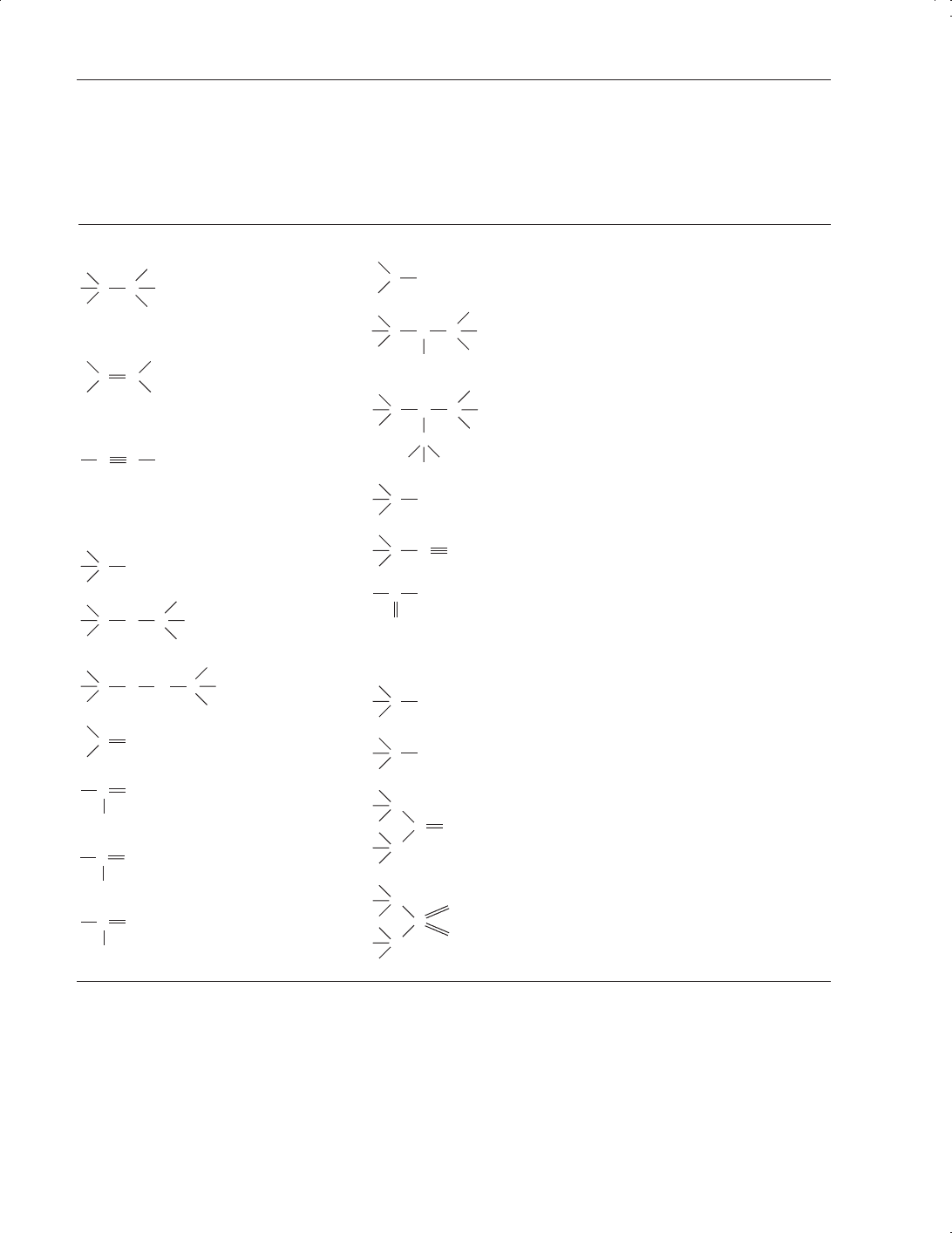
C C
C C
C CO
C O
C NO
2
C SH
C SO
3
H
C C
C
NH
2
C N C
H
C N C
C
C C N
C
C
SO
C
S
C
O
O
C O
OH
C O
Cl
C OOC
C OH
Carbon–carbon groups
Carbon–nitrogen groups
Carbon–oxygen groups
Carbon–sulphur groups
C
NH
2
O
Paraffin
Olefin
Acetylene
Alcohol
Ether
Peroxide
Ketone
Acyl chloride
Fatty acid
Primary amine
Secondary amine
Tertiary amine
Nitro
Nitrile (or cyanide)
Amide
Mercaptan
Sulphonic acid
Sulphoxide
Sulphone
C O
H
Aldehyde
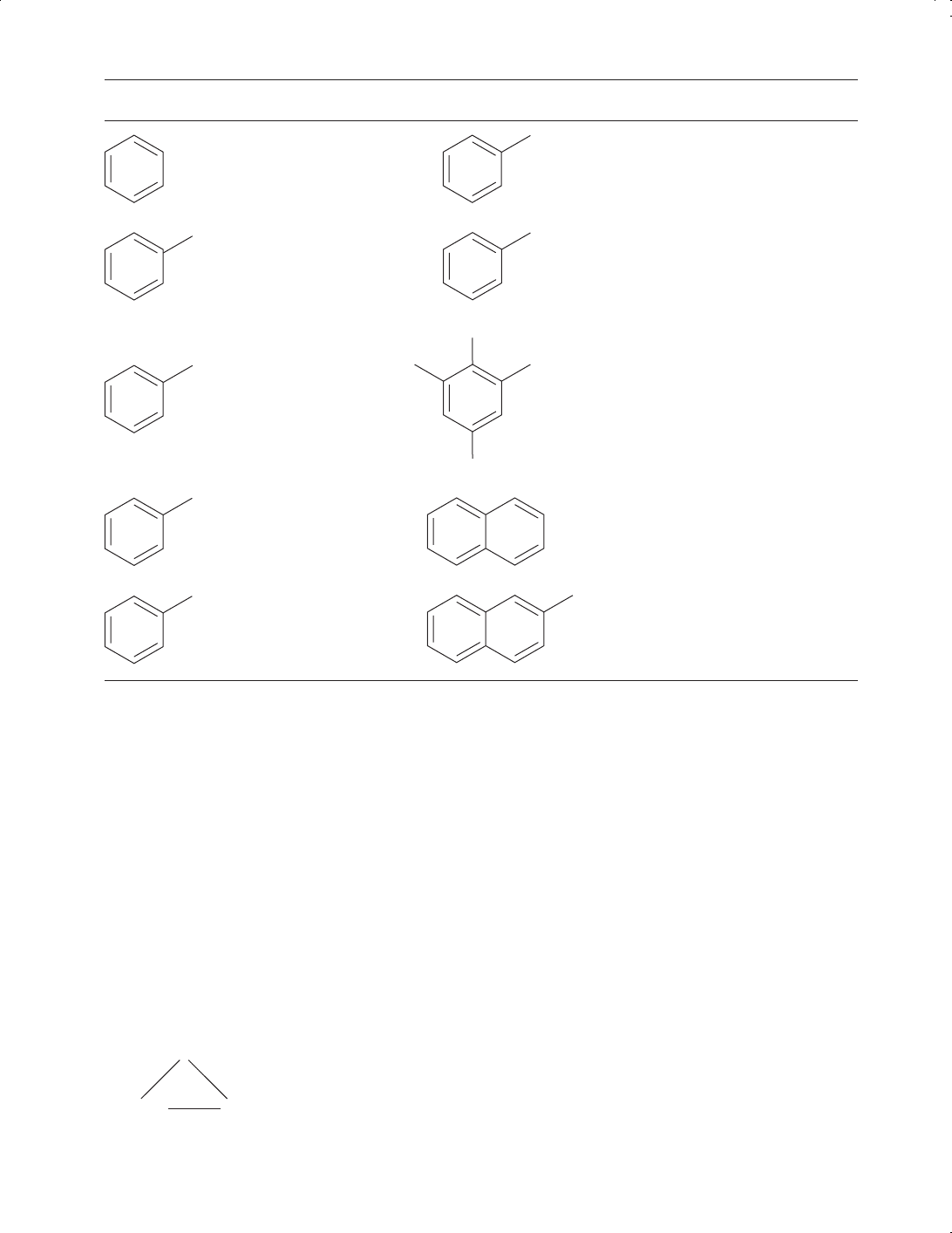
Tables 3.6 and 3.7 illustrate some of the key organic groupings. For convenience organic compounds
can be classified as either aliphatic or aromatic.
Table 3.6 Examples of aliphatic organic structures
Aliphatic compounds
Aliphatic compounds are straight chain or acyclic compounds and are characterized by addition
and free-radical chemistry.
ORGANIC CHEMISTRY 33
34 GENERAL PRINCIPLES OF CHEMISTRY
NH
2
Beta naphthylamine
Naphthalene
NO
2
NO
2
CH
3
NO
2
Trinitro toluene
(TNT)
CH
3
Methyl benzene
(Toluene)
Hydroxy benzene
(Phenol)
Benzene
NH
2
Amino benzene
(Aniline)
CO
2
H
Benzoic acid
SO
3
H
Benzene sulphonic acid
Cl
Chlorobenzene
OH
Carbon/carbon compounds
Paraffins
Compounds containing only carbon and hydrogen are termed paraffins or alkanes. The general
formula for these compounds is C
n
H
2n+2
where n is an integer. When only single bonds are
present between carbon atoms they are classified as ‘saturated’. Examples include, ethane, propane,
and butane; the last two are common fuel gases:
CH
4
methane (natural gas)
CH
3
—CH
3
ethane
CH
3
—CH
2
—CH
3
propane commonly used as
CH
3
—CH
2
—CH
2
—CH
3
butane liquefied petroleum gas
Table 3.7 Selected aromatic compounds
CH
2
CH
2
CH
2
cyclopropane

The alkanes are almost insoluble in water, sodium hydroxide and sulphuric acid but soluble in
non-polar solvents. The liquid density increases as the size of the paraffin molecule increases but
tends to level off at 0.8, i.e. all alkanes are less dense than water; therefore they will float and
spread as thin films on water. The boiling points and melting points increase as the number of
carbon atoms rises. The physical properties of cyclic aliphatic hydrocarbons resemble those of the
straight-chain counterparts, although the boiling points and densities of the cyclic compounds are
somewhat higher. The strong carbon–carbon and carbon–hydrogen bonds render paraffins relatively
unreactive and the few reactions they undergo require forcing conditions and tend to produce
mixtures. On heating between 400 and 600°C they can undergo thermal degradation or ‘cracking’
to produce simpler alkanes, olefins and hydrogen; this can increase the flammable hazards.
Olefins
When carbon atoms are linked by a double bond the compounds are called olefins. Since these
molecules contain less than the maximum quantity of hydrogen they are termed unsaturated.
Examples include ethylene, propylene, and butylene. Note that the latter can exist in several
forms:
CH
2
==
CH
2
ethylene
CH
3
CH
==
CH
2
propylene
CH
3
—CH
2
—CH
==
CH
2
1-butylene
CH
3
—CH
==
CH—CH
3
2-butylene
(CH
3
)
2
C
==
CH
2
iso-butylene
cyclohexene
Their physical properties are essentially those of the alkanes. It is the unsaturated linkages that
dominate the chemistry and the main reaction is one of addition (e.g. hydrogen, halogen, and
hydrogen halides) across the double bond to produce saturated compounds. This reactivity is
utilized in the manufacture of long-chain polymers, e.g. polyethylene and polypropylene.
Acetylenes
Compounds with even less hydrogen to carbon than olefins are acetylenes or alkynes as exemplified
by:
HC
≡≡
CH acetylene
CH
3
C
≡≡
CH propyne
CH
3
CH
2
C
≡≡
CH 1-butyne
CH
3
C
≡≡
CCH
3
2-butyne
Physical properties are similar to alkanes and the chemistry is dictated by the carbon triple bond.
This bond is less reactive than the olefin double bond towards electrophilic reagents, but more
ORGANIC CHEMISTRY 35

36 GENERAL PRINCIPLES OF CHEMISTRY
reactive towards chemicals that are themselves electron rich. Some metals, e.g. copper, react to
form metal acetylides. If allowed to dry out the heavy metal acetylides are prone to explode
(Chapter 7).
Carbon/Halogen compounds
One or several hydrogen atoms in hydrocarbons can be substituted by halogen to produce alkyl
halides. This significantly alters the toxicity, e.g. substitution of a chlorine atom in a hydrocarbon
leads to an increase in the potential narcotic and anaesthetic effects. Because of the increased
molecular weight, alkyl halides have considerably higher boiling points than the corresponding
hydrocarbon. For a given alkyl group the boiling point increases with increasing atomic weight
of halogen, with fluorides having the lowest boiling point and iodides the highest. Increasing the
halogen content also reduces the ease with which some compounds undergo chemical or biological
oxidation and hence they can accumulate in the environment. Some halogenated organic substances
react with ozone in the upper atmosphere and deplete the planet of this gas which provides a
protective shield against harmful ultra-violet light.
Some alkyl halides are toxic, e.g. trichloromethane or chloroform (CHCl
3
) and tetrachloromethane
or carbon tetrachloride (CCl
4
). Progressive chlorination of hydrocarbons gives liquids and/or
solids of increasing non-flammability, density, viscosity, solvent power and decreasing specific
heat, dielectric constant and water solubility. So perchloroethylene, CCl
2
==
CCl
2
, is a common
dry-cleaning solvent and trichloroethylene, CHCl
==
CCl
2
,
is widely used in vapour degreasing of
metal components. Despite being polarized molecules they are insoluble in water.
As with other groups, halogens can substitute hydrogen in organic compounds containing
additional functional moieties such as carboxylic acids to form acid chlorides, e.g. acetyl chloride
CH
3
COCl. These are reactive acidic compounds liberating hydrochloric acid on contact with
water.
Carbon/Nitrogen compounds
Of the organic compounds of sufficient basicity to turn litmus paper blue amines are the most
significant. These compounds have trivalent nitrogen bonded directly to carbon by single bonds
with the general formula RNH
2
, R
2
NH or R
3
N where R is an alkyl or aryl group. The first are
classed as primary amines, the next secondary amines and the last tertiary amines. The chemistry
is influenced by the number of hydrogen atoms attached to the nitrogen.
Amines, like ammonia NH
3
, are polar compounds and, except for tertiary amines, form
intermolecular hydrogen bonds leading to higher boiling points than non-polar compounds of the
same molecular weight, but lower boiling points than alcohols or acids. The smaller molecules,
containing up to about six carbon atoms, dissolve in water. Aliphatic amines are similar in
basicity to ammonia and form water-soluble salts with acids:
RNH
2
+ HCl = RNH
3
+
Cl
–
Nitriles, or alkyl cyanides, are compounds in which carbon is bound to nitrogen by triple bonds.
They tend to be stable, neutral substances with pleasant smells and are less toxic than hydrogen
cyanide. The smallest compounds are water soluble liquids and all are soluble in organic solvents.
Tertiary amines can be oxidized to form amine oxides in which the amino nitrogen atom is
linked to a single oxygen atom. The resulting compounds are basic dissolving in water thus:
R
3
N→ O + H
2
O = [R
3
N—OH]
+
OH
–
When nitrogen linked to two oxygen atoms is bound to carbon the compounds are termed

nitroparaffins. When pure these compounds are colourless liquids with pleasant smells. They are
sparingly soluble in water and most can be distilled at atmospheric pressure. The lower members
are used as solvents for oils, fats, cellulose esters, resins, and dyes. Nitroparaffins are also used
as raw materials for the synthesis of other chemicals such as pesticides, drugs, explosives, fuels
(e.g. nitromethane in drag racing fuel). Some nitroparaffins are explosive as described in Chapter 7.
Carbon/Oxygen compounds
Compounds containing oxygen linked to a carbon and a hydrogen atom are termed alcohols.
Simple examples are methyl and ethyl alcohol, CH
3
OH and C
2
H
5
OH, respectively. Reactions of
alcohols are characterized by the replacement of either the OH hydrogen atom or the entire OH
group:
2CH OH + 2Na = 2CH ONa + H
3
methyl alcohol
3
sodium methoxide
2
CH OH + HCl = CH Cl + H O
33
methyl chloride
2
Compounds in which oxygen bridges two carbon atoms are termed ethers, e.g. diethyl ether,
CH
3
CH
2
—O—CH
2
CH
3
.
This is used as a solvent and an anaesthetic. Generally, ethers are unreactive
compounds but on standing they can react with atmospheric oxygen to produce explosive peroxides,
e.g. diethyl peroxide, CH
3
CH
2
—O—O—CH
2
CH
3
.
Oxygen can link solely to carbon atoms by double bonds to form carbonyl compounds containing
the C
==
O group. If the same carbonyl group is linked to another carbon the compounds are
classed as ketones, if connected to a hydrogen atom they are aldehydes, and if connected to OH
groups they are carboxylic acids. The C
==
O carbon can also be bonded to other atoms such as
halogens, nitrogen and sulphur. The carbonyl group tends to dominate the chemistry of aldehydes
and ketones since it can be oxidized to carboxylic acids, reduced to alcohols or undergo addition
reactions. Carboxylic acids are acidic in nature, typically reacting with bases to form salts or with
alcohols to produce often sweet-smelling esters:
CH CO H + NaOH = CH CO Na + H O
32
acetic acid
sodium hydroxide
32
sodium acetate
2
water
CH CO H + CH OH = CH CO CH + H O
32 3 323
methyl acetate
2
Carbon/Sulphur compounds
Since sulphur is in the same group as oxygen in the periodic table it replaces oxygen in organic
structures to produce ‘thio’ analogues such as:
R—S—H thio alcohols or alkyl thiols
R—S—R thioethers or alkyl sulphides
R—C
||
O
—SH
thioacids
R—C
||
S
—SH
dithioacids
ORGANIC CHEMISTRY 37

38 GENERAL PRINCIPLES OF CHEMISTRY
S
||
R—C—R
thioketones
R—C
||
S
—H
thioaldehydes
With the exception of methanethiol, which is a gas, thiols are colourless, evil-smelling liquids.
Their boiling points are lower than those of the corresponding alcohols, reflecting their reduced
association and degree of hydrogen bonding between hydrogen and sulphur. For the same reason
thiols are less water soluble than their oxygen counterparts. The chemistry of thiols resembles
that of alcohols but they are more acidic, reflecting the stronger acidity of hydrogen sulphide over
water, of which alcohols can be regarded as alkyl derivatives. They are used as feedstocks in
rubber and plastics industries and as intermediates in agricultural chemicals, pharmaceuticals,
flavours and fragrances. Because they react with rubber-containing materials selection of hose
and gasket material is crucial.
Alkyl sulphides are the sulphur analogues of ethers from which they differ considerably in
chemistry. They are unpleasant-smelling oils, insoluble in water but soluble in organic solvents.
They tend to be comparatively inert. Mustard gas, ClCH
2
CH
2
—S—CH
2
CH
2
Cl, an oily liquid
boiling at 216°C with a mustard-like smell, is highly poisonous and a vesicant, and for this reason
found use in chemical warfare.
Alkyl sulphoxides occur widely in small concentrations in plant and animal tissues. No gaseous
sulphoxides are known and they tend to be colourless, odourless, relatively unstable solids soluble
in water, ethyl alcohol and ether. They are freely basic, and with acids form salts of the type
(R
2
SOH)
+
X
–
. Because sulphoxides are highly polar their boiling points are high. Their main use
is as solvents for polymerization, spinning, extractions, base-catalysed chemical reactions and for
pesticides.
Thioketones and aldehydes readily polymerize to the trimer and isolation of the monomer is
difficult.
Thioacids have a most disagreeable odour and slowly decompose in air. Their boiling points
are lower than those of the corresponding oxygen counterparts and they are less soluble in water,
but soluble in most organic solvents. An important dithioacid is dithiocarbonic acid (HO—CS
2
H).
Whilst the free acid is unknown, many derivatives have been prepared such as potassium xanthate
giving a yellow precipitate of copper xanthate with copper salts:
KOH + CS + C H OH = C H O—CS K + H O
potassium
hydroxide
2
carbon
disulphide
2
5
ethyl alcohol
(ethanol)
2
5
22
potassium xanthate
Unlike oxygen, sulphur can exist in higher valency states and as a result can be incorporated into
organic structures in additional ways. Examples include:
R—S
||
O
||
O
—R
Alkyl sulphones
RSO
3
H Sulphonic acids
Sulphones are colourless, very stable, water-soluble solids that are generally resistant to reduction.
The most important sulphones are sulpholane (1) and sulpholene (2):