
Darwin J. The Empire Project. The Rise and Fall of the British World-System, 1830-1970
Подождите немного. Документ загружается.

175 / The Britannic experiment
minority who had come to the mining towns of the South Island.
146
A new social ideal was in the making: the small independent yeoman
farmer or ‘cow-cockie’. It was given reality by the technological rev-
olution in New Zealand agriculture. By the mid-1890s, the technique
of refrigeration, the spread of large freezing works and the growing
demand for frozen meat and dairy produce in Britain was transform-
ing the New Zealand economy. Mutton and butter matched wool as
the premier export.
147
The area under white occupation increased by
50 per cent between 1896 and 1911, and the volume of production
by 60 per cent.
148
The colonisation of New Zealand entered a second
phase, lasting into the 1930s when settlers were still struggling to carve
out dairy farms ‘up on the roof’ in the old Maori ‘King Country’ of
central North Island.
149
Crucially, this new agrarian bonanza assured
the economic success of the Liberals’ drive to make New Zealand a land
of small farmers. It consolidated the ‘rural myth’
150
that belied the scale
of New Zealand’s port-cities, the growth of a unionised workforce, the
industrial basis of agricultural production and the extreme dependence
on faraway urban consumers.
The result was to bring a new depth and meaning to the old
tenets of ‘Vogelism’. The familiar idea of New Zealand as an Arcadia
recreating an idyll of rural England was energised and transformed by a
vision of social renewal. New Zealand was not to be an archaic Britain
but a distinct, progressive experiment in Britishness. New Zealanders
reinvented themselves not as a colonial fragment but as a modern,
rural British (or ‘Britannic’) nation in the South Pacific, which had
successfully erased the economic inequalities and social divisions of the
class-ridden motherland, partly by transplanting what was best and
brightest from ‘Home’.
151
The future lay not in gradual separation
from the mother-country but in more and more vigorous reciprocity
with her: the exchange of goods, men and ideas to press ahead with the
full colonisation of the New Zealand landscape, still half-conquered
and half-alien.
152
This was the ideology of ‘dominionhood’, the shift
from colonial to ‘dominion’ status consummated in 1907, and marked
by local adoption of ‘the Dominion’ as the country’s colloquial name.
It reflected a new confidence that New Zealand had something positive
to add to the grand project of making a ‘British world’. It was hardly
surprising, then, that Seddon should also have revived the imperial and
sub-imperial planks of Vogel’s platform and imbued them with a blunt
no-nonsense populism.
176 / Towards ‘The Sceptre of the World’
Indeed, since Vogel’s time, the pace of diplomatic competition
in the Pacific had quickened and with it the New Zealanders’ sense of
vulnerability. The idea that New Zealand could escape involvement in
the quarrels of the Old World – once favoured by Seddon’s old rival, the
South Island lawyer Robert Stout
153
– now seemed fanciful in the age of
Weltpolitik. The Anglo-German agreement on Samoa in 1899 was the
final straw: clinching evidence of London’s blindness to destiny – and
New Zealand’s interests.
154
Seddon revived Vogel’s scheme for a Poly-
nesian dominion. His well-publicised Pacific tour in 1900 was meant to
jog London’s elbow and assert New Zealand’s claim as the real trustee
of the British interest in the South Pacific. Seddon’s imperialism was
the counterpart of his nationalism. It identified ‘Empire’ not with the
territorial possessions of the imperial government but with the territo-
rial interests of the overseas British. Sympathy for the Uitlanders in the
Transvaal was its natural expression. Seddon had no doubts about the
justice of the British cause in South Africa and regarded the outbreak
of the Boer War there as a welcome sign that London could be made
to defend its beleaguered subjects.
155
It was a tendency he was eager
to encourage by New Zealand participation. ‘The flag that floats over
us’, he told the New Zealand parliament, ‘was expected to protect our
kindred and countrymen who are in the Transvaal.’ It was ‘our duty as
Englishmen’ to support the Uitlanders’ struggle. ‘We are a portion of
the dominant family of the world’, he went on,
we are of the English-speaking race. Our kindred are
scattered in dispersed parts of the globe, and wherever they
are, no matter how far distant apart, there is a feeling of
affection – that crimson tie, that bond of unity existing
which time does not affect – and in the end will become
indispensable.
156
But New Zealanders took part not at London’s command but as ‘part-
ners’ in the Empire, ‘sharing the profits and knowing the advantages’.
157
Seddon’s rhetoric was at once a manifesto of ‘Britannic nationalism’
and a claim to full membership in the management committee of the
British world-system. His great ally, John McKenzie, was an advocate
of imperial federation. His successor as premier, Melbourne-born Sir
Joseph Ward (premier, 1906–12), was to urge an ‘imperial parliament
of defence’ at the Imperial Conference in 1911 – but to no avail.
158
177 / The Britannic experiment
New Zealand’s commitment to empire was thus neither cynical
nor deferential, still less an aberration from the path to nationhood.
Its vehemence and certainty reflected the uniquely close fit between the
geopolitics of this white colonial settlement in the South Pacific and
the peculiar trajectory of its economic development. The influence of
both reached their height at the moment when the localised outlook of
mid-Victorian New Zealand began to be reshaped by the rise of its late-
Victorian ‘Britannic’ ideology of modernity, discipline and expansion.
Unlike Canada or Australia, there was much less of a tradition of
isolationism to challenge the ideal of the ‘imperial nation’.
159
There
was no ethnic interest to appease: the Maori had no quarrel with the
imperial connection declared the MP Honi Heke in October 1899.
160
Instead, more completely than in any other dominion, a new sense
of nationhood fused with a new conception of empire as the vehicle
of local safety and national ambition. But it was an empire that was
expected to embody not just the interests of the United Kingdom, but
a broader ‘Britannic’ ideal.
Building the British world
By the end of the nineteenth century, it was no longer a pipe-dream that
the main settlement colonies, with Canada in the van, might form the
heart of an overseas ‘British world’, a vast zone held together not by
rule or coercion but by common political values, and cultural attraction
as well as (in this case) by racial solidarity. Nor that a sense of shared
‘Britannic’ nationality, a collective insistence on a shared ‘Britishness’,
provincial but equal (or even superior), would induce spontaneous
identification with the fortunes of Britain, and even a willingness, in
a real emergency, to spend blood and treasure in the common British
cause. In the first forty years of the twentieth century, this ‘Britan-
nic’ identity was tested and proved in the hardest of trials. Indeed,
many contemporaries learned to take it for granted as a fact of polit-
ical life. Dismissed, disparaged or simply ignored by the ‘nationalist’
historians of the ex-‘white dominions’ in the 1960s and after, its per-
vasive, foundational importance has been rediscovered in more recent
years.
161
For historians of the British Empire, its key contribution to
the strength and survival of the British world-system can hardly be
doubted.
178 / Towards ‘The Sceptre of the World’
There was a further dimension of the ‘Britannic experi-
ment’ which we should not overlook. The settlement colonies, John
Robert Seeley declared, were really ‘a vast English nation’ merely dis-
persed by distance.
162
Seeley wrote in an age when the distinction
between ‘Britain’ and ‘England’ was usually elided, when Scotsmen (or
‘Scotchmen’) sometimes called themselves ‘English’, and when Scotland
itself could be referred to as ‘North Britain’. But Seeley knew perfectly
well that the making of empire and what he called ‘Greater Britain’
were the handiwork of all the four nations that comprised the British
‘Union’ – to the cohesion of which he was passionately committed.
163
Seeley seems to have assumed – what much recent scholarship has con-
firmed – that the opportunity, power and prestige brought by empire
reinforced the appeal of a composite ‘British’ nationality in the Home
Islands themselves. Welsh, Irish and Scots took pride in an empire they
had helped to create, cherished their links with their overseas country-
men, and identified their ‘regional’ interests – merchant, migrant and
missionary – with the empire’s success.
164
In the settlement colonies, distinct Scots and Irish identities
were emphatically visible. Scots made up a significant proportion of
emigrants to Nova Scotia and Upper Canada (Ontario). A ring of Scots
families supplied most of the mercantile leadership in Canada’s premier
port-city, Montreal.
165
The Presbyterian church, the ‘Caledonian’ soci-
eties and a fondness for curling forged strong social bonds. In Australia,
too, Scots Presbyterians played a prominent part in the professions and
business. Scots made up nearly a quarter of New Zealand’s popula-
tion by the end of the century.
166
And, although the main tide of Irish
migration had turned to the United States by the 1850s, an earlier
stream of Protestant Irish from both North and South had decisively
shaped Upper Canada’s political life, not least through the influence of
the Orange Lodge in the province.
167
Catholics were more numerous
in the Australian colonies where one-quarter of the population was of
Irish descent in 1900,
168
and in New Zealand where they made up
three-quarters of the Irish total and some 13 per cent of the whole
population.
Even more than at home, Scots and Irish ‘colonials’ adopted a
‘British’ allegiance even if they preserved a strong sentimental attach-
ment to their ethnic identity. There were several reasons for this. The
mobile conditions of colonial life discouraged the formation of closed or
exclusive communities. The parochial disputes of faraway homelands
179 / The Britannic experiment
had diminishing relevance. But perhaps the most important factor of
all was the inclusive character of colonial political life. Responsible (or
parliamentary) government was open to all (men) without regard to
religion. And, although the distinction between Catholic and Protes-
tant remained an important divide, it was not wide enough to subvert
Catholic attachment to British institutions. In three Catholic Irishmen,
Thomas D’Arcy McGee (1825–68), an ardent champion of confeder-
ation in Canada, (Sir) Charles Gavan Duffy (1816–1903), sometime
premier of Victoria, and Charles Coghlan (1863–1927), first prime
minister of Southern Rhodesia, strong nationalist feeling was combined
with a ‘Burkean reverence’ for parliamentary government and (at least
outwardly) deep loyalty to the Crown.
169
5
‘UN-BRITISH RULE’ IN ‘ANGLO-INDIA’
British rule in India had always been an awkward compromise between
principle and practice. The early Victorians had declared that the pur-
pose of the Company Raj was the political education of Indians and
their preparation for eventual self-government. Fifty years on, progress
towards this goal was barely perceptible. At the end of Company rule
in 1858, the Queen’s Proclamation had reassured Indians that race dis-
crimination would play no part in the new colonial regime. But this
was hard to square with the status of even educated Indians in the
politics and social life of the late-Victorian Raj. The third contradic-
tion was even more telling. The British had founded their rule on the
promise of social and economic improvement: what the annual reports
of the Indian government were to call ‘moral and material progress’.
Yet, even at the end of the century, India remained prey to devastating
famines, terrifying epidemics and contagious diseases whose sphere was
widening not contracting. Literacy (even in local languages) remained
(at around 10 per cent) embarrassingly low. But, while social progress
seemed stalled, the Indian government spent more and more on the
army, and especially on that part of it ‘borrowed’ from Britain. It
was hardly surprising, then, that the terms of India’s association with
the British world-system became more controversial after 1880.But
it was India’s growing importance to the imperial system, as much as
the grievances of its social elites, that shaped its late-Victorian and
Edwardian politics.
181 / ‘Un-British rule’ in ‘Anglo-India’
Madras
Calcutta
Dacca
Patna
A
S
S
A
M
B
U
R
M
A
BENGAL
Allahabad
Nagpur
BERAR
HYDERABAD
Poona
Bombay
Baroda
Karachi
Delhi
Lahore
CEYLON
TRAVANCORE
MYSORE
M
A
D
R
A
S
P
R
E
S
I
D
E
N
C
Y
B
O
M
B
A
Y
P
R
E
S
I
D
E
N
C
Y
S
I
N
D
RAJPUTANA
PUNJAB
CENTRAL
PROVINCES
C
E
N
T
R
A
L
I
N
D
I
A
A
G
E
N
C
Y
N
E
P
A
L
N
O
R
T
H
-
W
E
S
T
E
R
N
P
R
O
V
I
N
C
E
S
A
N
D
O
U
D
H
GOA
British provinces
Princely states
KASHMIR
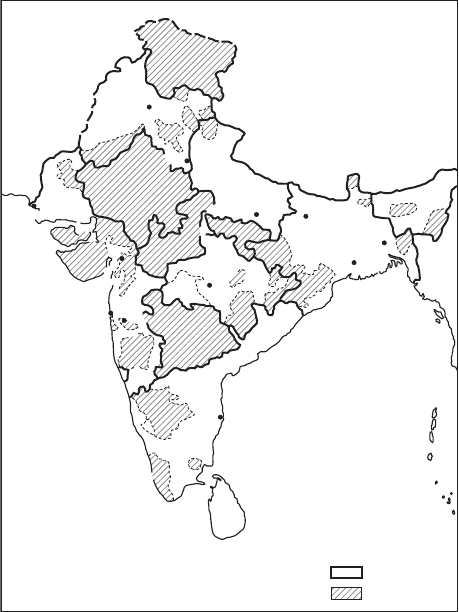
Map 7 The Indian Empire
Imperial India?
In the later nineteenth century, the value of India as the second centre
of British world power became more than ever an axiom of British
thinking. This was partly because, in the aftermath of the Mutiny of
1857, Company rule was replaced by the direct control of the London
government, a transition glamorised a few years later by the procla-
mation of Victoria as ‘Queen Empress of India’ or Kaisar-i-Hind.But
mainly it reflected the rising contribution that India made to the world-
system whose consolidation in the age of world politics after 1880 we
have been tracing. Without India as one of its four grand components,
the British world-system would have been without some of the most
vital sources of its security, stability and cohesion. And part of the
182 / Towards ‘The Sceptre of the World’
motive and much of the means for the acquisition of so many lesser
dependencies in Afro-Asia would have been lacking.
India’s contribution to British world power was not left to
chance or self-interest. It was deliberately shaped by British rule. After
1870, the Indian economy was developed rapidly as a major producer
of export commodities: wheat, raw cotton, jute and tea, among others.
1
It also became an ever more important market for British exports, espe-
cially cotton textiles and iron and steel. At a time when many other
markets were being sealed off by tariffs, India was wedged open by
imperial fiat.
2
The British officials who ran the Indian government could
levy import duties; but they could not protect Indian producers of tex-
tiles against outside competition because London insisted that any tariff
be matched by a local excise. In this way, India, which bought some
25 per cent of Lancashire’s export production, took the largest share
of Britain’s largest export up to 1914. Simultaneously, the growth of
its own exports, mainly destined for European or American consumers,
earned the foreign exchange that, when remitted to Britain, helped
square Britain’s own balance of payments. For, while Britain was usu-
ally in deficit to Europe and the United States, India was always in
deficit to Britain. This was partly a matter of borrowed capital, much
of it by government to build railways, and much of it at London’s
urging – since longer lines meant wider markets.
3
But it also grew from
the ‘Home Charges’ that London imposed on India to pay for the British
troops that were stationed there, as well as the pensions of British offi-
cials and the cost of the India Office, the Whitehall department from
which Indian affairs were supervised.
In the later nineteenth century, then, India’s economic value to
Britain – and to Britain’s ability to service its world-system – was great
and growing. The expansion of the Indian economy widened British
markets, increased the demand for British capital and helped India
bear more easily the cost of its second great imperial contribution – to
imperial defence. Even before 1857, the Company had maintained a
sizeable army in India to uphold its power and expand its territories.
It had ‘borrowed’ British troops at a charge from the home govern-
ment. After the Mutiny, the Indian troops were cut down in number
to between 120,000 and 140,000. But, at the same time, the all-British
contingent was enlarged so as to be roughly half the size of the Indian.
As we have seen, providing 60–70,000 British soldiers for Indian ser-
vice (with inevitable ‘wastage’ for disease) was a major strain on the
British military system and enforced considerable adaptation. But there
183 / ‘Un-British rule’ in ‘Anglo-India’
was also a benefit. By the late nineteenth century, when the Empire’s
standing armies totalled some 325,000 men, two-thirds of this number
was paid for by the Indian taxpayer. For the rule was that every British
soldier, once embarked for India, had to be paid, pensioned, equipped
and fed by the government of India, not of Britain. And there was
an irresistible tendency, as time went on, for more and more British
soldiers to be kept in India at Indian expense. How valuable this was
politically can be grasped by asking how readily the British parliament
would have agreed, at a time of rapidly rising naval costs, to maintain
an army nearly three times as large as that for which the Treasury had
actually to pay. How valuable it was strategically can be illustrated
by the frequency with which troops were despatched from India after
1860 on operations that had little or nothing to do with India’s own
defence – to China (1860, 1900–1), Ethiopia (1867–8), Malaya (1875),
Malta (1878), Egypt (1882), Sudan (1885–6, 1896), Burma (1885),
East Africa (1896, 1897, 1898), Somaliland (1890, 1903–4), South
Africa (1899, but white troops only) and Tibet (1903).
4
India’s commercial and military contributions were both func-
tions of British rule which facilitated, or enforced, a distinctive pattern
of economic development and financial spending. India made a third
contribution that was less directly the result of colonial control. Across
the whole face of the ‘British world’, Indian manpower and commer-
cial expertise helped open new regions to British influence and make
colonial government financially viable. Indian labour made plantation
agriculture possible in Malaya, Southeast Africa and the Pacific. It built
the railway to Uganda. Indian peasants streamed into British Burma
and made it the rice bowl of Southeast Asia.
5
Indian retailers and mer-
chants, with lower overheads than their European counterparts, built
a commercial infrastructure in places too exacting for the ‘nation of
shopkeepers’.
6
Indian policemen, clerks and orderlies served as far away
as China.
7
In much of the tropical world east of Suez, ‘British’ expan-
sion was really an Anglo-Indian enterprise: here was a field almost as
much of Indian as of British colonisation. It was Winston Churchill as
a junior minister who picturesquely evoked East Africa as ‘the America
of the Hindu’.
8
Between 1880 and 1914, these commercial, military and demo-
graphic connections (and others) sharpened the dominant tendency
in late-Victorian and Edwardian India: its ever-closer integration into
the British world-system. ‘Advancing civilisation’, remarked the Indian
Currency Committee in 1893, ‘brings with it constantly increasing
184 / Towards ‘The Sceptre of the World’
demands for Government action and enterprise.’
9
Irrigation schemes
and, above all, railways, were a heavy call on Indian revenues. Financ-
ing them drove the government of India ever more frequently to the
capital market in London. As a result, the proportion of its public debt
that was held there rose from a mere 7 per cent in 1858 to 60 per cent
by 1914.
10
Servicing this debt became an ever-increasing burden, espe-
cially when silver, the basis of India’s currency, depreciated sharply
against gold in the later nineteenth century. As a guarantee against
default on the ‘Home Charges’, the government of India was forced
after 1898 to maintain a gold fund in London, managed by the India
Office, whose operation regulated the supply of money in India – and
thus the general level of economic activity there.
11
This was integration
with a vengeance. The ‘silver problem’ exacerbated the growing burden
of Indian military spending, especially that part of it needed to ‘rent’ the
British garrison from London. Between 1884 and 1897, India’s military
expenditure increased by 45 per cent – a colossal figure.
12
Much of this
was due to the fall in silver’s value. But it also reflected increases in both
Indian manpower (up by 20,000) and the size of the British contingent
(up by 10,000).
Behind this martial expansion lay the diplomatic and geostrate-
gic imperatives that seemed to be drawing India ever more closely into
London’s embrace. The new geopolitics of the later nineteenth century
envisaged a handful of ‘world states’ whose global pre-eminence would
be based on their coordination of territories, resources and popula-
tions. At the same time, Asia (especially East Asia and the Pacific) was
becoming the focus of European (and American) economic and diplo-
matic rivalry. ‘I am one of those’, Lord Curzon told an enthusiastic
audience on the eve of his departure as Indian Viceroy in 1898,
who think that the Eastward trend of Empire will increase
and not diminish . . . [T]he strain upon us will become
greater not less. Parliament will learn to know East Asia as
well as it now knows Europe [and] Asiatic sympathies and
knowledge will be . . . the interest of the whole nation
(Cheers).
13
Both these developments pointed to a steady rise in the impe-
rial importance of India, the springboard and citadel of British influ-
ence in Asia – the ‘pivot and centre’, in Curzon’s phrase, ‘of the British
Empire’.
14
But they also made India more vulnerable. In the 1870s,