
Devore J.L., Berk K.N. Modern Mathematical Statistics with Applications
Подождите немного. Документ загружается.

Similarly,
PðX 3Þ
X
3
x ¼ 0
pðx; 2Þ¼
X
3
x ¼ 0
e
2
2
x
x!
¼ :135335 þ :270671 þ :270671 þ :180447
¼ :8571
and this again is quite close to the binomial value P(X 3) ¼ .8576.
■
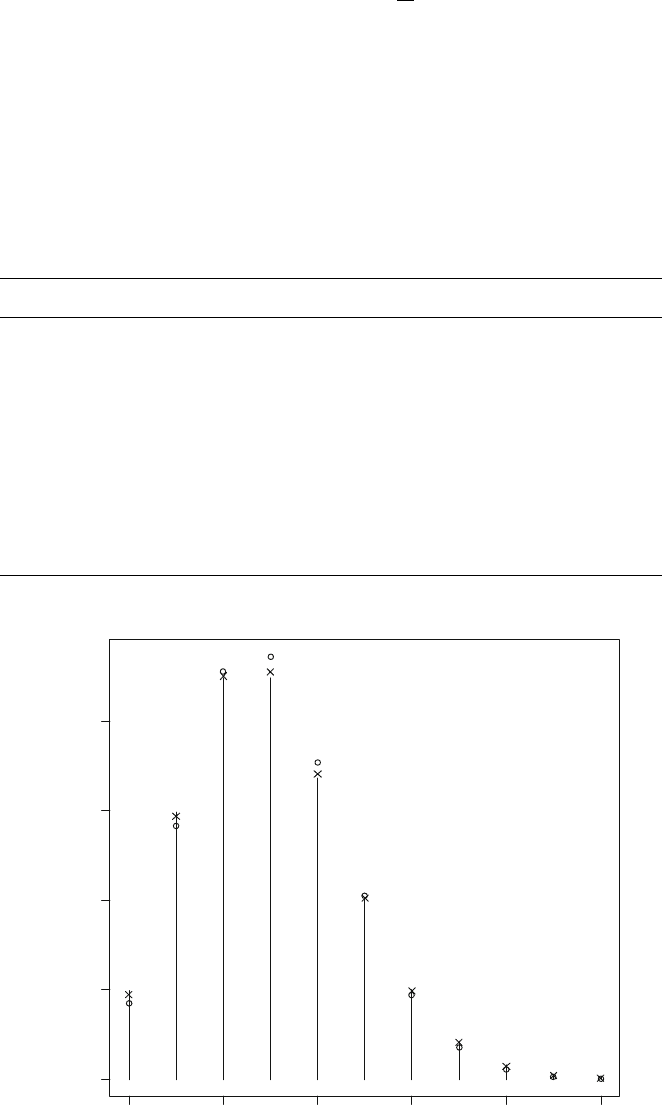
Table 3.2 shows the Poisso n distribution for l ¼ 3 along with three binomial
distributions with np ¼ 3, and Figure 3.8 (from R) plots the Poisson along with the
first two binomial distributions. The approximation is of limited use for n ¼ 30, but
of course the accuracy is better for n ¼ 100 and much better for n ¼ 300.
Table 3.2 Com paring the Poisson and three binomial distributions
xn¼ 30, p ¼ .1 n ¼ 100, p ¼ .03 n ¼ 300, p ¼ .01 Poisson, l ¼ 3
0 0.042391 0.047553 0.049041 0.049787
1 0.141304 0.147070 0.148609 0.149361
2 0.227656 0.225153 0.224414 0.224042
3 0.236088 0.227474 0.225170 0.224042
4 0.177066 0.170606 0.168877 0.168031
5 0.102305 0.101308 0.100985 0.100819
6 0.047363 0.049610 0.050153 0.050409
7 0.018043 0.020604 0.021277 0.021604
8 0.005764 0.007408 0.007871 0.008102
9 0.001565 0.002342 0.002580 0.002701
10 0.000365 0.000659 0.000758 0.000810
0246810
0.20
0.15
0.10
0.05
0.00
Bin,n=30(o); Bin,n=100(x); Poisson(|)
x
P(x)
Figure 3.8 Comparing a Poisson and two binomial distributions
148
CHAPTER 3 Discrete Random Variables and Probability Distributions

Appendix Table A.2 exhibits the cdf F(x; l) for l ¼ .1, .2, ...,1,2,..., 10,
15, and 20. For example, if l ¼ 2, then P (X 3) ¼ F(3; 2) ¼ .857 as in Example
3.48, whereas P(X ¼ 3) ¼ F(3; 2) –F(2; 2) ¼ .180. Alternatively, man y statistical
computer packages will generate p(x; l) and F(x; l) upon request.
The Mean, Variance and MGF of X
Since b(x; n, p) ! p(x; l)asn !1, p ! 0, np ! l, the mean and variance of a
binomial variable should approach those of a Poisson variable. These limits are
np ! l and np(1 p) ! l.
PROPOSITION
If X has a Poisson distribution with parameter l, then E(X) ¼ V(X) ¼ l.
These results can also be derived directly from the definitions of mean and variance
(see Exercise 104 for the mean).
Example 3.49
(Example 3.47
continued)
Both the expected number of creatures trapped and the variance of the number
trapped equal 4.5, and s
X
¼
ffiffiffi
l
p
¼
ffiffiffiffiffiffiffi
4:5
p
¼ 2:12. ■
The moment generating function of the Poisson distribution is easy to derive,
and it gives a direct route to the mean and variance (Exercise 108).
PROPOSITION
The Poisson moment generating function is
M
X
ðtÞ¼e
lðe
t
1Þ
Proof The mgf is by definition
M
X
ðtÞ¼Eðe
tx
Þ¼
X
1
x ¼ 0
e
tx
e
l
l
x
x!
¼ e
l
X
1
x ¼ 0
ðle
t
Þ
x
x!
¼ e
l
e
le
t
¼ e
le
t
l
This uses the series expansion
P
1
x ¼ 0
u
x
= x! ¼ e
u
: ■
The Poisson Process
A very important application of the Poisson distribution arises in connection with
the occurrence of events of a particular type over time. As an example, suppose that
starting from a time point that we label t ¼ 0, we are interested in counting the
number of radioactive pulses recorded by a Geiger count er. We make the following
assumptions about the way in which pulses occur:
3.7 The Poisson Probability Distribution 149

1. Th ere exists a parameter a > 0 such that for any short time interval of length Dt,
the probability that exactly one pulse is received is a Dt+o(Dt).
3
2. Th e probability of more than one pulse being received during Dt is o(Dt) [which,
along with Assumption 1, implies that the probability of no pulses during Dt is
1 a Dt o(Dt)].
3. Th e number of pulses received during the time interval Dt is independent of the
number received prior to this time interval.
Informally, Assumption 1 says that for a short interval of time, the probability of
receiving a single pulse is approximately proportional to the length of the time
interval, where a is the constant of proportionality. Now let P
k
(t) denote the
probability that k pulses will be received by the counter during any particular
time interval of length t.
PROPOSITION
P
k
(t) ¼ e
at
(at)
k
/k!, so that the number of pulses during a time interval of
length t is a Poisson rv with parameter l ¼ at. The expected number of pulses
during any such time interval is then at, so the expected number during a unit
interval of time is a.
See Exercise 107 for a derivation.
Example 3.50 Suppose pulses arrive at the counter at an average rate of 6/min, so that a ¼ 6.
To find the probability that in a .5-min interval at least one pulse is rece ived, note
that the number of pulses in such an interval has a Poisson distribution with
parameter at ¼ 6(.5) ¼ 3 (.5 min is used because a is expressed as a rate per
minute). Then with X ¼ the number of pulses received in the 30-s interval,
Pð1 XÞ¼1 PðX ¼ 0Þ¼1
e
3
3
0
0!
¼ :950
■
If in Assumptions 1–3 we replace “pulse” by “event,” then the number of
events occurring during a fixed time interval of length t has a Poisson distribution
with parameter at. Any process that has this distribution is called a Poisso n
process, and a is called the rate of the process. Other examples of situations giving
rise to a Poisson process include monitoring the status of a computer system over
time, with breakdowns constituting the events of interest; recording the number of
accidents in an industrial facility over time; answering calls at a telephone switch-
board; and observing the number of cosmic-ray showers from an observatory over
time.
Instead of observing events over time, consider observing events of some
type that occur in a two- or three-dimensional region. For example, we might select
on a map a certain region R of a forest, go to that region, and count the number of
trees. Each tree would represent an event occurring at a particular point in space.
3
A quantity is o(Dt) (read “little o of delta t”) if, as Dt approaches 0, so does o(Dt)/ Dt. That is, o(Dt)is
even more negligible than Dt itself. The quantity (Dt)
2
has this property, but sin(Dt) does not.
150 CHAPTER 3 Discrete Random Variables and Probability Distributions

Under assumptions similar to 1–3, it can be shown that the number of events
occurring in a region R has a Poisson distribution with parameter a a(R), where
a(R) is the area or volume of R. The quantity a is the expected number of events per
unit area or volume.
Exercises Section 3.7 (93–109)
93. Let X, the number of flaws on the surface of a
randomly selected carpet of a particular type,
have a Poisson distribution with parameter
l ¼ 5. Use Appendix Table A.2 to compute the
following probabilities:
a. P(X 8)
b. P(X ¼ 8)
c. P(9 X)
d. P(5 X 8)
e. P(5 < X < 8)
94. Suppose the number X of tornadoes observed in a
particular region during a 1-year period has a
Poisson distribution with l ¼ 8.
a. Compute P(X 5).
b. Compute P (6 X 9).
c. Compute P(10 X).
d. What is the probability that the observed
number of tornadoes exceeds the expected
number by more than 1 standard deviation?
95. Suppose that the number of drivers who travel
between a particular origin and destination dur-
ing a designated time period has a Poisson distri-
bution with parameter l ¼ 20 (suggested in the
article “Dynamic Ride Sharing: Theory and
Practice,” J. Transp. Engrg., 1997: 308–312).
What is the probability that the number of drivers
will
a. Be at most 10?
b. Exceed 20?
c. Be between 10 and 20, inclusive? Be strictly
between 10 and 20?
d. Be within 2 standard deviations of the mean
value?
96.
Consider writing onto a computer disk and then
sending it through a certifier that counts the
number of missing pulses. Suppose this number
X has a Poisson distribution with parameter
l ¼ .2. (Suggested in “Average Sample Number
for Semi-Curtailed Sampling Using the Poisson
Distribution,” J. Qual. Tech., 1983: 126–129.)
a. What is the probability that a disk has exactly
one missing pulse?
b. What is the probability that a disk has at least
two missing pulses?
c. If two disks are independently selected, what
is the probability that neither contains a
missing pulse?
97. An article in the Los Angeles Times (Dec. 3,
1993) reports that 1 in 200 people carry the
defective gene that causes inherited colon can-
cer. In a sample of 1000 individuals, what is
the approximate distribution of the number who
carry this gene? Use this distribution to calcu-
late the approximate probability that
a. Between 5 and 8 (inclusive) carry the gene.
b. At least 8 carry the gene.
98. Suppose that only .10% of all computers of a
certain type experience CPU failure during the
warranty period. Consider a sample of 10,000
computers.
a. What are the expected value and standard
deviation of the number of computers in the
sample that have the defect?
b. What is the (approximate) probability that
more than 10 sampled computers have the
defect?
c. What is the (approximate) probability that no
sampled computers have the defect?
99. Suppose small aircraft arrive at an airport
according to a Poisson process with rate a ¼ 8/h,
so that the number of arrivals during a time
period of t hours is a Poisson rv with parameter
l ¼ 8t.
a. What is the probability that exactly 6 small
aircraft arrive during a 1-h period? At least
6? At least 10?
b. What are the expected value and standard
deviation of the number of small aircraft
that arrive during a 90-min period?
c. What is the probability that at least 20 small
aircraft arrive during a 2
1
2
h period? That at
most 10 arrive during this period?
100. The number of people arriving for treatment at
an emergency room can be modeled by a Pois-
son process with a rate parameter of 5/h.
a. What is the probability that exactly four
arrivals occur during a particular hour?
3.7 The Poisson Probability Distribution 151

b. What is the probability that at least four peo-
ple arrive during a particular hour?
c. How many people do you expect to arrive
during a 45-min period?
101. The number of requests for assistance received
by a towing service is a Poisson process with rate
a ¼ 4/h.
a. Compute the probability that exactly ten
requests are received during a particular 2-h
period.
b. If the operators of the towing service take a 30-
min break for lunch, what is the probability that
they do not miss any calls for assistance?
c. How many calls would you expect during
their break?
102. In proof testing of circuit boards, the probability
that any particular diode will fail is .01. Suppose
a circuit board contains 200 diodes.
a. How many diodes would you expect to fail,
and what is the standard deviation of the
number that are expected to fail?
b. What is the (approximate) probability that at
least four diodes will fail on a randomly
selected board?
c. If five boards are shipped to a particular cus-
tomer, how likely is it that at least four of
them will work properly? (A board works
properly only if all its diodes work.)
103. The article “Reliability-Based Service-Life
Assessment of Aging Concrete Structures” (J.
Struct. Engrg., 1993: 1600–1621) suggests that
a Poisson process can be used to represent the
occurrence of structural loads over time. Suppose
the mean time between occurrences of loads
(which can be shown to be ¼ 1/a) is .5 year.
a. How many loads can be expected to occur
during a 2-year period?
b. What is the probability that more than five
loads occur during a 2-year period?
c. How long must a time period be so that the
probability of no loads occurring during that
period is at most .1?
104. Let X have a Poisson distribution with parameter
l. Show that E(X) ¼ l directly from the defini-
tion of expected value. [Hint: The first term in
the sum equals 0, and then x can be canceled.
Now factor out l and show that what is left
sums to 1.]
105. Suppose that trees are distributed in a forest
according to a two-dimensional Poisson process
with parameter a, the expected number of trees
per acre, equal to 80.
a. What is the probability that in a certain quar-
ter-acre plot, there will be at most 16 trees?
b. If the forest covers 85,000 acres, what is the
expected number of trees in the forest?
c. Suppose you select a point in the forest and
construct a circle of radius .1 mile. Let X ¼
the
number of trees within that circular region.
What is the pmf of X?[Hint: 1 sq mile ¼ 640
acres.]
106. Automobiles arrive at a vehicle equipment inspec-
tion station according to a Poisson process with
rate a ¼ 10/h. Suppose that with probability .5 an
arriving vehicle will have no equipment viola-
tions.
a. What is the probability that exactly ten arrive
during the hour and all ten have no violations?
b. For any fixed y 10, what is the probability
that y arrive during the hour, of which ten
have no violations?
c. What is the probability that ten “no-violation”
cars arrive during the next hour? [Hint: Sum
the probabilities in part (b) from y ¼ 10 to 1.]
107. a. In a Poisson process, what has to happen in
both the time interval (0, t) and the interval
(t, t+Dt) so that no events occur in the
entire interval (0, t+Dt)? Use this and
Assumptions 1–3 to write a relationship
between P
0
(t+Dt) and P
0
(t).
b. Use the result of part (a) to write an expres-
sion for the difference P
0
(t+Dt) P
0
(t).
Then divide by Dt and let Dt ! 0 to obtain
an equation involving (d/dt)P
0
(t), the deriva-
tive of P
0
(t) with respect to t.
c. Verify that P
0
(t) ¼ e
at
satisfies the equation
of part (b).
d. It can be shown in a manner similar to parts
(a) and (b) that the P
k
(t)’s must satisfy the
system of differential equations
d
dt
P
k
ðtÞ¼aP
k1
ðtÞaP
k
ðtÞ k ¼ 1; 2; 3; ...
Verify that P
k
(t) ¼ e
at
(at)
k
/k! satisfies the sys-
tem. (This is actually the only solution.)
108. a. Use derivatives of the moment generating
function to obtain the mean and variance for
the Poisson distribution.
b. As discussed in Section 3.4, obtain the Pois-
son mean and variance from R
X
(t) ¼ ln
[M
X
(t)]. In terms of effort, how does this
method compare with the one in part (a)?
109. Show that the binomial moment generating func-
tion converges to the Poisson moment generating
152
CHAPTER 3 Discrete Random Variables and Probability Distributions

function if we let n !1and p ! 0 in such a
way that np approaches a value l > 0. [Hint: Use
the calculus theorem that was used in showing
that the binomial probabilities converge to the
Poisson probabilities.] There is in fact a theorem
saying that convergence of the mgf implies con-
vergence of the probability distribution. In par-
ticular, convergence of the binomial mgf to the
Poisson mgf implies b(x; n, p) ! p(x; l).
Supplementary Exercises (110–139)
110. Consider a deck consisting of seven cards,
marked 1, 2, ... , 7. Three of these cards are
selected at random. Define an rv W by W ¼ the
sum of the resulting numbers, and compute the
pmf of W. Then compute m and s
2
.[Hint: Con-
sider outcomes as unordered, so that (1, 3, 7)
and (3, 1, 7) are not different outcomes. Then
there are 35 outcomes, and they can be listed.
(This type of rv actually arises in connection
with Wilcoxon’s rank-sum test, in which there
is an x sample and a y sample and W is the sum
of the ranks of the x’s in the combined sample.)]
111. After shuffling a deck of 52 cards, a dealer deals
out 5. Let X ¼ the number of suits represented
in the five-card hand.
a. Show that the pmf of X is
x 1 234
p(x) .002 .146 .588 .264
[Hint: p(1) ¼ 4P(all spades), p(2) ¼ 6P(only
spades and hearts with at least one of each),
and p(4) ¼ 4P(2 spades \ one of each other
suit).]
b. Compute m, s
2
, and s.
112. The negative binomial rv X was defined as the
number of F’s preceding the rth S. Let Y ¼ the
number of trials necessary to obtain the rth S.In
the same manner in which the pmf of X was
derived, derive the pmf of Y.
113. Of all customers purchasing automatic garage-
door openers, 75% purchase a chain-driven
model. Let X ¼ the number among the next
15 purchasers who select the chain-driven
model.
a. What is the pmf of X?
b. Compute P(X > 10).
c. Compute P(6 X 10).
d. Compute m and s
2
.
e. If the store currently has in stock 10 chain-
driven models and 8 shaft-driven models,
what is the probability that the requests of
these 15 customers can all be met from exist-
ing stock?
114. A friend recently planned a camping trip. He
had two flashlights, one that required a single 6-
V battery and another that used two size-D
batteries. He had previously packed two 6-V
and four size-D batteries in his camper. Sup-
pose the probability that any particular battery
works is p and that batteries work or fail inde-
pendently of one another. Our friend wants to
take just one flashlight. For what values of
p should he take the 6-V flashlight?
115. A k-out-of-n system is one that will function if
and only if at least k of the n individual compo-
nents in the system function. If individual com-
ponents function independently of one another,
each with probability .9, what is the probability
that a 3-out-of-5 system functions?
116. A manufacturer of flashlight batteries wishes to
control the quality of its product by rejecting
any lot in which the proportion of batteries
having unacceptable voltage appears to be too
high. To this end, out of each large lot (10,000
batteries), 25 will be selected and tested. If at
least 5 of these generate an unacceptable volt-
age, the entire lot will be rejected. What is the
probability that a lot will be rejected if
a. Five percent of the batteries in the lot have
unacceptable voltages?
b. Ten percent of the batteries in the lot have
unacceptable voltages?
c. Twenty percent of the batteries in the lot
have unacceptable voltages?
d. What would happen to the probabilities in
parts (a)–(c) if the critical rejection number
were increased from 5 to 6?
117. Of the people passing through an airport metal
detector, .5% activate it; let X ¼ the number
among a randomly selected group of 500 who
activate the detector.
Supplementary Exercises 153
a. What is the (approximate) pmf of X?
b. Compute P (X ¼ 5).
c. Compute P(5 X).
118. An educational consulting firm is trying to
dec ide wheth er high school students who have
never before used a hand-held calculator can
solve a certain type of problem more easily
with a calculator that uses reverse Polish logic
or one that does not use this logic. A sample of
25 students is selected and allowed to practice
on both calculat ors. Then each student is asked
to work one problem on the reverse Polish cal-
culator and a similar problem on the other. Let
p ¼ P(S), where S indicates that a student
worked the problem more quickly using reverse
Polish logic than without, and let X ¼ number
of S’s.
a. If p ¼ .5, what is P(7 X 18)?
b. If p ¼ .8, what is P(7 X 18)?
c. If the claim that p ¼ .5 is to be rejected when
either X 7orX 18, what is the probabil-
ity of rejecting the claim when it is actually
correct?
d. If the decision to reject the claim p ¼ .5 is
made as in part (c), what is the probability that
the claim is not rejected when p ¼ .6? When
p ¼ .8?
e. What decision rule would you choose for
rejecting the claim p ¼ .5 if you wanted the
probability in part (c) to be at most .01?
119. Consider a disease whose presence can be iden-
tified by carrying out a blood test. Let
p denote
the probability that a randomly selected individ-
ual has the disease. Suppose n individuals are
independently selected for testing. One way to
proceed is to carry out a separate test on each of
the n blood samples. A potentially more econom-
ical approach, group testing, was introduced dur-
ing World War II to identify syphilitic men
among army inductees. First, take a part of each
blood sample, combine these specimens, and
carry out a single test. If no one has the disease,
the result will be negative, and only the one test
is required. If at least one individual is diseased,
the test on the combined sample will yield a
positive result, in which case the n individual
tests are then carried out. If p ¼ .1 and n ¼ 3,
what is the expected number of tests using this
procedure? What is the expected number when
n ¼ 5? [The article “Random Multiple-Access
Communication and Group Testing” (IEEE
Trans. Commun., 1984: 769–774) applied these
ideas to a communication system in which the
dichotomy was active/ idle user rather than dis-
eased/nondiseased.]
120. Let p
1
denote the probability that any particular
code symbol is erroneously transmitted through a
communication system. Assume that on different
symbols, errors occur independently of one
another. Suppose also that with probability p
2
an erroneous symbol is corrected upon receipt.
Let X denote the number of correct symbols in a
message block consisting of n symbols (after the
correction process has ended). What is the prob-
ability distribution of X?
121. The purchaser of a power-generating unit
requires c consecutive successful start-ups before
the unit will be accepted. Assume that the out-
comes of individual start-ups are independent of
one another. Let p denote the probability that any
particular start-up is successful. The random
variable of interest is X ¼ the number of start-
ups that must be made prior to acceptance. Give
the pmf of X for the case c ¼ 2. If p ¼ .9, what is
P(X 8)? [Hint: For x 5, express p(x) “recur-
sively” in terms of the pmf evaluated at the
smaller values x 3, x 4, ... , 2.] (This
problem was suggested by the article “Evalua-
tion of a Start-Up Demonstration Test,” J. Qual.
Tech., 1983: 103–106.)
122. A plan for an executive travelers’ club has been
developed by an airline on the premise that 10%
of its current customers would qualify for mem-
bership.
a. Assuming the validity of this premise, among
25 randomly selected current customers, what
is the probability that between 2 and 6 (inclu-
sive) qualify for membership?
b. Again assuming the validity of the premise,
what are the expected number of customers
who qualify and the standard deviation of the
number who qualify in a random sample of
100 current customers?
c. Let X denote the number in a random sample
of 25 current customers who qualify for mem-
bership. Consider rejecting the company’s
premise in favor of the claim that p > .10 if
x 7. What is the probability that the com-
pany’s premise is rejected when it is actually
valid?
d. Refer to the decision rule introduced in part
(c). What is the probability that the com-
pany’s premise is not rejected even though
p ¼ .20 (i.e., 20% qualify)?
154
CHAPTER 3 Discrete Random Variables and Probability Distributions

123. Forty percent of seeds from maize (modern-day
corn) ears carry single spikelets, and the other
60% carry paired spikelets. A seed with single
spikelets will produce an ear with single spikelets
29% of the time, whereas a seed with paired
spikelets will produce an ear with single spikelets
26% of the time. Consider randomly selecting
ten seeds.
a. What is the probability that exactly five of
these seeds carry a single spikelet and pro-
duce an ear with a single spikelet?
b. What is the probability that exactly five of the
ears produced by these seeds have single spi-
kelets? What is the probability that at most
five ears have single spikelets?
124. A trial has just resulted in a hung jury because
eight members of the jury were in favor of a guilty
verdict and the other four were for acquittal. If the
jurors leave the jury room in random order and
each of the first four leaving the room is accosted
by a reporter in quest of an interview, what is the
pmf of X ¼ the number of jurors favoring acquit-
tal among those interviewed? How many of those
favoring acquittal do you expect to be inter-
viewed?
125. A reservation service employs five information
operators who receive requests for information
independently of one another, each according to
a Poisson process with rate a ¼ 2/min.
a. What is the probability that during a given
1-min period, the first operator receives no
requests?
b. What is the probability that during a given
1-min period, exactly four of the five opera-
tors receive no requests?
c. Write an expression for the probability that
during a given 1-min period, all of the opera-
tors receive exactly the same number of
requests.
126. Grasshoppers are distributed at random in a large
field according to a Poisson distribution with
parameter a ¼ 2 per square yard. How large
should the radius R of a circular sampling region
be taken so that the probability of finding at least
one in the region equals .99?
127. A newsstand has ordered five copies of a certain
issue of a photography magazine. Let X ¼ the
number of individuals who come in to purchase
this magazine. If X has a Poisson distribution
with parameter l ¼ 4, what is the expected num-
ber of copies that are sold?
128. Individuals A and B begin to play a sequence of
chess games. Let S ¼ {A wins a game}, and sup-
pose that outcomes of successive games are inde-
pendent with P(S) ¼ p and P(F) ¼ 1 p (they
never draw). They will play until one of them wins
ten games. Let X ¼ the number of games played
(with possible values 10, 11, ..., 19).
a.
For x ¼ 10, 11, ..., 19, obtain an expression
for p(x) ¼ P(X ¼ x).
b. If a draw is possible, with p ¼ P(S), q ¼ P(F),
1 p q ¼ P(draw), what are the possible
values of X?WhatisP(20 X)? [Hint:
P(20 X) ¼ 1 P(X < 20).]
129. A test for the presence of a disease has probabil-
ity .20 of giving a false-positive reading (indicat-
ing that an individual has the disease when this is
not the case) and probability .10 of giving a false-
negative result. Suppose that ten individuals are
tested, five of whom have the disease and five of
whom do not. Let X ¼ the number of positive
readings that result.
a. Does X have a binomial distribution? Explain
your reasoning.
b. What is the probability that exactly three of
the ten test results are positive?
130. The generalized negative binomial pmf is given
by
nb x; r; pðÞ¼kr; xðÞp
r
1 pðÞ
x
x ¼ 0; 1; 2; ...
where
kr; x
ðÞ
¼
ðxþr1Þðxþr2Þ:::ðxþrxÞ
x!
1
x ¼ 1; 2; ...
x ¼ 0
Let X, the number of plants of a certain species
found in a particular region, have this distribu-
tion with p ¼ .3 and r ¼ 2.5. What is P( X ¼ 4)?
What is the probability that at least one plant is
found?
131. Define a function p(x; l, m)by
pðx; l; mÞ
¼
1
2
e
l
l
x
x!
þ
1
2
e
m
m
x
x!
0
:
x ¼ 0; 1; 2; ...
otherwise
8
<
:
a. Show that p(x; l, m) satisfies the two condi-
tions necessary for specifying a pmf. [Note:If
a firm employs two typists, one of whom
makes typographical errors at the rate of l
per page and the other at rate m per page
and they each do half the firm’s typing, then
Supplementary Exercises 155
p(x; l, m) is the pmf of X ¼ the number of
errors on a randomly chosen page.]
b. If the first typist (rate l) types 60% of all
pages, what is the pmf of X of part (a)?
c. What is E(X) for p(x; l, m) given by the dis-
played expression?
d. What is s
2
for p(x; l, m) given by that expres-
sion?
132. The mode of a discrete random variable X with
pmf p(x) is that value x* for which p(x) is largest
(the most probable x value).
a. Let X ~ Bin(n, p). By considering the ratio
b(x +1;n, p)/b(x ; n, p), show that b(x; n, p)
increases with x as long as x < np (1 p).
Conclude that the mode x* is the integer
satisfying (n +1)p 1 x* (n +1)p.
b. Show that if X has a Poisson distribution with
parameter l, the mode is the largest integer
less than l.If
l is an integer, show that both
l 1 and l are modes.
133. For a particular insurance policy the number of
claims by a policy holder in 5 years is Poisson
distributed. If the filing of one claim is four times
as likely as the filing of two claims, find the
expected number of claims.
134. If X is a hypergeometric rv, show directly from
the definition that E(X) ¼ nM/N (consider only
the case n < M). [Hint: Factor nM/N out of the
sum for E(X), and show that the terms inside the
sum are of the form h(y; n 1, M 1, N 1),
where y ¼ x 1.]
135. Use the fact that
X
allx
ðx mÞ
2
pðxÞ
X
x:jxmjks
ðx mÞ
2
pðxÞ
to prove Chebyshev’s inequality, given in
Exercise 43 (Sect, 3.3).
136. The simple Poisson process of Section 3.7 is char-
acterized by a constant rate a at which events
occur per unit time. A generalization is to suppose
that the probability of exactly one event occur-
ring in the interval (t, t + Dt)isa(t) Dt+o(Dt).
It can then be shown that the number of events
occurring during an interval [t
1
, t
2
] has a Poisson
distribution with parameter
l ¼
Z
t
2
t
1
aðtÞdt
The occurrence of events over time in this situa-
tion is called a nonhomogeneous Poisson pro-
cess. The article “Inference Based on
Retrospective Ascertainment,” J. Amer. Statist.
Assoc., 1989: 360–372, considers the intensity
function
aðtÞ¼e
a
þbt
as appropriate for events involving transmission
of HIV (the AIDS virus) via blood transfusions.
Suppose that a ¼ 2 and b ¼ .6 (close to values
suggested in the paper), with time in years.
a. What is the expected number of events in the
interval [0, 4]? In [2, 6]?
b. What is the probability that at most 15 events
occur in the interval [0, .9907]?
137. Suppose a store sells two different coffee makers
of a particular brand, a basic model selling for
$30 and a fancy one selling for $50. Let X be the
number of people among the next 25 purchasing
this brand who choose the fancy one. Then
h(X) ¼ revenue ¼ 50X+30(25 X) ¼ 20X+
750, a linear function. If the choices are inde-
pendent and have the same probability, then how
is X distributed? Find the mean and standard
deviation of h(X). Explain why the choices
might not be independent with the same proba-
bility.
138. Let X be a discrete rv with possible values 0, 1, 2,
...or some subset of these. The function
hðsÞ¼Eðs
X
Þ¼
X
1
x ¼ 0
s
x
pðxÞ
is called the probability generating function [e.g.,
h(2) ¼ S2
x
p(x), h(3.7) ¼ S(3.7)
x
p(x), etc.].
a. Suppose X is the number of children born
to a family, and p(0) ¼ .2, p(1) ¼ .5, and
p(2) ¼ .3. Determine the pgf of X.
b. Determine the pgf when X has a Poisson
distribution with parameter l.
c. Show that h(1) ¼ 1.
d. Show that h
0
ðsÞ
s¼0
j
¼ pð1Þ (assuming that the
derivative can be brought inside the summa-
tion, which is justified). What results from
taking the second derivative with respect to
s and evaluating at s ¼ 0? The third deriva-
tive? Explain how successive differentiation
of h(s) and evaluation at s ¼ 0 “generates the
probabilities in the distribution.” Use this to
recapture the probabilities of (a) from the pgf.
[Note: This shows that the pgf contains all the
information about the distribution—knowing
h(s) is equivalent to knowing p(x).]
139. Three couples and two single individuals have
been invited to a dinner party. Assume indepen-
dence of arrivals to the party, and suppose that
the probability of any particular individual or
156
CHAPTER 3 Discrete Random Variables and Probability Distributions

any particular couple arriving late is .4 (the
two members of a couple arrive together).
Let X ¼ the number of people who show up
late for the party. Determine the pmf of X.
140. Consider a sequence of identical and indepen-
dent trials, each of which will be a success S or
failure F. Let p ¼ P(S) and q ¼ P(F).
a. Define a random variable X as the number of
trials necessary to obtain the first S. In Exam-
ple 3.18 we determined E( X) directly from
the definition. Here is another approach. Just
as P(B) ¼ P(B|A)P(A)+P(B|A
0
)P(A
0
), it can
be shown that E(X) ¼ E(X|A)P(A)+
E(X|A
0
)P(A
0
), where E(X|A) denotes the
expected value of X given that the event A
has occurred. Now let A ¼ {S on 1
st
trial}.
Show again that E(X) ¼ 1/p.[Hint: Denote E
(X)bym. Then given that the first trial is a
failure, one trial has been performed and,
starting from the second trial, we are still
looking for the first S. This implies that E(X|
A
0
) ¼ E(X|F) ¼ 1+m.]
b. The expected value property in (a) can
be extended as follows. Let A
1
, A
2
, ... , A
k
be a partition of the sample space (so
when the experiment is performed, exactly
one of these A
i
s will occur). Then E(X) ¼
E(X | A
1
) ∙ P(A
1
)+E(X | A
2
) ∙ P(A
2
)++
E(X | A
k
) ∙ P(A
k
). Let X ¼ the number of trials
necessary to obtain two consecutive Ss,
and determine E(X). [Hint: Consider the parti-
tion with k ¼ 3andA
1
¼ {F}, A
2
¼ {SS},
A
3
¼ {SF}.] [Note: It is not possible to deter-
mine E(X) directly from the definition because
there is no formula for the pmf of X;the
complication is the word consecutive.]
Bibliography
Durrett, Richard, Elementary Probability for Applica-
tions, Cambridge Univ. Press, London, England,
2009.
Johnson, Norman, Samuel Kotz, and Adrienne Kemp,
Univariate Discrete Distributions (3rd ed.), Wiley-
Interscience, New York, 2005. An encyclopedia of
information on discrete distributions.
Olkin, Ingram, Cyrus Derman, and Leon Gleser, Prob-
ability Models and Applications (2nd ed.), Macmil-
lan, New York, 1994. Contains an in-depth
discussion of both general properties of discrete
and continuous distributions and results for specific
distributions.
Pitman, Jim, Probability, Springer-Verlag, New York,
1993.
Ross, Sheldon, Introduction to Probability Models (9th
ed.), Academic Press, New York, 2006. A good
source of material on the Poisson process and gen-
eralizations and a nice introduction to other topics
in applied probability.
Bibliography 157