
Engelbrecht Andries P. Computational Intelligence: An Introduction
Подождите немного. Документ загружается.


308 16. Particle Swarm Optimization
– From Venter and Sobieszczanski-Sobieski [874, 875],
w(t +1)=αw(t
) (16.28)
where α =0.975, and t
is the time step when the inertia last changed. The
inertia is only changed when there is no significant difference in the fitness
of the swarm. Venter and Sobieszczanski-Sobieski measure the variation
in particle fitness of a 20% subset of randomly selected particles. If this
variation is too small, the inertia is changed. An initial inertia weight
of w(0) = 1.4 is used with a lower bound of w(n
t
)=0.35. The initial
w(0) = 1.4 ensures that a large area of the search space is covered before
the swarm focuses on refining solutions.
– Clerc proposes an adaptive inertia weight approach where the amount of
change in the inertia value is proportional to the relative improvement of
the swarm [134]. The inertia weight is adjusted according to
w
i
(t +1)=w(0) + (w(n
t
) − w(0))
e
m
i
(t)
− 1
e
m
i
(t)
+1
(16.29)
where the relative improvement, m
i
, is estimated as
m
i
(t)=
f(
ˆ
y
i
(t)) − f(x
i
(t))
f(
ˆ
y
i
(t)) + f(x
i
(t))
(16.30)
with w(n
t
) ≈ 0.5andw(0) < 1.
Using this approach, which was developed for velocity updates without the
cognitive component, each particle has its own inertia weight based on its
distance from the local best (or neighborhood best) position. The local best
position,
ˆ
y
i
(t) can just as well be replaced with the global best position
ˆ
y(t).
Clerc motivates his approach by considering that the more an individual
improves upon his/her neighbors, the more he/she follows his/her own way,
and vice versa. Clerc reported that this approach results in fewer iterations
[134].
• Fuzzy adaptive inertia, where the inertia weight is dynamically adjusted on
the basis of fuzzy sets and rules. Shi and Eberhart [783] defined a fuzzy system
for the inertia adaptation to consist of the following components:
– Two inputs, one to represent the fitness of the global best position, and the
other the current value of the inertia weight.
– One output to represent the change in inertia weight.
– Three fuzzy sets, namely LOW, MEDIUM and HIGH, respectively imple-
mented as a left triangle, triangle and right triangle membership function
[783].
– Nine fuzzy rules from which the change in inertia is calculated. An example
rule in the fuzzy system is [229, 783]:
if normalized best fitness is LOW, and
current inertia weight value is LOW
then the change in weight is MEDIUM

16.3 Basic Variations 309
• Increasing inertia, where the inertia weight is linearly increased from 0.4 to
0.9 [958].
The linear and nonlinear adaptive inertia methods above are very similar to the tem-
perature schedule of simulated annealing [467, 649] (also refer to Section A.5.2).
16.3.3 Constriction Coefficient
Clerc developed an approach very similar to the inertia weight to balance the
exploration–exploitation trade-off, where the velocities are constricted by a constant
χ, referred to as the constriction coefficient [133, 136]. The velocity update equation
changes to:
v
ij
(t +1)=χ[v
ij
(t)+φ
1
(y
ij
(t) − x
ij
(t)) + φ
2
(ˆy
j
(t) − x
ij
(t))] (16.31)
where
χ =
2κ
|2 − φ −
&
φ(φ − 4)|
(16.32)
with φ = φ
1
+ φ
2
,φ
1
= c
1
r
1
and φ
2
= c
2
r
2
. Equation (16.32) is used under the
constraints that φ ≥ 4andκ ∈ [0, 1]. The above equations were derived from a formal
eigenvalue analysis of swarm dynamics [136].
The constriction approach was developed as a natural, dynamic way to ensure conver-
gence to a stable point, without the need for velocity clamping. Under the conditions
that φ ≥ 4andκ ∈ [0, 1], the swarm is guaranteed to converge. The constriction
coefficient, χ, evaluates to a value in the range [0, 1] which implies that the velocity is
reduced at each time step.
The parameter, κ, in equation (16.32) controls the exploration and exploitation abili-
ties of the swarm. For κ ≈ 0, fast convergence is obtained with local exploitation. The
swarm exhibits an almost hill-climbing behavior. On the other hand, κ ≈ 1results
in slow convergence with a high degree of exploration. Usually, κ is set to a constant
value. However, an initial high degree of exploration with local exploitation in the
later search phases can be achieved using an initial value close to one, decreasing it to
zero.
The constriction approach is effectively equivalent to the inertia weight approach.
Both approaches have the objective of balancing exploration and exploitation, and
in doing so of improving convergence time and the quality of solutions found. Low
values of w and χ result in exploitation with little exploration, while large values result
in exploration with difficulties in refining solutions. For a specific χ, the equivalent
inertia model can be obtained by simply setting w = χ, φ
1
= χc
1
r
1
and φ
2
= χc
2
r
2
.
The differences in the two approaches are that
• velocity clamping is not necessary for the constriction model,
• the constriction model guarantees convergence under the given constraints, and
• any ability to regulate the change in direction of particles must be done via the
constants φ
1
and φ
2
for the constriction model.

310 16. Particle Swarm Optimization
While it is not necessary to use velocity clamping with the constriction model, Eberhart
and Shi showed empirically that if velocity clamping and constriction are used together,
faster convergence rates can be obtained [226].
16.3.4 Synchronous versus Asynchronous Updates
The gbest and lbest PSO algorithms presented in Algorithms 16.1 and 16.2 perform syn-
chronous updates of the personal best and global (or local) best positions. Synchronous
updates are done separately from the particle position updates. Alternatively, asyn-
chronous updates calculate the new best positions after each particle position update
(very similar to a steady state GA, where offspring are immediately introduced into
the population). Asynchronous updates have the advantage that immediate feedback
is given about the best regions of the search space, while feedback with synchronous
updates is only given once per iteration. Carlisle and Dozier reason that asynchronous
updates are more important for lbest PSO where immediate feedback will be more ben-
eficial in loosely connected swarms, while synchronous updates are more appropriate
for gbest PSO [108].
Selection of the global (or local) best positions is usually done by selecting the absolute
best position found by the swarm (or neighborhood). Kennedy proposed to select the
best positions randomly from the neighborhood [448]. This is done to break the
effect that one, potentially bad, solution drives the swarm. The random selection was
specifically used to address the difficulties that the gbest PSO experience on highly
multi-modal problems. The performance of the basic PSO is also strongly influenced
by whether the best positions (gbest or lbest) are selected from the particle positions
of the current iterations, or from the personal best positions of all particles. The
difference between the two approaches is that the latter includes a memory component
in the sense that the best positions are the best positions found over all iterations. The
former approach neglects the temporal experience of the swarm. Selection from the
personal best positions is similar to the “hall of fame” concept (refer to Sections 8.5.9
and 15.2.1) used within evolutionary computation.
16.3.5 Velocity Models
Kennedy [446] investigated a number of variations to the full PSO models presented
in Sections 16.1.1 and 16.1.2. These models differ in the components included in the
velocity equation, and how best positions are determined. This section summarizes
these models.
Cognition-Only Model
The cognition-only model excludes the social component from the original velocity
equation as given in equation (16.2). For the cognition-only model, the velocity update

16.3 Basic Variations 311
changes to
v
ij
(t +1)=v
ij
(t)+c
1
r
1j
(t)(y
ij
(t) − x
ij
(t)) (16.33)
The above formulation excludes the inertia weight, mainly because the velocity models
in this section were investigated before the introduction of the inertia weight. However,
nothing prevents the inclusion of w in equation (16.33) and the velocity equations that
follow in this section.
The behavior of particles within the cognition-only model can be likened to nostalgia,
and illustrates a stochastic tendency for particles to return toward their previous best
position.
From empirical work, Kennedy reported that the cognition-only model is slightly more
vulnerable to failure than the full model [446]. It tends to locally search in areas where
particles are initialized. The cognition-only model is slower in the number of iterations
it requires to reach a good solution, and fails when velocity clamping and the accelera-
tion coefficient are small. The poor performance of the cognitive model is confirmed by
Carlisle and Dozier [107], but with respect to dynamic changing environments (refer
to Section 16.6.3). The cognition-only model was, however, successfully used within
niching algorithms [89] (also refer to Section 16.6.4).
Social-Only Model
The social-only model excludes the cognitive component from the velocity equation:
v
ij
(t +1)=v
ij
(t)+c
2
r
2j
(t)(ˆy
j
(t) − x
ij
(t)) (16.34)
for the gbest PSO. For the lbest PSO, ˆy
j
is simply replaced with ˆy
ij
.
For the social-only model, particles have no tendency to return to previous best posi-
tions. All particles are attracted towards the best position of their neighborhood.
Kennedy empirically illustrated that the social-only model is faster and more efficient
than the full and cognitive models [446], which is also confirmed by the results from
Carlisle and Dozier [107] for dynamic environments.
Selfless Model
The selfless model is basically the social model, but with the neighborhood best solu-
tion only chosen from a particle’s neighbors. In other words, the particle itself is not
allowed to become the neighborhood best. Kennedy showed the selfless model to be
faster than the social-only model for a few problems [446]. Carlisle and Dozier’s results
show that the selfless model performs poorly for dynamically changing environments
[107].

312 16. Particle Swarm Optimization
16.4 Basic PSO Parameters
The basic PSO is influenced by a number of control parameters, namely the dimension
of the problem, number of particles, acceleration coefficients, inertia weight, neighbor-
hood size, number of iterations, and the random values that scale the contribution
of the cognitive and social components. Additionally, if velocity clamping or con-
striction is used, the maximum velocity and constriction coefficient also influence the
performance of the PSO. This section discusses these parameters.
The influence of the inertia weight, velocity clamping threshold and constriction co-
efficient has been discussed in Section 16.3. The rest of the parameters are discussed
below:
• Swarm size, n
s
, i.e. the number of particles in the swarm: the more particles
in the swarm, the larger the initial diversity of the swarm – provided that a
good uniform initialization scheme is used to initialize the particles. A large
swarm allows larger parts of the search space to be covered per iteration. How-
ever, more particles increase the per iteration computational complexity, and
the search degrades to a parallel random search. It is also the case that more
particles may lead to fewer iterations to reach a good solution, compared to
smaller swarms. It has been shown in a number of empirical studies that the
PSO has the ability to find optimal solutions with small swarm sizes of 10 to 30
particles [89, 865]. Success has even been obtained for fewer than 10 particles
[863]. While empirical studies give a general heuristic of n
s
∈ [10, 30], the op-
timal swarm size is problem-dependent. A smooth search space will need fewer
particles than a rough surface to locate optimal solutions. Rather than using
the heuristics found in publications, it is best that the value of n
s
be optimized
for each problem using cross-validation methods.
• Neighborhood size: The neighborhood size defines the extent of social inter-
action within the swarm. The smaller the neighborhoods, the less interaction
occurs. While smaller neighborhoods are slower in convergence, they have more
reliable convergence to optimal solutions. Smaller neighborhood sizes are less
susceptible to local minima. To capitalize on the advantages of small and large
neighborhood sizes, start the search with small neighborhoods and increase the
neighborhood size proportionally to the increase in number of iterations [820].
This approach ensures an initial high diversity with faster convergence as the
particles move towards a promising search area.
• Number of iterations: The number of iterations to reach a good solution is also
problem-dependent. Too few iterations may terminate the search prematurely.
A too large number of iterations has the consequence of unnecessary added
computational complexity (provided that the number of iterations is the only
stopping condition).
• Acceleration coefficients: The acceleration coefficients, c
1
and c
2
, together
with the random vectors r
1
and r
2
, control the stochastic influence of the cogni-
tive and social components on the overall velocity of a particle. The constants
c
1
and c
2
are also referred to as trust parameters, where c
1
expresses how much

16.4 Basic PSO Parameters 313
confidence a particle has in itself, while c
2
expresses how much confidence a par-
ticle has in its neighbors. With c
1
= c
2
= 0, particles keep flying at their current
speed until they hit a boundary of the search space (assuming no inertia). If
c
1
> 0andc
2
= 0, all particles are independent hill-climbers. Each particle finds
the best position in its neighborhood by replacing the current best position if
the new position is better. Particles perform a local search. On the other hand,
if c
2
> 0andc
1
= 0, the entire swarm is attracted to a single point,
ˆ
y.The
swarm turns into one stochastic hill-climber.
Particles draw their strength from their cooperative nature, and are most effec-
tive when nostalgia (c
1
)andenvy(c
2
) coexist in a good balance, i.e. c
1
≈ c
2
.If
c
1
= c
2
, particles are attracted towards the average of y
i
and
ˆ
y [863, 870]. While
most applications use c
1
= c
2
, the ratio between these constants is problem-
dependent. If c
1
>> c
2
, each particle is much more attracted to its own personal
best position, resulting in excessive wandering. On the other hand, if c
2
>> c
1
,
particles are more strongly attracted to the global best position, causing parti-
cles to rush prematurely towards optima. For unimodal problems with a smooth
search space, a larger social component will be efficient, while rough multi-modal
search spaces may find a larger cognitive component more advantageous.
Low values for c
1
and c
2
result in smooth particle trajectories, allowing particles
to roam far from good regions to explore before being pulled back towards good
regions. High values cause more acceleration, with abrupt movement towards or
past good regions.
Usually, c
1
and c
2
are static, with their optimized values being found empirically.
Wrong initialization of c
1
and c
2
may result in divergent or cyclic behavior
[863, 870].
Clerc [134] proposed a scheme for adaptive acceleration coefficients, assuming
the social velocity model (refer to Section 16.3.5):
c
2
(t)=
c
2,min
+ c
2,max
2
+
c
2,max
− c
2,min
2
+
e
−m
i
(t)
− 1
e
−m
i
(t)
+1
(16.35)
where m
i
is as defined in equation (16.30). The formulation of equation (16.30)
implies that each particle has its own adaptive acceleration as a function of the
slope of the search space at the current position of the particle.
Ratnaweera et al. [706] builds further on a suggestion by Suganthan [820] to lin-
early adapt the values of c
1
and c
2
. Suganthan suggested that both acceleration
coefficients be linearly decreased, but reported no improvement in performance
using this scheme [820]. Ratnaweera et al. proposed that c
1
decreases linearly
over time, while c
2
increases linearly [706]. This strategy focuses on exploration
in the early stages of optimization, while encouraging convergence to a good
optimum near the end of the optimization process by attracting particles more
towards the neighborhood best (or global best) positions. The values of c
1
(t)
and c
2
(t)attimestept is calculated as
c
1
(t)=(c
1,min
− c
1,max
)
t
n
t
+ c
1,max
(16.36)
c
2
(t)=(c
2,max
− c
2,min
)
t
n
t
+ c
2,min
(16.37)

314 16. Particle Swarm Optimization
where c
1,max
= c
2,max
=2.5andc
1,min
= c
2,min
=0.5.
A number of theoretical studies have shown that the convergence behavior of PSO is
sensitive to the values of the inertia weight and the acceleration coefficients [136, 851,
863, 870]. These studies also provide guidelines to choose values for PSO parameters
that will ensure convergence to an equilibrium point. The first set of guidelines are
obtained from the different constriction models suggested by Clerc and Kennedy [136].
For a specific constriction model and selected φ value, the value of the constriction
coefficient is calculated to ensure convergence.
For an unconstricted simplified PSO system that includes inertia, the trajectory of a
particle converges if the following conditions hold [851, 863, 870, 937]:
1 >w>
1
2
(φ
1
+ φ
2
) − 1 ≥ 0 (16.38)
and 0 ≤ w<1. Since φ
1
= c
1
U(0, 1) and φ
2
= c
2
U(0, 1), the acceleration coefficients,
c
1
and c
2
serve as upper bounds of φ
1
and φ
2
. Equation (16.38) can then be rewritten
as
1 >w>
1
2
(c
1
+ c
2
) − 1 ≥ 0 (16.39)
Therefore, if w, c
1
and c
2
are selected such that the condition in equation (16.39)
holds, the system has guaranteed convergence to an equilibrium state.
The heuristics above have been derived for the simplified PSO system with no stochas-
tic component. It can happen that, for stochastic φ
1
and φ
2
and a w that violates
the condition stated in equation (16.38), the swarm may still converge. The stochastic
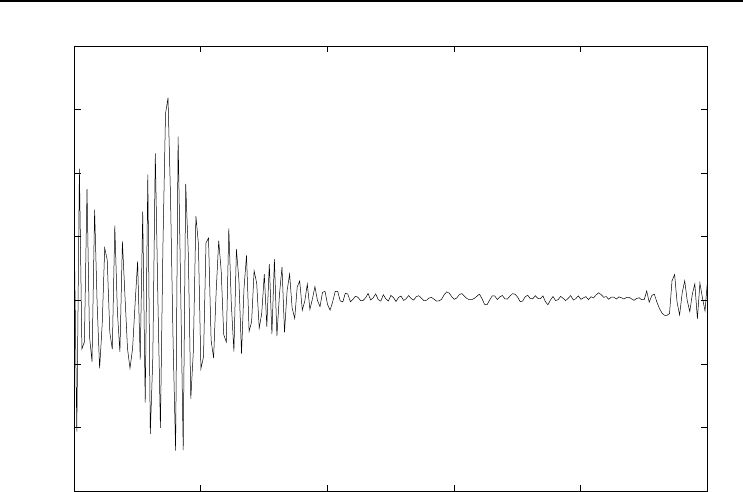
trajectory illustrated in Figure 16.6 is an example of such behavior. The particle fol-
lows a convergent trajectory for most of the time steps, with an occasional divergent
step.
Van den Bergh and Engelbrecht show in [863, 870] that convergent behavior will be
observed under stochastic φ
1
and φ
2
if the ratio,
φ
ratio
=
φ
crit
c
1
+ c
2
(16.40)
is close to 1.0, where
φ
crit
=supφ |0.5 φ − 1 <w, φ∈ (0,c
1
+ c
2
] (16.41)
It is even possible that parameter choices for which φ
ratio
=0.5, may lead to convergent
behavior, since particles spend 50% of their time taking a step along a convergent
trajectory.
16.5 Single-Solution Particle Swarm Optimization
Initial empirical studies of the basic PSO and basic variations as discussed in this chap-
ter have shown that the PSO is an efficient optimization approach – for the benchmark
16.5 Single-Solution Particle Swarm Optimization 315
-30
-20
-10
0
10
20
30
40
0 50 100 150 200 250
t
x(t)
Figure 16.6 Stochastic Particle Trajectory for w =0.9andc
1
= c
2
=2.0
problems considered in these studies. Some studies have shown that the basic PSO
improves on the performance of other stochastic population-based optimization algo-
rithms such as genetic algorithms [88, 89, 106, 369, 408, 863]. While the basic PSO
has shown some success, formal analysis [136, 851, 863, 870] has shown that the per-
formance of the PSO is sensitive to the values of control parameters. It was also shown
that the basic PSO has a serious defect that may cause stagnation [868].
A variety of PSO variations have been developed, mainly to improve the accuracy of
solutions, diversity and convergence behavior. This section reviews some of these vari-
ations for locating a single solution to unconstrained, single-objective, static optimiza-
tion problems. Section 16.5.2 considers approaches that differ in the social interaction
of particles. Some hybrids with concepts from EC are discussed in Section 16.5.3.
Algorithms with multiple swarms are discussed in Section 16.5.4. Multi-start methods
are given in Section 16.5.5, while methods that use some form of repelling mechanism
are discussed in Section 16.5.6. Section 16.5.7 shows how PSO can be changed to solve
binary-valued problems.
Before these PSO variations are discussed, Section 16.5.1 outlines a problem with the
basic PSO.

316 16. Particle Swarm Optimization
16.5.1 Guaranteed Convergence PSO
The basic PSO has a potentially dangerous property: when x
i
= y
i
=
ˆ
y,thevelocity
update depends only on the value of wv
i
. If this condition is true for all particles
and it persists for a number of iterations, then wv
i
→ 0, which leads to stagnation of
the search process. This point of stagnation may not necessarily coincide with a local
minimum. All that can be said is that the particles converged to the best position
found by the swarm. The PSO can, however, be pulled from this point of stagnation
by forcing the global best position to change when x
i
= y
i
=
ˆ
y.
The guaranteed convergence PSO (GCPSO) forces the global best particle to search
in a confined region for a better position, thereby solving the stagnation problem
[863, 868]. Let τ be the index of the global best particle, so that
y
τ
=
ˆ
y (16.42)
GCPSO changes the position update to
x
τj
(t +1)= ˆy
j
(t)+wv
τj
(t)+ρ(t)(1 − 2r
2
(t)) (16.43)
which is obtained using equation (16.1) if the velocity update of the global best particle
changes to
v
τj
(t +1)=−x
τj
(t)+ˆy
j
(t)+wv
τj
(t)+ρ(t)(1 − 2r
2j
(t)) (16.44)
where ρ(t) is a scaling factor defined in equation (16.45) below. Note that only the
global best particle is adjusted according to equations (16.43) and (16.44); all other
particles use the equations as given in equations (16.1) and (16.2).
The term −x
τj
(t) in equation (16.44) resets the global best particle’s position to the
position ˆy
j
(t). The current search direction, wv
τj
(t), is added to the velocity, and
the term ρ(t)(1 − 2r
2j
(t)) generates a random sample from a sample space with side
lengths 2ρ(t). The scaling term forces the PSO to perform a random search in an area
surrounding the global best position,
ˆ
y(t). The parameter, ρ(t) controls the diameter
of this search area, and is adapted using
ρ(t +1)=
2ρ(t)if#successes(t) >
s
0.5ρ(t)if#failures(t) >
f
ρ(t)otherwise
(16.45)
where #successes and #failures respectively denote the number of consecutive suc-
cesses and failures. A failure is defined as f(
ˆ
y(t)) ≤ f(
ˆ
y(t + 1)); ρ(0) = 1.0 was found
empirically to provide good results [863, 868]. The threshold parameters,
s
and
f
adhere to the following conditions:
#successes(t +1) > #successes(t) ⇒ #failures(t + 1) = 0 (16.46)
#failures(t +1) > #failures(t) ⇒ #successes(t + 1) = 0 (16.47)
The optimal choice of values for
s
and
f
is problem-dependent. Van den Bergh et al.
[863, 868] recommends that
s
=15and
f
= 5 be used for high-dimensional search

16.5 Single-Solution Particle Swarm Optimization 317
spaces. The algorithm is then quicker to punish poor ρ settings than it is to reward
successful ρ values.
Instead of using static
s
and
f
values, these values can be learnt dynamically. For
example, increase s
c
each time that #failures >
f
, which makes it more difficult
to reach the success state if failures occur frequently. Such a conservative mechanism
will prevent the value of ρ from oscillating rapidly. A similar strategy can be used for
s
.
The value of ρ determines the size of the local area around
ˆ
y where a better position
for
ˆ
y is searched. GCPSO uses an adaptive ρ to find the best size of the sampling
volume, given the current state of the algorithm. When the global best position is
repeatedly improved for a specific value of ρ, the sampling volume is increased to
allow step sizes in the global best position to increase. On the other hand, when
f
consecutive failures are produced, the sampling volume is too large and is consequently
reduced. Stagnation is prevented by ensuring that ρ(t) > 0 for all time steps.
16.5.2 Social-Based Particle Swarm Optimization
Social-based PSO implementations introduce a new social topology, or change the way
in which personal best and neighborhood best positions are calculated.
Spatial Social Networks
Neighborhoods are usually formed on the basis of particle indices. That is, assuming
a ring social network, the immediate neighbors of a particle with index i are particles
with indices (i − 1modn
s
)and(i − 1modn
s
), where n
s
is the total number of
particles in the swarm. Suganthan proposed that neighborhoods be formed on the
basis of the Euclidean distance between particles [820]. For neighborhoods of size
n
N
, the neighborhood of particle i is defined to consist of the n
N
particles closest to
particle i. Algorithm 16.4 summarizes the spatial neighborhood selection process.
Calculation of spatial neighborhoods require that the Euclidean distance between all
particles be calculated at each iteration, which significantly increases the computa-
tional complexity of the search algorithm. If n
t
iterations of the algorithm is executed,
the spatial neighborhood calculation adds a O(n
t
n
2
s
) computational cost. Determin-
ing neighborhoods based on distances has the advantage that neighborhoods change
dynamically with each iteration.
Fitness-Based Spatial Neighborhoods
Braendler and Hendtlass [81] proposed a variation on the spatial neighborhoods im-
plemented by Suganthan, where particles move towards neighboring particles that
have found a good solution. Assuming a minimization problem, the neighborhood of