
Engelbrecht Andries P. Computational Intelligence: An Introduction
Подождите немного. Документ загружается.


Chapter 16
Particle Swarm Optimization
The particle swarm optimization (PSO) algorithm is a population-based search al-
gorithm based on the simulation of the social behavior of birds within a flock. The
initial intent of the particle swarm concept was to graphically simulate the graceful
and unpredictable choreography of a bird flock [449], with the aim of discovering pat-
terns that govern the ability of birds to fly synchronously, and to suddenly change
direction with a regrouping in an optimal formation. From this initial objective, the
concept evolved into a simple and efficient optimization algorithm.
In PSO, individuals, referred to as particles, are “flown” through hyperdimensional
search space. Changes to the position of particles within the search space are based
on the social-psychological tendency of individuals to emulate the success of other
individuals. The changes to a particle within the swarm are therefore influenced by
the experience, or knowledge, of its neighbors. The search behavior of a particle is
thus affected by that of other particles within the swarm (PSO is therefore a kind of
symbiotic cooperative algorithm). The consequence of modeling this social behavior
is that the search process is such that particles stochastically return toward previously
successful regions in the search space.
The remainder of this chapter is organized as follows: An overview of the basic PSO,
i.e. the first implementations of PSO, is given in Section 16.1. The very important
concepts of social interaction and social networks are discussed in Section 16.2. Basic
variations of the PSO are described in Section 16.3, while more elaborate improvements
are given in Section 16.5. A discussion of PSO parameters is given in Section 16.4.
Some advanced topics are discussed in Section 16.6.
16.1 Basic Particle Swarm Optimization
Individuals in a particle swarm follow a very simple behavior: to emulate the success of
neighboring individuals and their own successes. The collective behavior that emerges
from this simple behavior is that of discovering optimal regions of a high dimensional
search space.
A PSO algorithm maintains a swarm of particles, where each particle represents a
potential solution. In analogy with evolutionary computation paradigms, a swarm is
Computational Intelligence: An Introduction, Second Edition A.P. Engelbrecht
c
2007 John Wiley & Sons, Ltd
289

290 16. Particle Swarm Optimization
similar to a population, while a particle is similar to an individual. In simple terms,
the particles are “flown” through a multidimensional search space, where the position
of each particle is adjusted according to its own experience and that of its neighbors.
Let x
i
(t) denote the position of particle i in the search space at time step t; unless
otherwise stated, t denotes discrete time steps. The position of the particle is changed
by adding a velocity, v
i
(t), to the current position, i.e.
x
i
(t +1)=x
i
(t)+v
i
(t + 1) (16.1)
with x
i
(0) ∼ U(x
min
, x
max
).
It is the velocity vector that drives the optimization process, and reflects both the
experiential knowledge of the particle and socially exchanged information from the
particle’s neighborhood. The experiential knowledge of a particle is generally referred
to as the cognitive component, which is proportional to the distance of the particle
from its own best position (referred to as the particle’s personal best position) found
since the first time step. The socially exchanged information is referred to as the social
component of the velocity equation.
Originally, two PSO algorithms have been developed which differ in the size of their
neighborhoods. These two algorithms, namely the gbest and lbest PSO, are summa-
rized in Sections 16.1.1 and 16.1.2 respectively. A comparison between gbest and lbest
PSO is given in Section 16.1.3. Velocity components are decsribed in Section 16.1.4,
while an illustration of the effect of velocity updates is given in Section 16.1.5. Aspects
about the implementation of a PSO algorithm are discussed in Section 16.1.6.
16.1.1 Global Best PSO
For the global best PSO, or gbest PSO, the neighborhood for each particle is the entire
swarm. The social network employed by the gbest PSO reflects the star topology
(refer to Section 16.2). For the star neighborhood topology, the social component of
the particle velocity update reflects information obtained from all the particles in the
swarm. In this case, the social information is the best position found by the swarm,
referred to as
ˆ
y(t).
For gbest PSO, the velocity of particle i is calculated as
v
ij
(t +1)=v
ij
(t)+c
1
r
1j
(t)[y
ij
(t) − x
ij
(t)] + c
2
r
2j
(t)[ˆy
j
(t) − x
ij
(t)] (16.2)
where v
ij
(t) is the velocity of particle i in dimension j =1,...,n
x
at time step
t, x
ij
(t) is the position of particle i in dimension j at time step t, c
1
and c
2
are
positive acceleration constants used to scale the contribution of the cognitive and
social components respectively (discussed in Section 16.4), and r
1j
(t),r
2j
(t) ∼ U (0, 1)
are random values in the range [0, 1], sampled from a uniform distribution. These
random values introduce a stochastic element to the algorithm.
The personal best position, y
i
, associated with particle i is the best position the
particle has visited since the first time step. Considering minimization problems, the

16.1 Basic Particle Swarm Optimization 291
personal best position at the next time step, t + 1, is calculated as
y
i
(t +1)=
y
i
(t)iff(x
i
(t +1))≥ f(y
i
(t))
x
i
(t +1) iff(x
i
(t +1))<f(y
i
(t))
(16.3)
where f : R
n
x
→ R is the fitness function. As with EAs, the fitness function measures
how close the corresponding solution is to the optimum, i.e. the fitness function
quantifies the performance, or quality, of a particle (or solution).
The global best position,
ˆ
y(t), at time step t, is defined as
ˆ
y(t) ∈{y
0
(t),...,y
n
s
(t)}|f(
ˆ
y(t)) = min{f(y
0
(t)),...,f(y
n
s
(t))} (16.4)
where n
s
is the total number of particles in the swarm. It is important to note that
the definition in equation (16.4) states that
ˆ
y is the best position discovered by any
of the particles so far – it is usually calculated as the best personal best position. The
global best position can also be selected from the particles of the current swarm, in
which case [359]
ˆ
y(t)=min{f (x
0
(t)),...,f(x
n
s
(t))} (16.5)
The gbest PSO is summarized in Algorithm 16.1.
Algorithm 16.1 gbest PSO
Create and initialize an n
x
-dimensional swarm;
repeat
for each particle i =1,...,n
s
do
//set the personal best position
if f(x
i
) <f(y
i
) then
y
i
= x
i
;
end
//set the global best position if f(y
i
) <f(
ˆ
y) then
ˆ
y = y
i
;
end
end
for each particle i =1,...,n
s
do
update the velocity using equation (16.2);
update the position using equation (16.1);
end
until stopping condition is true;
16.1.2 Local Best PSO
The local best PSO, or lbest PSO, uses a ring social network topology (refer to Sec-
tion 16.2) where smaller neighborhoods are defined for each particle. The social compo-
nent reflects information exchanged within the neighborhood of the particle, reflecting
local knowledge of the environment. With reference to the velocity equation, the social

292 16. Particle Swarm Optimization
contribution to particle velocity is proportional to the distance between a particle and
the best position found by the neighborhood of particles. The velocity is calculated as
v
ij
(t +1)=v
ij
(t)+c
1
r
1j
(t)[y
ij
(t) − x
ij
(t)] + c
2
r
2j
(t)[ˆy
ij
(t) − x
ij
(t)] (16.6)
where ˆy
ij
is the best position, found by the neighborhood of particle i in dimension j.
The local best particle position,
ˆ
y
i
, i.e. the best position found in the neighborhood
N
i
, is defined as
ˆ
y
i
(t +1)∈{N
i
|f(
ˆ
y
i
(t +1))=min{f(x)}, ∀x ∈N
i
} (16.7)
with the neighborhood defined as
N
i
= {y
i−n
N
i
(t), y
i−n
N
i
+1
(t),...,y
i−1
(t), y
i
(t), y
i+1
(t),...,y
i+n
N
i
(t)} (16.8)
for neighborhoods of size n
N
i
. The local best position will also be referred to as the
neighborhood best position.
It is important to note that for the basic PSO, particles within a neighborhood have
no relationship to each other. Selection of neighborhoods is done based on particle
indices. However, strategies have been developed where neighborhoods are formed
based on spatial similarity (refer to Section 16.2).
There are mainly two reasons why neighborhoods based on particle indices are pre-
ferred:
1. It is computationally inexpensive, since spatial ordering of particles is not re-
quired. For approaches where the distance between particles is used to form
neighborhoods, it is necessary to calculate the Euclidean distance between all
pairs of particles, which is of O(n
2
s
)complexity.
2. It helps to promote the spread of information regarding good solutions to all
particles, irrespective of their current location in the search space.
It should also be noted that neighborhoods overlap. A particle takes part as a member
of a number of neighborhoods. This interconnection of neighborhoods also facilitates
the sharing of information among neighborhoods, and ensures that the swarm con-
verges on a single point, namely the global best particle. The gbest PSO is a special
case of the lbest PSO with n
N
i
= n
s
.
Algorithm 16.2 summarizes the lbest PSO.
16.1.3 gbest versus lbest PSO
The two versions of PSO discussed above are similar in the sense that the social com-
ponent of the velocity updates causes both to move towards the global best particle.
This is possible for the lbest PSO due to the overlapping neighborhoods.
There are two main differences between the two approaches with respect to their
convergence characteristics [229, 489]:

16.1 Basic Particle Swarm Optimization 293
Algorithm 16.2 lbest PSO
Create and initialize an n
x
-dimensional swarm;
repeat
for each particle i =1,...,n
s
do
//set the personal best position
if f(x
i
) <f(y
i
) then
y
i
= x
i
;
end
//set the neighborhood best position
if f(y
i
) <f(
ˆ
y
i
) then
ˆ
y = y
i
;
end
end
for each particle i =1,...,n
s
do
update the velocity using equation (16.6);
update the position using equation (16.1);
end
until stopping condition is true;
• Due to the larger particle interconnectivity of the gbest PSO, it converges faster
than the lbest PSO. However, this faster convergence comes at the cost of less
diversity than the lbest PSO.
• As a consequence of its larger diversity (which results in larger parts of the search
space being covered), the lbest PSO is less susceptible to being trapped in local
minima. In general (depending on the problem), neighborhood structures such
as the ring topology used in lbest PSO improves performance [452, 670].
A more in-depth discussion on neighborhoods can be found in Section 16.2.
16.1.4 Velocity Components
The velocity calculation as given in equations (16.2) and (16.6) consists of three terms:
• The previous velocity, v
i
(t), which serves as a memory of the previous flight
direction, i.e. movement in the immediate past. This memory term can be seen
as a momentum, which prevents the particle from drastically changing direction,
and to bias towards the current direction. This component is also referred to as
the inertia component.
• The cognitive component, c
1
r
1
(y
i
−x
i
), which quantifies the performance of
particle i relative to past performances. In a sense, the cognitive component
resembles individual memory of the position that was best for the particle. The
effect of this term is that particles are drawn back to their own best positions,
resembling the tendency of individuals to return to situations or places that
satisfied them most in the past. Kennedy and Eberhart also referred to the
cognitive component as the “nostalgia” of the particle [449].
294 16. Particle Swarm Optimization
social velocity
cognitive velocity
inertia velocity
new velocity
x(t)
y(t)
x(t +1)
ˆ
y(t)
x
1
x
2
(a) Time Step t
new velocity
cognitive velocity
social velocity
inertia
velocity
x(t)
ˆ
y(t +1)
x
1
x
2
y(t +1)
x(t +1)
x(t +2)
(b) Time Step t +1
Figure 16.1 Geometrical Illustration of Velocity and Position Updates for a Single
Two-Dimensional Particle
• The social component, c
2
r
2
(
ˆ
y −x
i
), in the case of the gbest PSO or, c
2
r
2
(
ˆ
y
i
−
x
i
), in the case of the lbest PSO, which quantifies the performance of particle i
relative to a group of particles, or neighbors. Conceptually, the social component
resembles a group norm or standard that individuals seek to attain. The effect of
the social component is that each particle is also drawn towards the best position
found by the particle’s neighborhood.
The contribution of the cognitive and social components are weighed by a stochastic
amount, c
1
r
1
or c
2
r
2
, respectively. The effects of these weights are discussed in more
detail in Section 16.4.
16.1.5 Geometric Illustration
The effect of the velocity equation can easily be illustrated in a two-dimensional vector
space. For the sake of the illustration, consider a single particle in a two-dimensional
search space.
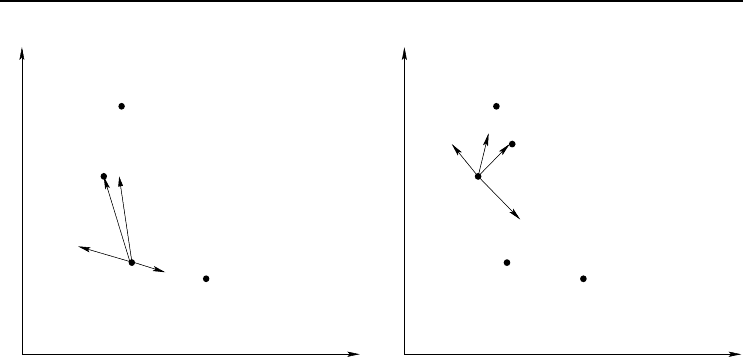
An example movement of the particle is illustrated in Figure 16.1, where the particle
subscript has been dropped for notational convenience. Figure 16.1(a) illustrates the
state of the swarm at time step t. Note how the new position, x(t +1), moves closer
towards the global best
ˆ
y(t). For time step t + 1, as illustrated in Figure 16.1(b),
assume that the personal best position does not change. The figure shows how the
three components contribute to still move the particle towards the global best particle.
It is of course possible for a particle to overshoot the global best position, mainly due
to the momentum term. This results in two scenarios:
1. The new position, as a result of overshooting the current global best, may be a
16.1 Basic Particle Swarm Optimization 295
better position than the current global best. In this case the new particle position
will become the new global best position, and all particles will be drawn towards
it.
2. The new position is still worse than the current global best particle. In subse-
quent time steps the cognitive and social components will cause the particle to
change direction back towards the global best.
The cumulative effect of all the position updates of a particle is that each particle
converges to a point on the line that connects the global best position and the personal
best position of the particle. A formal proof can be found in [863, 870].
x
2
x
1
ˆ
y
(a) At time t =0
x
2
x
1
ˆ
y
(b)Attimet =1
Figure 16.2 Multi-particle gbest PSO Illustration
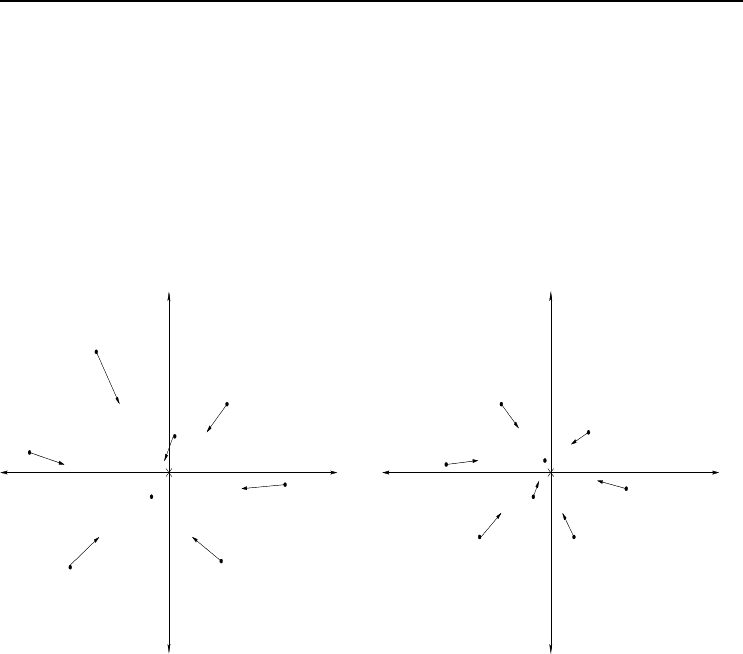
Returning to more than one particle, Figure 16.2 visualizes the position updates with
reference to the task of minimizing a two-dimensional function with variables x
1
and
x
2
using gbest PSO. The optimum is at the origin, indicated by the symbol ‘×’.
Figure 16.2(a) illustrates the initial positions of eight particles, with the global best
position as indicated. Since the contribution of the cognitive component is zero for each
particle at time step t = 0, only the social component has an influence on the position
adjustments. Note that the global best position does not change (it is assumed that
v
i
(0) = 0, for all particles). Figure 16.2(b) shows the new positions of all the particles
after the first iteration. A new global best position has been found. Figure 16.2(b) now
indicates the influence of all the velocity components, with particles moving towards
the new global best position.
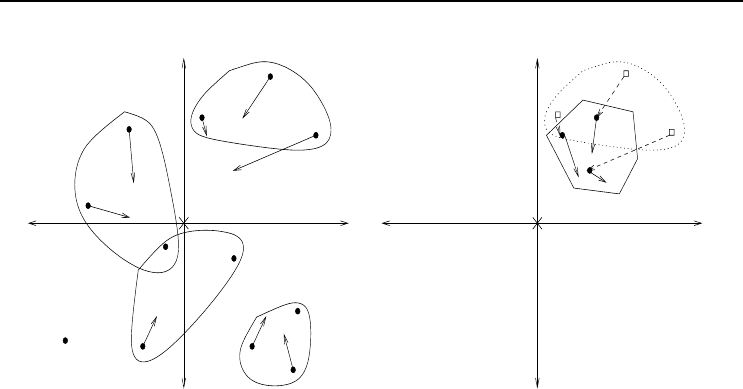
Finally, the lbest PSO, as illustrated in Figure 16.3, shows how particles are influenced
by their immediate neighbors. To keep the graph readable, only some of the movements
are illustrated, and only the aggregate velocity direction is indicated. In neighborhood
1, both particles a and b move towards particle c, which is the best solution within
that neighborhood. Considering neighborhood 2, particle d moves towards f,sodoes
e. For the next iteration, e will be the best solution for neighborhood 2. Now d and
296 16. Particle Swarm Optimization
x
x
1
2
i
g
b
a
c
h
e
f
k
j
1
2
3
4
d
(a) Local Best Illustrated – Initial Swarm
x
x
1
2
f
d
e
2
(b) Local Best – Second Swarm
Figure 16.3 Illustration of lbest PSO
f move towards e as illustrated in Figure 16.3(b) (only part of the solution space is
illustrated). The blocks represent the previous positions. Note that e remains the best
solution for neighborhood 2. Also note the general movement towards the minimum.
More in-depth analyses of particle trajectories can be found in [136, 851, 863, 870].
16.1.6 Algorithm Aspects
A few aspects of Algorithms 16.1 and 16.2 still need to be discussed. These aspects
include particle initialization, stopping conditions and defining the terms iteration and
function evaluation.
With reference to Algorithms 16.1 and 16.2, the optimization process is iterative. Re-
peated iterations of the algorithms are executed until a stopping condition is satisfied.
One such iteration consists of application of all the steps within the repeat...until
loop, i.e. determining the personal best positions and the global best position, and
adjusting the velocity of each particle. Within each iteration, a number of function
evaluations (FEs) are performed. A function evaluation (FE) refers to one calculation
of the fitness function, which characterizes the optimization problem. For the basic
PSO, a total of n
s
function evaluations are performed per iteration, where n
s
is the
total number of particles in the swarm.
The first step of the PSO algorithm is to initialize the swarm and control parameters.
In the context of the basic PSO, the acceleration constants, c
1
and c
2
, the initial veloc-
ities, particle positions and personal best positions need to be specified. In addition,
the lbest PSO requires the size of neighborhoods to be specified. The importance of
optimal values for the acceleration constants are discussed in Section 16.4.

16.1 Basic Particle Swarm Optimization 297
Usually, the positions of particles are initialized to uniformly cover the search space. It
is important to note that the efficiency of the PSO is influenced by the initial diversity
of the swarm, i.e. how much of the search space is covered, and how well particles are
distributed over the search space. If regions of the search space are not covered by the
initial swarm, the PSO will have difficulty in finding the optimum if it is located within
an uncovered region. The PSO will discover such an optimum only if the momentum
of a particle carries the particle into the uncovered area, provided that the particle
ends up on either a new personal best for itself, or a position that becomes the new
global best.
Assume that an optimum needs to be located within the domain defined by the two
vectors, x
min
and x
max
, which respectively represents the minimum and maximum
ranges in each dimension. Then, an efficient initialization method for the particle
positions is:
x(0) = x
min,j
+ r
j
(x
max,j
− x
min,j
), ∀j =1,...,n
x
, ∀i =1,...,n
s
(16.9)
where r
j
∼ U(0, 1).
The initial velocities can be initialized to zero, i.e.
v
i
(0) = 0 (16.10)
While it is possible to also initialize the velocities to random values, it is not necessary,
and it must be done with care. In fact, considering physical objects in their initial
positions, their velocities are zero – they are stationary. If particles are initialized with
nonzero velocities, this physical analogy is violated. Random initialization of position
vectors already ensures random positions and moving directions. If, however, velocities
are also randomly initialized, such velocities should not be too large. Large initial
velocities will have large initial momentum, and consequently large initial position
updates. Such large initial position updates may cause particles to leave the boundaries
of the search space, and may cause the swarm to take more iterations before particles
settle on a single solution.
The personal best position for each particle is initialized to the particle’s position at
time step t = 0, i.e.
y
i
(0) = x
i
(0) (16.11)
Different initialization schemes have been used by researchers to initialize the particle
positions to ensure that the search space is uniformly covered: Sobol sequences [661],
Faure sequences [88, 89, 90], and nonlinear simplex method [662].
While it is important for application of the PSO to solve real-world problems, in that
particles are uniformly distributed over the entire search space, uniformly distributed
particles are not necessarily good for empirical studies of different algorithms. This
typical initialization method can give false impressions of the relative performance of
algorithms as shown in [312]. For many of the benchmark functions used to evaluate
the performance of optimization algorithms (refer, for example, to Section A.5.3),
uniform initialization will result in particles being symmetrically distributed around
the optimum of the function to be optimized. In most cases it is then trivial for an