
Engelbrecht Andries P. Computational Intelligence: An Introduction
Подождите немного. Документ загружается.


298 16. Particle Swarm Optimization
optimization algorithm to find the optimum. Gehlhaar and Fogel suggest initializing
in areas that do not contain the optima, in order to validate the ability of the algorithm
to locate solutions outside the initialized space [312].
The last aspect of the PSO algorithms concerns the stopping conditions, i.e. criteria
used to terminate the iterative search process. A number of termination criteria have
been used and proposed in the literature. When selecting a termination criterion, two
important aspects have to be considered:
1. The stopping condition should not cause the PSO to prematurely converge, since
suboptimal solutions will be obtained.
2. The stopping condition should protect against oversampling of the fitness. If a
stopping condition requires frequent calculation of the fitness function, compu-
tational complexity of the search process can be significantly increased.
The following stopping conditions have been used:
• Terminate when a maximum number of iterations, or FEs, has been
exceeded. It is obvious to realize that if this maximum number of iterations (or
FEs) is too small, termination may occur before a good solution has been found.
This criterion is usually used in conjunction with convergence criteria to force
termination if the algorithm fails to converge. Used on its own, this criterion is
useful in studies where the objective is to evaluate the best solution found in a
restricted time period.
• Terminate when an acceptable solution has been found. Assume that
x
∗
represents the optimum of the objective function f. Then, this criterion
will terminate the search process as soon as a particle, x
i
, is found such that
f(x
i
) ≤|f(x
∗
) − |; that is, when an acceptable error has been reached. The
value of the threshold, , has to be selected with care. If is too large, the search
process terminates on a bad, suboptimal solution. On the other hand, if is too
small, the search may not terminate at all. This is especially true for the basic
PSO, since it has difficulties in refining solutions [81, 361, 765, 782]. Furthermore,
this stopping condition assumes prior knowledge of what the optimum is – which
is fine for problems such as training neural networks, where the optimum is
usually zero. It is, however, the case that knowledge of the optimum is usually
not available.
• Terminate when no improvement is observed over a number of itera-
tions. There are different ways in which improvement can be measured. For
example, if the average change in particle positions is small, the swarm can be
considered to have converged. Alternatively, if the average particle velocity over
a number of iterations is approximately zero, only small position updates are
made, and the search can be terminated. The search can also be terminated
if there is no significant improvement over a number of iterations. Unfortu-
nately, these stopping conditions introduce two parameters for which sensible
values need to be found: (1) the window of iterations (or function evaluations)
for which the performance is monitored, and (2) a threshold to indicate what
constitutes unacceptable performance.
• Terminate when the normalized swarm radius is close to zero. When

16.1 Basic Particle Swarm Optimization 299
the normalized swarm radius, calculated as [863]
R
norm
=
R
max
diameter(S)
(16.12)
where diameter(S) is the diameter of the initial swarm and the maximum radius,
R
max
,is
R
max
= ||x
m
−
ˆ
y||,m=1,...,n
s
(16.13)
with
||x
m
−
ˆ
y|| ≥ ||x
i
−
ˆ
y||, ∀i =1,...,n
s
(16.14)
is close to zero, the swarm has little potential for improvement, unless the global
best is still moving. In the equations above, || • || is a suitable distance norm,
e.g. Euclidean distance.
The algorithm is terminated when R
norm
<.If is too large, the search process
may stop prematurely before a good solution is found. Alternatively, if is too
small, the search may take excessively more iterations for the particles to form
a compact swarm, tightly centered around the global best position.
Algorithm 16.3 Particle Clustering Algorithm
Initialize cluster C = {
ˆ
y};
for about 5 times do
Calculate the centroid of cluster C:
x =
|C|
i=1,x
i
∈C
x
i
|C|
(16.15)
for ∀x
i
∈ S do
if ||x
i
−x|| <then
C ← C ∪{x
i
};
end
endFor
endFor
A more aggressive version of the radius method above can be used, where parti-
cles are clustered in the search space. Algorithm 16.3 provides a simple particle
clustering algorithm from [863]. The result of this algorithm is a single cluster,
C.If|C|/n
s
>δ, the swarm is considered to have converged. If, for example,
δ =0.7, the search will terminate if at least 70% of the particles are centered
around the global best position. The threshold in Algorithm 16.3 has the same
importance as for the radius method above. Similarly, if δ is too small, the search
may terminate prematurely.
This clustering approach is similar to the radius approach except that the clus-
tering approach will more readily decide that the swarm has converged.
• Terminate when the objective function slope is approximately zero.
The stopping conditions above consider the relative positions of particles in the
search space, and do not take into consideration information about the slope of

300 16. Particle Swarm Optimization
the objective function. To base termination on the rate of change in the objective
function, consider the ratio [863],
f
(t)=
f(
ˆ
y(t)) − f(
ˆ
y(t − 1))
f(
ˆ
y(t))
(16.16)
If f
(t) <for a number of consecutive iterations, the swarm is assumed to have
converged. This approximation to the slope of the objective function is superior
to the methods above, since it actually determines if the swarm is still making
progress using information about the search space.
The objective function slope approach has, however, the problem that the search
will be terminated if some of the particles are attracted to a local minimum,
irrespective of whether other particles may still be busy exploring other parts of
the search space. It may be the case that these exploring particles could have
found a better solution had the search not terminated. To solve this problem,
the objective function slope method can be used in conjunction with the radius
or cluster methods to test if all particles have converged to the same point before
terminating the search process.
In the above, convergence does not imply that the swarm has settled on an optimum
(local or global). With the term convergence is meant that the swarm has reached an
equilibrium, i.e. just that the particles converged to a point, which is not necessarily
an optimum [863].
16.2 Social Network Structures
The feature that drives PSO is social interaction. Particles within the swarm learn
from each other and, on the basis of the knowledge obtained, move to become more
similar to their “better” neighbors. The social structure for PSO is determined by
the formation of overlapping neighborhoods, where particles within a neighborhood
influence one another. This is in analogy with observations of animal behavior, where
an organism is most likely to be influenced by others in its neighborhood, and where
organisms that are more successful will have a greater influence on members of the
neighborhood than the less successful.
Within the PSO, particles in the same neighborhood communicate with one another
by exchanging information about the success of each particle in that neighborhood.
All particles then move towards some quantification of what is believed to be a better
position. The performance of the PSO depends strongly on the structure of the social
network. The flow of information through a social network, depends on (1) the degree
of connectivity among nodes (members) of the network, (2) the amount of clustering
(clustering occurs when a node’s neighbors are also neighbors to one another), and (3)
the average shortest distance from one node to another [892].
With a highly connected social network, most of the individuals can communicate with
one another, with the consequence that information about the perceived best member
quickly filters through the social network. In terms of optimization, this means faster

16.2 Social Network Structures 301
convergence to a solution than for less connected networks. However, for the highly
connected networks, the faster convergence comes at the price of susceptibility to local
minima, mainly due to the fact that the extent of coverage in the search space is less
than for less connected social networks. For sparsely connected networks with a large
amount of clustering in neighborhoods, it can also happen that the search space is
not covered sufficiently to obtain the best possible solutions. Each cluster contains
individuals in a tight neighborhood covering only a part of the search space. Within
these network structures there usually exist a few clusters, with a low connectivity
between clusters. Consequently information on only a limited part of the search space
is shared with a slow flow of information between clusters.
Different social network structures have been developed for PSO and empirically stud-
ied. This section overviews only the original structures investigated [229, 447, 452,
575]:
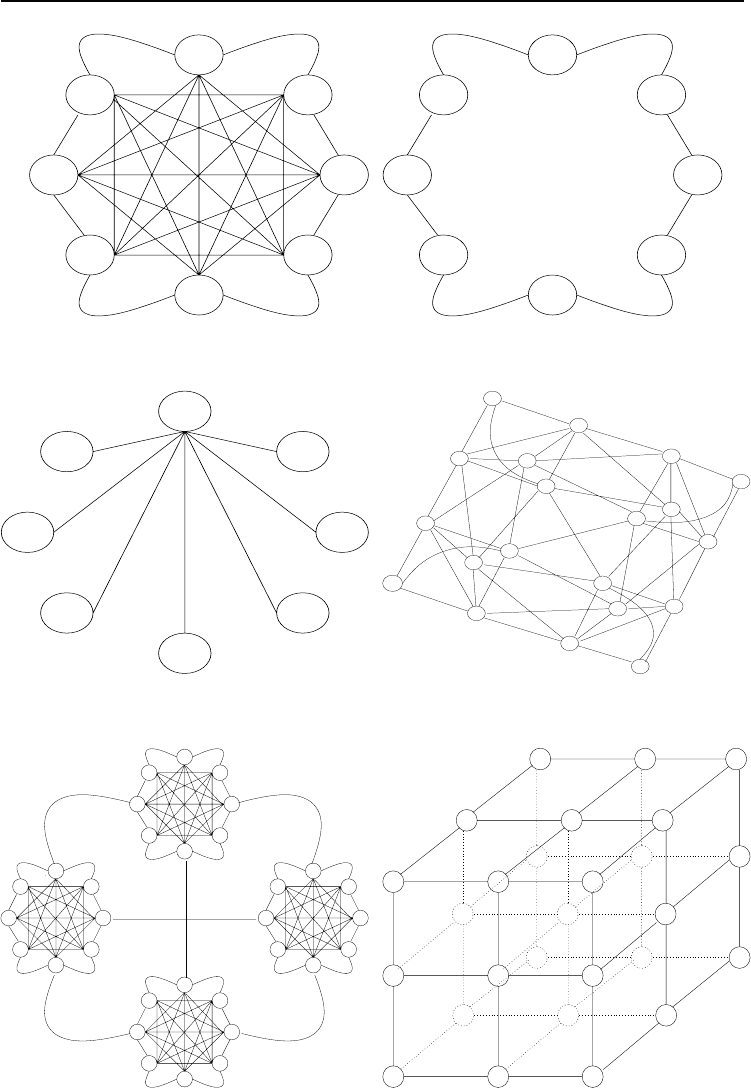
• The star social structure, where all particles are interconnected as illustrated
in Figure 16.4(a). Each particle can therefore communicate with every other
particle. In this case each particle is attracted towards the best solution found
by the entire swarm. Each particle therefore imitates the overall best solution.
The first implementation of the PSO used a star network structure, with the
resulting algorithm generally being referred to as the gbest PSO. The gbest PSO
has been shown to converge faster than other network structures, but with a
susceptibility to be trapped in local minima. The gbest PSO performs best for
unimodal problems.
• The ring social structure, where each particle communicates with its n
N
im-
mediate neighbors. In the case of n
N
= 2, a particle communicates with its
immediately adjacent neighbors as illustrated in Figure 16.4(b). Each parti-
cle attempts to imitate its best neighbor by moving closer to the best solution
found within the neighborhood. It is important to note from Figure 16.4(b) that
neighborhoods overlap, which facilitates the exchange of information between
neighborhoods and, in the end, convergence to a single solution. Since informa-
tion flows at a slower rate through the social network, convergence is slower, but
larger parts of the search space are covered compared to the star structure. This
behavior allows the ring structure to provide better performance in terms of the
quality of solutions found for multi-modal problems than the star structure. The
resulting PSO algorithm is generally referred to as the lbest PSO.
• The wheel social structure, where individuals in a neighborhood are isolated
from one another. One particle serves as the focal point, and all information
is communicated through the focal particle (refer to Figure 16.4(c)). The focal
particle compares the performances of all particles in the neighborhood, and
adjusts its position towards the best neighbor. If the new position of the focal
particle results in better performance, then the improvement is communicated
to all the members of the neighborhood. The wheel social network slows down
the propagation of good solutions through the swarm.
• The pyramid social structure, which forms a three-dimensional wire-frame as
illustrated in Figure 16.4(d).
• The four clusters social structure, as illustrated in Figure 16.4(e). In this
302 16. Particle Swarm Optimization
(a) Star (b) Ring
(c) Wheel (d) Pyramid
(e) Four Clusters (f) Von Neumann
Figure 16.4 Example Social Network Structures

16.3 Basic Variations 303
network structure, four clusters (or cliques) are formed with two connections
between clusters. Particles within a cluster are connected with five neighbors.
• The Von Neumann social structure, where particles are connected in a grid
structure as illustrated in Figure 16.4(f). The Von Neumann social network has
been shown in a number of empirical studies to outperform other social networks
in a large number of problems [452, 670].
While many studies have been done using the different topologies, there is no outright
best topology for all problems. In general, the fully connected structures perform best
for unimodal problems, while the less connected structures perform better on multi-
modal problems, depending on the degree of particle interconnection [447, 452, 575,
670].
Neighborhoods are usually determined on the basis of particle indices. For example,
for the lbest PSO with n
N
= 2, the neighborhood of a particle with index i includes
particles i −1,i and i + 1. While indices are usually used, Suganthan based neighbor-
hoods on the Euclidean distance between particles [820].
16.3 Basic Variations
The basic PSO has been applied successfully to a number of problems, including
standard function optimization problems [25, 26, 229, 450, 454], solving permutation
problems [753] and training multi-layer neural networks [224, 225, 229, 446, 449, 854].
While the empirical results presented in these papers illustrated the ability of the PSO
to solve optimization problems, these results also showed that the basic PSO has prob-
lems with consistently converging to good solutions. A number of basic modifications
to the basic PSO have been developed to improve speed of convergence and the quality
of solutions found by the PSO. These modifications include the introduction of an in-
ertia weight, velocity clamping, velocity constriction, different ways of determining the
personal best and global best (or local best) positions, and different velocity models.
This section discusses these basic modifications.
16.3.1 Velocity Clamping
An important aspect that determines the efficiency and accuracy of an optimization
algorithm is the exploration–exploitation trade-off. Exploration is the ability of a
search algorithm to explore different regions of the search space in order to locate a
good optimum. Exploitation, on the other hand, is the ability to concentrate the search
around a promising area in order to refine a candidate solution. A good optimization
algorithm optimally balances these contradictory objectives. Within the PSO, these
objectives are addressed by the velocity update equation.
The velocity updates in equations (16.2) and (16.6) consist of three terms that con-
tribute to the step size of particles. In the early applications of the basic PSO, it was
found that the velocity quickly explodes to large values, especially for particles far

304 16. Particle Swarm Optimization
from the neighborhood best and personal best positions. Consequently, particles have
large position updates, which result in particles leaving the boundaries of the search
space – the particles diverge. To control the global exploration of particles, velocities
are clamped to stay within boundary constraints [229]. If a particle’s velocity exceeds
a specified maximum velocity, the particle’s velocity is set to the maximum velocity.
Let V
max,j
denote the maximum allowed velocity in dimension j. Particle velocity is
then adjusted before the position update using,
v
ij
(t +1)=
#
v
ij
(t +1) if v
ij
(t +1)<V
max,j
V
max,j
if v
ij
(t +1)≥ V
max,j
(16.17)
where v
ij
is calculated using equation (16.2) or (16.6).
The value of V
max,j
is very important, since it controls the granularity of the search
by clamping escalating velocities. Large values of V
max,j
facilitate global exploration,
while smaller values encourage local exploitation. If V
max,j
is too small, the swarm
may not explore sufficiently beyond locally good regions. Also, too small values for
V
max,j
increase the number of time steps to reach an optimum. Furthermore, the
swarm may become trapped in a local optimum, with no means of escape. On the
other hand, too large values of V
max,j
risk the possibility of missing a good region.
The particles may jump over good solutions, and continue to search in fruitless regions
of the search space. While large values do have the disadvantage that particles may
jump over optima, particles are moving faster.
This leaves the problem of finding a good value for each V
max,j
in order to balance
between (1) moving too fast or too slow, and (2) exploration and exploitation. Usually,
the V
max,j
values are selected to be a fraction of the domain of each dimension of the
search space. That is,
V
max,j
= δ(x
max,j
− x
min,j
) (16.18)
where x
max,j
and x
min,j
are respectively the maximum and minimum values of the
domain of x in dimension j,andδ ∈ (0, 1]. The value of δ is problem-dependent, as
was found in a number of empirical studies [638, 781]. The best value should be found
for each different problem using empirical techniques such as cross-validation.
There are two important aspects of the velocity clamping approach above that the
reader should be aware of:
1. Velocity clamping does not confine the positions of particles, only the step sizes
as determined from the particle velocity.
2. In the above equations, explicit reference is made to the dimension, j.Amax-
imum velocity is associated with each dimension, proportional to the domain
of that dimension. For the sake of the argument, assume that all dimensions
are clamped with the same constant V
max
. Therefore if a dimension, j,exists
such that x
max,j
− x
min,j
<< V
max
, particles may still overshoot an optimum
in dimension j.
While velocity clamping has the advantage that explosion of velocity is controlled,
it also has disadvantages that the user should be aware of (that is in addition to
16.3 Basic Variations 305
position update
velocity update
x
1
v
2
(t +1)
v
1
(t +1) x
i
(t)
v
2
(t +1)
x
i
(t +1)
x
i
(t +1)
x
2
Figure 16.5 Effects of Velocity Clamping
the problem-dependent nature of V
max,j
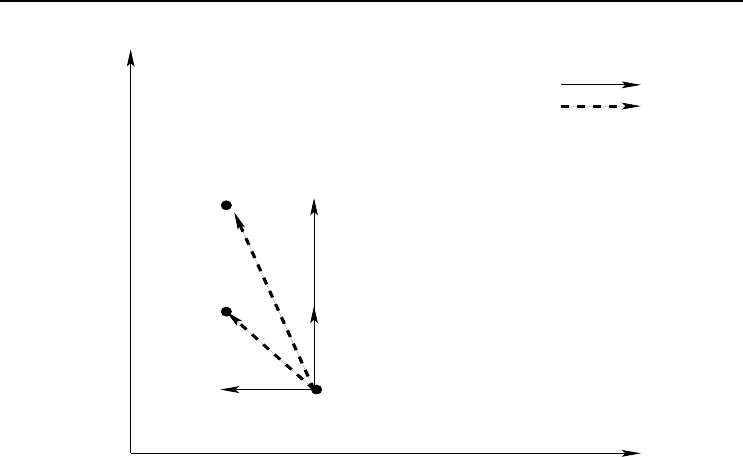
values). Firstly, velocity clamping changes
not only the step size, but also the direction in which a particle moves. This effect is
illustrated in Figure 16.5 (assuming two-dimensional particles). In this figure, x
i
(t+1)
denotes the position of particle i without using velocity clamping. The position x
i
(t+1)
is the result of velocity clamping on the second dimension. Note how the search
direction and the step size have changed. It may be said that these changes in search
direction allow for better exploration. However, it may also cause the optimum not to
be found at all.
Another problem with velocity clamping occurs when all velocities are equal to the
maximum velocity. If no measures are implemented to prevent this situation, particles
remain to search on the boundaries of a hypercube defined by [x
i
(t) − V
max
, x
i
(t)+
V
max
]. It is possible that a particle may stumble upon the optimum, but in general
the swarm will have difficulty in exploiting this local area. This problem can be solved
in different ways, with the introduction of an inertia weight (refer to Section 16.3.2)
being one of the first solutions. The problem can also be solved by reducing V
max,j
over time. The idea is to start with large values, allowing the particles to explore the
search space, and then to decrease the maximum velocity over time. The decreasing
maximum velocity constrains the exploration ability in favor of local exploitation at
mature stages of the optimization process. The following dynamic velocity approaches
have been used:
• Change the maximum velocity when no improvement in the global best position

306 16. Particle Swarm Optimization
has been seen over τ consecutive iterations [766]:
V
max,j
(t +1)=
γV
max,j
(t)iff(
ˆ
y(t)) ≥ f(
ˆ
y(t − t
)) ∀ t
=1,...,n
t
V
max,j
(t)otherwise
(16.19)
where γ decreases from 1 to 0.01 (the decrease can be linear or exponential
using an annealing schedule similar to that given in Section 16.3.2 for the inertia
weight).
• Exponentially decay the maximum velocity, using [254]
V
max,j
(t +1)=(1− (t/n
t
)
α
)V
max,j
(t) (16.20)
where α is a positive constant, found by trial and error, or cross-validation
methods; n
t
is the maximum number of time steps (or iterations).
Finally, the sensitivity of PSO to the value of δ (refer to equation (16.18)) can be
reduced by constraining velocities using the hyperbolic tangent function, i.e.
v
ij
(t +1)=V
max,j
tanh
v
ij
(t +1)
V
max,j
(16.21)
where v
ij
(t + 1) is calculated from equation (16.2) or (16.6).
16.3.2 Inertia Weight
The inertia weight was introduced by Shi and Eberhart [780] as a mechanism to
control the exploration and exploitation abilities of the swarm, and as a mechanism
to eliminate the need for velocity clamping [227]. The inertia weight was successful in
addressing the first objective, but could not completely eliminate the need for velocity
clamping. The inertia weight, w, controls the momentum of the particle by weighing
the contribution of the previous velocity – basically controlling how much memory of
the previous flight direction will influence the new velocity. For the gbest PSO, the
velocity equation changes from equation (16.2) to
v
ij
(t +1)=wv
ij
(t)+c
1
r
1j
(t)[y
ij
(t) − x
ij
(t)] + c
2
r
2j
(t)[ˆy
j
(t) − x
ij
(t)] (16.22)
A similar change is made for the lbest PSO.
The value of w is extremely important to ensure convergent behavior, and to opti-
mally tradeoff exploration and exploitation. For w ≥ 1, velocities increase over time,
accelerating towards the maximum velocity (assuming velocity clamping is used), and
the swarm diverges. Particles fail to change direction in order to move back towards
promising areas. For w<1, particles decelerate until their velocities reach zero (de-
pending on the values of the acceleration coefficients). Large values for w facilitate
exploration, with increased diversity. A small w promotes local exploitation. However,
too small values eliminate the exploration ability of the swarm. Little momentum is
then preserved from the previous time step, which enables quick changes in direc-
tion. The smaller w, the more do the cognitive and social components control position
updates.

16.3 Basic Variations 307
As with the maximum velocity, the optimal value for the inertia weight is problem-
dependent [781]. Initial implementations of the inertia weight used a static value for
the entire search duration, for all particles for each dimension. Later implementations
made use of dynamically changing inertia values. These approaches usually start with
large inertia values, which decreases over time to smaller values. In doing so, particles
are allowed to explore in the initial search steps, while favoring exploitation as time
increases. At this time it is crucial to mention the important relationship between
the values of w, and the acceleration constants. The choice of value for w has to be
made in conjunction with the selection of the values for c
1
and c
2
. Van den Bergh and
Engelbrecht [863, 870] showed that
w>
1
2
(c
1
+ c
2
) − 1 (16.23)
guarantees convergent particle trajectories. If this condition is not satisfied, divergent
or cyclic behavior may occur. A similar condition was derived by Trelea [851].
Approaches to dynamically varying the inertia weight can be grouped into the following
categories:
• Random adjustments, where a different inertia weight is randomly selected
at each iteration. One approach is to sample from a Gaussian distribution, e.g.
w ∼ N(0.72,σ) (16.24)
where σ is small enough to ensure that w is not predominantly greater than one.
Alternatively, Peng et al. used [673]
w =(c
1
r
1
+ c
2
r
2
) (16.25)
with no random scaling of the cognitive and social components.
• Linear decreasing, where an initially large inertia weight (usually 0.9) is lin-
early decreased to a small value (usually 0.4). From Naka et al. [619], Rat-
naweera et al. [706], Suganthan [820], Yoshida et al. [941]
w(t)=(w(0) − w(n
t
))
(n
t
− t)
n
t
+ w(n
t
) (16.26)
where n
t
is the maximum number of time steps for which the algorithm is ex-
ecuted, w(0) is the initial inertia weight, w(n
t
) is the final inertia weight, and
w(t)istheinertiaattimestept.Notethatw(0) >w(n
t
).
• Nonlinear decreasing, where an initially large value decreases nonlinearly to a
small value. Nonlinear decreasing methods allow a shorter exploration time than
the linear decreasing methods, with more time spent on refining solutions (ex-
ploiting). Nonlinear decreasing methods will be more appropriate for smoother
search spaces. The following nonlinear methods have been defined:
– From Peram et al. [675],
w(t +1)=
(w(t) − 0.4)(n
t
− t)
n
t
+0.4
(16.27)
with w(0) = 0.9.