
Engelbrecht Andries P. Computational Intelligence: An Introduction
Подождите немного. Документ загружается.

408 17. Ant Algorithms
dc
ab
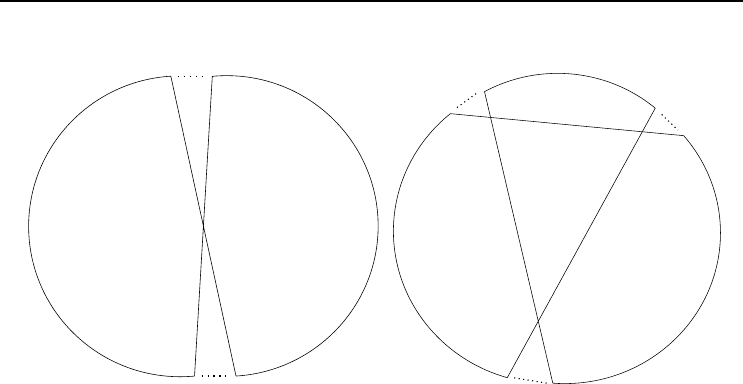
(a) 2-opt
a
b
c
d
ef
(b) 3-opt
Figure 17.4 2-opt and 3-opt Local Search Heuristic
n ≥ 25 cannot be solved exactly. This section discusses approaches to solve the QAP
using ACO algorithms.
Problem Definition
The main objective in QAPs is to assign facilities to locations such that the product
of the flow among activities is minimized, under the constraint that all facilities must
be allocated to a location and each location can have only one facility assigned to it.
The solution is a permutation π of {1,...,n
π
},wheren
π
is the number of facilities
and locations. Formally, the objective function to be minimized is defined as
f(π)=
n
π
i,j=1
d
ij
f
π(i)π(j)
(17.107)
where d
ij
is the Euclidean distance between locations i and j, f
hk
characterizes the
flow between facilities h and k,andπ(i) is the activity assigned to location i.
Problem Representation
The search space is represented by a graph, G =(V, E). Each node, v
i
∈ V,i =
1,...,n
π
, represents a location i. Associated with each link (i, j) ∈ E = {(i, j)|i, j ∈
V } is a distance d
ij
. An assignment is a permutation π of {1,...,n
π
}.

17.5 Applications 409
Solution Construction
Ants are randomly placed on the graph, and each ant constructs a permutation of
facilities incrementally. When in location i, the ant selects a facility from the set
of unallocated facilities and assigns that facility to location i. A complete solution
is found when all locations have been visited. Different mechanisms can be used
to step through the graph of locations, for example, in sequential or random order
[557]. Dorigo et al. [216] used a different approach where the objective function is
expressed as a combination of the potential vectors of distance and flow matrices. If
D =[d
ij
]
n
π
×n
π
is the distance matrix, and F =[f
hk
]
n
π
×n
π
the flow matrix, define the
potential vectors, D and F,as
D
i
=
n
π
j=1
D
ij
,i=1,...,n
π
(17.108)
F
h
=
n
π
k=1
F
hk
,h=1,...,n
π
(17.109)
The next location is deterministically chosen from the free locations as the location
with the lowest distance potential, D
i
.
For location i facility h (using the potential vectors approach), can be selected de-
terministically as the not yet assigned facility with the highest flow potential. Al-
ternatively, selection can be made probabilistically using an appropriate transition
probability function. St¨utzle and Hoos [816] used the transition probability
p
k
ih
(t)=
#
τ
ih
j∈N
k
i
(t)
τ
jh
if location i is still free
0otherwise
(17.110)
Maniezzo and Colorni [557] defined the transition probability as
p
k
ih
(t)=
#
ατ
ih
(t)+(1−α)η
ih
j∈N
k
i
(t)
ατ
jh
(t)+(1−α)η
jh
if location i is still free
0otherwise
(17.111)
Instead of using a constructive approach to solve the QAP, Gambardella et al. [304]
and Talbi et al. [835] used the hybrid AS (HAS) to modify approximate solutions. Each
ant receives a complete solution obtained from a nearest-neighbor heuristic and refines
the solution via a series of n
π
/3 swaps. For each swap, the first location i is selected
randomly from {1, 2,...,n
π
}, and the second location, j, is selected according to the
rule: if U (0, 1) <r,thenj ∼ U{1,...,n
π
}\{i}; otherwise, j is selected according to
the probability,
p
k
ij
(t)=
τ
iπ
k
(j)
+ τ
jπ
k
(i)
n
π
l=1
l=i
(τ
iπ
k
(l)
+ τ
lπ
k
(i)
)
(17.112)

410 17. Ant Algorithms
Heuristic Desirability
Based on the potential vectors defined in equation (17.108) and (17.109) [216],
η
i
=
1
s
ih
(17.113)
where s
ih
= D
i
F
h
∈ S = DF
T
gives the potential goodness of assigning facility h to
location i.
Constraint Satisfaction
The QAP defines two constraints:
• all facilities have to be assigned, and
• only one facility can be allocated per location.
To ensure that facilities are not assigned more than once, each ant maintains a facility
tabu list. When a new facility has to be assigned, selection is from the facilities not yet
assigned, i.e. {1,...,n
π
}\Υ
k
. Ants terminate solution construction when all nodes
(locations) have been visited, which ensures (together with the tabu list) that each
location contains one facility.
Local Search Heuristics
Gambardella et al. [304] consider all possible swaps in a random order. If a swap results
in an improved solution, that modification is accepted. The difference in objective
function value due to swapping of facilities π(i)andπ(j) is calculated as
∆f(π, i, j, )=(d
ii
− d
jj
)(f
π(j)π(j)
− f
π(i)π(i)
)
+(d
ij
− d
ji
)(f
π(j)π(i)
− f
π(i)π(j)
)
+
n
π
l=1,l=i
l=j
[(d
li
− d
lj
)(f
π(l)π(j)
− f
π(l)π(i)
) + (17.114)
+(d
il
− d
jl
)(f
π(j)π(l)
− f
π(i)π(l)
)]
The modification is accepted if ∆f(π, i,j) < 0.
St¨utzle and Hoos [816] proposed two strategies to decide if a swap is accepted:
• The first-improvement strategy accepts the first improving move, similar to
standard hill-climbing search.
• The best-improvement strategy considers the entire neighborhood and ac-
cepts the move that gives the best improvement [557], similar to steepest ascent
hill-climbing search.

17.6 Assignments 411
While the first-improvement strategy is computationally less expensive than the best-
improvement strategy, it may require more moves to reach a local optimum.
Roux et al. [743, 744] and Talbi et al. [835] used TS as local search method. Talbi
et al. used a recency-based memory, with the size of the tabu list selected randomly
between n/2and3n/2.
17.5.3 Other Applications
Ant algorithms have been applied to many problems. Some of these are summarized
in Table 17.2. Note that this table is not a complete list of applications, but just
provides a flavor of different applications.
17.6 Assignments
1. Consider the following situation: ant A
1
follows the shortest of two paths to the
food source, while ant A
2
follows the longer path. After A
2
reached the food
source, which path back to the nest has a higher probability of being selected by
A
2
? Justify your answer.
2. Discuss the importance of the forgetting factor in the pheromone trail depositing
equation.
3. Discuss the effects of the α and β parameters in the transition rule of equation
(17.6).
4. Show how the ACO approach to solving the TSP satisfies all the constraints of
the TSP.
5. Comment on the following strategy: Let the amount of pheromone deposited be
a function of the best route. That is, the ant with the best route, deposits more
pheromone. Propose a pheromone update rule.
6. Comment on the similarities and differences between the ant colony approach to
clustering and SOMs.
7. For the ant clustering algorithm, explain why
(a) the 2D-grid should have more sites than number of ants;
(b) there should be more sites than data vectors.
8. Devise a dynamic forgetting factor for pheromone evaporation.

Part V
ARTIFICIAL IMMUNE
SYSTEMS
An artificial immune system (AIS) models the natural immune system’s ability to
detect cells foreign to the body. The result is a new computational paradigm with
powerful pattern recognition abilities, mainly applied to anomaly detection.
Different views on how the natural immune system (NIS) functions have been devel-
oped, causing some debate among immunologists. These models include the classical
view of lymphocytes that are used to distinguish between self and non-self, the clonal
selection theory where stimulated B-Cells produce mutated clones, danger theory,
which postulates that the NIS has the ability to distinguish between dangerous and
non-dangerous foreign cells, and lastly, the network theory where it is assumed that
B-Cells form a network of detectors.
Computational models have been developed for all these views, and successfully ap-
plied to solve real-world problems. This part
1
aims to provide an introduction to these
computational models of the immune system. Chapter 18 provides an overview of the
natural immune system, while artificial immune systems are discussed in Chapter 19.
1
This part on artificial immune systems has been written by one of my PhD students, Attie
Graaff. Herewith I extend my thanks to Attie for contributing this part to the book, making this a
very complete book on computational intelligence.
413

Chapter 18
Natural Immune System
The body has many defense mechanisms, which among others are the skin of the body,
the membrane that covers the hollow organs and vessels, and the adaptive immune
system. The adaptive immune system reacts to a specific foreign body material or
pathogenic material (referred to as antigen). During these reactions the adaptive
immune system adapts to better detect the encountered antigen and a ‘memory’ is
built up of regular encountered antigen. The obtained memory speeds up and improves
the reaction of the adaptive immune system to future exposure to the same antigen.
Due to this reason defense reactions are divided into three types: non-specific defense
reactions, inherited defense reactions and specific defense reactions [582]. The adaptive
immune system forms part of the specific defense reactions.
Different theories exist in the study of immunology regarding the functioning and or-
ganizational behavior between lymphocytes in response to encountered antigen. These
theories include the classical view, clonal selection theory, network theory, and danger
theory. Since the clonal selection, danger theory and network theory are based on
concepts and elements within the classical view (see Section 18.1), the classical view
will first be discussed in detail to form a bases onto which the other three theories will
be explained in Sections 18.5, 18.6 and 18.7.
18.1 Classical View
The classical view of the immune system is that the immune system distinguishes
between what is normal (self) and foreign (non-self or antigen) in the body. The
recognition of antigens leads to the creation of specialized activated cells, which in-
activate or destroy these antigens. The natural immune system mostly consists of
lymphocytes and lymphoid organs. These organs are the tonsils and adenoids, thy-
mus, lymph nodes, spleen, Peyer’s patches, appendix, lymphatic vessels, and bone
marrow. Lymphoid organs are responsible for the growth, development and deploy-
ment of the lymphocytes in the immune system. The lymphocytes are used to detect
any antigens in the body. The immune system works on the principle of a pattern
recognition system, recognizing non-self patterns from the self patterns [678].
The initial classical view was defined by Burnet [96] as B-Cells and Killer-T-Cells
with antigen-specific receptors. Antigens triggered an immune response by interacting
Computational Intelligence: An Introduction, Second Edition A.P. Engelbrecht
c
2007 John Wiley & Sons, Ltd
415

416 18. Natural Immune System
with these receptors. This interaction is known as stimulation (or signal 1). It was
Bretscher and Cohn [87] who enhanced the initial classical view by introducing the
concept of a helper T-Cell (see Section 18.3.1). This is known as the help signal (or
signal 2). In later years, Lafferty and Cunningham added a co-stimulatory signal to the
helper T-Cell model of Bretscher and Cohn. Lafferty and Cunningham [497] proposed
that the helper T-Cell is co-stimulated with a signal from an antigen-presenting cell
(APC). The motivation for the co-stimulated model was that T-Cells in a body had a
stronger response to cells from the same species as the T-Cells in comparison to cells
from different species than the T-Cells. Thus, the APC is species specific.
The rest of this chapter explains the development of the different cell types in the
immune system, antigens and antibodies, immune reactions and immunity types and
the detection process of foreign body material as defined by the different theories.
18.2 Antibodies and Antigens
Within the natural immune system, antigens are material that can trigger immune
response. An immune response is the body’s reaction to antigens so that the antigens
are eliminated to prevent damage to the body. Antigens can be either bacteria, fungi,
parasites and/or viruses [762]. An antigen must be recognized as foreign (non-self).
Every cell has a huge variety of antigens in its surface membrane. The foreign antigen
is mostly present in the cell of micro-organisms and in the cell membrane of ‘donor
cells’. Donor cells are transplanted blood cells obtained through transplanted organs
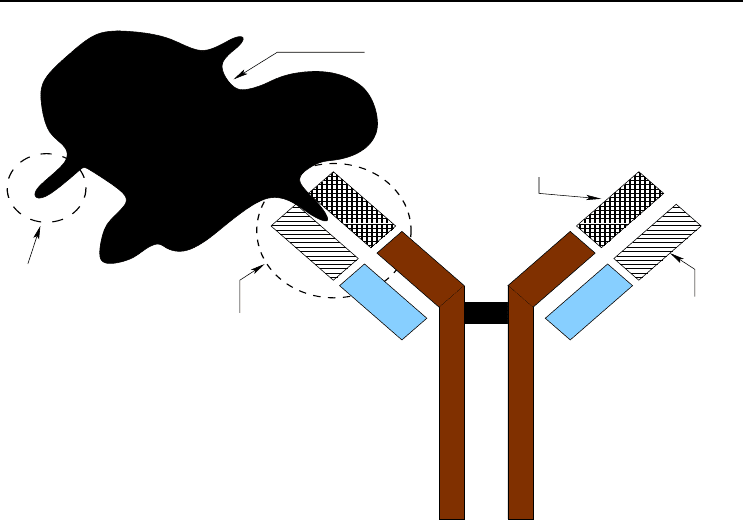
or blood. The small segments on the surface of an antigen are called epitopes and the
small segments on antibodies are called paratopes (as shown in Figure 18.1). Epitopes
trigger a specific immune response and antibodies’ paratopes bind to these epitopes
with a certain binding strength, measured as affinity [582].
Antibodies are chemical proteins. In contradiction to antigens, antibodies form part
of self and are produced when lymphocytes come into contact with antigen (non-
self). An antibody has a Y-shape (as shown Figure 18.1). Both arms of the Y consist
of two identical heavy and two identical light chains. The chains are distinct into
heavy and light since the heavy chain contains double the number of amino-acids than
the light chain. The tips of the arms are called the variable regions and vary from
one antibody to another [762]. The variable regions (paratopes) enable the antibody
to match antigen and bind to the epitopes of an antigen. After a binding between
an antibody and an antigen’s epitope, an antigen-antibody-complex is formed, which
results into the de-activation of the antigen [582]. There are five classes of antibodies:
IgM, IgG, IgA, IgE, IgD [582].
18.3 The White Cells
All cells in the body are created in the bone marrow (as illustrated in Figure 18.2).
Some of these cells develop into large cell- and particle-devouring white cells known
18.3 The White Cells 417
Antigen
Epitope
Variable region
Antibody
Light chain
Heavy chain
Figure 18.1 Antigen-Antibody-Complex
as phagocytes [762]. Phagocytes include monocytes, macrophages and neutrophils.
Macrophages are versatile cells that secrete powerful chemicals and play an impor-
tant role in T-Cell activation. Other cells develop into small white cells known as
lymphocytes.
18.3.1 The Lymphocytes
There are two types of lymphocytes: the T-Cell and B-Cell, both created in the bone
marrow. On the surface of the T-Cells and B-Cells are receptor molecules that bind
to other cells. The T-Cell binds only with molecules that are on the surface of other
cells. The T-Cell first become mature in the thymus, whereas the B-Cell is already
mature after creation in the bone marrow. A T-Cell becomes mature if and only if it
does not have receptors that bind with molecules that represent self cells. It is there-
fore very important that the T-Cell can differentiate between self and non-self cells.
Thus lymphocytes have different states: immature, mature, memory and annihilated
(Figure 18.3 illustrates the life cycle of lymphocytes). These states are discussed in
the subsections to follow below. Both T-Cells and B-Cells secrete lymphokines and
macrophages secrete monokines. Monokines and lymphokines are known as cytokines
and their function is to encourage cell growth, promote cell activation or destroy target
cells [762]. These molecules on the surface of a cell are named the major histocompati-
bility complex molecules (MHC-molecules). Their main function is to bring to light the