
Engelbrecht Andries P. Computational Intelligence: An Introduction
Подождите немного. Документ загружается.

468 21. Fuzzy Logic and Reasoning
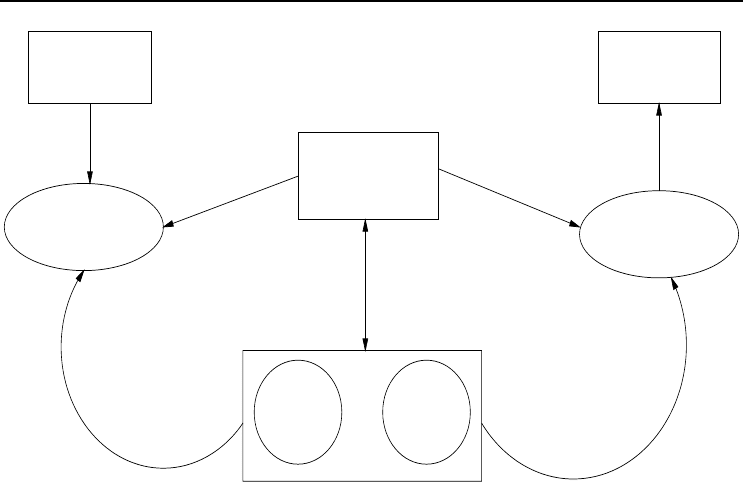
Fuzzy
Rules
Fuzzy
Sets
Fuzzification
Process
Non-Fuzzy
Inputs
Non-Fuzzy
Outputs
Defuzzification
Process
Engine
Inference
Figure 21.1 Fuzzy Rule-Based Reasoning System
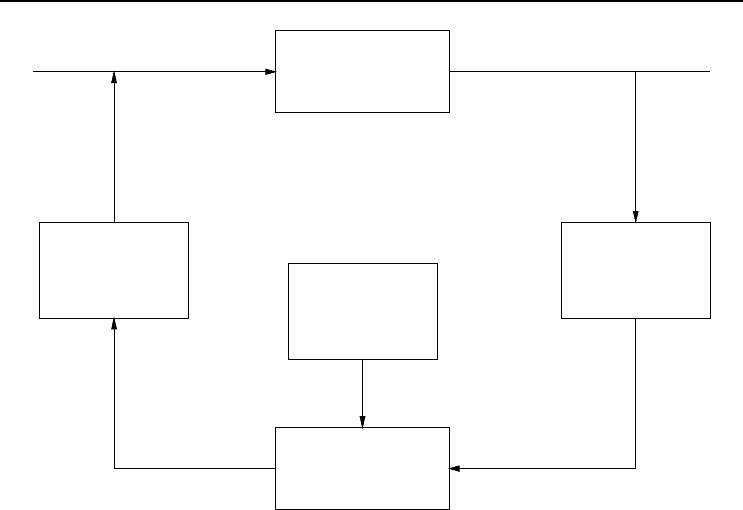
Together, the fuzzy sets and fuzzy rules form the knowledge base of a fuzzy rule-based
reasoning system. In addition to the knowledge base, a fuzzy reasoning system consists
of three other components, each performing a specific task in the reasoning process,
i.e. fuzzification, inferencing and defuzzification. The different components of a fuzzy
rule based system are illustrated in Figure 21.1.
The question is now what sense can be made from a single fuzzy rule. For example,
for the rule,
if Age is Old the Speed is Slow (21.7)
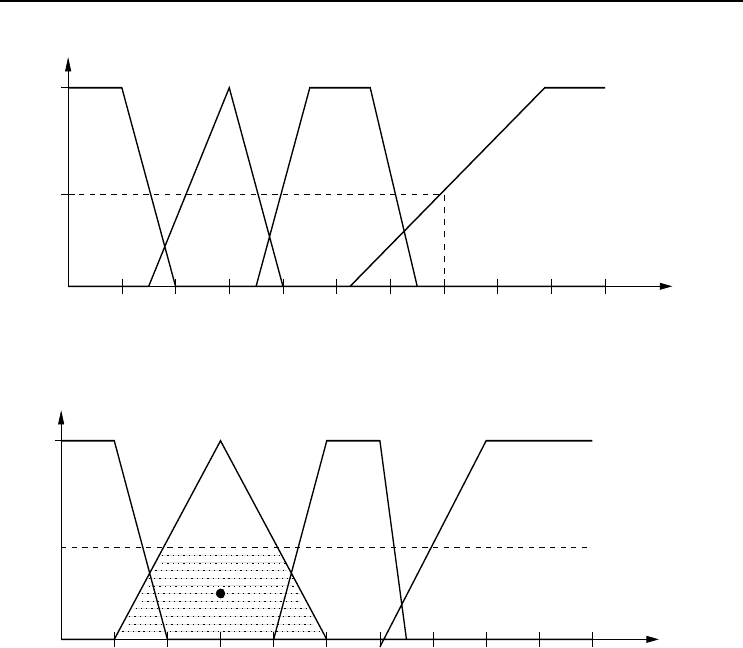
what can be said about Speed if Age has the value of 70? Given the membership
functions for Age and Speed in Figure 21.2(a), then find µ
Old
(70), which is 0.4. For
linguistic variable Speed find the intersection of the horizontal line with membership
function Slow. This gives the shaded area in Figure 21.2(b). A defuzzification operator
(refer to Section 21.2) is then used to find the center of gravity of the shaded area,
which gives the value of Speed =3.
This simple example leads to the next question: How is a plausible outcome determined
if a system has more than one rule? This question is answered in the next section.
21.2 Fuzzy Inferencing
Together, the fuzzy sets and fuzzy rules form the knowledge base of a fuzzy rule-based
reasoning system. In addition to the knowledge base, a fuzzy reasoning system consists
21.2 Fuzzy Inferencing 469
P(x)
1
Age
1
009080706050
4
030
2
0
1
00
oldmiddle agedyoungvery young
0.4
(a) Age Membership Functions
P(x)
1
Speed
1
098765
4
3
21
0
fastaverageslowvery slow
0.4
(b) Speed Membership Functions
Figure 21.2 Interpreting a Fuzzy Rule
of three other components, each performing a specific task in the reasoning process,
i.e. fuzzification, inferencing, and defuzzification (refer to Figure 21.1).
The remainder of this section is organized as follows: fuzzification is discussed in
Section 21.2.1, fuzzy inferencing in Section 21.2.2, and defuzzification in Section 21.2.3.
21.2.1 Fuzzification
The antecedents of the fuzzy rules form the fuzzy “input space,” while the consequents
form the fuzzy “output space”. The input space is defined by the combination of input
fuzzy sets, while the output space is defined by the combination of output sets. The
fuzzification process is concerned with finding a fuzzy representation of non-fuzzy input
values. This is achieved through application of the membership functions associated
with each fuzzy set in the rule input space. That is, input values from the universe of
discourse are assigned membership values to fuzzy sets.

470 21. Fuzzy Logic and Reasoning
For illustration purposes, assume the fuzzy sets A and B, and assume the correspond-
ing membership functions have been defined already. Let X denote the universe of
discourse for both fuzzy sets. The fuzzification process receives the elements a, b ∈ X,
and produces the membership degrees µ
A
(a),µ
A
(b),µ
B
(a)andµ
B
(b).
21.2.2 Inferencing
The task of the inferencing process is to map the fuzzified inputs (as received from
the fuzzification process) to the rule base, and to produce a fuzzified output for each
rule. That is, for the consequents in the rule output space, a degree of membership
to the output sets are determined based on the degrees of membership in the input
sets and the relationships between the input sets. The relationships between input
sets are defined by the logic operators that combine the sets in the antecedent. The
output fuzzy sets in the consequent are then combined to form one overall membership
function for the output of the rule.
Assume input fuzzy sets A and B with universe of discourse X
1
and the output fuzzy
set C with X
2
as universe of discourse. Consider the rule
if A is a and B is b then C is c (21.8)
From the fuzzification process, the inference engine knows µ
A
(a)andµ
B
(b). The
first step of the inferencing process is then to calculate the firing strength of each
rule in the rule base. This is achieved through combination of the antecedent sets
using the operators discussed in Section 20.3. For the example above, assuming the
min-operator, the firing strength is
min{µ
A
(a),µ
B
(b)} (21.9)
For each rule k, the firing strength α
k
is thus computed.
The next step is to accumulate all activated outcomes. During this step, one single
fuzzy value is determined for each c
i
∈ C. Usually, the final fuzzy value, β
i
, associated
with each outcome c
i
is computed using the max-operator, i.e.
β
i
=max
∀k
{α
k
i
} (21.10)
where α
k
i
is the firing strength of rule k which has outcome c
i
.
The end result of the inferencing process is a series of fuzzified output values. Rules
that are not activated have a zero firing strength.
Rules can be weighted aprioriwith a factor (in the range [0,1]), representing the
degree of confidence in that rule. These rule confidence degrees are determined by the
human expert during the design process.

21.2 Fuzzy Inferencing 471
21.2.3 Defuzzification
The firing strengths of rules represent the degree of membership to the sets in the
consequent of the corresponding rule. Given a set of activated rules and their cor-
responding firing strengths, the task of the defuzzification process is to convert the
output of the fuzzy rules into a scalar, or non-fuzzy value.
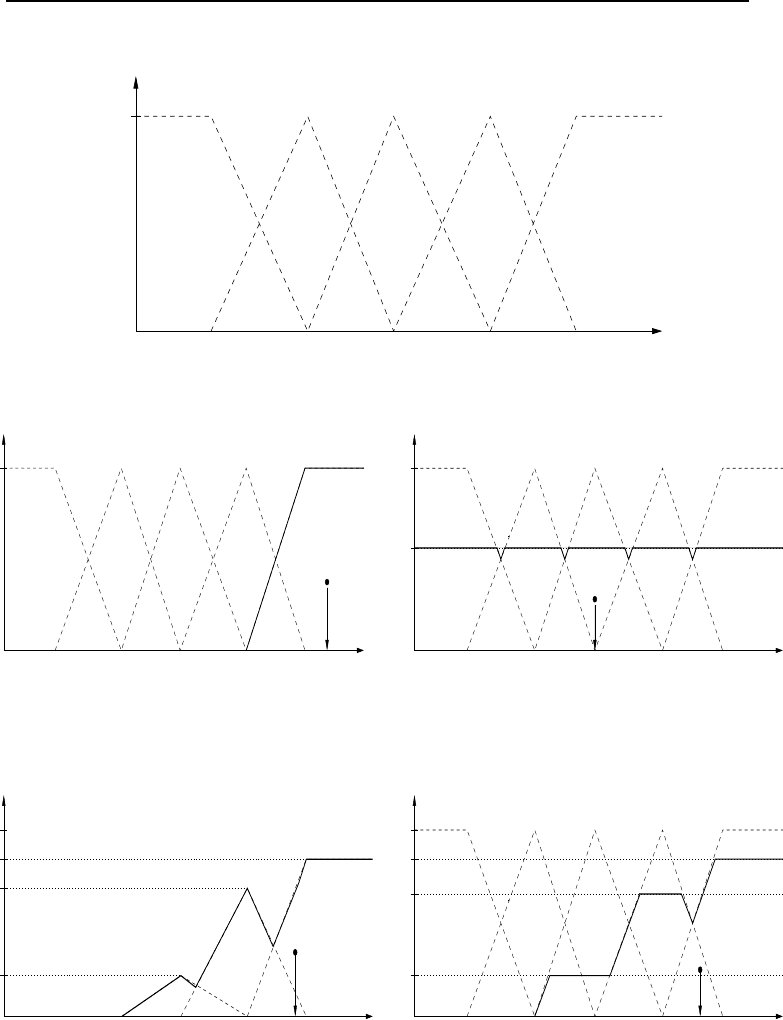
For the sake of the argument, suppose the following hedges are defined for linguistic
variable C (refer to Figure 21.3(a) for the definition of the membership functions):
large decrease (LD), slight increase (SI), no change (NC), slight increase (SI), and
large increase (LI). Assume three rules with the following C membership values: µ
LI
=
0.8,µ
SI
=0.6andµ
NC
=0.3.
Several inference methods exist to find an approximate scalar value to represent the
action to be taken:
• The max-min method: The rule with the largest firing strength is selected,
and it is determined which consequent membership function is activated. The
centroid of the area under that function is calculated and the horizontal coordi-
nate of that centroid is taken as the output of the controller. For our example,
the largest firing strength is 0.8, which corresponds to the large
increase mem-
bership function. Figure 21.3(b) illustrates the calculation of the output.
• The averaging method: For this approach, the average rule firing strength is
calculated, and each membership function is clipped at the average. The centroid
of the composite area is calculated and its horizontal coordinate is used as output
of the controller. All rules therefore play a role in determining the action of the
controller. Refer to Figure 21.3(c) for an illustration of the averaging method.
• The root-sum-square method: Each membership function is scaled such that
the peak of the function is equal to the maximum firing strength that corre-
sponds to that function. The centroid of the composite area under the scaled
functions are computed and its horizontal coordinate is taken as output (refer
to Figure 21.3(d)).
• The clipped center of gravity method: For this approach, each membership
function is clipped at the corresponding rule firing strengths. The centroid of
the composite area is calculated and the horizontal coordinate is used as the
output of the controller. This approach to centroid calculation is illustrated in
Figure 21.3(e).
The calculation of the centroid of the trapezoidal areas depends on whether the domain
of the functions is discrete or continuous. For a discrete domain of a finite number
of values, n
x
, the output of the defuzzification process is calculated as (
has its
algebraic meaning)
output =
n
x
i=1
x
i
µ
C
(x
i
)
n
x
i=1
µ
C
(x
i
)
(21.11)
In the case of a continuous domain (
.
has its algebraic meaning),
output =
.
x∈X
xµ(x)dx
.
x∈X
µ(x)dx
(21.12)

472 21. Fuzzy Logic and Reasoning
where X is the universe of discourse.
21.3 Assignments
1. For the two pencil fuzzy sets in the assignments of Chapter 20, define a hedge
for the set very long pencils, and give the resulting set.
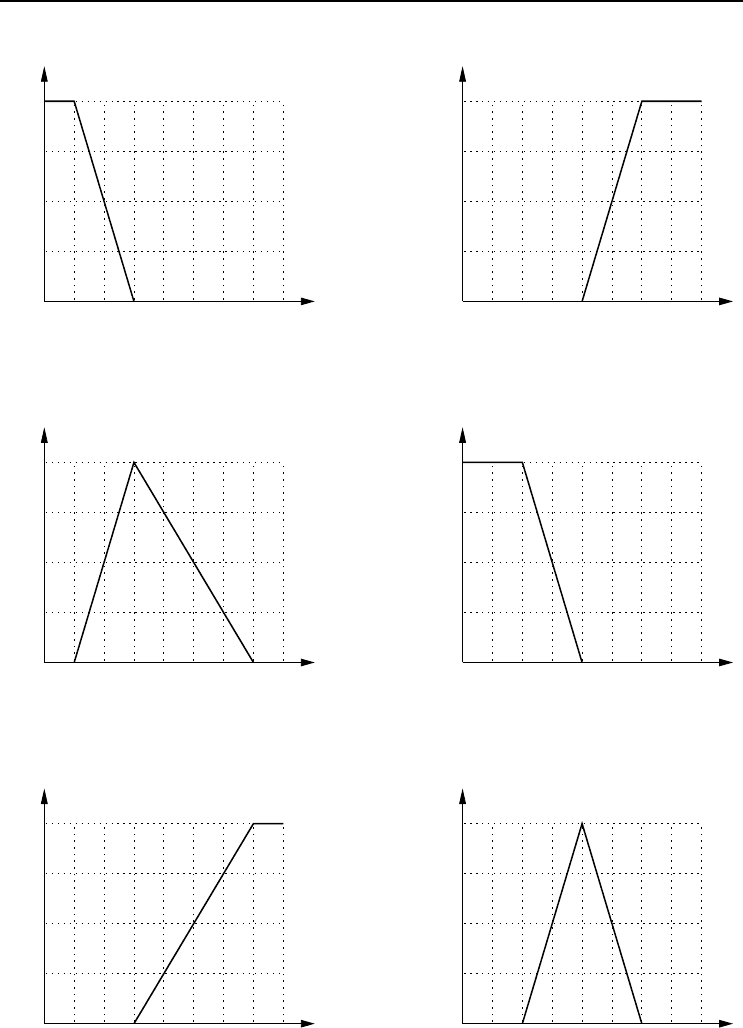
2. Consider the following rule base:
if x is Small then y is Big
if x is Medium then y is Small
if x is Big then y is Medium
Given the membership functions illustrated in Figure 21.4, answer the following
questions:
(a) Using the clipped center of gravity method, draw the composite function
for which the centroid needs to be calculated, for x =2.
(b) Compute the defuzzified output on the discrete domain,
Y = {0, 1, 2, 3, 4, 5, 6, 7, 8}
3. Repeat the assignment above for the root-sum-square method.
4. Develop a set of fuzzy rules and membership functions to adapt the values of
w, c
1
and c
2
of a gbest PSO.
5. Show how a fuzzy system can be used to adapt the learning rate of a FFNN
trained using gradient descent.
21.3 Assignments 473
Membership
1
LD SD NC SI LI
(a) Output Membership Functions
Membership
1
LD SD NC SI LI
Actual Controller
Output
Centroid
(b) Max-Min Method
Membership
1
LD SD NC SI LI
0.57
Centroid
Actual Controller
Output
(c) Averaging Method
Membership
1
0.3
0.6
0.8
NC
SI
LI
Centroid
Actual Controller
Output
(d) Root-Sum-Square Method
Membership
1
LD SD NC SI LI
0.3
0.6
0.8
Centroid
Actual Controller
Output
(e) Clipped Center of Gravity Method
Figure 21.3 Defuzzification Methods for Centroid Calculation
474 21. Fuzzy Logic and Reasoning
x
P
12 456
0.25
0
0.5
0.75
1.0
378
Small Big
y
P
12 456
0.25
0
0.5
0.75
1.0
378
(a) if x is Small then y is Big
x
P
12 456
0.25
0
0.5
0.75
1.0
378
y
P
12 456
0.25
0
0.5
0.75
1.0
378
Medium Small
(b) if x is Medium then y is Small
x
P
12 456
0.25
0
0.5
0.75
1.0
378
y
P
12 456
0.25
0
0.5
0.75
1.0
378
MediumBig
(c) if x is Big then y is Medium
Figure 21.4 Membership Functions for Assignments 2 and 3

Chapter 22
Fuzzy Controllers
The design of fuzzy controllers is one of the largest application areas of fuzzy logic.
Where fuzzy logic is frequently described as computing with words rather than numbers ,
fuzzy control is described as control with sentences rather than equations.Thus,
instead of describing the control strategy in terms of differential equations, control is
expressed as a set of linguistic rules. These linguistic rules are easier understood by
humans than systems of mathematical equations.
The first application of fuzzy control comes from the work of Mamdani and Assilian
[554] in 1975, with their design of a fuzzy controller for a steam engine. The objective
of the controller was to maintain a constant speed by controlling the pressure on
pistons, by adjusting the heat supplied to a boiler. Since then, a vast number of fuzzy
controllers have been developed for consumer products and industrial processes. For
example, fuzzy controllers have been developed for washing machines, video cameras,
air conditioners, etc., while industrial applications include robot control, underground
trains, hydro-electrical power plants, cement kilns, etc.
This chapter gives a short overview of fuzzy controllers. Section 22.1 discusses the
components of such controllers, while Section 22.2 overviews some types of fuzzy con-
trollers.
22.1 Components of Fuzzy Controllers
A fuzzy controller can be regarded as a nonlinear static function that maps controller
inputs onto controller outputs. A controller is used to control some system, or plant.
The system has a desired response that must be maintained under whatever inputs
are received. The inputs to the system can, however, change the state of the system,
which causes a change in response. The task of the controller is then to take corrective
action by providing a set of inputs that ensures the desired response. As illustrated
in Figure 22.1, a fuzzy controller consists of four main components, which are integral
to the operation of the controller:
• Fuzzy rule base: The rule base, or knowledge base, contains the fuzzy rules
that represent the knowledge and experience of a human expert of the system.
These rules express a nonlinear control strategy for the system.
Computational Intelligence: An Introduction, Second Edition A.P. Engelbrecht
c
2007 John Wiley & Sons, Ltd
475
476 22. Fuzzy Controllers
Inputs Outputs
System
Condition
Interface
Fuzzy
Rule Base
Fuzzy Controller
Action
Interface
Figure 22.1 A Fuzzy Controller
While rules are usually obtained from human experts, and are static, strategies
have been developed that adapt or refine rules through learning using neural
networks or evolutionary algorithms [257, 888].
• Condition interface (fuzzifier): The fuzzifier receives the actual outputs of
the system, and transforms these non-fuzzy values into membership degrees to
the corresponding fuzzy sets. In addition to the system outputs, the fuzzification
of input values to the system also occurs via the condition interface.
• Action interface (defuzzifier): The action interface defuzzifies the outcome
of the inference engine to produce a non-fuzzy value to represent the actual
control function to be applied to the system.
• Inference engine: The inference engine performs inferencing upon fuzzified
inputs to produce a fuzzy output (refer to Section 21.2.2).
As stated earlier, a fuzzy controller is basically a nonlinear control function. The
nonlinearity in fuzzy controllers is caused by
• the fuzzification process, if nonlinear membership functions are used;
• the rule base, since rules express a nonlinear control strategy;
• the inference engine, if, for example, the min-operator is used for intersection
and the max-operator is used for union; and
• the defuzzification process.

22.2 Fuzzy Controller Types 477
22.2 Fuzzy Controller Types
While there exists a number of different types of fuzzy controllers, they all have the
same components and involve the same design steps. The differences between types
of fuzzy controllers are mainly in the implementation of the inference engine and the
defuzzifier.
The design of a fuzzy controller involves the following aspects: A universe of discourse
needs to be defined, and the fuzzy sets and membership functions for both the input
and output spaces have to be designed. With the help of a human expert, the linguistic
rules that describe the dynamic behavior need to be defined. The designer has to decide
on how the fuzzifier, inference engine and defuzzifier have to be implemented, after
considering all the different options (refer to Section 21.1). Other issues that need to
be considered include the preprocessing of the raw measurements as obtained from
measuring equipment. Preprocessing involves the removal of noise, discretization of
continuous values, scaling and transforming values into a linguistic form.
In the next sections, three controller types are discussed, namely table-based, Mamdani
and Takagi-Sugeno.
22.2.1 Table-Based Controller
Table-based controllers are used for discrete universes, where it is feasible to calculate
all combinations of inputs. The relation between all input combinations and their
corresponding outputs are then arranged in a table. In cases where there are only two
inputs and one output, the controller operates on a two-dimensional look-up table. The
two dimensions correspond to the inputs, while the entries in the table correspond to
the outputs. Finding a corresponding output involves a simple and fast look-up in the
table. Table-based controllers become inefficient for situations with a large number of
input and output values.
22.2.2 Mamdani Fuzzy Controller
Mamdani and Assilian [554] produced the first fuzzy controller. Mamdani-type con-
trollers follow the following simple steps:
1. Identify and name input linguistic variables and define their numerical ranges.
2. Identify and name output linguistic variables and define their numerical ranges.
3. Define a set of fuzzy membership functions for each of the input variables, as
well as the output variables.
4. Construct the rule base that represents the control strategy.
5. Perform fuzzification of input values.
6. Perform inferencing to determine firing strengths of activated rules.