
Engelbrecht Andries P. Computational Intelligence: An Introduction
Подождите немного. Документ загружается.


448 19. Artificial Immune Models
The number of unread emails in the inbox determines the degree of the danger signal,
θ. If the degree of the danger signal reaches a limit, θ
max
, the unread emails, U,are
presented to the set of antibodies, B, for classification as uninteresting. An email,
z
p
∈U, is classified as uninteresting if the highest calculated affinity, a
h
,ishigher
than an affinity threshold, a
max
.Theuninteresting classified email is then moved to
a temporary folder or deleted. The degree of the danger signal needs to be calculated
for each new email received.
19.5.3 Intrusion Detection
The basic function of an intrusion detection system (IDS) is to monitor incoming traffic
at a specific host connected to a network. The IDS creates a profile of normal user
traffic and signals an alarm of intrusion for any detected abnormal traffic, i.e. traffic
not forming part of the normal profile. A problem to this solution of profile creation,
is that the normal traffic changes through time. Thus, the profile gets outdated.
The danger signal used in danger theory inspired the modeling of an adaptable IDS.
The danger signal can be defined as a signal generated by the host if any incoming traf-
fic resulted in abnormal CPU usage, memory usage or security attacks. The adaptable
IDS will only signal an alarm of abnormal traffic if the IDS receives a danger signal
from the host. If no danger signal is received from the host, the profile is adapted to
accommodate the new detected normal traffic. Danger theory inspired AISs applied
to intrusion/anomaly detection can be found in [13, 30].
19.6 Applications and Other AIS models
Artificial immune systems have been successfully applied to many problem do-
mains. Some of these domains range from network intrusion and anomaly detection
[13, 30, 176, 279, 280, 327, 373, 374, 457, 458, 803, 804] to data classification models
[692, 890], virus detection [281], concept learning [689], data clustering [184], robotics
[431, 892], pattern recognition and data mining [107, 398, 845, 847]. The AIS has
also been applied to the initialization of feed-forward neural network weights [189],
the initialization of centers of a radial basis function neural network [188] and the
optimization of multi-modal functions [181, 294]. The interested reader is referred to
[175, 183, 185] for more information on AIS applications.
19.7 Assignments
1. With reference to negative selection as described in Section 19.2.1, discuss the
consequences of having small values for r. Also discuss the consequences for
large values.
2. A drawback of negative selection is that the training set needs to have a good
representation of self patterns. Why is this the case?

19.7 Assignments 449
3. How can an AIS be used for classification problems where there is more than
two classes?
4. How does the self stabilizing AIS improve on AINE?
5. How does the enhanced artificial immune network improve on AINE?
6. The enhanced artificial immune network calculates the number of clones gener-
ated by an ARB as nc = l × sl.
(a) Why is the number of clones a function of the stimulation level?
(b) Explain the consequences of large and small values of l.
7. For the aiNet model in Algorithm 19.5, how does network suppression help to
control the size of the ARB population?
8. Why should an antibody be mutated less the higher the affinity of the antibody
to an antigen training pattern, considering the aiNet model?
9. Discuss the influence of different values for the danger signal threshold as applied
in the adaptive mailbox problem discussed in Section 19.5.2
Part VI
FUZZY SYSTEMS
Two-valued, or Boolean, logic is a well-defined and used theory. Boolean logic is es-
pecially important for implementation in computing systems where information, or
knowledge about a problem, is binary encoded. Boolean logic also played an impor-
tant role in the development of the first AI reasoning systems, especially the inference
engine of expert systems [315]. For such knowledge representation and reasoning sys-
tems, propositional and first-order predicate calculus are extensively used as represen-
tation language [539, 629]. Associated with Boolean logic is the traditional two-valued
set theory, where an element either belongs to a set or not. That is, set member-
ship is precise. Coupled with Boolean knowledge, two-valued set theory enabled the
development of exact reasoning systems.
While some successes have been achieved using two-valued logic and sets, it is not
possible to solve all problems by mapping the domain into two-valued variables. Most
real-world problems are characterized by the ability of a representation language (or
logic) to process incomplete, imprecise, vague or uncertain information. While two-
valued logic and set theory fail in such environments, fuzzy logic and fuzzy sets give the
formal tools to reason about such uncertain information. With fuzzy logic, domains
are characterized by linguistic terms, rather than by numbers. For example, in the
phrases ‘‘it is partly cloudy’’,or‘‘Stephan is very tall’’,bothpartly and very are
linguistic terms describing the magnitude of the fuzzy (or linguistic) variables cloudy
and tall. The human brain has the ability to understand these terms, and infer from
them that it will most probably not rain, and that Stephan might just be a good
basket ball player (note, again, the fuzzy terms!). However, how do we use two-valued
logic to represent these phrases?
Together with fuzzy logic, fuzzy set theory provides the tools to develop software
products that model human reasoning (also referred to as approximate reasoning).
In fuzzy sets, an element belongs to a set to a degree, indicating the certainty (or
uncertainty) of membership.
The development of logic has a long and rich history, in which major philosophers
played a role. The foundations of two-valued logic stemmed from the efforts of Aristotle
(and other philosophers of that time), resulting in the so-called Laws of Thought [440].
The first version of these laws was proposed around 400 B.C., namely the Law of the
Excluded Middle. This law states that every proposition must have only one of two
outcomes: either true or false. Even in that time, immediate objections were given
with examples of propositions that could be true, and simultaneously not true.
451

452 VI. FUZZY SYSTEMS
It was another great philosopher, Plato, who laid the foundations of what is today
referred to as fuzzy logic. It was, however, only in the 1900s that Lejewski and
Lukasiewicz [514] proposed the first alternative to the Aristotelian two-valued logic.
Three-valued logic has a third value which is assigned a numeric value between true and
false. Lukasiewicz later extended this to four-valued and five-valued logic. It was only
recently, in 1965, that Lotfi Zadeh [944] produced the foundations of infinite-valued
logic with his mathematics of fuzzy set theory.
Following the work of Zadeh, much research has been done in the theory of fuzzy
systems, with applications in control, information systems, pattern recognition and
decision support. Some successful real-world applications include automatic control of
dam gates for hydroelectric-powerplants, camera aiming, compensation against vibra-
tions in camcorders, cruise-control for automobiles, controlling air-conditioning sys-
tems, document archiving systems, optimized planning of bus time-tables, and many
more. While fuzzy sets and logic have been used to solve real-world problems, they
were also combined with other CI paradigms to form hybrid systems, for example,
fuzzy neural networks and fuzzy genetic algorithms [957].
A different set theoretic approach which also uses the concept of membership functions,
namely rough sets (introduced by Pawlak in 1982 [668]), is sometimes confused with
fuzzy sets. While both fuzzy sets and rough sets make use of membership functions,
rough sets differ in the sense that a lower and upper approximation to the rough set
is determined. The lower approximation consists of all elements that belong with full
certainty to the corresponding set, while the upper approximation consists of elements
that may possibly belong to the set. Rough sets are frequently used in machine
learning as classifier, where they are used to find the smallest number of features to
discern between classes [600]. Rough sets are also used for extracting knowledge from
incomplete data [600, 683]. Hybrid approaches that employ both fuzzy and rough sets
have also been developed [843].
The remainder of this Part is organized as follows: Chapter 20 discusses fuzzy sets,
while fuzzy logic and reasoning are covered in Chapter 21. A short overview of fuzzy
controllers is given in Chapter 22. The Part is concluded with an overview of rough
set theory in Chapter 23.

Chapter 20
Fuzzy Sets
Consider the problem of designing a set of all tall people, and assigning all the people
you know to this set. Consider classical set theory where an element is either a member
of the set or not. Suppose all tall people are described as those with height greater
than 1.75m. Then, clearly a person of height 1.78m will be an element of the set tall,
and someone with height 1.5m will not belong to the set of tall people. But, the same
will apply to someone of height 1.73m, which implies that someone who falls only 2cm
short is not considered as being tall. Also, using two-valued set theory, there is no
distinction among members of the set of tall people. For example, someone of height
1.78m and one of height 2.1m belongs equally to the set! Thus, no semantics are
included in the description of membership.
The alternative, fuzzy sets, has no problem with this situation. In this case all the
people you know will be members of the set tall, but to different degrees. For example,
a person of height 2.1m may be a member of the set to degree 0.95, while someone of
length 1.7m may belong to the set with degree 0.4.
Fuzzy sets are an extension of crisp (two-valued) sets to handle the concept of par-
tial truth, which enables the modeling of the uncertainties of natural language. The
vagueness in natural language is further emphasized by linguistic terms used to de-
scribe objects or situations. For example, the phrase when it is very cloudy, it will most
probably rain, has the linguistic terms very and most probably – which are understood
by the human brain. Fuzzy sets, together with fuzzy reasoning systems, give the tools
to also write software, which enables computing systems to understand such vague
terms, and to reason with these terms.
This chapter formally introduces fuzzy sets. Section 20.1 defines fuzzy sets, while
membership functions are discussed in Section 20.2. Operators that can be applied to
fuzzy sets are covered in Section 20.3. Characteristics of fuzzy sets are summarized
in Section 20.4. The chapter is concluded with a discussion of the differences between
fuzziness and probability in Section 20.5.
Computational Intelligence: An Introduction, Second Edition A.P. Engelbrecht
c
2007 John Wiley & Sons, Ltd
453

454 20. Fuzzy Sets
20.1 Formal Definitions
Different to classical sets, elements of a fuzzy set have membership degrees to that
set. The degree of membership to a fuzzy set indicates the certainty (or uncertainty)
that the element belongs to that set. Formally defined, suppose X is the domain, or
universe of discourse, and x ∈ X is a specific element of the domain X. Then, the
fuzzy set A is characterized by a membership mapping function [944]
µ
A
: X → [0, 1] (20.1)
Therefore, for all x ∈ X, µ
A
(x) indicates the certainty to which element x belongs to
fuzzy set A. For two-valued sets, µ
A
(x) is either 0 or 1.
Fuzzy sets can be defined for discrete (finite) or continuous (infinite) domains. The
notation used to denote fuzzy sets differ based on the type of domain over which
that set is defined. In the case of a discrete domain X, the fuzzy set can either
be expressed in the form of an n
x
-dimensional vector or using the sum notation. If
X = {x
1
,x
2
, ···,x
n
x
}, then, using set notation,
A = {(µ
A
(x
i
)/x
i
)|x
i
∈ X, i =1, ···,n
x
} (20.2)
Using sum notation,
A = µ
A
(x
1
)/x
1
+ µ
A
(x
2
)/x
2
+ ···+ µ
A
(x
n
x
)/x
n
x
=
n
x
i=1
µ
A
(x
i
)/x
i
(20.3)
where the sum should not be confused with algebraic summation. The use of sum
notation above simply serves as an indication that A is a set of ordered pairs. A
continuous fuzzy set, A, is denoted as
A =
X
µ(x)/x (20.4)
Again, the integral notation should not be algebraically interpreted.
20.2 Membership Functions
The membership function is the essence of fuzzy sets. A membership function, also
referred to as the characteristic function of the fuzzy set, defines the fuzzy set. The
function is used to associate a degree of membership of each of the elements of the
domain to the corresponding fuzzy set. Two-valued sets are also characterized by
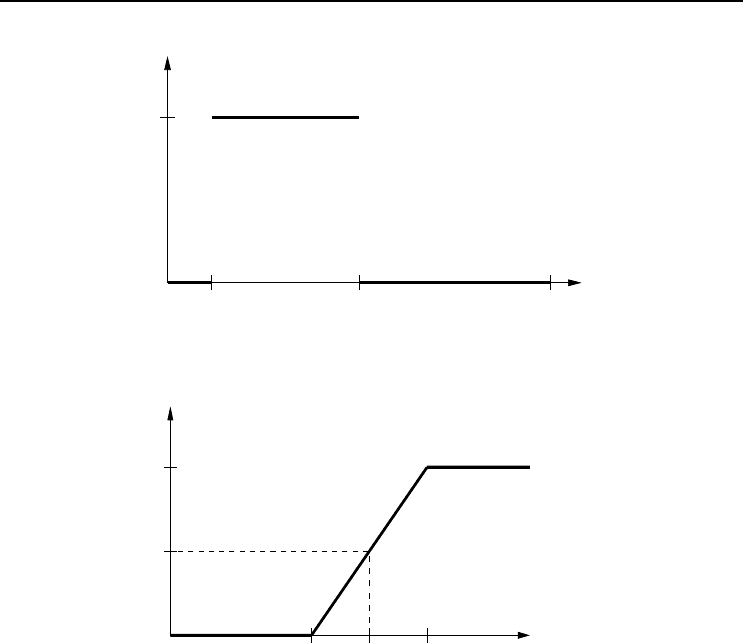
a membership function. For example, consider the domain X of all floating-point
numbers in the range [0, 100]. Define the crisp set A ⊂ X of all floating-point numbers
in the range [10, 50]. Then, the membership function for the crisp set A is represented
in Figure 20.1. All x ∈ [10, 50] have µ
A
(x) = 1, while all other floating-point numbers
have µ
A
(x)=0.
Membership functions for fuzzy sets can be of any shape or type as determined by
experts in the domain over which the sets are defined. While designers of fuzzy sets
20.2 Membership Functions 455
P
A
(x)
x
10005010
1
Figure 20.1 Illustration of Membership Function for Two-Valued Sets
0
1
tall(x)
height(x)
1
.5
2
.0
1
.75
0.5
Figure 20.2 Illustration of tall Membership Function
have much freedom in selecting appropriate membership functions, these functions
must satisfy the following constraints:
• A membership function must be bounded from below by 0 and from above by 1.
• The range of a membership function must therefore be [0, 1].
• For each x ∈ X, µ
A
(x) must be unique. That is, the same element cannot map
to different degrees of membership for the same fuzzy set.
Returning to the tall fuzzy set, a possible membership function can be defined as (also
illustrated in Figure 20.2)
tall(x)=
0iflength(x) < 1.5m
(length(x) − 1.5m) × 2.0m if 1.5m ≤ length(x) ≤ 2.0m
1iflength(x) > 2.0m
(20.5)
Now, assume that a person has a length of 1.75m, then µ
A
(1.75) = 0.5.
While the tall membership function above used a discrete step function, more complex
discrete and continuous functions can be used, for example:

456 20. Fuzzy Sets
• Triangular functions (refer to Figure 20.3(a)), defined as
µ
A
(x)=
0ifx ≤ α
min
x−α
min
β−α
min
if x ∈ (α
min
,β]
α
max
−x
α
max
−β
if x ∈ (β, α
max
)
0ifx ≥ α
max
(20.6)
• Trapezoidal functions (refer to Figure 20.3(b)), defined as
µ
A
(x)=
0ifx ≤ α
min
x−α
min
β
1
−α
min
if x ∈ [α
min
,β
1
)
α
max
−x
α
max
−β
2
if x ∈ (β
2
,α
max
)
0ifx ≥ α
max
(20.7)
• Γ-membership functions, defined as
µ
A
x =
0ifx ≤ α
1 − e
−γ(x−α)
2
if x>α
(20.8)
• S-membership functions, defined as
µ
A
(x)=
0ifx ≤ α
min
2
x−α
min
α
max
−α
min
2
if x ∈ (α
min
,β]
1 − 2
x−α
max
α
max
−α
min
2
if x ∈ (β, α
max
)
1ifx ≥ α
max
(20.9)
• Logistic function (refer to Figure 20.3(c)), defined as
µ
A
(x)=
1
1+e
−γx
(20.10)
• Exponential-like function, defined as
µ
A
(x)=
1
1+γ(x − β)
2
(20.11)
with γ>1.
• Gaussian function (refer to Figure 20.3(d)), defined as
µ
A
(x)=e
−γ(x−β)
2
(20.12)
It is the task of the human expert of the domain to define the function that captures
the characteristics of the fuzzy set.

20.3 Fuzzy Operators 457
20.3 Fuzzy Operators
As for crisp sets, relations and operators are defined for fuzzy sets. Each of these
relations and operators are defined below. For this purpose let X be the domain, or
universe, and A and B are fuzzy sets defined over the domain X.
Equality of fuzzy sets: For two-valued sets, sets are equal if the two sets have
exactly the same elements. For fuzzy sets, however, equality cannot be concluded
if the two sets have the same elements. The degree of membership of elements
to the sets must also be equal. That is, the membership functions of the two
sets must be the same.
Therefore, two fuzzy sets A and B are equal if and only if the sets have the same
domain, and µ
A
(x)=µ
B
(x) for all x ∈ X.Thatis,A = B.
Containment of fuzzy sets: For two-valued sets, A ⊂ B if all the elements of A
are also elements of B. For fuzzy sets, this definition is not complete, and the
degrees of membership of elements to the sets have to be considered.
Fuzzy set A is a subset of fuzzy set B if and only if µ
A
(x) ≤ µ
B
(x) for all x ∈ X.
That is, A ⊂ B.
Figure 20.4 shows two membership functions for which A ⊂ B.
Complement of a fuzzy set (NOT): The complement of a two-valued set is simply
the set containing the entire domain without the elements of that set. For fuzzy
sets, the complement of the set A consists of all the elements of set A, but the
membership degrees differ. Let
A denote the complement of set A. Then, for all
x ∈ X, µ
A
(x)=1− µ
A
(x). It also follows that A ∩ A = ∅ and A ∪ A = X.
Intersection of fuzzy sets (AND): The intersection of two-valued sets is the set
of elements occurring in both sets. Operators that implement intersection are
referred to as t-norms. The result of a t-norm is a set that contain all the
elements of the two fuzzy sets, but with degree of membership that depends on
the specific t-norm. A number of t-norms have been used, of which the min-
operator and the product operator are the most popular. If A and B are two
fuzzy sets, then
• Min-operator: µ
A∩B
(x)=min{µ
A
(x),µ
B
(x)}, ∀x ∈ X
• Product operator: µ
A∩B
(x)=µ
A
(x)µ
B
(x), ∀x ∈ X
The difference between the two operations should be noted. Taking the product
of membership degrees is a much stronger operator than taking the minimum,
resulting in lower membership degrees for the intersection. It should also be
noted that the ultimate result of a series of intersections approaches 0.0, even if
the degrees of memberships to the original sets are high.
Other t-norms are [676],
• µ
A∩B
(x)=
1
1+
p
1−µ
A
(x)
p
p
+
1−µ
B
(x)
p
p
,forp>0.
• µ
A∩B
(x)=max{0, (1 +p)(µ
A
(x)+µ
B
(x) −1) −pµ
A
(x)µ
B
(x)},forp ≥−1.