
Engelbrecht Andries P. Computational Intelligence: An Introduction
Подождите немного. Документ загружается.

458 20. Fuzzy Sets
1
0
µ
A
(x)
x
(a) Triangular Function
1
0
x
µ
A
(x)
(b) Trapezoidal Function
1
0
µ
A
(x)
x
(c) Logistic Function
1
0
x
µ
A
(x)
(d) Gaussian Function
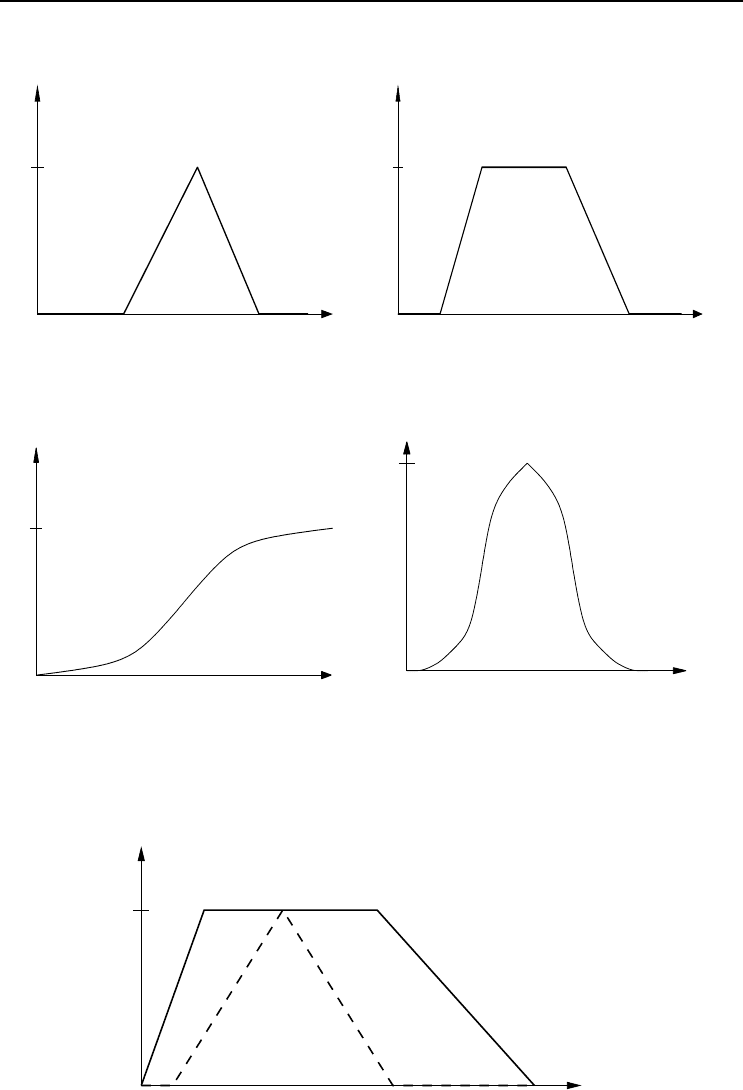
Figure 20.3 Example Membership Functions for Fuzzy Sets
1
x
µ(x)
µ
B
(x)
µ
A
(x)
Figure 20.4 Illustration of Fuzzy Set Containment

20.4 Fuzzy Set Characteristics 459
• µ
A∩B
(x)=
µ
A
(x)µ
B
(x)
p+(1−p)(µ
A
(x)+µ
B
(x)−µ
A
(x)µ
B
(x))
,forp>0.
• µ
A∩B
(x)=
1
p
1
(µ
A
(x))
p
+
1
(µ
B
(x))
p
−1
• µ
A∩B
(x)=
µ
A
(x)µ
B
(x)
max{µ
A
(x)µ
B
(x),p}
,forp ∈ [0, 1].
• µ
A∩B
(x)=p × min{µ
A
(x),µ
B
(x)} +(1− p) ×
1
2
(µ
A
(x)+µ
B
(x)), where
p ∈ [0, 1] [930].
Union of fuzzy sets (OR): The union of two-valued sets contains the elements of
all of the sets. The same is true for fuzzy sets, but with membership degrees
that depend on the specific uninion operator used. These operators are referred
to as s-norms, of which the max-operator and summation operator are most
frequently used:
• Max-operator: µ
A∪B
(x)=max{µ
A
(x),µ
B
(x)}, ∀x ∈ X,or
• Summation operator: µ
A∪B
(x)=µ
A
(x)+µ
B
(x)−µ
A
(x)µ
B
(x), ∀x ∈ X
Again, careful consideration must be given to the differences between the two
approaches above. In the limit, a series of unions will have a result that approx-
imates 1.0, even though membership degrees are low for the original sets!
Other s-norms are [676],
• µ
A∪B
(x)=
1
1+
p
µ
A
(x)
1−µ
A
(x)
p
+
µ
B
(x)
1−µ
B
(x)
p
,forp>0.
• µ
A∪B
(x)=min{1,µ
A
(x)+µ
B
(x)+pµ
A
(x)µ
B
(x)},forp ≥ 0.
• µ
A∪B
(x)=
µ
A
(x)+µ
B
(x)−µ
A
(x)µ
B
(x)−(1−p)µ
A
(x)µ
B
(x)
1−(1−p)µ
A
(x)µ
B
(x)
,forp ≥ 0.
• µ
A∪B
(x)=1−
1
p
1
(1−µ
A
(x))
p
+
1
(1−µ
B
(x))
p
−1
• 1 −
(1−µ
A
(x))(1−µ
B
(x))
max{(1−µ
A
(x)),(1−µ
B
(x)),p}
for p ∈ [0, 1].
• µ
A∪B
(x)=p × max{µ
A
(x),µ
B
(x)} +(1− p) ×
1
2
(µ
A
(x)+µ
B
(x)), where
p ∈ [0, 1] [930].
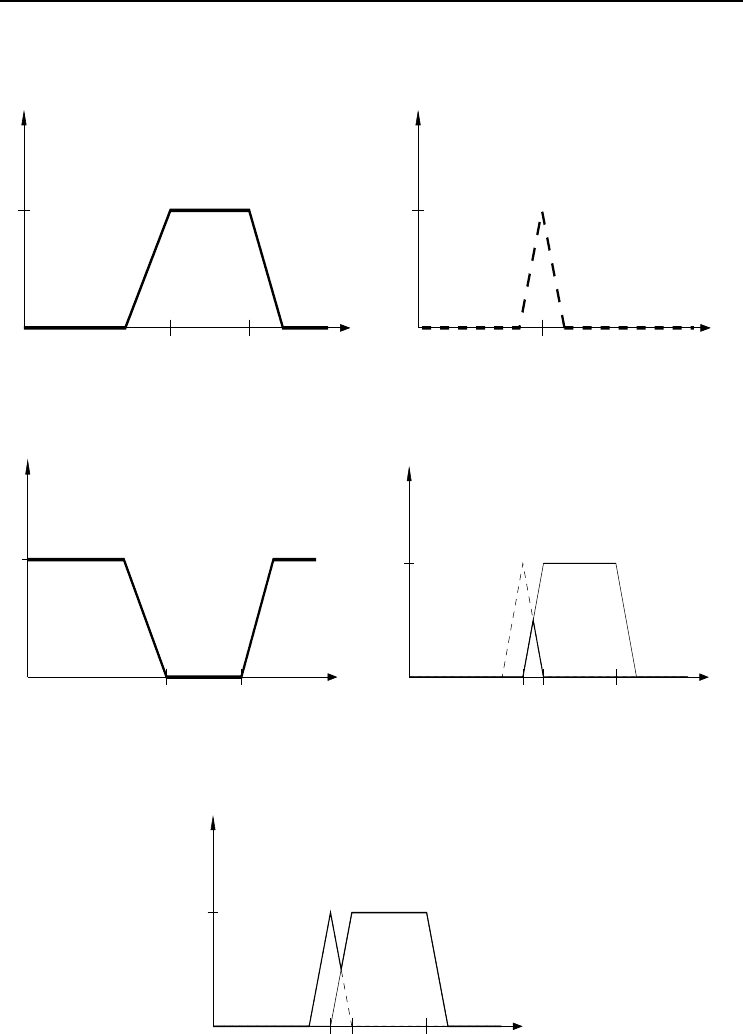
Operations on two-valued sets are easily visualized using Venn-diagrams. For fuzzy
sets the effects of operations can be illustrated by graphing the resulting membership
function, as illustrated in Figure 20.5. For the illustration in Figure 20.5, assume
the fuzzy sets A, defined as floating point numbers between [50, 80], and B, defined
as numbers about 40 (refer to Figure 20.5(a) for definitions of the membership func-
tions). The complement of set A is illustrated in Figure 20.5(b), the intersection of
the two sets are given in Figure 20.5(c) (assuming the min operator), and the union
in Figure 20.5(d) (assuming the max operator).
20.4 Fuzzy Set Characteristics
As discussed previously, fuzzy sets are described by membership functions. In this
section, characteristics of membership functions are overviewed. These characteristics
include normality, height, support, core, cut, unimodality, and cardinality.
460 20. Fuzzy Sets
0
11
8050
4
0
0
xx
µ
B
(x)µ
A
(x)
(a) Membership Functions for Sets A and B
0
1
8050
x
µ
A
(x)
(b) Complement of A
0
1
80
4
050
x
µ
A
(x)
µ
A
AND
B
(x)
µ
B
(x)
(c) Intersection of A and B
0
1
80
4
050
x
µ
A OR B
(x)
(d) Union of A
Figure 20.5 Illustration of Fuzzy Operators

20.4 Fuzzy Set Characteristics 461
Normality: A fuzzy set A is normal if that set has an element that belongs to the
setwithdegree1.Thatis,
∃x ∈ A • µ
A
(x) = 1 (20.13)
then A is normal, otherwise, A is subnormal. Normality can alternatively be
defined as
sup
x
µ
A
(x) = 1 (20.14)
Height: The height of a fuzzy set is defined as the supremum of the membership
function, i.e.
height(A)=sup
x
µ
A
(x) (20.15)
Support: The support of fuzzy set A is the set of all elements in the universe of
discourse, X, that belongs to A with non-zero membership. That is,
support(A)={x ∈ X|µ
A
(x) > 0} (20.16)
Core: The core of fuzzy set A is the set of all elements in the domain that belongs
to A with membership degree 1. That is,
core(A)={x ∈ X|µ
A
(x)=1} (20.17)
α-cut:ThesetofelementsofA with membership degree greater than α is referred
to as the α-cut of A:
A
α
= {x ∈ X|µ
A
(x) ≥ α} (20.18)
Unimodality: A fuzzy set is unimodal if its membership function is a unimodal
function, i.e. the function has just one maximum.
Cardinality: The cardinality of two-valued sets is simply the number of elements
within the sets. This is not the same for fuzzy sets. The cardinality of fuzzy set
A, for a finite domain, X, is defined as
card(A)=
x∈X
µ
A
(x) (20.19)
and for an infinite domain,
card(A)=
x∈X
µ
A
(x)dx (20.20)
For example, if X = {a, b, c, d},andA =0.3/a +0.9/b +0.1/c +0.7/d,then
card(A)=0.3+0.9+0.1+0.7=2.0.
Normalization: A fuzzy set is normalized by dividing the membership function by
the height of the fuzzy set. That is,
normalized(A)=
µ
A
(x)
height(x)
(20.21)

462 20. Fuzzy Sets
Other characteristics of fuzzy sets (i.e. concentration, dilation, contrast intensification,
fuzzification) are described in Section 21.1.1.
The properties of fuzzy sets are very similar to that of two-valued sets, however, there
are some differences. Fuzzy sets follow, similar to two-valued sets, the commutative,
associative, distributive, transitive and idempotency properties. One of the major
differences is in the properties of the cardinality of fuzzy sets, as listed below:
• card(A)+card(B)=card(A ∩ B)+card(A ∪ B)
• card(A)+card(
A)=card(X)
where A and B are fuzzy sets, and X is the universe of discourse.
20.5 Fuzziness and Probability
There is often confusion between the concepts of fuzziness and probability. It is im-
portant that the similarities and differences between these two terms are understood.
Both terms refer to degrees of certainty (or uncertainty) of events occurring. But
that is where the similarities stop. Degrees of certainty as given by statistical prob-
ability are only meaningful before the associated event occurs. After that event, the
probability no longer applies, since the outcome of the event is known. For example,
before flipping a fair coin, there is a 50% probability that heads will be on top, and
a 50% probability that it will be tails. After the event of flipping the coin, there is
no uncertainty as to whether heads or tails are on top, and for that event the degree
of certainty no longer applies. In contrast, membership to fuzzy sets is still relevant
after an event occurred. For example, consider the fuzzy set of tall people, with Peter
belonging to that set with degree 0.9. Suppose the event to execute is to determine
if Peter is good at basketball. Given some membership function, the outcome of the
event is a degree of membership to the set of good basketball players. After the event
occurred, Peter still belongs to the set of tall people with degree 0.9.
Furthermore, probability assumes independence among events, while fuzziness is not
based on this assumption. Also, probability assumes a closed world model where
everything is known, and where probability is based on frequency measures of occurring
events. That is, probabilities are estimated based on a repetition of a finite number
of experiments carried out in a stationary environment. The probability of an event
A is thus estimated as
Prob(A) = lim
n→∞
n
A
n
(20.22)
where n
A
is the number of experiments for which event A occurred, and n is the
total number of experiments. Fuzziness does not assume everything to be known, and
is based on descriptive measures of the domain (in terms of membership functions),
instead of subjective frequency measures.
Fuzziness is not probability, and probability is not fuzziness. Probability and fuzzy
sets can, however, be used in a symbiotic way to express the probability of a fuzzy
event.
20.6 Assignments 463
P
x
0.5
1.0
0.0
12345678
AB
0.25
0.75
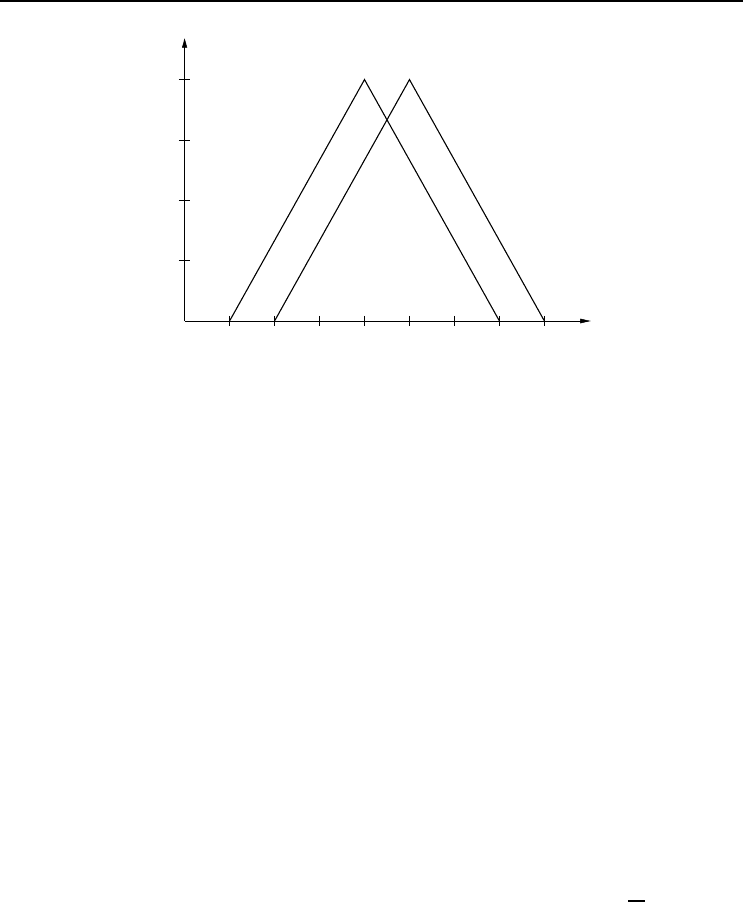
Figure 20.6 Membership Functions for Assignments 1 and 2
20.6 Assignments
1. Perform intersection and union for the fuzzy sets in Figure 20.5 using the t-norms
and s-norms defined in Section 20.3.
2. Give the height, support, core and normalization of the fuzzy sets in Figure 20.5.
3. Consider the two fuzzy sets:
long pencils = {pencil1/0.1,pencil2/0.2,pencil3/0.4,pencil4/0.6,
pencil5/0.8,pencil6/1.0}
medium pencils = {pencil1/1.0,pencil2/0.6,pencil3/0.4,pencil4/0.3,
pencil5/0.1}
(a) Determine the union of the two sets.
(b) Determine the intersection of the two sets.
4. What is the difference between the membership function of an ordinary set and
a fuzzy set?
5. Consider the membership functions of two fuzzy sets, A and B, as given in
Figure 20.6.
(a) Draw the membership function for the fuzzy set C = A ∩
B,usingthe
min-operator.
(b) Compute µ
C
(5).
(c) Is C normal? Justify your answer.
6. Consider the fuzzy sets A and B such that core(A) ∩ core(B)=∅. Is fuzzy set
C = A ∩ B normal? Justify your answer.
7. Show that the min-operator is
(a) commutative
(b) idempotent
(c) transitive

Chapter 21
Fuzzy Logic and Reasoning
The previous chapter discussed theoretical aspects of fuzzy sets. The fuzzy set oper-
ators allow rudimentary reasoning about facts. For example, consider the three fuzzy
sets tall, good
athlete and good basketball player. Now assume
µ
tall
(Peter)=0.9andµ
good athlete
(Peter)=0.8
µ
tall
(Carl)=0.9andµ
good athlete
(Carl)=0.5
If it is known that a good basketball player is tall and is a good athlete, then which
one of Peter or Carl will be the better basketball player? Through application of the
intersection operator,
µ
good basketball player
(Peter)=min{0.9, 0.8} =0.8
µ
good basketball player
(Carl)=min{0.9, 0.5} =0.5
Using the standard fuzzy set operators, it is possible to determine that Peter will be
better at the sport than Carl.
The example above is a very simplistic situation. For most real-world problems, the
sought outcome is a function of a number of complex events or scenarios. For example,
actions made by a controller are determined by a set of fuzzy if-then rules. The if-then
rules describe situations that can occur, with a corresponding action that the controller
should execute. It is, however, possible that more than one situation, as described by
if-then rules, are simultaneously active, with different actions. The problem is to
determine the best action to take. A mechanism is therefore needed to infer an action
from a set of activated situations.
What is necessary is a formal logic system that can be used to reason about uncer-
tainties in order to derive at plausible actions. Fuzzy logic [945] is such a system,
which together with an inferencing system form a tool for approximate reasoning.
Section 21.1 provides a short definition of fuzzy logic and a short overview of its main
concepts. The process of fuzzy inferencing is described in Section 21.2.
21.1 Fuzzy Logic
Zadeh [947] defines fuzzy logic (FL) as a logical system, which is an extension of multi-
valued logic that is intended to serve as a logic for approximate reasoning. The two
Computational Intelligence: An Introduction, Second Edition A.P. Engelbrecht
c
2007 John Wiley & Sons, Ltd
465

466 21. Fuzzy Logic and Reasoning
most important concepts within FL is that of a linguistic variable and the fuzzy if-then
rule. These concepts are discussed in the next subsections.
21.1.1 Linguistics Variables and Hedges
Lotfi Zadeh [946] introduced the concept of linguistic variable (or fuzzy variable) in
1973, which allows computation with words in stead of numbers. Linguistic variables
are variables with values that are words or sentences from natural language. For ex-
ample, referring again to the set of tall people, tall is a linguistic variable. Sensory
inputs are linguistic variables, or nouns in a natural language, for example, tempera-
ture, pressure, displacement, etc. Linguistic variables (and hedges, explained below)
allow the translation of natural language into logical, or numerical statements, which
provide the tools for approximate reasoning (refer to Section 21.2).
Linguistic variables can be divided into different categories:
• Quantification variables, e.g. all, most, many, none, etc.
• Usuality variables, e.g. sometimes, frequently, always, seldom, etc.
• Likelihood variables, e.g. possible, likely, certain, etc.
In natural language, nouns are frequently combined with adjectives for quantifications
of these nouns. For example, in the phrase very tall, the noun tall is quantified by the
adjective very, indicating a person who is “taller” than tall. In fuzzy systems theory,
these adjectives are referred to as hedges. A hedge serves as a modifier of fuzzy values.
In other words, the hedge very changes the membership of elements of the set tall
to different membership values in the set very
tall. Hedges are implemented through
subjective definitions of mathematical functions, to transform membership values in a
systematic manner.
To illustrate the implementation of hedges, consider again the set of tall people, and
assume the membership function µ
tall
characterizes the degree of membership of ele-
ments to the set tall. Our task is to create a new set, very
tall of people that are very
tall. In this case, the hedge very can be implemented as the square function. That is,
µ
very tall
(x)=µ
tall
(x)
2
. Hence, if Peter belongs to the set tall with certainty 0.9, then
he also belongs to the set very
tall with certainty 0.81. This makes sense according to
our natural understanding of the phrase very tall: Degree of membership to the set
very
tall should be less than membership to the set tall. Alternatively, consider the set
sort
of tall to represent all people that are sort of tall, i.e. people that are shorter than
tall. In this case, the hedge sort of can be implemented as the square root function,
µ
sort of tall
(x)=
&
µ
tall
(x). So, if Peter belongs to the set tall with degree 0.81, he
belongs to the set sort
of tall with degree 0.9.
Different kinds of hedges can be defined, as listed below:
• Concentration hedges (e.g. very), where the membership values get relatively
smaller. That is, the membership values get more concentrated around points

21.1 Fuzzy Logic 467
with higher membership degrees. Concentration hedges can be defined, in gen-
eral terms, as
µ
A
(x)=µ
A
(x)
p
,forp>1 (21.1)
where A
is the concentration of set A.
• Dilation hedges (e.g. somewhat, sort of, generally), where membership values
increases. Dilation hedges are defined, in general, as
µ
A
(x)=µ
A
(x)
1/p
for p > 1 (21.2)
• Contrast intensification hedges (e.g. extremely), where memberships lower
than 1/2 are diminished, but memberships larger than 1/2 are elevated. This
hedge is defined as,
µ
A
(x)=
2
p−1
µ
A
(x)
p
if µ
A
(x) ≤ 0.5
1 − 2
p−1
(1 − µ
A
(x))
p
if µ
A
(x) > 0.5
(21.3)
which intensifies contrast.
• Vague hedges (e.g. seldom), are opposite to contrast intensification hedges,
having membership values altered using
µ
A
(x)=
&
µ
A
(x)/2ifµ
A
(x) ≤ 0.5
1 −
&
(1 − µ
A
(x))/2ifµ
A
(x) > 0.5
(21.4)
Vague hedges introduce more “fuzziness” into the set.
• Probabilistic hedges, which express probabilities, e.g. likely, not very likely,
probably, etc.
21.1.2 Fuzzy Rules
For fuzzy systems in general, the dynamic behavior of that system is characterized by
a set of linguistic fuzzy rules. These rules are based on the knowledge and experience
of a human expert within that domain. Fuzzy rules are of the general form
if antecedent(s) then consequent(s) (21.5)
The antecedent and consequent of a fuzzy rule are propositions containing linguistic
variables. In general, a fuzzy rule is expressed as
if A is a and B is b then C is c (21.6)
where A and B are fuzzy sets with universe of discourse X
1
,andC is a fuzzy set with
universe of discourse X
2
. Therefore, the antecedent of a rule form a combination of
fuzzy sets through application of the logic operators (i.e. complement, intersection,
union). The consequent part of a rule is usually a single fuzzy set, with a corresponding
membership function. Multiple fuzzy sets can also occur within the consequent, in
which case they are combined using the logic operators.