
Floud R., Johnson P. The Cambridge Economic History of Modern Britain, Volume 1: Industrialisation, 1700-1860
Подождите немного. Документ загружается.

Transport 321
0.00
5.00
10.00
15.00
20.00
25.00
30.00
35.00
40.00
45.00
1761-
70
1771-
80
1781-
90
1791-
1800
1801-
10
1811-
20
1821-
30
1831-
40
1841-
50
1851-
60
Year
%
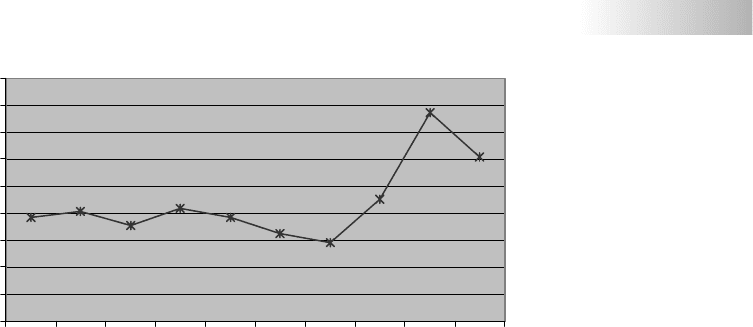
Figure 11.1
Transport’s share of
gross domestic fixed
capital formation in
Great Britain,
1761–1860
Source:Feinstein
1981:133–4.
decades of our period but is uncertain whether railway investment oc-
curred at the expense of social capital (Feinstein 1981: 133–4; Feinstein
and Pollard 1988: 444). His figures are decennial averages. A more disag-
gregated approach reveals that transport investment was highly cyclical
from year to year, as indicated by the canal and road building manias
in the mid-1790s and the railway surges in the late 1840s. In the latter
case, railway investment may have constituted as much as a half of gross
domestic fixed capital formation (Gourvish 1988: 60–1).
The large and highly cyclical nature of transport investment raises
questions about its impact upon capital and factor product markets. In
particular, is there evidence of crowding out in capital or factor markets,
possibly resulting in sub-optimal resource allocation? Since the funds for
capital hungry transport projects were often raised during periods of opti-
mism in the hope of future growth in transport demand, did this restrict
the opportunities for developing other new industries with important
growth potential? Contemporary opinion viewed transport projects as a
panacea for economic backwardness, which may have skewed investment.
However, it should be remembered that there is a much larger supply of
investible funds available during boom periods owing to optimism and
higher income levels. Moreover, as we saw earlier, transport played an
important role in capital market innovations, which helped to attract
additional sources of finance. This growth in capital markets is reflected
in a rising investment ratio into double figures during the railway age
(Gourvish 1988: 62). Major transport projects requiring parliamentary ap-
proval were characterised by a long gestation period from original plan-
ning to completion. Thus, projects planned and financed at the top of
economic cycles often generated a demand for labour and other produc-
tion factors during subsequent downturns, providing in some cases a
much needed contra-cyclical stimulus to the economy. The second half
of the 1840s is a case in point, as we shall see below.
Cambridge Histories Online © Cambridge University Press, 2008

322 Simon Ville
Table 11.7 Productivity growth in transport by mode (per cent per annum)
Roads Per Canals Shipping Railways
Annual compound growth (%) 0.7 0.8 1.4 2.2
(1690–1840) (1780–1830) (1780–1860) (1830–60)
Sources: Roads, Gerhold 1996: 511; canals, McCloskey 1981: 125; shipping, McCloskey 1981: 125; Harley 1993:
199–200; railways, McCloskey 1981: 125.
Productivity
What evidence do we have for productivity growth in transport that may
have mitigated the risks of crowding out by using a fixed amount of
resources more efficiently? Many of the sources of productivity growth
have been identified in the earlier sections of this chapter. They included
better roads, vehicles and horse breeds. On inland waterways this meant
better navigation by way of canal and the development of flying ser-
vices. Shipping benefited from organisational improvements associated
with specialist ship owning such as better stowage and navigation, and
from rapid technological changes, particularly the shifts to metal and
steam. Railways were still in their relative infancy by 1860 but rational-
isation through amalgamation and the operation of the clearing house
wasalready impacting upon productivity. As we have also seen on pp.
304–5 above, these improvements were reflected in falling freight rates,
and faster and more regular journeys. Calculating productivity change
provides us with a single statistic, reported in Table 11.7 which captures
most of these varied improvements.
McCloskey evaluated the size and importance of productivity improve-
ments in some of the key ‘modernised’ sectors of the British economy,
1780–1860. He calculated this by multiplying a sector’s annual produc-
tivity growth by the weighting of its output in the economy. This led
to the result that transport’s contribution was the largest among the
‘modernised’ sectors, that is, 0.23 per cent per annum of the modernised
sectors’ total growth of 0.52 per cent. McCloskey concluded that ‘trans-
portation was therefore among the more notably progressive parts of the
economy’ (McCloskey 1981: 114; 1994: 252). Table 11.8 reports McCloskey’s
estimates, and also Harley’s (1993) downwards revision of McCloskey’s
calculations for the modernised sectors. The contribution of shipping
is drastically reduced, from 0.14 to 0.03 per cent, by substituting Harley’s
ownproductivity growth estimates while retaining the same weightings.
Transport’s share (0.12) is now slightly behind that of cotton, although the
modernised sectors’ contribution to national performance is now greater
as a result of using Crafts’ more recent and more conservative calcula-
tions for total productivity growth. Harley’s figures are an improvement
in that they take some account of productivity in the coastal trade, but
his location of productivity improvements in technological changes in the
later nineteenth century may understate earlier advances in organisation
Cambridge Histories Online © Cambridge University Press, 2008

Transport 323
Table 11.8 Sectoral contributions to productivity: annual percentage growth, 1780–1860
McCloskey estimates Harley estimates Ville estimates
Share Productivity Contribution Productivity Contribution Productivity Contribution
Cotton 0.070 2.6 0.18 1.9 0.13 1.9 0.13
Worsteds 0.035 1.8 0.06 1.3 0.05 1.3 0.05
Woollens 0.035 0.9 0.03 0.6 0.02 0.6 0.02
Iron 0.020 0.9 0.02 0.9 0.02 0.9 0.02
Canals and railways 0.070 1.3 0.09 1.3 0.09 1.3 0.09
Shipping 0.060 2.3 0.14 0.5 0.03 1.4 0.08
Roads 0.040 0.7 0.03
Sum of modernised sectors 0.330 1.8 0.52 1.2 0.34 1.3 0.42
Agriculture 0.270 0.4 0.12 0.7 0.19 0.7 0.19
All others 0.850 0.6 0.55 0.02 0.02
Total 1.450 1.19 0.55 0.61
Note: Estimates of roads’ share based on evidence in Gerhold 1996: 497–8.
Sources: McCloskey 1981: 114; Harley 1993: 199–200; Table 11.7 above.
and infrastructure. Therefore, we offer a middle point between the work
of McCloskey and Harley as a figure for shipping productivity growth.
The substantial improvements in road services before the mid-nineteenth
century have now been estimated by Gerhold (1996: 511) and can be in-
cluded. Transport’s contribution exceeds cotton’s once more. Total pro-
ductivity growth in agriculture and the ‘modernised sectors’ aggregates
toafigure (0.61 per cent per annum) that is larger than Crafts’s (1985:
86; 1987a: 250) aggregate national estimates (0.55 per cent per annum).
Harley’s lower estimate for transport productivity, when aggregated with
theother modernised sectors and agriculture (0.53 per cent per annum),
is almost equivalent to the Crafts national figure. This suggests either
that all productivity growth in the British economy was confined to the
sectors indicated in Table 11.8, or that Crafts’s widely recognised down-
ward revisions of national productivity growth for this period are too
conservative.
Gemmell and Wardley (1990: 307) have calculated that by 1856 (and
through to 1913), ‘productivity levels in . . . transport services would ap-
pear to have been high relative to manufacturing’. Besides lending some
credence to the idea of productivity growth in the sector over the previous
century and a half, this additionally suggests that heavy investments in
transport were unlikely to have starved more productive sectors of scarce
resources.
Earnings
How important were the transport industries as a source of earnings
and profits in the British economy? Information on profits is sketchy and
there is no compelling evidence for consistently high profits in transport
Cambridge Histories Online © Cambridge University Press, 2008

324 Simon Ville
industries. Government intervention, or just the threat of it, may have
prevented widespread or persistent monopoly profits, thereby helping to
achieve a more efficient allocation of the benefits of new transport sys-
tems. Itwasnotedabove that the profitability of inland waterways was
not exceptional. Davis (1957) doubted whether ship owners achieved out-
standing returns in the early eighteenth century, although subsequent pe-
riods of war, especially the French Wars, provided exceptional temporary
returns to the industry owing to the increased demand for large numbers
of transport ships (Ville 1987). The earnings of shipping companies made
an important contribution to Britain’s trade balance by the boost they
provided to invisible earnings. Britain’s invisible trade grew more rapidly
than its visible trade in the eighteenth century as local ship owners
took over much of the international carrying trade from the Dutch
(Thomas and McCloskey 1981: 92). Some of the earliest railways, such as
theLiverpool to Manchester, achieved good returns, though many later
ones, especially regional and branch lines, performed poorly (Donaghy
1965–6). The significance of transport earnings lies perhaps in specific
regions and aspects of the economy rather than in national aggregates.
Port hinterlands, such as around Liverpool, Glasgow and Bristol, benefited
from substantial reinvestment of mercantile profits into evolving trade
and industry.
Social overhead capital
While transport featured prominently in a number of economic aggre-
gates, this evidence tells us little about the dynamics of change. Put sim-
ply, did transport provide the stimulus to economic expansion or just a
reactive force to initiatives elsewhere in the economy? Rostow leaves us
in little doubt about the dynamic role of the railway as a leading sector
but says nothing of the other transport modes. Figures in the first section
of this chapter show that most transport infrastructure and services grew
more rapidly than national income throughout the period. This suggests,
perhaps, that the transport sector was playing a leading rather than a
following role in the accelerated growth of the British economy from the
late eighteenth century. However, it does not preclude the possibility that
this represented periods of catch-up by transport providers.
Ahelpful manner of extending this analysis is through transport’s role
as the major form of social overhead capital (SOC) in the eighteenth and
nineteenth centuries. Investment in an economy can usefully be divided
into SOC, which supports production across the economy (for example
transport, education), or directly productive activities, which involve spe-
cific types of production (for example manufacturing). Hirschman (1958),
who developed this model, believed expansion in industrial output would
stretch the finite resources of SOC and thereby encourage increased
investment in transport, communications, education and health. Thus,
Cambridge Histories Online © Cambridge University Press, 2008

Transport 325
SOC is seen as a passive reactor. Alternatively, it has been argued that
investment in SOC, by improving the infrastructure for production, can
induce directly productive investment in a process referred to as devel-
opment by excess social overhead capital.
Investing in transport infrastructure ahead of demand is most likely to
occur where government plays a proactive role in stimulating economic
development. Even in an economy dominated by private investment deci-
sions, transport infrastructures can be built ahead of demand. The belief
in transport as a universal panacea for economic backwardness together
with the success of early projects often led to investment and construc-
tion ahead of demand, as perhaps is illustrated by the ‘mania’ phases
that characterised transport development. The success of the earliest and
most viable projects stimulated a ‘demonstration effect’: industrialists
hoped that further investment would yield similar industrial benefits
and would avoid ‘trade diversion’ to neighbouring areas where the trans-
port infrastructure had already been improved, while investors hoped for
similar rates of return to earlier projects. In fact, the fears and expecta-
tions were often overstated, since the earlier investments were often the
most promising. The lack of profitability of many later railway lines and
canals became notorious; the demand for them did not yet exist, and in
some cases never would.
State provision of subventions to a few steamship companies to carry
the mail toareaswhere there was little commercial trade provides an-
other example of development by excess social overhead capital. From
1839 the Royal Mail Steam Packet Company was paid a subvention by
theBritish government to carry mail to Mexico, Panama, Colombia,
Venezuela and the West Indies, while the Pacific Steam Navigation Com-
pany began a similar service to the west coast of South America in the
following year. In the early 1850s, mail contract payments to the West
Indies and Brazil were three times the postage revenue thereby gener-
ated (Daunton 1985: 159). Such evidence has caused one writer to note
that, ‘without British investment in shipping and ancillary services . . .
economic growth in Latin America would probably have begun later and
at a slower pace’ (Greenhill 1979: 265).
Linkages and spillovers
We turn now to look more specifically at transport’s links to different
sectors and aspects of the British economy. Rostowian backward, forward
and lateral ‘spreading effects’ help us to understand the extent of in-
terconnectedness. These linkages flowed backwards to supply industries,
forwards to industries benefiting from improved transport services, and
laterally to the local economy. Recent insights into economic develop-
ment associated with the school of new or ‘endogenous’ growth theory
have emphasised the importance of externalities or beneficial ‘spillovers’
Cambridge Histories Online © Cambridge University Press, 2008

326 Simon Ville
between sectors. These particularly relate to transfers of ‘useful knowl-
edge’ that enable industries to modernise and individual firms to enhance
their competitiveness (see chapters 1 and 5 above).
Input–output models are used to analyse the multiplier effects of trans-
port investment on supply industries. In his study of German railways,
Fremdling (1977) modified Rostow’s leading sector concept to a leading
sector ‘complex’ by intertwining the railways with several heavy indus-
tries. Mitchell (1964) and Gourvish have each shown the input linkages to
several key ‘complex’ industries including coal, iron and steel, and engi-
neering. The linkages were strongest during the construction booms; thus
railways have been estimated to have consumed 39 per cent of pig iron
production in 1844–51 and 6–10 per cent of coal output (Gourvish 1980:
24–5). The impact upon iron and steel demand was greater if account
is taken of the materials used in engineering products for the industry.
Knowledge spillovers from railways particularly relate to their pioneer-
ing role in meeting the challenges of large-scale enterprise which was
discussed above (pp. 317–18) and the precedents they set for new forms
of capital raising in finance markets (see pp. 306–7).
Similar analysis could be used in relation to other transport modes.
Ships require large amounts of material in their construction. In the
earlier part of the period this necessitated substantial timber imports
from the Baltic and North America, but also the use of domestic rolled
copper sheet for the sheathing of vessel hulls as a protection against ma-
rine life (see chapter 15). The metal steamship drew more heavily upon
the domestic coal, iron, steel and engineering industries. Indeed, Palmer
(1979: 337–9) has estimated that bunker coal represented 20 per cent
of British coal exports by the end of the nineteenth century. Shipbuild-
ing contributed to the clustering of heavy industries in conurbations in
Tyneside, Clydeside and Belfast, which yielded local external economies
of scale such as a highly skilled workforce (see chapter 14). Canal con-
struction had a limited direct impact on supply industries. However, it
provided spillover effects through confronting many civil engineering
challenges such as tunnels, bridges and embankments, thereby setting a
precedent for railway builders and many areas of construction.
Market integration
Quicker, cheaper, more regular and more comprehensive transport fos-
ters market integration. It provides for the widening of markets, the
breakdown of local monopolies and other restrictions on competition,
thedecline of subsistency, the opening up of new areas to production,
and improvements in information flows on which producers and mar-
kets rely. It can also concentrate markets by ensuring the necessary food
supply and residential expansion associated with urbanisation. Similarly,
improved transport impacts upon institutions operating within those
Cambridge Histories Online © Cambridge University Press, 2008

Transport 327
markets. Wider markets create the opportunity for larger-scale produc-
tion and economies of scale. Greater regularity of transport facilitates
thereduction of inventories, thus enabling the conversion of circulating
into fixed capital to finance such expansion. A more flexible and effi-
cient location of production may result, and provide the opportunity for
geographical expansion by individual firms nationally and even interna-
tionally. Improved information flows, and increased personal mobility,
facilitate the geographical expansion of enterprise.
The impact varied according to transport mode: roads and canals gen-
erally stimulated local and regional markets, while railways impacted
more on national markets, and shipping on international, reflecting the
different types of service and cost functions of these modes. Improved
road services in England led to the decline of many local markets and
their replacement by fewer, larger regional centres (Pawson 1977: 323).
This view has been reinforced for waterways by Turnbull, who argued
that the economic impact ‘was heavily local and regional’. Most freight
movement was over comparatively short distances, and long hauls were
restricted by the slow development of trunk routes and the ‘extreme
parochialism of most canal companies’ (1987: 540–1). The major regions
of industrial expansion in England by 1800 were inland coalfield areas
with a canal network; particular beneficiaries were the urban centres of
Manchester, Leeds and Sheffield. Coal prices were reduced through lower
transport costs and a redistribution of output in favour of lower-cost pro-
ducers (Turnbull 1987: 557–8). In Scotland the economic integration of
the central lowlands region owed much to transport (see chapter 14).
The integration of national markets through the railway can be seen
in the decline of regional price differences between producing and con-
suming areas that enabled greater regional specialisation of production.
These included a concentration of brewing firms at Burton, Alloa and
Glasgow, food processing at Reading, and confectionery at Birmingham
(Cain 1988: 99). Such firms could be located at their preferred location
and use the rail system to distribute to a national market. Chandler (1977)
has shown the central role of the railroads in facilitating large national
firms in the United States, which were able to draw upon remote sources
of raw materials and supply long-distance markets. While transport net-
works evolved over a longer period of time in Britain, railways with their
higher terminal but lower per mile costs helped to create national mar-
kets and national firms.
The integration of international markets in the eighteenth century
waslargely restricted to the North Atlantic. Productivity improvements in
thetobacco, rice, oil and bullion trades helped to turn the North Atlantic
ocean into ‘an English inland sea’, according to Menard (1996: 270). Over-
all, however, Ralph Davis’s verdict that the shipping industry contributed
‘a very small part indeed’ (1962: 391) to the changes associated with the
classic industrial revolution period remains the consensus. Lower freights
Cambridge Histories Online © Cambridge University Press, 2008

328 Simon Ville
provided consumers with cheaper goods and permitted a greater volume
of trade but stimulated no major industrial transformation in Britain, a
process we now know to have taken longer and stretched through the
first half of the nineteenth century.
Harley has drawn attention to the extension of the European and
North American trading economies after 1860 as a result of lower in-
ternational shipping costs (1994: 324–6). O’Rourke and Williamson (1999:
35) argue more broadly that ‘it was falling transport costs that provoked
globalization’ in the second half of the nineteenth century. Commodity
market integration in the form of spatial price convergence and produc-
tion specialisation is used as evidence of this early period of globalisation.
They argue that this was brought about by reduced transport costs, or the
reduced transport ‘wedge’ between export and import prices (O’Rourke
and Williamson 1999: 30–1). Primarily, this was the coming to fruition
of the major advances in shipping over the last fifty years of the nine-
teenth century, although improved internal transport helped to mitigate
the additional wedge of moving freight to and from port.
As well as providing opportunities for increased export penetration,
improved transportation facilitated the growth of multinationals. While
British firms did not grow as large and dominant in their home mar-
ketasAmerican ones, they were particularly noted for their activity in
international business in the nineteenth century, which owed much to
thefalling ratio of transport costs as a share of total production costs.
Wilkins (1977: 579) has argued that the growth of European, predom-
inantly British, multinationals in the later nineteenth century can be
traced to the speeding up of rail and ship communications, which eased
theproblems of long-distance management. Improved transportation en-
abled better international transfer of technologies, more effective mon-
itoring of employees and reduced uncertainty regarding conditions in
overseas markets.
Social savings
Of the many possible ways of assessing transport’s economic impact, the
most novel, stimulating but also controversial has been a counterfactual
exercise, the social savings methodology, which asks how the economy
would have developed without the railway. The methodology adopted is
to estimate the additional costs to the economy of carrying goods by
other means in the absence of the railway, using data for a specific year
post-dating the actual introduction of the railway. Thus, it is the equiva-
lent of closing down the railway system for a year. The initial advocates
of social saving analysed American railroads: Fogel (1964) concluded that
theeconomic impact of the railway was modest, and had been previ-
ously overstated relative to its main forerunner, the canal. Within the
broader debates of economic development, this conclusion challenged
Cambridge Histories Online © Cambridge University Press, 2008

Transport 329
the Rostowian idea of unbalanced development – that innovation in a
leading sector could cause the ‘take off’ of an economy.
Hawke (1970: 241–5) applied the social savings approach to Britain’s
railways. Using the year 1865, he calculated that the use of railways for
passenger traffic yielded a saving equivalent to between 1.5 and 6.0 per
cent of national income, depending upon whether a reduction of trav-
elling comfort was deemed acceptable. Hawke looked at freight traffic
separately and estimated a saving of about 4 per cent of national income.
While his results were not much higher than those of Fogel for the United
States, he concluded positively for the important growth-inducing role of
therailways. He additionally accepted that the social savings approach
provided only a partial examination, mostly of the direct economic im-
pact of the railway, and added to this an assessment of the beneficial
external economies of the railways in the form of induced cost-savings
and growth-inducing secondary effects to other industries. To capture
some of the broader impact Hawke calculates a social rate of return of
railways of about 15 to 20 per cent and notes that this might be higher
if one takes account of changes elsewhere that were not dependent on
railways but were facilitated by them (Hawke 1970: 405–8).
The methodology has attracted as much attention as its conclusions.
Among its shortcomings is the terminal weighting problem; the economy
would have developed differently without the railway, perhaps to rely less
upon transport services and with a different set of relative freight rates.
Thus, the social saving would have been different in reality, probably
lower. Imperfect substitutability between the railway and other transport
modes is a second problem in collecting data. Hawke has been criticised
forthe limited evidence he produces of freight rates, which also focuses
on coaches and canals for passenger and freight traffic respectively but
says nothing about highly competitive coastal shipping.
As a comparison, it is interesting to note that a contemporary of the
railway era, Dudley Baxter, undertook a similar exercise in calculating
that to have conveyed 1865 railway traffic by canal and road at pre-railway
rateswould have saved the equivalent of 9 per cent of national income,
anot dissimilar result from that of Hawke (Gourvish 1988: 82). An alter-
native counterfactual model could involve deciding which goods would
not have been moved in the absence of the railways and thereby calcu-
lating the loss to national income in terms of reduced production and
trading. Conceivably, this is a more realistic approach, although assump-
tions about the competitive structure in transport would still hinder its
accuracy. Interest in the social savings concept dwindled from the mid-
1970s, after a decade of extensive debate that concluded that the concept
provided, at best, only a partial analysis of rail’s economic impact.
Foreman-Peck revisited the question in 1991, asking the alternative
question: how much higher would national income have been if the
performance of the railway system had been better? His reworked social
Cambridge Histories Online © Cambridge University Press, 2008

330 Simon Ville
savings calculations for 1865, 1890 and 1910 led him to conclude that
‘railways were as important to the late Victorian economy as contempo-
raries thought, and call into question Fogel’s claim that railways were
only essential in economies like Mexico or Spain where water was scarce’
(Foreman-Peck 1991: 90).
The social saving methodology has never been applied extensively to
other transport modes, probably because it was only the railway that
was particularly novel, unlike new forms of road and water transport.
However, a study of malt movements by canal from Hertfordshire to east
London by brewers Truman in the first half of the nineteenth century
calculated the ‘social saving’ as a proportion of the company’s expendi-
ture. By this means it was estimated that waterways were a 1 to 3 per
cent saving on the roads, while the railway was a saving of only 0.19 to
0.29 per cent on waterways (Jones 1986). Hawke and Higgins (1981: 248–9)
calculated a ‘conjectural, non-factual’ social saving for freight carried on
canals over road transport as 1.4 to 6.9 per cent, depending on whether
theaverage journey was closer to 20 or 100 miles. Hawke suspects it was
closer to 20, giving a result not very different from Jones.
CONCLUSION
Transport featured heavily in the economic history of Britain in this pe-
riod. It witnessed the introduction of the railway system and the exten-
sion of road, inland waterway, shipping and urban transport structures
and services. Technological and organisational changes drove the growth
of output and productivity, while financial innovations and legal instru-
ments helped overcome potential impediments. Strategic, monopoly and
public good elements of transport attracted an uncommon degree of gov-
ernment attention. Besides questions of defence, particularly associated
with shipping, policy makers sought a degree of balance between social
and private returns from transport for reasons of both equity (distribu-
tion of benefits and costs) and efficiency (optimal levels of investment).
Government concern at the market power of some transport firms is not
surprising: they were among the largest, most capital hungry, spatially
diverse and thus organisationally complex businesses of the time. Re-
sponses to these challenges included the development of close working
relations with other firms, particularly specialist agencies and intermedi-
aries. For the larger railway companies in particular, new internal infor-
mation, accounting and labour management strategies were developed
under the control of professional executives within new organisational
structures. Assessing the overall economic impact of transport services is
perhaps the hardest task in light of the pervasive, and difficult to mea-
sure, externalities of this major form of social overhead capital. Trans-
port has represented a nationally important form of investment that was
Cambridge Histories Online © Cambridge University Press, 2008