
Francoise J.-P., Naber G.L., Tsun T.S. (editors) Encyclopedia of Mathematical Physics
Подождите немного. Документ загружается.


Since the 1980s, a lot of information has also
been gathered concerning matrix elements of
suitable sine-Gordon field quantities between
special quantum states (form factors). Unfortu-
nately, the correlation functions involve infinite
sums of form factors that are quite difficult to
control analytically. Hence, it is not known whether
the correlation functions associated with the form
factors give rise to a Wightman field theory with
the usual axiomatic properties.
The Relation to Relativistic
Calogero–Moser Systems
The behavior of the special classical solutions
discussed earlier is very similar to that of classical
point particles. Furthermore, the picture of classical
solitons, antisolitons, and their bound states scatter-
ing independently in pairs is essentially preserved on
the quantum level, just as one would expect for the
quantization of an integrable particle system.
Next, we note that from the quantum viewpoint
there is no physical distinction between wave
functions and point particles, whereas a classical
wave is a physical entity that is clearly very different
from a point particle. Even so, it is a na tural
question whether there exist classical Hamiltonian
systems of N point particles on the line whose
physical characteristics (charges, bound states, scat-
tering, etc.) are the same as those of the particle-like
sine-Gordon solutions. If so, a second question is
equally obvious: does the quantum version of the
N-particle systems still have the same features as
that of the quantum sine-Gordon excitations?
As we now sketch, the first question has been
answered in the affirmative, whereas the second one
has not been completely answered yet. However, all
of the information on the pertinent quantum
N-particle systems collected thus far points to an
affirmative answer. The systems at issue are relati-
vistic versions of the well-known nonrelativistic
Calogero–Moser N-particle systems.
To begin with the classical two-particle system, its
Hamiltonian is given by
H ¼ðcosh p
1
þ cosh p
2
Þcothðð x
1
x
2
Þ=2Þ½47
on the phase space
¼fðx; pÞ2R
4
jx
2
< x
1
g;!¼ dx ^ dp ½48
Taking x
2
!x
2
þ i yields the particle–antiparticle
Hamiltonian
~
H ¼ðcosh p
1
þ cosh p
2
Þjtanhððx
1
x
2
Þ=2Þj ½ 49
on the phase space
~
¼fðx; pÞ2R
4
g;!¼ dx ^ dp ½50
The two-antiparticle Hamiltonian is again given by
[47] and [48]. The interaction potential in [47] is
repulsive, whereas it is attractive in [49]. Hence, any
initial point in gives rise to a scattering state,
whereas points in
˜
yield scat tering states if and
only if the reduced Hamiltonian
~
H
r
¼ cosh pjtanhðx=2Þj; p ¼ðp
1
p
2
Þ=2
x ¼ x
1
x
2
½51
satisfies
~
H
r
> 1. More specifically, in both cases the
distance jx
1
(t) x
2
(t) j increases linearly as t !1,
the scattering (position shift) being encoded by the
same function [32] as for the sine-Gordon solitons.
The phase-space points on the separatrix {
~
H
r
= 1}
have the same temporal asymptotics as the multipole
solution [24], whereas the bound-state oscillations
for
~
H
r
< 1 match those of the breathers [20].
More generally, the Hamiltonian for N
þ
particles
and N
antiparticles is given by the function
X
N
þ
j¼1
coshðp
þ
j
Þ
Y
N
þ
k¼1
k6¼j
jcothððx
þ
j
x
þ
k
Þ=2Þj
Y
N
l¼1
jtanhððx
þ
j
x
l
Þ=2Þj þ
X
N
l¼1
coshðp
l
Þ
Y
N
m¼1
m6¼l
jcothððx
l
x
m
Þ=2Þj
Y
N
þ
j¼1
jtanhððx
l
x
þ
j
Þ=2Þj ½52
on the phase space
N
þ
;N
¼
n
ðx
þ
; p
þ
Þ2R
2N
þ
; ðx
; p
Þ
2 R
2N
jx
þ
N
þ
< < x
þ
1
; x
N
< < x
1
o
½53
!
N
þ
;N
¼ dx
þ
^ dp
þ
þ dx
^ dp
½54
This defining Hamiltonian can be supplemented by
(N
þ
þ N
1) independent Hamiltonians that pair-
wise commute. The action-angle map of this integr-
able system can be used to relate the scattering and
bound-state behavior to that of the sine-Gordon
solutions from an earlier section, yielding an exact
correspondence. Indeed, the variables we used to
describe the particle-like sine-Gordon solutions
amount to the action-angle variables associated to
[52]. Moreover, the matrix L [26] with t = x = 0
582 Sine-Gordon Equation

equals the Lax matrix for the N-particle system, which
is the manifestation of a remarkable self-duality
property of the equal-charge case. There is an equally
close relation between the general particle-like solu-
tions and the general systems encoded in [52].
As a matter of fact, the connection can be further
strengthened by introducing spacetime trajectories
for the solitons, antisolitons, and breathers, which
are defined in terms of the evolution of an initial
point in
N
þ
,N
under the time translation generator
[52] and the space translation generator, obtained
from [52] by the replacement cosh ! sinh . These
point particle and antiparticle trajectories make it
possible to follow the motion of the solitons,
antisolitons, and breathers during the temporal
interval in which the nonlinear interaction takes
place, wher eas for large times the trajectories are
located at the (then) clearly discernible positions of
the individual solitons, antisolitons , and breathers.
Before sketching the soliton-particle correspon-
dence at the quantum level, we add a remark on the
finite-gap solutions of the classical sine-Gordon
equation, already mentioned in the paragraph
containing [11]. These solutions may be viewed as
generalizations of the particle-like solutions dis-
cussed earlier, and they can also be obtained via
relativistic N-particle Calogero–Moser systems. The
pertinent systems are generalizations of the hyper-
bolic systems just described to the elliptic level.
Turning now to the quantum level, we begin by
mentioning that the Poisson-commuting Hamilto-
nians admit a quantization in terms of commuting
analytic difference operators. This involves a special
ordering choice of the p-dependent and x-dependent
factors in the classical Hamiltoni ans, which is
required to preserve commutativity. The resulting
quantum two-body problem can be explicitly solved
in terms of a generalization of the Gauss hypergeo-
metric function. For the case of equal charges, the
scattering is encoded in the sine-Gordon amplitudes
u
() (cf. [45] and [46]). For the unequal-charge
case, one should distinguish an even and odd
channel. The scattering on these channels is encoded
in the sine-Gordon amplitudes t
þ
() r
þ
().
Moreover, the bound-state spectrum agrees with
the DHN formula [44] and the bound-state wave
functions are given by hyperbolic functions.
As a consequence of these results, the physics
encoded in the two-body subspace of the sine-
Gordon quantum field theory is indistinguishable
from that of the corresponding two-body relativistic
Calogero–Moser systems. To extend this equivalence
to the arbitrary-N case, one needs first of all
sufficiently explicit solutions to the N-body
Schro¨ dinger equation. To date, this has only been
achieved for the case of N equal charges and the
special couplings for which the reflection amplitude
r
þ
vanishes. The asymptotics of the pertinent
solutions is factorized in terms of u
(), in agree-
ment with the sine-Gordon picture.
See also: Ba
¨
cklund Transformations; Boundary-Value
Problems for Integrable Equations; Calogero–
Moser–Sutherland Systems of Nonrelativistic and
Relativistic Type; Infinite-dimensional Hamiltonian
Systems; Integrability and Quantum Field Theory;
Integrable Systems and Discrete Geometry; Integrable
Systems and Inverse Scattering Method; Integrable
Systems: Overview; Ljusternik–Schnirelman Theory;
Solitons and Other Extended Field Configurations;
Solitons and Kac–Moody Lie Algebras; Symmetries and
Conservation Laws; Two-Dimensional Models;
Yang–Baxter Equations.
Further Reading
Ablowitz MJ, Kaup DJ, Newell AC, and Segur H (1974) The
inverse scattering transform – Fourier analysis for nonlinear
problems. Studies in Applied Mathematics 53: 249–315.
Coleman S (1977) Classical lumps and their quantum descen-
dants. In: Zichichi A (ed.) New Phenomena in Subnuclear
Physics, Proceedings Erice 1975, pp. 297–421. New York:
Plenum.
Faddeev LD and Takhtajan LA (1987) Hamiltonian Methods in
the Theory of Solitons. Berlin: Springer.
Flaschka HF and Newell AC (1975) Integrable systems of
nonlinear evolution equations. In: Moser J (ed.) Dynamical
Systems, Theory and Applications, Lecture Notes in Physics,
vol. 38, pp. 355–440. Berlin: Springer.
Karowski M (1979) Exact S-matrices and form factors in 1þ1
dimensional field theoretic models with soliton behaviour.
Physics Reports 49: 229–237.
Ruijsenaars SNM (2001) Sine-Gordon solitons vs. Calogero–
Moser particles. In: Pakuliak S and von Gehlen G (eds.)
Proceedings of the Kiev NATO Advanced Study Institute
Integrable Structures of Exactly Solvable Two-Dimensional
Models of Quantum Field Theory, NATO Science Series, vol. 35,
pp. 273–292. Dordrecht: Kluwer.
Scott AC, Chu FYF, and McLaughlin DW (1973) The soliton: a
new concept in applied science. Proceedings of the Institute of
Electrical and Electronics Engineers 61: 1443–1483.
Smirnov FA (1992) Form Factors in Completely Integrable
Models of Quantum Field Theory. Advanced Series in
Mathematical Physics, vol. 14. Singapore: World Scientific.
Thacker HB (1981) Exact integrability in quantum field theory
and statistical systems. Reviews of Modern Physics 53:
253–285.
Zamolodchikov AB and Zamolodchikov AlB (1979) Factorized
S-matrices in two dimensions as the exact solutions of certain
relativistic quantum field theory models. Annals of Physics
(NY) 120: 253–291.
Sine-Gordon Equation 583

Singularities of the Ricci Flow
M Anderson, State University of New York at
Stony Brook, Stony Brook, NY, USA
ª 2006 Elsevier Ltd. All rights reserved.
Introduction
Fix a closed n-dimensional manifold M, and let M
be the space of Riemannian metrics on M. As in the
reasoning leading to the Einstein equations in
general relativity, there is basically a unique simple
and natural vector field on the space M. Namely, the
tangent space T
g
M consists of symmetric bilinear
forms; besides multiples of the metric itself, the Ricci
curvature Ric
g
of g is the only symmetric form that
depends on at most the second derivatives of the
metric, and is invariant under coordinate chan ges,
that is, a (0, 2)-tensor formed from the metric. Thus,
consider
X
g
¼ Ric
g
þ g
where , are scalars. Setting = 2, the corre-
sponding equation for the flow of X is
d
dt
gðtÞ¼2Ric
gðtÞ
þ gðtÞ½1
The Ricci flow, introduced by Hamilton (1982),is
obtained by setting = 0:
d
dt
gðtÞ¼2Ric
gðtÞ
½2
Rescaling the metric and time variable t transforms
[2] into [1], with = (t). For example, rescaling the
Ricci flow [2] so that the volume of (M, g(t)) is
preserved leads to the flow equation [1] with
= 2
H
R, twice the mean value of the scalar
curvature R.
The Ricci flow [2] bears some relation with the
metric part of the -function or renormalization
group (RG) flow equation
d
dt
gðtÞ¼ðgð tÞÞ
for the two-dimensional sigma model of maps
2
! M.The-function is a vector field on M,
invariant under diffeomorphisms, which has an
expansion of the form
ðgÞ¼Ric
g
þ "Riem
2
þ
where Riem
2
is quadratic in the Riemann curvature
tensor. The Ricci flow corresponds to the one-loop
term or semiclassical limit in the RG flow
(cf. D’Hoker (1999) and Friedan (1985)).
Recently, G Perelman (2002, 2003a, b) has deve-
loped new insights into the geometry of the Ricci flow
which has led to a solution of long-standing mathe-
matical conjectures on the structure of 3-manifolds,
namely the Thurston geometrization conjecture
(Thurston 1982), and hence the Poincare´ conjecture.
Basic Properties of the Ricci Flow
In charts where the coordinate functions are locally
defined harmonic functions in the metric g(t), [2]
takes the form
d
dt
g
ij
¼ g
ij
þ Q
ij
ðg;@gÞ
where is the Laplace operator on functions with
respect to the metric g = g(t)andQ is a low er-order
term quadratic in g and its first-order partial
derivatives. This is a nonlinear heat-type equation
for g
ij
and leads to the existence and uniqueness of
solutions to the Ricci flow on some time interval
starting at any smooth initial metric. This is the
reason for the minus sign in [2]; a plus sign gives a
backwards heat-type equation, which has no solu-
tions in general.
The flow [2] gives a natural method to try to
construct canonical metrics on the manifold M.
Stationary points of the flow [2] are Ricci-flat
metrics, while stationary points of the flow [1] are
(Riemannian) Einstein metrics, where Ric
g
= (R=n)g,
with R the scalar curvature of g. One of Hamilton’s
motivations for studying the Ricci flow were results
on an analogous question for nonlinear sigma
models. Consider maps f between Riemannian
manifolds M, N with Lagrangian given by the
Dirichlet energy. Eells–Sampson studied the heat
equation for this action and proved that when the
target N has nonpositive curvature, the flow exists
for all time and converges to a stationary point of
the action, that is, a harmonic map f
1
: M ! N. The
idea is to see if an analogous program can be
developed on the space of metrics M .
There are a number of well-known obstructions to
the existence of Einstein metri cs on manifolds, in
particular, in dimensions 3 and 4. Thus, the Ricci
flow will not exist for all time on a general
manifold. Hence, it must develop singularities. A
fundamental issue is to try to relate the structure of
the singularities of the flow with the topology of the
underlying manifold M.
A few simple qualitative features of the Ricci flow
[2] are as follows: if Ric(x, t) > 0, then the flow
contracts the metric g(t) near x, to the future, while
584 Singularities of the Ricci Flow

if Ri c(x, t) < 0, then the flow expands g(t) near x.At
a general point, there will be directions of positive
and negative Ricci curvature, along which the metric
locally contracts or expands. The flow preserves
product structures of metrics, and preserves the
isometry group of the initial metric.
The form of [2] shows that the Ricci flow
continues as long as Ricci curvature remains
bounded. On a bounded time interval where Ric
g(t)
is bounded, the metrics g(t) are quasi-isometric, that
is, they have bounded distortion compar ed with the
initial metric g(0). Thus, one needs to consider
evolution equations for the curvature, induced by
the flow for the metric. The simplest of these is the
evolution equation for the scalar curvature R:
d
dt
R ¼ R þ 2jRicj
2
½3
Evaluating [3] at a point realizing the minimum R
min
of R on M shows that R
min
is monotone nondecreas-
ing along the flow. In particular, the Ricci flow
preserves positive scalar curvature. Moreover, if
R
min
(0) > 0, then
t
n
2R
min
ð0Þ
½4
Thus, the Ricci flow exists only up to a maximal
time T n=2R
min
(0) when R
min
(0) > 0. In contrast,
in regions where the Ricci curvature stays negative
definite, the flow exists for infinite time.
The evolution of the Ricci curvature has the same
general form as [3]:
d
dt
R
ij
¼ R
ij
þ
e
Q
ij
½5
The expression for
e
Q is much more complicated
than the Ricci curvature term in [3] but involves
only quadratic expressions in the curvature.
However,
e
Q involves the full Riemann curvature
tensor Riem of g , and not just the Ricci curvature (as
[3] involves Ricci and not just scalar curvature). An
important feature of dimension 3 is that the full
Riemann curvature Riem is determined algebraically
by the Ricci curvature. So the Ricci flow has a much
better chance of ‘‘working’’ in dimension 3. For
example, an analysis of
e
Q shows that the Ricci flow
preserves positive Ricci curvature in dimension 3; if
Ric
g(0)
> 0, then Ric
g(t)
> 0, for t > 0. This is not the
case in higher dimensio ns. On the other hand, in any
dimension >2, the Ricci flow does not preserve
negative Ricci curvature, or even a general lower
bound Ric , for >0. For the remainder of the
article, we usually assume then that dim M = 3.
The first basic result on the Ricci flow is the
following, due to Hamilton (1982).
Space-form theorem.Ifg(0) is a metric of positive
Ricci curvature on a 3-manifold M, then the volume
normalized Ricci flow exists for all time, and
converges to the round metric on S
3
=, where is
a finite subgroup of SO(4), acting freely on S
3
.
Thus, the Ricci flow ‘‘geometrizes’’ 3-manifolds of
positive Ricci curvature. There are two further
important structural results on the Ricci flow.
Curvature pinching estimate (Hamilton 1982,
Ivey 1993). For g(t) a solution to the Ricci flow on
a closed 3-manifold M, there is a nonincreasing
function :(1, 1) ! R, tending to 0 at 1, and a
constant C, depending only on g(0), such that,
Riemðx; tÞC ðRðx; t ÞÞ jRðx; tÞj ½6
This estimate does not imply a lower bound on
Riem(x, t) uniform in time. However, when com-
bined with the fact that the scalar curvature R(x, t)
is uniformly bounded below (cf. [3]), it implies that
jRiemj(x, t) 1 only where R(x,t) 1. To control
the size of jRiemj, it thus suffices to obtain just an upper
bound on R. This is remarkable, since the scalar
curvature is a much weaker invariant of the metric
than the full curvature. Moreover, at points where the
curvature is sufficiently large, [6]
shows that
Riem(x, t)=R(x,t) ,for small. Thus, if one scales
the metric to make R(x,t)= 1, then Riem(x,t) .In
such a scale, the metric then has almost non-negative
curvature near (x, t).
Harnack estimate (Hamilton 1982). Let (N, g (t))
be a solution to the Ricci flow with bounded and
non-negative curvature Riem 0, and suppose g (t)
is a complete Riemannian metric on N. Then for
0 < t
1
t
2
,
Rðx
2
; t
2
Þ
t
1
t
2
exp
d
2
t
1
ðx
1
; x
2
Þ
2ðt
2
t
1
Þ
!
Rðx
1
; t
1
Þ½7
where d
t
1
is the distance function on (M, g
t
1
). This
allows one to control the geometry of the solution at
different spacetime points, given control at an initial
point.
Singularity Formation
The deeper analysis of the Ricci flow is concerned
with the singularities that arise in finite time.
Equation [3] shows that the Ricci flow will not
exist for arbitrarily long time in general. In the case
of initial metrics with positive Ricci curvature, this is
resolved by rescaling the Ricci flow to constant
volume. However, the general situation is necessarily
much more complicated. For example, any manifold
which is a connected sum of S
3
= or S
2
S
1
factors
has metrics of positive scalar curvature. For obvious
Singularities of the Ricci Flow 585

topological reasons, the volume normalized Ricci
flow then cannot converge nicely to a round metric;
even the renormalized flow must develop
singularities.
The usual meth od to understand the structure of
singularities, particularly in geometric PDEs, is to
rescale or renormalize the solution on a sequence
converging to the singularity to make the solution
bounded, and try to pass to a limit of the
renormalization. Such a limit solution models the
singularity formation, and one hopes (or expects)
that the singularity models have special features
making them much simpler than an arbitrary
solution of the flow.
A singularity forms for the Ricci flow only where
the curvature becomes unbounded. Suppose then
that
2
i
= jRiemj(x
i
, t
i
) !1, on a sequence of points
x
i
2 M, and times t
i
! T < 1. Consider the
rescaled or blow-up metrics and times
g
i
ð
t
i
Þ¼
2
i
i
gðtÞ;
t
i
¼
2
i
ðt t
i
Þ½8
where
i
are diffeomorphisms giving local dilations
of the manifold near x
i
by the factor
i
.
The flow
g
i
is also a solution of the Ricci flow,
and has bounded curvature at (x
i
, 0). For suitable
choices of x
i
and t
i
, the curvature will be bounded
near x
i
, and for nearby times to the past,
t
i
0; for
example, one might choose points (x
i
, t
i
) where the
curvature is maximal on (M, g(t)), t t
i
.
The rescaling [8] expands all distances by the
factor
i
, and time by the factor
2
i
. Thus, in
effect one is studying very small regions, of
spatial size on the order of r
i
=
1
i
about (x
i
, t
i
),
and ‘‘using a microscope’’ to examine t he small-
scalefeaturesinthisregiononascaleofsize
about 1.
A limit solution of the Ricci flow, defined at least
locally in space and time, will exist provided that the
local volumes of the rescalings are bounded below
(Gromov compactness). In terms of the original
unscaled flow, this requires that the metric g(t)
should not be locally collapsed on the scale of its
curvature, that is,
vol B
x
i
ðr
i
; t
i
Þr
n
i
½9
for some fixed but arbitrary >0. A maximal
connected limit (N,
g(
t ), x) containing the base point
x = lim x
i
, is then called a ‘‘singularity model.’’
Observe that the topology of the limit N may well
be distinct from the original manifold M, most of
which may have been blown off to infinity in the
rescaling.
To see the potential usefulness of this proces s,
suppose one does have local noncollapse on the scale
of the curvature, and that base points of maximal
curvature in space and time t t
i
have been chosen.
At least in a subsequence, one then obtains a limit
solution to the Ricci flow (N,
g(
t), x), based at x,
defined at least for times (1, 0], with
g(
t )a
complete Riemannian metric on N. Such solutions
are called ancient solutions of the Ricci flow. The
estimate [6] shows that the limit has non-negative
curvature in dimension 3, and so [7] holds on N.
Thus, the limit is indeed quite special. The topology
of complete manifolds N of non-negative curvature
is completely understood in dimension 3. If N is
noncompact, then N is diffeomorphic to R
3
, S
2
R,
or a quotient of these spaces. If N is compact, then
a slightly stronger form of the space-form theo-
rem implies N is diffeomorphic to S
3
=, S
2
S
1
,or
S
2
Z
2
S
1
.
The study of the formation of singulariti es in
the Ricci flow was initiated by Hamilton (1995).
Recently, Perelman has obtained an essentially
complete understanding of the singularity behavior
of the Ricci flow, at least in dimension 3.
Perelman’s Work
Noncollapse
Consider the Einstein–Hilbert action
RðgÞ¼
Z
M
RðgÞdV
g
½10
as a functional on M. Critical points of R are Ricci-
flat metrics. It is natural and tempting to try to
relate the Ricci flow with the gradient flow of R
(with respect to a natural L
2
metric on the space M).
However, it has long been recognized that this
cannot be done directly. In fact, the gradient flow of
R does not even exist, since it implies a backwards
heat-type equation for the scalar curvature R
(similar to [3] but with a minus sign before ).
Consider however the following functional
extending R:
Fðg; f Þ¼
Z
M
ðR þjrf j
2
Þe
f
dV
g
½11
as a functional on the larger space M C
1
(M, R), or
equivalently a family of functionals on M,parame-
trized by C
1
(M, R). The functional [11] also arises in
string theory as the low-energy effective action; the
scalar field f is called the dilaton. Fix any smooth
measure dm on M and define the Perelman coupling
by requiring that (g, f )satisfy
e
f
dV
g
¼ dm ½12
586 Singularities of the Ricci Flow

The resulting functional
F
m
ðg; f Þ¼
Z
M
ðR þjrf j
2
Þdm ½13
becomes a funct ional on M. (This coupling does not
appear to have been considered in string theory.)
The L
2
gradient flow of F
m
is given simply by
d
e
g
dt
¼2ðRic
~
g
þ
e
D
2
f Þ½14
where
e
D
2
f is the Hessian of f with respect to
e
g.The
evolution equation [14] for
e
g is just the Ricci flow [2]
modified by an infinitesimal diffeomorphism:
e
D
2
f = (d=dt)(
t
e
g), where (d=dt)
t
=
f
rf . Thus, the
gradient flow of F
m
is the Ricci flow, up to
diffeomorphisms. The evolution equation for the
scalar field f,
f
t
¼
e
f
e
R ½15
is a backward heat equation (balancing the forward
evolution of the volume form of
e
g(t)). Thus, this
flow will not exist for general f, going forward in t.
However, one of the basic points of view is to let the
(pure) Ricci flow [2] flow for a time t
0
> 0. At t
0
,
one may then take an arbitrary f = f (t
0
) and flow
this f backward in time ( = t
0
t) to obtai n an
initial value f (0) for f. The choice of f (t
0
) deter-
mines, together with the choice of volume form of
g(0)), (or g(t
0
)), the measure dm and so the choice
of F
m
. The process of passing from F to F
m
corresponds to a reduction of the symmetry group of
all diffeomorphisms D of F to the group D
0
of
volume-preserving diffeomorphisms; the quotient
space D=D
0
has been decoupled into a space
C
1
(M, R) of parameters.
The functionals F
m
are not scale invariant. To
achieve scale invariance, Perelman includes an
explicit insertion of the scale parameter, related to
time, by setting
Wðg; f ;Þ¼
Z
ðjrf j
2
þ RÞþf n
ð4Þ
n=2
e
f
dV ½16
with coupling so that dm = (4)
n=2
e
f
dV is fixed.
The entropy functional W is invariant under
simultaneous rescaling of and g, and
t
= 1.
Again, the gradient flow of W is the Ricci flow
modulo diffeomorphisms and rescalings and the
stationary points of the gradient flow are the
gradient Ricci solitons,
Ric
g
þ D
2
f
1
2
g ¼ 0
for which the metrics evolve by diffeomorphisms
and rescalings. Gradient solitons arise naturally as
singularity models, due to the rescalings and
diffeomorphisms in the blow-up procedure [8].An
important example is the cigar soliton on R
2
R,
(or R
2
S
1
),
g ¼ð1 þ r
2
Þ
1
g
Eucl
þ ds
2
½17
Perelman then uses the scalar field f to probe the
geometry of g(t). For instance, the collapse or
noncollapse of the metric g(t ) near a point x 2 M
can be detected from the size of W(g(t)) by choosing
e
f
to be an approximation to a delta function
centered at (x, t). The more collapsed g(t) is near x,
the more negative the value of W(g(t)). The collapse
of the metric g(t) on any scale in finite time is then
ruled out by combining this with the fact that the
entropy functional W is increasing along the Ricci
flow.
Much more detailed information can be obtained
by studying the path integral associated to the
evolution equation [15] for f, given by
LðÞ¼
Z
ffiffiffi
p
½j
_
ðÞj
2
þ RððÞÞd
where R and j
˙
()j are computed with respect to the
evolving metrics g(). In particular, the study of the
geodesics and the associated variational theory of
the lengt h functional L are important in under-
standing the geometry of the Ricci flow near the
singularities.
Singularity Models
A major accom plishment of Perelman is essentially a
classification of all compl ete singularity models
(N, g(t)) that arise in finite time. In the simple case
where N is compact, then as noted above, N is
diffeomorphic to S
3
=, S
2
S
1
,orS
2
Z
2
S
1
.
In the much more important case where N is
complete and noncompact, Perelman proves that the
geometry of N near infinity is that of a union of
"-necks. Thus, at time 0, and at points x with
r(x) = dist(x, x
0
) 1, for a fixed base point x
0
,a
region of radius "
1
about x, in the scale where
R(x) = 1, is "-close to such a region in the standard
round product metric on S
2
R; " may be made
arbitrarily small by choosing r(x) sufficiently large.
For example, this shows that the cigar soliton [17]
cannot arise as a singularity model. Moreover, this
structure also holds on a time interval on the order
of "
1
to the past, so that on such regions the
solution is close to the (backwards) evolving Ricci
flow on S
2
R.
Singularities of the Ricci Flow 587

Perelman shows that this structural result for the
singularity models themselves also holds for the
solution g( t) very near any singulari ty time T. Thus,
at any base point (x, t) where the curvature is
sufficiently large, the rescaling as in [8] of the
spacetime by the curvature is smoothly close, on
large compact domains, to corresponding large
domains in a complete singul arity model. The
‘‘ideal’’ complete singularity models do actually
describe the geometry and topology near any
singularity. Consequently, one has a detailed under-
standing of the small-scale geometry and topology in
a neighborhood of every point where the curvature
is large on (M, g(t)), for t near T.
The main consequence of this analysis is the
existence of canonical, almost round 2-spheres S
2
in
any region of (M, g(t)) where the curvature is
sufficiently large; the radius of the S
2
’s is on the
order of the curvature rad ius. One then disconnects
the manifold M into pieces, by cutting M along a
judicious choice of such 2-spheres, and gluing in
round 3-balls in a natural way. This surgery process
allows one to excise out the regions of (M, g(t))
where the Ricci flow is almost singular, and thus
leads to a naturally defined Ricci flow with surgery,
valid for all times t 2 [0, 1).
The surgery process disconnects the original
connected 3-manifold M into a collection of disjoint
(connected) 3-manifolds M
i
, with the Ricci flow
running on each. However, topologically, there is a
canonical relation between M and the components
M
i
; M is the connected sum of {M
i
}. An analysis of
the long-time behavior of the volume-normalized
Ricci flow confirms the expectation that the flow
approaches a fixed point, that is, an Einstein metric,
or collapses along 3-manifolds admitting an S
1
fibration. This then leads to the proof of Thurston’s
geometrization conjecture for 3-manifolds and
consequently the proof of the Poincare´ conjecture.
It gives a full classification of all closed 3-manifolds,
much like the classification of surfaces given by the
classical uniformization theorem.
See also: Einstein Manifolds; Evolution Equations: Linear
and Nonlinear; Minimal Submanifolds; Renormalization:
General Theory; Topological Sigma Models.
Further Reading
Anderson M (1997) Scalar curvature and geometrization con-
jectures for 3-manifolds. In: Grove K and Petersen P (eds.)
Comparison Geometry, MSRI Publications, vol. 30, pp. 49–82.
Cambridge: Cambridge University Press.
Cao HT, Chow B, Cheng SC, and Yau ST (eds.) (2003) Collected
Papers on Ricci Flow. Boston: International Press.
D’Hoker E (1999) String theory. In: Deligne P et al. (eds.)
Quantum Fields and Strings: A Course for Mathematicians,
vol. 2, Providence, RI: American Mathematical Society.
Friedan D (1985) Nonlinear models in 2 þ " dimensions. Annals
of Physics 163: 318–419.
Hamilton R (1982) Three manifolds of positive Ricci curvature.
Journal of Differential Geometry 17: 255–306.
Hamilton R (1993) The Harnack estimate for the Ricci flow.
Journal of Differential Geometry 37: 225–243.
Hamilton R (1995) Formation of singularities in the Ricci flow.
In: Yau ST (ed.) Surveys in Differential Geometry vol. 2,
pp. 7–136. Boston, MA: International Press.
Ivey T (1993) Ricci solitons on compact three-manifolds.
Differential Geometry and Its Applications 3: 301–307.
Perelman G (2002) The entropy formula for the Ricci flow and its
geometric applications, math.DG/0211159.
Perelman G (2003a) Ricci flow with surgery on three-manifolds,
math.DG/0303109.
Perelman G (2003b) Finite extinction time for the solutions to the
Ricci flow on certain three-manifolds, math.DG/0307245.
Thurston W (1982) Three dimensional manifolds, Kleinian groups
and hyperbolic geometry. Bulletin of American Mathematical
Society 6: 357–381.
Singularity and Bifurcation Theory
J-P Franc¸ oise and C Piquet, Universite
´
P.-M. Curie,
Paris VI, Paris, France
ª 2006 Elsevier Ltd. All rights reserved.
Introduction
Dynamical systems first developed from the geometry
of Newton’s equations (see Goodstein and Goodstein
(1997)) and the question of the stability of the solar
system motivated further researches inspired by
celestial mechanics (cf. Siegel and Moser (1971)).
Then dynamical systems developed intensively from
stability theory (Lyapunov’s theory) to generic proper-
ties (based on functional analysis techniques,) hyper-
bolic structures (Anosov’s flows, Smale axiom A) and
to perturbation theory (Pugh’s closing lemma, KAM
theorem). There are many links with ergodic theory
dating back to Birkhoff’s ergodic theorem (motivated
by Boltzmann–Gibbs contributions to thermody-
namics). These aspects have been developed in several
articles of the encyclopedia (see Generic Properties of
588 Singularity and Bifurcation Theory

Dynamical Systems; Ergodic Theory; Hyperbolic
Dynamical Systems). This article develops another
aspect of dynamical systems, namely bifurcation
theory. In contrast, the mathematics involved relates
more to local analytic geometry in the broad sense and
provides local models like normal forms, uses blow-up
techniques and asymptotic developments. This con-
tains the singularity theory of functions (related to
singularities of gradient flows). A recent development
of the whole subject deals with bifurcation theory of
fast-slow systems.
Singularity Theory of Functions
A singular point of a gradient dynamics
dx
dt
¼ grad VðxÞ
is a critical point of the function V. Assume that the
function V: U !R is defined and infinitely differ-
entiable on an open set U. Let x
0
2 U be a critical
point of V.
Definition 1 The critical point x
0
is said to be of
Morse type if the Hessian of V at x
0
: D
2
x
V(x
0
)isof
maximal rank n. The corank of a singular point x
0
is
the corank of the matrix D
2
x
V(x
0
).
Denote by O the local ring of germs of C
1
functions at point x
0
.
Definition 2 The Jacobian ideal of the function V
at x
0
, denoted as Jac(V), is the ideal generated in
the ring O by the partial derivatives of
V: @V=@x
i
, i = 1, ..., n, considered as elements of
the local ring O.
The singularity (or the singular point) is isolated if
dim
R
O=JacðVÞ < 1
In that case, the Milnor number is defined as the
dimension
¼ dim
R
O=JacðVÞ
Local models of singularities at a point are simple
expressions that germs of functions singular at this
point have in local coordinates.
R Thom proposed to focus more particularly on the
singularities whose Milnor number is less than or
equal to 4 and whose corank is less than or equal to 2.
The list of local models V
(x) of functions whose
singularities at 0 display a Milnor number les s than
or equal to 4 and a corank less than or equal to 2 is
the following:
V
(x) =
1
3
x
3
þ
1
x, the fold,
V
(x) =
1
4
x
4
þ
1
2
1
x
2
þ
2
x,thecusp,
V
(x) =
1
5
x
5
þ
1
3
1
x
3
þ
1
2
2
x
2
þ
3
x,theswallow tail,
V
(x) =
1
6
x
6
þ
1
4
1
x
4
þ
1
3
2
x
3
þ
1
2
3
x
2
þ
4
x,the
butterfly,
V
(x) = x
3
3xy
2
þ
1
(x
2
þ y
2
) þ
2
x þ
3
y, the
elliptic umbilic,
V
(x) = x
3
þ y
3
þ
1
xy þ
2
x þ
3
y, the hyperbol ic
umbilic,and
V
(x) = y
4
þ x
2
y þ
1
x
2
þ
2
y
2
þ
3
x þ
4
y, the
parabolic umbilic.
Consider more particularly the first four cases.
The ‘‘state equation’’ defines the critical points of V
:
@V
@x
¼ 0
which contains the subset of the stable equilibrium
points of the associated gradient dynamics. The
nature of these equilibrium states changes at points
contained in the set defined by the equation
@
2
V
@x
2
¼ 0
The projection of this set on the space of parameters
contains the set of values of the parameters for which
the equilibrium position is susceptible to change of
topological type (in other terms to undergo a bifurca-
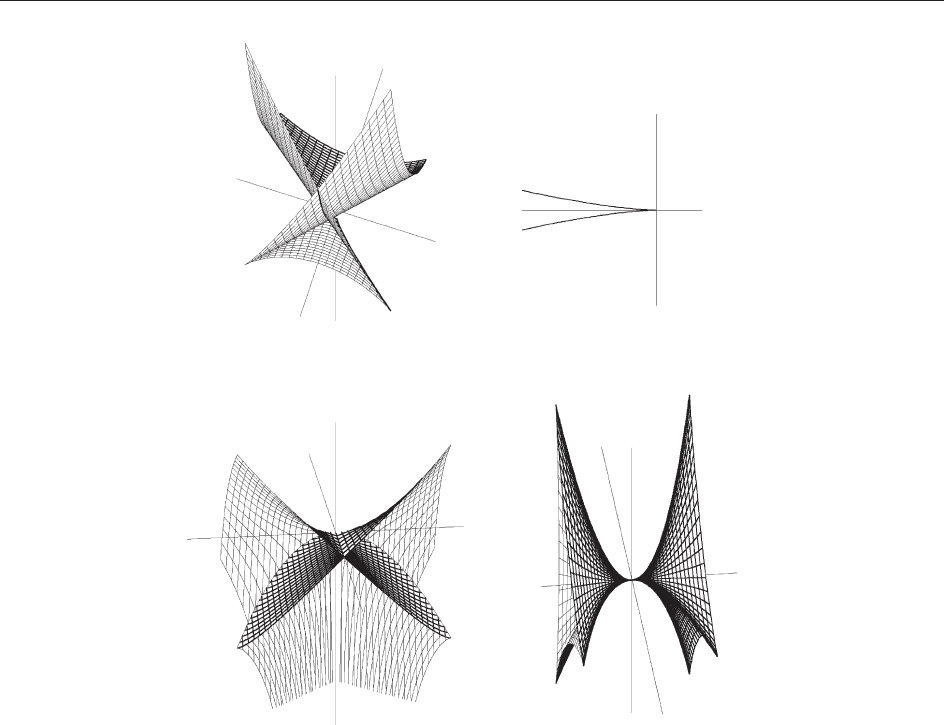
tion). This set is called the catastrophe set (see Figure 1).
Consider now the case of umbilics where there are
two state equations:
@V
@x
¼
@V
@y
¼ 0
The catastrophe set S is determined by one further
equation:
Hess V ¼
@
2
V
@x
2
@
2
V
@y
2
@
2
V
@x@y
2
¼ 0
In both cases of hyperbolic and elliptic umbilics, the set
S is a singular surface. For the last case of the parabolic
umbilic, the set S is of dimension 3 and again it is only
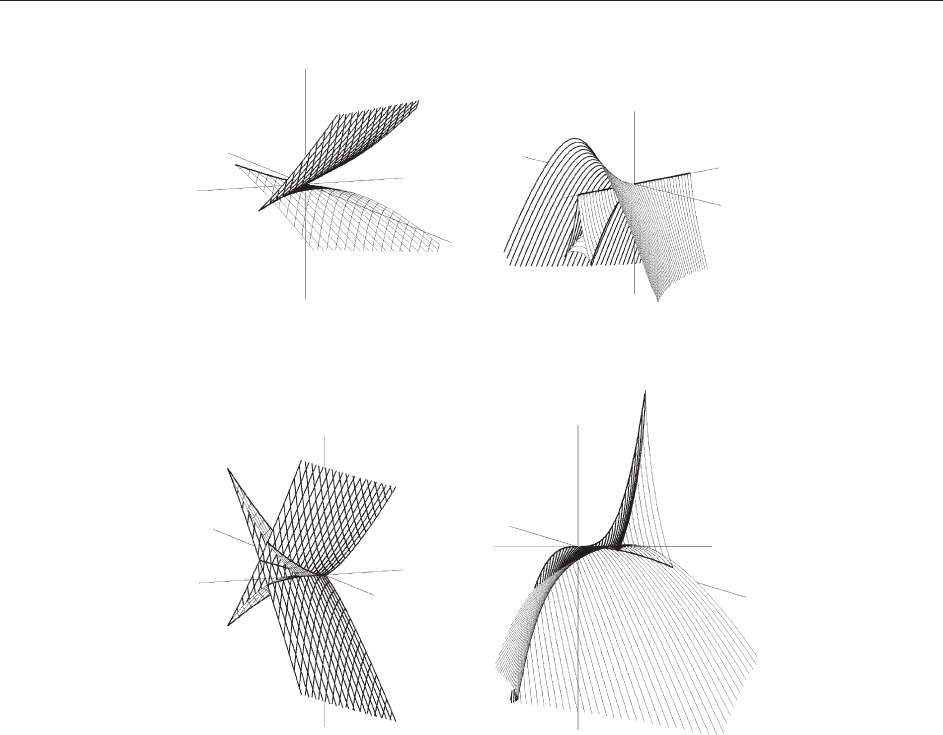
possible to represent it by a family of its sections by a
variable hyperplane (see Figure 2).
All possible deformations (in the space of func-
tions) of a function with an isolated singularity can
be induced by a single -dimensional family of
deformations named the ‘‘universal deformation.’’ In
general, the ‘‘codimension’’ of a bifurcation is the
minimal number of parameters needed to display all
possible phase diagrams of all possible unfoldings.
Several deep mathematical techniques, like the
Malgrange division theorem and preparation theo-
rem, allowed J Mather to prove the theorem (local,
then global) of existence of the universal unfolding.
Singularity and Bifurcation Theory 589
The theory of unfoldings of singularities can be
used, for instance, to provide asymptotic expression
of stationary phase integrals when critical points of
the phase are not of Morse type. This relates to
monodromy, Bernstein polynomials, Miln or fibra-
tion near a singular point, and simultaneous local
models of forms and functions (cf. Malgrange
(1974))andsee Feynman Path Integrals).
Singularity Theory of Vector Fields
Transcritical Bifurcation
The transcritical bifurcation is the standard mechan-
ism for changes in stability. The local model is given by
_
x ¼ rx x
2
For r < 0, there is an unstable fixed point at x
= r
and a stable fixed point at x
= 0. As r increases, the
unstable and the stable fixed points coalesce when
r = 0 and when r > 0, they exchange their stability.
A simplified model of the essential physics of a laser
is due to Haken (1983). It is given by
_
n ¼ GnN kn
were n is the number of photons in the laser field, N is
the number of excited atoms, and the gain term comes
from the process of stimulated emission which occurs
at a rate proportional to the product n.N. Further-
more, the number of excited atoms drops down by the
emission of photons N = N
0
n.Thenweobtain
_
n ¼ðGN
0
kÞn Gn
2
This model displays a transcritical bifurcation, which
explains in elementary terms the laser threshold.
Pitchfork Bifurcation
The local model for sup ercritical pitchfork bifurca-
tion is
_
x ¼ rx x
3
Swallow tail Cusp
Elliptic umbilicHyperbolic umbilic
λ
2
λ
3
λ
3
λ
2
λ
3
λ
1
λ
1
λ
2
λ
2
λ
1
λ
1
Figure 1 Examples of catastrophe sets. Adapted with permission from Franc¸oise J-P (2005) Oscillations en Biologie: Analyse
Qualitative et Mode
`
les (Mathe
´
matiques et Applications, vol. 46). Heidelberg: Springer.
590 Singularity and Bifurcation Theory
When the parameter r < 0, it displays one stable
equilibrium position. As r increases, this equilibrium
bifurcates (for r > 0) into two stable equilibria and
an unstable equilibrium. Its drawing sugges ts ‘‘the
pitchfork.’’ In case of subcritical pitchfork
bifurcation
_
x ¼ rx þ x
3
there is a single stabl e state for r < 0 that bifurcates
into two stable states and one unstable as r > 0.
Normal Forms
Local analysis of vector fields proceeds with local
models called normal forms. A local vector field
near a singular point (zero) is seen as a deri vation of
the local ring of functions which preserves the
unique maximal ideal (of the functions which vanish
at the singular point). It yields a linear operator of
the finite-dimensional vector spaces of truncated
Taylor expansions of functions. This leads to
decomposition of the vector fields into semisimple
and nilpotent parts (at the level of formal series). A
normal form is a formal coordinate system in which
the semisim ple part is linear. If the vector field
preserves a structure (like volume form or symplec-
tic form) the change of coordinates which brings it
to its normal form is also (volume-preserving,
symplectic). The simplicity of the normal form
depends on the number of allowed resonances for
the eigenvalues of the first-order jet of the vector
field at the singular point. The best-known example
is the Birkhoff normal form of Hamiltonian vector
fields that we recall now, but we should also
mention the Sternberg normal form of volume-
preserving vector fields.
Local analysis of a Hamiltonian vector field under
symplectic changes of coordinates is the same as the
local analysis of functions (namely its associated
Hamiltonian). Birkhoff normal form deals with the
Butterfly
(section
λ
1
=
0)
Parabolic umbilic
(section
λ
1
=
0)
Butterfly
(section
λ
2
=
0)
Parabolic umbilic
(section λ
2
=
0)
λ
2
λ
3
λ
3
λ
3
λ
3
λ
4
λ
4
λ
4
λ
4
λ
2
λ
1
λ
1
Figure 2 Sections of catastrophe sets. Adapted with permission from Franc¸oise J-P (2005) Oscillations en Biologie: Analyse
Qualitative et Mode
`
les (Mathe
´
matiques et Applications, vol. 46). Heidelberg: Springer.
Singularity and Bifurcation Theory 591