
Francoise J.-P., Naber G.L., Tsun T.S. (editors) Encyclopedia of Mathematical Physics
Подождите немного. Документ загружается.


According to the proposal of Hartle and Hawking,
one adopts path-integral formalism for the Eucli-
dean action where the functional integral is not only
carried out over the 4-metric, g
, and the scalar
field , but also one takes sum over the class of
manifolds, M. Note that B is a part of the bounda ry
of this set of manifold. If
h
ij
and
are the induced
metric and the configuration of the scalar field, ,
on the boundary, B, then the propagator (henceforth
we just call it the wave function) [
h
ij
,
, B] can be
given a functional-integral representation. Indeed,
obtaining the most general form of the path integral,
summing over the 4-manifolds, is quite a formidable
task. On the other hand, if one chooses a class of
4-manifolds which can be decomposed as a product
(foliation) R B, the wave function is expressed as
½
h;
; B
¼
Z
DN
Z
Dh
ij
D f ðN
Þ
FP
e
S
E
½g
;
½26
We have introduced the gauge-fixing condition
as f (N
), which is usually taken to be
_
N
= l
and
then the corresponding Faddeev–Popov determinant,
FP
, has to be inserted into the path-integral
measure. We recall from our earlier discussions
that N
has to be unrestricted on the boundary, B,
since they have no dynamical role when we express
the action in terms of the variables defined on the
3-surface. As noted in the previous discussion,
explicit time dependence does not appear after the
3 þ 1 split and (h
ij
(x), (x)) ha ve no dependence on
t. Therefore, we introduce a parameter to designate
the paths over which the functional integral is to be
taken. Recall that in the quantum-mechanical case,
the paths are parametrized as q
i
(t) for the coordi-
nates. However, when we resort to a parametriza-
tion of the variables for the case at hand, certain
conditions must be fulfilled. We are permitted to
integrate over h
ij
and over only those paths, while
parametrizing them as (h
ij
(x, ), (x, )), so that they
match the arguments of the wave function on the
boundary B. Therefore, we may define the metric
and the scalar field configuration so that at = 1
they assume their functional values on the boundary:
in other words,
h
ij
(x) = h
ij
(x, = 1) and
(x) = (x, = 1). It is worthwhile to go back to
the quantum-mechanical analogy once more. When
we compute amplitudes/propagators in quantum
mechanics, the functional integral is defined for the
amplitude of going from a configuration q
i
to q
f
while summing over all possible paths originating
from one endpoint q
i
and ending at the final point
q
f
. On this occasion, we have imposed the con-
straint on the final endp oint belonging to the
boundary B. Thus, in order to determine the wave
function of the universe, we are required to specify
the initial configurations of h
ij
and at = 0. We
shall not enter into important issues related with the
properties of the Euclidean action, the problems
associated with the choice of contours of the path
integrals, and related topics. The reader will find
detailed discussions in the lectures and monographs
referre d in the ‘‘Furt her readi ng’’ section.
It is important to re-emphasize that boundary
conditions are to be introduced while solving the
WDW equation. It was argued by De Witt that the
wave function will be determined uniquely from the
mathematical consistency of the theory and that
hope has not been realized. Whether one attempts to
solve the functional differential WDW equation or
obtain the wave function in the path-integral
formalism, the issue of boundary condition is
unavoidable. There are mainly three differe nt kinds
of boundary conditions in quantum cosmology:
Hartle–Hawking (HH) no-boundary proposal,
Vilenkin’s tunneling mechanism, and Linde’s bound-
ary condition. We shall briefly discuss the first two
proposals. Instead of stating the boundary condi-
tions in full generality, we shall envisage quantum
cosmology in a minisuperspace and provide illus-
trative examples to compare the main features of
HH and Vilenkin solutions to the WDW equation.
It is realized that the discussion and solutions of
quantum cosmology in the superspace is rather
difficult, since we deal with functional differential
equations and the configuration space is infinite
dimensional. Therefore, it is worthwhile to consider
a syst em, as a simple model, which has finite degrees
of freedom. Thus, we assume that the metric and
matter fields depend only on cosmic time to begin
with. There is a physical motivation behind this
assumption, since the present classical state of the
universe is described by the Friendmann–Robertson–
Walker (FRW) metric corresponding to an isotropic
and homogeneous universe. Notice that the classical
evolution equation resembles that of the motion of a
particle. The quantum evolution equations are now
given by differential equations of quantum
mechanics rather than functional differential equa-
tions. Similarly, the path-integral formulation
becomes analogous to the quantum-mechanical
frame work. Of course, adopting such a simplified
approach deprives us from describing some of the
important aspects of quantum gravity. However,
within this framework, several essential features can
be exhibited and deep insight might be gained into
the physics of the very early universe. The first step
in getting the minisuperspace metric is to assume
that the lapse is homogeneous, that is, N
?
= N
?
(t)
458 Wheeler–De Witt Theory
and the shift is set to zero, N
i
= 0. Thus, the metric
takes the form
ds
2
¼ðN
?
ðtÞÞ
2
dt
2
þ h
ij
ðx; tÞdx
i
dx
j
½27
The relevant choice of 3-metric for FRW isotropic
and homogeneous universe is
h
ij
ðx; tÞdx
i
dx
j
¼ aðtÞ
2
d
2
3
½28
Note that d
2
3
is the metric on a 3-sphere. It is
straightforward to derive the Friedmann equations
for such a geometry.
The HH no-boundary condition can be inter-
preted as a topological proposition about the set of
path over which we have to sum. The 3-surface B is
to be taken as the only surface of compact
4-manifold M which is endowed with the metric
g
, and
h
ij
and
are the induced metric and the
scalar field on the surface. The wave function is
obtained by using the matching condition supple-
mented with initial condition. For the minisuper-
space case, initial conditions impose constraints on
the scale factor a( = 0) and (da=d)( = o), and N
?
is to be gauge fixed. These conditions are to be
implemented in the context of determining the wave
function of the universe. In the case of the tunneling
boundary condition of Vilenkin, the qualitative
scenario is as follows. If we look at the solution
to the WDW equation (in the path-integral
approach, Vilenkin considers Lorentzian action),
the solution, crudely speaking, has both ingoing
and outgoing modes at the boundary. In his
proposal, the outgoing mode at the boundary is to
be accepted. The exact prescription is lot more
subtle than the above statement, since one has to
define the meaning of outgoing mode carefully in
the absence of a timelike Killing vector when we
write the WDW equation on the superspace. The
qualitative picture for Vilenkin’s boundary condi-
tion, in the minisuperspace, is like tunneling solu-
tions in quantum mechanics when a particle
penetrates through a potential barrier.
Let us consider a minisuperspace model with the
scalar field and potential V(). The action is
S ¼
1
2
Z
dta
3
1
N
?
_
a
a
2
þ
ð
_
Þ
2
N
?
"
N
?
VðÞþ
N
?
a
2
#
½29
A few comments are in order here. For the FRW
metric, we have
ffiffiffi
g
p
R = 6(a
_
a þ ka)þ a total
derivative term; the total derivative term can be
removed by adding a boundary term and k is
positive since we take the spatial part to be closed.
We have redefined the scale factor, the scalar
field, the potential term, and k such that the
Einstein–Hilbert action with matter field assumes
the form of [29] and this action facilitates the
definition of conjugate momenta without cumber-
some numerical factors, and the Hamiltonia n takes
a simple form. The conjugate momenta and result-
ing Hamiltonian are
a
¼
a
_
a
N
?
;
¼
a
3
_
N
?
½30
H
c
¼
N
?
2
2
a
a
þ
2
a
3
þ a
3
VðÞa
"#
¼ N
?
H ½31
and the constraint is H = 0. In the quantum
cosmology context, we solve the WDW equation:
H=0. Since the exact solution is not possible, one
resorts to some approximation with simple assump-
tions. The differential equation is
@
2
@a
2
1
a
2
@
2
@
2
þ a
4
VðÞa
2
¼ 0 ½32
Let us consider the case when V() does not grow
very fast, that is, V()=V()
0
<< 1 and consider the
solution to the WDW equation where has weak
dependence on . Consequently, we may ignore the
derivative term in [32]. The purpose of these
assumptions is to reduce the problem to a one-
dimensional quantum mechanics problem and then
employ WKB method. It is hoped that at least some
of the nonperturbative aspects can still be captured.
When the effective potential appearing in [32] is
negative (this is a classically inaccessible region), the
wave function is
ða;Þe
ð1=3VðÞÞð1 a
2
VðÞÞ
3=2
½33
We expect the wave function have oscillatory
behavior in the classically allowed domain and it
does have that property,
ða;Þe
ði=3VðÞÞða
2
VðÞ1Þ
3=2
½34
The choice of signs is decided from the boundary
conditions imposed and the usual matching of
the wave functions of the two regions is done as is
the case with the WKB approximation. Note that we
are considering the metric and the scalar field on
Wheeler–De Witt Theory 459

the boundary which were denoted by
h
ij
and
;
strictly speaking, we should denote the solutions
as
a and
. But from now on, we drop this bar on
a and .
Let us momentarily assume that V is -indepen-
dent and therefore, we have an effective cosmologi-
cal constant. The problem is identical to the motion
of a particle in a potential well. There are two
turning points. In one region, the particle starts from
a = 0, reaches one turning point r
1
and returns back.
In another case, it starts from a = 1, travels up to
a = r
2
and reflects back. In the quantum-mechanical
case, the particle can tunnel through the barrier. The
wave function has both decaying and growing
modes under the barrier, and boundary conditions
tell us which mode to choose. One possibility is that
the particle starts from a = 0, tunnels through and
proceeds towards a = 1, that is, it has outgoing
mode. The other possibility is that the wave function
has both outgoing and ingoing modes. In this simple
scenario, the former corresponds to Vilenkin’s
tunneling boundary condition, where the universe
is created at a = 0 and it keeps growing. The latter is
HH no-bou ndary proposal where the wave function
has both modes and the universe contracts and
expands.
Now we discuss the two boundary conditions in
the presence of the potential, with the approxima-
tions mentioned above. The proposition of Vilenkin
amounts to the following conditions on the wave
function: the region of the boundary which is
nonsingular is finite and a = 0. Other than this
domain, either a or diverge on any other region of
the boundary; both can diverge in this singular
boundary. Notice from the expression for [33] and
[34] that the tunneling region corresponds to
a
2
V() < 1, whereas, the oscillatory domain is
a
2
V() > 1. If we use the saddle-point approxima-
tion, e
iS
cl
. Vilenkin’s boundary condition cor-
responds to e
iS
cl
, with
S
cl
¼
ð
ffiffiffiffiffiffiffiffiffiffiffiffiffiffiffiffiffiffiffiffiffiffiffiffi
a
2
VðÞ1
p
Þ
3
3VðÞ
So far, we considered the situation where differential
operator for is dropped in [32]. In order to
account for weak -dependence, we could introduce
it by multiplying a slowly varying function, say F()
and write (a, ) F()e
iS
cl
. Similarly, the wave
function can be obtained under the barrier and
required to satisfy WKB matching conditions.
Furthermore, the regularity condition on the wave
function in small scale factor limit and behavior of
its derivative with respect to in that limit
determine the form of F(). In summary, the
Vilenkin boundary conditions yield the following
wave functions:
ða;Þ
V
e
ð1=3VðÞÞð1½1a
2
VðÞ
3=2
Þ
½35
ða;Þ
V
e
1=3VðÞ
e
ði=3VðÞÞ½a
2
VðÞ1
3=2
½36
Note that [35] is the wave function under the barrier,
that is, a
2
V() < 1 in this region, whereas [36] is in
the classically accessible domain (a
2
V() > 1) which
is reflected by the oscillatory character. The slowly
varying function F() e
1=3V()
appears as the
common factor for the wave functions in the two
domains.
The HH no-boundary proposal to derive the wave
function of the universe was formulated in the
Euclidean path-integral formalism. A considerable
amount of attention has been focuse d in this area.
We shall present the HH wave funct ion providing
only a sketc hy argument. In the Euclidean descrip-
tion, 4-metric is ds
2
= (N
?
)
2
d
2
þ a
2
()d
2
3
. The
4-geometry should close in a regular way. If we
make the boundi ng 3-space smaller and smaller, it
can be closed with flat space. We can infer about the
behavior of the scale factor in the limit !0 from
this consideration. Furthermore, in the semiclassical
approximation (a, ) e
S
E
; we have replaced
(
a,
)by(a, ) as remarked earlier. Thus, our aim
is to evaluate S
E
at the saddle point. This is achieved
by writing down the (Euclidean version) field
equations for a and and the Hamiltonian
constraint, and then solve for a(), (), and N
?
().
Eventually, we want to eliminate N
?
and then
obtain S
E
. After all, the path integral is dominated
by the classical trajectory, a(), and one does not fix
the gau ge for N
?
while solving for a. In fact, the
lapse gets eliminated by utilizing the Hamiltonian
constraint which involve -derivatives of both a and
. We mention, without going into details, that the
classical action is not unique. One of the ways to
visualize it is to note that the solutions obtained for
the lapse from the Hamiltonian constraint have sign
ambiguities.
The classical action is
S
E
¼
1
3VðÞ
1 ½1 a
2
VðÞ
3=2
½37
Note that the two solutions correspond to 3-sphere
boundary being closed off by sections of 4-sphere.
Moreover, the Euclidean action is negative. Hartle
and Hawking argue that the negative sign in [37]
gives the correct answer since the wave function
peaks for that choice. However, there is no unanimity
460 Wheeler–De Witt Theory

for HH argument and some authors have put
forward a point of view that additional inputs are
necessary to arrive at the HH conclusion about
choosing the negative sign for S
E
in [37]. We refer the
reader to the reviews of Hartle and Halliwell for
detailed discussions on the choice of contours for
path integrals, subtleties involved in getting various
solutions for the lapse and their interpretations. We
give below the wave function under the barrier (with
choice of negative sign in [37]):
HH
ða;Þe
ð1=3vðÞÞð1½1a
2
VðÞ
3=2
Þ
½38
HH
ða;Þe
1=3VðÞ
cos
1
3VðÞ
½a
2
VðÞ1
3=2
4
½39
Remarks The wave function in [38] is obtained in
the classically inaccessible region under the condition
a
2
V() < 1, and wave function [39] corresponds to
the case a
2
V() > 1, where the particle motion is
permissible classically. Note the factor e
1=3V()
in the
wave functions in both the regions and compare that
with the Vilenkin’s wave function which has the
opposite sign. We may conclude where the wave
function will peak for each of the two boundary
conditions. Whereas Vilenkin’s proposal implies that
V
(a, ) peaks when V() takes large values, HH no-
boundary condition tells us that it peaks when
V() !0. Furthermore, we note that
V
is complex
and
HH
is real in the oscillatory region. Although
the debates on the merits and demerits of each of the
boundary proposals are going on for more than two
decades, the issue is far from being settled. In the
absence of any experimental tests, there is no way to
favor one boundary proposal over another. Then,
boundary conditions do have predictions about the
evolution of the universe after the quantum era and
have predictions in that (classical) regime. Therefore,
determination of the wave function with specific
boundary conditions does have some connections
with the laws that govern the evolution of our
universe in the present epoch.
It is worthwhile to dwell on the WDW equation
from the perspectives of string theories. Indeed, there
have been important developments to understand the
dynamics of the universe in the string-theoretic
framework. It is important to note the key role
played by dilaton in string theory: (1) it is one of the
massless states of the theory, and (2) the vacuum
expectation value (VEV) of this field determines the
coupling constants we hope to use in describing
fundamental interactions. Therefore, the graviton is
always accompanied by the dilaton in any string-
theoretic approach to study the universe. The duality
symmetries are recognized to provide deep under-
standing of the string dynamics. Therefore, the
investigations of quantum gravity phenomena from
the string-theory viewpoint are necessarily influenced
by above mentioned facts. Indeed, classical cosmolo-
gical solutions, derived from string effective action,
have several interesting characteristics. We mention is
passing that the WDW equation has played an
important role to study quantum evolution equations
in string cosmology. The choice of operator-ordering
prescription in defining the WDW Laplace–Beltrami
operator can be resolved by appealing to the duality
symmetries. Furthermore, the boundary conditions
imposed on the wave function are dictated by string
symmetries and therefore, the resulting wave function
has very interesting properties. The string theory has
addressed some of the most important problems in
quantum gravity and it has provided resolutions to
several key issues. It is expected that string theory
will provide answers to challenging questions in
quantum cosmology. In summary, we have conveyed
some of the salient aspects of the WDW equation.
The canonical quantization technique is adopted to
study quantum gravity in this approach. We have
illustrated the crucial role of the constraint formalism
due to Dirac and argued that some of the nonpertur-
bative aspects of quantum gravity could be retained.
In a short article of this nature, it is not possible to
provide detailed discussion about the general deriva-
tion of the WDW equation and discuss the role of
boundary conditions more exhaustively. Instead, we
presented some of the key steps in the derivation of
the WDW equation adopting the canonical formalism
and provided simple examples. The subject is still an
active area of research. The interested reader may
benefit from the bibliography.
See also: Canonical General Relativity; Loop Quantum
Gravity; Quantum Cosmology; Quantum Dynamics in
Loop Quantum Gravity; Quantum Geometry and its
Applications; Superstring Theories.
Further Reading
De Witt BS (1967) Quantum theory of gravity. Physical Review
160: 1113.
Feynman RP, Morinigo FB, and Wagner WG (1995) Feynman
Lectures on Gravity. New York: Addison-Wesley.
Halliwell JJ (1990) Quantum cosmology. In: Randjbar-Daemi S,
Sezgin E, and Shafi Q (eds.) Summer School in High Energy
Physics and Cosmology, p. 513. Singapore: World Scientific.
Hartle JB (1989) Introductory lectures on quantum cosmology. In:
Coleman S, Hartle JB, Piran T, and Weinberg S (eds.) Quantum
Cosmology and Baby Universes, Proceedings of 7th Winter
School in Theoretical Physics, p. 159. Jerusalem: World Scientific.
Wheeler–De Witt Theory 461

Hartle JB and Hawking SW (1983) Wave function of the
universe. Physical Review D 28: 2960.
Hawking SW (1983) Quantum cosmology. Les Houches Lectures
on Quantum Cosmology, p. 333. (Les Houches Publication) in
Einstein Centenary Volume.
Vilenkin A (1984) Quantum creation of universe. Physical Review
D 30: 509.
Wheeler JA (1963) Geometrodynamics. In: De Witt C and De
Witt BS (eds.) Relativity, Groups and Topology. New York:
Gordon and Breach.
Wightman Axioms see Axiomatic Quantum Field Theory
Wulff Droplets
S Shlosman, Universite
´
de Marseille, Marseille,
France
ª 2006 Elsevier Ltd. All rights reserved.
Introduction
Historically, the first question where the Wulff shapes
have ap peared is the one of the formation of a droplet
or a crystal of one substance inside another. The
natural problem here is: what shape such a formation
would take? The statement that such a shape should
be defined by the minimum of the overall surface
energy subject to the volume constraint is physically
very natural. In the isotropic case, when the surface
tension does not depend on the orientation of the
surface, and so is just a positive number, the shape in
question should be of course spherical (provided we
neglect the gravitational effects). In a more general
situation the shape in question is less symmetric. The
corresponding variational problem is called the Wulff
problem. Wulff (1901) formulated it in his paper,
where he also presented a geometric solution to it,
called the ‘‘Wulff construction.’’
The Wulff variational problem is formulated as
follows. Let (n), n 2 S
d1
, be some continuous
function on the unit sphere S
d1
R
d
. We suppose
that >0, and that is even: (n) = (n). The value
(n) plays the role of the surface tension between two
phases separated by the hyp erplane orthogonal to the
vector n. For every closed compact (hyper)surface
M
d1
R
d
, we define its surface energy as
W
MðÞ¼
Z
M
n
s
ðÞds
where n
s
is the normal vector to M at s 2 M. The
functional W
(M) has the meaning of the surface
energy of the M-shaped droplet made from one of
these two phases. It is called the Wulff functional.
Let W
be the surface which minimizes W
() over
all the surfaces enclosing the unit volume. Such a
minimizer does exist and is unique up to translat ion.
It is called the Wulff shape.
The following is the geometric construction of
W
. Consider the set
K
¼ x 2 R
d
: 8n 2 S
d1
x; nðÞ nðÞ
no
If we define the half-spaces
L
;n
¼ x 2 R
d
: x; nðÞ nðÞ
no
then
K
¼\
n
L
;n
½1
In particular, K
is convex. It turns out that
W
¼
@ K
ðÞ
where the dilatation factor
is defined by the
normalization: vol(
K
) = 1. The relation [1] is
called the Wulff construction. For the future use,
we introduce the notation w
for the value of the
surface energy of the Wulff shape:
w
¼W
W
ðÞ
The Wulff construction was considered by the
rigorous statistical mechanics as just a phenomeno-
logical statement, though the notion of the surface
tension was among its central notions. The situation
changed after the appearance of the book by
Dobrushin et al. (1992). There it was shown that
in the setting of the canonical ensemble formalism,
in the regime of the first-order phase transition, the
(random) shape occupied by one of the phases has
asymptotically (in the thermodynamic limit) a
nonrandom shape, given precisely by the Wulff
construction! In other words, a typical macroscopic
random droplet looks very close to the Wulff shape.
In what follows we will explain the above result.
Another important application of the concepts
introduced above – the role played by the Wulff
462 Wulff Droplets

shapes in the theory of metastability – is also
described (see Metastable States).
Crystals in the Ising Model
Ising spins
x
take values 1, with x 2 Z
d
. We will
wrap Z
d
into a torus T
d
N
by taking a factor lattice:
T
d
N
= Z
d
=NZ
d
. Ising-model grand canonical Gibbs
state in T
d
N
is the probability measure
N
:
N
ðÞ¼Z
1
N ;
expðH
N
ðÞÞ
Here H
N
() =
P
x, y n.n., x , y 2T
d
N
x
y
, >0 is the
inverse temperature, and Z
N,
is the normalization
factor. Ising-model canonical Gibbs state in T
d
N
is the probability measure
,
N
, obtained from
N
by
taking its conditional distribution:
;
N
ðÞ¼
N
j
X
x2T
d
N
x
¼ N
d
!
;
jj
< 1
(Here we make a slight abuse of notation. More
precisely, since
x
= 1, one has to consider
the conditioning
P
x
=
N
N
d
, where
N
! as
N !1, while the numbers (1
N
)N
d
are even
integers; otherwise the condit ion is empty.) We will
characterize the canonical state
,
N
by describing the
properties of contours, {
i
()}, of configuration .
Contours
i
of configuration are hypersurfaces
made of elementary (d 1)-dimensional unit cubes of
the dual lattice, which separate the nearest-neighbor
(n.n.) points x, y 2 T
d
N
where
x
6¼
y
.
Suppose that the temperature
1
is low enough,
while the density parameter satisfies the constraints:
m
d
ðÞ>>g
d
Here m
d
() is the spontaneous magnetization of the
d-dimensional Ising model, while g
d
is some geo-
metric factor, the role of which will be explained
later. The above constraint forces some amount of
the ()-phase into the (þ)-phase. It turns out that
this amount gathers into one big droplet, which has
approximately the Wulff shape.
We first formulate the known rigorous results for
the case d = 2, and then indicate some extensions.
Two-Dimensional Case
The following holds with
,
N
-probability approach-
ing 1 as N !1:
The set {
i
()} of contours of has precisely one
‘‘big’’ contour, (); the diameters of other
contours do not exceed K ln N, K = K().
The area Int ()
jj
inside () satisfies
Int ðÞ
jj
N
2
KN
6=5
ln NðÞ
K
where
¼
m
2
ðÞ
jj
2m
2
ðÞ
; K ¼ KðÞ
There is a point x = x() – the ‘‘center’’ of ()–
such that the shift of ()byx() brings the
contour () very close to the scaled Wulff curve,
defined by the Ising-model surface tension :
r
H
ðÞxðÞ;
ffiffiffiffiffiffi
2
w
s
NW
!
KN
2=3
ln NðÞ
K
½2
(Here r
H
is the Hausdorff distance: for every two
sets A, C 2 R
d
, r
H
(A, C) is defined as max{inf[r :
A C þ B
r
], inf[r : C A þ B
r
]}, where B
r
is the
ball of radius r.)
The proof of the above result is the content of
the book by Dobrushin et al. (1992). In the
two-dimensional case, it remains true for all
temperatures
1
below the critical one (Ioffe and
Schonmann 1998). The value 2/3 of the exponent is
an improvement of the original 3/4 result
(Alexander 1992). Probably, it can be further
improved down to 1/2. Though Dobrushin et al.
(1992) treat only the Ising model, their results are
valid for a wide range of other models.
The restriction >g
d
in the theorem is needed
because without it the droplet may prefer to assume
the shape of a strip between two meridians rather
than to take the Wulff shape.
Three-Dimensional Case
In the case d = 3ord 3, the statement that a
typical configuration has only one big contour
() is still true. But the analog of [2] is not known.
It is natural to conjecture that it holds at low
temperatures, even in a stronger version, with only a
logarithmic term K(ln N)
K
in the RHS. It probably
fails at higher subcritical temperatures.
What is known to hold is a weaker version of this
theorem, wher e the distance between random
droplet and the Wulff shape is measured not in
Hausdorf distance, but in L
1
sense. To state the
corresponding theorem, we will associate with every
configuration on a lattice torus T
d
N
a real-valued
function M
(t) on the unit torus T
d
= R
d
=Z
d
,
and we then compare this function with the
indicator function I
sK
, where sK
T
d
is the Wulff
body, properly scaled.
The function M
(t) is defined as follows. We
denote by i
N
the natural embedding of the discrete
torus T
d
N
into T
d
, the image of i
N
being the grid with
spacing 1=N. For t 2 T
d
we define b
N
(t) T
d
to be
Wulff Droplets 463

the ball centered at t with radius
ffiffiffiffiffiffiffiffiffiffi
1=N
d
p
, and let
B
N
(t) (N) be its preimage under i
N
. Then
M
ðrÞ¼
1
B
N
ðtÞ
jj
X
x2B
N
ðtÞ
xðÞ
We have to expect to see a droplet sK
with
s ¼
ffiffiffiffiffiffiffiffiffiffiffiffiffiffiffiffiffiffiffiffiffiffiffiffiffiffiffiffi
d
w
m
d
ðÞ
2m
d
ðÞ
d
s
Let us introduce for every subset A T
d
the
indicator
I
A
ðtÞ¼
1; t 2 A
1; t 2 A
c
For every function v in L
1
(T
d
) we denote by U(v, )
its -neighborhood in L
1
(T
d
).
The result can now be formulated. Suppose the
temperature
1
is below the critical one. Then the
function M
(t) is close to the characteristic function
of the Wulff shape: For every >0
lim
N!1
;
N
1
m
d
ðÞ
M
ðÞ 2
[
t2T
d
U I
sK
þt
;ðÞ
8
<
:
9
=
;
¼ 1
The shifts by all t–s of the Wulff shape sK
appear
in the statement since the location of the drople t can
be arbitrary. Note that if a point t is such that the
ball B
N
(t) stays away from the boundary of the
droplet () present in the configuration , then the
value M
(t) should be expected to be m
d
(),
depending on whether t is outside or inside the
droplet, which explains the factor 1=m
d
().
For a proof, see Bodineau (1999) and Cerf and
Pizstora (1999).
See also: Cluster Expansion; Large Deviations in
Equilibrium Statistical Mechanics; Metastable States;
Percolation Theory; Statistical Mechanics of Interfaces.
Further Reading
Alexander K (1992) Stability of the Wulff minimum and fluctua-
tions in shape for large clusters in two-dimensional percolation.
Probability Theory and Related Fields 91: 507–532.
Bodineau T (1999) The Wulff construction in three and more
dimensions. Communications in Mathematical Physics 207(1):
197–229.
Cerf R and Pizstora A (2000) On the Wulff crystal in the Ising
model. Annals of Probability 28(3): 947–1017.
Dobrushin RL, Kotecky R, and Shlosman SB (1992) Wulff
Construction: A Global Shape from Local Interaction. AMS
Translations Series. Providence, RI: American Mathematical
Society.
Ioffe D and Schonmann R (1998) Dobrushin–Kotecky–Shlosman
theory up to the critical temperature. Communications in
Mathematical Physics 199: 117–167.
Wulff G (1901) Zur frage der geschwindigkeit des wachsturms
under auflosung der kristallchen. Z. Kristallogr.34:
449–530.
464 Wulff Droplets
Y
Yang–Baxter Equations
J H H Perk and H Au-Yang, Oklahoma State
University, Stillwater, OK, USA
ª 2006 Elsevier Ltd. All rights reserved.
Introduction
The term Yang–Baxter equations (YBEs) was coined
by Faddeev in the late 1970s to denote a principle of
integrability, that is, exact solvability, in a wide
variety of fields in physics and mathematics. Since
then it ha s become a common name for several
classes of local equivalence transformations in
statistical mechanics, quantum field theory, differ-
ential equations, knot theory, quantum groups, and
other disciplines. We shall cov er the various versions
and their relationships, paying attention also to the
early historical development.
Electric Networks
The first such transformation came up as early as
1899 when the Bro oklyn engineer Kennelly pub-
lished a short paper, entitled ‘‘The equivalence of
triangles and three-pointed stars in conducti ng net-
works.’’ This work gave the definite answer to such
questions as whether it is better to have the three
coils in a dynamo – or three resistors in a network –
arranged as a star or as a triangle, see Figure 1.
Using Kirchhoff’s laws, the two situations in Figure 1
can be shown to be equivalent provided
Z
1
Z
1
¼ Z
2
Z
2
¼ Z
3
Z
3
¼ Z
1
Z
2
þ Z
2
Z
3
þ Z
3
Z
1
½1
¼
Z
1
Z
2
Z
3
=ðZ
1
þ Z
2
þ Z
3
Þ½2
Here one has to take either [1] or [2] as second line
of the equation, depending on which direction the
transformation is to go. The star–triangle transfor-
mation thus defined is also known under other
names within the electric network theory literature
as wye–delta (Y ), upsilon–delta ( ), or
tau–pi (T ) transformation.
Spin Models
When Onsager wrote his monumental paper on the
Ising model published in 1944, he made a brief
remark on an obvious star–triangle transformation
relating the model on the honeycomb lattice with
the one on the triangular lattice. His details on this
were first presented in Wannier’s review article of
1945. However, the star–triangle transformati on
played a much more crucial role in Onsager’s
reasoning, as it is also intimately connected with
his elliptic function uniformizing parametrization.
Furthermore, it implies the commutation of
transfer matrices and spin-chain Hamiltonians.
Only in his Battelle lecture of 1970 did Onsager
explain how he used this remarkable observation in
his derivation of the formula for the spontaneous
magnetization which he had announced as a
conference remark in 1948 and of which the first
complete derivation had been publi shed by Yang in
1952 using a completely different method.
Many other applications and generalizations have
since appeared. Most generally, we can consider a
system whose state variables – also called spins – take
values from some suitable discrete or continuous sets.
The interactions between spins a and b are given in
termsofweightfactorsW
ab
and W
ab
,whichare
complex numbers in general, see Figure 2.One
quantity of special interest is the partition function –
sum of the product of all weight factors over all
allowed spin values. The integrability of the model is
expressed by the existence of spectral variables –
rapidities p, q, r, ... – that live on oriented lines, two
of which cross between a and b as indicated by the
dotted lines in Figure 2. Arrows from a to b are added
to keep track of the ordering of a and b in case the
weights are chiral (not symmetric).
In Onsager’s special choice of the Ising model the
spins take values a, b, c, ... = 1 and the weight
factors are the usual real positive Boltzmann weights
depending on the product ab = 1, uniformizing
variable p q, and elliptic modulus k. In the integra-
ble chiral Potts model the weights depend on a b
mod N,witha, b = 1, ..., N, whereas the rapidities p
and q are living in general on a higher-genus curve.
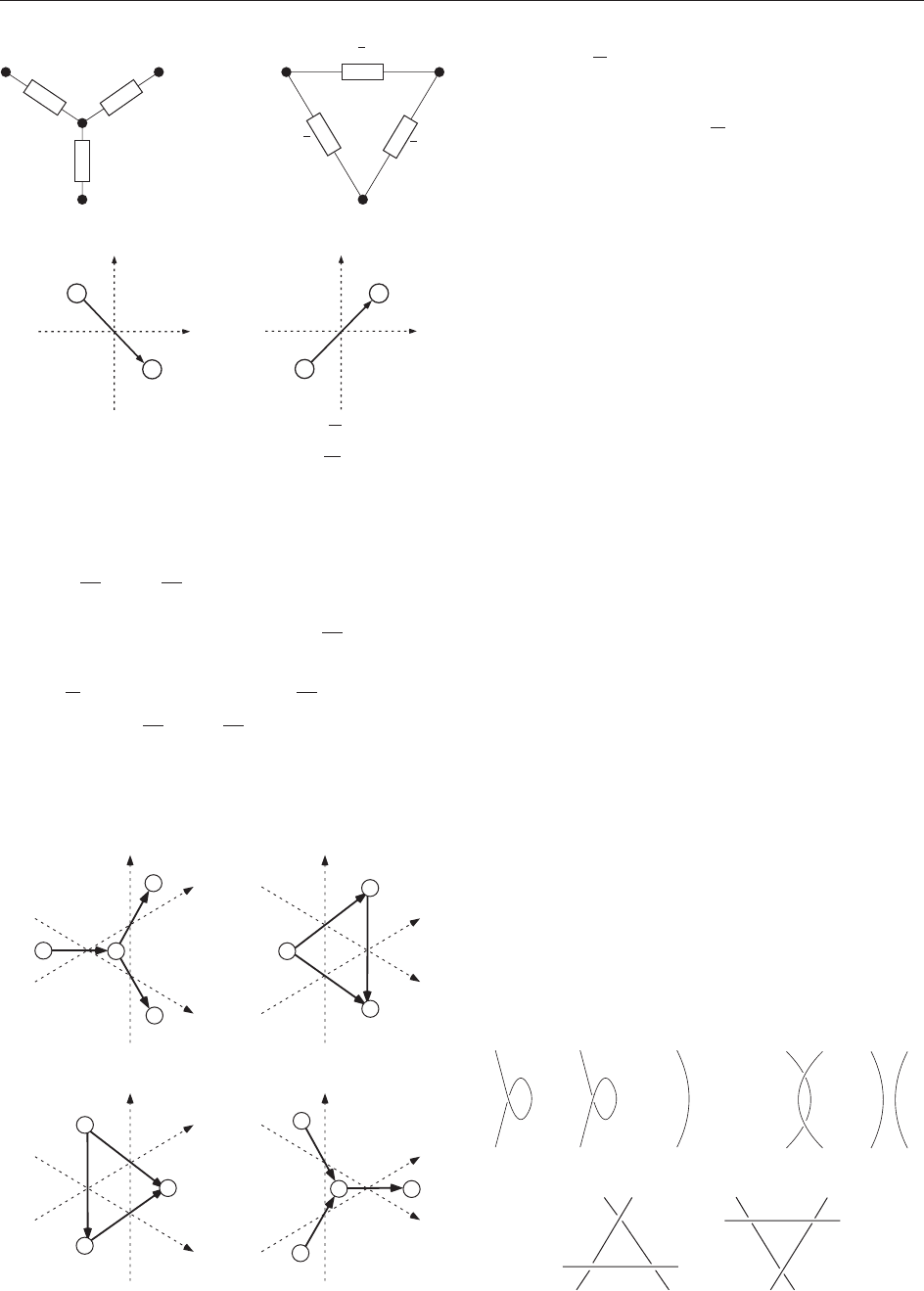
When the weights are asymmetric in the spins, there
are two sets of star–triangle equations which can be
expressed both pictorially (Figure 3) and algebraically:
X
d
W
cd
ðp; qÞW
db
ðq; rÞW
da
ðp; rÞ
¼ Rðp; q; rÞW
ba
ðp; qÞW
ca
ðq; rÞW
cb
ðp; rÞ½3
Rðp; q; rÞW
ab
ðp; qÞW
ac
ðq; rÞW
bc
ðp; rÞ
¼
X
d
W
dc
ðp; qÞW
bd
ðq; rÞW
ad
ðp; rÞ½4
Note that eqns [3] and [4] differ from each other by the
transposition of both spin variables in all six weight
factors. In general, there may also appear scalar factors
R(p, q, r)and
R(p, q, r), which can often be eliminated
by a suitable renormalization of the weights. If a, b,
and c take values in the same set, we can sum over
a = b = c, showing that R =
R in that case.
The Kennelly star–triangle equation [1], [2] can be
recovered as a special limit of a spin model where
the states are continuous variables.
Knot Theory and Braid Group
A seemingly totally different situ ation occurs in the
theory of knots, links, tangles, and braids. In 1926,
Reidemeister showed that only three types of moves
suffice to show the equivalence between two
different configurations, see Figure 4. Moves of
type I – removing simple loops – do not apply to
braids. Moves of type II, for which one strand crosses
twice over another strand, can be reformulated for
braids, namely that an overcrossing is the inverse of
an undercrossing. The Reidemeister move of type III
is a precursor of the more general Yang–Baxter
moves and can be represented also by the defining
relations of Artin’s braid group. Let R
i, iþ1
be the
operator representing the situation in which the
strand in position i crosses over the one in position
i þ 1. Then a braid can be represented by a product
of R
j, jþ1
’s and their inverses, provided
R
i;iþ1
R
iþ1;iþ2
R
i;iþ1
¼ R
iþ1;iþ2
R
i;iþ1
R
iþ1;iþ2
½5
and
½R
i;iþ1
; R
j;jþ1
¼0; if ji jj2 ½6
and similar relations in which R
i, iþ1
and/or R
iþ1, iþ2
are replaced by their inverses.
Factorizable S-Matrices and Bethe Ansatz
In the early 1960s, Lieb and Liniger solved the one-
dimensional Bose gas with delta-function interaction
using the Bethe ansatz. Yang and McGuire then tried
to generalize this result to systems with internal
degrees of freedom and to fermions. This led to the
b
a
p
q
b
a
p
q
W
ab
W
ab
Figure 2 Spin model weights W
ab
(p, q) and W
ab
(p, q):
b
b
d
=
=
c
c
a
a
p
p
q
q
b
d
c
a
p
q
r
r
r
b
c
a
p
q
r
Figure 3 Star–triangle equation.
==
=
=
Figure 4 Reidemeister moves of types I, II, and III.
z
2
z
3
z
1
z
3
z
2
z
1
=
Figure 1 Star–triangle equation for impedances.
466 Yang–Baxter Equations
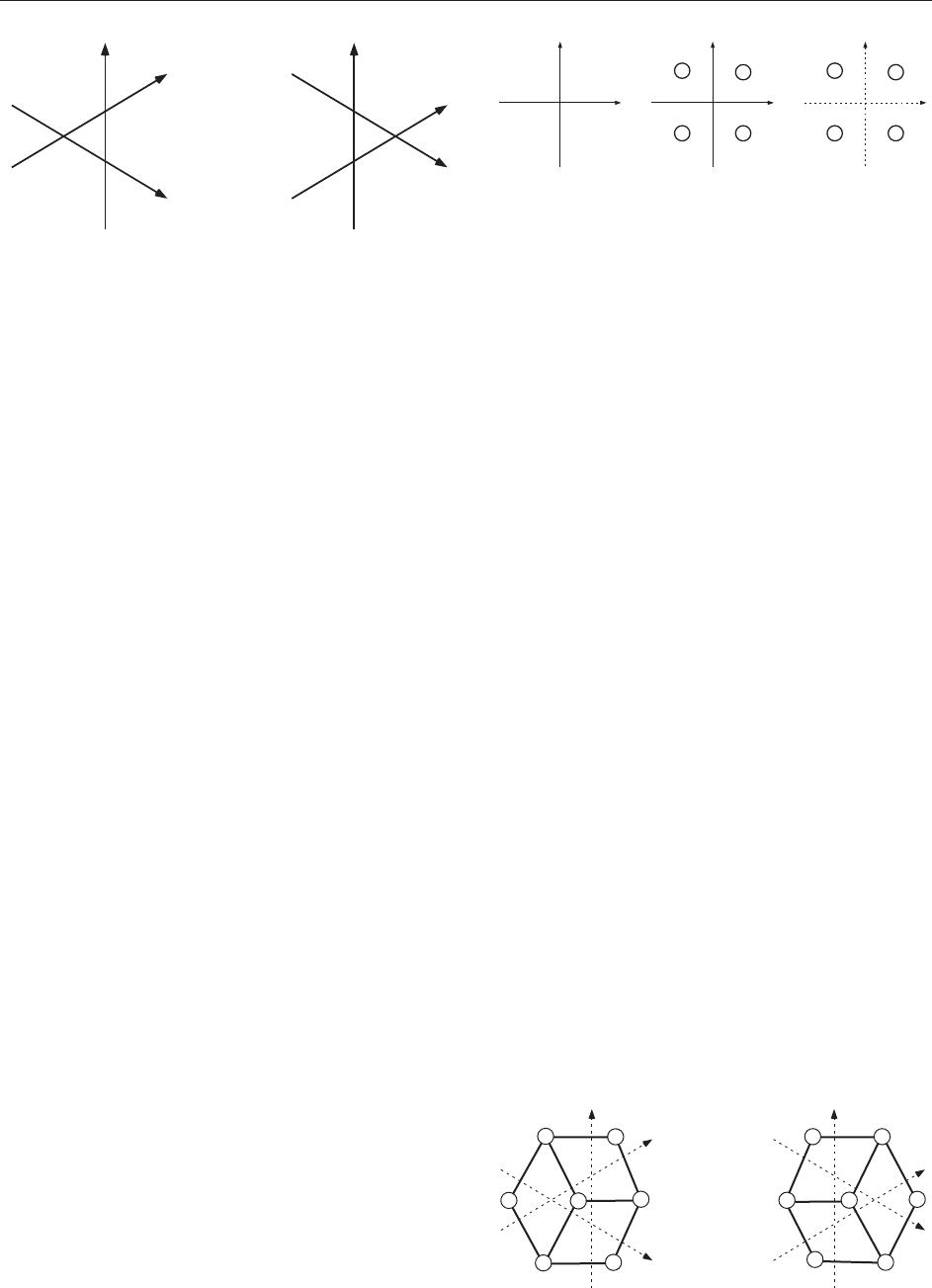
discovery of the condition for factorizable S-matrices
by McGuire in 1964, represented pictorially by
Figure 5, where the world lines of the particles are
given. Upon collisions the particles can only exchange
their rapidities p, q, r, so that there is no dispersion.
Also indicated are the internal degrees of freedom in
Greek letters. In other words, the three-body S-matrix
can be factorized in terms of two-body contributions
and the order of the collisions does not affect the
final outcome. McGuire also realized that this
condition is all one needs for the consistency of
factoring the n-body S-matrix in terms of two-body
S-matrices. The consistency condition is obviously
related to the Reidemeister move of type III in
Figure 4.
Yang su cceeded in solving the spin-1/2 fermionic
model using a nested Bethe ansatz, utilizing a
generalization of Artin’s braid relations [5] and [6],
R
i;iþ1
ðp qÞ
R
iþ1;iþ2
ðp rÞ
R
i;iþ1
ðq rÞ
¼
R
iþ1;iþ2
ðq rÞ
R
i;iþ1
ðp rÞ
R
iþ1;iþ2
ðp qÞ½7
He submitted his findings in two short papers in
1967. The
R operators in eqn [7] – a notation
introduced later by the Leningrad school – depend
on differences of two momenta or two relativistic
rapidities. Sutherland solved the general spin case
using repeated nested Bethe ansa¨ tze, while Lieb and
Wu used Yang’s work to solve the one-dimensional
Hubbard model.
Vertex Models
Since Lieb’s solution of the ice model by a Bethe
ansatz, there have been many developments on
vertex models, in which the state variables live on
line segments and weight factors !
are assigned to
a vertex where four line segments with the four
states , , , on them meet, see Figure 6.
Baxter solved the eight-vertex model in 1971, using
a method based on commuting transfer matrices,
starting from a solution of what he then called the
generalized star–triangle equation, but what is now
commonly called the Yang–Baxter equation (YBE):
X
00
X
00
X
00
!
00
00
ðp; qÞ!
0
0
00
00
ðq; rÞ!
00
0
00
ðp; rÞ
¼
X
00
X
00
X
00
!
0
0
00
00
ðp; qÞ!
00
00
ðq; rÞ!
0
00
00
ðp; rÞ½8
This equation is represented graphically in Figure 5.
From it one can also derive a sufficient condition for
the commutation of transfer matrices and spin-chain
Hamiltonians, generalizing the work of McCoy and
Wu, who had earlier initiated the search by showing
that the general six-vertex model transfer matrix
commutes with a Heisenberg spin-chain Hamilto-
nian. To be more precise, Baxter found that if
!
=
for some choice of p and q, some spin-
chain Hamiltonians could be derived as logarithmic
derivatives of the transfer matrix.
Interaction-Round-a-Face Model
Baxter introduced another language, namely that of the
IRF or ‘ ‘interaction-round-a-face’ ’ model, which he
introduced in connection with his solution of the hard-
hexagon model. This formulation is convenient when
studying one-point functions using the corner-transfer-
matrix method. Now the integrability condition can be
represented graphically as in Figure 7 or algebraically as
X
d
w
a
0
d
cb
0
ðp; qÞw
a
0
b
dc
0
ðq; rÞw
dc
0
b
0
a
ðp; rÞ
¼
X
d
0
w
bc
0
d
0
a
ðp; qÞw
cd
0
b
0
a
ðq; rÞw
a
0
b
cd
0
ðp; rÞ½9
The spins live on faces enclosed by rapidity lines and
the weights w
dc
ab
(p, q) are assigned as in Figure 6.
α′
α″
α
β
β
″
β
′
γ′
γ
γ″
p
q
α″
α
α′
β
β
″
β
′
γ′
γ″
γ
p
q
rr
=
Figure 5 Vertex model YBE.
μμ
α
α
β
β
λ
λ
p
p
p
q
qq
d
c
a
b
d
c
a
b
wW
ω
Figure 6 Vertex model weight !
(p, q), mixed model weight
W
j
dc
ab
(p, q) and IRF model weight w
dc
ab
(p, q).
a′
a
a
a
′
b′
bb
c
′
c
′
d
′
d
b′
c
c
p
p
q
q
r
r
=
Figure 7 IRF model YBE.
Yang–Baxter Equations 467