
Freiling G., Yurko V. Lectures on Differential Equations of Mathematical Physics: A First Course
Подождите немного. Документ загружается.


102 G.
Freiling and V. Yurko
with the
domain of definition D(L
o
) = {y : y ∈ L
2
(I) ∩AC
loc
(I), y
0
∈ AC
loc
(I) , L
o
y ∈
L
2
(I), U(y) = 0}, where I := [0, ∞). It is easy to verify that the spectrum of L
o
coin-
cides with Λ
0
. For the Sturm-Liouville equation there is no difference between working
either with the operator L
o
or with the pair L. However, for generalizations for many other
classes of inverse problems, from methodical point of view it is more natural to consider
the pair L (see, for example, [19] ).
Theorem 2.7.12. L has no eigenvalues λ > 0.
Proof. Suppose that λ
0
= ρ
2
0
> 0 is an eigenvalue, and let y
0
(x) be a correspond-
ing eigenfunction. Since the functions {e(x,ρ
0
),e(x, −ρ
0
)} form a fundamental system
of solutions of (2.7.30), we have y
0
(x) = Ae(x,ρ
0
) + Be(x, −ρ
0
). For x → ∞, y
0
(x) ∼
0, e(x,±ρ
0
) ∼ exp(±iρ
0
x). But this is possible only if A = B = 0. 2
Theorem 2.7.13.If (1 + x)q(x) ∈ L(0,∞), then λ = 0 is not an eigenvalue of L.
Proof. The function e(x) := e(x,0) is a solution of (2.7.30) for λ = 0, and according
to Theorem 2.7.8,
lim
x→∞
e(x) = 1.
Take a > 0 such that
e(x) ≥
1
2
for x ≥ a,
and
consider
the function
z(x) := e(x)
x
a
dt
e
2
(t)
.
It
is
easy to check that
z
00
(x) = q(x)z(x), lim
x→∞
z(x) = +∞,
and
e(x)z
0
(x) −e
0
(x)z(x) ≡ 1.
Suppose that λ = 0 is an eigenvalue, and let y
0
(x) be a corresponding eigenfunction. Since
the functions {e(x),z(x)} form a fundamental system of solutions of (2.7.30) for λ = 0,
we have
y
0
(x) = C
0
1
e(x) +C
0
2
z(x).
It follows from above that this is possible only if C
0
1
= C
0
2
= 0. 2
Remark 2.7.6. Let
q(x) =
2a
2
(1 + ax)
2
, h = −a,
where a is
a
complex number such that a /∈ (−∞,0]. Then q(x) ∈ L(0,∞), but xq(x) /∈
L(0,∞). In this case λ = 0 is an eigenvalue, and by differentiation one verifies that
y(x) =
1
1 + ax
is
the
corresponding eigenfunction.
Theorem 2.7.14. Let λ
0
/∈ [0, ∞). For λ
0
to be an eigenvalue, it is necessary and
sufficient that ∆(ρ
0
) = 0. In other words, the set of nonzero eigenvalues coincides with

Hyperbolic P
artial Differential Equations 103
Λ
0
. For
each eigenvalue λ
0
∈ Λ
0
there exists only one (up to a multiplicative constant)
eigenfunction, namely,
ϕ(x,λ
0
) = β
0
e(x,ρ
0
), β
0
6= 0. (2.7.90)
Proof. Let λ
0
∈ Λ
0
. Then U(e(x, ρ
0
)) = ∆(ρ
0
) = 0 and, by virtue of (2.7.33),
lim
x→∞
e(x,ρ
0
) = 0. Thus, e(x,ρ
0
) is an eigenfunction, and λ
0
= ρ
2
0
is an eigenvalue. More-
over, it follows from (2.7.84) and (2.7.89) that hϕ(x, λ),e(x, ρ)i = ∆(ρ), and consequently
(2.7.90) is valid.
Conversely, let λ
0
= ρ
2
0
, Im ρ
0
> 0 be an eigenvalue, and let y
0
(x) be a correspond-
ing eigenfunction. Clearly, y
0
(0) 6= 0. Without loss of generality we put y
0
(0) = 1.
Then y
0
0
(0) = h, and hence y
0
(x) ≡ ϕ(x,λ
0
). Since the functions E(x, ρ
0
) and e(x,ρ
0
)
form a fundamental system of solutions of equation (2.7.30), we get y
0
(x) = α
0
E(x,ρ
0
) +
β
0
e(x,ρ
0
). As x → ∞, we calculate α
0
= 0, i.e. y
0
(x) = β
0
e(x,ρ
0
). This yields (2.7.90).
Consequently, ∆(ρ
0
) = U(e(x, ρ
0
)) = 0, and ϕ(x,λ
0
) and e(x,ρ
0
) are eigenfunctions. 2
Thus, the spectrum of L consists of the positive half-line {λ : λ ≥0}, and the discrete
set Λ = Λ
0
∪Λ
00
. Each element of Λ
0
is an eigenvalue of L. According to Theorem 2.7.12,
the points of Λ
00
are not eigenvalues of L, they are called spectral singularities of L.
Example 2.7.2. Let q(x) ≡ 0, h = iθ, where θ is a real number. Then ∆(ρ) = iρ −h,
and Λ
0
=
/
0, Λ
00
= {θ}, i.e. L has no eigenvalues, and the point ρ
0
= θ is a spectral
singularity for L.
It follows from (2.7.34), (2.7.82), (2.7.84) and (2.7.87) that for |ρ| → ∞, ρ ∈Ω,
M(λ) =
1
iρ
µ
1 +
m
1
iρ
+ o
µ
1
ρ
¶¶
, (2.7.91)
Φ
(ν)
(x,λ)
=
(iρ)
ν−1
exp(iρx)
µ
1 +
B(x)
iρ
+ o
µ
1
ρ
¶¶
, (2.7.92)
uniformly
for x ≥0;
here
m
1
= h, B(x) = h +
1
2
x
0
q(s)d
s
.
Taking (2.7.83) into account one can derive more precisely
M(λ) =
1
iρ
µ
1 +
m
1
iρ
+
1
iρ
∞
0
q(t) e
xp(2
iρt)dt + O
µ
1
ρ
2
¶¶
, (2.7.93)
|ρ|
→ ∞
, ρ ∈Ω.
Moreover, if q(x) ∈W
N
, then by virtue of (2.7.50) we get
M(λ) =
1
iρ
Ã
1 +
N+1
∑
s=1
m
s
(iρ)
s
+ o
µ
1
ρ
N+1

!
, |ρ|
→ ∞, ρ ∈ Ω, (
2.7.94)
where m
1
= h, m
2
= −
1
2
q(0)
+ h
2
.

104 G.
Freiling and V. Yurko
Denote
V (λ) =
1
2πi
¡
M
−
(λ) −M
+
(λ)
¢
, λ > 0, (2.7.95)
where
M
±
(λ)
= lim
z
→0,Re z>0
M(λ ±iz).
It follows from (2.7.91) and (2.7.95) that for ρ > 0, ρ → +∞,
V (λ) =
1
2πi
³
−
1
iρ
³
1 −
m
1
iρ
+ o
³
1
ρ
´´
−
1
iρ
³
1 +
m
1
iρ
+ o
³
1
ρ
´´´
,
and
consequently
V (λ
) =
1
πρ
µ
1 + o
µ
1
ρ
¶¶
, ρ > 0, ρ →+∞. (2.7.96)
In
vie
w of (2.7.93), we calculate more precisely
V (λ) =
1
πρ
µ
1 +
1
ρ
∞
0
q(t) sin
2ρt
dt + O
µ
1
ρ
2
¶¶
, ρ > 0, ρ →+∞. (2.7.97)
Moreo
v
er, if q(x) ∈W
N+1
, then (2.7.94) implies
V (λ) =
1
πρ
Ã
1 +
N+1
∑
s=1
V
s
ρ
s
+ o
µ
1
ρ
N+1

!
, ρ > 0, ρ →+∞, (2.7.98)
where V
2s
=
(−1
)
s
m
2s
, V
2s+1
= 0.
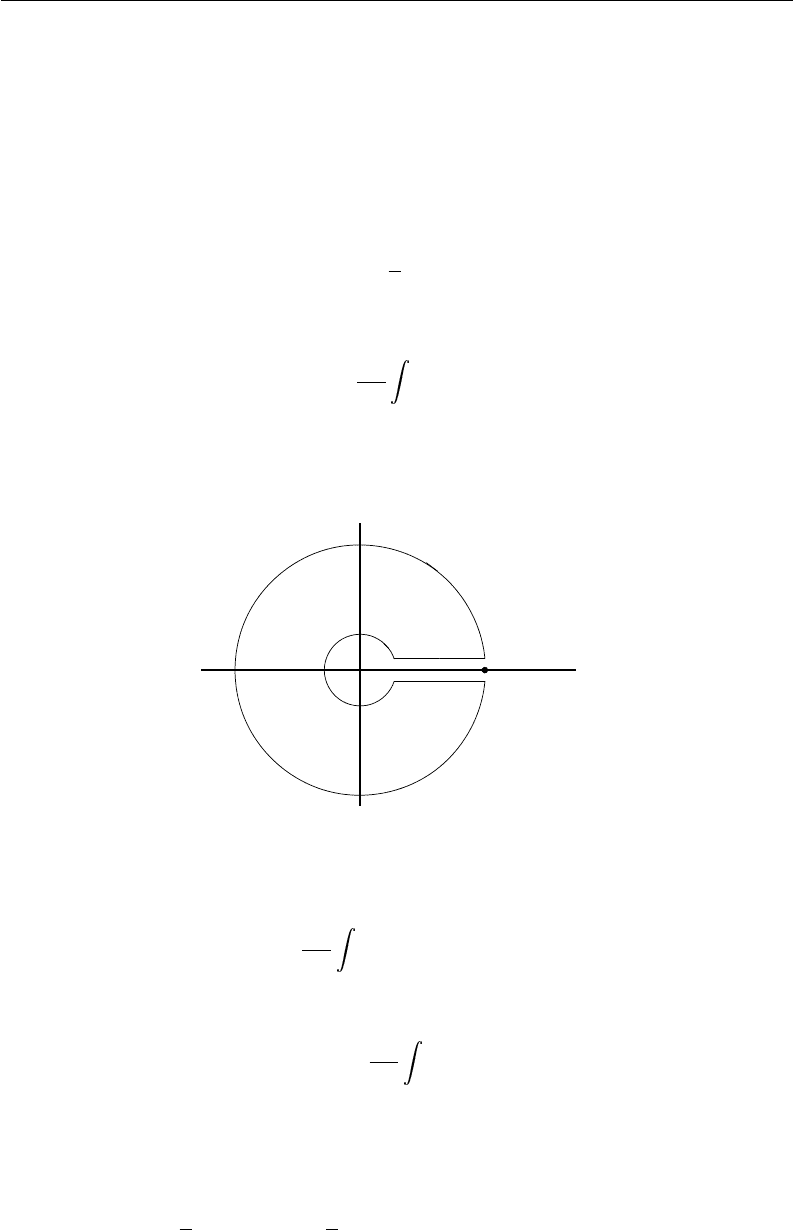
An expansion theorem. In the λ - plane we consider the contour γ = γ
0
∪γ
00
(with
counterclockwise circuit), where γ
0
is a bounded closed contour encircling the set Λ∪{0},
and γ
00
is the two-sided cut along the arc {λ : λ > 0, λ /∈ int γ
0
}.
6
-
¾
-
]
γ
0
γ
00
γ
Figure
2.7.1.

Hyperbolic P
artial Differential Equations 105
Theorem
2.7.15. Let f (x) ∈W
2
. Then, uniformly for x ≥0,
f (x) =
1
2πi
γ
ϕ(x,λ)F(λ)M(λ)dλ, (2.7.99)
where
F(λ) :=
∞
0
ϕ(t, λ) f (t)d
t.
Pr
oof. We will use the contour integral method. For this purpose we consider the
function
Y (x,λ) = Φ(x,λ)
x
0
ϕ(t, λ) f (t)dt + ϕ(x,λ)
∞
x
Φ(t, λ) f (t)dt. (2.7.100)
Since the functions ϕ(x,λ) and Φ(x,λ) satisfy (2.7.30) we transform Y (x, λ) as follows
Y (x,λ) =
1
λ
Φ(x,λ)
x
0
(−ϕ
00
(t, λ)
+ q
(t)ϕ(t,λ)) f (t)dt
+
1
λ
ϕ(x,λ)
∞
x
(−Φ
00
(t, λ)
+ q
(t)Φ(t,λ)) f (t)dt.
Two-fold integration by parts of terms with second derivatives yields in view of (2.7.89)
Y (x,λ) =
1
λ
³
f (x)
+ Z(x,λ
)
´
, (2.7.101)
where
Z(x,λ) = ( f
0
(0) −h f (0))Φ(x,λ) + Φ(x,λ)
x
0
ϕ(t, λ)` f (t)dt
+ϕ(x,λ)
∞
x
Φ(t,λ)` f (t)dt. (2.7.102)
Similarly,
F(λ) = −
1
λ
³
f
0
(0) −h
f (0
)
´
+
1
λ
∞
0
ϕ(t, λ)` f (t)d
t, λ > 0
. (2.7.103)
The function ϕ(x,λ) satisfies the integral equation (2.2.47). Denote
µ
T
(λ) = max
0≤x≤T
(|ϕ(x,λ)|exp(−|τ|x)), τ := Imρ.
Then (2.2.47) gives for |ρ| ≥ 1, x ∈[0,T ],
|ϕ(x,λ)|exp(−|τ|x) ≤C +
µ
T
(λ)
|ρ|
T
0
|q(t)|d
t,
and
consequently
µ
T
(λ) ≤C +
µ
T
(λ)
|ρ|
T
0
|q(t)|d
t ≤C +
µ
T
(λ
)
|ρ|
∞
0
|q(t)|d
t.
106 G.
Freiling and V. Yurko
From this
we get |µ
T
(λ)| ≤ C for |ρ| ≥ ρ
∗
. Together with (2.2.48) this yields for ν =
0,1, |ρ|≥ ρ
∗
,
|ϕ
(ν)
(x,λ)| ≤C|ρ|
ν
exp(|τ|x), (2.7.104)
uniformly for x ≥0. Furthermore, it follows from (2.7.92) that for ν = 0,1 , |ρ| ≥ ρ
∗
,
|Φ
(ν)
(x,λ)| ≤C|ρ|
ν−1
exp(−|τ|x), (2.7.105)
uniformly for x ≥0. By virtue of (2.7.102), (2.7.104) and (2.7.105) we get
Z(x,λ) = O
³
1
ρ
´
, |λ|
→ ∞,
uniformly
for x ≥0. Hence, (2.7.101) implies
lim
R→∞
sup
x≥0
¯
¯
¯
¯
f (x) −
1
2πi
|λ|=R
Y (x,λ) dλ
¯
¯
¯
¯
= 0, (2.7.106)
where
the
contour in the integral is used with counterclockwise circuit. Consider the contour
γ
0
R
= (γ ∩{λ : |λ| ≤ R}) ∪{λ : |λ| = R} (with clockwise circuit).
6
-
¾
-
I
~
R
γ
0
R
Figure
2.7.2.
By
Cauchy‘s theorem [14, p.85]
1
2πi
γ
0
R
Y (x,λ)dλ = 0.
T
aking
(2.7.106) into account we obtain
lim
R→∞
sup
x≥0
¯
¯
¯
¯
f (x) −
1
2πi
γ
R
Y (x,λ) dλ
¯
¯
¯
¯
= 0,
where γ
R
= γ ∩
{
λ : |λ| ≤ R} (with counterclockwise circuit). From this, using (2.7.100)
and (2.7.88), we arrive at (2.7.99), since the terms with S(x, λ) vanish by Cauchy‘s theo-
rem. We note that according to (2.7.97), (2.7.103) and (2.7.104),
F(λ) = O
³
1
λ
´
, M(λ)
= O
³
1
ρ
´
, ϕ(x,λ)
= O(
1), x ≥0, λ > 0, λ → ∞,

Hyperbolic P
artial Differential Equations 107
and consequently
the integral in (2.7.99) converges absolutely and uniformly for x ≥ 0.
Theorem 2.7.15 is proved. 2
Remark 2.7.7. If q(x) and h are real, and (1 + x)q(x) ∈ L(0,∞), then (see [27, Sec.
2.3]) Λ
00
=
/
0, Λ
0
⊂(−∞, 0) is a finite set of simple eigenvalues, V (λ) > 0 for λ > 0 ( V (λ)
is defined by (2.7.95)), and M(λ) = O(ρ
−1
) as ρ →0. Then (2.7.99) takes the form
f (x) =
∞
0
ϕ(x,λ)F(λ)V (λ)dλ +
∑
λ
j
∈Λ
0
ϕ(x,λ
j
)F(λ
j
)Q
j,
Q
j
:= Res
λ=λ
j
M(λ).
or
f (x) =
∞
−∞
ϕ(x,λ)F(λ)dσ(λ),
where σ(λ) is the spectral function of L (see [19]). For λ < 0, σ(λ) is a step-function;
for λ > 0, σ(λ) is an absolutely continuous function, and σ
0
(λ) = V (λ).
Remark 2.7.8. It follows from the proof that Theorem 2.7.15 remains valid also for
f (x) ∈W
1
.
4. Recovery of the differential equation from the Weyl function
In this subsection we study the inverse problem of recovering the pair L = L(q(x),h)
of the form (2.7.30)-(2.7.31) from the given Weyl function M(λ). For this purpose we will
use the method of spectral mappings (see [17], [18]). First, let us prove the uniqueness
theorem for the solution of the inverse problem.
Theorem 2.7.16. If M(λ) =
˜
M(λ), then L =
˜
L. Thus, the specification of the Weyl
function uniquely determines q(x) and h .
Proof. Let us define the matrix P(x, λ) = [P
jk
(x,λ)]
j,k=1,2
by the formula
P(x,λ)
·
˜
ϕ(x,λ)
˜
Φ(x,λ)
˜
ϕ
0
(x,λ)
˜
Φ
0
(x,λ)
¸
=
·
ϕ(x,λ) Φ(x,λ)
ϕ
0
(x,λ) Φ
0
(x,λ)
¸
.
By virtue of (2.7.89), this yields
P
j1
(x,λ) = ϕ
( j−1)
(x,λ)
˜
Φ
0
(x,λ) −Φ
( j−1)
(x,λ)
˜
ϕ
0
(x,λ)
P
j2
(x,λ) = Φ
( j−1)
(x,λ)
˜
ϕ(x,λ) −ϕ
( j−1)
(x,λ)
˜
Φ(x,λ)
, (2.7.107)
ϕ(x,λ) = P
11
(x,λ)
˜
ϕ(x,λ) + P
12
(x,λ)
˜
ϕ
0
(x,λ)
Φ(x,λ) = P
11
(x,λ)
˜
Φ(x,λ) + P
12
(x,λ)
˜
Φ
0
(x,λ)
)
. (2.7.108)
Using (2.7.107), (2.7.104)-(2.7.105) we get for |λ| → ∞, λ = ρ
2
,
P
jk
(x,λ) −δ
jk
= O(ρ
−1
), j ≤k; P
21
(x,λ) = O(1). (2.7.109)
If M(λ) ≡
˜
M(λ) , then in view of (2.7.107) and (2.7.88), for each fixed x, the functions
P
jk
(x,λ) are entire in λ. Together with (2.7.109) this yields P
11
(x,λ) ≡ 1, P
12
(x,λ) ≡ 0.

108 G.
Freiling and V. Yurko
Substituting into
(2.7.108) we get ϕ(x,λ) ≡
˜
ϕ(x,λ), Φ(x,λ) ≡
˜
Φ(x,λ) for all x and λ,
and consequently, L =
˜
L. 2
Let us now start to construct the solution of the inverse problem. We shall say that
L ∈V
N
if q(x) ∈W
N
. We shall subsequently solve the inverse problem in the classes V
N
.
Let a model pair
˜
L = L( ˜q(x),
˜
h) be chosen such that
∞
ρ
∗
ρ
4
|
ˆ
V (λ)|
2
dρ < ∞,
ˆ
V := V −
˜
V (2.7.110)
for sufficiently large ρ
∗
> 0. The condition (2.7.110) is needed for technical reasons. In
principal, one could take any
˜
L (for example, with ˜q(x) =
˜
h = 0 ) but generally speaking
proofs would become more complicated. On the other hand, (2.7.110) is not a very strong
restriction, since by virtue of (2.7.97),
ρ
2
ˆ
V (λ) =
1
π
∞
0
ˆq(t) sin
2ρt
dt + O
³
1
ρ
´
.
In
particular
, if q(x) ∈ L
2
, then (2.7.110) is fulfilled automatically for any ˜q(x) ∈ L
2
.
Hence, for N ≥ 1, the condition (2.7.110) is fulfilled for any model
˜
L ∈V
N
.
It follows from (2.7.110) that
∞
λ
∗
|
ˆ
V (λ)|dλ = 2
∞
ρ
∗
ρ|
ˆ
V (λ)|dρ < ∞, λ
∗
= (ρ
∗
)
2
, λ = ρ
2
. (2.7.111)
Denote
D(x,λ, µ) =
hϕ(x,λ), ϕ(x,µ)i
λ −µ
=
x
0
ϕ(t, λ)ϕ(t, µ)d
t,
˜
D(x,λ
,µ) =
h
˜
ϕ(x,λ),
˜
ϕ(x,µ)i
λ −µ
=
x
0
˜
ϕ(t, λ)
˜
ϕ(t, µ)d
t,
r(x,λ,µ
) = D(x, λ,µ)
ˆ
M(µ), ˜r(x,λ,µ) =
˜
D(x,λ, µ)
ˆ
M(µ).
(2.7.112)
Lemma 2.7.7. The following estimate holds
|D(x,λ, µ)|, |
˜
D(x,λ, µ)| ≤
C
x
exp(|Im ρ|x)
|ρ ∓θ|+ 1
, (2.7.113)
λ = ρ
2
, µ = θ
2
≥ 0, ±θReρ ≥0.
Pr
oof
. Let ρ = σ+iτ. For definiteness, let θ ≥0 and σ ≥0. All other cases can be treated
in the same way. Take a fixed δ
0
> 0. For |ρ −θ| ≥ δ
0
we have by virtue of (2.7.112) and
(2.7.104),
|D(x,λ, µ)| =
¯
¯
¯
hϕ(x,λ), ϕ(x,µ)i
λ −µ
¯
¯
¯
≤C e
xp(|τ
|x)
|ρ|+ |θ|
|ρ
2
−θ
2
|
. (2.7.114)
Since
|ρ|+ |θ|
|ρ + θ|
=
√
σ
2
+ τ
2
+ θ
p
(σ + θ)
2
+ τ
2
≤
√
σ
2
+ τ
2
+ θ
√
σ
2
+ τ
2
+ θ
2
≤
√
2

Hyperbolic P
artial Differential Equations 109
(here we
use that (a + b)
2
≤ 2(a
2
+ b
2
) for all real a,b ), (2.7.114) implies
|D(x,λ, µ)| ≤
C exp(|τ|x)
|ρ −θ|
. (2.7.115)
F
or |ρ −θ
| ≥ δ
0
, we get
|ρ −θ|+ 1
|ρ −θ|
≤ 1 +
1
δ
0
,
and
consequently
1
|ρ −θ|
≤
C
0
|ρ −θ|+ 1
with C
0
=
δ
0
+ 1
δ
0
.
Substituting
this
estimate into the right-hand side of (2.7.115) we obtain
|D(x,λ, µ)| ≤
C exp(|τ|x)
|ρ −θ|+ 1
,
and
(2.7.113)
is proved for |ρ −θ| ≥ δ
0
.
For |ρ −θ| ≤ δ
0
, we have by virtue of (2.7.112) and (2.7.104),
|D(x,λ, µ)| ≤
x
0
|ϕ(t, λ)ϕ(t, µ)|dt ≤C
x
exp(|τ|x),
i.e. (2.7.113) is also valid for |ρ −θ| ≤ δ
0
. 2
Lemma 2.7.8. The following estimates hold
∞
1
dθ
θ(|R −θ|+ 1)
= O
³
lnR
R
´
, R →∞, (2.7.116)
∞
1
dθ
θ
2
(|R −θ|+ 1)
2
= O
³
1
R
2
´
, R →∞. (2.7.117)
Pr
oof
. Since
1
θ(R −θ + 1)
=
1
R + 1
³
1
θ
+
1
R −θ + 1
´
,
1
θ(θ −R + 1)
=
1
R −1
³
1
θ −R + 1
−
1
θ
´
,
we
calculate
for R > 1,
∞
1
dθ
θ(|R −θ|+ 1)
=
R
1
dθ
θ(R −θ + 1)
+
∞
R
dθ
θ(θ −R + 1)
=
1
R + 1
R
1
³
1
θ
+
1
R −θ + 1
´
dθ +
1
R −1
∞
R
³
1
θ −R + 1
−
1
θ
´
dθ
=
2
lnR
R + 1
+
lnR
R −1
,
i.e.
(2.7.116)
is valid. Similarly, for R > 1,
∞
1
dθ
θ
2
(|R −θ|+ 1)
2
=
R
1
dθ
θ
2
(R −θ + 1)
2
+
∞
R
dθ
θ
2
(θ −R + 1)
2

110 G.
Freiling and V. Yurko
≤
1
(R + 1)
2
R
1
³
1
θ
+
1
R −θ + 1
´
2
dθ +
1
R
2
∞
R
dθ
(θ −R + 1)
2
=
2
(R + 1)
2
³
R
1
dθ
θ
2
+
R
1
dθ
θ(R −θ + 1)
´
+
1
R
2
∞
1
dθ
θ
2
= O
³
1
R
2
´
,
i.e.
(2.7.116)
is valid. 2
In the λ - plane we consider the contour γ = γ
0
∪γ
00
(with counterclockwise circuit),
where γ
0
is a bounded closed contour encircling the set Λ ∪
˜
Λ ∪{0}, and γ
00
is the two-
sided cut along the arc {λ : λ > 0, λ /∈ int γ
0
} (see fig. 2.7.1).
Theorem 2.7.17. The following relations hold
˜
ϕ(x,λ) = ϕ(x,λ) +
1
2πi
γ
˜r(x,λ,µ)ϕ(x,µ)d
µ
, (2.7.118)
r(x,λ,µ) − ˜r(x,λ,µ) +
1
2πi
γ
˜r(x,λ,ξ)r(x,ξ,µ)dξ = 0. (2.7.119)
Equation (2.7.118) is
called
the main equation of the inverse problem.
Proof. It follows from (2.7.91), (2.7.104), (2.7.112) and (2.7.113) that
|r(x,λ,µ)|, |˜r(x,λ,µ)| ≤
C
x
|µ|(|ρ ∓θ|+ 1)
, |ϕ(x, λ)|
≤C, (2
.7.120)
λ,µ ∈γ, ±ReρReθ ≥0.
In view of (2.7.116), it follows from (2.7.120) that the integrals in (2.7.118) and (2.7.119)
converge absolutely and uniformly on γ for each fixed x ≥ 0.
Denote J
γ
= {λ : λ /∈γ∪int γ
0
}. Consider the contour γ
R
= γ∩{λ : |λ|≤R} with coun-
terclockwise circuit, and also consider the contour γ
0
R
= γ
R
∪{λ : |λ| = R} with clockwise
circuit (see fig 2.7.2). By Cauchy‘s integral formula [12, p.84],
P
1k
(x,λ) −δ
1k
=
1
2πi
γ
0
R
P
1k
(x,µ) −δ
1k
λ −µ
d
µ
, λ ∈int γ
0
R
,
P
jk
(x,λ) −P
jk
(x,µ)
λ −µ
=
1
2πi
γ
0
R
P
j
k
(x,ξ
)
(λ −ξ)(ξ −µ)
dξ, λ,µ ∈in
t γ
0
R
.
Using
(2.7.109) we get
lim
R→∞
|µ|=R
P
1k
(x,µ) −δ
1k
λ −µ
d
µ = 0
, lim
R→∞
|ξ|=R
P
jk
(x,ξ)
(λ −ξ)(ξ −µ)
dξ = 0,
and
consequently
P
1k
(x,λ)
= δ
1k
+
1
2πi
γ
P
1k
(x,µ)
λ −µ
d
µ
, λ ∈J
γ
, (2.7.121)
P
jk
(x,λ) −P
jk
(x,µ)
λ −µ
=
1
2πi
γ
P
j
k
(
x,ξ)
(λ −ξ)
(ξ −µ
)
dξ, λ,µ ∈J
γ
. (2.7.122)

Hyperbolic P
artial Differential Equations 111
Here (and
everywhere below, where necessary) the integral is understood in the principal
value sense:
γ
= lim
R→∞
γ
R
.
By virtue of (2.7.108) and (2.7.121),
ϕ(x,λ) =
˜
ϕ(x,λ) +
1
2πi
γ
˜
ϕ(x,λ)P
11
(x,µ)
+
˜
ϕ
0
(x,λ)
P
12
(x,µ)
λ −µ
d
µ
, λ ∈J
γ
.
Taking (2.7.107) into account we get
ϕ(x,λ) =
˜
ϕ(x,λ) +
1
2πi
γ
(
˜
ϕ(x,λ)(ϕ(x, µ)
˜
Φ
0
(x,µ) −Φ(x,µ)
˜
ϕ
0
(x,µ))
+
˜
ϕ
0
(
x,λ)(Φ(x, µ)
˜
ϕ(x,µ) −ϕ(x,µ)
˜
Φ(x,µ))
dµ
λ −µ
.
In
vie
w of (2.7.88), this yields (2.7.118), since the terms with S(x, µ) vanish by Cauchy‘s
theorem. Using (2.7.122), (2.7.107)-(2.7.109) and (2.7.112), we arrive at
D(x,λ, µ) −
˜
D(x,λ, µ) =
1
2πi
γ
³
h
˜
ϕ(x,λ),
˜
Φ(x,ξ)i
hϕ(
x,ξ), ϕ(x,µ)i
(λ −ξ)(ξ −µ)
−
h
˜
ϕ(x,λ),
˜
ϕ(x,ξ)i
hΦ
(x,ξ), ϕ(x,µ)i
(λ −ξ)
(ξ −µ
)
´
dξ.
In view of (2.7.88) and (2.7.112), this yields (2.7.119). 2
Analogously one can obtain the relation
˜
Φ(x,λ) = Φ(x,λ) +
1
2πi
γ
h
˜
Φ(x,λ),
˜
ϕ(x,µ)i
λ −µ
ˆ
M(µ)ϕ(x,µ)d
µ
, λ ∈J
γ
. (2.7.123)
Let us consider the Banach space C(γ) of continuous bounded functions z(λ) , λ ∈ γ,
with the norm kzk = sup
λ∈γ
|z(λ)|.
Theorem 2.7.18. For each fixed x ≥ 0, the main equation (2.7.118) has a unique
solution ϕ(x,λ) ∈C(γ).
Proof. For a fixed x ≥ 0, we consider the following linear bounded operators in C(γ) :
˜
Az(λ) = z(λ) +
1
2πi
γ
˜r(x,λ,µ)z(µ)d
µ
,
Az(λ) = z(λ) −
1
2πi
γ
r(x,λ,µ)z(µ)d
µ.
Then
˜
AAz(λ) = z(λ) +
1
2πi
γ
˜r(x,λ,µ)z(µ)d
µ −
1
2πi
γ
r(x,λ,µ)z(µ)d
µ
−
1
2πi
γ
˜r(x,λ,ξ)
³
1
2πi
γ
r(x,ξ,µ)z(µ)d
µ
´
dξ