
Freiling G., Yurko V. Lectures on Differential Equations of Mathematical Physics: A First Course
Подождите немного. Документ загружается.


112 G.
Freiling and V. Yurko
= z(λ) −
1
2πi
γ
³
r(x,λ,µ) − ˜r(x,λ,µ)
+
1
2πi
γ
˜r(x,λ,ξ)r(x,ξ,µ)dξ
´
z(µ)d
µ.
By
virtue of (2.7.119) this yields
˜
AAz(λ) = z(λ), z(λ) ∈C(γ).
Interchanging places for L and
˜
L, we obtain analogously A
˜
Az(λ) = z(λ). Thus,
˜
AA =
A
˜
A = E, where E is the identity operator. Hence the operator
˜
A has a bounded inverse
operator, and the main equation (2.7.118) is uniquely solvable for each fixed x ≥0. 2
Denote
ε
0
(x) =
1
2πi
γ
˜
ϕ(x,µ)ϕ(x, µ)
ˆ
M(µ)d
µ
, ε(x) = −2ε
0
0
(x). (2.7.124)
Theorem 2.7.19. The following relations hold
q(x) = ˜q(x) + ε(x), (2.7.125)
h =
˜
h −ε
0
(0). (2.7.126)
Proof. Differentiating (2.7.118) twice with respect to x and using (2.7.112) and
(2.7.124) we get
˜
ϕ
0
(x,λ) −ε
0
(x)
˜
ϕ(x,λ) = ϕ
0
(x,λ) +
1
2πi
γ
˜r(x,λ,µ)ϕ
0
(x,µ) d
µ
, (2.7.127)
˜
ϕ
00
(x,λ) = ϕ(x,λ) +
1
2πi
γ
˜r(x,λ,µ)ϕ
00
(x,µ) d
µ
+
1
2πi
γ
2
˜
ϕ(x,λ)
˜
ϕ(x,µ)
ˆ
M(µ)ϕ
0
(x,µ) d
µ
+
1
2πi
γ
(
˜
ϕ(x,λ)
˜
ϕ(x,µ))
0
ˆ
M(µ)ϕ(x,µ)d
µ
. (2.7.128)
In (2.7.128) we replace the second derivatives using equation (2.7.30), and then we replace
ϕ(x,λ) using (2.7.118). This yields
˜q(x)
˜
ϕ(x,λ) = q(x)
˜
ϕ(x,λ) +
1
2πi
γ
hϕ(x,λ), ϕ(x,µ)i
ˆ
M(µ)ϕ(x,µ)d
µ
+
1
2πi
γ
2
˜
ϕ(x,λ)
˜
ϕ(x,µ)
ˆ
M(µ)ϕ
0
(x,µ) d
µ
+
1
2πi
γ
(
˜
ϕ(x,λ)
˜
ϕ(x,µ))
0
ˆ
M(µ)ϕ(x,µ)d
µ
.
After canceling terms with
˜
ϕ
0
(x,λ) we arrive at (2.7.125). Taking x = 0 in (2.7.127) we
get (2.7.126). 2
Thus, we obtain the following algorithm for the solution of the inverse problem.

Hyperbolic P
artial Differential Equations 113
Algorithm 2.7.2. Let
the function M(λ) be given. Then
(1) Choose
˜
L ∈V
N
such that (2.7.110) holds.
(2) Find ϕ(x,λ) by solving equation (2.7.118) .
(3) Construct q(x) and h via (2.7.124) −(2.7.126) .
Let us now formulate necessary and sufficient conditions for the solvability of the in-
verse problem. Denote in the sequel by W the set of functions M(λ) such that
(i) the functions M(λ) are analytic in Π with the exception of an at most countable
bounded set Λ
0
of poles, and are continuous in Π
1
with the exception of bounded set
Λ (in general, Λ and Λ
0
are different for each function M(λ) );
(ii) for |λ| → ∞, (2.7.91) holds.
Theorem 2.7.20. For a function M(λ) ∈ W to be the Weyl function for a certain
L ∈V
N
, it is necessary and sufficient that the following conditions hold:
1) ( Asymptotics ) There exists
˜
L ∈V
N
such that (2.7.110) holds;
2) ( Condition S ) For each fixed x ≥ 0, equation (2.7.118) has a unique solution
ϕ(x,λ) ∈C(γ);
3) ε(x) ∈W
N
, where the function ε(x) is defined by (2.7.124) .
Under these conditions q(x) and h are constructed via (2.7.125) −(2.7.126) .
As it is shown in Example 2.7.3, conditions 2) and 3) are essential and cannot be omit-
ted. On the other hand, in [27, Sec. 2.3] we provide classes of operators for which the
unique solvability of the main equation can be proved.
The necessity part of Theorem 2.7.20 was proved above. We prove now the sufficiency.
Let a function M(λ) ∈ W , satisfying the hypothesis of Theorem 2.7.20, be given, and let
ϕ(x,λ) be the solution of the main equation (2.7.118). Then (2.7.118) gives us the analytic
continuation of ϕ(x, λ) to the whole λ - plane, and for each fixed x ≥ 0, the function
ϕ(x,λ) is entire in λ of order 1/2. Using Lemma 2.7.1 one can show that the functions
ϕ
(ν)
(x,λ), ν = 0,1, are absolutely continuous with respect to x on compact sets, and
|ϕ
(ν)
(x,λ)| ≤C|ρ|
ν
exp(|τ|x). (2.7.129)
We construct the function Φ(x, λ) via (2.7.123), and L = L(q(x),h) via (2.7.125)-
(2.7.126). Obviously, L ∈V
N
.
Lemma 2.7.9. The following relations hold
`ϕ(x,λ) = λϕ(x,λ), `Φ(x,λ) = λΦ(x,λ).
Proof. For simplicity, let
∞
λ
∗
ρ|
ˆ
V (λ)|dλ < ∞
(the general case requires minor modifications). Then (2.7.129) is valid for ν = 0,1,2.
Differentiating (2.7.118) twice with respect to x we obtain (2.7.127) and (2.7.128). It
follows from (2.7.128) and (2.7.118) that
−
˜
ϕ
00
(x,λ) + q(x)
˜
ϕ(x,λ) = `ϕ(x,λ) +
1
2πi
γ
˜r(x,λ,µ)`ϕ(x,µ)d
µ

114 G.
Freiling and V. Yurko
+
1
2πi
γ
h
˜
ϕ(x,λ),
˜
ϕ(x,µ)i
ˆ
M(µ)ϕ(x,µ)d
µ
−2
˜
ϕ(x,λ
)
1
2πi
γ
(
˜
ϕ(x,λ)
˜
ϕ(x,µ)
)
0
ˆ
M(µ
)ϕ(x,µ) dµ.
Taking (2.7.125) into account we get
˜
`
˜
ϕ(x,λ) = `ϕ(x,λ) +
1
2πi
γ
˜r(x,λ,µ)`ϕ(x,µ)d
µ
+
1
2πi
γ
h
˜
ϕ(x,λ),
˜
ϕ(x,µ)i
ˆ
M(µ)ϕ(x,µ)d
µ
. (2.7.130)
Using (2.7.123) we calculate similarly
˜
Φ
0
(x,λ) −ε
0
(x)
˜
Φ(x,λ) = Φ
0
(x,λ)
+
1
2πi
γ
h
˜
Φ(x,λ),
˜
ϕ(x,µ)i
λ −µ
ˆ
M(µ)ϕ
0
(x,µ) d
µ
, (2.7.131)
˜
`
˜
Φ(x,λ) = `Φ(x,λ) +
1
2πi
γ
h
˜
Φ(x,λ),
˜
ϕ(x,µ)i
λ −µ
ˆ
M(µ)`ϕ(x,µ)d
µ
+
1
2πi
γ
h
˜
Φ(x,λ),
˜
ϕ(x,µ)i
ˆ
M(µ)ϕ(x,µ)d
µ
. (2.7.132)
It follows from (2.7.130) that
λ
˜
ϕ(x,λ) = `ϕ(x,λ) +
1
2πi
γ
˜r(x,λ,µ)`ϕ(x,µ)d
µ
+
1
2πi
γ
(λ −µ)˜r(x,λ,µ)ϕ(x,µ)d
µ
.
Taking (2.7.118) into account we deduce for a fixed x ≥ 0,
η(x,λ) +
1
2πi
γ
˜r(x,λ,µ)η(x,µ)d
µ = 0
, λ ∈γ, (2.7.133)
where η(x,λ) := `ϕ(x,λ) −λϕ(x, λ). According to (2.7.129) we have
|η(x,λ)| ≤C
x
|ρ|
2
, λ ∈γ. (2.7.134)
By virtue of (2.7.133), (2.7.112) and (2.7.113),
|η(x,λ)| ≤C
x
³
1 +
∞
λ
∗
|
ˆ
V (µ)|
|ρ −θ|+ 1
|η(x,µ)|d
µ
´
, (2
.7.135)
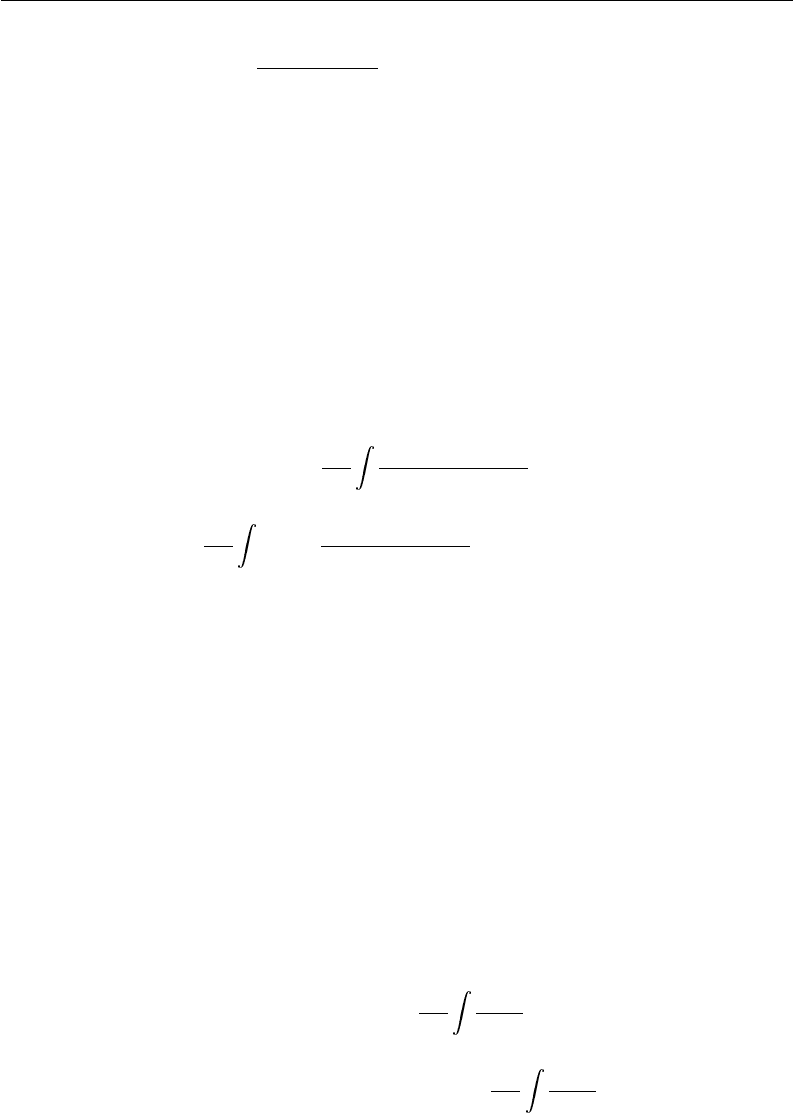
λ ∈ γ, θ > 0, Re ρ ≥0.
Substituting (2.7.134) into the right-hand side of (2.7.135) we get
|η(x,λ)| ≤C
x
³
1 +
∞
λ
∗
θ
2
|
ˆ
V (µ)|
|ρ −θ|+ 1
d
µ
´
, λ ∈γ, θ > 0
, Re ρ ≥ 0.
Hyperbolic P
artial Differential Equations 115
Since
θ
ρ(|ρ −θ|+ 1)
≤ 1 for θ,ρ ≥ 1,
this
yields
|
η(x,λ)| ≤C
x
|ρ|, λ ∈γ. (2.7.136)
Using (2.7.136) instead of (2.7.134) and repeating the preceding arguments we infer
|η(x,λ)| ≤C
x
, λ ∈γ.
According to Condition S of Theorem 2.7.20, the homogeneous equation (2.7.133) has only
the trivial solution η(x,λ) ≡ 0. Consequently,
`ϕ(x,λ) = λϕ(x,λ). (2.7.137)
It follows from (2.7.132) and (2.7.137) that
λ
˜
Φ(x,λ) = `Φ(x,λ) +
1
2πi
γ
h
˜
Φ(x,λ),
˜
ϕ(x,µ)i
λ −µ
ˆ
M(µ)µϕ(x,µ)d
µ
+
1
2πi
γ
(λ −µ)
h
˜
Φ(x,λ),
˜
ϕ(x,µ)i
λ −µ
ˆ
M(µ)ϕ(x,µ)d
µ
.
Together with (2.7.123) this yields `Φ(x, λ) = λΦ(x, λ). 2
Lemma 2.7.10. The following relations hold
ϕ(0,λ) = 1, ϕ
0
(0,λ) = h. (2.7.138)
U(Φ) = 1, Φ(0,λ) = M(λ), (2.7.139)
Φ(x,λ) = O(exp(iρx)), x → ∞. (2.7.140)
Proof. Taking x = 0 in (2.7.118) and (2.7.127) and using (2.7.126) we get
ϕ(0,λ) =
˜
ϕ(0,λ) = 1,
ϕ
0
(0,λ) =
˜
ϕ
0
(0,λ) −ε
0
(0)
˜
ϕ(0,λ) =
˜
h + h −
˜
h = h,
i.e. (2.7.138) is valid. Using (2.7.123) and (2.7.131) we calculate
Φ(0,λ) =
˜
Φ(0,λ) +
1
2πi
γ
ˆ
M(µ)
λ −µ
d
µ
, (2.7.141)
Φ
0
(0,λ) =
˜
Φ
0
(0,λ) −
˜
Φ(0,λ)ε
0
(0) +
h
2πi
γ
ˆ
M(µ)
λ −µ
d
µ
.
Consequently,
U(Φ) = Φ
0
(0,λ) −hΦ(0,λ) =
˜
Φ
0
(0,λ) −(ε
0
(0) + h)
˜
Φ(0,λ) =
˜
Φ
0
(0,λ) −
˜
h
˜
Φ(0,λ) =
˜
U(
˜
Φ) = 1.

116 G.
Freiling and V. Yurko
Furthermore, since hy, z
i = yz
0
−y
0
z, we rewrite (2.7.123) in the form
Φ(x,λ) =
˜
Φ(x,λ)
+
1
2πi
γ
˜
Φ
0
(x,λ)
˜
ϕ(x,µ) −
˜
Φ(x,λ)
˜
ϕ
0
(x,µ)
λ −µ
ˆ
M(µ)ϕ(x,µ)d
µ
, (2.7.142)
where λ ∈ J
γ
. The function ϕ(x, λ) is the solution of the Cauchy problem (2.7.137)-
(2.7.138). Therefore, according to (2.7.104),
|ϕ
(ν)
(x,µ)| ≤C|θ|
ν
, µ = θ
2
∈ γ, x ≥ 0, ν = 0,1. (2.7.143)
Moreover, the estimates (2.7.104)-(2.7.105) are valid for
˜
ϕ(x,λ) and
˜
Φ(x,λ), i.e.
|
˜
ϕ
(ν)
(x,µ)| ≤C|θ|
ν
, µ = θ
2
∈ γ, x ≥ 0, ν = 0,1, (2.7.144)
|
˜
Φ
(ν)
(x,λ)| ≤C|ρ|
ν−1
exp(−|Im ρ|x), x ≥0, ρ ∈Ω. (2.7.145)
By virtue of (2.7.91),
ˆ
M(λ) = O
³
1
λ
´
, |ρ|
→ ∞, ρ ∈ Ω. (2
.7.146)
Fix λ ∈J
γ
. Taking (2.7.143)-(2.7.146) into account we get from (2.7.142) that
|Φ(x,λ) exp(−iρx)|≤C
³
1 +
∞
ρ
∗
dθ
θ|λ −µ|
´
≤C
1
,
i.e.
(2.7.140)
is valid.
Furthermore, it follows from (2.7.141) that
Φ(0,λ) =
˜
M(λ) +
1
2πi
γ
ˆ
M(µ)
λ −µ
d
µ.
By
Cauchy‘s integral formula
ˆ
M(λ) =
1
2πi
γ
0
R
ˆ
M(µ)
λ −µ
d
µ
, λ ∈int γ
0
R
.
Since
lim
R→∞
1
2πi
|µ|=R
ˆ
M(µ)
λ −µ
d
µ = 0
,
we get
ˆ
M(λ) =
1
2πi
γ
ˆ
M(µ)
λ −µ
d
µ, λ ∈J
γ
.
Consequently
, Φ(0,λ) =
˜
M(λ) +
ˆ
M(λ) = M(λ), i.e. (2.7.139) is valid. 2
Thus, Φ(x,λ) is the Weyl solution, and M(λ) is the Weyl function for the constructed
pair L(q(x),h), and Theorem 2.7.20 is proved. 2
Example 2.7.3. Let ˜q(x) = 0 and
˜
h = 0. Then
˜
M(λ) =
1
iρ
. Consider
the
function
M(λ) =
˜
M(λ) +
a
λ −λ
0
,

Hyperbolic P
artial Differential Equations 117
where a and λ
0
are comple
x numbers. Then the main equation (2.7.118) becomes
˜
ϕ(x,λ
0
) = F(x)ϕ(x,λ
0
),
where
˜
ϕ(x,λ
0
) = cos ρ
0
x, F(x) = 1 + a
x
0
cos
2
ρ
0
t dt, λ
0
= ρ
2
0
.
The solvability condition for the main equation takes the form
F(x) 6= 0 for all x ≥0,
and the function ε(x) can be found by the formula
ε(x) =
2aρ
0
sin2ρ
0
x
F(x)
+
2a
2
cos
4
ρ
0
x
F
2
(x)
.
Case
1. Let λ
0
= 0
. Then
F(x) = 1 +ax,
and the solvability condition is equivalent to the condition
a /∈ (−∞,0).
If this is fulfilled then M(λ) is the Weyl function for L of the form (2.7.30)-(2.7.31) with
q(x) =
2a
2
(1 + ax)
2
, h = −a,
ϕ(x,λ)
= cos ρ
x −
a
1 + ax
·
sinρx
ρ
, e(x,ρ)
= e
xp(iρx)
³
1 −
a
iρ(1 + ax)
´
,
∆(ρ)
= i
ρ, V (λ) =
1
πρ
, ϕ(x, 0)
=
1
1 + ax
.
If a < 0, then
the
solvability condition is not fulfilled, and the function M(λ) is not a Weyl
function.
Case 2. Let λ
0
6= 0 be a real number, and let a > 0. Then F(x) ≥1, and the solvability
condition is fulfilled. But in this case ε(x) /∈ L(0,∞), i.e. ε(x) /∈W
N
for any N ≥ 0.
The Gelfand-Levitan method. For Sturm-Liouville operators on a finite interval, the
Gelfand-Levitan method was presented in subsection 2. For the case of the half-line there
are similar results. Therefore here we confine ourselves to the derivation of the Gelfand-
Levitan equation. For further discussion see [15], [16] and [25].
Consider the differential equation and the linear form L = L(q(x),h) of the form
(2.7.30)-(2.7.31). Let ˜q(x) = 0,
˜
h = 0. Denote
F(x,t) =
1
2πi
γ
cosρx cos ρt
ˆ
M(λ)dλ, (2.7.147)

118 G.
Freiling and V. Yurko
where γ is the
contour defined above (see fig. 2.7.1). We note that by virtue of (2.7.111)
and (2.7.111),
1
2πi
γ
00
cosρx cos ρt
ˆ
M(λ)dλ =
∞
λ
∗
cosρx cos ρt
ˆ
V (λ)dλ < ∞.
Let G(x,t) be
tak
en from (2.7.4), and let H(x,t) be the kernel of the operator E + H :=
(E + G)
−1
, i.e.
cosρx = ϕ(x,λ) +
x
0
H(x,t)ϕ(t, λ)dt. (2.7.148)
Theorem 2.7.21. For each fixed x, the function G(x,t) satisfies the following linear
integral equation
G(x,t) + F(x,t) +
x
0
G(x,s)F(s,t)ds = 0, 0 < t < x. (2.7.149)
Equation (2.7.149) is the Gelfand-Levitan equation.
Proof. Using (2.7.4) and (1.7.148) we calculate
1
2πi
γ
R
ϕ(x,λ) cosρt
M(λ
)dλ =
1
2πi
γ
R
cosρx cos ρt
M(λ
)dλ
+
1
2πi
γ
R
µ
x
0
G(x,s) cosρs
d
s

cosρtM(λ)dλ,
1
2πi
γ
R
ϕ(x,λ) cosρt
M(λ
)dλ =
1
2πi
γ
R
ϕ(x,λ)ϕ(t,λ)M(λ) dλ
+
1
2πi
γ
R
µ
t
0
H(t, s)ϕ(s,λ) d
s

ϕ(x,λ
)M(λ)dλ,
where γ
R
= γ ∩{λ : |λ| ≤ R}. This yields
Φ
R
(x,t) = I
R1
(x,t) + I
R2
(x,t) + I
R3
(x,t) + I
R4
(x,t),
where
Φ
R
(x,t) =
1
2πi
γ
R
ϕ(x,λ)ϕ(t,λ)M(λ) dλ −
1
2πi
γ
R
cosρx cos ρt
˜
M(λ)dλ,
I
R1
(x,t)
=
1
2πi
γ
R
cosρx cos ρt
ˆ
M(λ)dλ,
I
R2
(x,t)
=
x
0
G(
x,s)
µ
1
2πi
γ
R
cosρt cos ρs
ˆ
M(λ)dλ

d
s
,
I
R3
(x,t) =
1
2πi
γ
R
cosρt
µ
x
0
G(x,s) cosρs
d
s

˜
M(λ)dλ,
I
R4
(x,t) = −
1
2πi
γ
R
ϕ(x,λ)
µ
t
0
H(t, s)ϕ(s,λ) d
s

M(λ
)dλ.

Hyperbolic P
artial Differential Equations 119
Let ξ(t), t ≥ 0 be a
twice continuously differentiable function with compact support. By
Theorem 2.7.15,
lim
R→∞
∞
0
ξ(t)Φ
R
(x,t)dt = 0, lim
R→∞
∞
0
ξ(t)I
R1
(x,t)dt =
∞
0
ξ(t)F(x,t)dt,
lim
R→∞
∞
0
ξ(t)I
R2
(x,t)dt =
∞
0
ξ(t)
µ
x
0
G(x,s)F(s,t)ds

dt,
lim
R→∞
∞
0
ξ(t)I
R3
(x,t)dt =
x
0
ξ(t)G(x,t)dt,
lim
R→∞
∞
0
ξ(t)I
R4
(x,t)dt = −
∞
x
ξ(t)H(t, x)dt.
Put G(x,t) = H(x,t) = 0 for x < t. In view of the arbitrariness of ξ(t), we derive
G(x,t) + F(x,t) +
x
0
G(x,s)F(s,t)ds −H(t,x) = 0.
For t < x, this gives (2.7.149). 2
Thus, in order to solve the inverse problem of recovering L from the Weyl function
M(λ) one can calculate F(x,t) by (2.7.147), find G(x,t) by solving the Gelfand-Levitan
equation (2.7.149) and construct q(x) and h by (2.7.27).
Remark 2.7.9. We show the connection between the Gelfand-Levitan equation and the
main equation of inverse problem (2.7.118). For this purpose we use the cosine Fourier
transform. Let ˜q(x) =
˜
h = 0. Then
˜
ϕ(x,λ) = cos
√
λx. Multiplying
(2.7.149)
by cos
√
λt
and
inte
grating with respect to t, we obtain
x
0
G(x,t) cos
√
λt
d
t +
x
0
cos
√
λt
µ
1
2πi
γ
cos
√
µx cos
√
µ
t
ˆ
M(µ
)dµ

dt
+
x
0
cos
√
λt
x
0
G(x,s)
µ
1
2πi
γ
cos
√
µ
t cos
√
µs
ˆ
M(µ)d
µ

d
s = 0.
Using (2.7.4) we arrive at (2.7.118).
Remark 2.7.10. If q(x) and h are real, and (1+x)q(x) ∈L(0,∞) , then (2.7.147) takes
the form
F(x,t) =
∞
−∞
cosρx cos ρt d
ˆ
σ(λ),
where
ˆ
σ
=
σ
−
˜
σ
,
and
σ
and
˜
σ
are the spectral functions of
L
and
˜
L
respectively.
5. The generalized Weyl function
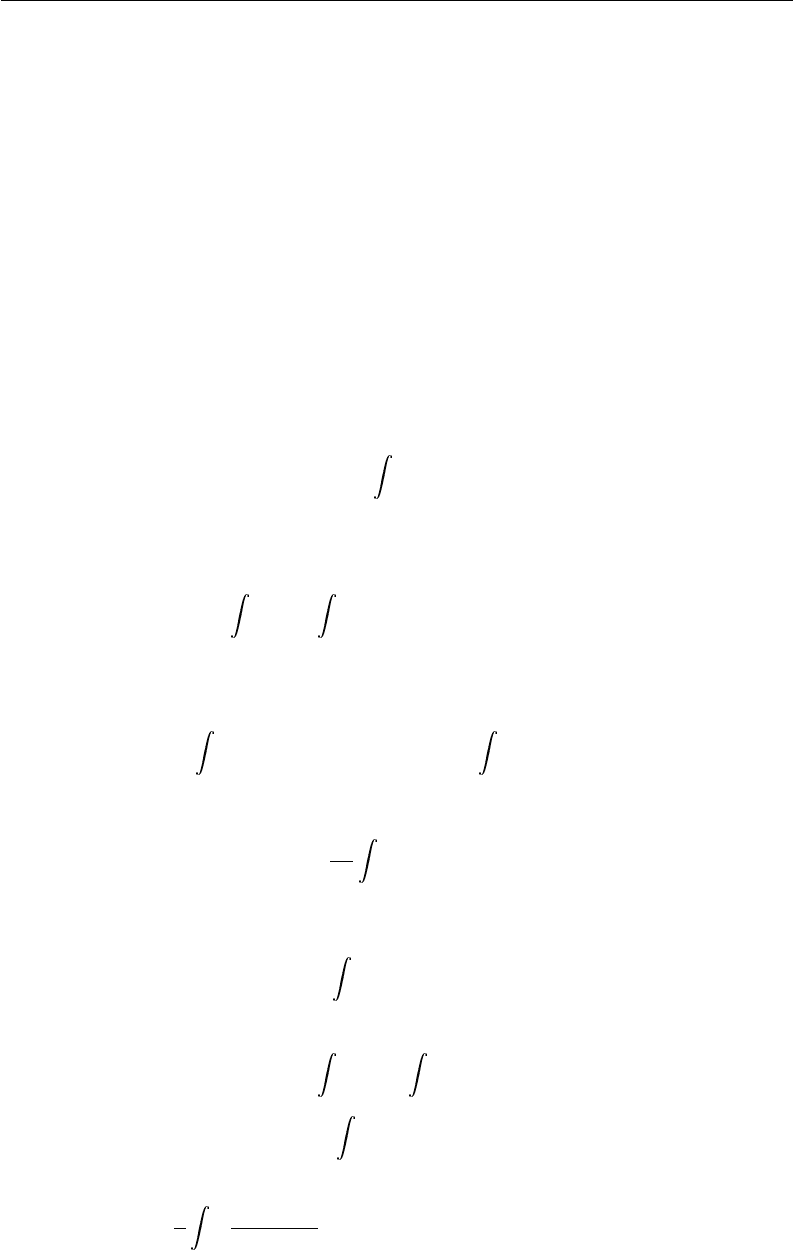
Let us consider the differential equation and the linear form L = L(q(x), h) :
`y := −y
00
+ q(x)y = λy, x > 0,
U(y) := y
0
(0) −hy(0).
120 G.
Freiling and V. Yurko
In this
subsection we study the inverse spectral problem for L in the case when q(x) is a
locally integrable complex-valued function, and h is a complex number. We introduce the
so-called generalized Weyl function as a main spectral characteristic.
For this purpose we define a space of generalized functions (distributions). Let D be
the set of all integrable and bounded on the real line entire functions of exponential type
with ordinary operations of addition and multiplication by complex numbers and with the
following convergence: z
k
(ρ) is said to converge to z(ρ) if the types σ
k
of the functions
z
k
(ρ) are bounded ( sup σ
k
< ∞ ), and kz
k
(ρ) −z(ρ)k
L(−∞,∞)
→ 0 as k → ∞. The linear
manifold D with this convergence is our space of test functions.
Definition 2.7.2. All linear and continuous functionals
R : D →C, z(ρ) 7→ R(z(ρ)) = (z(ρ), R),
are called generalized functions (GF). The set of these GF is denoted by D
0
. A sequence of
GF R
k
∈ D
0
converges to R ∈ D
0
, if lim(z(ρ),R
k
) = (z(ρ),R), k → ∞ for any z(ρ) ∈ D.
A GF R ∈ D
0
is called regular if it is determined by R(ρ) ∈ L
∞
via
(z(ρ),R) =
∞
−∞
z(ρ)R(ρ)dρ.
Definition 2.7.3. Let a function f (t) be locally integrable for t > 0 (i.e. it is integrable
on every finite segment [0,T ] ). The GF L
f
(ρ) ∈ D
0
defined by the equality
(z(ρ),L
f
(ρ)) :=
∞
0
f (t)
³
∞
−∞
z(ρ)exp(iρt) dρ
´
dt, z(ρ) ∈ D, (2.7.150)
is called the generalized Fourier-Laplace transform for the function f (t).
Since z(ρ) ∈ D, we have
∞
−∞
|
z(ρ)
|
2
dρ ≤ sup
−∞<ρ<∞
|
z(ρ)
|
·
∞
−∞
|
z(ρ)
|
dρ,
i.e. z(ρ) ∈ L
2
(−∞,∞). Therefore, by virtue of the Paley-Wiener theorem [4], the function
B(t) :=
1
2π
∞
−∞
z(ρ)e
xp(i
ρt)dρ
is continuous and has compact support, i.e. there exists a d > 0 such that B(t) = 0 for
|t| > d, and
z(ρ) =
d
−d
B(t) exp(−iρt)dt. (2.7.151)
Consequently, the integral in (2.7.150) exists. We note that f (t) ∈ L(0,∞) implies
(z(ρ),L
f
(ρ)) :=
∞
−∞
z(ρ)
³
∞
0
f (t)exp(iρt) dt
´
dρ,
i.e. L
f
(ρ) is a regular GF (defined by
∞
0
f (t)exp(iρt) dt ) and coincides with the ordinary
Fourier-Laplace transform for the function f (t). Since
1
π
∞
−∞
1 −cosρx
ρ
2
e
xp(i
ρt)dρ =
½
x −t, t < x,
0, t > x,

Hyperbolic P
artial Differential Equations 121
the follo
wing inversion formula is valid:
x
0
(x −t) f (t)dt =
µ
1
π
·
1 −cosρx
ρ
2
, L
f
(ρ)

. (2.7.152)
Let
no
w u(x,t) be the solution of (2.6.1)-(2.6.2) with a locally integrable complex-
valued function q(x). Define u(x,t) = 0 for 0 < t < x, and denote (with λ = ρ
2
)
Φ(x,λ) := −L
u
(ρ), i.e.
(z(ρ),Φ(x,λ)) = −
∞
x
u(x,t)
³
∞
−∞
z(ρ)exp(iρt)dρ
´
dt. (2.7.153)
For z(ρ) ∈ D, ρ
2
z(ρ) ∈ L(−∞, ∞), ν = 1,2, we put
(z(ρ),(iρ)
ν
Φ(x,λ)) := ((iρ)
ν
z(ρ),Φ(x, λ)),
(z(ρ),Φ
(ν)
(x,λ)) :=
d
ν
d
x
ν
(
z(ρ),Φ(x,λ)).
Theorem 2.7.22. The following relations hold
`Φ(x,λ) = λΦ(x,λ), U(Φ) = 1.
Proof. We calculate
(z(ρ),`Φ(x,λ)) = (z(ρ),−Φ
00
(x,λ) + q(x)Φ(x,λ))
= −
∞
−∞
(iρ)z(ρ)exp(iρx)dρ −u
x
(x,x)
∞
−∞
z(ρ)exp(iρx)dρ
+
∞
x
³
u
xx
(x,t) −q(x)u(x,t)
´³
∞
−∞
z(ρ)exp(iρt) dρ
´
dt,
(z(ρ),λΦ(x,λ)) = −
∞
−∞
(iρ)z(ρ)exp(iρx)dρ −u
t
(x,x)
∞
−∞
z(ρ)exp(iρx)dρ
+
∞
x
u
tt
(x,t)
³
∞
−∞
z(ρ)exp(iρt) dρ
´
dt.
Using u
t
(x,x) + u
x
(x,x) =
d
d
x
u
(x,x) ≡ 0, we infer (z(ρ),`Φ(x,λ) −λΦ(x,λ)) = 0. Fur-
thermore, since
(z(ρ),Φ
0
(x,λ)) =
∞
−∞
z(ρ)exp(iρx)dρ
−
∞
x
u
x
(x,t)
³
∞
−∞
z(ρ)exp(iρt) dρ
´
dt,
we get
(z(ρ),U(Φ)) = (z(ρ),Φ
0
(0,λ) −hΦ(0,λ)) =
∞
−∞
z(ρ)dρ.
2
Definition 2.7.4. The GF Φ(x,λ) is called the generalized Weyl solution, and the GF
M(λ) := Φ(0,λ) is called the generalized Weyl function (GWF) for L(q(x),h).