
Freiling G., Yurko V. Lectures on Differential Equations of Mathematical Physics: A First Course
Подождите немного. Документ загружается.


202 G.
Freiling and V. Yurko
3. Pr
operties of single- and double-layer potentials
We consider the functions Q(x) and F(x) of the form (4.6.1).
Theorem 4.6.1. The functions Q(x) and F(x) are harmonic in D and D
1
, and
Q(x) = O
µ
1
kxk

, F(x)
= O
µ
1
kxk
2

as x →∞.
Pr
oof
. 1) Let
G ⊂ D (or G ⊂ D
1
)
be
a bounded closed domain. Then for all x ∈
G ,
ξ ∈ Σ we
ha
ve r = kx −ξk ≥ d > 0, where d is the distance of
G and Σ. Therefore,
Q(x) ∈C
∞
(
G) , F(x) ∈C
∞
(G), and
all
their derivatives can be obtained by differentiation
under the sign of integration. In particular,
∆Q(x) =
Σ
q(ξ)∆
µ
1
r

d
s = 0
,
∆F(x) =
Σ
f (ξ)
∂
ξ
∂n
ξ
µ
∆
µ
1
r
¶¶
d
s = 0
,
i.e. Q(x) and F(x) are harmonic in
G. By
virtue
of the arbitrariness of
G we
obtain
that
Q(x) and F(x) are harmonic in D and D
1
.
2) By Lemma 4.3.1,
∂
ξ
r
∂n
ξ
= cos(n
ξ
, ¯r),
and
consequently
, the function F(x) takes the form
F(x) = −
Σ
f (ξ)
cos(n
ξ
, ¯r)
r
2
d
s
. (4.6.12)
Let D ⊂ K
R
(0), kxk ≥ 2R, ξ ∈Σ. Then
r ≥ kxk−kξk ≥ kxk−R ≥ kxk/2,
i.e. 1/r ≤ 2/kxk. From (4.6.1) and (4.6.12) we obtain the estimates
|Q(x)| ≤
C
kxk
, |F(x)|
≤
C
kxk
2
, kxk
≥ 2
R.
Theorem 4.6.1 is proved. 2
Theorem 4.6.2. The function F(x) exists and is continuous on Σ.
Proof. Let x ∈ Σ, δ ≤δ
0
. It follows from (4.6.1) and Lemma 4.6.4 that
|F(x)| ≤C
f
Ã
Σ
δ
(x)
¯
¯
¯
¯
¯
∂
ξ
(
1
r
)
∂n
ξ
¯
¯
¯
¯
¯
d
s +
Σ
\Σ
δ
(x)
¯
¯
¯
¯
¯
∂
ξ
(
1
r
)
∂n
ξ
¯
¯
¯
¯
¯
d
s
!
≤C
f
µ
4
πΦ
0
δ +
Σ\Σ
δ
(x)
|cos( ¯n
ξ
, ¯r)|
r
2
d
s

≤C
f
µ
4
πΦ
0
δ +
S
Σ
δ
2

,

Elliptic P
artial Differential Equations 203
where C
f
= sup
ξ∈Σ
|f (ξ)| and S
Σ
is the
measure of Σ. Therefore, the integral in (4.6.1)
converges absolutely and uniformly on Σ, and consequently, the function F(x) exists and
is bounded on Σ.
Let y ∈ Σ
δ/2
(x) := K
δ/2
(x) ∩Σ. We have
F(x) −F(y) =
Σ
f (ξ)
Ã
∂
ξ
(
1
r
)
∂n
ξ
−
∂
ξ
(
1
r
1
)
∂n
ξ
!
d
s
, r := kx −ξk, r
1
:= ky −ξk.
Using Lemma 4.6.4, we infer
¯
¯
¯
¯
¯
Σ
δ/2
(x)
f (ξ)
Ã
∂
ξ
(
1
r
)
∂n
ξ
−
∂
ξ
(
1
r
1
)
∂n
ξ
!
d
s
¯
¯
¯
¯
¯
≤C
f
Ã
Σ
δ/
2
(x)
¯
¯
¯
¯
¯
∂
ξ
(
1
r
)
∂n
ξ
¯
¯
¯
¯
¯
d
s +
Σ
δ/
2
(x)
¯
¯
¯
¯
¯
∂
ξ
(
1
r
1
)
∂n
ξ
¯
¯
¯
¯
¯
d
s
!
≤C
f
Ã
Σ
δ/
2
(x)
¯
¯
¯
¯
¯
∂
ξ
(
1
r
)
∂n
ξ
¯
¯
¯
¯
¯
d
s +
Σ
δ
(y
)
¯
¯
¯
¯
¯
∂
ξ
(
1
r
1
)
∂n
ξ
¯
¯
¯
¯
¯
d
s
!
≤C
0
δ
, C
0
:= 6πΦ
0
C
f
.
Take ε > 0. Let δ = ε/(2C
0
). Then
¯
¯
¯
¯
¯
Σ
δ/2
(x)
f (ξ)
Ã
∂
ξ
(
1
r
)
∂n
ξ
−
∂
ξ
(
1
r
1
)
∂n
ξ
!
d
s
¯
¯
¯
¯
¯
≤
ε
2
for
all y ∈ Σ
δ/2
(x).
On Σ \Σ
δ/2
(x) the
integrand has no singularities. By virtue of the continuity, one has that
∃ δ
1
(δ
1
< δ/2) ∀ y ∈Σ
δ
1
(x)
¯
¯
¯
¯
¯
Σ\Σ
δ/2
(x)
f (ξ)
Ã
∂
ξ
(
1
r
)
∂n
ξ
−
∂
ξ
(
1
r
1
)
∂n
ξ
!
d
s
¯
¯
¯
¯
¯
≤
ε
2
.
Thus,
we
have proved that
∀ ε > 0 ∃ δ
1
∀ y ∈ Σ
δ
1
(x) |F(x) −F(y)| ≤ ε,
and consequently, F(x) ∈C(Σ). Theorem 4.6.2 is proved. 2
Theorem 4.6.3. The function Q(x) exists and is continuous for all x ∈ R
3
.
Proof. The case x /∈Σ was considered in Theorem 4.6.1. Let x ∈Σ , δ ≤δ
0
. It follows
from (4.6.1) and Lemma 4.6.3 that
|Q(x)| ≤C
q
µ
Σ
δ
(x)
ds
r
+
Σ\Σ
δ
(x)
d
s
r

≤C
q
µ
4πδ +
C
Σ
δ

.
Therefore,
the
integral in (4.6.1) converges absolutely and uniformly, and consequently, the
function Q(x) exists and is bounded on Σ. Let y ∈K
δ/2
(x). We have
|Q(x) −Q(y)|≤
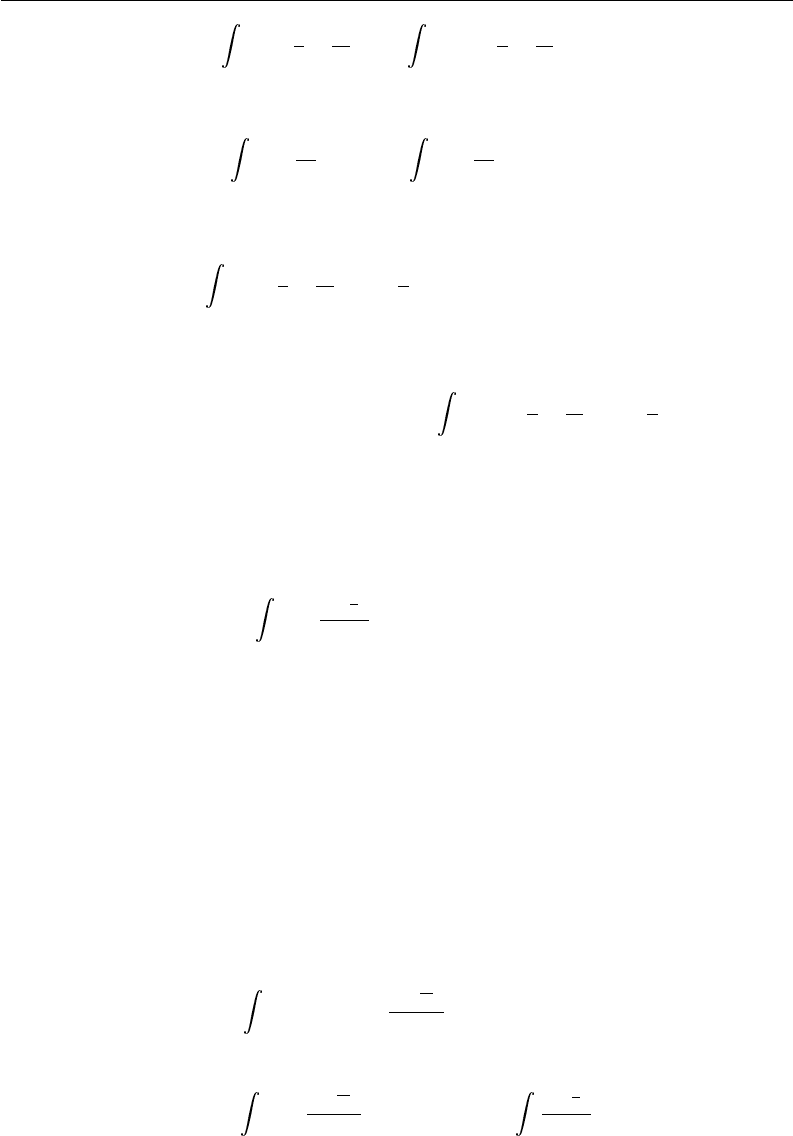
204 G.
Freiling and V. Yurko
C
q
µ
Σ
δ/2
(x)
¯
¯
¯
¯
1
r
−
1
r
1
¯
¯
¯
¯
d
s +
Σ
\Σ
δ/2
(x)
¯
¯
¯
¯
1
r
−
1
r
1
¯
¯
¯
¯
d
s

,
where r
1
= k
y −ξk. By virtue of Lemma 4.6.3,
Σ
δ/2
(x)
ds
r
≤ 2πδ,
Σ
δ/2
(x)
d
s
r
1
≤ 4πδ.
Fix ε > 0. T
ak
e δ = ε/(12πC
q
). Then
C
q
Σ
δ/2
(x)
¯
¯
¯
¯
1
r
−
1
r
1
¯
¯
¯
¯
d
s ≤
ε
2
for
all y ∈ K
δ
/2
(x).
On Σ \Σ
δ/2
(x) the integrand has no singularities; hence by virtue of the continuity,
∃ δ
1
(δ
1
< δ/2) ∀ y ∈K
δ
1
(x) C
q
Σ\Σ
δ/2
(x)
¯
¯
¯
¯
1
r
−
1
r
1
¯
¯
¯
¯
d
s ≤
ε
2
.
Thus,
∀ ε > 0 ∃ δ
1
∀ y ∈ K
δ
1
(x) |Q(x) −Q(y)|
≤ ε
.
Theorem 4.6.3 is proved. 2
Denote
Φ(x) =
Σ
q(ξ)
∂
x
(
1
r
)
∂n
x
d
s
, x ∈Σ, r = kx −ξk. (4.6.13)
Theorem 4.6.4. The function Φ(x) exists and is continuous on Σ.
We omit the proof since it is similar to the one of Theorem 4.6.2.
Theorem 4.6.5. Let x ∈Σ. Then there exist the finite limits
F
+
(x) := lim
y→x,y∈D
1
F(y), F
−
(x) := lim
y→x,y∈D
F(y),
and
F
±
(x) = F(x) ±2π f (x), x ∈ Σ. (4.6.14)
Proof. Fix x ∈ Σ and denote
J(y) :=
Σ
( f (ξ) − f (x))
∂
ξ
(
1
r
1
)
∂n
ξ
d
s
, r
1
:= ky −ξk.
Then
F(y) =
Σ
f (ξ)
∂
ξ
(
1
r
1
)
∂n
ξ
d
s = J(y
) + f (x)
Σ
∂
ξ
(
1
r
)
∂n
ξ
d
s
,
and consequently, by virtue of Lemma 4.6.7,
F(y) =
½
J(y) −4π f (x), y ∈D,
J(y), y ∈D
1
,
(4.6.15)

Elliptic P
artial Differential Equations 205
Moreov
er, by Lemma 4.6.7,
J(x) = F(x) + 2π f (x), x ∈Σ. (4.6.16)
Let us show that
lim
y→x
J(y) = J(x). (4.6.17)
We have
J(y) −J(x) =
Σ
( f (ξ) − f (x))
Ã
∂
ξ
(
1
r
1
)
∂n
ξ
−
∂
ξ
(
1
r
)
∂n
ξ
!
d
s. (
4.6.18)
Let δ ≤δ
0
, y ∈ K
δ/2
(x). Using Lemmas 4.6.4 and 4.6.6 we calculate
Σ
δ
(x)
¯
¯
¯
¯
¯
∂
ξ
(
1
r
1
)
∂n
ξ
¯
¯
¯
¯
¯
d
s +
Σ
δ
(x)
¯
¯
¯
¯
¯
∂
ξ
(
1
r
)
∂n
ξ
¯
¯
¯
¯
¯
d
s ≤C
∗
+ 4
πΦ
0
δ ≤C
∗
+
π
2
:= C
1
.
Fix ε > 0. Since f ∈C(Σ), there
e
xists δ (δ ≤ δ
0
) such that |f (ξ) − f (x)|≤ ε/(2C
1
) for
all ξ ∈ Σ
δ
(x). Then
¯
¯
¯
¯
¯
Σ
δ
(x)
( f (ξ) − f (x))
Ã
∂
ξ
(
1
r
1
)
∂n
ξ
−
∂
ξ
(
1
r
)
∂n
ξ
!
d
s
¯
¯
¯
¯
¯
≤
ε
2
for
all y ∈ K
δ
/2
(x).
On Σ \Σ
δ
(x) the integrand in (4.6.18) has no singularities. Hence, by virtue of the conti-
nuity, ∃ δ
1
(δ
1
< δ/2) ∀ y ∈K
δ
1
(x) :
¯
¯
¯
¯
¯
Σ\Σ
δ
(x)
( f (ξ) − f (x))
Ã
∂
ξ
(
1
r
1
)
∂n
ξ
−
∂
ξ
(
1
r
)
∂n
ξ
!
d
s
¯
¯
¯
¯
¯
≤ 2C
f
Σ\Σ
δ
(
x)
¯
¯
¯
¯
¯
∂
ξ
(
1
r
1
)
∂n
ξ
−
∂
ξ
(
1
r
)
∂n
ξ
¯
¯
¯
¯
¯
d
s ≤
ε
2
.
Thus,
∀ ε > 0 ∃ δ
1
∀ y ∈ K
δ
1
(x) |J(y) −J(x)|
≤ ε,
i.e.
(4.6.17) is proved. All assertions of the theorem follow from (4.6.15)-(4.6.17). 2
Theorem 4.6.6. Let x ∈Σ. Then there exist the finite limits
Φ
±
(x) = lim
∂Q(y)
∂n
x
, y →x, y = x ±αn
x
, α > 0,
(i.e
.
Q(x) has on Σ normal derivatives from outside, denoted by Φ
+
(x) , and from inside,
denoted by Φ
−
(x) ). Moreover,
Φ
±
(x) = Φ(x) ∓2πq(x). (4.6.19)
Proof. Fix x ∈ Σ and denote
J
1
(y) :=
Σ
q(ξ)
Ã
∂
y
(
1
r
1
)
∂n
x
+
∂
ξ
(
1
r
1
)
∂n
ξ
!
d
s
, r
1
:= ky −ξk. (4.6.20)

206 G.
Freiling and V. Yurko
Let us
show that
limJ
1
(y) = J
1
(x), y →x, y = x ±αn
x
, α > 0. (4.6.21)
Let δ ≤δ
0
, y ∈ K
δ/2
(x). We infer from (4.6.20) that
J
1
(y) −J
1
(x)
=
Σ
q(ξ)
ÃÃ
∂
y
(
1
r
1
)
∂n
x
+
∂
ξ
(
1
r
1
)
∂n
ξ
!
−
Ã
∂
x
(
1
r
)
∂n
x
+
∂
ξ
(
1
r
)
∂n
ξ
!
!
d
s
=
Σ
δ
(x)
+
Σ\Σ
δ
(x)
.
It follows from Lemmata 4.6.4-4.6.5 that
¯
¯
¯
¯
Σ
δ
(x)
¯
¯
¯
¯
≤C
0
δ.
Fix ε > 0. Take δ = ε/(2C
0
). Then
¯
¯
¯
¯
Σ
δ
(x)
¯
¯
¯
¯
≤
ε
2
.
On Σ \Σ
δ
(x) the
inte
grand has no singularities. Hence, by virtue of the continuity,
∃ δ
1
(δ
1
< δ/2) ∀ y ∈K
δ
1
(x)
¯
¯
¯
¯
Σ\Σ
δ
(x)
¯
¯
¯
¯
≤
ε
2
.
Thus,
∀ ε > 0 ∃ δ
1
∀ y ∈K
δ
1
(x) |J
1
(y) −J
1
(x)|
≤ ε
,
i.e. (4.6.21) is proved. Denote
Q
1
(x) :=
Σ
q(ξ)
∂
ξ
(
1
r
)
∂n
ξ
d
s, r := kx −ξk.
This is the double-layer potential with the density q(ξ). By Theorem 4.6.5, for x ∈Σ there
exist the finite limits
Q
±
1
(x) := lim Q
1
(y), y →x, y = x ±αn
x
, α > 0,
and
Q
±
1
(x) = Q
1
(x) ±2πq(x), x ∈Σ. (4.6.22)
We rewrite (4.6.20) in the form
∂Q(y)
∂n
x
= J
1
(y) −Q
1
(y).
F
or y → x, y = x ±α
n
x
, α > 0, we get, in view of (4.6.21)-(4.6.22),
Φ
±
(x) = J
1
(x) −Q
±
1
(x) = J
1
(x) −Q
1
(x) ∓2πq(x).
Moreover, it follows from (4.6.20) that J
1
(x) = Φ(x) + Q
1
(x) , x ∈ Σ, and we arrive at
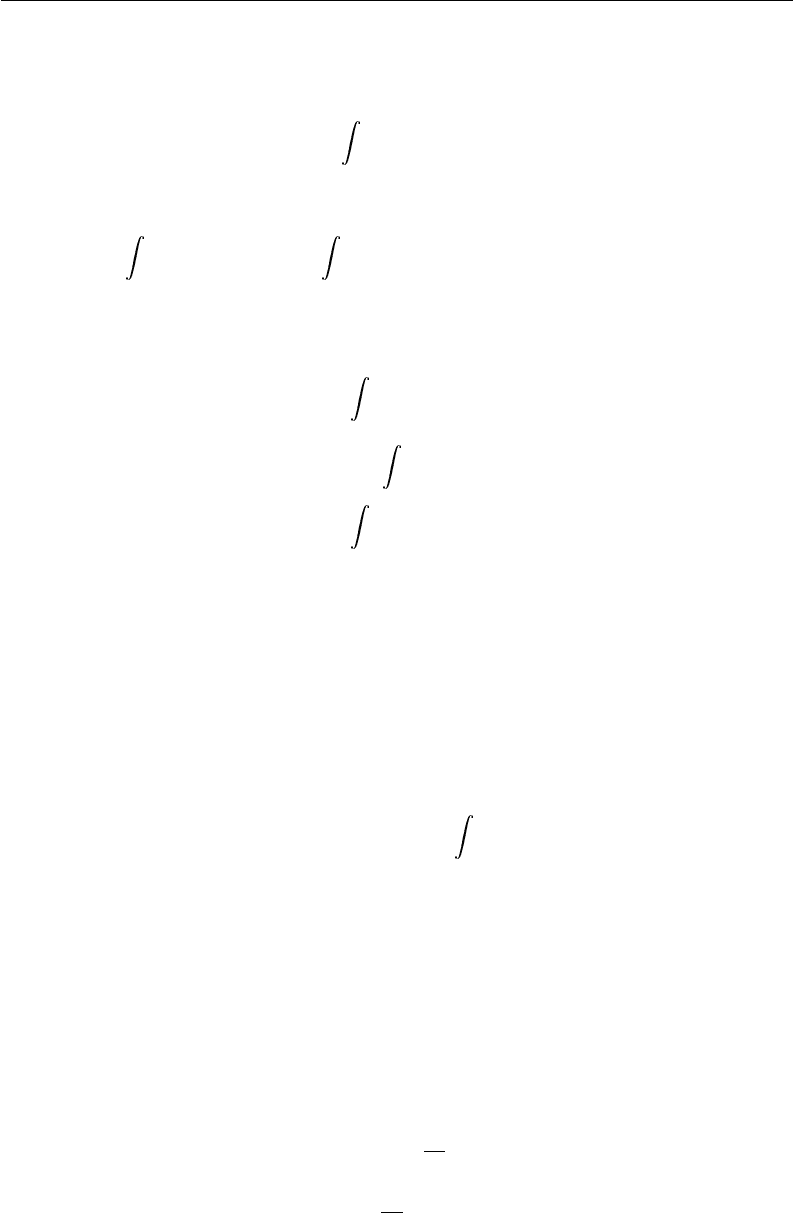
(4.6.21). Theorem 4.6.6 is proved. 2
Elliptic P
artial Differential Equations 207
4. Basic
results from the theory of Fredholm integral equations
Let G ⊂ R
n
be a bounded closed set. We consider the following integral equation:
y(x) = ϕ(x) +
G
K(x,ξ)y(ξ)dξ, x ∈ G, (4.6.23)
where ϕ(x) ∈C(G), and the real kernel K(x,ξ) satisfies the conditions
G
|K(x,ξ)|dξ ≤C,
G
K(x,ξ)y(ξ)dξ ∈C(G) ∀ y ∈C(G).
A solution of (4.6.23) is a function y(x) ∈C(G), satisfying (4.6.23). Together with (4.6.23)
we consider the following equations
y(x) =
G
K(x,ξ)y(ξ)dξ, (4.6.23
0
)
z(x) = ψ(x) +
G
K(ξ,x)z(ξ)dξ, (4.6.23
∗
)
z(x) =
G
K(ξ,x)z(ξ)dξ. (4.6.23
∗
0
)
Equation ( 4.6.23
∗
) is called conjugate to (4.6.23), and equations ( 4.6.23
0
) and ( 4.6.23
∗
0
)
are the corresponding homogeneous equations. The following Fredholm theorem is valid
(see, for example, [3, Chapter 18] or [Freiling: Lectures on functional analysis, University
of Duisburg, 2003]).
Fredholm’s alternative theorem. 1) If the homogeneous equation (4.6.23
0
) has
only the trivial solution (y ≡ 0) , then equation (4.6.23) has a unique solution for each
ϕ(x) ∈C(G).
2) The homogeneous equations (4.6.23
0
) and (4.6.23
∗
0
) have the same number of linear
independent solutions.
3) Equation (4.6.23) has a solution if and only if
G
ϕ(ξ)z(ξ)dξ = 0 for all solutions of
equation (4.6.23
∗
0
) .
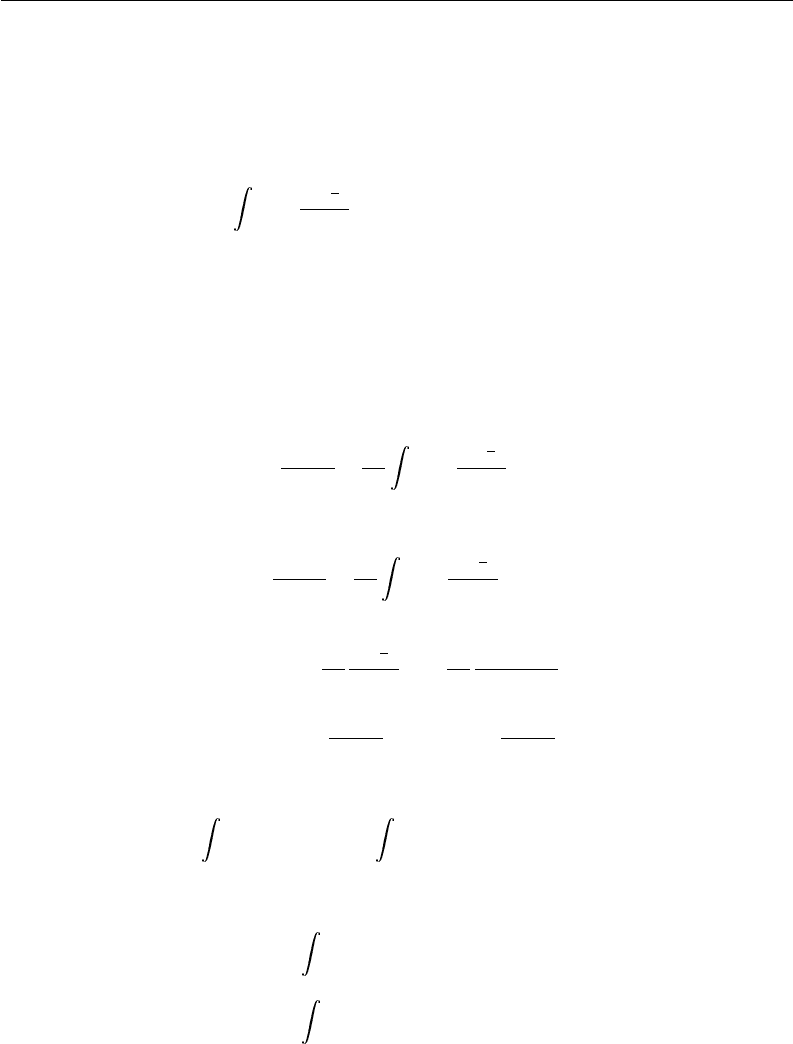
5. Solution of the Dirichlet and Neumann problems
We consider the following problems
∆u = 0 (x ∈ D), u
|Σ
= ϕ
−
(x), (A
−
)
∆u = 0 (x ∈ D
1
), u
|Σ
= ϕ
+
(x), u(∞) = 0, (A
+
)
∆u = 0 (x ∈ D),
∂u
∂n
¯
¯
¯
Σ
= ψ
−
(x), (B
−
)
∆u = 0 (x ∈ D
1
),
∂u
∂n
¯
¯
¯
Σ
= ψ
+
(x), u(∞)
= 0
. (B
+
)
208 G.
Freiling and V. Yurko
The problems (A
−
) and (
A
+
) are the Dirichlet problems (interior and exterior, respec-
tively), and the problems (B
−
) and (B
+
) are the Neumann problems (interior and exterior,
respectively).
We will seek solutions of the Dirichlet problems (A
−
) and (A
+
) in the form of a
double-layer potential:
F(x) =
Σ
f (ξ)
∂
ξ
(
1
r
)
∂n
ξ
d
s
, r := kx −ξk, f ∈C(Σ). (4.6.24)
By Theorem 4.6.1, the function F(x) is harmonic in D and D
1
, F(∞) = 0, and by Theo-
rem 4.6.5, it has finite limits F
+
(x) and F
−
(x) on Σ from outside and inside, respectively.
Therefore, for the function F(x) to be a solution of the problem (A
±
) it is necessary that
F
±
(x) = ϕ
±
(x). Then (4.6.14) takes the form:
For (A
−
) : ϕ
−
(x) = F(x) −2π f (x) or
f (x) = −
ϕ
−
(x)
2π
+
1
2π
Σ
f (ξ)
∂
ξ
(
1
r
)
∂n
ξ
d
s
, x ∈Σ.
For (A
+
) : ϕ
+
(x) = F(x) + 2π f (x) or
f (x) =
ϕ
+
(x)
2π
−
1
2π
Σ
f (ξ)
∂
ξ
(
1
r
)
∂n
ξ
d
s, x ∈Σ
.
Denote
K(x,ξ) :=
1
2π
∂
ξ
(
1
r
)
∂n
ξ
= −
1
2π
cos( ¯n
ξ
, ¯r)
r
2
,
ϕ
1
(x) := −
ϕ
−
(x)
2π
, ϕ
2
(x) :=
ϕ
+
(x)
2π
.
By
virtue
of Lemma 4.6.4 and Theorem 4.6.2,
Σ
|K(x,ξ)|ds ≤C,
Σ
K(x,ξ) f (ξ)ds ∈C(Σ)
for any f ∈C(Σ). As a result we arrive at the following integral equations:
f (x) = ϕ
1
(x) +
Σ
K(x,ξ) f (ξ)ds, x ∈ Σ (for (A
−
)), (4.6.25)
f (x) = ϕ
2
(x) −
Σ
K(x,ξ) f (ξ)ds, x ∈ Σ (for (A
+
)). (4.6.26)
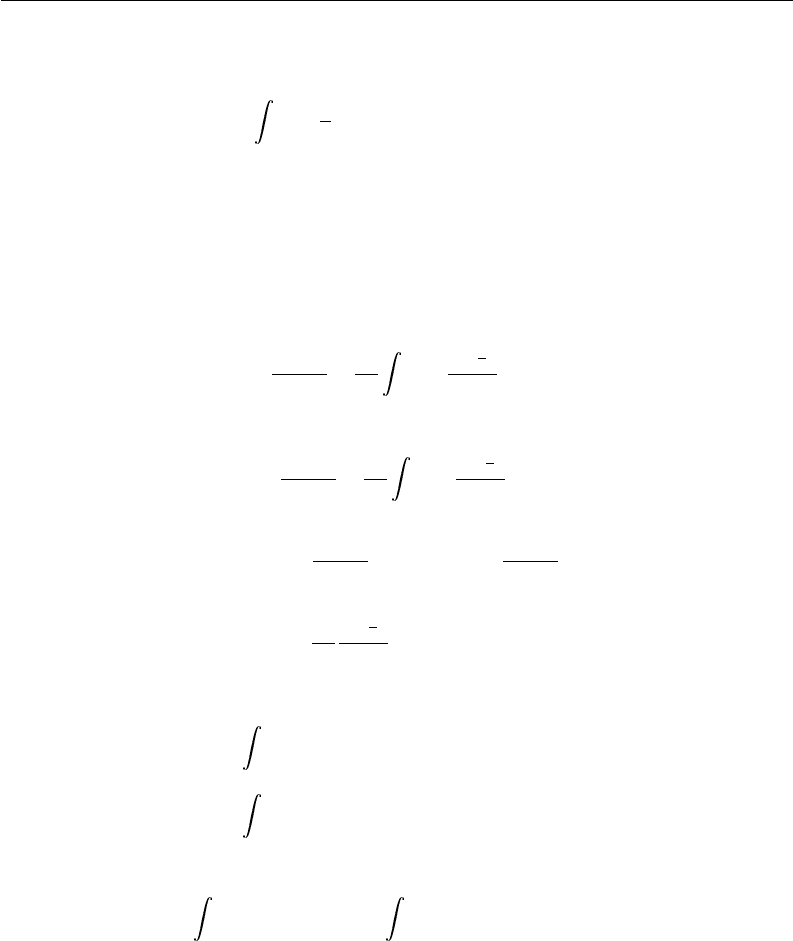
Thus, we have proved the following theorem.
Theorem 4.6.7. 1) If f (x) is a solution of equation (4.6.25) , then F(x), defined by
(4.6.24) , is a solution of problem (A
−
) .
2) If f (x) is a solution of equation (4.6.26), then F(x), defined by, (4.6.24) is a solution
of problem (A
+
) .
Elliptic P
artial Differential Equations 209
We
will seek solutions of the Neumann problem (B
−
) and (B
+
) in the form of a
single-layer potential:
Q(x) =
Σ
q(ξ)
1
r
d
s
, r := kx −ξk, q ∈C(Σ). (4.6.27)
By Theorem 4.6.1, the function Q(x) is harmonic in D and D
1
, Q(∞) = 0, and by Theo-
rem 4.6.6, it has on Σ normal derivatives Φ
+
(x) (from outside) and Φ
−
(x) (from inside).
Therefore, for the function Q(x) to be a solution of problem (B
±
) it is necessary that
Φ
±
(x) = ψ
±
(x). Then relations (4.6.19) take the form:
For (B
−
) : ψ
−
(x) = Φ(x) + 2πq(x) or
q(x) =
ψ
−
(x)
2π
−
1
2π
Σ
q(ξ)
∂
x
(
1
r
)
∂n
x
d
s
, x ∈Σ,
For (B
+
) : ψ
+
(x) = Φ(x) −2πq(x) or
q(x) = −
ψ
+
(x)
2π
+
1
2π
Σ
q(ξ)
∂
x
(
1
r
)
∂n
x
d
s
, x ∈Σ.
Denote
ψ
1
(x) :=
ψ
−
(x)
2π
, ψ
2
(x) := −
ψ
+
(x)
2π
.
Since
1
2π
∂
x
(
1
r
)
∂n
x
= K(ξ,x),
we
arri
ve at the following integral equations:
q(x) = ψ
1
(x) −
Σ
K(ξ,x)q(ξ)ds, x ∈ Σ (for (B
−
)), (4.6.26
∗
)
q(x) = ψ
2
(x) +
Σ
K(ξ,x)q(ξ)ds, x ∈ Σ (for (B
+
)). (4.6.25
∗
)
By virtue of Lemma 4.6.4 and Theorem 4.6.4,
Σ
|K(ξ,x)|ds ≤C,
Σ
K(ξ,x)q(ξ)ds ∈C(Σ)
for any q ∈C(Σ). Thus, we have proved the following theorem.
Theorem 4.6.8. 1) If q(x) is a solution of equation (4.6.26
∗
) , then Q(x), defined by
(4.6.27) , is a solution of problem (B
−
) .
2) If q(x) is a solution of equation ( 4.6.25
∗
), then Q(x), defined by (4.6.27) , is a solution
of problem (B
+
) .
Let us study the integral equations ( 4.6.25 ), ( 4.6.26 ), ( 4.6.25
∗
) and ( 4.6.26
∗
).
Theorem 4.6.9. For any continuous functions ϕ
1
(x) and ψ
2
(x) the solutions of the
integral equations (4.6.25) and (4.6.25
∗
) exist and are unique.
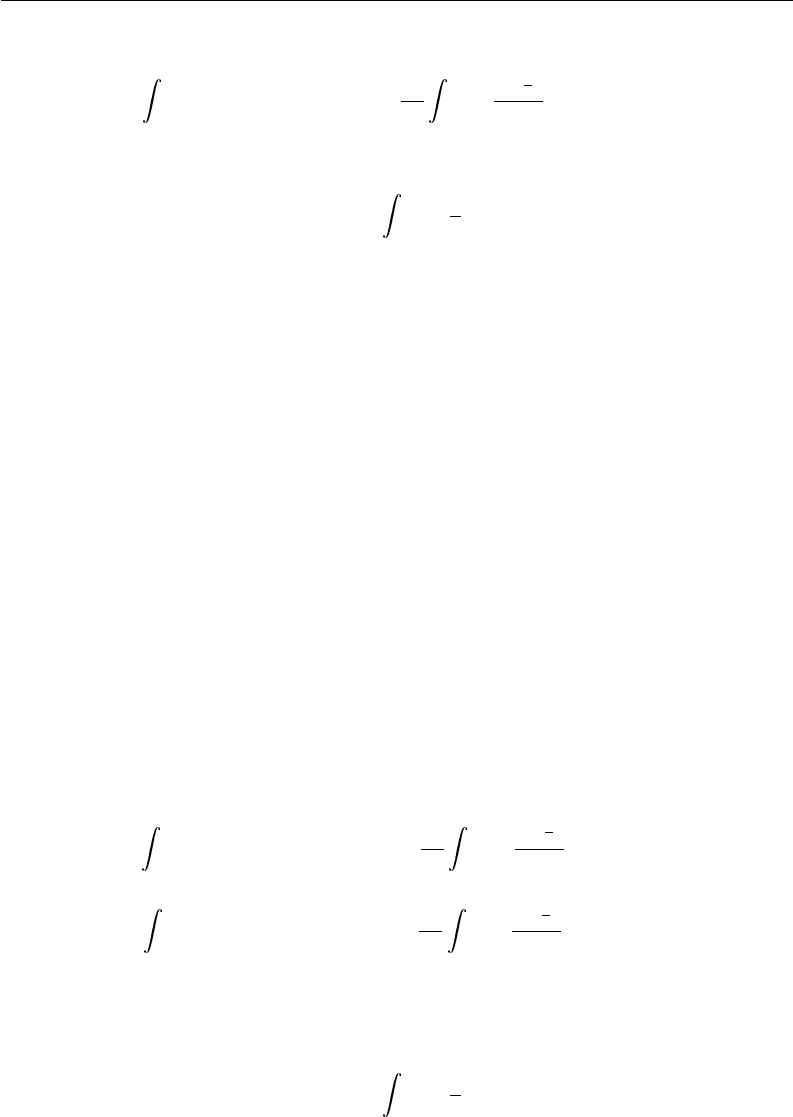
210 G.
Freiling and V. Yurko
Proof
. Let ˜q(x) be a solution of the homogeneous equation
˜q(x) =
Σ
K(ξ,x) ˜q(ξ)ds, ⇔ ˜q(x) =
1
2π
Σ
˜q(ξ)
∂
x
(
1
r
)
∂n
x
d
s
, x ∈Σ. (4.6.25
∗
0
)
We consider the single-layer potential
˜
Q(x) :=
Σ
˜q(ξ)
1
r
d
s
and
the corresponding functions
˜
Φ(x) and
˜
Φ
±
(x). Then ( 4.6.25
∗
0
) has the form
˜
Φ(x) −
2π ˜q(x) = 0. On the other hand, by Theorem 4.6.6,
˜
Φ(x) −2π ˜q(x) =
˜
Φ
+
(x), and con-
sequently,
˜
Φ
+
(x) = 0 , x ∈ Σ. By the uniqueness theorem for problem ( B
+
), we have
˜
Q(x) = 0 , x ∈ D
1
. According to Theorem 4.6.3,
˜
Q(x) is continuous in R
3
, hence
˜
Q(x) = 0, x ∈Σ. By the uniqueness theorem for problem ( A
−
), we have
˜
Q(x) = 0 , x ∈D.
Therefore,
˜
Q(x) ≡ 0 , x ∈ R
3
, and consequently,
˜
Φ
±
(x) = 0 , x ∈ Σ. By Theorem 4.6.6,
˜q(x) = 0 , x ∈ Σ. Thus, the homogeneous equation ( 4.6.25
∗
0
) has only the trivial solution.
Using the Fredholm theorem we obtain the assertions of Theorem 4.6.9. 2
The following theorems are corollaries of Theorems 4.6.7-4.6.9 and the uniqueness
theorem for the problems ( A
−
) and ( B
+
).
Theorem 4.6.10. For any continuous function ϕ
−
(x) the solution of the interior Dirich-
let problem ( A
−
) exists, is unique and has the form (4.6.24) , where the function f (x) is
the solution of the integral equation (4.6.25) .
Theorem 4.6.11. For any continuous function ψ
+
(x) the solution of the exterior Neu-
mann problem (B
+
) exists, is unique and has the form (4.6.27) , where the function q(x)
is the solution of the integral equation (4.6.25
∗
) .
Studying the problems ( A
+
) and ( B
−
) is a more complicated task. We consider the
homogeneous equations
˜
f (x) = −
Σ
K(x,ξ)
˜
f (ξ) ds, ⇔
˜
f (x) = −
1
2π
Σ
˜
f (ξ)
∂
ξ
(
1
r
)
∂n
ξ
d
s
, x ∈Σ, (4.6.26
0
)
˜q(x) = −
Σ
K(ξ,x) ˜q(ξ)ds, ⇔ ˜q(x) = −
1
2π
Σ
˜q(ξ)
∂
x
(
1
r
)
∂n
x
d
s
, x ∈Σ. (4.6.26
∗
0
)
By virtue of Lemma 4.6.7, the function
˜
f (x) ≡1 is a solution of equation ( 4.6.26
0
). Then,
by Fredholm’s theorem, equation ( 4.6.26
∗
0
) also has a nontrivial solution ˜q(x) 6≡0. For this
solution we consider the single-layer potential
˜
Q(x) :=
Σ
˜q(ξ)
1
r
d
s
and
the corresponding functions
˜
Φ(x) and
˜
Φ
±
(x). Equation ( 4.6.26
∗
0
) has the form
˜
Φ(x) + 2π ˜q(x) = 0. On the other hand, by Theorem 4.6.6,
˜
Φ(x) + 2π ˜q(x) =
˜
Φ
−
(x), and
consequently,
˜
Φ
−
(x) = 0 , x ∈ Σ. By the uniqueness theorem for problem ( B
−
), we have

Elliptic P
artial Differential Equations 211
˜
Q(x) ≡C , x ∈
D. Let us
show that equation ( 4.6.26
∗
0
) has not two linearly independent
solutions. Indeed, let ˜q
1
(x) and ˜q
2
(x) be solutions of ( 4.6.26
∗
0
). Then
˜
Q
k
(x) :=
Σ
˜q
k
(ξ)
1
r
d
s ≡C
k
, x ∈
D.
Denote ˆq(x) := C
2
˜q
1
(x) −C
1
˜q
2
(x). Then
ˆ
Q
k
(x) :=
Σ
ˆq
k
(ξ)
1
r
d
s ≡ 0
, x ∈
D,
and
consequently
, by virtue of the uniqueness theorem for the problem ( A
+
),
ˆ
Q(x) ≡ 0 in
R
3
. Then we have
ˆ
Φ
±
(x) = 0 and ˆq(x) = 0, i.e. C
2
˜q
1
(x) ≡C
1
˜q
2
(x).
Thus, equation ( 4.6.26
∗
0
) has only one nontrivial solution (up to a multiplicative con-
stant). Normalizing: Let q
0
(x) 6≡ 0 be a solution of equation ( 4.6.26
∗
0
) such that
Q
0
(x) :=
Σ
q
0
(ξ)
1
r
d
s ≡ 1
, x ∈
D.
The
potential q
0
(x) is
called the Roben potential. By Fredholm’s theorem, equation
( 4.6.26
0
) also has only one nontrivial solution (up to a multiplicative constant)
˜
f (x) ≡ 1.
Using Fredholm’s theorem again we arrive at the following assertion.
Theorem 4.6.12. 1) The integral equation (4.6.26
∗
) has a solution if and only if
Σ
ψ
1
(ξ)ds = 0.
If q
1
(x) and q
2
(x) are solutions of (4.6.26
∗
) , then q
1
(x) −q
2
(x) ≡Cq
0
(x), where q
0
(x)
is the Roben potential.
2) The integral equation (4.6.26) has a solution if and only if
Σ
ϕ
2
(ξ)q
0
(ξ)ds = 0,
where q
0
(ξ) is the Roben potential. If f
1
(x) and f
2
(x) are solutions of (4.6.26) , then
f
1
(x) − f
2
(x) ≡C.
The following theorem is a corollary of Theorem 4.6.8, 4.6.12 and 4.2.3.
Theorem 4.6.13. The interior Neumann problem ( B
−
) has a solution if and only if
Σ
ψ
−
(ξ)ds = 0.
The solution is defined up to a constant summand. Any solution of (B
−
) has the form
(4.6.27) , where the function q(x) is a solution of the integral equation (4.6.26
∗
) .
It remains to study the exterior Dirichlet problem ( A
+
). We reduced it to equation
(4.6.26). It follows from Theorem 4.6.12 that equation (4.6.26) has either no solutions
or an infinite number of solutions. But this contradicts to the uniqueness theorem for the