
Freiling G., Yurko V. Lectures on Differential Equations of Mathematical Physics: A First Course
Подождите немного. Документ загружается.

212 G.
Freiling and V. Yurko
problem ( A
+
).
The reason is that we seek a solution of problem ( A
+
) in the form (4.6.24),
but by Theorem 4.6.1,
F(x) = O
µ
1
kxk
2

, x →∞.
Thus,
we
do not take into account solutions of the class O
µ
1
kxk

. Therefore,
we
will act
as follows.
Fix x
0
∈ D. Let us seek a solution of the problem ( A
+
) in the form
u(x) = F(x) +
α
kx −x
0
k
,
where F(x) has
the
form (4.6.24), α = const. Clearly, u(x) is harmonic in D
1
, u(∞) = 0
and u(x) ∈C(
D
1
). Therefore,
for
the function u(x) to be a solution of ( A
+
), it is necessary
that u
|Σ
= ϕ
+
, i.e.
ϕ
+
(x) = F
+
(x) +
α
kx −x
0
k
, x ∈Σ.
Since F
+
(x)
= F(x)
+ 2π f (x), we arrive at the equation:
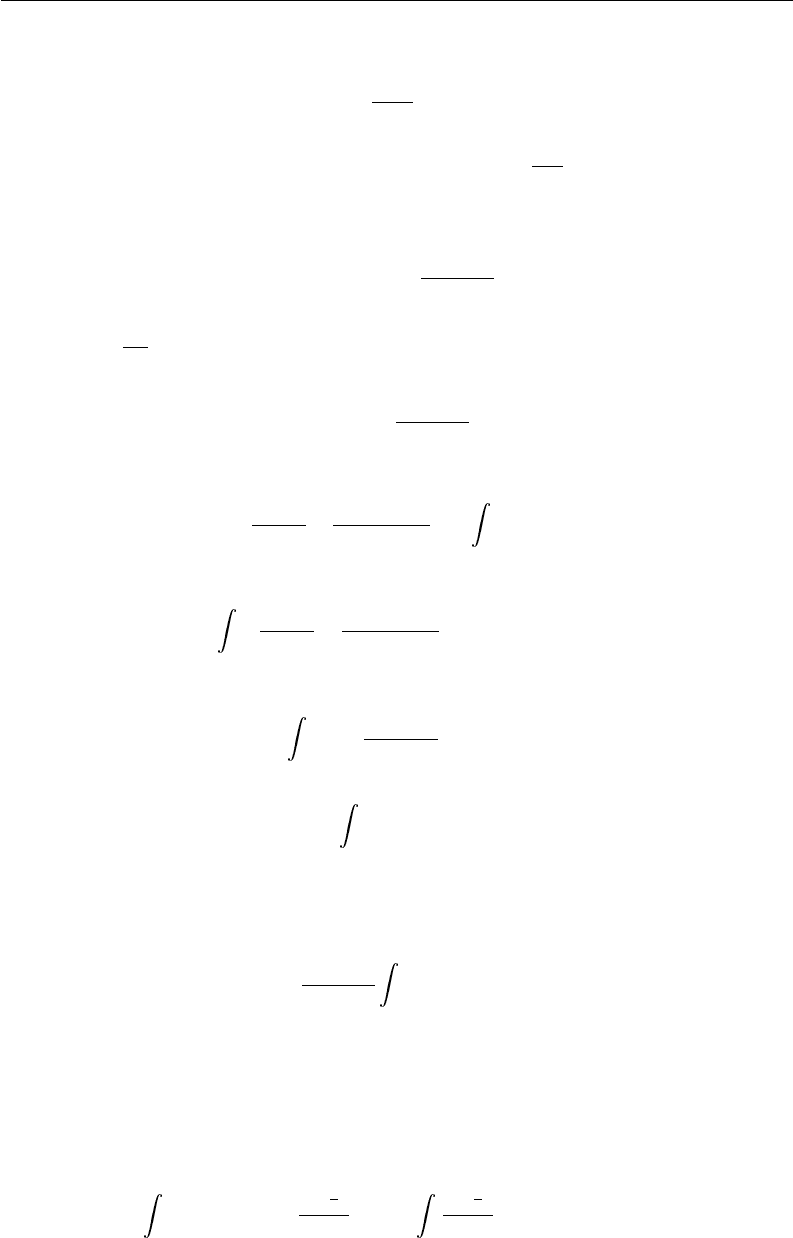
f (x) =
µ
ϕ
+
(x)
2π
−
α
2πkx −x
0
k

−
Σ
K(x,ξ) f (ξ)d
s. (
4.6.28)
According to Theorem 4.6.12, equation (4.6.28) is solvable if and only if
Σ
µ
ϕ
+
(ξ)
2π
−
α
2πkξ −x
0
k

q
0
(ξ)d
s = 0
.
Since x
0
∈ D and q
0
is the Roben potential, we have
Σ
q
0
(ξ)
1
kξ −x
0
k
d
s = 1
,
and consequently,
α =
Σ
ϕ
+
(ξ)q
0
(ξ)ds.
Thus, we have proved the following assertion.
Theorem 4.6.14. For any continuous function ϕ
+
(x) the solution of the exterior
Dirichlet problem ( A
+
) exists, is unique and has the form
u(x) = F(x) +
1
kx −x
0
k
Σ
ϕ
+
(ξ)q
0
(ξ)d
s
, x ∈D
1
,
where q
0
(x) is the Roben potential, F(x) has the form (4.6.24) , and f (x) is a solution
of the integral equation (4.6.28) .
We note that equation (4.6.28) has an infinite number of solutions but F(x) is unique.
Indeed, if
ˆ
f (x) is another solution (different from f (x) ) of equation (4.6.28), then
ˆ
f (x) −
f (x) ≡C, and by virtue of Lemma 4.6.7,
Σ
³
f (ξ) −
ˆ
f (ξ)
´
∂
ξ
(
1
r
)
∂n
ξ
d
s = C
Σ
∂
ξ
(
1
r
)
∂n
ξ
d
s = 0
, x ∈D
1
.
Elliptic P
artial Differential Equations 213
4.7. The
Variational Method
1. The variational Dirichlet principle
Let D ⊂ R
n
be a bounded domain with the boundary Σ ∈PC
1
. We consider the Dirichlet
problem
∆u = 0 (x ∈ D),
u
|Σ
= ϕ(x), ϕ(x) ∈C(Σ).
)
(4.7.1)
Denote
R
ϕ
:= {u : u ∈C(
D), u ∈C
2
(D), u
|Σ
= ϕ}.
A
function u
(x) is called a solution of problem (4.7.1) if u ∈ R
ϕ
and ∆u = 0 in D. We
consider the Dirichlet functional
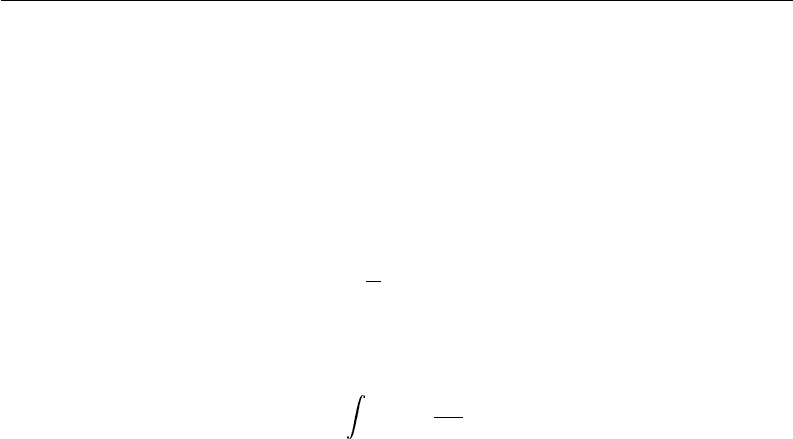
Φ(u) :=
D
³
n
∑
k=1
³
∂u
∂x
k
´
2
´
d
x (4
.7.2)
and formulate the variational extremal problem
Φ(u) → inf, u ∈ R
ϕ
. (4.7.3)
Clearly, Φ(u) ≥ 0, and consequently, there exists inf
u∈R
ϕ
Φ(u). Suppose that there exists a
function u
∗
∈ R
ϕ
such that
Φ(u
∗
) = inf
u∈R
ϕ
Φ(u).
Then u
∗
satisfies the Euler equation. For the functional (4.7.2) the Euler equation has the
form ∆u = 0. Therefore, if u
∗
is a solution of the variational problem (4.7.3), then u
∗
is
a solution of problem (4.7.1). Thus, we replace (4.7.1) by the variational problem (4.7.3).
This approach is fruitful since one can use methods of the variational calculus.
Criticism. 1) It can happen that infΦ(u) = ∞, i.e. Φ(u) = ∞ ∀u ∈R
ϕ
. An example of
such a function is due to Hadamard (see [8, Chapter 22]). In this case the variational method
does not work (although a solution of the problem (4.7.1) can exist as in the Hadamard
example). In order to apply the variational method we impose an additional condition.
Denote Q
ϕ
:= {u ∈R
ϕ
: Φ(u) < ∞}.
Continuability (extendability) condition: Q
ϕ
6=
/
0. (4.7.4)
For such ϕ we have inf Φ(u) < ∞. In particular, if Σ is smooth, and ϕ ∈C
1
, then condi-
tion (4.7.4) is fulfilled automatically.
2) We suppose that problem (4.7.3) has a solution. This is not always valid, i.e. the
infimum in (4.7.3) is not always attained (see [8, Chapter 22]). However, if one takes simply
connected domains and extends the notion of the solution, then the variational method gives
us the existence and the uniqueness of the solution of the Dirichlet problem, and also a
constructive procedure for its solution.

214 G.
Freiling and V. Yurko
2. Operator
equations in a Hilbert space
Let H be a real Hilbert space with the scalar product (·, ·) and with the norm k·k. Let
A : D
A
→ E
A
be a symmetric operator in H with an everywhere dense domain D
A
.
Definition 4.7.1. The operator A is called positive definite ( A > 0 ), if (Au,u) ≥γkuk
2
for some γ > 0 and for all u ∈D
A
.
Everywhere below we assume that A > 0. In particular, this yields that on E
A
there
exists the inverse operator A
−1
. We consider in H the equation
Au = f , f ∈ H. (4.7.5)
An element u
∗
is called a solution of (4.7.5), if u
∗
∈ D
A
and Au
∗
= f . The following
theorem is obvious.
Theorem 4.7.1. 1) If a solution of (4.7.5) exists, then it is unique.
2) A solution of (4.7.5) exists if and only if f ∈ E
A
. In particular, if E
A
= H, then a
solution of (4.7.5) exists for all f ∈ H.
Consider the functional
F(u) = (Au,u) −2(u, f ), u ∈D
A
(4.7.6)
on D
A
and the extremal problem
F(u) → inf, u ∈ D
A
. (4.7.7)
An element u
∗
∈ D
A
is called a solution of the problem (4.7.7), if F(u
∗
) = inf
u∈D
A
F(u).
Theorem 4.7.2. The problems (4.7.5) and (4.7.7) are equivalent, i.e. they are solvable
or unsolvable simultaneously, and u
∗
is a solution of (4.7.5) if and only if u
∗
is a solution
of (4.7.7).
Proof. 1) Let Au
∗
= f , u
∗
∈ D
A
. Let v ∈D
A
, η = v −u
∗
, i.e. v = u
∗
+ η. Then
F(v) = (A(u
∗
+ η),u
∗
+ η) −2(u
∗
+ η, f ) = F(u
∗
) + (Aη,η) > F(u
∗
),
and consequently, u
∗
is a solution of (4.7.7).
2) Let u
∗
be a solution of (4.7.7), and let η ∈D
A
, λ = const. . Then u
∗
+λη ∈D
A
, and
consequently, F(u
∗
+ λη) ≥ F(u
∗
). This yields 2λ(Au
∗
− f ,η) + λ
2
(Aη,η) ≥ 0. This is
possible only if (Au
∗
− f , η) = 0 for all η ∈D
A
. Since D
A
is everywhere dense, we have
Au
∗
= f , and Theorem 4.7.2 is proved. 2
Remark 4.7.1. If E
A
6= H, f /∈ E
A
, then the problems (4.7.5) and (4.7.7) have no
solutions. We extend the notion of the solution. For this purpose we introduce the so-called
energy space.
We introduce a new scalar product and the corresponding norm: [u, v] := (Au,v) , |u|
2
=
[u,u] , u,v ∈ D
A
. Then we complete this space by taking its closure, i.e. by including the
limit elements with respect to its norm. As a result we obtain a new Hilbert space which is
denoted by H
A
and is called the energy space. It can be shown [9] that H
A
⊂ H.

Elliptic P
artial Differential Equations 215
Example 4.7.1. Let H = L
2
(0
,1) ,
Au = −u
00
(x), u(0) = u(1) = 0, D
A
= {u ∈C
2
[0,1] : u(0) = u(1) = 0}.
Then
(Au,u) =
1
0
³
u
0
(x)
´
2
dx.
Since
u(x) =
1
0
u
0
(x)dx,
we have |u(x)| ≤ ku
0
k
L
2
, and consequently, kuk
L
2
≤ ku
0
k
L
2
, i.e. A > 0. Moreover,
H
A
= {u(x) ∈ AC[0,1] : u
0
(x) ∈ L
2
(0,1), u(0) = u(1) = 0}.
We extend the domain of the functional F(u) of the form (4.7.6) to H
A
, namely, we
consider the functional
F(u) = [u,u] −2(u, f ), u ∈H
A
.
Since
|u|
2
= (Au,u) ≥ γkuk
2
,
we have
|(u, f )| ≤ kf k·kuk ≤ γ
−1/2
kf k·|u|,
and consequently, the functional (u, f ) is bounded in H
A
. By the Riesz representation
theorem, there exists a unique element f
∗
∈ H
A
such that (u, f ) = [u, f
∗
]. Therefore the
functional takes the form
F(u) = [u,u] −2[u, f
∗
], u ∈H
A
. (4.7.8)
Consider the extremum problem
F(u) → inf, u ∈ H
A
. (4.7.9)
An element u
∗
∈ H
A
is called a solution of (4.7.9), if F(u
∗
) = inf
u∈H
A
F(u).
Theorem 4.7.3. For each f
∗
∈ H
A
problem (4.7.9) has a unique solution u
∗
, and
u
∗
= f
∗
.
Indeed, by virtue of (4.7.8),
F(u) = [u − f
∗
,u − f
∗
] −[ f
∗
, f
∗
] = |u − f
∗
|
2
−|f
∗
|
2
.
This yields the assertion of the theorem.
Definition 4.7.2. An element u
∗
∈H
A
, which gives a solution of (4.7.9) (i.e. u
∗
= f
∗
),
is called a generalized solution of problem (4.7.5).
One can give another (equivalent) definition of a generalized solution of problem
(4.7.5). Indeed, from (4.7.5) we infer (Au,v) = ( f ,v) , v ∈ H
A
or [u,v] = ( f ,v).

216 G.
Freiling and V. Yurko
Definition 4.7.3. An
element u
∗
∈ H
A
is called a generalized solution of problem
(4.7.5) if [u
∗
,v] = ( f ,v) for all v ∈ H
A
.
These definitions are equivalent since ( f ,v) = [ f
∗
,v].
Theorem 4.7.4. For each f ∈ H a generalized solution of problem (4.7.5) exists, is
unique and has the form u
∗
= f
∗
.
3. Solution of the Dirichlet problem
Next we apply the theory developed above for the solution of the Dirichlet problem. We
confine ourselves to the cases n = 2 and n = 3. Let us consider the following Dirichlet
problem:
−∆u = f (x ∈ D), f ∈L
2
(D),
u
|Σ
= 0,
)
(4.7.10)
where D is a bounded simply connected domain. Denote
R := {u : u ∈W
2
2
(D), u
|Σ
= 0} =: W
2,0
2
.
By the embedding theorem u ∈C(
D).
Definition
4.7.4. A
function u
∗
is called a(classical) solution of problem (4.7.10), if
u
∗
∈ R and −∆u
∗
= f .
Problem (4.7.10) is a particular case of problem (4.7.5), where H = L
2
(D), A =
−∆, D
A
= R. It is known [9] that A > 0. In this case
[u,v] =
D
Ã
n
∑
k
=
1
∂u
∂x
k
∂v
∂x
k
!
d
x.
One
can show that H
A
= W
1,0
2
.
Definition 4.7.5. A function u
∗
is called a generalized solution of problem (4.7.10), if
u
∗
∈W
1,0
2
and [u
∗
,v] = ( f ,v) for all v ∈W
1,0
2
.
By virtue of Theorem 4.7.4, for any f ∈ L
2
(D) a generalized solution of problem
(4.7.10) exists and is unique. We note that for (4.7.10) a generalized solution is also a
classical one. In other words, the following assertion is valid [9]:
Theorem 4.7.5. Let u
∗
∈W
1,0
2
be a generalized solution of (4.7.10) . Then u
∗
∈W
2,0
2
and −∆u
∗
= f , i.e. u
∗
is a classical solution of (4.7.10) .
Corollary 4.7.1. For any f ∈ L
2
(D), a classical solution of problem (4.7.10) exists
and is unique.
Now we consider the Dirichlet problem for the homogeneous equation:
∆u = 0 (x ∈ D),
u
|Σ
= ϕ(x), ϕ(x) ∈C(Σ).
)
(4.7.11)

Elliptic P
artial Differential Equations 217
Denote R
ϕ
:= {u : u ∈ W
2
2
(D), u
|Σ
= ϕ}. If u ∈ R
ϕ
, then by
the embedding theorem
u ∈C(
D).
Definition
4.7.6. A
function u
∗
is called a solution of problem (4.7.11) if u
∗
∈ R
ϕ
and ∆u
∗
= 0 in D.
Denote Q
ϕ
:= {u ∈ R
ϕ
: Φ(u) < ∞}, where Φ(u) is defined by (4.7.2). Let Q
ϕ
6=
/
0,
i.e. the continuability (extendability) condition (4.7.4) is fulfilled. Fix w ∈ Q
ϕ
. Clearly, if
u ∈ R
ϕ
, then v := u −w ∈ R, and conversely, if v ∈R, then u := v + w ∈R
ϕ
. This yields
that the function u
∗
is a solution of problem (4.7.11) if and only if the function v
∗
= u
∗
−w
is a solution of the problem
−∆v = f (x ∈D), f := ∆w ∈L
2
(D),
v
|Σ
= 0.
)
(4.7.12)
According to Corollary 4.7.1, the (classical) solution of problem (4.7.12) exists and is
unique. Thus, we have proved the following assertion.
Theorem 4.7.6. Let ϕ be such that Q
ϕ
6=
/
0. Then a solution of the problem (4.7.11)
exists and is unique.
For more details on variational methods in connection with problems of mathematical
physics we refer the reader to textbooks like [7], [8] and [9].

Chapter
5.
The
Cauchy-Kowalevsky Theorem
Definition 5.1. A function f (x
1
,. .. ,x
n
) is called analytic at the point (x
0
1
,. .. ,
x
0
n
), if in some neighbourhood of this point it can be represented in the form of an ab-
solutely convergent power series
f (x
1
,. .. ,x
n
) =
∞
∑
k
1
,...,k
n
=0
A
k
1
,...,k
n
(x
1
−x
0
1
)
k
1
.. .(x
n
−x
0
n
)
k
n
. (5.1)
Consequently, the function f has partial derivatives of all orders and
A
k
1
,...,k
n
=
1
k
1
!.
.
.k
n
!
∂
k
1
+...+k
n
f
∂x
k
1
1
.
.
.∂x
k
n
n
¯
¯
¯
x
1
=x
0
1
,...,x
n
=x
0
n
.
Moreover, the series (5.1) can be differentiated termwise in its domain of convergence an
arbitrary number of times.
Without loss of generality we will consider the case when
(x
0
1
,. .. ,x
0
n
) = (0,.. ., 0).
Then (5.1) takes the form
f (x
1
,. .. ,x
n
) =
∞
∑
k
1
,...,k
n
=0
A
k
1
,...,k
n
x
k
1
1
.. .x
k
n
n
. (5.2)
Definition 5.2. A function F(x
1
,. .. ,x
n
) is called a majorant for a function
f (x
1
,. .. ,x
n
) of the form (5.2), if F(x
1
,. .. ,x
n
) is analytic in a neighbourhood of the origin:
F(x
1
,. .. ,x
n
) =
∞
∑
k
1
,...,k
n
=0
B
k
1
,...,k
n
x
k
1
1
.. .x
k
n
n
(5.3)
in a neighbourhood of 0 , and
|A
k
1
,...,k
n
| ≤ B
k
1
,...,k
n
for all k
1
,. .. ,k
n
. Clearly, the radius of convergence of (5.2) is not less than the radius of
convergence of (5.3).

220 G.
Freiling and V. Yurko
Lemma 5.1. Let
the function f (t,x
1
,. .. ,x
n
) be analytic at the origin:
f (t,x
1
,. .. ,x
n
) =
∞
∑
k
0
,...,k
n
=0
A
k
0
,...,k
n
t
k
0
x
k
1
1
.. .x
k
n
n
. (5.4)
Then there exist M > 0 and a > 0 such that for each fixed α ∈(0,1] the function
F(t,x
1
,. .. ,x
n
) =
M
1 −
t/α+x
1
+.
..+x
n
a
(5.5)
is
a
majorant for f .
Proof. Since the series (5.4) converges absolutely in a neighbourhood of the origin,
there exist positive numbers a
0
,a
1
,. .. ,a
n
such that
∞
∑
k
0
,...,k
n
=0
|A
k
0
,...,k
n
|a
k
0
0
.. .a
k
n
n
< ∞.
In particular, there exists M > 0 such that
|A
k
0
,...,k
n
|a
k
0
0
.. .a
k
n
n
≤ M
for all k
1
,. .. ,k
n
. Therefore,
|A
k
0
,...,k
n
| ≤
M
a
k
0
0
.
.
.a
k
n
n
.
Let a = min
0≤m≤n
a
m
. Then
|A
k
0
,...,k
n
| ≤
M
a
k
0
+..
.+k
n
. (5
.6)
Consider a function F(t, x
1
,. .. ,x
n
) of the form (5.5) with these M > 0 and a > 0. Since
(5.5) is the sum of terms of the geometric progression, we have for |t|/α+|x
1
|+.. .+|x
n
|<
a
F(t,x
1
,. .. ,x
n
) = M
∞
∑
k=0
(t/α + x
1
+ ... + x
n
)
k
a
k
= M
∞
∑
k=0
1
a
k
∑
k
0
+.
..+k
n
=k
k!
k
0
!.
.
.k
n
!
³
t
α
´
k
0
x
k
1
1
.
.
.x
k
n
n
.
Taking (5.6) into account we obtain
B
k
0
,...,k
n
=
M
a
k
0
+..
.+k
n
α
k
0
(k
0
+ .
.. + k
n
)!
k
0
!.
.
.k
n
!
≥
M
a
k
0
+..
.+k
n
≥
|A
k
0
,...,k
n
|,
and Lemma 5.1 is proved. 2
The general Cauchy-Kowalevsky theorem is a fundamental theorem on the existence
of the solution of the Cauchy problem for a wide class of systems of partial differential
equations. For simplicity we confine ourselves here to the case of linear systems of the first
order. We consider the following Cauchy problem:
∂u
i
∂t
=
N
∑
j=1
n
∑
k=1
a
i
j
k
(t, x
1
,. .. ,x
n
)
∂u
j
∂x
k
+
N
∑
j=1
b
i
j
(t, x
1
,
.. ., x
n
)u
j

The Cauch
y-Kowalevsky Theorem 221
+c
i
(t, x
1
,.
.. ,x
n
), (5.7)
u
i|t=t
0
= ϕ
i
(x
1
,. .. ,x
n
), i =
1,N, (5.8)
Here t,x
1
,
.
.. ,x
n
are independent variables and u
1
,. .. ,u
N
are unknown functions.
Theorem 5.1. Let the functions a
i jk
, b
i j
, c
i
be analytic at the point (t
0
,x
0
1
,. .. ,
x
0
n
), and let the functions ϕ
i
be analytic at (x
0
1
,. .. ,x
0
n
). Then in some neighbourhood of
the point (t
0
,x
0
1
,. .. ,x
0
n
) the Cauchy problem (5.7) −(5.8) has a unique analytic solution.
Proof. Without loss of generality we assume that t
0
= x
0
1
= . .. = x
0
n
= 0, i.e. we
seek a solution in a neighbourhood of the origin. Without loss of generality we also assume
that ϕ
i
(x
1
,. .. ,x
n
) ≡ 0. Otherwise, for the functions v
i
:= u
i
−ϕ
i
we obtain a system of
the form (5.7) with different c
i
, but with zero initial conditions. Thus, we will solve the
Cauchy problem for system (5.7) in a neighbourhood of the origin with the initial conditions
u
i
(0,x
1
,. .. ,x
n
) = 0. (5.9)
Step 1: Constructing of the solution. Suppose that there exists an analytic (at the
origin) solution of the Cauchy problem (5.7), (5.9):
u
i
(t, x
1
,. .. ,x
n
) =
∞
∑
k
0
,...,k
n
=0
α
i
k
0
,...,k
n
t
k
0
x
k
1
1
.. .x
k
n
n
, (5.10)
α
i
k
0
,...,k
n
=
1
k
0
!.
.
.k
n
!
∂
k
0
+...+k
n
u
i
∂t
k
0
∂x
k
1
1
.
.
.∂x
k
n
n
|t=0,x
1
=...=x
n
=0
.
Let us give a constructive procedure for finding the coefficients α
i
k
0
,...,k
n
.
1) Differentiating (5.9) k
1
times with respect to x
1
, .. . , k
n
times with respect to x
n
and taking t = x
1
= . .. = x
n
= 0, we obtain α
i
0,k
1
...,k
n
= 0.
2) We differentiate (5.7) k
1
times with respect to x
1
, . .. , k
n
times with respect to x
n
and take t = x
1
= .. . = x
n
= 0. Then from the left we obtain α
i
1,k
1
...,k
n
, and from the right
we obtain known quantities. Thus, we have constructed the coefficients α
i
1,k
1
,...,k
n
.
3) We differentiate (5.7) once with respect to t , k
1
times with respect to x
1
,. .. , k
n
times with respect to x
n
and take t = x
1
= . .. = x
n
= 0. Then from the left we obtain
α
i
2,k
1
...,k
n
, and from the right we obtain known quantities which depend on α
i
1,k
1
,...,k
n
. Thus,
we have constructed the coefficients α
i
2,k
1
,...,k
n
.
4) We continue this process by induction. Suppose that the coefficients α
i
j,k
1
,...,k
n
have been already constructed for j =
0,k
0
−1. W
e
differentiate (5.7) k
0
−1 times with
respect to t , k
1
times with respect to x
1
,. .. , k
n
times with respect to x
n
and take
t = x
1
= ... = x
n
= 0. Then from the left we obtain α
i
k
0
,k
1
...,k
n
, and from the right we obtain
known quantities which depend on α
i
j,k
1
,...,k
n
, j =
0,k
0
−1. Thus,
we
have constructed the
coefficients α
i
k
0
,k
1
,...,k
n
.
This procedure of constructing the analytic solution (5.10) of the Cauchy problem (5.7),
(5.9) is called the A-procedure. In particular, this yields the uniqueness of the analytic so-
lution. It remains to show that the series (5.10), constructed by the A-procedure, converges
in some neighbourhood of the origin.