
Gary Dahl. Advertising for Dummies
Подождите немного. Документ загружается.


Organizing the information in your press release
When you have something interesting to say and you want to submit a press
release, you need to write the release in the form that editors and reporters
are used to seeing. The standard press release format is a fairly structured
one, written in the journalistic style (a narrative style in which the most
important facts come first) and contain the five Ws: who, what, when, where,
and why. The reader of a press release should be able to grasp all the neces-
sary facts after reading only the first paragraph.
Your release should include the following information, in this order:
The sending company’s name, address, phone number, fax number,
e-mail address, and contact person (that’s you).
The date of submission and the instructions as to when the story is to
be released to the public — usually “For immediate release.”
The words “Press Release” — this way the editors know what this story is.
A headline: a straightforward, one-line summary of the story. Although
some people feel that including a headline on a press release is an insult
to the editor of the publication (who may want to write his own head-
line), I usually add a headline anyway to attract the editor’s attention
and to make the story easily understood.
An introductory paragraph: a slightly more-detailed summary of the
story.
262
Part IV: Beyond the Basics: Creating Buzz and Using Publicity
What editors and reporters
look for in a press release
I asked a columnist for the
San Jose Mercury
News
what he looks for in a press release —
why he prints one story and discards another.
His response was succinct: “What’s a good
press release? Brief, to the point, and promising
information no one else has.” He then said, “If I
were to offer one suggestion to people sending
out press releases, it would be to first read the
publication the release is going to and to read
the writings of the editor or reporter to whom
the release is being sent. That, more than any-
thing else, will increase your chances of being
published.”
Remember:
Sending out a press release isn’t a
guarantee that you’ll ever see it in print. You may
think your story is newsworthy, but the editor
may not. Editors only print news that can inter-
est their readers. And they know what their
readers want. Your story could also be killed
because you had the unfortunate timing of
sending it in just when a major news story
erupted. Because space (whether print or
broadcast) is finite, your story could get bumped
in favor of more important news. Sometimes, it’s
the luck of the draw.
25_045833 ch18.qxp 11/22/06 3:45 PM Page 262

The bulk of the story containing straightforward, pertinent information,
written with the copious use of quotes. Using quotes allows you to
impart information that then appears to have been gleaned by a
reporter from an actual interview of the person “speaking.”
Fluff: information of some interest, but not directly relevant to the story.
A photo, drawing, chart, or other graphic element directly related to the
story, along with a suggested caption written by you.
The end of the story should be clearly marked with # # #.
In addition to the press release, a full media kit could include some or all of
the following information:
A Q&A simulated interview: Providing an interview in this format
would call attention to some of the key points you want to make about
your business. Broadcast news media may then use this format as the
basis for an actual interview with you, and print media may simply
reprint it in their publications.
A detailed bio of you or other key people who founded or run your
business: This biography should be no more than one page, but that
should be more than enough for you to highlight what you’re most suc-
cessful at or experienced in doing! It’s okay to brag a little, as long as
you can back it up!
Endorsements or testimonials from satisfied customers or clients: You
may have collected these over the years, if you’ve gotten them in writ-
ing, or you can contact some of your best customers and ask them to
provide you with one now.
Make sure you have your clients’ permission, though, to include these
comments in your press materials — you don’t want to surprise anyone
who wouldn’t expect to see his name in print or on the air!
Articles previously published by or about you in other publications: If
you or your business have already been profiled in some magazine or
newspaper, include copies of those. Ideally, they should be glossy repro-
ductions of the actual article, with the publication’s masthead. If you
don’t have that, though, a simple black-and-white photocopy is fine, but
try not to use printouts from the Web: They don’t have the same note of
authenticity — even though they’re real — as a reprint does.
Getting the story to the right media
You can either deliver, mail, or e-mail your press release directly to your local
publication. Or if you’re eager to get the story published by multiple publica-
tions or broadcasters (if the story has national implications, for instance),
you can use a professional service such as the Business Wire.
263
Chapter 18: Leveraging Your Advertising
25_045833 ch18.qxp 11/22/06 3:45 PM Page 263

Business Wire (www.businesswire.com) is a service that electronically dis-
seminates your story and photos to a wide variety of national and interna-
tional media. You choose the list of recipients (specific editors for magazines,
radio or television stations, daily newspapers, or all the above), and you pay
for the service based on the scope of your media choices. You may also send
your press release to PRWeb online (www.prweb.com), where many people
post press releases these days.
You may also consider hiring your own PR firm or freelance publicist, if you
decide that doing it yourself is too much for you to take on, in addition to all
the other aspects of running your business. By doing a little research, you
can find professional help that matches up with your business’s publicity and
financial needs.
The worst thing you can do with your press release is send it to a post office
box or general street address or to the editor-in-chief. Your release will get
lost in a huge pile of daily mail received by the publication, and it may never
reach the proper editor or reporter. Unfortunately, the right person for the
right story varies at each publication or broadcast station. It could be the
news director, news editor, city editor, executive editor, or senior editor.
Take the time to call or write the publications and ask who should be
addressed for a particular story. Get a name, title, and routing address for
this person. Your release has a much better chance of seeing print if you
invest this small amount of effort.
The secret to getting a reporter’s attention for your story is salesmanship. You
must pursue your target market, in this case the media, with a nicely pack-
aged product (meaning a well-written story or provocative story outline). And
your product must be something that the reporter needs or desires, meaning
a story about a subject he covers that can be resold to the editor or producer.
Like all sales efforts, you need to sell reporters on you, on your product, on
your story, and on why they and their audience should care. Tell them how
your story adds to any particular point of public discussion or marketplace
need. The sell must be timely or must be cultivated over time (serving that
reporter as a source of tips and information). The reporter must trust you and
be interested in what you have to say.
Unless you see the story as having very broad implications and want to get
as much news coverage as possible, limit the number of publications you
send it to. If the information is highly technical and specific to your own
trade, send it to journals and trade publications within your industry. If the
release is more general (you’re introducing a new product or you’re involved
in a community project, for example), send it to your trade journals, plus all
area newspapers, magazines, broadcast stations, and publications.
264
Part IV: Beyond the Basics: Creating Buzz and Using Publicity
25_045833 ch18.qxp 11/22/06 3:45 PM Page 264
Editors receive piles of press releases each week. They are all read and con-
sidered, but they are not all published. Every publication has its own ideas as
to what constitutes news. Some releases may result in a phone call, an inter-
view, and a full write-up; others may get only a line or two of copy. If you’ve
sent along a photo, you may see the story but no picture, or vice versa. Or,
sadly, none of the above may happen. Don’t be too discouraged if your story
never gets ink. Try again with another story at some future date.
If you don’t see your story printed within a reasonable amount of time, you
can call the editor to whom you sent the story to innocently ask whether she
received it. Keep in mind, though, that your release probably arrived as part
of a huge pile of mail, so don’t get all bent out of shape because the editor
doesn’t know what you’re talking about. Calling alerts the editor that your
story is somewhere on her desk and will likely get her to at least look at it.
Remember to be respectful, not confrontational. Don’t nag or pester or stalk
the media, but it’s okay to follow up politely.
If a reporter does cover your business in response to your press release, be
sure to follow up promptly with a thank-you note! Reporters depend on
experts in a variety of businesses, and if they know they can count on you for
useful information, that you’re professional and easy to talk to, and that
you’ll get back to them quickly when they need information, they’ll add you
to their calling list, and you become one of their go-to sources — and you’ll
start to see your name in print or on air more often!
265
Chapter 18: Leveraging Your Advertising
Dealing with the news media
When you have a story, keep it simple, clear,
brief, and to the point. Here are some tips for
dealing with the news media:
Target media representatives covering
your area of business. Send notes compli-
menting them about stories they do. Call or
write and let them know that you could be a
good resource on specific topics. Alert
them to things you may know about.
Provide good photography whenever pos-
sible. Use the photography to help tell your
story.
Develop a point of view. To the extent
possible, make your perspective colorful,
entertaining, provocative, confident, and
visionary.
Remember:
If you know how to work with the
news media effectively, you can get all kinds of
free publicity for your business — and publicity
is a great form of advertising.
25_045833 ch18.qxp 11/22/06 3:45 PM Page 265
Advertising on Specialty Items
Despite all the critical things consumers often say about advertising, they’re
increasingly willing to be walking billboards for various brands as they don
all sorts of promotional wearables and display everything from logo-covered
coffee mugs to candy jars on their desks. In the world of advertising, these
free gifts are called specialty advertising (which is stuff on which you print
your company logo and slogan) and premium items (which are bonus gifts
intended to entice you to buy the regularly priced item in order to get the
“free” gift that comes with it, such as the toys and goodies your kids get when
you buy a kid’s meal at a fast-food emporium). Specialty advertising is often
the only advertising many small businesses do.
For better or worse, specialty advertising items are everywhere. Here are just
a few of the many specialty advertising and premium items you’re probably
very familiar with: baseball caps, t-shirts, golfing jackets, sweatshirts, umbrel-
las, letter openers, stadium blankets, bumper stickers, calculators, calendars,
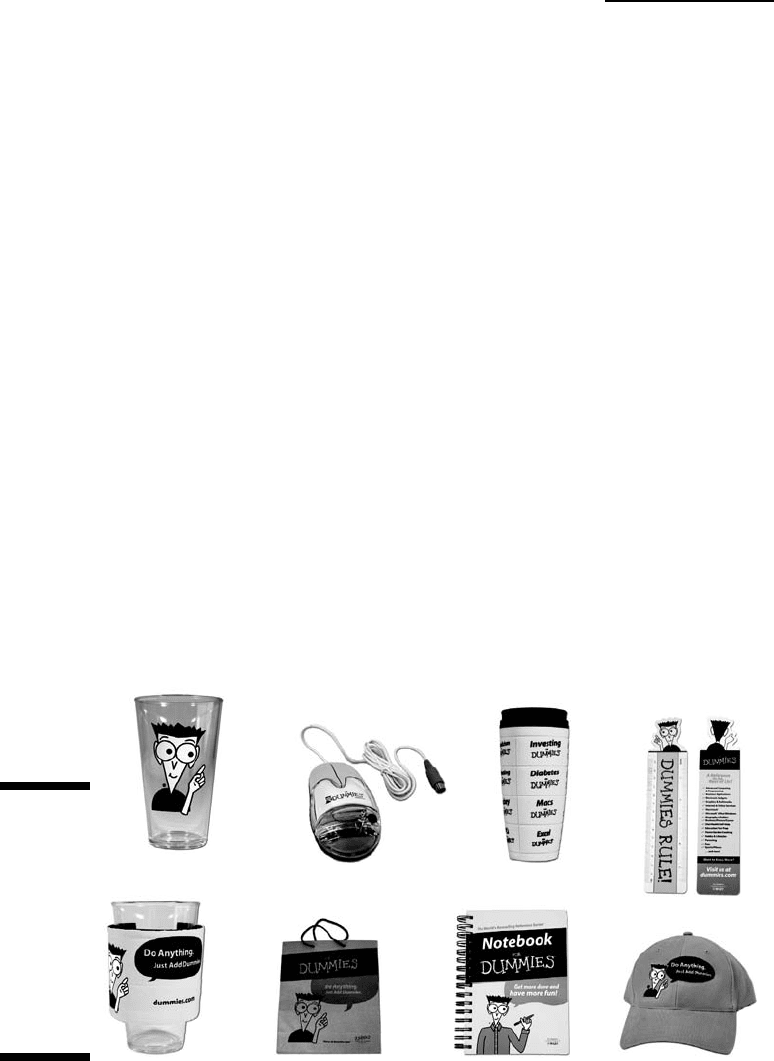
and coffee mugs, to name a few. Figure 18-1 shows examples of the various
types of “freebies” often made available to customers. All of these items are
adorned with company logos, graciously received, and passed along by us to
friends, clients, or office neighbors who don’t mind parading around wearing
or displaying advertising.
In the following sections, I tell you why these items are good ways to adver-
tise your business, how to select the right item for your business, and how
best to include information about your business on a specialty item.
Figure 18-1:
Examples of
promotional
and
giveaway
items. The
company
logo is
prominently
displayed on
each item.
266
Part IV: Beyond the Basics: Creating Buzz and Using Publicity
25_045833 ch18.qxp 11/22/06 3:45 PM Page 266

Recognizing the advantages
of specialty advertising
If you plan carefully and select a truly useful specialty advertising item to
include in a promotion, an item with intrinsic or decorative value that your
customers are glad to receive and certain to use, this form of advertising is
worth including in your overall campaign. In the following sections, I cover a
few good reasons to add quality premiums to your media mix.
Specialty items are relatively inexpensive
If you’re advertising on a budget, then specialty advertising items may be just
the thing to get your name before the buying public. For the most part, spe-
cialty items can be very affordable. For example, you can print your logo
onto a fairly good ballpoint pen for 50 cents apiece. A plastic clip that reseals
opened potato chip bags, a rubber circle that helps open jars, a razor-blade
letter opener — people may use all of these items every day, and none of
them costs more than a dollar a piece. If you print your logo on them and
give them out, the recipients will be continually reminded of your business.
You can pay thousands of dollars for a television package and hope that a few
of your spots run in good viewing times — and that viewers are watching,
instead of getting a snack when your spots run. But for just a few bucks
apiece (or less), you can get a whole pile of specialty items printed with your
logo, ready to advertise your company on a long-term basis (provided that
you select an item people actually want).
A radio station once gave me a really nifty pocket calculator that folds away
and takes up no room at all on my desk. I use this item each and every day.
And when I touch the little button that unfolds it, I can’t help but see the sta-
tion’s logo, and I am reminded of who gave it to me. This specialty advertising
item — an item I actually use on a daily basis — has a purpose. You want to be
sure to find a premium that people can enjoy and use for years to come —
otherwise, you’re just wasting your money.
Specialty items are stand-alone ads
Specialty advertising products are one of the few advertising vehicles that
can stand alone. Most other types of advertising need to be supported with
more advertising. For instance, you need to buy advertising on mass media
in order to direct people to your Web site. But a promotional item, whether
mailed to your customer list or handed out at your place of business, is pretty
much self-sufficient in getting your advertising message across to your
customers.
267
Chapter 18: Leveraging Your Advertising
25_045833 ch18.qxp 11/22/06 3:45 PM Page 267

You can imprint anything
In addition to t-shirts, coffee mugs, and key chains, you can find companies
that can laser-etch your logo onto the shells of live lobsters so you can send
them to clients you really want to impress. You can have your logo engraved
onto solid-gold putters for golfers you desperately want to do business with.
A bakery in my area will inkjet (using edible inks) your logo, four-color photo,
or whatever onto delicious cakes, which they will then deliver to your clients.
And I used a local microbrewery to make a batch of beer with my own private
label, packed the bottles in wooden cases that were laser-etched with my
logo, and sent the brews to clients as holiday gifts. It was a big hit.
If you can look beyond the obvious promotional items, the ones everyone
sends out, then you can truly make an impression.
Multiple impressions are a good thing
When I measure the effectiveness of radio or television buys, I do so in
terms of gross impressions (the number of audience members delivered by a
media schedule without regard to duplication) and cost per thousand (the
cost per 1,000 people or households delivered by a media schedule). With
specialty items, using these methods of measurement is impossible, because
specialty items — at least the ones that are useful and have actual value to
the recipient — have the advantage of scoring repeated impressions without
repeated costs. You buy it once, and it sits on a customer’s desk forever.
One Christmas, a radio station sent me beautiful note cards and envelopes
with my name richly embossed on top-quality paper. Every time I send a
note, I’m reminded of that station — which had the good taste to send me
something I’m proud to use. Multiple impressions are a very good thing!
Premiums reinforce your other media efforts
Burger King, McDonald’s, and other fast-food giants use premiums to reinforce
their mass media efforts, so why shouldn’t you? When Burger King gives away
an item tied to a movie promotion (like Open Season, the animated film comedy
where Boog the bear moves from his home in a suburban garage to the real
world of the forest), it calls attention to its giveaway items in its TV and radio
advertising, saying something like, “Eight toys for the taking: one toy in every
kids meal while supplies last.” Likewise, the premium items themselves call
attention to BK’s broadcast efforts — in this case, the toys were plastic repli-
cas of characters in the movie: a spinning Boog the Bear, a bucking Elliot the
deer, a hopping McSquizzy the squirrel, or a chopping Reilly the beaver.
Every form of media reinforces every other form of media, thereby making
the entire promotion just that much more effective.
If you’re giving away a premium or a specialty item with your logo affixed, by
all means tell people about it in your other advertising: “Come in today,
browse our new selection of fine kitchen cabinets, and be sure to ask for your
very own laser-etched lobster.” This cross-referencing will go a long way in
stretching your advertising dollars.
268
Part IV: Beyond the Basics: Creating Buzz and Using Publicity
25_045833 ch18.qxp 11/22/06 3:45 PM Page 268

Premiums are user-friendly
Advertising, by its very nature, is designed to be intrusive. If it weren’t intru-
sive, how would anyone notice it? Specialty advertising items, on the other
hand, aren’t so intrusive that they irritate people — especially items with a
purpose. People actually want and appreciate advertising specialties that
have utilitarian, intrinsic, or decorative value. What they don’t want are com-
mercials interrupting their favorite TV shows.
Selecting specialty items with a purpose
Coffee mugs, key chains, baseball caps, and t-shirts are the mainstays of spe-
cialty advertising, but literally thousands of items are out there, onto which
your logo or ad slogan can be printed or etched. The trick is to select an item
that has real appeal to the consumer; something unusual and interesting;
something that will be gratefully accepted and actually used.
In general, it’s a good idea to select specialty items that have relevance to
your product, service, or business and your target audience. For example, a
yardstick or tape measure is relevant to a lumberyard; an accountant may give
clients a calculator just as a restaurant may give coffee mugs. I know of an auto
service shop that gives each regular customer an air pressure gauge, which not
only keeps the shop’s name in the car owner’s glove box but also sends a clear
message that this shop wants to help its customers take care of their cars.
Also, one trend in specialty items is to give gifts that aren’t imprinted or are
discreetly imprinted. Clients are more likely to use a gift that doesn’t adver-
tise your name, and they will still be likely to remember who gave it to them.
Finally, consider gift-wrapping your items. For example, if you’re giving out a
pen, invest in a nice one (around $4.00), and go the extra step of buying the
twenty-five-cent box. Clients greatly overestimate the value of something as
simple as a pen: They appreciate it because it’s useful. Similarly, pulling an
ordinary golf shirt out of a big carton isn’t nearly as impressive, exciting, or
appreciated as receiving a gift-wrapped box with a shirt that ideally has your
name embroidered on it and is the correct size. Bottom line: Going the extra
mile can pay off.
Twenty years ago I received a candy jar with a wooden lid on which a radio
station’s call letters were etched. It’s a tasteful item (in more ways than one),
and it still sits, two decades later, on the coffee table in my office, continually
filled with a fresh supply of M&M’s. The candy jar was a specialty item with a
purpose. Over the years, I have tossed out hundreds of caps, t-shirts, and
bumper stickers, but I still keep the candy jar.
More than 250,000 premium items and specialty advertising items are on the
market today, just waiting for your logo. Look for something that you would
be proud to give away and your customers would be happy to receive. In just
269
Chapter 18: Leveraging Your Advertising
25_045833 ch18.qxp 11/22/06 3:45 PM Page 269

a quick glance around my office, I see specialty items of every size and shape.
Here are my favorites:
A very utilitarian folding calculator
A candy jar
Embossed personal stationery and note cards
A desktop business card holder
A clever, razor-blade letter opener
I use these items many times throughout the day. All the other stuff — mugs,
golfing jackets, baseball caps, magnetic vinyl bumper stickers, key chains, ball-
point pens, and other things — are still lying around the office only because no
one has bothered to throw them out. The neat stuff gets used. The not-so-neat
stuff just takes up space — and wastes your valuable advertising dollars.
If you thoughtfully select your specialty advertising items, you can measure
their effectiveness in terms of frequency just as you would a radio or TV com-
mercial. Why? Because if the item is used daily, perhaps multiple times every
day, then each time the item is used you have made another impression with
the same advertising message. That principle is called frequency.
However, to attain frequency, you must first select an item that has either a
utilitarian or a decorative value and can, therefore, be used or displayed by
the recipient. You’re not going to get a lot of mileage out of some cheapo
t-shirt that’s relegated to the bottom of a dresser drawer (especially if it’s a
one-size-fits-all — it usually doesn’t). But you can win friends and influence
people with a gift item that solves a problem or fills a need. When my barber
gave me a logo-imprinted rubber pad that aids in opening sticky jar lids, I
thought he was nuts and had wasted his money. But that was only until I used
it once and found out that this goofy item actually works! Hard-to-open jars
are no longer a problem (especially important for a guy who loves pickles). It
turned out to be a specialty item with legs — its effectiveness is, therefore,
measurable on a frequency basis.
If you want to get an overview of the incredible array of specialty advertising
items that are available, as well as some great promotional ideas and insights,
visit the Advertising Specialty Institute Web site at www.promomart.com.
You can also check your local Yellow Pages to find specialty advertising sales-
people in your area.
Some specialty advertising items can be quite effective. However, choose
your items as though you were picking out something for yourself. Ask your-
self: “Would I actually use this thing? Would I be grateful to receive it?” If you
answer yes, incorporate it into your overall advertising scheme.
270
Part IV: Beyond the Basics: Creating Buzz and Using Publicity
25_045833 ch18.qxp 11/22/06 3:45 PM Page 270
Keep the copy simple on a specialty item
Keep in mind that a promotional product isn’t an information source — it’s
an advertisement. Its job is to capture people’s attention and help them
remember you. If the product does its job, you often have no need to include
additional information. The phone call or e-mail you’ll likely receive provides
that opportunity. Keep your copy brief and to the point, toss in some selling
points or a slogan, and let it go at that. Don’t try to include everything you do
or a list of your entire store inventory. Stick to the main selling proposition. A
logo, phone number, Web site address, and perhaps your company slogan are
more than enough information to include on a specialty advertising item. For
more information on how to write simple, effective copy, check out Chapter
5. In general, when you’re delivering your message, just remember to KISS:
Keep it simple, stupid!
Generating Traffic: Promotional Events
Sometimes, getting the world to beat a path to your door requires that you
offer a little bribery — an incentive to get the world to even consider your
door, let alone beat a path to it. Promotions are events designed to generate
traffic, to get lots of people together in one place at one time in order to do a
sales job on them. Promotions and events are a good way to call attention to
yourself, your business, your current sale, your new inventory, or your
expanded showrooms. They’re also a great way to meet prospective cus-
tomers face to face. But these advertising forms can add to your bottom line
only if you’re careful about what you participate in and objective as to
whether the promotion or event is truly relevant to your business.
271
Chapter 18: Leveraging Your Advertising
T-shirt hysteria
It never ceases to amaze me what people
endure in order to get a free t-shirt.
The San
Jose Mercury News,
my area’s major daily news-
paper, sponsors a charity-based 10K race pro-
motion each year and gets 10,000 runners, walk-
ers, strollers, saunterers, and staggerers —
many of whom are only there to get the free
t-shirt (which isn’t really free because there is
a $10 entry fee). The radio and TV stations in the
Bay Area trot out a nearly infinite variety of pro-
motions each year to attract new listeners and
viewers for the stations and new customers for
the advertisers, who are willing to pony up extra
dollars to buy space at the event and the adver-
tising to tell people about it. What do the folks
who attend these promotions receive for their
trouble? Yep, you guessed it. Free t-shirts — oh,
maybe water bottles, almost certainly CDs spe-
cific to that station’s formatting, and perhaps a
flimsy painter’s cap with a cheesy logo, but
always a t-shirt!
25_045833 ch18.qxp 11/22/06 3:45 PM Page 271