
Gliklikh Y.E. Global and Stochastic Analysis with Applications to Mathematical Physics
Подождите немного. Документ загружается.


366 15 The Newton-Nelson Equation
μ on (
˜
Ω,
˜
F) by the relation dμ = θ(l)dν. On the probability space (
˜
Ω,
˜
F,μ)
the coordinate process W(t) turns into ξ(t)=x
0
+
t
0
a(s)ds+w(t)wherew(t)
is a “new” Wiener process on (
˜
Ω,
˜
F,μ), adapted to P
W
t
= P
ξ
t
(Girsanov’s
theorem). Note that by construction a(t) is not anticipative with respect to
P
ξ
t
, i.e., ξ(t) is a diffusion type process.
Theorem 15.14 The process ξ(t) satisfies equation (15.6) and the initial
conditions (15.23).
Lemma 15.15 The random element x
0
has the same probability distribution
on (
˜
Ω,
˜
F,ν) and on (
˜
Ω,
˜
F,μ).
Proof. Let f be an arbitrary bounded Borel measurable function. As in Sec-
tion 8.3 we denote by E
0
(ψ |B) the conditional expectation for ψ with
respect to B on the probability space (Ω,F,ν)andbyE
(ψ |B)thesame
conditional expectation on (Ω,F,μ). Then
E
[f(x
0
)] = E
0
[f(x
0
)θ(l)] = E
0
[f(x
0
)E
0
0
θ(l)] = E
0
[f(ξ
0
)],
because E
0
0
θ(l)=θ(0) = 1 (since θ(t) is a martingale). The assertion of the
Lemma follows from the fact that f is arbitrary.
Proof. [of Theorem 15.14] On the probability space (
˜
Ω,
˜
F,μ) equation (15.24)
turns into
a(t)=a
0
+
t
0
¯α
0
(s, ξ(s)) ds +
t
0
¯α
1
(s, ξ(s))a(s)ds
+
t
0
¯α
1
(s, ξ(s))dw(s)+
1
2
t
0
tr ∇¯α
1
(s, ξ(s)) ds
+
t
0
D
W
u
W
(s, ξ(s)) ds +
t
0
(a(s) ·∇)u
W
(s, ξ(s)) ds.
Now the proof is reduced to the verification that the required formulae are
satisfied. This is done by application of formulae from Section 8.3 (for details,
see [128]and[129]).
Let a
1
be an arbitrary bounded random element with values in R
n
.
Corollary 15.16 Let there exist a δ>0 such that for all x ∈ R
n
the in-
equality ρ
0
(x) >δholds and let in addition grad log ρ
0
be uniformly bounded.
Then for a
0
= a
1
+ u
W
(0,x
0
) the process ξ(t) from Theorem 15.14 satisfies
equation (15.6) with initial conditions ξ(0) = x
0
and D
S
ξ(0) = a
1
.

15.2 The Geometric Form of Stochastic Mechanics 367
15.2 The Geometric Form of Stochastic Mechanics
15.2.1 Some comments on stochastic mechanics on
Riemannian manifolds
Stochastic-mechanical systems are influenced by the geometry of configura-
tion space even more so than the systems of classical mechanics. As in the
classical case the Riemannian metric on the configuration space determines
the kinetic energy of the system, but it also defines the field of Wiener pro-
cesses in terms of which the motion is described, so that the quadratic deriva-
tive of a trajectory yields the (2, 0) metric tensor. In addition, the curvature
of the configuration space is involved in the stochastic version of Newton’s
law.
Let M be a n-dimensional Riemannian manifold. We study the exponential
map, parallel translation and other geometric objects on M generated by the
Levi-Civit´a connection.
Let ξ(t) be a stochastic process in M and assume that the mean derivatives
in the sense of Definition 9.1 and formulae (9.14)and(9.15) exist for ξ(t).
Definition 15.17. The vector
1
2
(DD
∗
+ D
∗
D)ξ(t) is called the acceleration
of ξ(t) (cf. Definition 15.1).
As in Section 15.1.1 there exists a Borel vector field on M (the regression)
such that the acceleration is the composition of that field and ξ(t).
On determining the covariant mean derivatives D
S
=
1
2
(D + D
∗
)and
D
A
=
1
2
(D −D
∗
), we then obtain the following analog of formula (15.1)
1
2
(DD
∗
+ D
∗
D)ξ(t)=(D
S
D
S
−D
A
D
A
)ξ(t)=D
S
v
ξ
(t) −D
A
u
ξ
(t). (15.25)
Now suppose that D
2
ξ(t)=σ
2
¯g where D
2
is the quadratic mean derivative,
σ>0isaconstantand¯g isthemetric(2, 0)-tensor. According to the material
of Section 9.4 this means that we determine the forward and backward mean
derivatives with respect to the Levi-Civit´a connection of Riemannian metric
given by D
2
ξ(t). In this case we derive from formulas (9.17)and(9.18)the
following analogs of formulas (15.2)and(15.3):
D
S
v
ξ
(t)=
∂
∂t
v
ξ
(t)+∇
v
ξ
(t)
v
ξ
(t), (15.26)
D
A
u
ξ
(t)=∇
u
ξ
(t)
u
ξ
(t)+
1
2
σ
2
∇
2
u
ξ
(t), (15.27)
where ∇ is the covariant derivative of the Levi-Civit´a connection and ∇
2
is the Laplace-Beltrami operator (see Definition 2.58). Thus from formulae
(15.25)–(15.27) it follows that for such ξ(t) the following formula

368 15 The Newton-Nelson Equation
1
2
(DD
∗
+D
∗
D)ξ(t)=
∂
∂t
v
ξ
(t)+∇
v
ξ
(t)
v
ξ
(t)
−
σ
2
2
∇
2
u
ξ
(t)+∇
u
ξ
(t)
u
ξ
(t)
(15.28)
holds (this is the analog of formula (15.4)).
Let M be the configuration space of a mechanical system as in Section 11.1
with a force field ¯α(t, m, X), i.e., the trajectory of the system is governed
by equation (11.2). It seems to be natural to determine Newton’s law for
stochastic mechanics in this case by complete analogy with equation (15.6),
i.e., by setting the acceleration equal to the force. But in doing this we will
not obtain the correspondence with the solutions of the Schr¨odinger equations
analogous to those described in Section 15.1.1. More precisely, the situation
is as follows. One can easily make a minimal modification of the construction
and prove an analog of Theorem 15.4 (we leave this to the reader as a simple
exercise) but one obtains the Laplace-Beltrami operator ∇
2
in the analog of
equation (15.7), while physicists would normally use the Laplace-de Rham
operator Δ =dδ +δd from Definition 1.73 (this difference seems to have been
first highlighted in [45]).
So, in order to obtain the correspondence mentioned above we might re-
place the Laplace-Beltrami operator by the Laplace-de Rham operator in the
right hand side of (15.28), i.e., change the above definition of acceleration (a
variant of such a change is discussed below in Remark 15.19). Instead we take
into account Weitzenbock’s formula (2.37) and define a stochastic mechanical
system on M as follows (cf. Definition 15.2):
Definition 15.18. A process ξ(t)inM is called a stochastic-mechanical tra-
jectory in M of a particle with mass m, under the action of the force field
¯α(t, m, X), if it satisfies the system
⎧
⎨
⎩
1
2
(DD
∗
+ D
∗
D)ξ(t)=
1
m
¯α(t, ξ(t),v
ξ
(t)) +
2m
Ric(ξ(t)) ◦ u
ξ
(t),
D
2
ξ(t)=
m
¯g,
(15.29)
where ¯g is an autonomous positive definite symmetric (2, 0)-tensor and all
mean derivatives and the Ricci tensor in the first equality of (15.29)arede-
termined with respect to the Levi-Civit´a connection of the Riemannian (0, 2)-
metric tensor inverse to ¯g. In this case we say that a stochastic-mechanical
system with force ¯α(t, m, X) is given on M . Relation (15.29) is called the
Newton-Nelson equation on M.
Note that (15.29) determines the Riemannian metric which defines the
kinetic energy for a classical mechanical system whose quantization is de-
scribed by (15.29). In particular, the Newton law (11.2) for the latter system
is given in terms of the covariant derivative of the Levi-Civit´a connection of
that metric.
In what follows we shall look for solutions of (15.29) in the class of Itˆo
processes that are Itˆo developments of processes in tangent spaces of the form
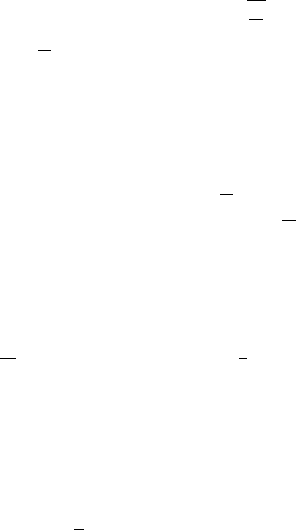
15.2 The Geometric Form of Stochastic Mechanics 369
ζ(t)=
t
0
a(s)ds + σw(t)whereσ =
m
(see Section 9.3). In this case it is
evident that if
m
≈ 0 (i.e., if the mass is very big in comparison with Plank’s
constant), similarly to the trajectories in R
n
, ξ(t) turns into a deterministic
curve and the first equality of (15.29) becomes the classical Newton law
(11.2) if the metric determined from the second equality of (15.29) remains
unchanged (recall that for a deterministic curve its quadratic derivative is
zero).
We shall not deal with limits as
m
→ 0 and so without loss of generality
in what follows we shall suppose the mass
m
=1.
Now the correspondence between stochastic mechanics and ordinary quan-
tum mechanics on manifolds is analogous to that of Section 15.1.1 and is
proved via the same argument (cf. [190]).
Remark 15.19. In order to make natural the definition of acceleration in
the form (
∂
∂t
v
ξ
(t)+∇
v
ξ
(t)
v
ξ
(t)) − (−
1
2
Δu + ∇
u
ξ
(t)
u
ξ
(t)) with the Laplace-
de Rham operator Δ (see above), in [53, 54] the construction of the parallel
translation along stochastic processes was modified so that the parallel trans-
lation obtained takes into account the deviation of geodesics. Having defined
¯
D and
¯
D
∗
by formula (9.15), where the new parallel translation is involved,
one obtains the Newton-Nelson equation in the form
1
2
(
¯
DD
∗
+
¯
D
∗
D)ξ(t)=¯α(t, ξ(t),v
ξ
(t)), (15.30)
completely analogous to the usual form. Of course, (15.30) is equivalent to
(15.29). Note that the Newton-Nelson equation in the form (15.30) is given
in [53, 54, 190]. We do not use the form (15.30) since our constructions below
are based on the usual parallel translation.
15.2.2 Existence theorems
The main purpose of this section is to generalize the existence theorem of Sec-
tion 15.1.2 to a rather broad class of Riemannian manifolds, not necessarily
Euclidean spaces (see [106, 107, 115]).
Our generalization follows the same scheme as the basic existence theo-
rems of Section 15.1.2, the necessary modification is based on the methods
developed in Chapters 8 and 9. Using parallel translation along stochastic
processes we construct a special stochastic equation in the tangent space at
the initial configuration of the motion (a certain stochastic version of the
velocity hodograph equation (11.20), different from (14.10)) and prove the
existence of its solutions. Then we show that the developments of the solu-
tions satisfy the Newton-Nelson equation (at least after a certain non-zero
instant, fixed in advance, if the initial configuration is deterministic). Note

370 15 The Newton-Nelson Equation
that the trajectory is an Itˆo process of diffusion type on a manifold, not
necessarily a diffusion process.
We consider a vector force field ¯α of the same kind as in Section 15.1.2,
namely of the form ¯α(t, m, X)=¯α
0
(t, m)+¯α
1
(t, m)X where ¯α
0
(t, m)isa
vector field on M depending on t ∈ [0,l]and¯α
1
(t, m) is a linear operator in
T
m
M depending on the parameter t ∈ [0,l], i.e., ¯α
1
(t, m)isa(1, 1)-tensor
field on M.Examplesofsuch ¯α include potential and gyroscopic force fields
(e.g., a magnetic field or an electromagnetic field on a general relativistic
space-time).
As in Section 15.1.2, for the sake of simplicity (and without loss of gener-
ality) we set
m
= 1 (i.e., we work in the system of units with this property).
Let us introduce some notation. For a (1, 1)-tensor field υ(t, m) we will deal
with its covariant derivative, the (1, 2)-tensor field ∇υ(t, m)(·, ·):T
m
M ×
T
m
M → T
m
M, as well as with the tensor ∇υ(t, m)(υ(t, m)·, ·):T
m
M ×
T
m
M → T
m
M and its trace, the vector field
tr∇υ(t, m)(υ)=
n
i=1
∇υ(t, m)(υ(t, m)e
i
,e
i
),
where e
1
,...,e
n
is an orthonormal frame in T
m
M (see formula 6.11).
Examples of the above (1, 1)-tensor fields are
Ric(m)and¯α
1
(t, m), for
which we consider the vector fields (traces) tr∇
Ric(m)(
Ric) and
tr∇¯α
1
(t, m)(¯α
1
). Note that the field tr∇
Ric(m)(
Ric) is C
∞
-smooth since
the tensor field
Ric is also C
∞
-smooth.
In what follows in this Section we assume the next two conditions to be
fulfilled.
Condition 15.20 The Riemannian manifold M is complete in the usual
sense (see Definition 1.49 and the Hopf-Rinow Theorem (Theorem 3.68)).
The Ricci tensor, the linear operator
Ric(m):T
m
M → T
m
M,isbounded
uniformly in m with respect to the operator norm generated in the tangent
spaces by the Riemannian metric ·, ·. The vector field tr∇
Ric(
Ric) on M is
also uniformly bounded with respect to the norm generated by the Riemannian
metric.
Condition 15.21 The vector field ¯α
0
(t, m) and the tensor field ¯α
1
(t, m) are
Borel measurable jointly in t and m, the vector field tr∇¯α
1
(t, x)(¯α
1
) exists
and is also Borel measurable jointly in t and m, and there exists a constant
C>0 such that
l
0
¯α
0
(t, m(t))
2
+ ¯α
1
(t, m(t))
2
+ tr∇¯α
1
(t, x)(¯α
1
)
2
dt<C
for any continuous curve m(t) on M , t ∈ [0,l],andwhere¯α
1
(t, m) is the
operator norm.
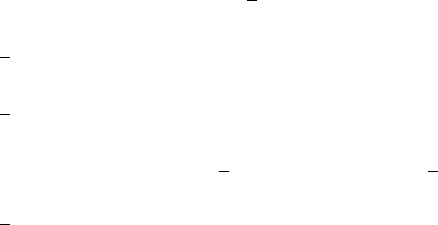
15.2 The Geometric Form of Stochastic Mechanics 371
Remark 15.22. From Theorem 7.80 it follows that under Condition 15.20
the Riemannian manifold M is stochastically complete.
Let m
0
∈ M and introduce the probability space (
˜
Ω,
˜
F,ν)where
˜
Ω =
C
0
([0,l],T
m
0
M),
˜
F is the σ-algebra generated by the cylinder sets and ν is
the Wiener measure (recall that T
m
0
M is an n-dimensional Euclidean space
with respect to the metric tensor ·, · at m
0
). Denote by
˜
B
t
the σ-algebra
generated by the cylinder sets with bases over [0,t], all the
˜
B
t
being completed
by the sets of ν-measure zero.
Recall that the coordinate process W (t, ω(·)) = ω(t), ω(·) ∈
˜
Ω, is a Wiener
process in T
m
0
M.SincebyRemark15.22 M is stochastically complete, the
Itˆo development R
I
W (t) is well-defined for t ∈ [0,l] and Riemannian parallel
translation is also well-defined along R
I
W (t) (see Section 7.6.1). Further on
we will use the operator Γ
t,s
of parallel translation introduced in Section
7.7.1.
Thus for any vector or tensor field υ(t, m) we can consider the vector
(tensor) field Γ
0,t
υ(t, R
I
W (t)) at m
0
to be the result of parallel translation
of υ(t, R
I
W (t)) along R
I
W (·) from the (random) point R
I
W (t) to the point
R
I
W (0) = m
0
.SinceR
I
W (t) is an extension of Cartan’s development R
c
from the class of piecewise smooth curves onto ν-almost all continuous curves
in T
m
0
M and the analogous fact is valid for parallel translation along R
I
W (·)
(see Remarks 7.67 and 7.84), Γ
0,t
υ(t, R
I
W (t) is determined along ν-almost
all continuous curves in T
m
0
M. This field along ω(·) ∈
˜
Ω will be denoted by
(Γ
0,t
υ)(t, ω(·)). Note that it may depend on t (which is compatible with the
notation) even if υ(m) is autonomous.
Pick t
0
∈ (0,l)andfort ∈ [0,l] consider the function t
0
(t) defined by
formula (15.13).
Let a
0
∈ T
m
0
M and consider in T
m
0
M the equation
a(t)=a
0
+
t
0
(Γ
0,s
¯α
0
)(s, W (·))ds −
1
4
t
0
Γ
0,s
tr∇
Ric
Ric
(s, W (·))ds
+
1
2
t
0
(Γ
0,s
tr∇¯α
1
(¯α
1
))(s, W (s))ds
+
1
2
t
0
Γ
0,s
Ric
(s, W (·)) − t
0
(s)
a(s)ds
+
t
0
(Γ
0,s
¯α
1
)(s, W (·)) −
1
2
Γ
0,s
Ric
(s, W (·)) +
1
2
t
0
(s)
dW (s)
−
1
2
t
0
(t)W (t) (15.31)
(an analog of equation (15.14)).
Equation (15.31) has a unique strong solution for t ∈ [0,l]. Indeed, the
coefficients of (15.31) are either Lipschitz continuous and have linear growth
with respect to a,ordonotdependona. Since the solution is strong, it
exists for any Wiener process and is non-anticipative with respect to P
W
t
.In
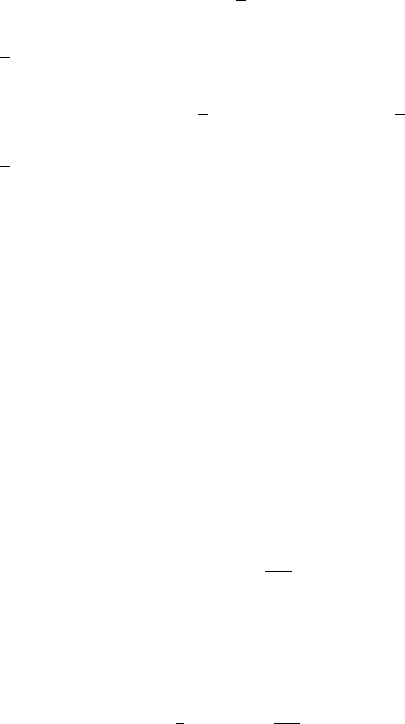
372 15 The Newton-Nelson Equation
what follows we will consider a(t) for the realization of W (t) as the coordinate
process on (
˜
Ω,
˜
F,ν). From Condition 15.21 it follows that a(t) satisfies (7.54).
Consider the probability density θ(l)on(
˜
Ω,
˜
F) defined for the above a
by formula (8.33) (cf. Section 15.1.2). Introduce the measure μ
ζ
= θdν on
(
˜
Ω,
˜
F) and denote by ζ(t) the coordinate process on (
˜
Ω,
˜
F,μ
ζ
). Then (see
Sections 8.3 and 15.1.2) ζ(t) is expressed in the form
ζ(t)=
t
0
a(s)ds + w(t) (15.32)
where w(t) is a Wiener process on (
˜
Ω,
˜
F,μ
ζ
) adapted to P
W
t
= P
ζ
t
= B
t
.
Since ζ(t)andW (t) coincide as coordinate processes on (
˜
Ω,
˜
F), (15.31) turns
into
a(t)=a
0
+
t
0
(Γ
0,s
¯α
0
)(s, ζ(·))ds −
1
4
t
0
Γ
0,s
tr∇
Ric
Ric
(s, ζ(·))ds
+
1
2
t
0
(Γ
0,s
tr∇¯α
1
(¯α
1
))(s, ζ(·))ds +
t
0
(Γ
0,s
¯α
1
)(s, ζ(·)) ◦a(s)ds
+
t
0
((Γ
0,s
¯α
1
)(s, ζ(·)) −
1
2
Γ
0,s
Ric
(s, ζ(·)) +
1
2
t
0
(s))dw(s)
−
1
2
t
0
(t)ζ(t) (15.33)
(an analog of equation (15.16)).
Since by Remark 15.22 M is stochastically complete and since a(t) satisfies
(7.54), from Theorem 7.98 it follows that for ζ(t)theItˆo development ξ(t)=
R
I
ζ(t) is well-defined on the entire interval t ∈ [0,l].
Theorem 15.23 For t ∈ (t
0
,l) the above-mentioned process ξ(t) satisfies
(15.29) with the force ¯α(t, m, X)=¯α
0
(t, m)+¯α
1
(t, m)X, i.e., it is a trajectory
of the stochastic mechanical system with that force.
Proof. By construction ξ(t) satisfies equation (9.22). This allows us to derive
some technical statements which follow from the results of Section 7.7 and
from those on the calculation of mean derivatives in Chapters 8 and 9.
Lemma 15.24
(i) Dξ(t)=E
ξ
t
(Γ
t,0
a(t)).
(ii) D
∗
ξ(t)=E
ξ
t
(Γ
t,0
a(t)) + E
ξ
t
Γ
0,t
ζ(t)
t
− κ(t)
,whereκ(t) is as de-
fined in Lemma 8.35.
Proof. Assertion (i) is in fact formula (9.25), and (ii) is (9.29).
Corollary 15.25
(i) D
S
ξ(t)=E
ξ
t
(Γ
t,0
a(t)) +
1
2
E
ξ
t
Γ
t,0
ζ(t)
t
− κ(t)
.
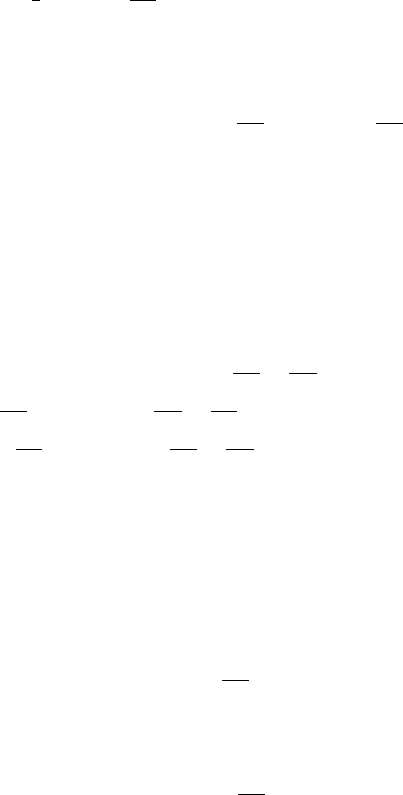
15.2 The Geometric Form of Stochastic Mechanics 373
(ii) D
A
ξ(t)=−
1
2
E
ξ
t
Γ
t,0
ζ(t)
t
− κ(t)
.
Corollary 15.25 can be obtained from formulae (9.30)and(9.31).
Lemma 15.26
(i) DD
∗
ξ(t)=D
ξ
(Γ
t,0
a(t)) + E
ξ
t
Γ
t,0
a(t)
t
− E
ξ
t
Γ
t,0
ζ(t)
t
2
.
(ii) D
∗
Dξ(t)=D
ξ
∗
(Γ
t,0
a(t)).
The assertion of Lemma 15.26 follows from Lemma 15.24, Lemma 8.36
(which can evidently be generalized to the processes in M) and Lemma 8.38.
So the proof of Theorem 15.23 is reduced to the calculation of mean deriva-
tives for Γ
t,0
a(t) which can be done by calculating the derivatives for the
summands in (15.33).
Lemma 15.27 For t ≥ t
0
:
(i) D
ξ
∗
Γ
t,0
t
0
t
0
(s)dw(s)
= E
ξ
t
Γ
t,0
ζ(t)
t
2
−
κ(t)
t
;
(ii) D
ξ
Γ
t,0
ζ(t)
t
= E
ξ
t
Γ
t,0
a(t)
t
−
ζ(t)
t
2
;
(iii) D
∗
ξΓ
t,0
ζ(t)
t
= E
ξ
t
Γ
t,0
a(t)
t
−
κ(t)
t
.
The proof of Lemma 15.27(i) is analogous to that of Lemma 15.8(ii) with
a modification based on formulae (9.15). The proofs of (ii) and (iii) are anal-
ogous to that of Lemma 8.37.
Lemma 15.28
(i) D
ξ
∗
Γ
t,0
t
0
(Γ
0,t
¯α
1
)(s, ζ(·)) dw(s)
=
− Γ
t,0
(Γ
0,t
tr∇¯α
1
(¯α
1
)) (t, ζ(t))
+ Γ
t,0
(Γ
0,t
¯α
1
)(t, ζ(·)) ◦ E
ξ
t
Γ
t,0
ζ(t)
t
− κ(t)
.
(ii) D
ξ
∗
Γ
t,0
t
0
Γ
0,t
Ric
(s, ζ(·)) dw(s)
=
− Γ
t,0
Γ
0,t
tr∇
Ric
Ric
(s, ζ(s))
+ Γ
t,0
Γ
0,t
Ric
(t, ζ(·)) ◦ E
ξ
t
Γ
t,0
ζ(t)
t
− κ(t)
.
To prove Lemma 15.28 one should apply formulae (9.15), the definitions of
the integrands and the expression for Itˆo integrals via the backward integrals
(6.7)and(6.26) (cf. Lemma 15.8(i)).
All other summands in (15.32) are differentiated directly according to
(9.15).
By the definition of the processes ζ(t)andξ(t) and of the operator of
parallel translation Γ
t,s
the following relations hold:
Γ
t,0
(Γ
0,t
¯α)(t, ζ(·)) = ¯α(t, ξ(t));
Γ
t,0
(Γ
0,t
Ric)(t, ζ(·)) =
Ric(ξ(t)).
374 15 The Newton-Nelson Equation
Thus by Lemmas 15.26–15.28 and formula (15.33)
1
2
(DD
∗
+ D
∗
D)ξ(t)
=¯α
0
(t, ξ(t)) + ¯α
1
(t, ξ(t)) ◦ a(t)+
1
2
E
ξ
t
Γ
t,0
ζ(t)
t
− κ(t)
+
1
2
Ric(ξ(t)) ◦
−E
ξ
t
Γ
t,0
ζ(t)
t
− κ(t)
. (15.34)
Taking into account Corollary 15.25 one sees that (15.34) coincides with
(15.29). Theorem 15.23 follows.
Remark 15.29. As in Remark 15.11 we should point out that ξ(t)doesnot
satisfy (15.29)fort ∈ (0,t
0
) because here t
0
(t)=
1
t
0
and E
ξ
t
(Γ
t,0
ζ(t)
t·t
0
) =
E
ξ
t
(Γ
t,0
ζ(t)
t
2
). Thus ξ(t) can be interpreted only as a trajectory of the stochas-
tic mechanical system beginning at the instant t
0
from the random configu-
ration ξ(t
0
) with the initial mean forward derivative E
ξ
t
(Γ
t,0
a(t
0
)) (see the
details in Remark 15.10). A certain analog of this situation with ‘big bang’
will be described below in Section 15.3.2, which is devoted to general relativ-
ity.
Remark 15.30. One can easily see that E
ξ
t
(a(t)) is the hodograph of the
forward mean derivative for the process ξ(t) and that equation (15.33)isa
direct analog of the velocity hodograph equation (11.20).
We now turn to the proof of an existence theorem analogous to Theo-
rem 15.14.
Theorem 15.31 Let Conditions 15.20 and 15.21 be fulfilled. Let η be a ran-
dom element taking values in M with density ρ(m) =0for all m ∈ M.Leta
be a bounded Borel measurable vector field on M. Then there exists a solution
ξ(t) of (15.29) with initial conditions ξ(0) = η and Dξ(0) = a(η). If there
exists a δ>0 such that ρ
0
(m) >δfor all m ∈ M and Grad log ρ
0
(see (8.20))
is bounded, then there exists a solution ξ(t) of (15.29) with initial conditions
ξ(0) = η and D
S
ξ(0) = a(η).
Proof. Denote by W (t) the coordinate process on the probability space
(C
0
([0,l], R
n
), F,ν) taking values in R
n
where F is the σ-algebra gener-
ated by cylinder sets and ν is a Wiener measure. As above, it is clear that
W (t) is a standard Wiener process in R
n
. Take some Borel measurable cross-
section b
0
of the bundle OM and consider the Itˆo development R
I
W (t) with
initial data b
0
(η) (see Definition 7.68). R
I
W (t)existsfort ∈ [0,l]byThe-
orem 7.99 since, by Remark 15.22, from Condition 15.20 it follows that M
is stochastically complete. Consider the following objects along R
I
W (t): the
vector field u
W
(t, m) constructed for R
I
W (t) by formula (8.20), the vector
field D
W
u
W
(t, m) and the tensor field ∇u
W
(t, m)=K ◦ T (u
W
(t, m)) (the
15.2 The Geometric Form of Stochastic Mechanics 375
operator of covariant derivative applied to u
W
(t, m)). Using the construc-
tion of parallel translation along R
I
W (t) (see Section 7.6), in this section
the operator Γ
t,0
is applied to a tensor υ(t, R
I
W (t)) yielding the tensor field
Γ
t,0
υ(t, W (t)) along W (t)inR
n
, which is well-defined along a.s. all continu-
ouscurvesinR
n
with respect to Wiener measure (see Section 7.6).
Denote by a
0
the vector b(0)
−1
[a(η)+u
W
(0,W(0))] and consider the fol-
lowing stochastic differential equation in R
n
:
a(t)=a
0
+
t
0
Γ
0,s
α
0
(s, W (s))ds +
t
0
Γ
0,s
α
1
(s, W (s)) ◦ dW (s)
+
Γ
0,s
D
W
u
W
(s, W (s))ds +
t
0
Γ
0,s
∇u
W
(s, W (s)) ◦ a(s)
ds
−
1
2
t
0
Γ
0,s
Ric(s, W (s)) ◦ dW (s), (15.35)
where ◦dW (s) denotes Stratonovich integration in composition with parallel
translation, i.e.,
t
0
Γ
0,s
A(s, W (s)) ◦ dW
=
t
0
Γ
0,s
A(s, W (s))dW (s)+
1
2
t
0
Γ
0,s
tr∇A(t, m)(A)ds
for a (1, 1)-tensor field A on M.
Since (15.35) is linear in a, it has a unique solution a(t). From Condi-
tion 15.21 it follows that a(t) satisfies (7.54). Set
θ(t) = exp
−
1
2
t
0
a(s)
2
ds +
t
0
a ·dW.
Under these assumptions θ(t) is a martingale with Eθ(t) = 1. Thus we can
introduce a new probability measure μ on (C
0
([0,l], R
n
), F) by the relation
dμ = θ(l)dν. Denote by ζ(t) the coordinate process on (C
0
([0,l], R
n
), F,μ).
By Girsanov’s theorem ζ(t)=
t
0
a(s)ds + w(t)wherew(t) is a Wiener pro-
cess on C
0
([0,l], R
n
), F,μ) adapted to ζ(t)anda(t) is not anticipative with
respect to P
ζ
t
, i.e., ζ is a process satisfying the hypothesis of Theorem 7.99.
Since M is stochastically complete and a(t) satisfies (7.54), there exists an
Itˆo development ξ(t)=R
I
ζ(t) with initial condition η.
Lemma 15.32 The process ξ(t) is the solution of equation (15.29) with ini-
tial conditions ξ(0) = η and D
S
ξ(0) = a(η).
Proof. From the definition of Itˆo development it evidently follows that
Γ
t,0
Γ
0,t
u
W
(t, ξ(t)) = u
W
(t, ξ(t)); Γ
t,0
Γ
0,t
∇u
W
◦ a = ∇
Γ
t,0
a
u
W