
Gliklikh Y.E. Global and Stochastic Analysis with Applications to Mathematical Physics
Подождите немного. Документ загружается.

336 14 Mechanical Systems with Random Perturbations
Theorem 14.7 Consider a process ξ(t)=Sv(t) with v(t)=
t
0
b(s)ds +
t
0
B(s)dw(s) in T
m
0
M as above. Then D
2
˙
ξ(t)=E
ξ
t
(Γ
t,0
(B(t)B
∗
(t))) where
B
∗
is the adjoint operator.
Proof. As in the proof of Theorem 14.5, from the properties of parallel trans-
lation and from the construction of ξ(t) it follows that
E
ξ
t
(
˙
ξ(t) ⊗
˙
ξ(t)) = E
ξ
t
(Γ
0,t
(v(t) ⊗v(t))),
where v(t)=
t+t
t
b(s)ds +
t+t
t
B(s)dw(s). In addition from the prop-
erties of the Itˆo integral we obtain that in the expression v(t) ⊗v(t)only
the summand (
t+t
t
B(s)dw(s)) ⊗(
t+t
t
B(s)dw(s)) is infinitesimal of the
same order as t while all other summand are infinitesimals of higher order
than t. Now the Theorem follows from Definition 14.6 and from the prop-
erties of the Itˆo integral.
The fact that ξ(t) a.s. has C
1
-smooth paths is equivalent to the equality
D
2
ξ(t)=0(seeTheorem8.12 and Lemma 9.16). Thus we are in a position
to give the following:
Definition 14.8. The Langevin equation with force field (14.2) is the system
⎧
⎨
⎩
D
˙
ξ(t)=¯α(t, ξ(t),
˙
ξ(t))
D
2
˙
ξ(t)=A(t, ξ(t),
˙
ξ(t)) A
∗
(t, ξ(t),
˙
ξ(t))
D
2
ξ(t)=0.
(14.6)
Let ξ(t) be a stochastic process with values in M which is non-anticipative
with respect to B
t
and such that the sample trajectories of ξ are a.s. C
1
-
smooth and ξ(0) = m
0
∈ M . Thus, as above, we can use the ordinary Rie-
mannian parallel translation along the sample paths of ξ. Retaining the nota-
tion of Sections 3.2 and 11.8, we denote Γ
0,t
by Γ and so Γ ¯α(t, ξ(t),
˙
ξ(t)) and
ΓA(t, ξ(t),
˙
ξ(t)) are obtained by the parallel translation of ¯α(t, ξ(t),
˙
ξ(t)) and
A(t, ξ(t),
˙
ξ(t)), respectively, along ξ(·) from the point ξ(t)toξ(0) = m
0
,where
¯α and A are the coefficients of force field (14.2). The processes Γ ¯α(t, ξ,
˙
ξ)and
ΓA(t, ξ,
˙
ξ) take values in T
m
0
M and L(T
m
0
M,T
m
0
M), respectively, and their
trajectories are a.s. continuous, for so are the fields ¯α(t, m, X)andA(t, m, X).
Since parallel translation preserves the Riemannian norm, it follows from
(14.4)that
Γ ¯α
t, ξ(t),
˙
ξ(t)
+
ΓA
t, ξ(t),
˙
ξ(t)
<K
1+
Γ
˙
ξ(t)
. (14.7)
Lemma 14.9 The processes Γ ¯α
t, ξ(t),
˙
ξ(t)
and ΓA
t, ξ(t),
˙
ξ(
t)
ar
e non-
anticipative with respect to B
t
.
The lemma is a consequence of the fact that the parallel translation opera-
tor Γ is continuous on the space of C
1
-curves equipped with the C
1
-topology

14.2 The Langevin Equation and Ornstein-Uhlenbeck Processes on Manifolds 337
and of our assumptions that ξ is non-anticipative and the fields ¯α and A are
both continuous.
By Lemma 14.9, we can define the process z(t)inT
m
0
M as
z(t)=
t
0
Γ ¯α
τ,ξ(τ),
˙
ξ(τ )
dτ +
t
0
ΓA
τ,ξ(τ),
˙
ξ(τ )
dw(τ), (14.8)
where the second term on the right-hand side is the Itˆo integral. It is clear
that z(t) given by (14.8) is non-anticipative with respect to B
t
and almost
surely has continuous trajectories.
Setting v(t)=z(t), we obtain the Langevin equation (14.6) in the integral
form:
ξ(t)=S
t
0
Γ ¯α
τ,ξ(τ),
˙
ξ(τ )
dτ +
t
0
ΓA
τ,ξ(τ),
˙
ξ(τ )
dw(τ)+
¯
C
.
(14.9)
Indeed, one can easily see that a process satisfying (14.9) also satisfies (14.6).
On the other hand, taking into account the relationship between Newton’s
equation (11.2) and the integral equation (11.19), we see that a solution ξ(t)
of (14.9) is a stochastic trajectory of the system with the force field given by
(14.2) and with the initial condition ξ(0) = m
0
and
˙
ξ(0) =
¯
C ∈ T
m
0
M.
Definition 14.10. We say that (14.9)hasaweak solution on [0,l] ⊂ R with
initial conditions ξ(0) = m
0
,
˙
ξ(0) = C if there exist a probability space
(Ω,F, P), an M-valued stochastic process ξ(t) with a.s. C
1
-smooth sample
paths, defined on (Ω,F, P) with initial conditions ξ(0) = m
0
and
˙
ξ(0) = C
and a Wiener process w(t)inR
n
, defined on (Ω,F, P) and adapted to ξ(t),
such that for all t ∈ [0,l] P-a.s. (14.9) is fulfilled.
Definition 14.11. We say that (14.9)hasastrong solution on [0,l] ⊂ R with
initial conditions ξ(0) = m
0
,
˙
ξ(0) = C if on every probability space (Ω,F, P)
which admits a Wiener process, and for any Wiener process w(t)inR
n
,
defined on (Ω,F, P), there exists an M -valued stochastic process ξ(t), non-
anticipative with respect to w(t) and having a.s. C
1
-smooth sample paths,
that is defined on (Ω,F, P) with initial condition ξ(0) = m
0
, such that for
all t ∈ [0,l] P-a.s. (14.9) is fulfilled.
Remark 14.12. Equation (14.9) involves the Itˆo integral
t
0
ΓA(τ,ξ,
˙
ξ)dw.
A similar equation involving the Stratonovich integral
t
0
ΓA(τ,ξ,
˙
ξ) ◦ dw is
also well-defined.
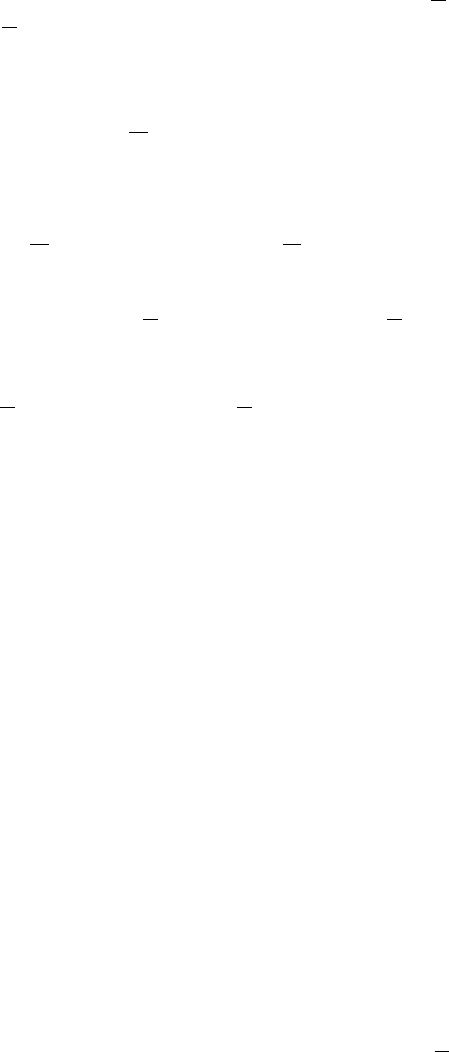
The velocity hodograph equation corresponding to (14.9)is
v(t)=
t
0
Γ ¯α
t, Sv(t),
d
dt
Sv(t)
dτ +
t
0
ΓA
t, Sv(t),
d
dt
Sv(t)
dw(τ)+
¯
C
(14.10)
338 14 Mechanical Systems with Random Perturbations
(cf. Section 11.8.1). It is clear that the fields Γ ¯α
t, Sx(t),
d
dt
Sx(t)
and
ΓA
t, Sx(t),
d
dt
Sx(t)
are defined along any curve x(·) ∈ C
0
[0,l],T
m
0
M
and continuous on the space R ×C
0
[0,l],T
m
0
M
. By construction (see Sec-
tion 3.2.1) and by the properties of parallel translation, we have
d
dt
S (x(t))
= x(t),
and, therefore, by (14.7),
Γ ¯α
t, Sx(t),
d
dt
Sx(t)
+
ΓA
t, Sx(t),
d
dt
Sx(t)
≤ K (1 + x(t)) .
(14.11)
Lemma 14.13 Γ ¯α
t, Sx(t),
d
dt
Sx(t)
and ΓA
t, Sx(t),
d
dt
Sx(t)
are non-
anticipative with respect to the family
¯
B
t
from Lemma 14.4.
The assertion of Lemma 14.13 clearly follows from the construction of
Γ ¯α
t, Sx(t),
d
dt
Sx(t)
and ΓA
t, Sx(t),
d
dt
Sx(t)
and from the properties of
parallel translation, as well as from Lemma 14.4.
Equation (14.10)isanItˆo stochastic differential equation of diffusion type
on the linear space T
m
0
M. Since Definitions 6.23 and 6.24 are valid for
(14.10), we needn’t introduce any special notions of strong and weak so-
lutions for it.
It is clear that v(t) and the Wiener process w(t)inT
m
0
M satisfy (14.10)
if and only if Sv(t) (taking values in M)andw(t) satisfy (14.9). Observe
also that Sv(t) is defined on the same probability space and has the same
measurability properties with respect to w(t)asv(t). Thus, we have proved:
Theorem 14.14 The process v(t) is a strong (respectively, weak) solution of
(14.10) if and only if Sv(t) is a strong (respectively, weak) solution of (14.9).
Remark 14.15. Let us specify a realization of w(t)inT
m
0
M. Applying to
it the parallel translation along Sv(·), we obtain realizations of w(t) in all
spaces T
Sv(·)
M. These realizations give rise to a force field defined along the
trajectory. One may also use the realizations to introduce the notion of a
solution of (14.9) in a similar way to Definitions 7.92 and 7.93.
Theorem 14.16 Assume that ¯α(t, m, X) and A(t, m, X) are jointly con-
tinuous in all variables and satisfy (14.4).Thenon[0,l] there exists a
weak solution of equation (14.9) for any initial conditions ξ(0) = m
0
and
˙
ξ(0) =
¯
C ∈ T
m
0
M.
Proof. First, we pass to (14.10), which is equivalent to (14.9). Note that
(14.10) is a diffusion type equation on a vector space. Recall that this means
that the coefficients of (14.10) depend on the past, i.e., on the entire tra-
jectory on the interval [0,t]. As has been shown, Γ ¯α
t, Sx(t),
d
dt
Sx(t)
and

14.2 The Langevin Equation and Ornstein-Uhlenbeck Processes on Manifolds 339
ΓA
t, Sx(t),
d
dt
Sx(t)
are well-defined and continuous on R×C
0
([0,l],T
m
0
M)
Moreover, they satisfy (14.11), the linear growth condition and by Lemma
14.13 they are not anticipative with respect to the family of σ-subalgebras
¯
B
t
.
Thus, the standard existence theorem in linear spaces (see, e.g., [83, Chap-
ter 3, Section 2] or [162, Section 19.3.8]) guarantees that a weak solution of
(14.10) exists. To complete the proof we simply apply Theorem 14.14.
The following results can also be proved by passing to (14.10) and applying
the results of the standard theory of stochastic equations on vector spaces
[83, 84, 162].
Theorem 14.17 Let ¯α(t, m, X) and A(t, m, X) be as in Theorem 14.16.As-
sume that the operator A(t, m, X) is invertible for all t, m,andX.Ifa
solution of the equation
ξ(t)=S
t
0
ΓA
τ,ξ(τ),
˙
ξ(τ )
dw(τ)
(14.12)
is weakly unique, then so is a solution of (14.9).
Theorem 14.18 Let ¯α(t, m, X) be jointly continuous in all variables, satisfy
(14.4), and be such that the solution of the Cauchy problem for (11.2) is
unique. In addition, let A
ε
(t, m, X),whereε ∈ (0,δ) and δ>0,bejointly
continuous in ε, t, m and X, and satisfy (14.4) with K independent of ε.
Assume also that:
(i) A
0
=0;
(ii) lim
ε→0
A
ε
→ 0 uniformly on every compact subset of [0,l] ×TM;
(iii) a solution of the equation
ξ(t)=S
t
0
Γ ¯α
τ,ξ(τ),
˙
ξ(τ )
dτ
+
t
0
ΓA
ε
τ,ξ(τ),
˙
ξ(τ )
dw(τ)+
¯
C
ε
(14.13)
is weakly unique for some
¯
C
ε
such that lim
ε→0
¯
C
ε
=
¯
C.
Then the measures on C
1
m
0
([0,l],M) corresponding to the solutions of
(14.13) weakly converge as ε → 0 to the measure concentrated on the unique
solution of (11.2).
Example 14.19. Let A = εI,whereI is the identity operator. Then it is clear
that a solution of (14.12) is unique. Thus, for ¯α as before, the equation
ξ(t)=S
t
0
Γ ¯α
τ,ξ(τ),
˙
ξ(τ )
dτ + εw(t)+C
340 14 Mechanical Systems with Random Perturbations
has a unique solution. If, for example, ¯α is locally Lipschitz in m and X,then
Theorem 14.18 holds true for the latter equation.
Remark 14.20. Let β be a (possibly, non-holonomic) constraint on M.Em-
ploying the operators S
β
and Γ
β
defined in Section 11.8.2, one can extend
the notion of a Langevin equation to manifolds with constraints. In this case,
the velocity hodograph equation in a fiber of β turns out to be very similar
to (14.10). As a consequence, analogs of all results of this section hold true
for the Langevin equations with constraints.
It is known that equation (14.9) has a strongly unique strong solution
provided that the coefficients of the diffusion type equation (14.9) satisfy a
Lipschitz type condition (see e.g., [66, 170] and Section 6.2.3). However, the
existence of a strong solution is rather hard to prove in the general case where
the coefficients involve the operators Γ and S. The reason is that Γ and S
are defined by means of parallel translation and, as a consequence, we have a
condition imposed on the entire mechanical system, rather than just on the
force field.
On the other hand, the existence can easily be verified for certain particular
force fields. Here we consider three examples of such fields:
(i) The drag force:
¯α(t, m, X)=φ (t, X) · ˆa
m
(X),
A(t, m, X)=Ψ
t, X
·
ˆ
A
m
(X),
where φ and Ψ are scalar functions, ˆa is a (1, 1)-tensor field with ∇ˆa =
0, and
ˆ
A is a field of operators
ˆ
A
m
: T
m
M → L(T
m
M) parallel along
every curve in M. (Note that the equation ∇ˆa = 0 is a restriction of the
same kind as that imposed on
ˆ
A: the operators ˆa
m
: T
m
M → T
m
M are
parallel along every curve.) For example, one may take ˆa = ±I or, if
M is an oriented two-dimensional manifold, then ˆa
m
may be a rotation
by a fixed angle. The same operators can be taken as examples of
ˆ
A
if we assume in addition that
ˆ
A
m
(X) is independent of X (i.e.,
ˆ
A
m
,
regarded as a function of X, is constant).
(ii) A particular case of (i) involving friction and constant diffusion:
¯α(t, m, X)=−b(t) · X, A(t, m, X)=φ(t) ·
ˆ
A
m
,
where the friction coefficient b ≥ 0 is a real-valued function of time
and
ˆ
A is a (1, 1)-tensor field with ∇
ˆ
A =0.
(iii) A force given in a “stationary coordinate system”. Let the mappings
¯α
m
0
(t): T
m
0
M → T
m
0
M and A
m
0
(t): T
m
0
M → L(T
m
0
M), t ∈ [0,l]
be given. The operators ¯α and A at other points of the trajectory ξ(t)
are obtained by the parallel translation of ¯α
m
0
and A
m
0
along ξ(·).
(See Section 11.9 for a mechanical interpretation of parallelism.)
14.2 The Langevin Equation and Ornstein-Uhlenbeck Processes on Manifolds 341
Theorem 14.21 Let ¯α and A be as in (i)-(iii). Assume also that ¯α
m
0
and
A
m
0
are Lipschitz in X ∈ T
m
0
M and satisfy (14.4), the linear growth condi-
tion. Then (14.9) has a strongly unique strong solution on [0,l].
Proof. Under the hypotheses of the theorem, equation (14.10)onT
m
0
M is
equivalent to the following:
v(t)=
t
0
¯α (τ,m
0
,v(τ )) dτ +
t
0
A (τ,m
0
,v(τ )) dw(τ)+
¯
C. (14.14)
This equation has a strongly unique strong solution defined on [0,l]. The
initial velocity
¯
C can be viewed as a random vector measurable with respect
to the σ-algebra B
0
[170, 66]. To finish the proof it suffices to apply Theorem
14.14.
If ¯α and A are as in (ii), then the hypotheses of Theorem 14.21 are au-
tomatically satisfied, provided that b and φ are bounded. In this case, the
solution v(t)of(14.14) and the solution Sv(t) of the Langevin equation are
called the Ornstein-Uhlenbeck velocity process and the Ornstein-Uhlenbeck
coordinate process, respectively.
The assumption that b and φ are bounded can be omitted in the hodograph
equation for Ornstein-Uhlenbeck processes so that the velocity process exists
on a random interval up to the explosion time (see Definition 6.32).
Recall that Ornstein-Uhlenbeck processes describe Brownian motion in
a medium with a drag force. A detailed discussion can be found in [188].
Ornstein-Uhlenbeck processes on manifolds are also discussed in [154].
Let v(t) be a solution of (14.14). Denote by Ev(t) the mathematical ex-
pectation of v(t)inT
m
0
M.
Definition 14.22. The curve S(Ev(t)) on M is said to be the mathematical
expectation of the process Sv(t). The function E(Ev(t) − v(t))
2
is called the
dispersion of Sv(t).
It is easy to see that for the system defined in (i) and, in particular, for
(ii) the mathematical expectation of a solution of (14.9) satisfies (11.2).
Passing to the hodograph equation and applying standard results on equa-
tions in a vector space, we obtain the following theorem.
Theorem 14.23 Under the assumptions of Theorem 14.21, the solutions of
ξ(t)=S
t
0
Γ ¯α
τ,ξ(τ),
˙
ξ(τ )
dτ
+ ε
t
0
ΓA
τ,ξ(τ),
˙
ξ(τ )
dw(τ)+ε
¯
C
(14.15)
converge as ε → 0 to the solution of (11.19) in the topology of the space
S
C
0
([0,l],L
2
(Ω,T
m
0
M))
.
342 14 Mechanical Systems with Random Perturbations
The mathematical expectation of the solution of (14.15) uniformly converges
to the solution of (11.19).
Here L
2
(Ω,T
m
0
M) is the space of square integrable maps from Ω to T
m
0
M
and S(C
0
([0,l],L
2
(Ω,T
m
0
M))) is the image of the space of continuous curves
in L
2
(Ω,T
m
0
M) given on [0,l], under the mapping S. Note that the conver-
gence means that the dispersion of ξ converges uniformly to zero. Recall also
that equations (11.19)and(11.2) are equivalent.
Remark 14.24. For the Langevin equation with constraint mentioned in Re-
mark 14.20, the Ornstein-Uhlenbeck processes with constraint can be defined
analogously as strong solutions of the corresponding hodograph equations.
14.3 Set-Valued Forces. Langevin Type Inclusions
In this section we investigate second order stochastic differential inclusions
on Riemannian manifolds which are set-valued analogs of the Langevin equa-
tions from Section 14.2. As mentioned above, the set-valued force arises in
a system with control or may be obtained from a discontinuous force (for
instance, if dry friction is considered or if the motion takes place in a compli-
cated medium). If the force is discontinuous there are well-known methods
of transition to a set-valued force (for stochastic differential equations the
pioneering paper was [41]). Examples of systems having discontinuous forces
with random components of the above-mentioned sort are rather common in
physics, for example, they describe the motion of a physical Brownian par-
ticle in a complicated medium. The use of Riemannian manifolds allows one
to cover mechanics on non-linear configuration spaces.
In this Section we use the set-valued vector force fields and set-valued
tensor force fields introduced in Definition 11.43 and Definition 14.1, respec-
tively.
Let α and A be a set-valued vector force field and a set-valued tensor
field, respectively. For a stochastic process ξ(t) with a.s. C
1
-smooth sample
paths consider the set-valued maps Γ α(τ, ξ(τ),
˙
ξ(τ )) and Γ A(τ,ξ(τ),
˙
ξ(τ ))
sending [0,l]intoT
m
0
M and into the space of linear operators on T
m
0
M and
denote by PΓ α(τ,ξ(τ),
˙
ξ(τ )) and PΓ A(τ,ξ(τ),
˙
ξ(τ)) the sets of their Borel
measurable selectors.
A Langevin inclusion is a system of the form
⎧
⎨
⎩
D
˙
ξ(t) ∈ α(t, ξ(t),
˙
ξ(t))
D
2
˙
ξ(t) ∈ A(t, ξ(t),
˙
ξ(t)) A
∗
(t, ξ(t),
˙
ξ(t))
D
2
ξ(t)=0
(14.16)
where D and D
2
are defined in Section 14.2 by means of ordinary parallel
translation along C
1
-smooth curves. In integral form (14.16) is expressed as
14.3 Set-Valued Forces. Langevin Type Inclusions 343
ξ(t) ∈S
t
0
PΓ α
τ,ξ(τ),
˙
ξ(τ )
dτ +
t
0
PΓ A
τ,ξ(τ),
˙
ξ(τ )
dw(τ)+C
.
(14.17)
Definition 14.25. We say that (14.16)hasaweak solution on [0,l] ⊂ R
with initial conditions ξ(0) = m
0
,
˙
ξ(0) = C if there exist a probability space
(Ω,F, P), an M-valued stochastic process ξ(t) with a.s. C
1
-smooth sample
paths, defined on (Ω,F, P) with initial conditions ξ(0) = m
0
and
˙
ξ(0) = C,
a Wiener process w(t)inR
n
, defined on (Ω,F, P) and adapted to ξ(t), a
single-valued vector field ¯α(t, m, X)onM and a single-valued (1, 1)-tensor
field A(t, m, X) such that:
(i) for all t the random vector ¯α(t, ξ(t),
˙
ξ(t)) belongs to α(t, ξ(t),
˙
ξ(t))
P-a.s.;
(ii) for all t the random tensor A(t, ξ(t),
˙
ξ(t)) belongs to A(t, ξ(t),
˙
ξ(t))
P-a.s.;
(iii) the integrals
t
0
Γ ¯α(τ,ξ(τ),
˙
ξ(τ ))dτ and
t
0
ΓA(τ,ξ(τ),
˙
ξ(τ ))dw(τ )are
well-defined for ξ(t), w(t), ¯α and A,
and for all t ∈ [0,l] P-a.s.
ξ(t)=S
t
0
Γ ¯α
τ,ξ(τ),
˙
ξ(τ )
dτ +
t
0
ΓA
τ,ξ(τ),
˙
ξ(τ )
dw(τ)+C
.
(14.18)
Definition 14.26. We say that (14.16)hasastrong solution on [0,l] ⊂ R
with initial conditions ξ(0) = m
0
,
˙
ξ(0) = C if on any probability space
(Ω,F, P) which admits a Wiener process, and for any Wiener process w(t)in
R
n
, defined on (Ω,F, P), there exist: a stochastic process ξ(t) with a.s. C
1
-
smooth sample paths in M, defined on (Ω, F, P) and non-anticipating with
respect to w(t) with initial condition ξ(0) = m
0
and
˙
ξ(0) = C, a single-valued
vector field ¯α(t, m, X)onM and a single-valued (1, 1)-tensor field A(t, m, X)
such that:
(i) for all t the random vector ¯α(t, ξ(t),
˙
ξ(t)) belongs to α(t, ξ(t),
˙
ξ(t))
P-a.s.;
(ii) for all t the random tensor A(t, ξ(t),
˙
ξ(t)) belongs to A(t, ξ(t),
˙
ξ(t))
P-a.s.;
(iii) the integrals
t
0
Γ ¯α(τ,ξ(τ),
˙
ξ(τ ))dτ and
t
0
ΓA(τ,ξ(τ),
˙
ξ(τ ))dw(τ )are
well-defined for ξ(t), w(t), ¯α and A and P-a.s. (14.18) holds for all
t ∈ [0,l].
As in Section 14.2 one can easily prove that ξ(t) as above satisfies (14.18)
if and only if its velocity hodograph v(t) (i.e., v(t) given by the relation
ξ(t)=Sv(t)) satisfies the velocity hodograph equation of the form

344 14 Mechanical Systems with Random Perturbations
v(t)=
t
0
Γ ¯α
τ,Sv(τ),
d
dτ
Sv(τ )
dτ+
t
0
ΓA
τ,Sv(τ),
d
dτ
Sv(τ )
dw(τ)+C
(14.19)
which is an equation of diffusion type in the tangent (i.e., linear) space at
m
0
and hence is easier to study. Below, we shall find ¯α and A as in Defini-
tions 14.25 and 14.26 and a corresponding v(t), being a solution of (14.19)in
the weak or strong sense, and then obtain ξ(t)=Sv(t) satisfying (14.18).
If both α and A have continuous selectors satisfying the Itˆo condition (see
(14.20) below), the existence of a weak solution trivially follows from that for
the Langevin equation obtained in Section 14.2.Ifthisisnotthecase,the
existence problem for Langevin inclusions requires special constructions.
For vector and tensor set-valued force fields on manifolds we use the fol-
lowing modification of Definition 3.49:
Definition 14.27. A continuous single-valued force field ¯α
ε
(t, m, X) is called
an ε-approximation of the set-valued force field α(t, m, X)onM if its graph
(t, m, X, ¯α
ε
(t, m, X)) lies in an ε-neighborhood of (t, m, X, α(t, m, X)) (the
graph of α)in[0,l] × TM ⊕ TM,where⊕ denotes the Whitney sum. For
(1, 1)-tensor fields the definition is analogous.
One can easily see that the natural analog of Theorem 4.11 holds for both
vector and (1, 1)-tensor force fields.
We say that α and A satisfy the Itˆo condition if they have linear growth in
velocities, i.e., there exists a Θ>0 for which the following inequality holds:
α(t, m, X) + A(t, m, X) <Θ(1 + X). (14.20)
Theorem 14.28 Let the set-valued force field α(t, m, X) and set-valued
(1, 1)-tensor field A(t, m, X) be upper semi-continuous with convex bounded
closed values and satisfy the Itˆo condition (14.20) for some Θ.
Then for any m
0
∈ M and C ∈ T
m
0
M the Langevin inclusion (14.16) has
a weak solution with initial conditions ξ(0) = m
0
,
˙
ξ(0) = C, well-defined for
all t ∈ [0, ∞).
Proof. Let l>0. Denote by B the Borel σ-algebra on [0,l]andbyλ the
normalized Lebesgue measure on it. Here we use the following notation:
˜
Ω =
C
0
([0,l],T
m
0
M) is the Banach space of continuous curves x :[0,l] → T
m
0
M
with the usual uniform norm and
˜
F is the σ-algebra generated by cylindrical
sets on
˜
Ω.By
˜
P
t
we denote the σ-algebra generated by cylinder sets with
bases over [0,t] (cf. Section 6.1.1).
We shall use several measures on (
˜
Ω,
˜
F) and on the product space [0,l]×
˜
Ω
we shall introduce the corresponding product measures.
Take a sequence ε
i
→ 0 and construct sequences f
i
(t, m, X)anda
i
(t, m, X)
of continuous ε
i
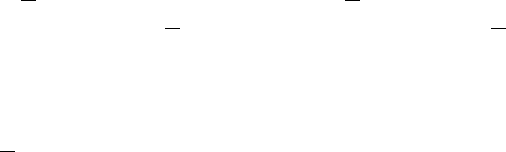
-approximations of F (t, m, X)andA(t, m, X), respectively,
14.3 Set-Valued Forces. Langevin Type Inclusions 345
as in Theorem 4.11. In particular, denote by Ψ
i
(t, m, X) a continuous set-
valued force field with convex closed values whose graph belongs to the ε
i
-
neighborhood of the graph of F (t, m, X) and such that for all (t, m, X)the
inclusion F (t, m, X) ⊂ Ψ
i
(t, m, X) holds (the existence of such Ψ
i
(t, m, X)
follows from [79]). Then as in the proof of Theorem 4.11 the minimal se-
lectors f
i
(t, m, X)ofΨ
i
(t, m, X) point-wise converge to the minimal selector
f(t, m, X)ofF (t, m, X)asi →∞and f(t, m, X) is Borel measurable. By an
analogous argument we introduce a continuous (1, 1)-tensor field
ˆ
Ψ
i
(t, m, X)
whose graph belongs to the ε
i
-neighborhood of the graph of A(t, m, X)and
such that for all (t, m, X) the inclusion A(t, m, X) ⊂
ˆ
Ψ
i
(t, m, X) holds. The
minimal selectors a
i
(t, m, X)of
ˆ
Ψ
i
(t, m, X) point-wise converge to the mini-
mal selector a(t, m, X)ofA(t, m, X)asi →∞and a(t, m, X) is Borel mea-
surable.
Taking into account Definition 14.27 and inequality (14.20)wehave
f
i
(t, m, X) + a
i
(t, m, X) <Q(1 + X)
for a certain Q>Θand for all i.
Pass from the sequences f
i
(t, m, X)anda
i
(t, m, X) to the sequences
˜
f
i
:[0,l] ×
˜
Ω → TM and ˜a
i
:[0,l] ×
˜
Ω → TM,where
˜
f
i
(t, x(·)) =
f
i
(t, Sx(t),
d
dt
Sx(t)) and ˜a
i
(t, x(·)) = a
i
(t, Sx(t),
d
dt
Sx(t)). In addition, intro-
duce
˜
f(t, x(·)) = f(t, Sx(t),
d
dt
Sx(t)) and ˜a(t, x(·)) = a(t, Sx(t),
d
dt
Sx(t)).
Consider the maps Γ
˜
f
i
(t, x(·)) from [0,l] ×
˜
Ω into T
m
0
M and Γ ˜a
i
(t, x(·))
from [0,l] ×
˜
Ω into the set of linear endomorphisms on T
m
0
M. One can
easily see that Γ
˜
f
k
(t, x(·)) point-wise converges to Γ
˜
f(t, x(·)) and Γ ˜a
k
(t, x(·))
point-wise converges to Γ ˜a(t, x(·)) as k →∞.
Since
d
dt
Sx(t) is by construction parallel to x(t) along Sx(·)andthepar-
allel translation preserves the norms, we get
Γ
˜
f
i
(t, x(·)) + Γ ˜a
i
(t, x(·)) <Q(1 + x(·)). (14.21)
By construction, Γ
˜
f
i
(t, x(·)) and Γ ˜a
i
(t, x(·)) are continuous on [0,l] ×
˜
Ω
(this follows from the continuity of Γ , see [99, 106, 107, 115]) and measurable
with respect to the σ-subalgebra P
t
in F generated by cylindrical sets with
bases over [0,t]. Since it also satisfies (14.21), by Theorem 6.26 there exists
a weak solution v
i
(t) of the equation
v
i
(t)=
t
0
Γ
˜
f
i
(τ,v
i
(·))dτ +
t
0
Γ ˜a
i
(τ,v
i
(·))dw(t)+C (14.22)
Denote by μ
i
the measure on (
˜
Ω,
˜
F) corresponding to v
i
. Recall that v
i
(t)
is represented as the coordinate process v
i
(t, x(·)) = x(t) on the probability
space (
˜
Ω,
˜
F,μ
i
).