
Gliklikh Y.E. Global and Stochastic Analysis with Applications to Mathematical Physics
Подождите немного. Документ загружается.

356 15 The Newton-Nelson Equation
analogous way to Nelson’s original version. Moreover, following the ideology
of equations with mean derivatives of Section 8.1 (see Definition 8.21)we
suggest an equation of Itˆo type for finding solutions of the Newton-Nelson
equation such that for two independent particles it splits into two independent
equations. Another (very simple) modification is that we find the diffusion
term of the process from a separate equation with quadratic mean derivative
and do not postulate its value apriori.
The intersection of the domains of applicability of stochastic mechanics
and ordinary (Hamiltonian) quantum mechanics is as follows: for the case of
forces for which the Schr¨odinger equation is well-defined (i.e., for potential
forces, certain forces with friction and the magnetic field), there exists a
natural interrelation between the processes of stochastic mechanics and wave
functions, the solutions of the corresponding Schr¨odinger equations (see, e.g.,
[187, 188, 233]). Below in Section 15.1.1 we describe this interrelation for the
case of potential forces. Note that in the paper [38] (see also [27, 192, 240]) this
interrelation and the methods of partial differential equations were applied to
obtain the existence of trajectories for non-relativistic stochastic mechanical
systems with potential forces in R
n
where the potential belongs to the so-
called Rellich class. It should be pointed out that the trajectories obtained in
[27, 38, 73, 240] are Markov diffusion processes, as was postulated in Nelson’s
pioneering works [187, 188].
15.1 Stochastic Mechanics in R
n
This section consists of two subsections. In Subsection 15.1.1 we present
the basic ideas of stochastic mechanics and, in particular, we describe the
Newton-Nelson equation and its relation to the Schr¨odinger equation.
In Subsection 15.1.2, following [102, 105, 128, 129], we prove the existence
of trajectories for non-relativistic stochastic mechanical systems under vari-
ous initial conditions and with forces in R
n
which are a sum of a force inde-
pendent of velocities and a force linearly dependent on velocities. We do not
assume the forces to be potential or gyroscopic; i.e., we include cases where
other methods of quantization are not applicable (e.g., where the Schr¨odinger
equation does not exist).
We apply the methods developed in Chapter 8.
15.1.1 Principal ideas of Nelson’s stochastic mechanics
Let ξ(t) be a stochastic process and assume that the mean derivatives (see
Section 8.1) exist for ξ(t).

15.1 Stochastic Mechanics in R
n
357
Definition 15.1. The vector
1
2
(DD
∗
+D
∗
D)ξ(t) is called the acceleration of
the stochastic process ξ(t).
Of course there exists a Borel vector field on R
n
(the regression) such that
the above acceleration is the composition of that vector field and ξ(t).
Direct calculations show that
1
2
(DD
∗
+ D
∗
D)ξ(t)=(D
S
D
S
− D
A
D
A
)ξ(t)=D
S
v
ξ
(t) −D
A
u
ξ
(t) (15.1)
(see Definitions 8.15 and 8.16).
In this Section we shall mainly deal with a process of type (8.15), i.e., of
the form ξ(t)=ξ
0
+
t
0
a(s)ds + σw(t). For such a process, from formulae
(8.24)and(8.25) it follows that
D
S
v
ξ
(t)=
∂
∂t
v
ξ
(t)+(v
ξ
(t) ·∇)v
ξ
(t) (15.2)
and
D
A
u
ξ
(t)=(u
ξ
(t) ·∇)u
ξ
(t)+
σ
2
2
∇
2
u
ξ
(t). (15.3)
(Note that the right hand side of (15.2) has the form of an ordinary derivative
of a non-autonomous vector field in the direction of itself in R
n
.) Thus, from
(15.1)–(15.3) we obtain for a ξ(t)oftype(8.15)that
1
2
(DD
∗
+ D
∗
D)ξ(t) (15.4)
=
∂v
ξ
(t)
∂t
+(v
ξ
(t) ·∇)v
ξ
(t)
−
σ
2
2
∇
2
u
ξ
(t)+(u
ξ
(t) ·∇)u
ξ
(t)
.
Consider a Newtonian mechanical system in R
n
with the vector force field
¯α(t, x, X). Here Newton’s law (11.2) takes the following trivial form:
¨x(t)=
1
m
¯α(t, x(t), ˙x(t)), (15.5)
where m is the mass of a particle, ¨x(t) is the acceleration vector and ˙x(t)is
the velocity vector of the curve x(t).
In stochastic mechanics the trajectory of a particle is assumed to be a
stochastic process, not a deterministic curve. More precisely, we have the
following:
Definition 15.2. A diffusion type process ξ(t)inR
n
is called a stochastic-
mechanical trajectory of a particle with mass m > 0 under the action of the
force field ¯α(t, x, X)ifitsatisfiesthesystem
⎧
⎨
⎩
1
2
(DD
∗
+ D
∗
D)ξ(t)=
1
m
¯α(t, ξ(t),v
ξ
(t))
D
2
ξ(t)=
m
I
(15.6)

358 15 The Newton-Nelson Equation
where =
h
2π
, h is Plank’s constant and I is the unit n × n matrix. In this
case we also say that the stochastic-mechanical system with force ¯α(t, x, X)
is given. The equality (15.6) is called the Newton-Nelson equation.
From the second equation of (15.6) it follows that ξ(t) is a process of type
(8.15) with σ such that
σ
2
2
=
2m
.
If σ = 0, the process ξ(t) from Definition 15.2 turns into a deterministic
curve and (15.6) becomes the ordinary Newton law (15.5). Without loss of
generality we assume m = 1.
Remark 15.3. Equality (15.6) for the Euclidean space R
n
was first obtained
by Nelson in [187]. It was also shown there that among all possible definitions
of the acceleration of a stochastic process which are symmetric in time (i.e.,
well-defined physically) and coincide with the ordinary definition for smooth
trajectories, only Definition 15.1 gives the correct result for some particular
examples in quantum mechanics. Later equation (15.6) (for potential forces
and in the form where the right-hand side is transformed according to (15.4))
was derived from some variational principles (see [190]).
Note that in stochastic mechanics one deals with the “quantization” of
Newton’s second law, while in the ordinary quantization procedures some
other equations of motion (Euler-Lagrange or Hamilton) are involved.
The correspondence between stochastic mechanics and ordinary (Hamil-
tonian) quantum mechanics was established for potential forces (see, e.g.,
[187, 188, 190]) and for certain forces with friction [233] where both the
Schr¨odinger equation and Newton-Nelson equation (15.6) are well-defined.
We illustrate this correspondence with an example of potential forces. The
arguments here are close to those in [187], but since we apply Lemmas 8.17
and 8.18 instead of classical results for Markov diffusions, we show that the
correspondence is also valid under the assumption that the trajectories are
Itˆo processes of diffusion type.
Let the force field ¯α of the mechanical system be a potential, i.e., it does
not depend on velocity and ¯α = −grad V ,whereV is the potential energy.
Let ξ(t) be a trajectory of the stochastic-mechanical system as in Definition
15.2 with this force. Recall that for the osmotic velocity u
ξ
(t)=u
ξ
(t, ξ(t))
the vector field u
ξ
(t, x) is always described in the form u
ξ
= σ
2
grad R,where
R =
1
2
log ρ
ξ
(t, x)(see(8.18)). Let us suppose that for the current velocity
v
ξ
(t)=v
ξ
(t, ξ(t)) the vector field v
ξ
(t, x) is also a gradient v
ξ
= σ
2
grad S for
some real function S(t, x). Note that S(t, x) is defined to within the functions
depending only on t, i.e., whose gradient is zero. Consider the complex-valued
function Ψ on M of the form Ψ(t, x)=exp(R +iS).
Theorem 15.4 Ψ satisfies the Schr¨odinger equation
∂Ψ
∂t
=i
σ
2
2
∇
2
Ψ − i
1
VΨ. (15.7)

15.1 Stochastic Mechanics in R
n
359
Proof. From Lemmas 8.17 and 8.18 it follows that
∂u
ξ
∂t
= −
σ
2
2
grad div v
ξ
−
grad (v
ξ
˙u
ξ
). From (15.4)and(15.6)for¯α = −grad V it follows that
∂v
ξ
∂t
=
−grad V −(v
ξ
·∇)v
ξ
+(u
ξ
·∇)u
ξ
+
σ
2
2
∇
2
u
ξ
. Then straightforward calculations
show that
∂Ψ
∂t
=
∂R
∂t
+i
∂S
∂t
Ψ. (15.8)
In order to find (
∂R
∂t
+i
∂S
∂t
)wenotethatgrad(
∂R
∂t
+i
∂S
∂t
)=
1
σ
2
(
∂u
ξ
∂t
+i
∂v
ξ
∂t
)and
so, by the above expressions for
∂u
ξ
∂t
and
∂v
ξ
∂t
,sinceu
ξ
and v
ξ
are gradients,
we obtain the formula
grad
∂R
∂t
+i
∂S
∂t
= −grad div v
ξ
−
1
σ
2
grad (v
ξ
· u
ξ
) −
i
σ
2
grad V
−
i
σ
2
(v
ξ
·∇)v
ξ
+
i
σ
2
(u
ξ
·∇)u
ξ
+
i
2
∇
2
u
ξ
=grad
−
1
2
div v
ξ
−
1
σ
2
(v
ξ
· u
ξ
) −
i
σ
2
V −
i
2σ
2
(v
ξ
)
2
+
i
2σ
2
(u
ξ
)
2
+
i
2
div u
ξ
=grad
i
2
(div u
ξ
+idivv
ξ
)+
i
2σ
2
(u
ξ
+iv
ξ
)
2
−
i
σ
2
V
.
Hence,
∂R
∂t
+i
∂S
∂t
= −
i
2
(div u
ξ
+idiv v
ξ
)+
1
2σ
2
(u
ξ
+iv
ξ
)
2
−
i
σ
2
V +if(t) (15.9)
where f(t) is a real function, depending only on t, i.e., grad f (t)=0.Onthe
other hand,
∇
2
Ψ = Ψ
1
σ
2
(u
2
+iv
2
)
2
+
1
σ
4
(div u
ξ
+idivv
ξ
)
. (15.10)
Comparing (15.8), (15.9)and(15.10), we see that the following equality holds:
∂Ψ
∂t
=i
σ
2
2
∇
2
Ψ − i
1
VΨ+if (t)Ψ. (15.11)
Adding to S an appropriate constant depending on t, one can obtain the
equality f =0.So(15.11) turns into the Schr¨odinger equation (15.7) with
potential V .
So, Ψ(t, x) is a Schr¨odinger wave function corresponding to the above
mechanical system. Conversely, let Ψ satisfy the Schr¨odinger equation (15.7)
with potential V . Consider the functions R = Re log Ψ and S = Im log Ψ
and the vector fields u(t, x)=σ
2
grad R, v(t, x)=σ
2
grad S and a(t, x)=
v(t, x)+u(t, x).
360 15 The Newton-Nelson Equation
Theorem 15.5 Solutions ξ(t) of the Itˆo equation
dξ(t)=a(t, ξ(t))dt + σdw(t), (15.12)
where a(t, x) and σ are as introduced above, satisfy equation (15.6) with ¯α =
−grad V .
We leave the proof to the reader as a simple exercise. Note that for a
solution ξ(t)of(15.12)wehavev
ξ
(t, x)=v(t, x)andu
ξ
(t, x)=u(t, x), and
it should be emphasized that in this case the assumption that v
ξ
(t, x)isa
gradient is fulfilled automatically. Note also that strong solutions of (15.12)
are Markov diffusion processes (see Definition 6.17). Thus we can formulate:
Proposition 15.6 If a stochastic-mechanical trajectory ζ(t) with the force
¯α = −grad V is an unique strong solution of (15.12) corresponding to a
Schr¨odinger wave-function Ψ as described above, then ζ(t) is a Markov dif-
fusion process.
Indeed, ρ
ζ
(t, x)=|Ψ(t, x)|
2
= ρ
ξ
(t, x), where ρ
ξ
(t, x) is the probability
density of the diffusion process ξ(t), the solution of (15.12) constructed from
Ψ(t, x), which corresponds to ζ(t). The above diffusion process (trajectory)
can be shown to exist when V belongs to the very broad so-called Rellich
class (see [38]).
15.1.2 Existence theorems
In this Section we prove the existence of the trajectory assuming neither the
Schr¨odinger equation to be well-defined nor its solution to exist. In this case
the trajectory is not a diffusion process but an Itˆo process of type (8.15).
First we consider deterministic initial data for the solution which leads to a
singularity at t = 0 resembling the Big Bang (see Remark 15.10 below). Then
we obtain another version of the construction that yields the existence of a
solution, for random initial data, such that its distribution is nowhere zero.
In the latter case no singularity at time zero arises.
Everywhere below in this Section we consider the vector force field ¯α
of the form ¯α(t, x, X)=¯α
0
(t, x)+¯α
1
(t, x)X where ¯α
0
(t, x) is a vector
field on R
n
depending on t ∈ [0,l]and¯α
1
(t, x) is a linear operator in
R
n
depending on the parameters t ∈ [0,l]andx ∈ R
n
, i.e., ¯α
1
(t, x)isa
(1.1)-tensor field on R
n
. Consider the derivative of ¯α
1
(t, x), i.e., the field
of bilinear operators ¯α
1
(t, x))(·, ·):R
n
× R
n
→ R
n
, and the vector field
tr¯α
1
(t, x)(¯α
1
)ds =
n
i=1
¯α
1
(t, x)(¯α
1
(t, x)e
i
,e
i
), where e
1
,...,e
n
is an arbi-
trary orthonormal frame in R
n
. We assume the following condition to be
fulfilled:

15.1 Stochastic Mechanics in R
n
361
Condition 15.7 The vector field ¯α
0
(t, x) and the tensor field ¯α
1
(t, x) are
Borel measurable jointly in t and x, tr¯α
1
(s, W (s))(¯α
1
) exists and is also Borel
measurable jointly in t, x and there exists a constant C>0 such that
l
0
(¯α
0
(t, x(t))
2
+ ¯α
1
(t, x(t))
2
+ tr¯α
1
(t, x(t))(¯α
1
)
2
)dt<C
for any continuous curve x(t) in R
n
, t ∈ [0,l],where¯α
1
(t, x) is the operator
norm.
Condition 15.7 is fulfilled, for example, if ¯α
0
(t, x) is continuous and uni-
formly bounded, ¯α
1
(t, x) belongs to the functional space C
1
(R×R
n
×R
n
, R
n
)
and has a bounded norm in that space.
For the sake of simplicity, without loss of generality we may assume σ =1.
We shall deal with stochastic processes starting at a non-random point in R
n
,
and for the sake of simplicity we assume this point to be equal to the origin.
Consider the probability space (
˜
Ω,
˜
F,ν)where
˜
Ω = C
0
([0,l], R
n
),
˜
F is the
σ-algebra generated by the cylindrical sets, and ν is a Wiener measure (see
Section 6.2.1). Denote by B
t
the σ-algebra generated by the cylindrical sets
with the bases over [0,t]; all the B
t
are completed by the sets of ν-measure
zero.
Recall that the coordinate process W (t, x(·)) = x(t), x(·) ∈
˜
Ω,on(
˜
Ω,
˜
F,ν)
is a Wiener process in R
n
.
Let t
0
∈ (0,l)andfort ∈ [0,l] denote by t
0
(t) the function
t
0
(t)=
⎧
⎨
⎩
1
t
0
if t<t
0
,
1
t
if t ≥ t
0
.
(15.13)
Recall that we are looking for a solution as a process of type (8.15) that under
the above assumptions takes the form ξ(t)=
t
0
a(s)ds+ w(t)wherea(t)isto
be found. Pick a deterministic initial condition a
0
∈ R
n
for a(t) and consider
in R
n
the equation
a(t)=a
0
+
t
0
¯α
0
(s, W (·))ds +
t
0
¯α
1
(s, W (s))dW (s)+
1
2
t
0
tr¯α
1
(¯α
1
)ds
−
1
2
t
0
t
0
(s)a(s)ds +
1
2
t
0
t
0
(s)dW (s) −
1
2
t
0
(t)W (t) (15.14)
Equation (15.14) has a unique strong solution for t ∈ [0,l]. Indeed, the coef-
ficients of (15.14) are either Lipschitz continuous and have a linear growth
with respect to a or do not depend on a. Since the solution is strong, it exists
for any Wiener process and is non-anticipative with respect to P
W
t
= B
t
.In
what follows we will consider a(t) for the realization of W (t) as the coordinate
process on (
˜
Ω,
˜
F,ν).
From Condition 15.7 it follows that a(t) satisfies (8.32).
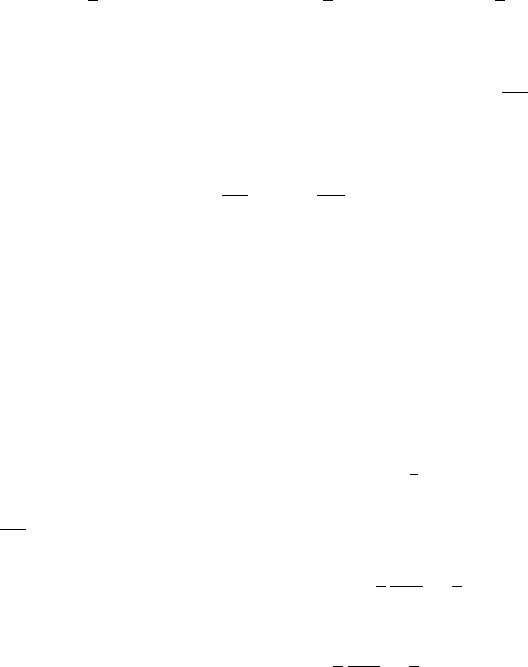
362 15 The Newton-Nelson Equation
Below in this Section we will use the notation introduced in Section 8.3.
Consider the function θ(l)on
˜
Ω determined for the process a(t) by formula
(8.33). From the above condition it easily follows that θ(l) is a probability
density on (
˜
Ω,
˜
F,ν). Denote by μ
ξ
the corresponding measure on (
˜
Ω,
˜
F), i.e.,
dμ
ξ
= θ dν (note that μ
ξ
and ν are equivalent), and by ξ(t) the coordinate
process on (
˜
Ω,
˜
F,μ
ξ
). Then (see Section 8.3) the process ξ(t) is expressed in
the required form
ξ(t)=
t
0
a(s)ds + w(t) (15.15)
where w(t) is a Wiener process on (
˜
Ω,
˜
F,μ
ξ
) adapted to P
ξ
t
= P
W
t
= B
t
.
Since ξ(t)andW (t) coincide as coordinate processes on (
˜
Ω,
˜
F), (15.14)
clearly turns into
a(t)=a
0
+
t
0
¯α
0
(s, ξ(s))ds +
t
0
¯α
1
(s, ξ(s))a(s)ds +
t
0
¯α
1
(s, ξ(s))dw(s)
+
1
2
t
0
tr¯α
1
(s, ξ(s))(¯α
1
)ds +
1
2
t
0
t
0
(s))dw(s) −
1
2
t
0
(t)ξ(t). (15.16)
Lemma 15.8
(i) D
ξ
∗
¯α
1
(s, ξ(s))dw(s)=−tr¯α
1
(t, ξ(t))(¯α
1
)+¯α
1
(t, ξ(t))
ξ(t)
t
−¯α
1
(t, ξ(t))E
ξ
t
(κ(t)).
(ii) D
ξ
∗
t
0
t
0
(s)dw(s)=
ξ(t)
t
2
− E
ξ
t
κ(t)
t
for t>t
0
,
where κ(t) is as in Lemma 8.35.
In order to prove (i) one should replace the Itˆo integral by a backward Itˆo
integral according to formula (6.7) and then apply formula (8.37) with the
same arguments as in the proof of Lemma 8.26(ii). Assertion (ii) follows from
formula (8.37), the definition of the Itˆo integral, and the definition of t
0
(t)
given by formula (15.13).
Theorem 15.9 For t ∈ (t
0
,l) the process ξ(t) satisfies (15.6), i.e., it is a
trajectory of the stochastic mechanical system with force ¯α(t, m, X).
Proof. Recall that for t ∈ (t
0
,l)wehavet
0
(t)=
1
t
.From(15.15) and Theorem
8.7 it follows that Dξ(t)=E
ξ
t
(a(t)). By (8.36) we obtain D
∗
ξ(t)=E
ξ
t
(a(t))+
ξ(t)
t
− E
ξ
t
(κ(t)). In particular
v
ξ
(t)=D
S
ξ(t)=E
ξ
t
(a(t)) +
1
2
ξ(t)
t
−
1
2
E
ξ
t
(κ(t)) (15.17)
and
u
ξ
(t)=D
A
ξ(t)=−
1
2
ξ(t)
t
+
1
2
E
ξ
t
(κ(t)). (15.18)

15.1 Stochastic Mechanics in R
n
363
Then for t>t
0
, using formula (8.38) and equation (15.16), as well as Lem-
mas 8.36, 8.37 and 8.38, one can obtain
DD
∗
ξ(t)=¯α
0
(t, ξ(t)) + ¯α
1
(t, ξ(t))E
ξ
t
(a(t)) +
1
2
tr¯α
1
(s, ξ(s))(¯α
1
)
+E
ξ
t
a(t)
t
−
ξ(t)
t
2
−
1
2
E
ξ
t
a(t)
t
+
1
2
a(t)
t
2
.
Analogously, using in addition formula (8.39) and Lemma 15.8, one can cal-
culate
D
∗
Dξ(t)=¯α
0
(t, ξ(t)) + ¯α
1
(t, ξ(t))E
ξ
t
(a(t)) + ¯α
1
(t, ξ(t))
x(t)
t
−¯α
1
(t, ξ(t)E
ξ
t
(κ(t)) −
1
2
tr¯α
1
(t, ξ(t))(¯α
1
)+
1
2
ξ(t)
t
2
−
1
2
E
ξ
t
κ(t)
t
−
1
2
E
ξ
t
a(t)
t
+
1
2
E
ξ
t
κ(t)
t
.
So
1
2
(DD
∗
+ D
∗
D)ξ(t)=¯α
0
(t, ξ(t)) (15.19)
+¯α
1
(t, ξ(t))
E
ξ
t
(a(t)+
1
2
ξ(t)
t
−
1
2
κ(t))
.
From formula (15.17) it follows that (15.19) coincides with the first equation
of (15.6).
Since ξ(t) is a process of the form (8.15) (see above), by Theorem 8.12
D
2
ξ = I (recall that we set σ = 1) and so system (15.6) is fulfilled.
Remark 15.10. Generally speaking, ξ(t)fort ∈ (0,t
0
) does not satisfy
(15.6). Thus ξ(t) can be interpreted only as a trajectory of the stochastic
mechanical system beginning at the instant t
0
in the random configuration
ξ(t
0
) with the initial forward derivative E
ξ
t
(a(t
0
)). It is clear that t
0
may be
chosen arbitrarily close to zero, and so we can bring the initial values of the
trajectory to the origin for the configuration and, again as close as we want,
to a
0
for the forward derivative. But we cannot put t
0
= 0, since the integral
t
0
1
s
dw(s) does not exist (
t
0
1
s
2
ds diverges, see, e.g., [162] and Section 6.2.2),
i.e., when t
0
= 0 equations (15.14)and(15.16) are ill-posed. This behavior
of the solution is interpreted in Section 15.3 as a possible description of the
Big Bang (see Remark 15.51).
Remark 15.11. If ¯α = −grad V then there may exist a trajectory of the
stochastic mechanical system obtained by Carlen [38] (see above). Suppose
that both our and Carlen’s trajectories are connected with the same solu-
tion Ψ of the corresponding Schr¨odinger equation. Then those trajectories
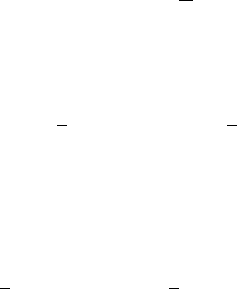
364 15 The Newton-Nelson Equation
determine different probability measures on the space of sample paths but
the densities ρ on R ×R
n
coincide and are equal to |Ψ|
2
.
Since the function t
0
(t) is piecewise smooth (see its definition by formula
(15.13)) we may consider its derivative t
0
(t) defined by the formula
t
0
(t)=
0ift<t
0
,
−
1
t
2
if t ≥ t
0
.
(15.20)
Theorem 15.12 Equations (15.14) and (15.16) are equivalent to the follow-
ing equations of Stratonovich type
a(t)=a
0
−
1
2
t
0
t
0
(s)a(s)ds −
1
2
t
0
t
0
(s)W (s)ds
+
t
0
¯α
0
(s, W (·))ds +
t
0
¯α
1
(s, W (s)) ◦ dW (s) (15.21)
and
a(t)=a
0
−
1
2
t
0
t
0
(s)a(s)ds −
1
2
t
0
t
0
(s)ξ(s)ds +
t
0
¯α
0
(s, ξ(·))ds
+
t
0
¯α
1
(s, ξ(s))a(s)ds +
t
0
¯α
1
(s, ξ(s)) ◦ dw(s), (15.22)
respectively.
Proof. Indeed, by the Itˆo formula (6.10)forf(t, x)=t
0
(t)x we have
d(t
0
(t)W (t)) = t
0
(t)W (t)dt + t
0
(t)dW (t)
and
d(t
0
(t)ξ(t)) = (t
0
(t)a(t)+t
0
(t)ξ(t))dt + t
0
(t)dw(t).
An application of formula (6.23) (which follows from (6.6)) to A =¯α
1
com-
pletes the proof.
Remark 15.13. Equations (15.21)and(15.22) show that a(t) is a vector
(belongs to the tangent bundle), a fact which plays a significant role in the
transition to manifolds. Note also that if ¯α
1
=0,a(t) becomes a process with
a.s. smooth sample paths.
Now we are in position to prove the existence of a solution of the Newton-
Nelson equation (15.6) with random initial data. Here we shall obtain a pro-
cess that is a solution for all positive times, i.e., without singularity at t =0.
However, the initial density must be nowhere equal to zero.
The main technical difference from the above case is that here we can
calculate some derivatives “beforehand” and then use them to construct a
solution of (15.6).

15.1 Stochastic Mechanics in R
n
365
As above, consider equation (15.6) with ¯α(t, x, X)=¯α
0
(t, x)+¯α
1
(t, x)X
and suppose that ¯α
0
and ¯α
1
satisfy Condition 15.7. Consider the initial data
for (15.6)oftheform
ξ(0) = x
0
,Dξ(0) = a
0
, (15.23)
where x
0
and a
0
are random elements with values in R
n
, x
0
has a smooth
distribution ρ
0
with respect to Lebesgue measure on R
n
with ρ(x) = 0 for all
x and a
0
is bounded.
All processes below in this section are considered on some finite time in-
terval [0,l].
Let W
0
(t) be the standard Wiener process on R
n
, i.e., the coordinate
process on the probability space (
˜
Ω,
˜
F,ν) introduced at the beginning of this
section. The filtration P
W
0
t
is generated by cylinder sets with bases on [0,t].
Consider the process W (t)=x
0
+ W
0
(t). Its density, denoted by ρ
W
(t, x),
satisfies the diffusion equation
∂
∂t
ρ
W
(t, x)=
1
2
Δρ
W
(t, x)
with initial condition ρ
W
(0,x)=ρ
0
. Thus the density ρ
W
(t, x)canbe
considered as given aprioriand we use it in the further construction. By
Lemma 8.17 the osmotic velocity u
W
(t, W (t)) of W (t) can be found by the
formula
u
W
(t, x)=
1
2
grad log ρ
W
(t, x).
Hence u
W
(t, x) is uniquely constructed from ρ
W
(t, x) (and, like ρ
W
(t, x), will
also be used later in the construction).
Consider the Itˆo equation
a(t)=a
0
+
t
0
¯α
0
(s, W (s)) ds (15.24)
+
t
0
¯α
1
(s, W (s)) dW (s)+
1
2
t
0
tr ∇¯α
1
(¯α
1
(s, W (s))) ds
+
t
0
D
W
u
W
(s, W (s)) ds +
t
0
(a(s) ·∇)u
W
(s, W (s)) ds,
where D
W
is defined in (8.7) and may be represented as D
W
=
∂
∂t
+
1
2
Δ (see
(8.22)and(8.24)). Thus D
W
u
W
(s, W (s)) is known and we can prove the
existence of a solution a(t) of equation (15.24) by imitating the method used
for equation (15.14). Since (15.24) is linear in a, under the above conditions
this equation has a unique strong solution that we shall again denote by a(t).
Let θ(l) be defined by formula (8.33) with a(t)andW (t) as above. Clearly
θ(t) is a martingale with expectation 1. Introduce a new probability measure