
Gliklikh Y.E. Global and Stochastic Analysis with Applications to Mathematical Physics
Подождите немного. Документ загружается.


56 2 Connections
Hence,
T
k
i,j
= Γ
k
ij
− Γ
k
ji
. (2.28)
Formula (2.28) immediately yields:
Proposition 2.47 The equality T =0holds at all points m ∈ M if and only
if in all charts Γ
k
ij
= Γ
k
ji
, i.e., the local connector Γ
m
(·, ·) is a symmetric
bilinear operator.
2.6 Riemannian Connections. The Levi-Civit´a
Connection
From all the connections on a Riemannian manifold M we select one whose
covariant derivative properties are the closest to those of the ordinary deriva-
tive in Euclidean space.
If on a manifold M a Riemannian metric and a connection are given in-
dependently, one should not expect, for the covariant derivative, to find an
analog of the Leibnitz formula for differentiating the inner product. Neverthe-
less for every Riemannian manifold there exists a class of connections having
this property.
Let a Riemannian or semi-Riemannian metric ·, · be given on M .For
two smooth vector fields Y and Z on M we consider the smooth function
Y,Z that assigns the value of the Riemannian inner product Y
m
,Z
m
of
the vectors of Y and Z at m to the point m. We find the derivative XY,Z
of the function Y,Z in the direction of a smooth vector field X.
Definition 2.48. A connection on M is said to be Riemannian if for all
smooth vector fields X, Y and Z on M the following equality holds:
XY, Z = ∇
X
Y,Z + Y, ∇
X
Z. (2.29)
Taking into account the interrelation between ∇ and
D
dt
(see Remark 2.27)
one can easily derive the following version of formula (2.29)for
D
dt
d
dt
Y (t),Z(t) =
D
dt
Y (t),Z(t)
+
Y (t),
D
dt
Z(t)
, (2.30)
where Y (t)andZ(t) are smooth vector fields along a smooth curve m(t).
An existence theorem for Riemannian connections will be proved below
(see Remark 2.55).
Specify a Riemannian connection on a Riemannian manifold M.
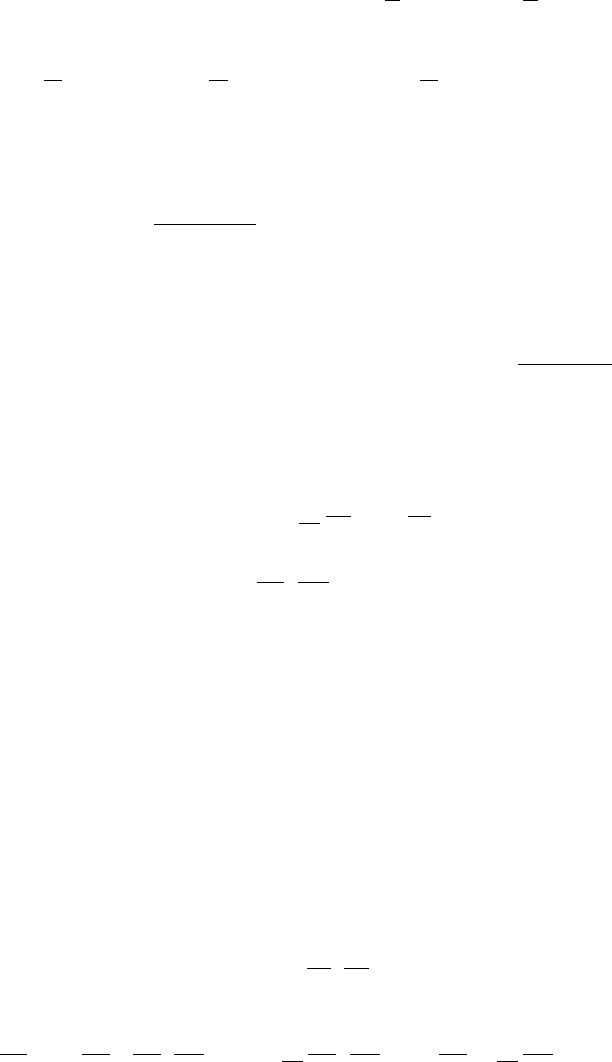
Theorem 2.49 Let Y (t) and Z(t) be parallel vector fields along a smooth
curve m(t).ThenY (t),Z(t) =const.
2.6 Riemannian Connections. The Levi-Civit´a Connection 57
Proof. By the definition of a parallel vector field,
D
dt
Y (t)=0and
D
dt
Z(t)=0.
Having substituted these expressions into (2.30) we obtain
d
dt
Y (t),Z(t) =
D
dt
Y (t),Z(t)
+
Y (t),
D
dt
Z(t)
=0.
This means that the function Y (t),Z(t) is constant.
Corollary 2.50 If Y (t) is a parallel vector field along a smooth curve m(t),
Y (t) =const.
Indeed, Y (t) =
Y (t),Y(t) and the assertion of Corollary 2.50 follows
from Theorem 2.49.
Corollary 2.51 If Y (t) and Z(t) are parallel vector fields along a smooth
curve m(t), the cosine of the angle between those vectors is constant.
Since the cosine of the angle between Y (t)andZ(t) equals
Y (t),Z(t)
Y (t)Z(t)
,
the assertion of Corollary 2.51 follows from Theorem 2.49 and Corollary 2.50.
Definition 2.52. The functions Γ
ij,k
= ∇
∂q
i
∂q
j
,∂q
k
in a chart of a Rie-
mannian manifold M are called Christoffel symbols of the first kind.
We now describe the interrelation between Christoffel symbols of the first
and second kinds. By formula (2.22) ∇
∂
∂q
i
∂
∂q
j
= Γ
l
ij
∂
∂q
l
.Thus
Γ
ij,k
=
Γ
l
ij
∂
∂q
l
,
∂
∂q
k
= g
lk
Γ
l
ij
. (2.31)
Applying the same arguments as in the derivation of formula (1.21), from
(1.20) we obtain
Γ
k
ij
= g
lk
Γ
ij,l
. (2.32)
In particular, if the torsion tensor equals zero, i.e., Γ
k
ij
= Γ
k
ji
, then also
Γ
ij,k
= Γ
ji,k
.
Note that here we use only the fact that the matrix (g
ij
) is invertible,
not that it is positive-definite. Thus formula (2.32) is well-defined both for
Riemannian and semi-Riemannian metrics.
Lemma 2.53 (The principal lemma of Riemannian geometry) On every
manifold M with Riemannian or semi-Riemannian metric ·, · there ex-
ists a unique Riemannian connection whose torsion tensor equals zero at
all m ∈ M.
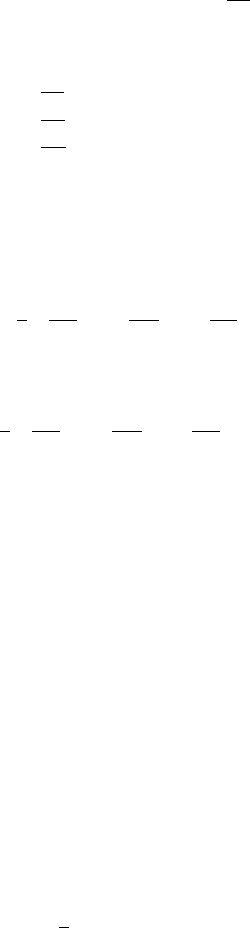
Proof. Recall that by definition g
ij
=
∂
∂q
i
,
∂
∂q
j
. Since the connection that
we are looking for is Riemannian, from formula (2.29) it follows that
∂
∂q
l
g
ij
=
∂
∂q
l
∂
∂q
i
,
∂
∂q
j
=
∇
∂
∂q
l
∂
∂q
i
,
∂
∂q
j
+
∂
∂q
i
, ∇
∂
∂q
l
∂
∂q
j
.
58 2 Connections
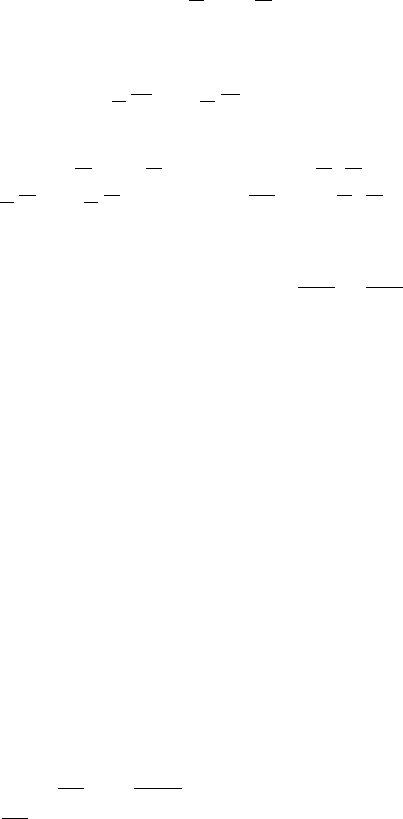
So, taking into account Definition 2.52, we obtain
∂
∂q
l
g
ij
= Γ
li,j
+ Γ
lj,i
. Con-
sidering all rearrangements of the given indices i, j, l we obtain a system of
three equations of the same kind as above:
⎧
⎪
⎨
⎪
⎩
∂
∂q
l
g
ij
= Γ
li,j
+ Γ
lj,i
∂
∂q
i
g
lj
= Γ
il,j
+ Γ
ij,l
∂
∂q
j
g
il
= Γ
ji,l
+ Γ
jl,i
.
(2.33)
Recall that the torsion tensor equals zero, i.e., the Christoffel symbols of the
first kind are symmetric in the first two indices. The system (2.33)ofthree
linear algebraic equations has three unknowns. Adding the second equation
to the third one and subtracting the first one from the sum, we obtain
Γ
ij,l
=
1
2
∂
∂q
i
g
lj
+
∂
∂q
j
g
li
−
∂
∂q
l
g
ij
. (2.34)
Then by formula (2.32)
Γ
k
ij
=
1
2
∂
∂q
i
g
lj
+
∂
∂q
j
g
li
−
∂
∂q
l
g
ij
g
kl
. (2.35)
Formula (2.35) uniquely determines the Christoffel symbols of the second
kind. From this it follows that the connection we are looking for is unique.
The existence is proved by an elementary verification that the connection with
Christoffel symbols (2.35) has the properties described in the hypothesis.
Definition 2.54. The connection whose existence is asserted in Lemma 2.53
is called the Levi-Civit´a connection of the metric ·, ·.
It is easy to see that in the Euclidean space R
n
the Levi-Civit´a connection
of the standard inner product coincides with the Euclidean connection of the
standard coordinate system.
Remark 2.55. If a connection is Riemannian but the torsion is not zero,
system (2.33) consists of three equations but has six unknowns. This sys-
tem has an infinite set of solutions, each of them determining a Riemannian
connection.
Remark 2.56. The tetrad Christoffel symbols (see Remark 2.37)oftheLevi-
Civit´a connection are determined by the formula
◦
Γ
k
ij
=
1
2
c
i
kj
+ c
j
ki
+ c
k
ij
, (2.36)
where c
l
pq
can be found from the equalities [e
p
,e
q
]=c
l
pq
e
l
, see [57].
The next property of the Levi-Civit´a connection follows from the fact that
its torsion tensor equals zero and so the property does not hold for other
Riemannian connections.
2.6 Riemannian Connections. The Levi-Civit´a Connection 59
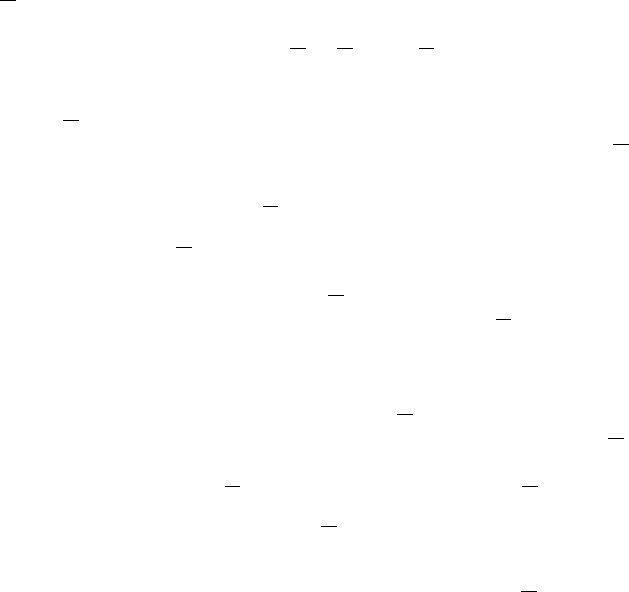
Let γ(t, s) be a smooth mapping from the rectangle [a, b] × (c, d)intoM.
Then one can consider the vector fields
∂
∂t
and
∂
∂s
on γ([a, b] × (c, d)).
Lemma 2.57 (Lemma on the second covariant derivative )
∇
∂
∂t
∂
∂s
= ∇
∂
∂s
∂
∂t
.
Proof. By construction, s and t are coordinates on [a, b] × (c, d). Hence on
γ([a, b] × (c, d)) the fields
∂
∂s
and
∂
∂t
commute, i.e.,
∂
∂t
,
∂
∂s
= 0 (see Sec-
tion 1.7). Then ∇
∂
∂t
∂
∂s
−∇
∂
∂s
∂
∂t
=(Γ
k
ij
− Γ
k
ji
)
∂
∂q
k
= T
∂
∂t
,
∂
∂s
and the as-
sertion of the Lemma follows from the fact that the torsion tensor T equals
zero.
Lemma 2.57 is an analog of the classical equality
∂
2
∂x∂y
=
∂
2
∂y∂x
.
For the curvature tensor of the Levi-Civit´a connection of a Riemannian or
semi-Riemannian metric we consider the following constructions. As above
denote by R
i
jkl
the components of the curvature tensor R. Contract R by the
only contravariant and the second covariant indices (see Section 1.5). The
result is a tensor Ric called the Ricci curvature. Its components take the
form R
jl
= R
k
jkl
. If R =0, it is evident that Ric = 0, but not vice versa. Ric
is a symmetric (0, 2)-tensor.
Let
Ricbethe(1, 1)-tensor with components R
l
j
that is physically equiv-
alent to Ric. The contraction of
Ric, i.e., the scalar S = R
j
j
, is called the
Gaussian or scalar curvature.IfRic=0,thenS = 0 but not vice versa.
Nevertheless, if dim M = 2 the Gaussian curvature determines both the
Ricci curvature and the curvature tensor and if dim M = 3 the Ricci curva-
ture determines the curvature tensor. If dim M ≥ 4 no such determinations
are valid.
Definition 2.58. The operator ∇
2
= ∇∇
∗
,where∇
∗
is the operator con-
jugate to the operation of covariant derivation of the Levi-Civit´a connection
∇, is called the Laplace-Beltrami operator.
In local coordinates of a chart the operator ∇
2
is described by the formula
∇
2
= g
ij
∇
i
∇
j
= −g
ij
Γ
k
ij
∂
∂q
k
+ g
ij
∂
2
∂q
i
∂q
j
where ∇
k
is the covariant derivative
in the direction of
∂
∂q
k
and g
ij
are the components of the metric tensor (g
ij
).
From this one can easily see that in a Euclidean space R
n
with standard
basis, ∇
2
coincides with the ordinary Laplacian. Note also that the above
coordinate representation of ∇
2
defines its action on functions.
In general the Laplace-Beltrami operator does not coincide with the
Laplace-de Rham operator Δ =dδ + δd (see Definition 1.73)inspiteof
thefactthatinR
n
, modulo the sign, they both give the Laplacian. On func-
tions both operators on all Riemannian manifolds take the same value. In
the general case of differential forms (polyvectors) on manifolds the relation
between the operators is described by the so-called Weitzenb¨ok formulae (a
60 2 Connections
special formula exists for each degree of the form), see [135]. For the mate-
rial below we need the following Weitzenb¨ok formula for 1-forms (and so for
vector fields):
ΔX = −∇
2
X +
Ric ◦X. (2.37)
2.7 Connections on Principal Bundles
Let G be a principal bundle with fiber (structure group) G over base M.The
fiber at m ∈ M will be denoted G
m
. Recall that G
m
is homeomorphic to
the group G. In the tangent space T
g
G to G at g ∈ G,asisthecaseforany
bundle, we can consider the subspace that consists of the vectors tangent to
the fiber G
πg
. As usual we call this space the vertical subspace and denote it
by V
g
⊂ T
g
G. The vectors in V
g
are said to bevertical.
The collection of vertical subspaces at all points forms the bundle V → G
with fibers V
g
.
Theorem 2.59 The bundle V → G
is trivial.
Proof. Every point g ∈ G
determines a diffeomophism of the group G onto
the fiber G
πg
(which will be denoted by the same symbol g) by the formula
g ◦G,where◦ is the right action of G on G
(see Section 1.3). It is clear that
the diffeomorphism g sends the unit e ∈ G to the point g ∈ G
. Since this is
a diffeomorphism, the tangent map Tg : TG → TG
g
is a linear isomorphism
of T
e
G = g onto the tangent space to the fiber G
πg
at g, i.e., onto V
g
.Thus
every vertical subspace V
g
is linearly isomorphic to the Lie algebra g and the
isomorphism smoothly depends on the point g ∈ G
. Hence, having specified
a vector X =0∈ g, we obtain the smooth vector field
¯
X
g
= TgX =0onG.
In particular, taking vectors of a basis in g, we obtain a basis at every V
g
.
So, we have represented V → G
in the form of a direct product G ×g.
Definition 2.60. The vector field
¯
X on G
, constructed in the proof of The-
orem 2.59 from the vector X ∈ g, is called a fundamental vector field.
Thus the fundamental vector fields trivialize the bundle V → G
since they
determine the frames in the fibers of V
g
.
Recall that for a vector bundle Θ we also constructed vertical subspaces
V
(m,ϑ)
⊂ T
ϑ
Θ
m
that were sent onto the fibers Θ
πq
by the linear isomorphism
p. In the case of a principal bundle an isomorphism like p does not exist since
the fibers of the bundle are not vector spaces. However, Theorem 2.59 provides
us with something that was not available in the case of vector bundles: all
V
g
are in a standard way isomorphic to a unique vector space g while in the
case of a vector bundle vertical subspaces at the points of Θ
m
were sent onto
“their own” fiber Θ
m
.
Notation 2.61 The isomorphism V
g
→ g, described above, is denoted by p.
2.7 Connections on Principal Bundles 61
Definition 2.62. We say that a connection H is given on a principal bundle
G
if to every T
g
G is associated a subspace H
g
that is complementary to V
g
,
smoothly depends on the point g ∈ G
and is such that the connection H is
invariant with respect to the right action of the group G on G
(i.e., for every
element h of G and every g ∈ G
the equality TR
h
H
g
= H
g◦h
holds where
R
h
(g)=g ◦ h is the right action of h on G). The subspaces H
g
comprising a
connection are called horizontal, as are the vectors belonging to them.
As in the case of a vector bundle, Y ∈ T
g
G is uniquely represented as the
sum Y = HY + VY where HY ∈ H
g
and VY ∈ V
g
.
Definition 2.63. The mapping ϕ : TG
→ g whose value at Y ∈ TG is given
by the formula ϕ(Y )=pVY is called the connection form of H .
It is clear that the connection form is a direct analog of the connector
(connection map) on vector bundles. It turns out that connection forms have
a much richer collection of properties than connectors and their use allows
one to obtain much deeper results. We refer the reader, e.g., to [26]and[161]
for a more detailed exposition of the theory of general principal bundles and
their connection forms. Here we only describe some objects and constructions
that are used later.
For every k-form α on G
with values in g the so-called covariant differential
Dα(·,...,·)=dα(H·,...,H·) (2.38)
is introduced where, as above, the symbol H denotes the projection onto the
connection subspace (i.e., H of a vector is the horizontal component of the
vector).
Definition 2.64. The 2-form Φ =Dϕ =dϕ(H·, H·) is called the curvature
form of the connection H.
Since ϕ takes values in the Lie algebra g, the composition [ϕ, ϕ]ofthe
operators ϕ and bracket [·, ·] is well-defined.
The so-called Bianchi identity
DΦ = 0 (2.39)
and the structure equation
dϕ = −
1
2
[ϕ, ϕ]+Φ (2.40)
hold (for the proofs see, e.g., [26]). Note that for a matrix group G
−
1
2
[ϕ, ϕ]=−ϕ
2
(2.41)
(for details see, e.g., [26, 146]).
62 2 Connections
As in the case of vector bundles, by construction Tπ : H
g
→ T
πg
M is
a linear isomorphism. Via this we also obtain the well-defined notion of a
horizontal lift
˜
X of a vector field X from the base M onto G
:
˜
X
g
= Tπ
−1
|H
g
X
πg
.
Consider a smooth curve m(t) on the base. The pull-back of the bundle G
over this curve is a manifold on which the vector field
˙m(t), the horizontal
lift of the velocity vector field ˙m(t)ofm(t), is given. Take a point g
0
∈ G
m(0)
and consider the integral curve g(t)of
˙m(t) with initial data g(0) = g
0
.
Definition 2.65. The curve g(t) is called the parallel translation of g
0
along
the curve m(t).
Let Θ be a bundle with fiber F associated with a principal bundle G
.
As on any other bundle, we can consider vertical subspaces in the tangent
spaces to Θ, i.e., the subspaces tangent to fibers. The mapping λ : G
×F →
Θ (see Notation 1.36) sends horizontal subspaces on G
into subspaces of
tangent spaces to Θ complementary to vertical subspaces. The collection of
subspaces that we obtain in this way is called the connection on Θ.The
parallel translation in the associated bundle Θ is defined by analogy with
Definition 2.65.
If G is GL(k, R), or one of its subgroups, with the standard action on R
k
,
the associated bundle is a vector bundle.
Proposition 2.66 Every connection on a vector bundle by means of Section
2.2 is an image of some connection on the corresponding principal bundle
under the mapping λ.
Now let us consider what is for us the most important case of a prin-
cipal bundle, the frame bundle BM (see Definition 1.37). Recall that the
tangent bundle TM is associated with BM, i.e., by the last statement every
connection on the manifold M is obtained from some connection on BM as
explained above.
We introduce a connection H on BM by means of Definition 2.62. Consider
the bundle H → BM whose fiber at every point b ∈ BM is H
b
.
Theorem 2.67 The bundle H → BM is trivial.
Proof. Specify a vector X ∈ R
n
, i.e., a column with coordinates X
1
,...,X
n
.
Every b ∈ BM, i.e., a frame b = e
1
,...,e
n
in T
πb
M, can be considered
as a linear mapping b : R
n
→ T
πb
M defined by the formula bX = X
i
e
i
(see
Section 1.3). Denote by E
b
(X) the vector in H
b
of the form E
b
(X)=Tπ
−1
|H
b
bX.
One can easily see that the mapping E
b
: R
n
→ H
b
is a linear isomorphism
and smoothly depends on b ∈ BM. In particular a basis in R
n
determines a
corresponding basis in every H
b
so that, using coordinate decomposition of
vectors of H
b
with respect to this basis, we can represent H → BM in the
form BM × R
n
.
Definition 2.68. The vector field E(X)onBM that is equal to E
b
(X)at
b ∈ BM is called the basic vector field.
2.7 Connections on Principal Bundles 63
It is clear that basic vector fields are smooth. The basic vector fields triv-
ialize the bundle H → BM just as the fundamental vector fields trivialize
V → BM.
Theorem 2.69 The tangent bundle TBM is trivial.
This statement is a corollary to Theorem 2.59 and Theorem 2.67. Indeed,
by construction, for every b ∈ BM we have T
b
BM = H
b
⊕ V
b
, but by the
theorems mentioned above the bundles H → BM and V → BM are trivial.
We introduce a mapping from TBM to R
n
as follows. For b ∈ BM,where
b =(e
1
,...,e
n
)isabasisinT
πb
M, consider a vector X ∈ T
b
BM.Then
TπX ∈ T
πb
M has the coordinate decomposition TπX = ω
i
e
i
. The mapping
X → (ω
1
,...,ω
n
) ∈ R
n
is considered as a 1-form ω with values in R
n
and
is called the displacement form. Note that the displacement form ω exists
without having to introduce a connection on BM. But if a connection H on
BM is specified, we can consider the covariant differential Dω =dω(H·, H·)
(see formula (2.38)) of ω with respect to this connection (cf. Definition 2.64).
Definition 2.70. The 2-form Ω =Dω is called the torsion form of H.
The curvature form Φ and the torsion form Ω determine the curvature and
torsion tensors, respectively (see details, e.g., in [26]). In addition to (2.40)
there is another structure equation for H on BM in terms of ω and Ω:
dω = −ϕω + Ω (2.42)
where ϕ is the connection form. The composition ϕω makes sense since ϕ is a
transformation of R
n
(a matrix from gl(n, R)) and ω takes values in R
n
(see
[26, 146] for details).
At the moment we have two constructions of a parallel vector field along
a curve on a manifold: by general Definition 2.28 applied to connections on
manifolds (see Section 2.3) and by analogy with Definition 2.65 for the case
of associated bundles. Here we describe a third construction.
Let m(t) be a smooth curve on M and b(t) be the parallel translation
of a basis b
0
= b(0) in the tangent space T
m(0)
M along m(t)bymeans
of Definition 2.65. As said above, every basis b(t) is a linear isomorphism
b(t):R
n
→ T
m(t)
M.LetX
0
∈ T
m(0)
M and consider the vector field X(t)=
b(t)(b
−1
0
X
0
) ∈ T
m(t)
M along m(t). Notice that X(0) = b
0
(b
−1
0
X
0
)=X
0
.
Proposition 2.71 The vector field X(t) along m(t), introduced above, does
not depend on the initial basis b
0
of the parallel translation b(t).
Proof. Specify another basis
¯
b
0
in T
m(0)
M and let
¯
b(t) be the parallel trans-
lation of this basis along m(t). It is clear that there exists an h ∈ GL(n, R)
such that
¯
b
0
= b
0
◦h where ◦ denotes the right action of h on BM.Sinceby
definition a connection H on BM is invariant with respect to the right action
of GL(n, R) (see Definition 2.62), one can easily see that
¯
b(t)=b(t) ◦h.Then
¯
b(t)(
¯
b
−1
0
X
0
)=b(t) ◦h((b
0
◦ h)
−1
X
0
)=b(t) ◦h((h
−1
◦ b
−1
0
)X
0
)=X(t).
64 2 Connections
Thus the formula X(t)=b(t)(b
−1
0
X
0
) uniquely determines the translation
of X
0
along m(t). The following statement holds:
Theorem 2.72 Let a connection on M be obtained from a connection on
BM as described above. Then the parallel translation by means of Definition
2.28 applied to connections on manifolds, the parallel translation introduced
analogously to Definition 2.65 for the case of associated bundles, and the
translation by formula b(t)(b
−1
0
X
0
) coincide.
Remark 2.73. Let a connection on M be obtained from a connection on
BM as described above. It is clear that the geodesics of this connection, and
only these geodesics, are projections onto M of integral curves of basic vector
fields on BM (see Definition 2.68).
Consider the bundle of orthonormal frames OM on a Riemannian manifold
M. This is a principal bundle with a structure group O(n) of orthogonal
matrices. If a connection is given on BM, one can consider the spaces H
b
of
this connection at the points b ∈ OM. However, this collection of subspaces
becomes a connection on OM only if it is invariant with respect to the right
action of O(n)onOM. In addition, a connection on a Riemannian manifold
M is Riemannian if and only if it is obtained from some connection on OM
as the image of the mapping λ.
Among the connections on OM there is unique connection with zero tor-
sion form. This connection corresponds to the Levi-Civit´a connection M.A
detailed description of this material can be found in [26]and[161].
2.8 A Connection on the Total Space of a Vector Bundle
In this section we describe a construction that allows one to create a con-
nection on the total space of a vector bundle (as on a manifold) from a
connection of the bundle and a connection on the base (again as on a man-
ifold). A more detailed presentation of this material (at least for the case of
a tangent bundle) can be found in [23].
Denote by π : Θ → M the vector bundle and by Θ
m
its fiber at m ∈ M.
Let a connection H
π
be given on Θ by means of Section 2.2.Denotethe
connector of this connection by K
π
: TΘ → Θ.
In order to avoid confusion, in this section we denote the projection of a
tangent bundle TM on M by τ : TM → M . Let a connection be given on
the manifold M; for this connection we introduce the notation H
τ
and denote
its connector by K
τ
: T
2
M → TM (recall that according to Section 2.3 a
connection on a manifold M is a connection on its tangent bundle TM).
Using connections H
τ
and H
π
, we construct a connection H
Θ
on the total
space of Θ (i.e., on the manifold Θ) as follows. We define the connector
K : T
2
Θ → TΘ of this connection by the formula K = K
H
⊕ K
V
with
K
H
: T
2
Θ → H
π
and K
V
: T
2
Θ → V where V is the vertical subspace at
2.9 Second Order Tangent Vectors and Connections 65
the corresponding point (recall that the fibers of the bundle V over Θ are
the subspaces in TΘ that are tangent to the fibers of Θ, see above). These
connectors we define in the form K
H
= Γ
π
◦K
τ
◦T
2
π where Γ
π
= Tπ
−1
is a
linear isomorphism of tangent spaces to M onto H
π
(see Lemma 2.12) while
K
V
= p
−1
◦ K
π
◦ TK
π
where p : V
q
→ Θ
πq
is the natural isomorphism of
the tangent space V
q
to the vector space Θ
πq
onto the space Θ
πq
introduced
in (1.2) (see also (2.11)).
The covariant derivative on a manifold Θ corresponding to K will be
denoted by
D
dt
= K◦
d
dt
. By construction,
D
dt
=
D
dt
H
+
D
dt
V
where
D
dt
H
= K
H
◦
d
dt
and
D
dt
V
= K
V
◦
d
dt
. Notice the following important feature: Tπ
D
dt
= Tπ
D
dt
H
and it is equal to the covariant derivative of the connection H
τ
on M.From
this it follows that for a parallel translation X(t) along a curve q(t)inΘ
with respect to the connection H
Θ
, the vector field TπX(t) along the curve
m(t)=πq(t)inM is the parallel translation with respect to the connection
H
τ
. In particular the geodesics of the connection H
Θ
on Θ are projected by
π onto the geodesics of the connection H
τ
on M.
2.9 Second Order Tangent Vectors and Connections
Definition 2.74. A second order tangent vector to a manifold M at a point
m ∈ M is a second order differential operator on M at m with zero constant
term and a symmetric matrix of coefficients at second order derivatives in
local coordinates. The linear space of second order tangent vectors at a point
m ∈ M is called the second order tangent space and is denoted by τ
m
M.
Usually the fact that the constant term of a second order differential op-
erator A equals zero is expressed by the condition A1 = 0 where 1 is the
function identically equal to unity.
Recall that a vector (i.e., a first order vector) may be considered as a
first order differential operator without constant term (the derivative in the
direction of a vector, see Section 1.1). By analogy, second order differential
operators without constant terms are called second order tangent vectors.
The set of all second order tangent vectors has the structure of a fiber
bundle with fiber τ
m
M and is called the second order tangent bundle τM.
In local coordinates every second order tangent vector A∈τ
m
M is
uniquely represented in the form: Ax = b
i
∂
∂q
i
+ β
ij
∂
2
∂q
j
∂q
j
where the matrix
(β
ij
) is symmetric since
∂
2
f
∂q
j
∂q
j
=
∂
2
f
∂q
j
∂q
i
for a smooth real-valued f.Thus
∂
∂x
i
and
∂
2
∂x
i
∂x
j
, i, j =1, 2,...,n form a basis in τ
m
M. The transformation of the
components of a second order vector under coordinate changes is described
by the formulae (see, e.g., [148])