
Gliklikh Y.E. Global and Stochastic Analysis with Applications to Mathematical Physics
Подождите немного. Документ загружается.


36 2 Connections
other hand, by construction the vectors
∂
∂ϑ
1
,...,
∂
∂ϑ
d
are tangent to the fiber
Θ
m
, i.e., they belong to the tangent space T
ϑ
Θ
m
.
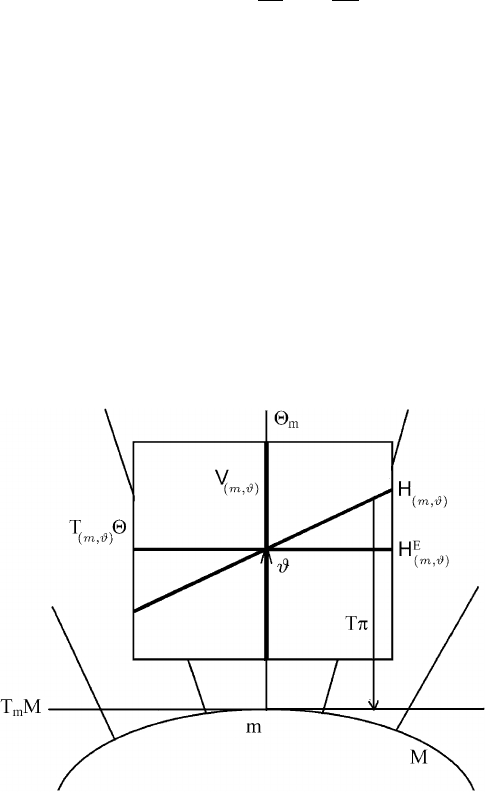
Definition 2.1. The tangent space T
ϑ
Θ
m
to the fiber of a bundle Θ at m is
called the vertical subspace in the tangent space T
(m,ϑ)
Θ to the total space
of the bundle and is denoted by V
(m,ϑ)
. The vectors of V
(m,ϑ)
are said to be
vertical.
For every vector Y
(m,ϑ)
at a point (m, ϑ) ∈ Θ we can find its coordinate
decomposition with respect to the basis mentioned above: Y = Y
i
∂
∂q
i
+
˙
Y
j
∂
∂ϑ
j
, i =1,...,n, j =1,...,d. By introducing vectors Y
1
= Y
i
∂
∂q
i
∈ T
m
M
and Y
2
=
˙
Y
j
∂
∂ϑ
j
∈ T
ϑ
Θ
m
the vectors Y
(m,ϑ)
∈ T
(m,V )
Θ are represented as
quadruples (m, ϑ, Y
1
,Y
2
). This notation is compatible with that of Convention
1.3 for tangent vectors as points of the tangent bundle: here (m, ϑ) is a point
of the manifold Θ and (Y
1
,Y
2
) is a tangent vector to Θ.
Let us find the formula of transformation of Y
1
and Y
2
under standard
changes of coordinates of the form (ϕ
βα
,g
βα
(m)) (see Definition 1.32)onthe
total space Θ. Recall that, since Θ is a vector bundle, g
βα
(m) is a linear
operator in R
d
and so it is equal to its derivative. On the other hand the
derivative in m ∈ M of the linear operator g
βα
(m), depending on m,is
a bilinear operator. Denote it by g
βα
(m)(·, ·). The first argument of this
operator is a vector from the fiber and the second argument is a vector
tangent to the base M. In particular, the derivative g
βα
(m)inm at the
point (m, ϑ) ∈ Θ takes the form g
βα
(m)(ϑ, ·). Since ϕ
βα
does not depend
on the points of fiber, the derivative of ϕ
βα
in R
d
equals zero. Taking this
into account it is easy to see that the derivative of the change of coordinates
(ϕ
βα
,g
βα
(m)) at the point (m, ϑ) ∈ Θ is represented in the form
(ϕ
βα
,g
βα
(m))
=
ϕ
βα
0
g
βα
(m)(ϑ, ·) g
βα
(m)
.
This means that under the above-mentioned changes of coordinates the col-
umn (Y
1
,Y
2
) transforms by the formula
(Y
β
1
,Y
β
2
)
(m
β
,ϑ
β
)
=
ϕ
βα
0
g
βα
(m
α
)(ϑ
α
, ·) g
βα
(m
α
)
Y
α
1
Y
α
2
=
ϕ
βα
Y
α
1
g
βα
(m
α
)(ϑ
α
,Y
α
1
)+g
βα
(m
α
)(Y
α
2
)
. (2.1)
In terms of quadruples formula (2.1) takes the form
(m
β
,ϑ
β
,Y
β
1
,Y
β
2
) (2.2)
=(ϕ
βα
m
α
,g
βα
(m
α
)ϑ
α
,ϕ
βα
Y
α
1
,g
βα
(m
α
)(ϑ
α
,Y
α
1
)+g
βα
(m
α
)(Y
α
2
)).

2.1 The Structure of a Tangent Bundle to a Vector Bundle 37
By the definition of the projection π we have π(q
1
,...,q
n
,ϑ
1
,...,ϑ
d
)=
(q
1
,...,q
n
). Hence, the Jacobi matrix (presentation of the differential d
(m,ϑ)
π
in the given coordinate system) takes the form (I 0) where I and 0 are the
unit n × n matrix and zero k ×n matrix, respectively. As a consequence we
obtain the formula for Tπ : TΘ → TM in the form
Tπ(m, ϑ, Y
1
,Y
2
)=(m, Y
1
) (2.3)
(by definition the tangent mapping Tπ acts as π on the points (m, ϑ)and
as d
(m,ϑ)
π on the vectors (Y
1
,Y
2
)). Recall that by construction Y
1
on the
left-hand side of (2.3) belongs to T
(m,ϑ)
Θ while Y
1
on the right-hand side
of (2.3) belongs to T
m
M but both vectors have the same coordinates with
respect to
∂
∂q
1
,...,
∂
∂q
n
(the first “half”of the basis in T
(m,ϑ)
Θ and the entire
basis in T
m
M, respectively, are isomorphic to each other, see above). We do
not distinguish between these two vectors or the frames in this notation.
Formula (2.3)meansthat
Tπ
Y
i
∂
∂q
i
+
˙
Y
j
∂
∂ϑ
j
= Y
i
∂
∂q
i
. (2.4)
Remark 2.2. As on every manifold, there is a natural projection of TΘ onto
Θ. Denote it by π
1
: TΘ → Θ. In coordinates it is represented in the form
π
1
(m, ϑ, Y
1
,Y
2
)=(m, ϑ). (2.5)
We emphasize the difference between (2.3)and(2.5).
Let Y be a cross-section of the bundle Θ.OverthechartU
α
we have
the decomposition Y = Y
i
e
i
(see above). Recall that we consider the cross-
section Y as a mapping Y : M → Θ such that πY = id (see Definition 1.38).
Consider also its tangent mapping TY : TM → TΘ.SinceY has the form
Y (q
1
,...,q
n
)=(q
1
,...,q
n
,Y
1
(q
1
,...,q
n
),...,Y
k
(q
1
,...,q
n
)),
its Jacobi matrix takes the form
d
m
Y =
I
∂Y
i
∂q
j
,
where I is the unit n ×n matrix and
∂Y
i
∂q
j
is the n ×d Jacobi matrix of Y .
Thus for (m, X) ∈ TM we obtain
TY(m, X)=
m, Y, X,
∂Y
i
∂q
j
X
(2.6)
(recall that TY acts as Y on points m and as d
m
X on X).

38 2 Connections
On the vector bundle Θ the so-called action of the real line is given as
follows. For every a ∈ R defined a : Θ → Θ (we denote the number and the
corresponding mapping by the same symbol a)by:
a(m, ϑ)=(m, aϑ), (2.7)
where (m, ϑ) ∈ Θ, i.e. the action consists of multiplying all vectors from all
fibers of Θ by a.Thusa(q
1
,...,q
n
,ϑ
1
,...,ϑ
d
)=(q
1
,...,q
n
,aϑ
1
,...,aϑ
d
)
and evidently d
(m,ϑ)
a =
I 0
0 aI
, where I and 0 are the unit and zero
matrices, respectively, of corresponding dimensions. Hence
Ta(m, ϑ, Y
1
,Y
2
)=(m, aϑ, Y
1
,aY
2
). (2.8)
Below we shall often use the constructions described in this section on
tangent and cotangent bundles. For these cases we have to define the previous
formulae and notation more precisely.
Since the fibers of a tangent bundle are tangent spaces, they already have
the standard frames
∂
∂q
1
,...,
∂
∂q
n
. For the case of a tangent bundle we most
often use such frames and the trivialization generated by them in a tangent
bundle over charts (the construction of this trivialization is described in Sec-
tion 1.1). Sometimes we shall also use alternative trivializations but those
cases will be mentioned explicitly.
In this case the notation ˙q
i
for coordinates in fibers is compatible with the
interpretation of a tangent vector as a velocity of some curve. We replace ϑ
i
by this notation. Thus the frames in tangent spaces to TM have the form
∂
∂q
1
,...,
∂
∂q
n
,
∂
∂ ˙q
1
,...,
∂
∂ ˙q
n
.
For an analogous trivialization in a cotangent bundle we use the basis
dq
1
,..., dq
n
and coordinates in fibers with respect to those frames are de-
noted by p
i
(here we take into account the interpretation of cotangent vectors
as momenta). Respectively, the frame in a cotangent space to T
∗
M takes the
form
∂
∂q
1
,...,
∂
∂q
n
,
∂
∂p
1
,...,
∂
∂p
n
.
The frame in a cotangent space to TM is denoted by dq
1
,...,dq
n
,
d˙q
1
,...,d˙q
n
and in a cotangent space to T
∗
M by dq
1
,...,dq
n
, dp
1
,...,dp
n
.
We consider in detail the case of tangent bundles. The constructions on
cotangent bundles are analogous.
Definition 2.3. The tangent bundle to a tangent bundle TM is called the
second tangent bundle to the manifold M and is denoted by TTM or T
2
M.
The vectors of the second tangent bundle, i.e., tangent vectors to TM,are
described as quadruples of the form (m, X, Y
1
,Y
2
)whereX and Y
1
belong to
T
m
M while Y
2
is a vector tangent to T
m
M.
The Jacobi matrix of the natural projection π : TM → M has the form
(I,0) where I is the unit matrix and 0 is the zero matrix, both n × n.Thus
Tπ
Y
i
∂
∂q
i
+
˜
Y
i
∂
∂ ˙q
i
= Y
i
∂
∂q
i
.

2.1 The Structure of a Tangent Bundle to a Vector Bundle 39
The action of the real line on TM is defined as a particular case of the
general definition. For a ∈ R the Jacobi matrix of the corresponding mapping
a : TM → TM has the same form as above.
The transformation rule for quadruples describing vectors of the second
tangent bundle under changes of coordinates also has to be specified. First of
all on TM the transformation g
βα
(m) in fibers takes the form g
βα
(m)=ϕ
βα
.
Hence g
βα
(m)(·, ·)=ϕ
βα
(·, ·)where
denotes the second derivative of the
change of coordinates ϕ
βα
. Since the fiber of TM at m is the tangent space
T
m
M, both arguments in ϕ
βα
(·, ·) have the same nature: they are vectors
tangent to M. This is why we replace the symbol ϑ in the notation for an
element in the fiber of Θ by the symbol X of a tangent vector to M.
Thus formula (2.1) is transformed into
(Y
β
1
,Y
β
2
)
(m
β
,X
β
)
=
ϕ
βα
0
ϕ
βα
(X
α
, ·) ϕ
βα
Y
α
1
Y
α
2
=
ϕ
βα
Y
α
1
ϕ
βα
(m
α
)(X
α
,Y
α
1
)+ϕ
βα
(m
α
)(Y
α
2
)
. (2.9)
So, by formula (2.9) the transformation of quadruples as vectors tangent to
TTM under the change of coordinates ϕ
βα
on M has the form
(m
β
,X
β
,Y
β
1
,Y
β
2
)
=(ϕ
βα
m
α
,ϕ
βα
X
α
,ϕ
βα
Y
α
1
,ϕ
βα
(X
α
,Y
α
1
)+ϕ
βα
(Y
α
2
)). (2.10)
We return to the general case.
Recall that by Definition 2.1 the space T
ϑ
Θ
m
is called the vertical subspace
in T
(m,ϑ)
Θ and is denoted by V
(m,ϑ)
. The vectors belonging to V
(m,ϑ)
are said
to be vertical.
As a direct consequence of the construction we obtain the following:
Proposition 2.4 The space V
(m,ϑ)
does not depend on the choice of the
chart U
α
, its coordinate system (q
1
,...,q
n
) in a neighborhood of m ∈ M,or
on the choice of the trivialization of π
−1
U
α
.
Indeed, the fiber Θ
m
and hence the tangent space T
ϑ
Θ
m
= V
(m,ϑ)
are
determined without use of any coordinate system. The system (q
1
,...,q
n
)is
involved only in representing V
(m,ϑ)
as the linear span of
∂
∂ϑ
1
,...,
∂
∂ϑ
d
. Notice
that these vectors do depend on the trivialization of π
−1
U
α
.
Recall that by formula (1.2) we introduced the linear isomorphism p of a
tangent space to a vector space onto the vector space. Thus here p : V
(m,ϑ)
→
Θ
m
is well-defined and takes the coordinate representation
p
∂
∂ϑ
i
= e
i
. (2.11)

40 2 Connections
Denote by H
E
(m,ϑ)
the linear span of the vectors
∂
∂q
1
,...,
∂
∂q
n
in T
(m,ϑ)
Θ.
By construction, H
E
(m,ϑ)
is the tangent space to the submanifold U
α
× ϑ in
π
−1
U
α
with respect to the given trivialization of π
−1
U
α
. Immediately from
the definition we get T
(m,ϑ)
Θ = H
E
(m,ϑ)
⊕ V
(m,ϑ)
where ⊕ is the direct sum.
Notice that for the vector Y
(m,ϑ)
=(m, ϑ, Y
1
,Y
2
) ∈ T
(m,ϑ)
Θ by definition
Y
1
∈ H
E
(m,ϑ)
and Y
2
∈ V
(m,ϑ)
so that Y
(m,ϑ)
= Y
1
⊕ Y
2
.
Proposition 2.5 The subspace H
E
(m,ϑ)
depends on the choice of trivialization
of π
−1
U
α
and hence on the chart U
α
.
Proof. Indeed, consider another chart U
β
with non-empty intersection U
αβ
with U
α
. Let a trivialization of π
−1
U
β
be given so that the standard basis in
R
d
generates another field of bases e
1
,...,e
d
different from the field e
1
,...,e
d
generated by the above trivialization of π
−1
U
α
. The layers in U
α
×R
d
of the
vectors U
α
× ϑ and in U
β
× R
d
of the vectors U
β
× ϑ for a specified vector
ϑ ∈ R
d
are different since the former is generated by those ϑ
’s from Θ
m
,
m
∈ U
α
whose coordinates with respect to e
1
,...,e
d
are the same as the
coordinates of ϑ and the latter by those whose coordinates with respect to
e
1
...,e
d
are the same as those of ϑ. Since the layers going through (m, ϑ)
are different, their tangent spaces at (m, ϑ) are also different.
Remark 2.6. From the definitions it immediately follows that the quadruple
for a vector from H
E
(m,ϑ)
takes the form (m, ϑ, Y
1
, 0) and, for a vector from
V
(m,ϑ)
,theform(m, ϑ, 0,Y
2
).
Proposition 2.7 Tπ sends any H
E
(m,ϑ)
isomorphically onto T
m
M and V
(m,ϑ)
is the kernel of Tπ at any T
(m,ϑ)
Θ.
Indeed, a vector from H
E
(m,ϑ)
takes the form (m, ϑ, Y
1
, 0) and from V
E
(m,ϑ)
the form (m, ϑ, 0,Y
2
) (see Remark 2.6). So, by (2.3) Tπ(m, ϑ, Y
1
, 0) = (m, Y
1
)
and Tπ(m, ϑ, 0,Y
2
)=(m, 0).
2.2 Connections on Vector Bundles
Connection and connector
Definition 2.8. Let Θ be a vector bundle and suppose that in every tangent
space T
(m,ϑ)
Θ a subspace H
(m,ϑ)
, complementary to V
(m,ϑ)
(i.e. T
(m,ϑ)
Θ =
H
(m,ϑ)
⊕V
(m,ϑ)
at any (m, ϑ) ∈ Θ), is specified such that the total family of
subspaces H = {H
(m,ϑ)
|(m, ϑ) ∈ Θ} satisfies the following two properties:
(i) the space H
(m,ϑ)
depends smoothly on (m, ϑ) ∈ Θ (in the sense de-
scribed below);
(ii) the family H is invariant with respect to the action of the real line on
Θ, i.e., TaH
(m,ϑ)
= H
(m,aϑ)
for every a ∈ R and (m, ϑ) ∈ Θ.
Then H is said to be a connection on Θ.
The subspaces H
(m,ϑ)
of a connection H are called horizontal,asarethe
vectors of T
(m,ϑ)
Θ belonging to H
(m,ϑ)
.
2.2 Connections on Vector Bundles 41
The precise meaning of the statement that H
(m,ϑ)
is smooth in (m, ϑ)isas
follows. In a neighborhood of any point (m, ϑ) ∈ Θ there are n smooth linearly
independent vector fields such that, for any (m
,ϑ
) in the neighborhood, the
subspace H
(m
,ϑ
)
is the linear span of vectors of those fields at (m
,ϑ
).
Proposition 2.9 The family H
E
(m,ϑ)
introduced in Section 2.1 is a connection
on π
−1
U
α
.
Proof. The presentation T
(m,ϑ)
Θ = H
E
(m,ϑ)
⊕ V
(m,ϑ)
was derived in Section
2.1 from the definition of H
E
(m,ϑ)
. Also by definition H
E
(m,ϑ)
is the linear span
of smooth linearly independent vectors
∂
∂q
1
,...,
∂
∂q
n
.
At any point (m, ϑ) ∈ Θ the space H
E
(m,ϑ)
is the set of all vectors whose
quadruple presentation takes the form (m, ϑ, Y
1
, 0) (see Remark 2.6). By for-
mula (2.8)weseethatTa is a one-to-one mapping sending (m, ϑ, Y
1
, 0) to
the quadruple (m, aϑ, Y
1
, 0). Thus TaH
(m,ϑ)
= H
(m,aϑ)
.
Definition 2.10. The family of subspaces H
E
(m,ϑ)
is called the Euclidean con-
nection of a given trivialization of π
−1
U
α
.
Indeed, H
E
(m,ϑ)
depends on the trivialization (see Proposition 2.5).
There exist connections {H
(m,ϑ)
} that may not be presented as the Eu-
clidean connection of a trivialization. Of course, at a given point (m, ϑ)fora
subspace H
(m,ϑ)
, complimentary to V
(m,ϑ)
, one can find a trivialization such
that H
(m,ϑ)
coincides with the Euclidean connection of a trivialization at
(m, ϑ), but in general this cannot be achieved for subspaces at all points in
a given neighborhood. In order not to exclude general connections, we have
not limited ourselves to Euclidean connections.
Proposition 2.11 Tπ : H
(m,ϑ)
→ T
m
M is a linear isomorphism.
42 2 Connections
Proof. Recall that Tπ : T
(m,ϑ)
Θ → T
m
M is surjective and (by Proposi-
tion 2.7) V
(m,ϑ)
is the kernel of Tπ. Thus, the Proposition follows from the
general result of linear algebra that a surjective linear operator is one-to-one
on a complement to the kernel.
The above proof is also valid in the analogous case of H
E
(m,ϑ)
in Proposi-
tion 2.7. However, we used a coordinate proof there for simplicity.
Combining Propositions 2.7 and 2.11 we see that Tπ is connected with the
decomposition T
(m,ϑ)
Θ = H
(m,ϑ)
⊕ V
(m,ϑ)
as follows:
Lemma 2.12
(i) Tπ : H
(m,ϑ)
→ T
m
M is an isomorphism.
(ii) V
(m,ϑ)
=kerTπ.
Our next step is to construct a map that is one-to-one on V
(m,ϑ)
and
whose kernel is H
(m,ϑ)
. Recall that the operator p that establishes a linear
isomorphism between the vector space Θ
m
and the tangent space T
ϑ
Θ
m
to
it acts by formula (2.11). Hence, for a vector from V
(m,ϑ)
with the quadruple
(m, ϑ, 0,Y
2
) (see Remark 2.6)whereY
2
=
˙
Y
i
∂
∂ ˙q
i
,wehave
p(m, ϑ, 0,Y
2
)=(m, pY
2
)=
˙
Y
i
e
i
. (2.12)
The decomposition T
(m,ϑ)
Θ = H
(m,ϑ)
⊕ V
(m,ϑ)
yields the decomposition
Y
(m,ϑ)
= HY ⊕ VY for every Y
(m,ϑ)
∈ T
(m,ϑ)
Θ,whereHY ∈ H
(m,ϑ)
and
VY ∈ V
(m,ϑ)
. The symbols H and V may be considered as projections H :
T
(m,ϑ)
Θ → H
(m,ϑ)
and V : T
(m,ϑ)
Θ → V
(m,ϑ)
in the above decomposition.
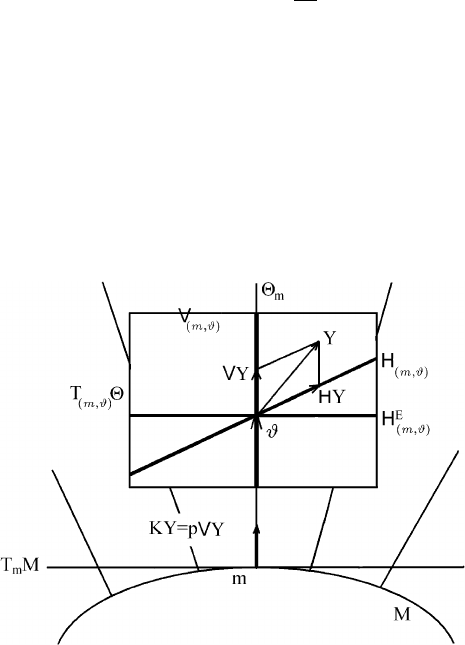
Definition 2.13. The map K = pV : T
(m,ϑ)
Θ → Θ is called the connector
of the connection H.
2.2 Connections on Vector Bundles 43
Thus K(Y
(m,ϑ)
)=p(VY
(m,ϑ)
). Evidently K on V
(m,ϑ)
coincides with p and
so K maps V
(m,ϑ)
onto Θ
m
isomorphically. On the other hand, V(H
(m,ϑ)
)=
0 ∈ V
(m,ϑ)
and so K(H
(m,ϑ)
)=0∈ Θ
m
. We summarize these properties in
the following lemma:
Lemma 2.14
(i) K : V
(m,ϑ)
→ Θ
m
is a linear isomorphism.
(ii) H
(m,ϑ)
=kerK.
Compare Lemmas 2.12 and 2.14. Notice the difference: we know that
V
(m,ϑ)
and Tπ exist on each vector bundle Θ while H
(m,ϑ)
and K must
be given “by hand”.
In order to work with H
(m,ϑ)
and K we need to describe them by means
of coordinates. The best way to do that is to compare H
(m,ϑ)
with H
E
(m,ϑ)
of
a certain trivialization over a chart U
α
since the coordinate presentation of
H
E
(m,ϑ)
is known.
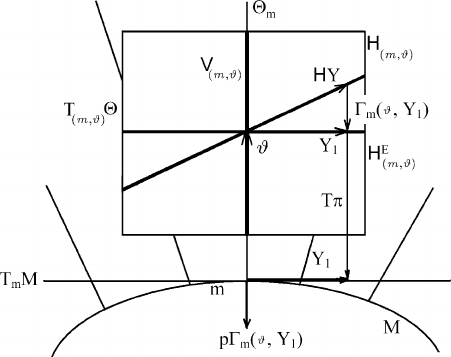
Consider a vector Y
1
∈ T
m
M.SinceTπ sends both H
(m,ϑ)
and H
E
(m,ϑ)
onto T
m
M one-to-one, each of the spaces contains a unique vector whose im-
age under Tπ is Y
1
. The vector in H
E
(m,ϑ)
is usually denoted by the same
symbol Y
1
. Denote the vector in H
(m,ϑ)
by HY . Consider the difference
Γ
m
(ϑ, Y
1
)=Y
1
− HY ∈ T
(m,ϑ)
Θ. By construction we have TπΓ
m
(ϑ, Y
1
)=
Tπ(Y
1
) − Tπ(HY )=Y
1
− Y
1
=0∈ T
m
M. Hence, Γ
m
(ϑ, Y
1
) ∈ V
(m,ϑ)
since V
(m,ϑ)
is the kernel of Tπ. Thus we can apply p to Γ
m
(ϑ, Y
1
)and
obtain the vector pΓ
m
(ϑ, Y
1
) ∈ Θ
m
. We have constructed the operator
pΓ
m
(·, ·):Θ
m
× T
m
M → Θ
m
.
Definition 2.15. The operator pΓ
m
(·, ·) is called the local connector (or local
connection coefficient) of the connection H.

44 2 Connections
The word “local” means that the operator is constructed and calculated
in a certain chart U
α
on M with respect to a certain trivialization of π
−1
U
α
.
Theorem 2.16 The operator pΓ
m
(·, ·) is linear in the second argument.
Indeed, pΓ
m
(ϑ, Y
1
)=Tπ
−1
(Y
1
)
|H
E
(m,ϑ)
− Tπ
−1
(Y
1
)
|H
(m,ϑ)
.Sincetheop-
eration Tπ
−1
and the operation of taking the difference are both linear,
pΓ
m
(ϑ, Y
1
) is linear in Y
1
.
Theorem 2.17 The operator pΓ
m
(·, ·) is linear in the first argument.
To prove Theorem 2.17 we need the following:
Lemma 2.18 Let B : E → E be a map in the vector space E, smooth and
homogeneous with degree 1.ThenB is a linear operator.
Proof. (of Lemma 2.18) Recall that B is homogeneous with degree k if for
any vector X ∈ E and any λ ∈ R we have B(λX)=λ
k
B(X). From the
homogeneity it follows that B(0) = 0.
Since B is smooth, we can expand it by the Taylor formula in a neighbor-
hood of 0 ∈ E up to a certain degree greater than 1. Thus, since B(0) = 0,
B(X)=B
(X)+
1
2
B
(X, X)+... where B
is the first derivative of B at
the origin (recall that B
is a linear operator), B
is the second derivative of
B at the origin (recall that B
is a bilinear operator), etc. On the right-hand
side only B
is homogeneous with degree 1; B
(X, X) is homogeneous with
degree 2 and the other summands have greater degrees of homogeneity. Thus
the left-hand side is homogeneous with degree 1 only if all summands on the
right hand side except B
are equal to zero. Hence B = B
and so it is a
linear operator.
Proof. (of Theorem 2.17) Since by Definition 2.8(i) both H
(m,ϑ)
and H
E
(m,ϑ)
are smooth in ϑ,sotooispΓ
m
(ϑ, Y
1
). We shall show that pΓ
m
(ϑ, Y
1
)is
homogeneous with degree 1 in ϑ so that the statement of Theorem 2.17 will
follow from Lemma 2.18.
The vector HY = Tπ
−1
(Y
1
) ∈ H
(m,ϑ)
is presented as a quadruple in the
form (m, ϑ, Y
1
,Γ
m
(ϑ, Y
1
)). By Definition 2.8(ii) and by formula (2.8)(de-
scribing Ta) the vector Ta(HY )=(m, aϑ, Y
1
,aΓ
m
(ϑ, Y
1
)) belongs to H
(m,aϑ)
.
Using formula (2.3)wegetTπ((m, aϑ, Y
1
,aΓ
m
(ϑ, Y
1
)) = (m, Y
1
). Since Tπ
is one-to-one on H
(m,aϑ)
, it is the unique vector in H
(m,aϑ)
whose image
under Tπ is (m, Y
1
). But the vector HY = Tπ
−1
(Y
1
) ∈ H
(m,aϑ)
,whose
quadruple takes the form (m, aϑ, Y
1
,Γ
m
(aϑ, Y
1
)), also has this property:
Tπ(m, aϑ, Y
1
,Γ
m
(aϑ, Y
1
)) = (m, Y
1
). Hence,
(m, aϑ, Y
1
,aΓ
m
(ϑ, Y
1
)) = (m, aϑ, Y
1
,Γ
m
(aϑ, Y
1
))
and so, since p is linear, pΓ
m
(aϑ, Y
1
)=apΓ
m
(ϑ, Y
1
).
2.2 Connections on Vector Bundles 45
So, pΓ
m
(·, ·) is linear in both arguments. It is useful to find its values
on basis vectors. Consider pΓ
m
(e
i
,
∂
∂q
j
). It is a vector from Θ
m
and so it
can be expanded in coordinates Γ
k
ij
with respect to the basis e
1
,...,e
d
:
pΓ
m
(e
i
,
∂
∂q
j
)=Γ
k
ij
e
k
. The coordinates Γ
k
ij
depend on m ∈ U
α
(as well as on
a trivialization), this means that they are real-valued functions of m ∈ U
α
.
Definition 2.19. The functions Γ
k
ij
are called Christoffel symbols of the sec-
ond kind for the connection H.
Knowing Γ
k
ij
, we can calculate the values pΓ
m
(X, Y ) for any X ∈ Θ
m
,
Y ∈ T
m
M. Indeed, let X = X
i
e
i
and Y = Y
j
∂
∂q
j
, then by linearity we get
pΓ (X, Y )=X
i
Y
j
Γ
k
ij
e
k
. (2.13)
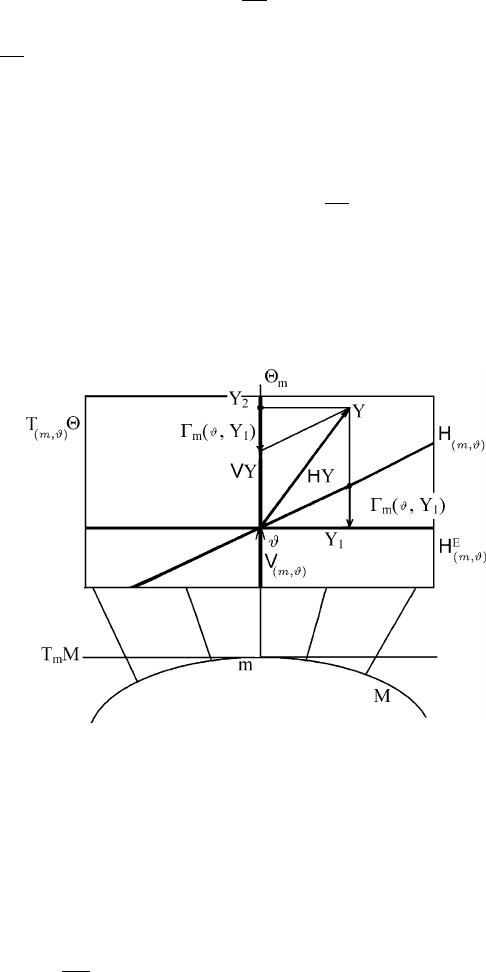
Now let us turn back to the connector K. Recall that K(Y )=pVY for Y ∈
T
(m,ϑ)
Θ. Thus we need to describe pVY .ForY we have two decompositions:
Y = Y
1
+Y
2
and Y = HY +VY . Hence Y
1
+Y
2
= HY +VY and so VY −Y
2
=
Y
1
− HY = Γ
m
(ϑ, Y
1
). Thus VY = Y
2
+ Γ
m
(ϑ, Y
1
) and consequently VY =
V(m, ϑ, Y
1
,Y
2
)=(m, ϑ, 0,Y
2
+ Γ
m
(ϑ, Y
1
)). Finally we obtain the formula for
K in the form:
K(m, ϑ, Y
1
,Y
2
)=pV(m, ϑ, Y
1
,Y
2
)=(m, pY
2
+ pΓ (ϑ, Y
1
)). (2.14)
Compare (2.14) with (2.3)and(2.5).
Let Y
2
=
˙
Y
k
∂
∂ϑ
k
and ϑ =˙q
i
e
i
.Using(2.12) we describe (2.14)incoordi-
nates as follows
K(m, ϑ, Y
1
,Y
2
)=(
˙
Y
k
+˙q
i
Y
j
Γ
k
ij
)e
k
. (2.15)