
Gliklikh Y.E. Global and Stochastic Analysis with Applications to Mathematical Physics
Подождите немного. Документ загружается.

46 2 Connections
Remark 2.20. If we choose arbitrary functions Γ
k
ij
(m)onU
α
for all possible
values of i, j and k, we shall be able to define a local connector pΓ
m
(·, ·)by
formula (2.13) and consequently a connector K by formula (2.14)or(2.15)
and then define the corresponding connection H on π
−1
U
α
as kernels of K in
all tangent spaces.
Remark 2.21. We say that pΓ
m
(ϑ, Y
1
) is a vector in Θ
m
. If we change the
trivialization, this vector will no longer correspond to the local connector.
Indeed, the Euclidean connection will be changed (see Proposition 2.5)and
the old pΓ
m
(ϑ, Y
1
) will not be the difference between VY and the new Y
1
.
So, the change of pΓ
m
(ϑ, Y
1
) under a change of coordinates on M and of
a trivialization is described by a complicated “non-tensorial” formula that
follows from (2.2). We shall derive it in explicit form for some special cases
below (see formula (2.19)).
The covariant derivative and parallel translation
Here we present the general construction by which every connection defines
its own method of differentiating a cross-section of Θ along a vector field on
M. Notice that the use of a Euclidean connection of a natural trivialization
of R
n
×R
d
gives the standard method of differentiating typically introduced
in a classical course in mathematical analysis.
Let X be a smooth vector field on M and Y be a cross-section of a vector
bundle Θ equipped with a connection H.
Definition 2.22. The covariant derivative ∇
X
Y of a cross-section Y along
a vector field X is the cross-section of Θ determined by the formula ∇
X
Y =
K ◦ TY(X).
Let us discuss this definition. The cross-section Y canbeconsideredasa
smooth map Y : M → Θ. Its tangent map TY sends the vector X ∈ T
m
M
to the tangent space T
(m,Y )
Θ. On applying K we again map into Θ
m
.
Example 2.23. Consider the Euclidean connection of a natural trivialization
of R
n
× R
d
. The section Y can be presented as the map m → (m, Y
m
).
We express the tangent map TY in coordinates and find the vector TY(X).
Here V coincides with the projection along H
E
. One can easily see that the
obtained covariant derivative coincides with the ordinary derivative of Y
along the field X.
Theorem 2.24 The covariant derivative has the following properties for any
vector fields X, X
1
and X
2
, smooth cross-sections Y , Y
1
and Y
2
, smooth
function f : M → R and κ,λ ∈ R:
(i) ∇
(κX
1
+λX
2
)
Y = κ∇
X
1
Y + λ∇
X
2
Y ;
(ii) ∇
fX
Y = f∇
X
Y ;
(iii) ∇
X
(κY
1
+ λY
2
)=κ∇
X
Y
1
+ λ∇
X
Y
2
;
2.2 Connections on Vector Bundles 47
(iv) ∇
X
fY =(Xf)Y + f∇
X
Y ,
where Xf is the derivative of f along X.
Proof. Properties (i) and (ii) follow immediately from the linearity of TY :
T
m
M → T
(m,Y )
Θ, of the projection V and of p (see Definition 2.13 of K).
In order to prove (iii) one should recall the action of TY derivedin(2.6)
and the representation of K via pΓ
m
(·, ·)in(2.14). Now (iii) follows from
the fact that d
m
Y is linear in Y and from the linearity of pΓ
m
(·, ·)inthe
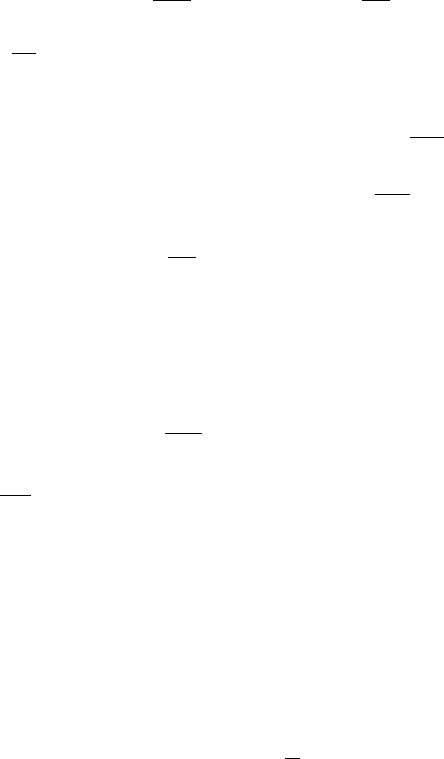
first argument (Theorem 2.17). For the proof of (iv), we find a formula for
d
m
(fY) according to the usual rules of differentiation as follows:
d
m
(fY)=
I
∂fY
i
∂q
j
=
I
Y df + f
∂Y
i
∂q
j
where df =
∂f
∂q
i
dq
i
is the differential of f (see (1.14)). Thus, taking into
account that Xf =df(X) (see formula (1.16)), we get
T (fY)X
m
= T (fY)(m, X)=
m, fY, X, (Xf)Y +
∂Y
i
∂q
j
X
=(m, f Y, 0, (Xf)Y )+
m,fY,X,f
∂Y
i
∂q
j
X
.
By definition K
m,fY,X,f
∂Y
i
∂q
j
X
= f∇
X
Y . Since (m, f Y, 0, (Xf)Y )
is vertical (i.e., belongs to V
(m,fY )
), K((m, fY, 0, (Xf)Y )) = (m, (Xf)Y ).
Using the expression of K via Christoffel symbols (2.15), we find the ex-
pression for ∇
X
Y in local coordinates in the form:
∇
X
Y =
∂Y
k
∂q
j
X
j
+ Y
i
X
j
Γ
k
ij
e
k
. (2.16)
Notice that
∂Y
k
∂q
j
X
j
e
k
is the ordinary derivative of Y along X as in a trivial
bundle. Under a change of trivialization this term transforms incorrectly.
Only after adding Y
i
X
j
Γ
k
ij
e
k
does (2.16) retain its form under a change of
coordinates and trivialization. In the language used by physicists, this means
that formula (2.16)iscovariant. This is why we call the operation ∇
X
Y the
covariant derivative.
For further applications we also need a covariant construction for differ-
entiating a cross-section in the “time” variable t along a certain curve m(t)
in M.
Let m(t) be a smooth curve on M and Y (t) be a cross-section of Θ over
m(·). This means that at any point m(t) there is associated a vector Y (t) ∈
Θ
m(t)
,andY (t)issmoothint. The vector
d
dt
Y (t)atanyt belongs to the
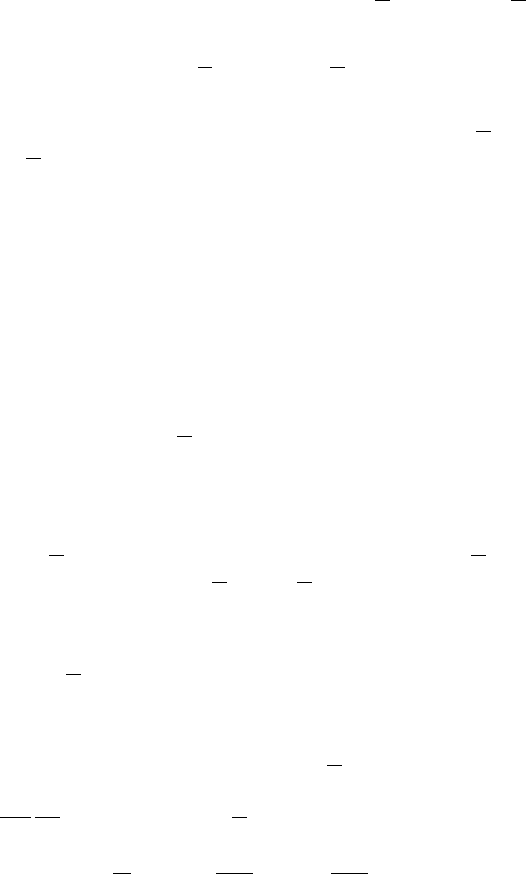
48 2 Connections
tangent space T
(m(t),Y (t))
Θ. Consider the vector
D
dt
Y (t)=K ◦
d
dt
Y (t)in
Θ
m(t)
.
Definition 2.25. The vector
D
dt
Y (t)=K ◦
d
dt
Y (t) is called the covariant
derivative of Y (t) along m(t)int.
Let us discuss the relation between the operations ∇ and
D
dt
. We might
hope that
D
dt
Y (t) would be equal to ∇
˙m(t)
Y = K ◦ TY(˙m(t)) if the latter
expression were well-defined. Unfortunately this is not the case since the
cross-section Y (t) is given only at the points of the curve m(t) while, when
determining TY, it is necessary that Y is defined in a neighborhood of m(t).
This is why we have to apply the following trick. On a subinterval of the
domain, where the curve has neither self intersections nor periods where it
is constant, define an auxiliary smooth vector field
˜
Y in a neighborhood of
m(t)suchthatatthepointsofm(t) it coincides with Y (t):
˜
Y
m(t)
= Y (t).
Various constructions of such fields are typically described in textbooks on
differential geometry and topology. The expression ∇
˙m(t)
˜
Y = K ◦T
˜
Y (˙m(t))
therefore makes sense.
Theorem 2.26 ∇
˙m(t)
˜
Y =
D
dt
Y (t) and so it does not depend on the choice
of smooth vector field
˜
Y .
Proof. Since the curve m(t)andthemap
˜
Y : M → TM are smooth, the
curve
˜
Y
m(t)
in Θ is smooth and by the construction of the tangent map
T
˜
Y (˙m(t)) =
d
dt
˜
Y
m(t)
.But
˜
Y
m(t)
= Y (t), hence T
˜
Y (˙m(t)) =
d
dt
Y (t)andso
∇
˙m(t)
˜
Y = K ◦ T
˜
Y (˙m(t)) = K ◦
d
dt
Y (t)=
D
dt
Y (t). In particular ∇
˙m(t)
˜
Y does
not depend on the choice of
˜
Y .
Remark 2.27. Taking into account Theorem 2.26 we shall sometimes use
the expression
D
dt
Y (t)=∇
˙m
Y (t) where it is understood that in the right
hand side Y (t) represents some
˜
Y such that
˜
Y
m(t)
= Y (t). This will simplify
the formulae and arguments below.
Thus, in order to obtain a representation of
D
dt
in terms of a local connector,
analogous to (2.16), we should replace the vector field X by the velocity vector
˙m(t)=
dm
j
dt
∂
∂q
j
and T
˜
Y (˙m(t)) by
d
dt
Y (t). So, the analog of (2.16) takes the
form
D
dt
Y (t)=
dY
k
dt
+ Γ
k
ij
Y
i
dm
j
dt
e
k
. (2.17)
If our vector bundle Θ is trivial and a trivialization is specified, the notion
of a constant cross-section of Θ is well-defined. Indeed, since Θ is represented
as a direct product M × R
d
, the cross-section M × Y
0
corresponding to the
layer of a fixed Y
0
∈ R
d
can be considered where at any point m ∈ M the
same vector in Θ
m
is applied. The visual image here is that all vectors of the
cross-section are parallel to each other. The derivative of such a cross-section
along any smooth curve in M is equal to zero.

2.2 Connections on Vector Bundles 49
In a general non-trivial bundle the idea of “applying the same vector” at
each point of M cannot be realized. Nevertheless we still have a covariant
derivative along a curve (rather than an ordinary derivative, which is not
convenient, see above) and so we can consider cross-sections along curves
with zero covariant derivatives and say that they consist of vectors parallel
to each other. Let us give the exact definition.
Definition 2.28. A cross-section Y (t) along a curve m(t), t ∈ [0,l], is called
parallel if
D
dt
Y (t) = 0 for all t ∈ [0,l].
It follows from (2.17) that a parallel cross-section is described by the sys-
tem of first order linear differential equations
dY
k
dt
+ Γ
k
ij
Y
i
dm
j
dt
=0. (2.18)
Theorem 2.29 For any initial vector Y
0
∈ Θ
m(0)
there exists a unique so-
lution Y (t) of the system (2.18), well-defined for all t ∈ [0,l].
Indeed, this is a well-known existence and uniqueness theorem for linear
first order differential equations. The only modification needed here is that
one should prove the existence and uniqueness in a finite number of charts
since (2.18) is given in terms of local coordinates.
Definition 2.30. The solution Y (t) whose existence is asserted in Theo-
rem 2.29 is called the parallel translation of vector Y
0
along m(·).
The idea of parallel translation can also be expressed in another language.
Let a vector field X be given on M. At any point m ∈ M consider the fiber
Θ
m
and the horizontal subspaces H
(m,ϑ)
at all points (m, ϑ) ∈ Θ
m
. Recall
that (see Proposition 2.7) Tπ : H
(m,ϑ)
→ T
m
M is one-to-one and so at any
(m, ϑ) we can define the vector
˜
X
(m,ϑ)
= Tπ
−1
(X
m
)
|H
(m,ϑ)
.
Definition 2.31. The vector field
˜
X on Θ is called the horizontal lift of the
field X.
Now restrict the bundle Θ to the curve m(·) and consider on Θ
m(·)
the
horizontal lift of the field ˙m(t). This gives a smooth vector field on Θ
m(·)
and,
taking the initial value Y
0
∈ Θ
m(0)
, we can find the unique integral curve Y (t)
of this vector field. One can easily see that Y (t) is the parallel translation of
Y
0
according to Definition 2.30.
Let m(t), t ∈ [0,T], be a smooth curve on M and ϑ(t) be a cross-section of
Θ along m(·) (i.e., ϑ(t) belongs to the fiber Θ
m(t)
for all t ∈ [0,T]). Denote by
Γ
s,t
the linear operator of parallel translation along m(·)fromΘ
m(t)
to Θ
m(s)
.
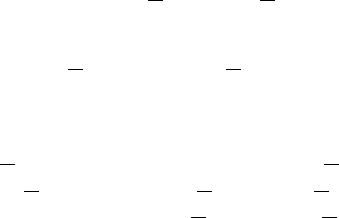
Consider
¯
ϑ(t)=Γ
s,t
ϑ(t), a curve in the fiber Θ
m(s)
. Its derivative
d
dt
¯
ϑ(t)
|t=s
belongs to T
¯
ϑ(s)
Θ
m(s)
. Applying to it the operator p, we obtain a vector in
the fiber Θ
m(s)
. Everywhere below we regard
d
dt
¯
ϑ(t)
|t=s
as a free vector lying
in Θ
m(s)
and so we do not distinguish in notation between p
d
dt
ϑ(t)
|t=s
and
d
dt
ϑ(t)
|t=s
.
50 2 Connections
Theorem 2.32
D
dt
ϑ(t)
|t=s
=
d
dt
(Γ
s,t
ϑ(t))
|t=s
.
Proof. Since the curve Γ
s,t
ϑ(t) lies in the fiber Θ
m(s)
, its derivative is vertical.
Clearly
d
dt
Γ
s,t
ϑ(t)=TΓ
s,t
d
dt
ϑ(t). Note that for any given t the vector Γ
s,t
ϑ(t)
is the value at s of the horizontal lift of m(t)thatatt goes through q(t) ∈
Θ
m(t)
. Then the vector tangent to the horizontal lift belongs to the kernel of
the tangent mapping TΓ
s,t
. But this vector is the horizontal component of
d
dt
ϑ(t). In particular, this means that
d
dt
Γ
s,t
ϑ(t)
|t=s
is the vertical component
of
d
dt
ϑ(t)
|t=s
. Hence p
d
dt
ϑ(t)
|t=s
=
D
dt
ϑ(t)
|t=s
. Since (see above) we do not
distinguish between p
d
dt
ϑ(t)
|t=s
and
d
dt
ϑ(t)
|t=s
, the Theorem follows.
2.3 Connections on Manifolds
Since the tangent bundle TM of a manifold M is a particular case of a vector
bundle, all the constructions of Section 2.2 are also valid for tangent bundles.
Definition 2.33. A connection as in Section 2.2, given on the vector bundle
TM, is called a connection on the manifold M.
Connections on manifolds have special features since here the fiber of the
bundle is also a tangent space to the manifold (the base of the bundle).
For this reason some constructions are simplified and some operators acquire
new properties. In this Section we describe these special features. We use the
notation and constructions from Section 2.1.
The vertical subspace V
(m,X)
⊂ T
(m,X)
TM turns out to be the tangent
space to the fiber of the tangent bundle, i.e. V
(m,X)
= T
X
T
m
M.Thisiswhy
the operator p, introduced by formula (1.2), is an isomorphism of V
(m,X)
to
T
m
M.
When we specify a connection H on the tangent bundle, we introduce a
subspace H
(m,X)
in each T
(m,X)
TM that is complementary to V
(m,X)
in such
a way that the collection H satisfies Definition 2.8.
Recall that the tangent bundle of TM is called the second tangent bundle
to M and is denoted by TTM or T
2
M (see Definition 2.3). So, the connector
K sends TTM onto TM and in particular it transforms each T
(m,X)
TM into
T
m
M. The subspaces H
(m,X)
are kernels of K and the mapping K on V
(m,X)
coincides with p. As in the general case, Tπ sends H
(m,X)
isomorphically
onto T
m
M and V
(m,X)
is the kernel of Tπ. Thus for any vector Y ∈ T
m
M at
any point (m, X) ∈ TM there exists a unique vector Y
l
∈ V
(m,X)
such that
pY
l
= Y , and a unique vector Y
T
∈ H
(m,X)
such that TπY
T
= Y .
Definition 2.34. The vector Y
l
is called the vertical lift of Y at the point
(m, X), and the vector Y
T
is called the horizontal lift of Y at the point
(m, X).
2.3 Connections on Manifolds 51
Recall that a Euclidean connection and the local connector corresponding
to it depend on a trivialization in π
−1
U
α
. We retain the notation H
E
(m,X)
for a
trivialization by coordinate frames
∂
∂q
1
,...,
∂
∂q
n
(see Sections 1.1 and 2.1). For
corresponding objects with respect to other trivializations we shall introduce
the special notation below. For the sake of simplicity we denote by Γ
m
(·, ·)the
local connector with respect to this trivialization, i.e., Γ
m
(·, ·)=pΓ
m
(·, ·).
The local connector Γ
m
(·, ·) is a bilinear operator Γ
m
: T
m
M × T
m
M →
T
m
M. In particular, in this case the condition that Γ
m
is symmetric is rea-
sonable. The Christoffel symbols of the second kind Γ
k
ij
are well-defined for
indices i, j, k =1,...,n. We emphasize that in the natural coordinate sys-
tems Γ
m
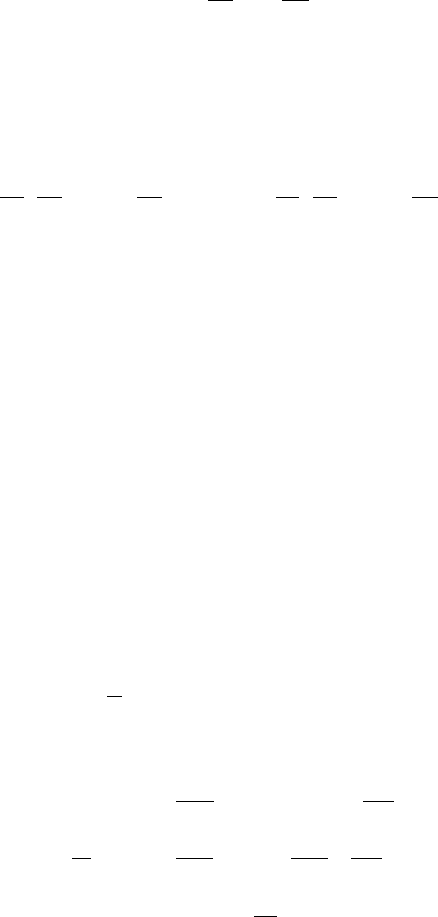
∂
∂q
i
,
∂
∂q
j
= Γ
k
ij
∂
∂ ˙q
k
while Γ
m
∂
∂q
i
,
∂
∂q
j
= Γ
k
ij
∂
∂q
k
where Γ
k
ij
are
Christoffel symbols of the second kind.
Since the operator g
βα
in TM equals ϕ
βα
and Γ
m
(X, Y
1
) as a quadruple
is presented in the form (m, X, Y
1
,Γ
m
(X, Y
1
)), from formula (2.10) it follows
that under a change of coordinates ϕ
βα
the local connector of a connection
on a manifold transforms in the following manner
Γ
m
(X, Y
1
)
β
= −ϕ
βα
(m
α
)(X
α
,Y
α
1
)+ϕ
βα
(Γ
m
(X, Y
1
)
α
). (2.19)
The geometric interpretation of formula (2.19) is the same as that given in
Remark 2.21.
Proposition 2.35 The difference Γ (·, ·) −
¯
Γ (·, ·) of local connectors Γ (·, ·)
and
¯
Γ (·, ·) of different connections is a (1, 2)-tensor.
Indeed, by formula (2.19) the difference transforms under coordinate
changes by the rule
Γ
m
(·, ·)
β
−
¯
Γ
m
(·, ·)
β
= ϕ
βα
[Γ
m
(·, ·)
α
−
¯
Γ
m
(·, ·)
α
].
Since the cross-sections of a tangent bundle are vector fields on M ,the
covariant derivative ∇
X
Y differentiates the vector field Y in the direction of
the vector field X and
D
dt
X(t) differentiates the vector field X(t) in the time
parameter along the curve m(t) (see Section 2.2).
Equations (2.16)and(2.17)taketheforms
∇
X
Y =
∂Y
k
∂q
j
X
j
+ Γ
k
ij
Y
i
X
j
∂
∂q
k
, (2.20)
D
dt
Y (t)=
dY
k
dt
+ Γ
k
ij
Y
i
dm
j
dt
∂
∂q
k
. (2.21)
Since in each chart the basis vectors
∂
∂q
i
have constant coordinates in the
decomposition with respect to the same basis (the i-th coordinate is 1 and
all others equal zero), from formula (2.20) it follows that
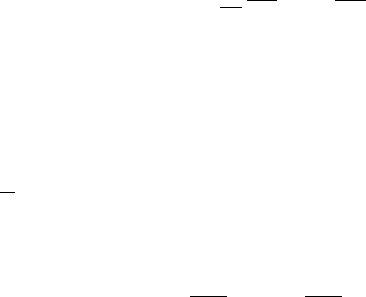
52 2 Connections
∇
∂
∂q
i
∂
∂q
j
= Γ
k
ij
∂
∂q
k
. (2.22)
Theorem 2.36 Let ∇ and
¯
∇ be covariant derivatives of two different con-
nections. Then there exists a unique (1, 2)-tensor S(·, ·), determined by the
connections, such that for any pair of smooth vector fields X and Y the equal-
ity ∇
X
Y −
¯
∇
X
Y = S(X, Y ) holds.
Theorem 2.36 follows from formula (2.20) and Proposition 2.35.
If
D
dt
X(t) = 0, by analogy with Definition 2.28 we say that X(t)isaparallel
vector field along the curve m(t). From (2.21) it follows that a parallel vector
field satisfies the system of equations
dY
k
dt
+ Γ
k
ij
Y
i
dm
j
dt
=0. (2.23)
A parallel vector field along a curve is an analog of a constant vector
field in a linear space. We refer the reader to Section 2.2 where the analogy
between a “constant” cross-section of a trivial vector bundle and a parallel
cross-section along a curve is described. Notice that the Euclidean connection
H
E
on a linear space has zero local connector and so the covariant derivative
generated by it coincides with the ordinary derivative of a vector field along
a vector field or in time along a curve. Thus, on a linear space, parallel vector
fields become constant.
Applying Theorem 2.29 to equation (2.23) we obtain that for every smooth
curve m(t) and for a specified initial vector X ∈ T
m
0
M, there exists a unique
parallel vector field X(t) with initial condition X(0) = X that is well-defined
for all t in the domain of the curve. This vector field is called the parallel
translation of X along m(t).
Remark 2.37. In the case of a Riemannian manifold M, there is another
commonly used trivialization of π
−1
U
α
, namely by a field of orthonormal
frames. Let in each tangent space T
m
M, m ∈ U
α
, an orthonormal frame
be specified that consists of vectors e
1
,...,e
n
and let each vector field e
i
,
i =1,...,n, be smooth. This frame field generates the trivialization in which
a point (m, X
i
e
i
) ∈ π
−1
U
α
transforms into the point (m, (X
1
,...,X
n
)) ∈
U
α
×R
n
. The corresponding local connector is called a tetrad connector and
is denoted by p
◦
Γ
m
(·, ·) (the term “tetrad” derives from general relativity
where n = 4). The tetrad Christoffel symbols are denoted by
◦
Γ
k
ij
and are
defined by the equality ∇
e
i
e
j
=
◦
Γ
k
ij
e
k
.Sincep
◦
Γ
m
(·, ·) is bilinear, it is
uniquely determined by the tetrad symbols. For more detail, see e.g. [57].

2.4 Geodesics 53
2.4 Geodesics
The notion of a parallel vector field along a curve leads to another important
notion.
Definition 2.38. Acurvem(t) along which its velocity vector field ˙m(t)is
parallel is called a geodesic.
On a manifold with connection the geodesics are analogs of straight lines in
a vector space. Indeed, since a parallel vector field along a curve is an analog
of a constant vector field in linear space, the property of a curve possessing
a parallel velocity vector field is analogous to the property of a curve in a
vector space possessing constant velocity. In a vector space the straight lines
with natural parametrization, and only these lines, have the latter property.
From Definition 2.38 and the definition of parallel translation it follows
that a curve m(t) is a geodesic if and only if at each of its points the equality
D
dt
˙m(t) = 0 (2.24)
holds. Equation (2.24) describes an analog of the property that straight lines
in linear spaces have zero second derivative.
We now derive the equation of geodesics in local coordinates. For this
purpose, in equation (2.23) we replace the coordinates of the vector Y by the
coordinates of the vector ˙m(t), since in our case the latter is parallel along
m(t). Then we obtain
d
2
m
k
dt
2
+ Γ
k
ij
dm
i
dt
dm
j
dt
=0. (2.25)
Unlike (2.18)and(2.23), (2.25) is a non-linear second order differential equa-
tion (recall that (2.18)and(2.23) are linear first order differential equations).
This is why we can apply only the most general existence of solution theorem
for second order differential equations with smooth right-hand sides, from
which we obtain the following statement of local existence and uniqueness of
geodesics with given initial data.
Theorem 2.39 For every point m ∈ M and every vector X ∈ T
m
M there
exists a unique geodesic m(t), with initial conditions m(0) = m and ˙m(0) =
X, that is defined for t ∈ [0,ε) where ε>0 is a sufficiently small positive
number.
Theorem 2.39 is much weaker than existence Theorem 2.29 but it mirrors
the physical situation if no additional hypotheses are assumed. For example,
on an open manifold (e.g., consisting of only one open chart) the geodesic
exists for t ∈ [0,ε)whereε is the instant of time when the geodesic reaches
the boundary, but it does not exist at any later time.

54 2 Connections
Definition 2.40. If each geodesic of a connection H exists for t ∈ (−∞, ∞),
the connection H on M is said to be complete.
Let X ∈ T
m
M be a tangent vector at a point m. Denote by m
X
(t)the
geodesic with initial data m(0) = m and ˙m(0) = X (which we know exists for
t ∈ [0,ε)byTheorem2.39). Specify a positive number λ<1. One can easily
see that m(λt) is a geodesic with initial vector λX that exists for t ∈ [0,
1
λ
ε).
Thus, if X is close enough to the origin, the geodesic m
X
(t)existsatt =1.
Definition 2.41. The mapping exp : O→M,whereO is a neighborhood of
the origin in T
m
M, is given by the formula exp(X)=m
X
(1), and is called
the exponential mapping of the connection H.
It is clear that if H is a complete connection, the exponential mapping is
well-defined on T
m
M. Sometimes, when dealing with exponential mappings
from tangent spaces at various points of M, we shall use the notation exp
m
:
O
m
→ M.
Theorem 2.42 There exists a neighborhood O
m
of the origin in T
m
M such
that exp
m
is a diffeomorphism of O
m
onto exp
m
O
m
and the exponential
mapping is smooth on the neighborhood
m∈M
O
m
of the zero-section in TM.
A proof of Theorem 2.42 can be found, for example, in [26]and[161].
Notice that the pair (O
m
, exp
m
) satisfies the definition of chart. This pair
is called the normal chart (or normal neighborhood) of the connection H at the
point m. In this chart at m the connection space H
(m,X)
at each X ∈ T
m
M
coincides with the Euclidean connection space H
E
(m,X)
and so Γ
m
(·, ·)=0.
Hence in a normal chart at m all Christoffel symbols of the second kind
Γ
k
ij
(m)forH at this point are equal to zero.
Suppose that the connection is complete and O
m
is the maximal domain
on which exp
m
is one-to-one, i.e., such that the exponential map is one-to-one
on O
m
but not on the boundary ∂O
m
in T
m
M.
Definition 2.43. The set ∂O
m
⊂ T
m
M is called the cut locus corresponding
to the point m. The same term is also used to designate the image of ∂O
m
under the mapping exp
m
.
All points of M besides the cut locus belong to the image of O
m
under
the diffeomorphism exp
m
. From this it follows that each manifold can be
constructed from an open ball in a vector space by “gluing” the points of
the boundary (according to a rule, determined by the manifold) so that the
corresponding cut locus is obtained (see [140]).
Let the points m
0
and m
1
be connected by a geodesic a(·) of a connection
H. This means that m
1
=exp
m
0
X for some vector X ∈ T
m
0
M.
Definition 2.44. If the differential d
X
exp : T
X
T
m
0
M → T
m
1
M at X is de-
generate, we say that m
1
=exp
m
0
X is conjugate with m
0
along the geodesic
a(·) joining them.

2.5 Curvature and Torsion Tensors 55
2.5 Curvature and Torsion Tensors
Let X and Y be smooth vector fields on a manifold M with connection. These
vector fields determine a transformation of an arbitrary smooth vector field
Z by the formula
R
XY
Z = ∇
X
∇
Y
Z −∇
Y
∇
X
Z −∇
[X,Y ]
Z. (2.26)
Observe that the value R
XY
Z at m ∈ M depends only on the values
of the vector fields X, Y, Z at m (it does not depend on their values in a
neighborhood of m), i.e., R
XY
Z is a tensor. (In particular this means that,
in spite of the definition, (2.26) is well-defined for non-smooth vector fields
X, Y and Z.)
Definition 2.45. R
XY
Z is called the curvature tensor.
If R
XY
Z = 0 for all X, Y, Z,, the connection is called flat. An example of
a flat connection is a Euclidean connection of any coordinate system.
The curvature is a (1, 3)-tensor and its description as a polylinear form
takes the form R(α, X, Y, Z)=α(R
XY
Z), where α is a covector field (1-
form). We denote the components of the curvature tensor by R
i
jkl
.
For two vector fields X and Y on M one can consider a third vector field
T(X, Y )=∇
X
Y −∇
Y
X − [X, Y ]. (2.27)
Observe that the value T(X, Y )atm ∈ M depends only on the values of
X and Y at m (it does not depend on their values in a neighborhood of m),
i.e., T(X, Y )isatensor.
Definition 2.46. T(X, Y ) is called the torsion tensor.
The curvature and torsion tensors together “measure” how the vector can
be transformed under parallel translation along a closed infinitesimal loop
(for details see, e.g., [26]).
Torsion is a (1, 2)-tensor, i.e., its description as a polylinear form takes the
form T(α, X, Y )=α(T(X, Y )) where α is a covector field (1-form). Denote
the components of T by the symbols T
k
ij
. To calculate these components we
substitute into (2.27) the coordinate expressions of ∇
X
Y and ∇
Y
X from
formula (2.20) as well as the coordinate expression for [X, Y ] from Proposi-
tion 1.7. We then obtain
T(X, Y )=
∂Y
k
∂q
j
X
j
+ Y
i
X
j
Γ
k
ij
−
∂X
k
∂q
j
Y
j
+ X
i
Y
j
Γ
k
ji
−
∂Y
k
∂q
j
X
j
−
∂X
k
∂q
j
Y
j
∂
∂q
k
= Y
i
X
j
Γ
k
ij
− X
i
Y
j
Γ
k
ji
.