
He M., Petoukhov S. Mathematics of Bioinformatics: Theory, Methods and Applications
Подождите немного. Документ загружается.


PROTEIN STRUCTURES AND PREDICTION 123
groups in the backbone of one strand establish hydrogen bonds with the C = O
groups in the backbone of the adjacent strands. In the fully extended β - strand,
successive side chains point straight up, then straight down, then straight up,
and so on. Adjacent β - strands in a β - sheet are aligned so that their C
α
atoms
are adjacent and their side chains point in the same direction.
However, β - strands are rarely perfectly extended; rather, they exhibit a
slight twist due to the chirality of their component amino acids. The energeti-
cally preferred dihedral angles ( ϕ , ψ ) = ( − 135 ° , 135 ° ) diverge somewhat from
the fully extended conformation ( ϕ , ψ ) = ( − 180 ° , 180 ° ) (Voet and Voet, 2004 ).
The twist is often associated with alternating fl uctuations in the dihedral
angles to prevent the individual β - strands in a larger sheet from splaying
apart. A good example of such a twisted β - hairpin can be seen in the protein
BPTI. The side chains point outward from the folds of the pleats, roughly
perpendicularly to the plane of the sheet; successive residues point outward
on alternating faces of the sheet.
Information - Theoretic Method of Protein Secondary Structure Prediction
The prediction of protein secondary structure from its amino acid sequence
can be considered as the problem of fi nding the correlation between the two
objects. It can be studied in the framework of information theory. The amino
acid sequence can be regarded as an information source. The corresponding
secondary structure can be considered as an information receiver. For an
amino acid sequence of length N , one can construct a secondary structure
sequence of the same length written by three letters α , β , and c following the
one - to - one correspondence between residue and secondary structure.
Let p ( a
i
) be the probability of structure a
i
in the secondary structure
sequence ( a
i
= α , β , c ) and let p ( s
i
) be the probability of amino acid s
i
in the
protein ( j = 1, 2, … , 20). Defi ne average mutual information
IXY HX HXY pa pa ps pas pas
ii
i
iii ii
j
;loglog
()
=
()
−
()
=−
() ()
+
()() ()
∑∑∑∑
i
(5.8)
Similarly, we can also defi ne
IYX HY HYX ps ps pa psa psa
ji
j
iii ii
j
;loglog
()
=
()
−
()
=−
(
)
()
+
()() ()
∑∑∑∑
i
It is easy to prove that
IXY IYX;;
()
=
()
The maximum of H ( X | Y ) is H ( X ), which corresponds to no correlation
between X and Y . So the correlation between secondary structure ( X ) and
amino acid ( Y ) is defi ned by

124 PROTEIN STRUCTURES, GEOMETRY, AND TOPOLOGY
r
IXY
HX
acsACWY
ij1
=
()
()
==
(
)
;
,,; , , , ,αβ …
(5.9)
where r
1
takes values between 0 and 1:
• r
1
= 0 indicates no correlation.
• r
1
= 1 the full determination of secondary structure by amino acid, which
occurs in the case of p ( a
i
| s
j
) = 0 or 1 for all a
i
and s
j
.
The single peptide - structure correspondence can easily be extended to
dipeptide (tripeptide) - structure correspondence through residue numeration
by shifting a window of width 2 (3). The equations above can be generalized
in these cases. For the case of dipeptide - structure correspondence, a
i
takes nine
confi rmations:
αα αβ α βα ββ β α β,,,,,,,,cccccc
s
j
takes 400 dipeptides in the equations above; that is,
AA AC WY YY,,,,…
The correlation between secondary structure and neighboring dipeptide can
be defi ned by
r
IXY
HX
2
=
()
()
;
(5.10)
The correlation between secondary structure and tripeptide can be defi ned
by
r
IXY
HX
a ccc s AAA AAC WYY YYYY
ij3
=
()
()
= … = …
(
)
;
,,,; , ,, ,ααα ααβ
(5.11)
It can be demonstrated that the correlation of protein secondary structure
with dipeptide frequency is much stronger than that with a single peptide and
the correlation with tripeptide frequency is much stronger than that with a
dipeptide. Therefore, the prediction of protein secondary structure from dipep-
tide and tripeptide distribution is a better approach than single - peptide predic-
tion. Thus, the information - theoretic approach provides a method to estimate
the effi ciency of a structural prediction. The averaged mutual information
I ( X ; Y ) is a useful quantity for the estimate.
PROTEIN STRUCTURES AND PREDICTION 125
Tertiary Structure Prediction
According to a protein ’ s tertiary structure, proteins can be divided into globu-
lar and fi brous proteins. Globular proteins are nearly spherical. All enzymes
are globular. Proteins are predominantly globular. Fibrous proteins contain a
variety of structure proteins and normally exhibit regularities in their primary
structures. These regularities are generally so strong that the native conforma-
tions of structural proteins are much easier to characterize than those of
globular proteins. The conformational search of the global minimum energy
conformation of a protein ab initio from the amino acid sequence is one of
the greatest challenges in computational biology.
A challenge in the area of computational biology has been to develop a
method to theoretically predict the correct three - dimensional structure of a
protein ab initio from the primary structure. The two most common approaches
to the problem of predicting protein structure from sequence would be either
to search the native structure of the protein among the entire conformational
space available to the polypeptide, or to simulate the folding process in detail.
The former appears to be beyond our reach. Even the structures of small
organic molecules cannot be generated using algorithmic implementations of
the laws of physics for atomic interactions. Full atom protein folding simula-
tions are completely beyond current computational resources. Short simula-
tions from the folded state, known as molecular dynamics simulations , are
possible but do not accurately recreate the behavior of folded proteins in
solution.
Exhaustive conformational search is also out of reach; the number of pos-
sible conformations is immense and would take too long to explore either
computationally or in vivo during folding (Levinthal, 1968 ). In an attempt to
reduce the search space, a common approach is to use a simplifi ed polypeptide
representation and restrain atom or residue positions to a lattice (Dill et al.,
1995 ). Folding or conformational search experiments are rarely successful,
even for small proteins.
Potential Energy Surface Defi ned by Force Fields
Let ’ s consider a molecule with N atoms. The position of the i th atom is denoted
by the vector x
i
. We describe the potential energy surface of a protein by
molecular mechanics. Molecular mechanics states that the potential energy of
a protein can be approximated by the potential energy of the nuclei. Therefore,
the energy contribution of the electrons is neglected. This approximation
allows one to write the potential energy of a protein as a function of the
nuclear coordinates. A typical molecular modeling force fi eld contains fi ve
types of potentials. These potentials correspond to deformation of covalent
bond length and bond angles, torsional motion associated with rotation about
bonds, electrostatic interaction, and van der Waals interaction.

126 PROTEIN STRUCTURES, GEOMETRY, AND TOPOLOGY
Vx V V V V V
()
=+++ +
length angle torsion electrostatic weak
(5.12)
The potential energy V = V ( x ) is a function of the atomic coordinate x of
the molecule. The distance is measured in angstroms ( Å ), energy in kilocalo-
ries per mole (kcal/mol), and mass in the atomic mass unit, the dalton (Da).
The bond length potential is given by
Vkrr
ij
ij
length
bonds
=−
(
)
∑
00
2
,
(5.13)
where r
ij
= 储 x
i
− x
j
储 is the bond length, r
0
the reference bond length, and k
0
a
force constant. Reference bond lengths and force constants depend on the
bond type. The bond potential corresponds to covalent bond deformation. The
bond length deformations are suffi ciently small at ordinary temperatures and
in the absence of chemical reactions. The bond deformation energy between
the i th and j th atoms is given by a harmonic potential,
kr r
ij00
2
−
(
)
The bond angle potential is given by
Vk
angle
angle
=−
()
∑
00
2
θθ
θ
(5.14)
where θ
0
is the reference bond angle and k
0
is a force constant, both of which
depend on the type of atom involved. The angle θ between the bonds p = x
j
− x
i
and r = x
k
− x
j
is given by
cos , ,θθπ=
⋅
∈
[]
pr
pr
0
(5.15)
The bond angle potential corresponds to angle deformation. Bond angle
deformations are suffi ciently small at ordinary temperatures and in the absence
of chemical reactions.
The potentials for bond length and bond angle deformation are considered
as the hard degrees of freedom in a molecular system in the sense that con-
siderable energy is necessary to cause signifi cant deformation from their refer-
ence values. The most variation in structure and relative energy comes from
the remaining potential energy terms.
The torsion potential corresponds to the barriers of bond rotation, which
involves the dihedral angles of the rotatable bonds. The barriers of torsion can
be expressed as a series of cosine functions. The mathematical expression for
the torsion potential is given by
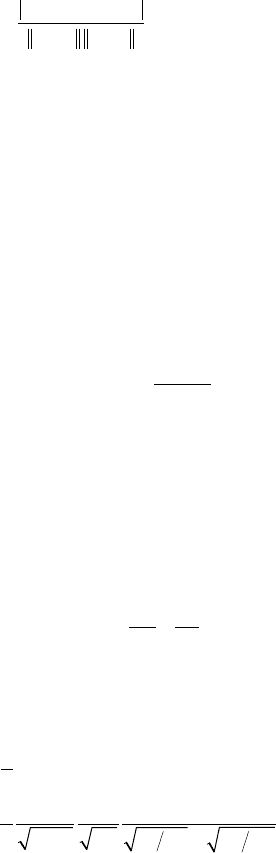
Vkkn
torsion
dihedral
=−
()
∑
00 0
2
θ
θ
::
cos
(5.16)
PROTEIN STRUCTURES AND PREDICTION 127
where n
0
is the multiplicity of the angle and k
0
is a force constant, both of
which depend on the type of atoms involved. The dihedral angle θ can be
obtained from
cos , ,θθππ=
×
()
⋅×
()
××
∈−
[]
pr rq
prrq
(5.17)
where
pr q=− =− =−xx xx xx
ji kj lk
,,
and the sign of the angle θ is given by the sign of the inner product ( p × q ) · r .
The complementary angle π − θ is the torsion angle of the bond, x
j
− x
k
.
The electrostatic potential corresponds to the nonbounded interaction
between the charged atoms in a molecule. The interaction is attractive when
the charges have opposite sign and repulsive when the charges have the same
sign. The electrostatic potential of a molecule is given by
V
qq
r
ij
ij
ij
electrostatic
atoms
=
<
∑
4
0
πδ
(5.18)
where q
i
is the point charge of the i th atom, δ
0
is the dielectric constant of
vacuum, and r
ij
is the distance between the i th and j th atoms.
The van der Waals potential corresponds to the interaction between non-
bounded atoms in a molecule. This interaction comes from attractive and
repulsive forces. The van der Waals potential is given by
V
A
r
B
r
ij
ij
ij
ij
ij
weak
atoms
=−
⎛
⎝
⎜
⎞
⎠
⎟
<
∑
12 6
(5.19)
where A
ij
and B
ij
are given by
ABRR
ij ij i j
=+
(
)
1
2
6
B
m
e
NN
ij
e
ij
ii j j
=
+
3
2
1
4
1
0
πδ
αα
αα
where e is the electron charge, the reduced Planck constant, m
e
the
electron mass, α
i
the polarizability of the i th atom, N
i
the effective number of
outer shell electrons in the i th atom, and R
i
the van der Waals radius of the
i th atom.

128 PROTEIN STRUCTURES, GEOMETRY, AND TOPOLOGY
Conformational Search Methods
The conformational search of the global minimum energy surface of a protein
from the amino acid sequence is one of the challenging problems in bioinfor-
matics. In recent years, several optimization approaches to solve this problem
have appeared in the literature. The most common approach is to model the
protein surface by using a force fi eld. Among the most commonly used force
fi elds are CHARMM, developed by Brooks et al. (1983) . Conformational
search based on force fi elds can be approached by the global optimization
techniques of Horst and Pardalos (1994) . These methods are currently better
suited for lower - dimensional problems. For higher - dimensional problems, one
of the most successful optimization techniques for conformational search is
conformational space annealing (CSA), introduced by Lee et al. (1997) . CSA
has been designed to search a large portion of the potential energy surface. It
is an iterative algorithm maintaining local minimum energy conformations in
each iteration of a population. It has been applied successfully to proteins with
100 to 150 residues (Scheraga, 1996 ). It is currently one of the leading confor-
mational search algorithms. The protein conformation generation can be found
at http://www.bbmb.iastate.edu/jerniganresearch.shtml.
The smoothing method , also known as the diffusion equation method ,
invented by Kostrowicki et al. (1991) [see also Kostrowicki and Scheraga
(1992) ] is another useful technique for conformational search. This method
can be used to approximate the potential energy surface such that the number
of local minima largely decreases while the deepest local minimum is retained.
When a force fi eld is smoothed such that the potentials for bond lengths and
bond angles are smoothed as well, the entire molecular structure will become
a single point. Comprehensive coverage of smoothing various potentials is
available in a book by Zimmermann (2003) . The general scheme is to defi ne
a smooth operator that is linear where each term of the potential can be
smoothed separately. For example, the exponential operator is given by
Ψ
t
t
d
dx
=
⎛
⎝
⎜
⎞
⎠
⎟
exp
2
2
(5.20)
This smooth operator is linear and transforms polynomial functions into poly-
nomial functions of the same degree. For example,
Ψ
t
xx xt t
44 2 2
12 12=+ +
(5.21)
Here we describe the process of smoothing the torsion potential of a protein.
Let ’ s recall that the torsion potential of a protein is expressed as a linear
combination of cosine terms of dihedral angles (5.3). To smooth this potential,
we express the dihedral angles by distances. We assume that bond lengths and
bond angles are fi xed to their reference values. Then the cosine of a dihedral
angle θ can be expressed by the distance r = 储 x
l
− x
i
储 of the fi rst and last of the
atoms involved:
PROTEIN STRUCTURES AND PREDICTION 129
cosθαβ=+r
2
where α and β are constants depending on the reference bond lengths and
reference bond angles. In general, cos n θ of a multiple dihedral angle can be
represented as a Chebyshev polynomial in cos θ , which is a polynomial in r
2
.
Let x = cos θ ; then the Chebyshev polynomials can be written as
Tx n n x
n
()
==
()
cos cos arccosθ
(5.22)
Furthermore, we have
Tx n T r
nn
()
==+
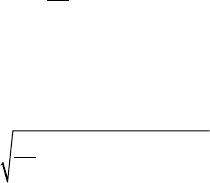
()
cos θαβ
2
(5.23)
Consequentially, the torsion potential can be expressed as a linear combina-
tion of Chebyshev polynomials:
VkkTr
ntorsion
dihedral
=−+
()
∑
00
2
θ
αβ
::
(5.24)
Each term is a polynomial in r
2
, so the torsion potential V
torsion
( x ) can be
smoothed by the linear operator Ψ
t
,
Vxt Vx
ttorsion torsion
,
()
=
()
Ψ
(5.25)
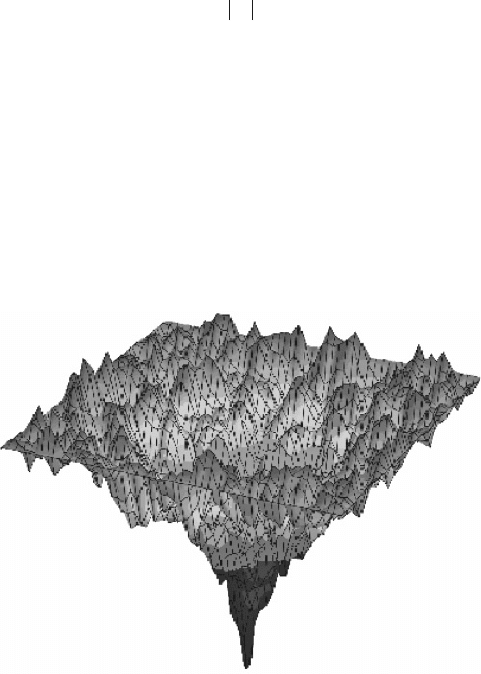
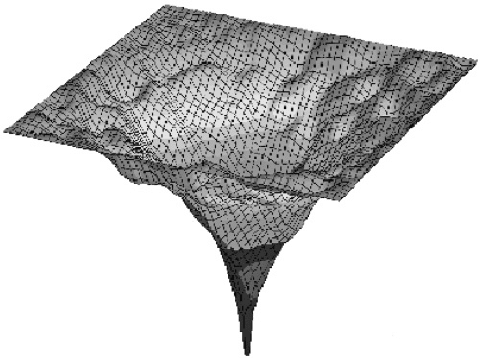
The potential energy surface of a protein and the smoothed potential energy
surface of a protein are illustrated in (Figures 5.6 and 5.7 ).
FIGURE 5.6 Potential energy surface of protein.
130 PROTEIN STRUCTURES, GEOMETRY, AND TOPOLOGY
5.4 STATISTICAL APPROACH AND DISCUSSION
The objective of conformational search is to fi nd all preferred conformations
of a molecule. An alternative to conformational search is fold recognition.
Proteins may have similar tertiary structures even if their primary structures
are not suffi ciently similar or different. This observation has led to the hypoth-
esis that there are only a limited number of signifi cantly distinct tertiary
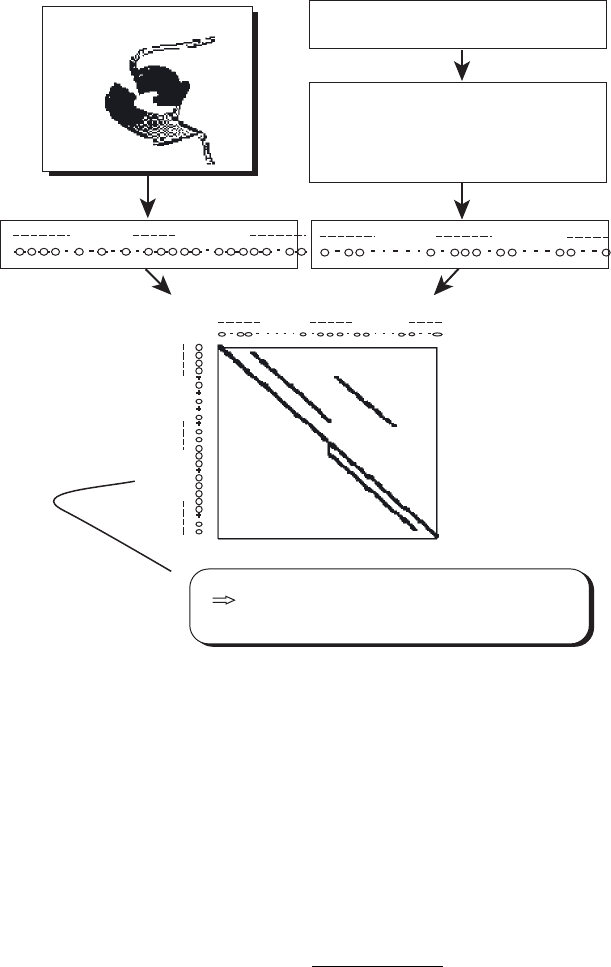
structures. The main goal of fold recognition is to predict the tertiary structure
of a protein from its amino acid sequence by fi nding the best match between
the amino acid sequence and some tertiary structure in a protein database
(Figure 5.8 ).
A basic approach to fold recognition is comparative modeling. Let A be
the amino acid sequence of a protein with unknown tertiary structure, and
align the sequence A to the primary structures of all proteins in the database
of tertiary protein structures. Suppose that the sequence A best aligns to the
primary structure of B . This sequence alignment can be used to inter the
structural alignment. For example, if the residue a
i
of A aligns with the residue
b
j
of B , the position of the residue a
i
in the unknown tertiary structure is
defi ned as the position of the residue b
j
in the tertiary structure in the database.
Subsequences of the sequence of A aligned with a series of blanks of the
sequence of B are modeled as a coil region.
A more sophisticated approach to fold recognition makes use of the method
of three - dimensional profi le - sequence alignment. For this, we make use of
both a sequence and a protein database. Let A be a sequence of amino acids
and P be the three - dimensional profi le of a protein. We align A to P . Let
FIGURE 5.7 Smoothed potential energy surface of protein.
STATISTICAL APPROACH AND DISCUSSION 131
σ ( P , A ) be the corresponding alignment score. To estimate the signifi cance of
these alignment scores, we align the protein with three - dimensional profi le
P against all amino acid sequences of a sequence database. The Z - score for
aligning the amino acid sequence A to the protein with three - dimensional
profi le P is given by
ZPA
PA P
P
,
,
()
=
()
−
()
()
σµ
σ
(5.26)
where µ ( P ) is the mean score of alignment scores given by
FIGURE 5.8 Threading predicted one - dimensional structure profi les into known
three - dimensional structures: (1) input a sequence; (2) generate sequence alignment;
(3) predict the one - dimensional structure; (4) align the predicted and known structure(s).
Project known 3D structure
onto ID
Project ID structure from sequence
Good match to one of the known structures?
(1)
(2)
(3)
(4)
• predict fold of matching structure
• model 3D coordinates by homology
LWQRPLVTIKIGGQLKEALLDTGAD
LWQRPLVTIKIGGQLKEALLDTGAD
LWRRPVVTAHIEGQLVEVLLDTGAD
DRPLVRVILTNTGstALLDSGAD
LEKRPTTIVLINDTPLNVLLDTGAD
EEEEE EEEEEE
EEEEE EEEEEE
EEEEEE EEEEE
EEEEE EEEEEE
.
.
.
132 PROTEIN STRUCTURES, GEOMETRY, AND TOPOLOGY
µσP
M
PA
A
()
=
()
∑
1
,
(5.27)
with M as the number of sequences in the sequence database and σ ( P ) as the
standard deviation of the scores, given by
σσµP
M
Pa P
A
()
=
()
−
()
[]
∑
1
2
,
(5.28)
A high Z - score Z ( P , Z ) may indicate that amino acid sequence A has a tertiary
structure similar to that of a protein with a three - dimensional profi le P .
The most accurate approach to fold recognition is based on a knowledge -
based potential. Knowledge - based potentials (Sipple, 1995 ) have been applied
successfully to detecting errors in experimentally determined structures
(Sipple, 1993 ). In addition, stochastic sampling methods can be used to explore
the potential energy surface. There is a vast literature on statistical mechanics
(Amit and Verbin, 1999 ; Gallavotti, 1999 ; Phillies, 1994 ). Comprehensive
accounts of stochastic sampling methods for conformational search have been
given by Allen and Tildesley (1987) and Leach (1996) .
5.5 CHALLENGES AND PERSPECTIVES
Crucial problems in the fi eld of protein structure prediction include, for
sequences of similar structures in PDB (especially those with a weakly or
distant homologous relation to the target), how to identify the correct tem-
plates and how to refi ne the template structure closer to the native; and for
sequences without appropriate templates, how to build models of correct
topology from scratch. Since a detailed physicochemical description of protein
folding principles does not yet exist, the protein structure prediction problem
is defi ned largely by the evolutionary or structural distance between the target
and the solved proteins in the PDB library. For proteins with close templates,
full - length models can be constructed by copying the template framework.
In recent years, despite many debates, structure genomics has probably
become one of the most noteworthy efforts in protein structure determination,
which aims to obtain three - dimensional models of all proteins by an optimized
combination of experimental structure solution and computer - based structure
prediction (Burley et al., 1999 ; Chandonia and Brenner, 2006 ). Two factors will
dictate the success of structure genomics: experimental structure determina-
tion of optimally selected proteins and effi cient computer modeling algo-
rithms. Depending on whether similar structures are found in the PDB library,
the protein - structure prediction can be categorized into template - based mod-
eling and free modeling. Although threading is an effi cient tool for detecting
structural analogs, advancements in methodology development have arrived