
He M., Petoukhov S. Mathematics of Bioinformatics: Theory, Methods and Applications
Подождите немного. Документ загружается.

COMPUTATIONAL GEOMETRY AND TOPOLOGY PRELIMINARIES 113
mRNA into proteins. The process of translation is coordinated by start and
stop codons. Start codons signal the location on the RNA molecule where
translation should begin, while stop codons signal the location where the
translation should terminate. Once the chain of amino acids that made up a
particular protein is assembled, the protein disassociates from the organelle
and folds into a specifi c three - dimensional structure. The chain of several
amino acids is referred to as a peptide . Longer chains are often called poly-
peptides or proteins . Proteins are synthesized as linear polymers (chains). The
order of the amino acids in a protein ’ s primary sequence plays an important
role in determining its secondary structure and, ultimately, its tertiary struc-
ture. The sequence of amino acids that comprises a protein completely deter-
mines its three – dimensional shape, its physical and chemical properties, and
ultimately, its biological function. Proteins perform a variety of functions in
the cell, covering all aspects of cellular functions, from metabolism to growth
to division. Most proteins are fully biologically active when folded into their
native globular structure, and understanding the forces behind this process is
one of the most important questions in biology.
In this chapter we present the basic concepts of geometry and topology,
followed by protein primary structures, secondary structures, tertiary structure,
and quaternary structure by geometric means. We also discuss the classifi cation
of proteins, physical forces in proteins, protein motion (folding and unfolding),
and basic methods (optimization and statistical methods) for secondary struc-
ture and tertiary structure prediction.
5.2 COMPUTATIONAL GEOMETRY AND TOPOLOGY
PRELIMINARIES
Computational Geometry
Computational geometry is the study of effi cient algorithms to solve geometric
problems, such as: Given N points in a plane, what is the fastest way to fi nd
the nearest neighbor of a point? Given N straight lines, fi nd the lines that
intersect. Computational geometry emerged from the fi eld of algorithm design
and analysis in the late 1970s. It has grown into a recognized discipline. The
success of the fi eld as a research discipline can, on the one hand, be explained
by the beauty of the problems studied and the solutions obtained, and, on the
other hand, by the many application domains — computer graphics, geographic
information systems, robotics, proteins, and others — in which geometric algo-
rithms play a fundamental role.
The connections and interactions between molecular modeling and com-
putational geometry have been growing recently. Many questions in molecu-
lar modeling can be understood geometrically in terms of arrangements of
spheres in three dimensions. Problems include computing properties of such
arrangements, such as their volume and topology, testing intersections and
114 PROTEIN STRUCTURES, GEOMETRY, AND TOPOLOGY
collisions between molecules, fi nding offset surfaces, data structures for com-
puting interatomic forces and performing molecular dynamics simulations,
and computer graphic algorithms for rendering molecular models accurately
and effi ciently. Computational geometry can also be used as a tool for study-
ing topology and architecture of macromolecules and macromolecular
complexes. Here we introduce briefl y the common terms and algorithmic
problems in computational geometry. Detailed descriptions may be found in
Skiena (2008) .
Polygon A polygon is a collection of line segments that form a cycle and do
not cross each other. A polygon can be represented as a sequence of points.
For example, the points
00 01 11 10,, ,, ,, ,
()()()()
form a square. The line segments of the polygon connect adjacent points in
the list, together with one additional segment connecting the fi rst and last
points. A simple polygon is one in which no two segments cross. A convex
polygon is one in which any two points inside the polygon can be connected
by a line segment that does not cross the polygons. The smallest convex
polygon containing a collection of points is known as a convex hull .
Convex Hull The convex hull of a set of points S in n dimensions is the
intersection of all convex sets containing S . Finding the convex hull of a set of
points is the most elementarily interesting problem in computational geometry,
just as the minimum spanning tree is the most elementarily interesting problem
in graph algorithms. It arises because the hull quickly captures a rough idea
of the shape or extent of a data set. Convex hull also serves as a fi rst prepro-
cessing step to many, if not most, geometric algorithms. For example, consider
the problem of fi nding the diameter of a set of points, which is the pair of
points a maximum distance apart. The diameter will always be the distance
between two points on the convex hull. The convex hull representation has
recently been used for supervised classifi cation of protein structures (Wang
et al., 2006a,b, 2008 ). Specifi cally, the novel patterns based on convex hull
representation are fi rst extracted from a protein structure, then the classifi ca-
tion system is constructed and machine learning methods such as neural net-
works and hidden Markov models are employed (Wang et al., 2008 ).
Triangulation Triangulation is the division of a surface or plane polygon into
a set of triangles, usually with the restriction that each triangle side is shared
entirely by two adjacent triangles. Triangulation is a fundamental problem in
computational geometry, because the fi rst step in working with complicated
geometric objects is to break them into simple geometric objects. The simplest
geometric objects are triangles in two dimensions, and tetrahedra in three.
Classical applications of triangulation include fi nite - element analysis and com-
COMPUTATIONAL GEOMETRY AND TOPOLOGY PRELIMINARIES 115
puter graphics. Recently, triangulation has been applied to computation of a
molecular surface (Ryu et al., 2007a,b , 2009 ) . A molecular surface is used for
both the visualization of a molecule and the computation of various molecular
properties, such as the area and volume of a protein, which are important for
studying problems such as protein docking and folding.
Voronoi Diagram Voronoi diagrams represent the region of infl uence
around each of a given set of sites. Given a set S of points p
1
, … , p
n
, Voronoi
diagrams decompose the space into regions around each point, such that all
the points in the region around p
i
are closer to p
i
than to any other point in
S . It involves partitioning a plane with points into convex polygons such that
each polygon contains exactly one generating point, and every point in a given
polygon is closer to its generating point than to any other. A Voronoi diagram
is sometimes known as a Dirichlet tessellation . The cells are called Dirichlet
regions , Thiessen polytopes , or Voronoi polygons . Voronoi diagrams have been
used to compute molecular surfaces on proteins (Ryu et al., 2007a,b ).
Nearest - Neighbor Search Nearest - neighbor search (or similarity search ) is a
search to quickly fi nd the nearest neighbor of a query point; that is, given a
set S of n points in d dimensions and a query point q , which point in S is closest
to q ? Nearest - neighbor search is important in classifi cation. Such nearest -
neighbor classifi ers are widely used, often in high - dimensional spaces. The
vector - quantization method of image compression partitions an image into
8 × 8 pixel regions. This method uses a predetermined library of several thou-
sand 8 × 8 pixel tiles and replaces each image region by the most similar library
tile. The most similar tile is the point in 64 - dimensional space that is closest to
the image region in question. Compression is achieved by reporting the identi-
fi er of the closest library tile instead of the 64 pixels, at some loss of image
fi delity. The nearest - neighbor search has been used to approximate the protein
structure (Lotan and Schwarzer, 2004 ).
Polygon Partitioning Polygon partitioning is an important preprocessing
step for many geometric algorithms, because most geometric problems are
simpler and faster on convex objects than on nonconvex objects. Given a
polygon or polyhedron P , how can P be partitioned into a small number of
simple (typically, convex) pieces? It is easier to work with the pieces indepen-
dently than with the original object.
Shape Similarity Shape similarity is a problem that underlies much of
pattern recognition. Given two polygonal shapes, P
1
and P
2
, how similar are
P
1
and P
2
? Defi nition of similarity is application dependent. There is no single
algorithmic approach that can solve all shape - matching problems. Consider a
system for optical character recognition (OCR). We have a known library of
shape models representing letters and the unknown shapes we obtain by scan-
ning a page. We seek to identify an unknown shape by matching it to the most
116 PROTEIN STRUCTURES, GEOMETRY, AND TOPOLOGY
similar shape model. The shape similarity measures are widely used in protein
structure comparison and prediction (Lotan and Schwarzer, 2004 ; Sael et al.,
2008 ).
Topology
Topology is a branch of mathematics that can be defi ned as the study of quali-
tative properties of certain objects (called topological spaces ) that are invari-
ant under certain types of transformations (called continuous maps ), especially
those properties that are invariant under a certain type of equivalence (called
homeomorphism ). The mathematical defi nition of topology is described briefl y
here.
Let X be any set and let T be a family of subsets of X . Then T is a topology
on X if:
• Both the empty set and X are elements of T .
• Any union of arbitrarily many elements of T is an element of T .
• Any intersection of fi nitely many elements of T is an element of T .
If T is a topology on X , then X together with T is called a topological
space .
All sets in T are called open ; note that in general not all subsets of X need
be in T . A subset of X is said to be closed if its complement is in T (i.e., it is
open). A subset of X may be open, closed, both, or neither.
A function or map from one topological space to another is called continu-
ous if the inverse image of any open set is open. If the function maps the real
numbers to the real numbers (both spaces with the standard topology),
this defi nition of continuous is equivalent to the defi nition of continuous in
calculus. If a continuous function is one - to - one and onto and if the inverse of
the function is also continuous, the function is called a homeomorphism and
the domain of the function is said to be homeomorphic to the range. Another
way of saying this is that the function has a natural extension to the topology.
If two spaces are homeomorphic, they have identical topological properties
and are considered to be topologically the same. A cube and a sphere are
homeomorphic, as are a coffee cup and a doughnut. But the circle is not
homeomorphic to the doughnut. DNA topology and protein topology are
active research areas.
Mathematical Space Mathematical space is an informal term for any of many
different types of sets with added structure. Mathematical spaces often form
a hierarchy (i.e., one space may inherit all the characteristics of a parent space).
For example, all inner product spaces are also normed vector spaces, all
normed vector spaces are also metric spaces, and all metric spaces are topo-
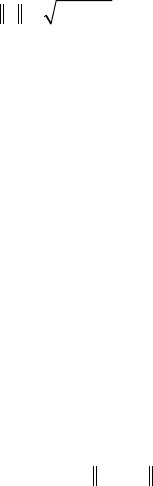
logical spaces, because the inner product induces a norm on the inner product
space such that
PROTEIN STRUCTURES AND PREDICTION 117
xxx=< >,
and so on.
Mathematical Optimization In mathematics programming, an optimization
problem is a problem of fi nding the best solution from all feasible solutions.
More formally, an optimization problem has the general form
min max
xS
xS
fx fx
∈
∈
() ()
or
(5.1)
where:
• f ( x ) is a real - valued function defi ned on the space R
n
, called an objective
function .
• S is a subset of the space R
n
, called a feasible set .
• The points x * in S are called feasible .
A point x * in S is said to be a local minimum of the f ( x ) if
fx fx x S x x x**
()
≤
()
∀∈∩ − < >
{}
,,,δδ 0
(5.2)
A point x * in S is said to be a global minimum of the function f ( x ) if
fx fx x S*
()
≤
()
∀∈
(5.3)
Local and global maximum points can be defi ned similarly. Maximization and
minimization are related by the relation
max , min ,fx x S fx x S
()
∀∈
{}
=− −
()
∀∈
{}
(5.4)
Therefore, any maximization problem can be converted into an equivalent
minimization problem, and vice versa.
5.3 PROTEIN STRUCTURES AND PREDICTION
In this section we begin with a discussion on amino acids and present their
three - dimensional geometric shapes. We introduce protein primary, secondary,
tertiary, and quaternary structure by geometric means.
Chemical Structure of Amino Acids
We fi rst present the chemical structure of 20 amino acids. Each amino acid
contains an amino group NH
2
and the carboxyl group COOH. The NH
2
group
is a proton acceptor with the following equilibrium at pH 7:
118 PROTEIN STRUCTURES, GEOMETRY, AND TOPOLOGY
RNH H O RNH OH
22 3
+↔ +
−−
(5.5)
The COOH group is a proton donator with the following equilibrium at
pH 7:
RCO H H O RNH OH
22 3
+↔ +
−−
(5.6)
Protein Shape Representation
A protein can be viewed as a set of its individual atoms. Each atom type can
be modeled as a sphere of a given radius. The radii are restricted to a relatively
small interval, and the minimal distances between the centers of these atomic
spheres are also restricted. This volumetric representation is important in
studying the protein - to - protein interaction. The computational geometry plays
important roles in dealing with intersection and location queries (Halperin
and Overmars, 1998 ).
A protein can also be viewed as a folded three - dimensional curve of amino
acids (polypeptide chain) (Lesk, 2001 ). A molecule made up of amino acids is
needed for the body to function properly. Proteins are an important class of
biological macromolecules present in all biological organisms, made up of such
elements as carbon, hydrogen, nitrogen, phosphorus, oxygen, and sulfur. All
proteins are polymers of amino acids. Proteins are the basis of body structures
such as skin and hair and of substances such as enzymes and antibodies.
Proteins fold in three dimensions. Protein structure is organized hierarchically
from primary structure to quaternary structure. Higher - level structures are
motifs and domains . Protein structures are commonly grouped into four levels
of structure:
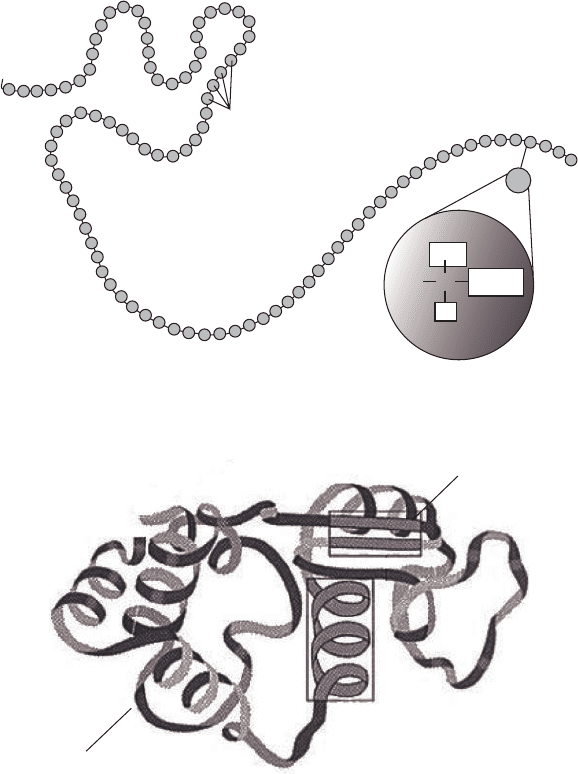
1 . Primary structure. The amino acid sequence of the peptide chains
(Figure 5.1 ). The primary structure is held together by covalent or
peptide bonds, which are made during the process of protein biosynthe-
sis or translation. These peptide bonds provide rigidity to a protein. The
two ends of the amino acid chain are referred to as the C - terminal end
or carboxyl terminus (C - terminus) and the N - terminal end or amino
terminus (N - terminus) based on the nature of the free group on each
extremity.
2 . Secondary structure. Highly regular substructures ( α - helix and strands
of β - sheet ; Figure 5.2 ), which are locally defi ned, meaning that there
can be many different secondary motifs present in a single protein
molecule.
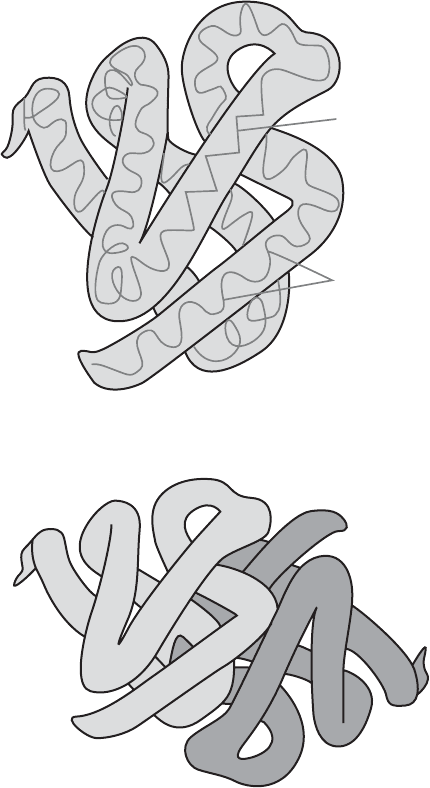
3 . Tertiary structure. Three - dimensional structure of a single protein
molecule; a spatial arrangement of the secondary structures (Figure 5.3 ).
It also describes the completely folded and compacted polypeptide
chain.
PROTEIN STRUCTURES AND PREDICTION 119
4 . Quaternary structure. Complex of several protein molecules or polypep-
tide chains (Figure 5.4 ), usually called protein subunits in this context,
which function as part of the larger assembly or protein complex.
In addition to these levels of structure, a protein may shift between several
similar structures in performing its biological function. This process is also
reversible. In the context of these functional rearrangements, tertiary or qua-
ternary structures are usually referred to as chemical conformation , and transi-
tions between them are called conformational changes .
FIGURE 5.1 Primary structure of a protein.
Amino Acid
R group
Amino group
Phe
Acidic
carboxyl
group
COOH
NH
2
R
HC
Amino Acids
FIGURE 5.2 Secondary structure of protein.
Beta Sheet
Alpha Helix
120 PROTEIN STRUCTURES, GEOMETRY, AND TOPOLOGY
Protein Motion (Folding and Unfolding)
Folding and unfolding is an exciting area of geometry. It is attractive in the
way that problems and even results can easily be understood, with little knowl-
edge of mathematics or computer science, yet the solutions are diffi cult and
involve many sophisticated techniques. The general sort of problem consid-
ered is how a particular object (e.g., linkage, piece of paper, polyhedron,
protein) can be reconfi gured or folded according to a few constraints, which
depend on the object being folded and the problem of interest. In particular,
FIGURE 5.3 Tertiary structure of protein.
Alpha Helix
Pleated sheet
FIGURE 5.4 Quaternary structure of protein.
PROTEIN STRUCTURES AND PREDICTION 121
we are interested in effi cient algorithms for characterizing fold ability and
fi nding effi cient folding processes, or in proving that such algorithms are
impossible. Most folding and unfolding problems are attractive from a pure
mathematical standpoint, from the beauty of the problems themselves.
Nonetheless, most of the problems have close connections to important indus-
trial applications. Linkage folding has applications in robotics and hydraulic
tube bending, and has connections to protein folding.
Secondary Structure Prediction
The purpose of secondary protein structure prediction is to locate all α - helices
and β - strands within a protein. The secondary structures of a protein are
formed by short - and long - ranging interactions during the protein ’ s folding
process. This can be viewed as the specifi c geometric shape caused by intra-
molecular and intermolecular hydrogen bonding of amide groups. The geom-
etry assumed by the protein chain is directly related to molecular geometry
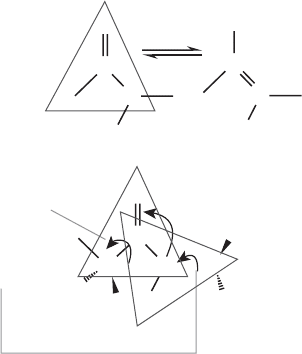
concepts of hybridization theory. Experimental evidence shows that the amide
unit is a rigid planar structure. This is derived from the planar triangle geom-
etry of the carbonyl unit (C = O) (Figure 5.5 ).
The geometry around the nitrogen is derived from an unusual situation with
planar triangle geometry. Apparently, the double bond on oxygen can alter-
nate to make a double bond between carbon and nitrogen. Rotation around
bonds C – C and N – C does take place. The C
= O and NH are always in a rigid
plane. Notice that the carbonyl group and the hydrogen on nitrogen are almost
always trans to each other. The result is that chains of amino acids as peptides
with amide bonds refl ect this geometry.
FIGURE 5.5 Planar triangle geometry of the carbonyl unit (C = O).
O
O
C
C
C
H
H
H
O
–
C
C
N
N
R
120°
Trigonal Planar
geometry on
both C and N.
Geometry of Amide Functional Group
Rotation on
bonds
takes
place.
R
N
+
H
H

122 PROTEIN STRUCTURES, GEOMETRY, AND TOPOLOGY
As a result of studying x - ray photographs and constructing molecular
models, Linus Pauling and Robert Cory proposed in 1951 that the protein
structures were either in the form of an α - helix or a β - pleated sheet. In an
α - helix , the polypeptide chain is coiled tightly in the fashion of a spring. The
“ backbone ” of the peptide forms the inner part of the coil, while the side
chains extend outward from the coil. The helix is stabilized by hydrogen bonds
between the > N – H of one amino acid and the > C = O on the fourth amino acid
away from it.
One turn of the coil requires 3.6 amino acid units. The helix can be either
right - or left - handed in the sense of threads on a screw. The naturally occurring
α - helixes found in proteins are all right - handed. Not all proteins have a helical
structure; some do not have it at all and are random.
The amino acids in an α - helix are arranged in a right - handed helical struc-
ture, 5.4 Å ( = 0.54 nm) wide. Each amino acid corresponds to a 100 ° turn in
the helix (i.e., the helix has 3.6 residues per turn) and a translation of 1.5 Å
( = 0.15 nm) along the helical axis. Most important, the N – H group of an amino
acid forms a hydrogen bond with the C = O group of the amino acid four resi-
dues earlier; this repeated hydrogen bonding defi nes an α - helix. Similar struc-
tures include the 3
10
helix (hydrogen bonding) and the π - helix (hydrogen
bonding). These alternative helices are relatively rare, although the 3
10
helix is
often found at the ends of α - helices, “ closing ” them off. Transient helices
(sometimes called δ - helices) have also been reported as intermediates in
molecular dynamics simulations of α - helical folding.
Residues in α - helices typically adopt backbone ( ϕ , ψ ) dihedral angles
around ( − 60 ° , − 45 ° ). More generally, they adopt dihedral angles such that the
ψ dihedral angle of one residue and the ϕ dihedral angle of the next residue
sum to roughly − 105 ° . Consequently, α - helical dihedral angles generally fall
on a diagonal stripe on the Ramachandran plot (of slope − 1), ranging from
( − 90 ° , − 15 ° ) to ( − 35 ° , − 70 ° ). For comparison, the sum of the dihedral angles
for a 3
10
helix is roughly − 75 ° , whereas that for the π - helix is roughly − 130 ° .
The general formula for the rotation angle Ω per residue of any polypeptide
helix with trans isomers is given by the equation
31
2
2
cos cosΩ= −
+φψ
(5.7)
The α - helix is tightly packed; there is almost no free space within the helix.
The β - sheet (also β - pleated sheet ) is the second form of regular secondary
structure in proteins, consisting of β - strands connected laterally by three or
more hydrogen bonds, forming a generally twisted, pleated sheet (the most
common form of regular secondary structure in proteins is the α - helix). A β -
strand is a stretch of amino acids, typically 5 to 10 amino acids long, whose
peptide backbones are almost fully extended.
The majority of β - strands are arranged adjacent to other strands and form
an extensive hydrogen bond network with their neighbors in which the N – H