
He M., Petoukhov S. Mathematics of Bioinformatics: Theory, Methods and Applications
Подождите немного. Документ загружается.

KNOT THEORY PRELIMINARIES 93
An orientation on a knot is defi ned by choosing a direction to travel around
the knot. This direction is denoted by placing coherently directed arrows along
the projection of the knot in the direction of our choice. We then say that the
knot is oriented . Certain types of knots possess knot projections in which cross-
ings alternate between under - and overpasses as one travels around the knot
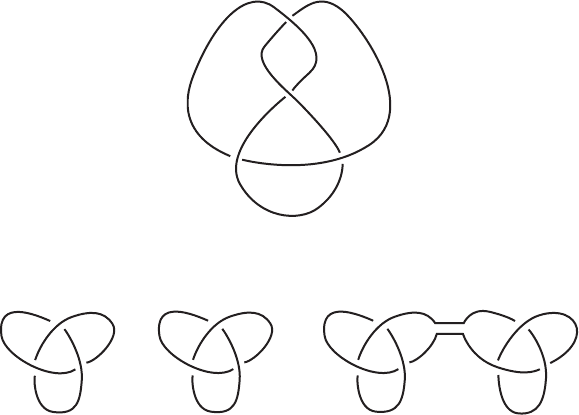
in a fi xed direction. We call this type of knot an alternating knot . The trefoil
knot and the fi gure - eight knot are alternating.
Given two projections of knots and assuming that the two projections do
not overlap, one can compose a new knot by deleting a small arc from each
knot projection and then connecting the four ending points by two new arcs,
as in Figure 4.3 . The resulting knot is called the composition (or knot sum) of
the two knots, denoted K
1
# K
2
(or K
1
+ K
2
) .
A knot that can be expressed as the composition of two nontrivial knots is
called a composite knot . The unknot is not a composite knot. The knots that
make up a composite knot are called factor knots . The unknot or trivial knot
may also be called an identity knot , as the composition of a knot K with an
unknot is again K (i.e., K + C = K ). A knot that is not the composition of any
two nontrivial knots is called a prime knot . Both the trefoil and fi gure - eight
knots are prime knots. It is often possible to combine two prime knots to create
two different composite knots, depending on the orientation of the two.
Schubert (1949) showed that every knot can be decomposed uniquely (up to
the order in which the decomposition is performed) as a knot sum of prime
knots. There is no known formula for giving the number of distinct prime
knots as a function of the number of crossings. Rolfsen (1976) has provided a
FIGURE 4.2 Figure - eight knot.
FIGURE 4.3 Composition (sum) of K
1
and K
2
.
+=
94 STRUCTURES OF DNA AND KNOT THEORY
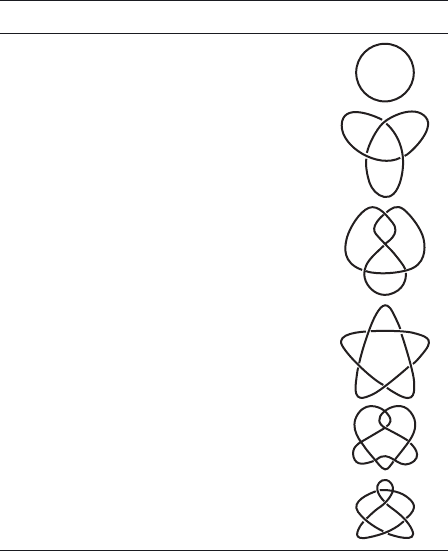
pictorial enumeration of prime knots of up to 10 crossings. The k th knot having
n crossings in this (arbitrary) ordering of knots is given the symbol n
k
. Table
4.1 summarizes a number of named prime knots.
Suppose that we have two projections of the same knot. If we made a knot
out of string that modeled the fi rst of the two projections, we should be able
to rearrange the string to resemble the second projection. We call this process
of continuous deformation of the rearranging of the string through three -
dimensional space without letting it pass through itself, ambient isotopy .
Deformation of a knot projection is called planar isotopy if it deforms the
projection plane.
Reidemeister was the fi rst person to prove rigorously that knots exist
which are distinct from an unknot. He did this in the 1930s by showing that
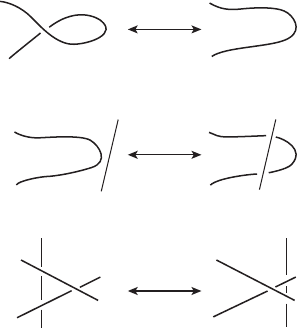
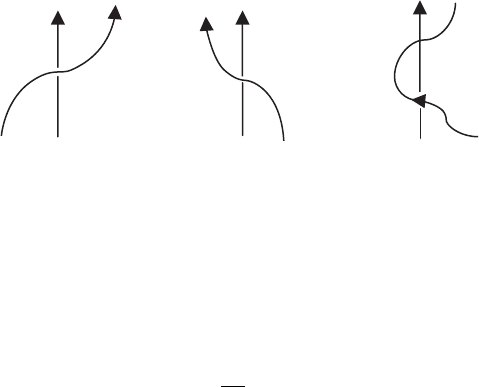
all knot deformations can be reduced to a sequence of three types of moves
(Figure 4.4 ):
1 . Twist move (type I Reidemeister move): to put in, or take out, a twist in
a knot
2 . Poke move (type II Reidemeister move): to either add or remove two
crossings
TABLE 4.1 Prime Knots
Knot Symbol Prime Knot Knot Projection
0
1
Unknot
3
1
Trefoil knot
4
1
Figure - eight knot
5
1
Solomon ’ s seal knot
6
1
Stevedore ’ s knot
6
2
Miller Institute
knot
KNOT THEORY PRELIMINARIES 95
3 . Slide move (type III Reidemeister move): to slide a strand of a knot from
one side of a crossing to the other side
These moves are most commonly called Reidemeister moves , although the
term equivalence moves is sometimes used. If two projections represent the
same knot, there must be a sequence of Reidemeister moves to get from
the one projection to the other.
Links
Next we consider a set of several knots. A link is the union of a fi nite number
of disjoint knots in three - dimensional space. A knot will be considered a link
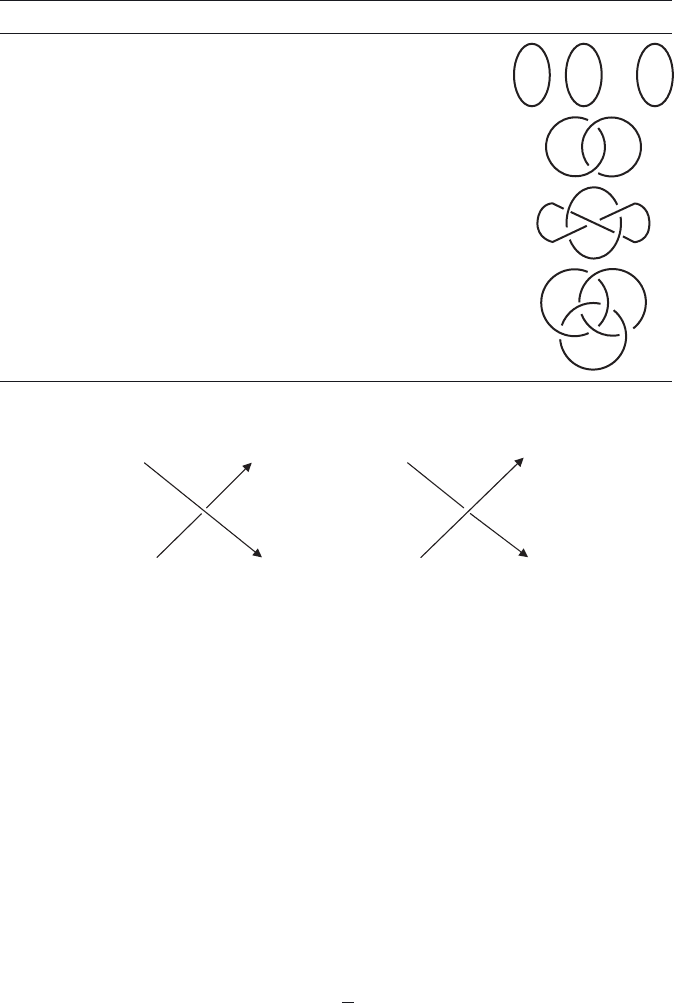
of one component. Four common links — the trivial link (or unlink), the Hopf
link, the Whitehead link, and the Borromean link — are shown in Table 4.2 . The
notation and ordering follow Rolfsen (1976) , with
c
k
r
denoting the k th r -
component link with crossing number c .
Two links are considered to be the same if we can deform the one link to
the other link without ever having any one of the knots intersect itself or any
of the other loops in the process. That is, two links are considered equal if they
are isotopic. Many statements about knots also apply to links. This may be a
good reason to extend the study to links. However, the most important ratio-
nale for including links is that certain operations that we will consider leave
invariant the class of links, but not the class of knots.
Linking Number
Next, we defi ne an important number known as the linking number . Let K
1
and K
2
be two components in a link L , and choose an orientation on each
FIGURE 4.4 Reidemeister moves.
twist untwist
unpoke poke
slide
Type I move
Type II move
Type III move
96 STRUCTURES OF DNA AND KNOT THEORY
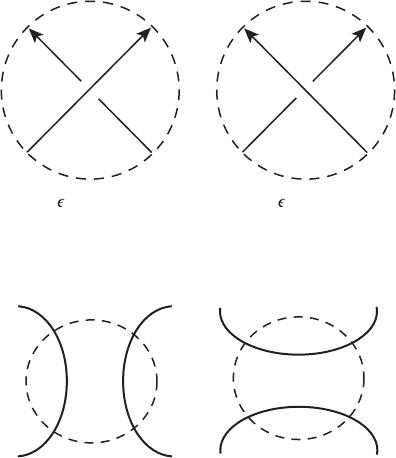
FIGURE 4.5 Computing the linking number.
Type I: +1 Type II -1
TABLE 4.2 Links
Link Number Link Name Link Diagram
0
1
2
Trivial link
...
2
1
2
Hopf link
5
1
2
Whitehead link
6
2
3
Borromean link (rings)
component. Then at each crossing between the two components, we count a
+ 1 for each crossing of the fi rst type, and a − 1 for each crossing of the second
type (Figure 4.5 ). In other words, to each of these crossings is associated an
index number of + 1 or − 1, according to the direction in which the tangent
vector to the top curve must be rotated to coincide with the tangent vector to
the bottom curve. If the rotation is clockwise, the index number is − 1, and if
it is counterclockwise, the index number is + 1. Adding all the indices associated
with all the crossings and dividing by 2 gives the link number of two knots
denoted by L ( K
1
, K
2
). Formally, a linking number is defi ned as the sum of + 1
crossings and − 1 crossings over all crossings between the two links divided by
2 calculated by the formula
LK K p
p
12
1
2
,
()
=
()
∈ ∩
∑
ε
αβ
KNOT THEORY PRELIMINARIES 97
where α ∩ β is the set of crossings of α with β , and ε ( p ) is the sign of the
crossing. The linking number of a splittable two - component link is always 0.
The linking number has four major properties:
1. The linking number L ( K
1
, K
2
) is a property of the curves in space and is
independent of the planar projection.
2. The linking number L ( K
1
, K
2
) is unchanged if either of the curves is
deformed continuously, provided that no breaks are made in either
curve. Moreover, the Reidemeister moves do not affect the linking
number.
3. The linking number L ( K
1
, K
2
) changes sign if the direction of one of the
curves is reversed.
4. The linking number L ( K
1
, K
2
) changes sign if a pair of curves is refl ected
in a plane.
It is well known that the linking number is an invariant of the oriented links;
that is, once the orientations are selected on the two components of the link,
the linking number is unchanged by ambient isotopy. In special cases in which
two oriented curves K
1
and K
2
bound a ribbonlike surface, the linking number
L ( K
1
, K
2
) is the sum of two geometric quantities: twist T ( K
1
, K
2
), and writhe
W ( K
1
).
LK K TK K WK
12 12 1
,,
()
=
()
+
()
(4.1)
This important characteristic, together with the invariance of the linking
number, have been applied to the study of circular DNA structure (Adams,
1994 ).
Basically, the twist T ( K
1
, K
2
) of one curve K
1
about another curve K
2
mea-
sures the magnitude of the spinning of K
1
around K
2
. The twist of helices about
a linear axis is the number of times the helix ( K
1
) resolves about the axis ( K
2
).
This number, T ( K
1
, K
2
) > 0 if the helix K
1
is right - handed and T ( K
1
, K
2
) < 0 if
the helix K
1
is left - handed, as illustrated in Figure 4.6 .
For the more general cases in which K
2
is not linear, or planar, the defi nition
of the twist is much more complex, for the concept is no longer geometrically
obvious. To defi ne the twist in the general case, we need the ribbonlike surface
joining and bounded by the two curves called the corresponding surface . We
assume this surface to be differentiable near the curve K
2
so that there is a
tangent plane to the surface at every point of K
2
. Let T be the unit tangent
vector to the curve K
2
at a point x and V be a unit vector perpendicular to T
at x and tangent to the surface at x pointing in the direction of K
1
. Their cross -
product T × V is a unit vector perpendicular to the surface at x . It varies along
with point x along the curve K
2
. The twist of K
1
around K
2
is defi ned to be the
measure of the total change of V in the direction of T × V as x moves along
98 STRUCTURES OF DNA AND KNOT THEORY
the entire curve K
2
. This is given by the line integral (normalized in turns) over
the curve K
2
:
TK K T VdV
K
12
1
2
2
,
()
=×
()
∫
π
(4.2)
This integral is not necessarily an integer. It changes under deformations
of either the curve K
2
or the corresponding surface. Since the cross - product
operation is not commutative, the twist depends on the ordering of the curves.
The twist of K
1
about K
2
is not necessarily the twist of K
2
about K
1
.
The writhing number of a curve K
1
, denoted by W ( K
1
), is a knot property,
defi ned as the sum of crossings p of a curve K
1
,
WK p
pCK
1
1
()
=
()
∈
()
∑
ε
(4.3)
where ε ( p ) is defi ned to be ± 1 if the overpass slants from top left to bottom
right or bottom left to top right, and C ( K
1
) is the set of crossings of an oriented
curve as illustrated in Figure 4.7 .
The proof of this equation is beyond our scope in this chapter. The main
characteristic of this fundamental equation should be noted. The linking
number L ( K
1
, K
2
) is a topological invariant. However, the twist number T ( K
1
,
K
2
) and writhing number W ( K
2
) are not, and in fact, vary under deformation.
Therefore, whereas the twist and a change in writhing could increase or
increase linking, the linking number is invariant under deformation.
Tangle
A tangle in a knot or link projection is a region in the projection plane sur-
rounded by a circle such that the knot or link crosses the circle exactly four
times (Figure 4.8 ). We will always think of the four points where the knot or
link crosses the circle as occurring in the four compass directions NW, NE, SW,
FIGURE 4.6 Twist of helices about a linear axis.
K
1
K
1
K
2
K
2
K
1
K
2
T(K
1
, K
2
) =+1/2 T(K
1
, K
2
) = -1/2 T(K
1
, K
2
) = -1
KNOT THEORY PRELIMINARIES 99
and SE. The tangles can be used to build blocks of knot and link projections.
Understanding tangles will be very useful in understanding knots.
Two tangles are equivalent if a sequence of Reidemeister moves can be used
to transform one into the other while keeping the four string endpoints fi xed
and not allowing strings to pass outside the circle. The simplest tangles are the
∞ - tangle (trivial) and 0 - tangle (trivial), shown in Figure 4.8 . The family of
tangles that can be converted to the trivial tangled by moving the endpoints
of the strings is the family of rational tangles . Equivalently, a rational tangle is
one in which the strings can continuously be deformed (fi xing the endpoints)
entirely into the boundary 2 - sphere of the 3 - ball, with no string passing through
itself or through another string. An algebraic tangle is any tangle obtained by
additions and multiplications of rational tangles. Rational tangles form a
homologous family of two - string confi gurations in a 3 - sphere and formed by
a pattern of plectonemic supercoiling of pairs of strings.
The rational tangle may be represented by an even or an odd number of
integers. If the rational tangle is represented by an even or odd number of
integers, we start with two vertical or horizontal strings (i.e., the ∞ tangle/0
tangle) and alternately twist the two bottom/right - hand endpoints appropri-
ately, followed by twisting the two right - hand/bottom endpoints appropriately.
The equivalence between two rational tangles is well connected, with contin-
ued fractions corresponding to the integers. Suppose that we have two rational
FIGURE 4.7 Writhe index.
(
p
)
= +1
(
p
)
= –1
FIGURE 4.8 Tangles.
0∞
100 STRUCTURES OF DNA AND KNOT THEORY
tangles T
1
and T
2
given by the sequences of integers i , j , k , … , l , m and n , p ,
q , … , r , s . The two rational tangles T
1
and T
2
are equivalent if and only if the
corresponding continued fractions m + 1/[ l + 1/( l · · · 1/[ k + 1/( j + 1 / i )])] for T
1
and s + 1/[ r + 1/( r · · · 1/[ q + 1/( p + 1 / n )])] for T
2
are equal. The proof of this
result is beyond the scope of the book. For the proof, see the book by Burde
and Zieschang (1985) .
One can use rational tangles to construct new tangles by the multiplication
and addition operations. We call the resulting tangle an algebraic tangle .
Although many tangles are algebraic, there are tangles that are not algebraic.
While discussing tangles, there is another way to obtain new knots, called
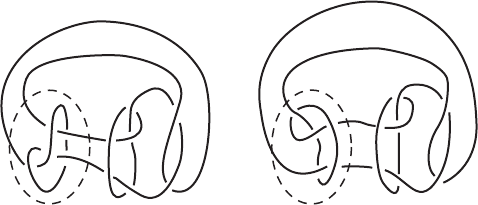
mutation . Suppose that we have a knot K formed from two tangles. We cut the
knot open along four points on each of the four strings coming out of T
2
, fl ip-
ping T
2
over, and gluing the four strings back together. We could also cut the
four strings coming out of T
2
, fl ip T
2
left to right, and then glue the strings back
together. We can also do both operations in turn: It ’ s as if we rotated the tangle
180 ° and then reglued it. Any of these three operations is called a mutation,
and the three resulting knots together with the original knot are called mutants
of one another. Figure 4.9 shows two famous mutants, called the Kinoshita –
Terasaka mutants .
Although mutation can turn one knot into another, it cannot turn a non-
trivial knot into a trivial knot. The mutants and tangles will be used to help us
understand knotting in DNA. The mathematics of tangles has been applied to
model protein – DNA binding. A tangle consists of strings properly embedded
in a three - dimensional ball. The protein complex can be thought of as a three -
dimensional ball, while the DNA segments bound by the protein complex can
be thought of as strings embedded within the ball. This simple model can be
used to determine the topology of protein - bound DNA.
In the 1980s, biochemists discovered knotting in DNA molecules.
Concurrently, synthetic chemists realized that it is possible to create knotted
molecules, where the type of knot determined the properties of the molecules.
To perform various biological functions such as replication, transcription, and
recombination, DNA has to be utilized. The knotting and tangling in the DNA
FIGURE 4.9 Kinoshita – Terasaka mutants.
KNOT THEORY PRELIMINARIES 101
molecules make the performance of these functional processes diffi cult, yet
there must be a way of manipulating the tangled masses of DNA molecules.
Applications of knot theory to DNA structures are discussed in the next
section.
Knot Polynomials
Next, we introduce knot polynomials and compute the knot polynomial from
a projection of the knot. We ’ ll note that any two different projections of the
same knot yield the same polynomials. So the polynomial is an invariant of
the knot. A knot invariant in the form of a polynomial such as the Alexander
polynomial and the Jones polynomial are discussed in detail.
A polynomial is a mathematical expression involving a sum of powers in
one or more variables multiplied by coeffi cients. A polynomial in one variable
(i.e., a univariate polynomial) with constant coeffi cients is given by
ax ax ax a
n
n
++ + +
2
2
10
(4.4)
A Laurent polynomial with coeffi cients is an algebraic object that is typi-
cally expressed in the form
+ + ++ ++ ++ +
−
−
−−
()
−−
()
−
−
at a t at a at ax
n
n
n
n
n
n
1
1
1
1
01
(4.5)
A Laurent polynomial is an algebraic object in the sense that it is treated as
a polynomial except that the indeterminant t can also have negative powers.
The Alexander polynomial is a knot invariant discovered in 1923 by J. W.
Alexander (Alexander, 1928 ). The Alexander polynomial remained the only
known knot polynomial until the Jones polynomial was discovered in 1984.
Unlike the Alexander polynomial, the more powerful Jones polynomial does,
in most cases, distinguish handedness.
The notation [ a + b + c + · · · ] is an abbreviation for the Alexander polyno-
mial of a knot
abxx cx x++
()
++
()
+
−−122
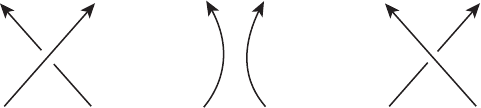
The notation can be extended for links (Figure 4.10 ), in which case one or
more matrices are used to generate the corresponding multivariate Alexander
polynomial (Rolfsen, 1976 , p. 389).
A second knot polynomial, the Jones polynomial , was discovered sub-
sequently. Unlike the fi rst - discovered Alexander polynomial, can sometimes
distinguish handedness. Jones polynomials are Laurent polynomials in t
assigned to an R
3
knot. The Jones polynomials are denoted V
L
( t ) for links,
V
k
( t ) for knots, and normalized so that
Vt
unknot
()
= 1
102 STRUCTURES OF DNA AND KNOT THEORY
For example, the right - and left - hand trefoil knots have the polynomials
Vtttt
trefoil
()
=+ −
34
Vtttt
trefoil*
()
=+−
−−−134
respectively.
4.3 DNA KNOTS AND LINKS
Geneticists have discovered that DNA can form knots and links that can be
described mathematically. By understanding knot theory more completely,
scientists are becoming more able to comprehend the massive complexity
involved in the life and reproduction of the cell. The particular fascination in
this process for geneticists is the fact that chemical changes occur in the DNA
strand as a result of this process. Changes in the DNA structure due to the
actions of these enzymes have required geneticists to use very advanced math-
ematical topology (which includes knot theory) and geometry in their study
of molecular biology.
Descriptive Properties Associated with Supercoiling
Supercoiling is an abstract mathematical property and represents the sum of
twist and writhe. Supercoil is seldom used as a noun with reference to DNA
topology. It is the combination of twists and writhes that imparts supercoiling,
and these occur in response to a change in the linking number. A coiled struc-
ture is at a higher energy (less stable). When the linking number is reduced in
closed circular DNA, the molecule supercoils by minimizing twisting and
bending. To partially relieve the strain introduced by the change in linking
number (a “ defi cit ” in the link), the DNA must distort in other ways —
compensating with a change in twist or writhe. These are, physically, the two
ways that the DNA can do so. The relationship of twist, writhe, and supercoil-
ing is expressed by the equation S = T + W (known as White ’ s formula ). Twist
and writhe are geometric quantities. Unusually, link as a topological property
is equal to the sum of two geometric properties. Their values change if the
FIGURE 4.10 Links.
L
+
L
0
L
–