
He M., Petoukhov S. Mathematics of Bioinformatics: Theory, Methods and Applications
Подождите немного. Документ загружается.

FRACTAL GEOMETRY IN BIOLOGICAL SYSTEMS 163
sequences in animals, plants, and humans display fractal properties. They also
showed that exon and intron sequences differ in their fractal properties.
Fractals in Cell, Protein, and Chromosome Structures Takahashi (1989)
hypothesized that the basic architecture of a chromosome is treelike, consist-
ing of a concatenation of “ minichromosomes. ” A fractal dimension of D = 2.34
was determined from an analysis of fi rst - and second - order branching patterns
in a human metaphase chromosome. Xu et al. (1994) hypothesized that the
twistings of DNA binding proteins have fractal properties.
Lewis and Rees (1985) determined the fractal dimension of protein surfaces
(2 ⇐ D ⇐ 3) using microprobes. A mean surface dimension of D = 2.4 was
determined using microprobe radii ranging from 1 to 3.5 Å . More highly irreg-
ular surfaces ( D > 2.4) were found to be sites of interprotein interaction.
Wagner et al. (1985) estimated the fractal dimension of heme and iron – sulfur
proteins using crystallographic coordinates of the carbon backbone. They
found that the structural fractal dimension correlated positively with the tem-
perature dependence of protein relaxation rates. Smith et al. (1989) used
fractal dimension as a measure of contour complexity in two - dimensional
images of neural cells. They recommend D as a quantitative morphological
measure of cellular complexity.
Fractals in Enzyme and Ion Channel Kinetics The kinetics of protein ion
channels in the phospholipid bilayer were examined by Liebovitch et al.
(1987) . The timing of openings and closings of ion channels had fractal proper-
ties, implying that processes operating at different time scales are related, not
independent (Liebovitch and Koniarek 1992 ). L ó pez - Quintela and Casado
(1989) developed a fractal model of enzyme kinetics, based on the observation
that kinetics is a function of substrate concentration. They found that some
enzyme systems displayed classical Michaelis – Menten kinetics ( D = 1),
whereas others showed fractal kinetics ( D < 1 ) .
Fractals and DNA Walk A DNA walk of a genome represents how the
frequency of each nucleotide of a pairing nucleotide couple changes locally.
This analysis implies measurement of the local distribution of G ’ s in the
content of GC and of T ’ s in the content of TA. Lobry was the fi rst to propose
this analysis ( 1996 ).
As you probably already know, DNA is a long sequence of nucleotides that
code all the genetic information about us. The nucleotides can be either
adenine, guanine, cytosine, or thymine (abbreviated A, G, C, and T). One of
the fractal patterns that were studied was in the sequence of nucleotides in
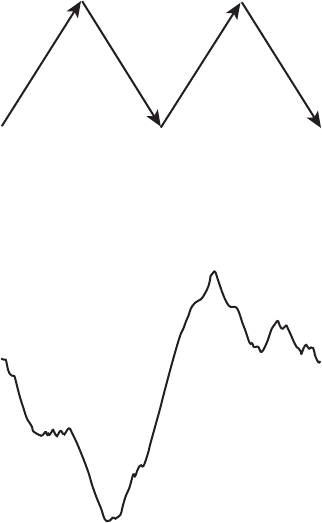
what is called the DNA walk , a graphical representation of the DNA sequence
in which you move up if you hit C or T and down if you hit A or G. For example,
Figure 7.3 represents the sequence CATG. Fractal patterns were found in
many DNA walks. These patterns are remarkably similar to Brownian motion .
Figure 7.4 is a model of a fractal DNA walk.
164 BIOLOGICAL SYSTEMS, FRACTALS, AND SYSTEMS BIOLOGY
As we have shown above, the DNA walk is a geometrical representation
of the nucleotide sequence. This DNA walk scheme could be applied to
demonstrate the symmetric and fractal structure of the genetic codon system.
Next we present a simple approach to constructing the biperiodic table of
the genetic code (Petoukhov, 2001 ) by using a triple of RNA tetrahedrons. We
then use various methods to classify the codon table and demonstrate the
symmetric and fractal structure of the genetic codon system.
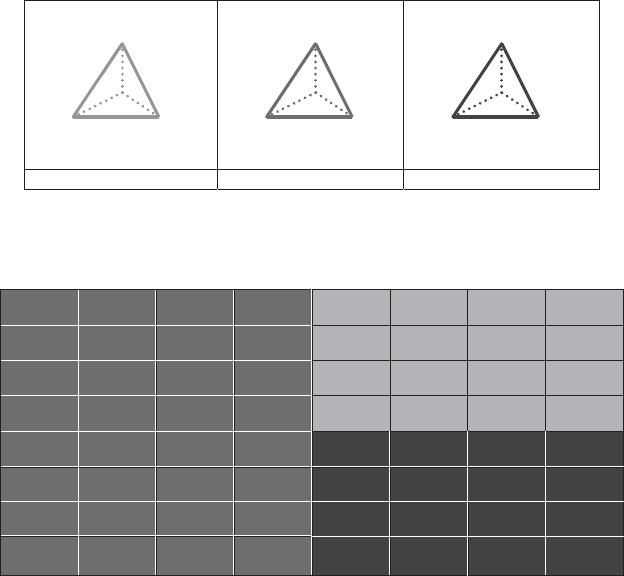
RNA Tetrahedron A regular tetrahedron has four equal faces, four vertices,
and six edges (the minimal number of faces required to form a three -
dimensional polyhedron, similar to the fact that a triangle is the fi rst polygon
in two - dimensional space). RNA bases consists of four bases: A, C, G, and U.
We label each letter to each face of a regular tetrahedron. We color each tet-
rahedron red, green, and blue, respectively (Figure 7.5 ).
To construct a biperiodic table of the genetic code, we roll three tetrahe-
drons and record three letters covered at the bottom of each toss. Assume that
each event is equally likely. It ’ s easy to see that there are a total of
4 × 4 × 4 = 4
3
= 64 possible outcomes. We list all these 64 elements in the table
G ( i , j ), i , j = 1, 2, 3, 4, 5, 6, 7, 8.
FIGURE 7.3 DNA walk.
DNA Walk (C·A·T·G)
FIGURE 7.4 Fractal model of a DNA walk.
FRACTAL GEOMETRY IN BIOLOGICAL SYSTEMS 165
FIGURE 7.5 RNA tetrahedron.
A
C G
U
A
C G
U
A
C G
U
Red Tetrahedron Green Tetrahedron BlueTetrahedron
Theoretically, for each cell of the table, there are 64 possible ways to arrange
a codon. The total number of codons in the table is 64!. One way to list all 64
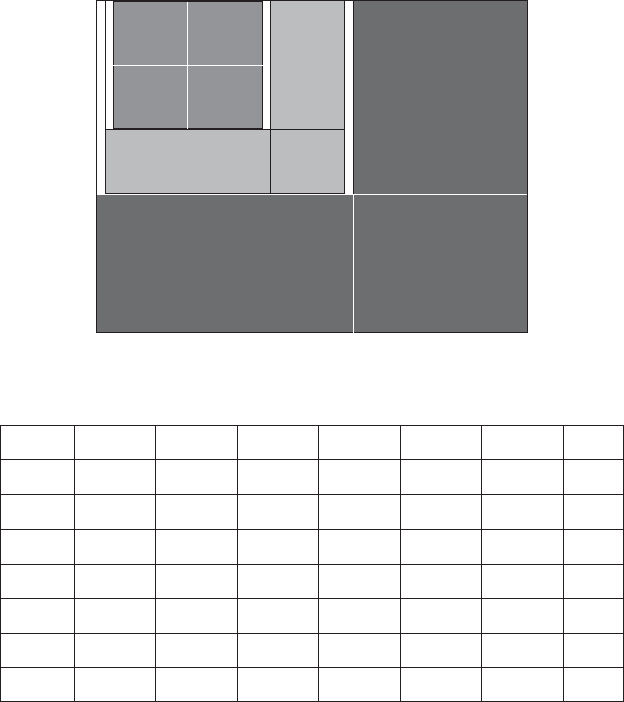
codons is to use a full 4 - ary tree structure. One may label A, C, G, and U to
each edge of the tree, respectively, from left to right. Allow the tree to grow
up to three levels (the height of the tree is 3). The total number of the nodes
of this full 4 - ary tree with level 3 is 4
3
= 64. A complete list of the codons is
given in Figure 7.6 . This table may be visualized by the three levels of the 4 × 4
table shown in Figure 7.7 .
An important variation of Figure 7.6 is the biperiodical table of genetic code
(Petoukhov, 2001 ; Figure 7.8 ). This table demonstrates a great fractal structure
and has led to many discoveries. The distribution of the RNA codons may
provide some patterns and relations for the genetic code. Next we introduce
three different methods to classify the codes in Figure 7.8 . The fi rst method is
based on the equivalence properties of A, C, G, and U (attribute - based
method). The second method connects the RAN codon with a six - digit binary
table (binary code method). The third method uses the Fibonacci numbers and
six - digit binary code to classify the genetic code (Fibonacci method). The
FIGURE 7.6 Genetic code from a full 4 - ary tree.
AAA ACA AGA AUA CAA CCA CGA CUA
AAC ACC AGC AUC CAC CCC CGC CUC
AAG ACG AGG AUG CAG CCG CGG CUG
AAU ACU AGU AUU CAU CCU CGU CUU
GAA GCA GGA GUA UAA UCA UGA UUA
GAC GCC GGC GUC UAC UCC UGC UUC
GAG GCG GGG GUG UAG UCG UGG UUG
GAU GCU GGU GUU UAU UCU UGU UUU
166 BIOLOGICAL SYSTEMS, FRACTALS, AND SYSTEMS BIOLOGY
distributions of the genetic code based on these three methods demonstrate
the great symmetries of the codons.
Attribute - Based Method Recently, Petoukhov (2001) pointed out that
regular matrices of the genetic code arise if one takes into consideration the
existence of the three subalphabets of the genetic alphabet, in accordance with
the three types of attributes of nitrogenous bases A, C, G, and U. Table 2.2
shows that each letter of the code alphabet has three “ faces ” or meanings in
three binary subalphabets in connection with the three types of attributes.
We ’ ll use these attributes to assign A, C, G, and U values of 1, 2, and 3 to
each equivalence pair. The following are all possible combinations of these
assignments:
FIGURE 7.7 Genetic code from a full 4 - ary tree.
A-
Branch
C-
Branch
G-
Branch
U-
Branch
C-
Branch
G-Branch
U-
Branch
C-Branch
G-Branch
U-Branch
FIGURE 7.8 Biperiodical table of genetic code.
CCC CC A CAC CAA ACC ACA AAC AAA
CCU CCG CAU CAG ACU ACG AAU AAG
CUC CUA CGC CGA AUC AUA AGC AGA
UCC UCA UAC UAA GCC GCA GAC GAA
CUU CUG CGU CGG AUU AUG AGU AGG
UCU UCG UAU UAG GCU GCG GAU GAG
UUC UUA UGC UGA GUC GUA GGC GGA
UUU UUG UGU UGG GUU GUG GGU GGG

FRACTAL GEOMETRY IN BIOLOGICAL SYSTEMS 167
• C = G = 3, A = U = 2, hydrogen bond – based (2,3) - combination
• C = U = 1, A = G = 2, pyrimidine/purine ring – based (1,2) - combination
• G = U = 1, A = C = 3, amino group – based (1,3) - combination
For each case, we apply two basic operations, addition and multiplication,
to generate numerical tables. These tables are used to construct corresponding
frequency tables of the distributions of the genetic code. For example, with
C = G = 3, A = U = 2, if we apply the multiplication to Figure 7.6 , we have
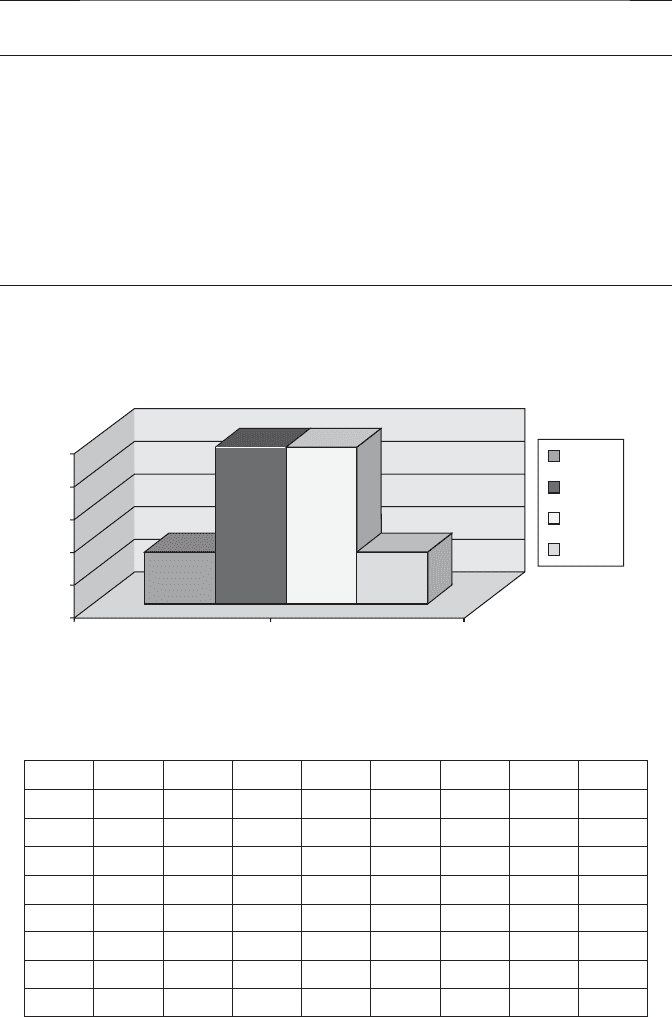
the results shown in Figure 7.9 . We have the distribution of codons with
equal numbers shown in Table 7.1 . A symmetrical histogram is illustrated in
Figure 7.10 .
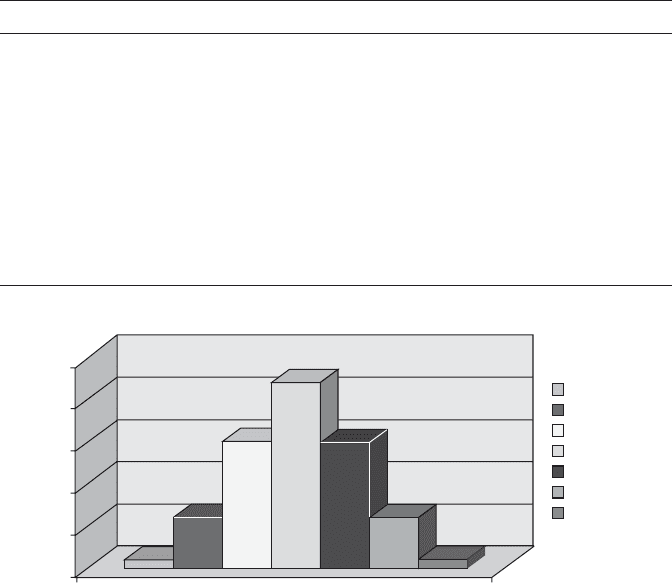
Binary Code Method Next we consider a 3 - bit binary code: 111, 110, 101,
100, 011, 010, 001, and 000. Using these codes, we construct the 8 × 8 table
B(i, j), i , j = 1, 2, 3, 4, 5, 6, 7, 8, shown in Figure 7.11 , where the asterisk implies
the append operation between three - digit binary code. Various distributions
of G ( i , j ) may be constructed by using these correspondences. Let X be the
number of 1 ’ s in table B(i, j). Then the possible values of X are 0, 1, 2, 3, 4, 5,
and 6. Seven classes of the codons are divided. The frequency table of the
genetic code is given in Table 7.2 . It is easy to see that the table demonstrates
a normal distribution of the random variable X (Figure 7.12 ).
Fibonacci Method This method was used initially in the article by A. Stakhov
(2008) and in his book (Stakhov, 2009 ). The Fibonacci code could have an X -
digit code. X is the fi rst few numbers in the Fibonacci sequence. If there is a
six - digit code, the fi rst few numbers would be 1, 1, 2, 3, 5, and 8. Let ’ s consider
FIGURE 7.9 C = G = 3, A = U = 2. P
1
, product of hydrogen bonds.
27 18 18 12 18 12 12 8
18 27 12 18 12 18 8 12
18 12 27 18 12 8 18 12
18 12 12 8 27 18 18 12
12 18 18 27 8 12 12 18
12 18 8 12 18 27 12 18
12 8 18 12 18 12 27 18
8 12 12 18 12 18 18 27
168 BIOLOGICAL SYSTEMS, FRACTALS, AND SYSTEMS BIOLOGY
FIGURE 7.10 Attribute - based distribution of genetic code.
0
5
10
15
20
25
1
Distribution of Genetic Code
Series1
Series2
Series3
Series4
TABLE 7.1 C = G = 3, A = U = 2
Product of
Hydrogen Bonds Codons
Frequency
of Codons
8 AAA, AAU, AUA, UAA, AUU, UAU, UUA, UUU 8
12 CAA, ACA, AAC, CAU, ACU, AAG, CUA, AUC,
AGA, UCA, UAC, GAA, CUU, AUG, AGU,
UCU, UAG, GAU, UUC, UGA, GUA, UUG,
UGU, GUU
24
18 CCA, CAC, ACC, CCU, CAG, ACG, CUC, CGA,
AGC, UCC, GCA, GAC, CUG, CGU, AGG,
UCG, GCU, GAG, UGC, GUC, GGA, UGG,
GUG, GGU
24
27 CCC, CCG, CGC, GCC, CGG, GCG, GGC, GGG 8
FIGURE 7.11 Six - digit binary code B(i, j).
* 111 110 101 100 011 010 001 000
111
111111 111110 111101 111100 111011 111010 111001 111000
110
110111 110110 110101 110110 110011 110010 110001 110000
101 101111 101110 101101 101100 101011 101010 101001 101000
100
100111 100110 100101 100100 100011 100010 100001 100000
011
011111 011110 011101 011100 011011 011010 011001 011000
010
010111 010110 010101 010100 010011 010010 010001 010000
001
001111 001110 001101 001100 001011 001010 001001 001000
000
000111 000110 000101 000100 000011 000010 000001 000000
FRACTAL GEOMETRY IN BIOLOGICAL SYSTEMS 169
FIGURE 7.12 Binary code – based distribution of genetic code.
0
5
10
15
20
25
1
Series1
Series2
Series3
Series4
Series5
Series6
Series7
TABLE 7.2 Frequency Table of the Genetic Code
X Elements No. of Elements
0 GGG 1
1 GGU, GGA, UGG. GAA, GUG, GAG 6
2 AAG, GGC, UUG, GUU, AGG, UAA, UGU, GCG,
AGA, GUA, UGA, GAU, GCU, UAG, GAC, GCA
15
3 UUU, AAA, AAU, UUA, CGG, GCC, AUA, GUC,
UAU, UCG, UGC, GCU, AGU, AUG, UAC, UCA,
AGC, CGA, ACG, CAG
20
4 AAC, CCG, UUC, AUU, UCC, CAA, ACA, UCU,
UCU, CGU, CUG, AUC, CUA, ACU, CAU
15
5 CCA, CCU, ACC, CUU, CUC, CAC 6
6 CCC 1
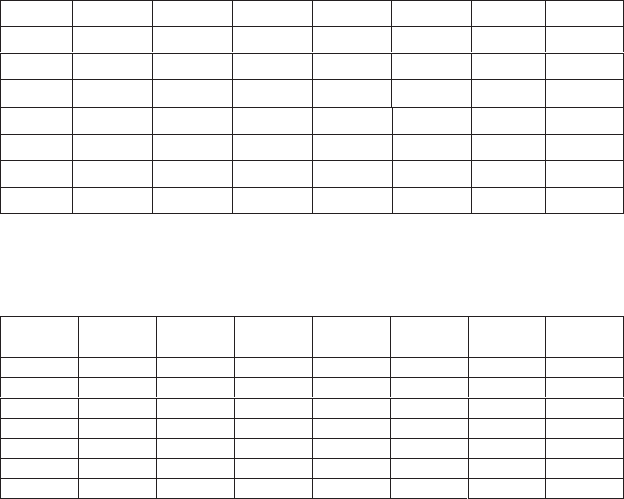
the six - digit Fibonacci code using Fibonacci numbers 1, 1, 2, 3, 5, and 8 as digit
weights. We fi rst label each cell of the 8 × 8 table by C0 to C63, as shown in
Figure 7.13 . Applying the formula
Na a a a a a=×+×+×+×+×+×
654321
853211
to both tables B ( i , j ) and C ( i , j ), we obtain another table F ( i , j ) of the Fibonacci
code (Figure 7.14 ). For example,
C63 18151312111120=×+×+×+×+×+×=
C00805030201010=×+×+×+×+×+×=
C11805030201018=×+×+×+×+×+×=
Since all four tables have the same 8 × 8 dimensions, we assume the following
one - to - one correspondence for each i , j = 1, 2, 3, 4, 5, 6, 7, 8:
170 BIOLOGICAL SYSTEMS, FRACTALS, AND SYSTEMS BIOLOGY
FIGURE 7.14 Fibonacci code F( i , j ).
C63 = 20
C61 = 15 C60 = 7
C59 = 17
C58 = 9 C57 = 12 C56 = 4
C62 = 12
C55 = 18 C54 = 10 C53 = 13 C52 = 5 C51 = 15 C50 = 7 C49 = 10 C48 = 2
C47 = 19 C46 = 11 C45 = 14 C44 = 6 C43 = 16 C42 = 8 C41 = 11 C40 = 3
C39 = 17 C38 = 9 C37 = 12 C36 = 4 C35 = 14 C34 = 6 C33 = 9 C32 = 1
C31 = 19 C30 = 11 C29 = 14 C28 = 6 C27 = 16 C26 = 8 C25 = 11 C24 = 3
C23 = 17 C22 = 9 C21 = 12 C20 = 4 C19 = 14 C18 = 6 C17 = 9 C16 = 1
C15 = 18 C14 = 10 C13 = 13 C12 = 5 C11 = 15 C10 = 7 C9 = 10 C8 = 2
C7 = 16 C6 = 8 C5 = 11 C4 = 3 C3 = 13 C2 = 5 C1 = 8 C0 = 0
FIGURE 7.13 Fibonacci code C( i , j ).
C63 C62 C61 C60 C59 C 58 C57 C56
C55 C54 C53 C52 C51 C 50 C49 C48
C47 C46 C45 C44 C43 C 42 C41 C40
C39 C38 C37 C36 C35 C 34 C33 C32
C31 C30 C29 C28 C27 C 26 C25 C24
C23 C22 C21 C20 C19 C 18 C17 C16
C15 C14 C13 C12 C11 C10 C9 C8
C7 C6 C5 C4 C3 C2 C1 C0
GBCFij ij ij ij,,,,
()
↔
()
↔
()
↔
()
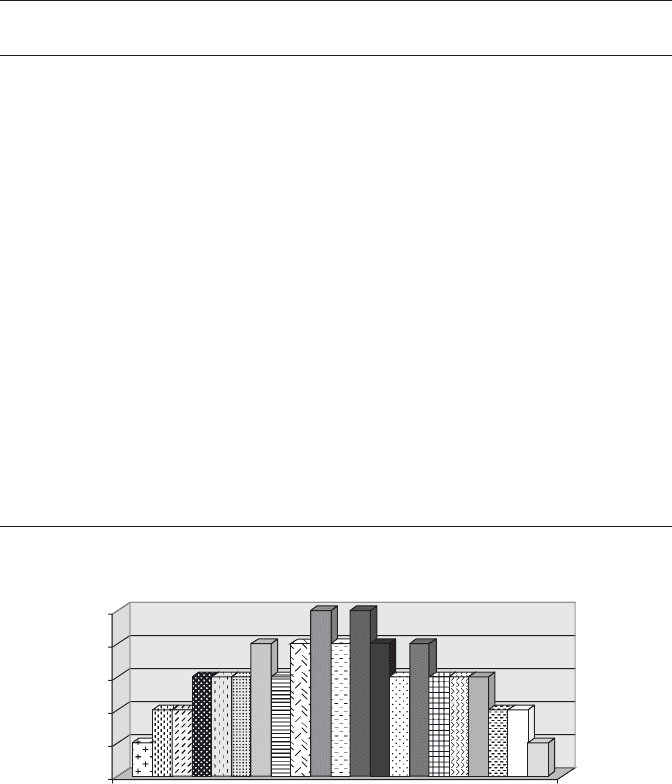
Next we use tables F( i , j ) and G( i , j ) to construct a frequency table (Table
7.3 ). We have a total number of 21 groups according to this method. The fre-
quency distribution of Table 7.3 can be illustrated by a histogram, as shown in
Figure 7.15 .
Scale - Invariant Features of Coding and Noncoding DNA Sequences
The role of genomic DNA sequences in coding for protein structure is well
known. The coding region of a gene is the portion of DNA or RNA that is
transcribed into another RNA, such as a messenger RNA or a noncoding RNA
(e.g., a transfer RNA or a ribosomal RNA). A transcript can then be translated
into proteins. A noncoding DNA describes DNA which does not contain
instructions for making proteins (or other cell products, such as noncoding
RNAs). In eukaryotes, a large percentage of many organisms ’ total genome
size comprises noncoding DNA (a puzzle known as the C - value enigma ). Some
noncoding DNA is involved in regulating the activity of coding regions.
However, much of this DNA has no known function and is sometimes referred
to as junk DNA . An open question in computational molecular biology is
FRACTAL GEOMETRY IN BIOLOGICAL SYSTEMS 171
FIGURE 7.15 Fibonacci code – based distribution of genetic code.
0
1
2
3
4
5
1
TABLE 7.3 Fibonacci Code – Based Frequency Table of Genetic Code
Fibonacci
Code Genetic Codons
0 GGG
1 GAA GAG
2 GGA AAG
3 UGG AGG AGA
4 UAG UAA AAA
5 GUG UGA CAG
6 GCG CGG GCA CGA
7 G U A A C G C A A
8 GGU UUG AUG AUA
9 GAU UCG GAU UCA ACA
10 GGC UUA AAU CCG
11 UGU AGU CUG AGC CUA
12 UAU UAC AAC CCA
13 GUU UGC CAU
14 GCU CGU GCC CGC
15 GUC ACU CAC
16 UUU AUU AUC
17 UCU UCC ACC
18 UUC CCU
19 CUU CUC
20 CCC
whether long - range correlation is present in both coding and noncoding DNA
or only in the latter.
To answer this question, systematic analyses of biological databases have
been performed by Buldyrev et al. (1995) . The authors considered all thirty -
three 301 coding and all twenty - nine 453 noncoding eukaryotic sequences,
each of length greater than 512 base pairs (bp) in the present release of the
GenBank, to determine whether there is any statistically signifi cant distinction
172 BIOLOGICAL SYSTEMS, FRACTALS, AND SYSTEMS BIOLOGY
in their long - range correlation properties. Standard fast Fourier transform
(FFT) analysis indicates that coding sequences have practically no correlations
in the range 10 to 100 bp (spectral exponent β = 0.00 ± 0.04, where the uncer-
tainty is two standard deviations). In contrast, for noncoding sequences, the
average value of the spectral exponent β is positive (0.16 ± 0.05), which unam-
biguously shows the presence of long - range correlations. Buldyrev et al. also
separately analyzed the 874 coding and the 1157 noncoding sequences that
have more than 4096 bp and found a larger region of power - law behavior.
Buldyrev et al. calculated the probability that these two data sets (coding and
noncoding) were drawn from the same distribution and found that it is less
than 10
− 10
. They also obtained independent confi rmation of these fi ndings
using the method of detrended fl uctuation analysis (DFA), which is designed
to treat sequences with statistical heterogeneity, such as DNA ’ s known mosaic
structure ( “ patchiness ” ) arising from the nonstationarity of nucleotide con-
centration. The nearly perfect agreement between the two independent analy-
sis methods, FFT and DFA, increases the confi dence in the reliability of the
conclusion regarding long - range correlation properties of coding and noncod-
ing sequences. Recently, long - range correlation in DNA sequences was ana-
lyzed by Bacry et al. (1995) using wavelet analysis. The wavelet transform
modulus maxima method was used to analyze the fractal scaling properties of
DNA sequences. This method, based on the defi nition of partition functions,
which use the values of the wavelet transform at its modulus maxima, allows
one to determine accurately the singularity spectrum of a given singular signal.
It was found that there exist long - range correlations in noncoding regions and
no long - range correlations in coding regions, in excellent agreement with the
results of Buldyrev et al. (1995) .
Fractal Properties of Proteins and Polymers
A polymer is a molecule composed of a series of “ building blocks ” (called
monomers ) connected to one another in a chain. If you take a polymer, you
will fi nd that its monomers are not connected in a straight line. Instead, the
angles between the monomers can be different and the entire molecule can
twist into pretty complicated shapes. The same is true for proteins, which are
formed by amino acids bonding together in a chain. Twisting alone, as well as
folding and breaking, often implies that the shape is fractal. Proteins and many
other polymers are, indeed, fractal, and various methods exist for fi nding their
fractal dimension. The results for some interesting proteins are shown in Table
7.4 . Note that the dimensions are much higher than 1, which you would expect
from a linear chain. This is another proof that proteins are fractal.
The numerical value of the fractal dimension D gives us a quantitative
measure of self - similarity. It tells us how many small pieces N ( r ) are revealed
when an object is viewed at fi ner resolution r . The quantitative relationship
between N ( r ) and the fractal dimension is that N ( r ) is proportional to r
−
D
. The
larger the fractal dimension, the larger the number of small pieces that are