
He M., Petoukhov S. Mathematics of Bioinformatics: Theory, Methods and Applications
Подождите немного. Документ загружается.

GENETIC MATRICES AND THE DEGENERACY OF THE GENETIC CODE 193
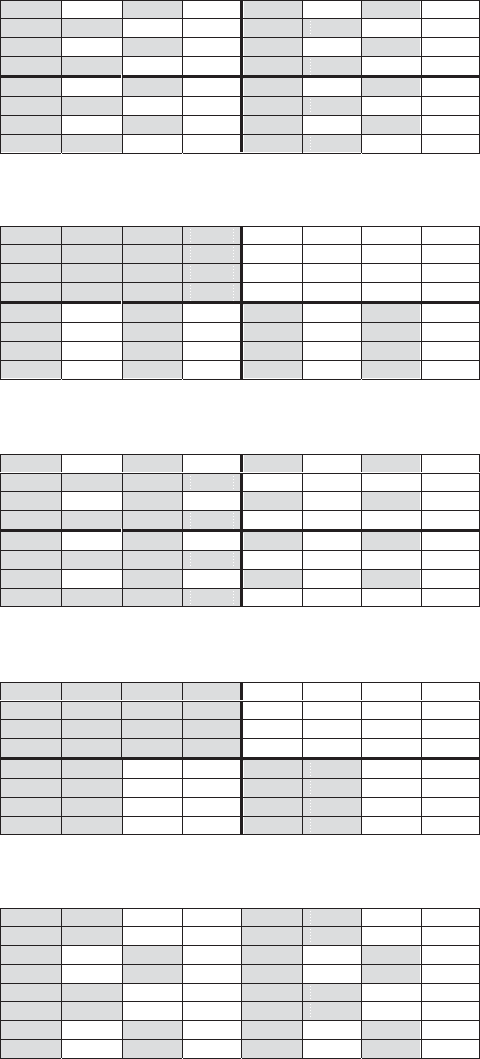
FIGURE 8.13 Genomatrix
P
231
CAGU
.
CCC CA C ACC AAC CCA C AA ACA AAA
CGC CUC AGC AUC CGA CUA A GA AUA
GCC GAC UCC UAC GCA GA A UCA UAA
GGC GUC UGC UUC GGA GUA UG A U UA
CCG CA G ACG AAG CCU C AU ACU AAU
CGG CUG AGG AUG CGU CUU A GU AUU
GCG GAG UCG UAG GCU GA U UCU UAU
GGG GUG UGG UUG GGU GUU UG U U UU
FIGURE 8.14 Genomatrix
P
312
CAGU
.
CCC ACC CCA ACA C AC AAC C AA AAA
GCC UCC GCA UCA GAC UA C GAA UAA
CCG ACG CCU ACU C AG AA G CAU AAU
GCG UCG GCU UCU GAG UA G GAU UAU
CGC AG C CGA AGA CUC A UC CUA AUA
GGC UG C GGA UGA GUC UU C GUA UUA
CGG AG G CGU AGU CUG A UG CUU AUU
GGG U GG GGU UGU GUG UU G GUU UUU
FIGURE 8.15 Genomatrix
P
132
CAGU
.
CCC CA C CCA CAA ACC A AC ACA AAA
CGC CUC CGA CUA A GC AU C A GA AUA
CCG CA G CCU CAU ACG A AG ACU AAU
CGG CUG CGU CUU AGG AU G A GU AUU
GCC GAC GCA GA A UCC U AC UCA UAA
GGC GUC GGA GUA UGC UU C U GA UUA
GCG GAG GCU GA U UCG U AG UCU UAU
GGG GUG GGU GUU UG G U UG UG U U UU
FIGURE 8.16 Genomatrix
P
213
CAGU
.
CGC CGA AGC AGA CUC CUA A UC AUA
CGG CGU AGG AGU CUG CUU A UG AUU
GGC GGA UGC UGA GUC GUA U UC UUA
GGG GGU UGG UGU GUG GUU U UG UUU
CCC CCA ACC ACA C AC CAA A AC AAA
CCG CCU ACG ACU C AG CA U A AG AAU
GCC GCA UCC UCA GAC GA A UAC UAA
GCG GCU UCG UCU GAG G AU U AG UAU
FIGURE 8.17 Genomatrix
P
321
CAGU
.
CCC ACC CA C AAC CCA ACA C AA AAA
GCC UCC GAC UAC GCA UCA GAA UAA
CGC AG C CUC AUC CGA AGA CUA AUA
GGC U GC GUC UUC GGA UGA GUA UUA
CCG ACG CA G AAG CCU ACU C AU AAU
GCG UCG GAG UAG GCU UCU GAU UAU
CGG AG G CUG AUG CGU AGU CUU AUU
GGG U GG GUG UUG GGU UGU GUU UUU
194 MATRIX GENETICS, HADAMARD MATRICES, AND ALGEBRAIC BIOLOGY
algorithm was discovered (Petoukhov, 2005b ) which inverts the color of some
cells in these matrices and leads to the generation of a new set of mosaic
genomatrices (Figures 8.20 and 8.21 ) related to the Walsh functions and to
Hadamard matrices. If the black (white) color of each cell of these new matri-
ces is interpreted such that this cell contains the element + 1 ( − 1), these numeri-
cal matrices demonstrate the following:
• Each row (or each column in some cases) of these new genomatrices
coincides with one of the Walsh functions.
• A set of all rows (or columns in some cases) of each genomatrix is a
complete set of eight different Walsh functions, and each genomatrix is
one of the Hadamard 8 × 8 matrices.
Later we describe this genetic algorithm, called the U - algorithm because it
is constructed on the basis of the special molecular status of uracil U (or
thymine T). But next we review Hadamard matrices.
8.3 THE GENETIC CODE AND HADAMARD MATRICES
By defi nition, a Hadamard matrix of dimension n is the n × n matrix H ( n ) with
elements + 1 and − 1. It satisfi es the condition
HnHn nI
n
() ()
=
T
(8.1)
where H ( n )
T
is the transposed matrix and H ( n ) is the n × n identity matrix.
Some Hadamard matrices of dimension 2
k
are formed, for example, by the
recursive formula H (2
k
) = H (2)
(
k
)
= H (2) 䊟 H (2
k
− 1
) for 2 ≤ k ∈ N , where 䊟
denotes the Kronecker (or tensor) product and ( k ) the Kronecker exponentia-
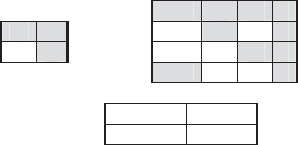
tion, k and N are integers, and H (2) is as shown in Figure 8.18 . In this chapter
we will indicate by black (white) all cells in the Hadamard matrices that
contain the element + 1 (the element − 1, correspondingly).
Rows of a Hadamard matrix are mutually orthogonal; that is, every two
different rows in a Hadamard matrix represent two perpendicular vectors, a
FIGURE 8.18 Family of Hadamard matrices H (2
k
) based on the Kronecker product.
Matrix cells with elements + 1 are shown in black.
1 1 1 1
1 1 -1 1 - 1 1
H
(2) = -1 1 ; H(4) = -1 -1 1 1
1 -1 -1 1
H(2
K-1
) H(2
K-1
)
H(2
K
) = -H (2
K-1
) H(2
K-1
)
THE GENETIC CODE AND HADAMARD MATRICES 195
scalar product of which is equal to 0. The element − 1 can be disposed in any
of four positions in a Hadamard matrix H (2).
A Kronecker product of two Hadamard matrices is a Hadamard matrix as
well. A permutation of any columns or rows of a Hadamard matrix leads to a
new Hadamard matrix. Hadamard matrices and their Kronecker powers are
used widely in spectral methods of analysis and processing of discrete signals
and in quantum computers. A transform of a vector a¯ by means of a Hadamard
matrix H gives the vector u¯ = H a¯ , generally called the Hadamard spectrum of
the vector a¯ . A greater analogy exists between Hadamard transforms and
Fourier transforms (Ahmed and Rao, 1975 ). In particular, the fast Hadamard
transform exists in parallel with the fast Fourier transform. An entire class of
multichannel spectrometers with Hadamard transforms is known (Tolmachev,
1976 ), where the principle of tape masks (or chain masks) is used, reminiscent
of the principles of a chain construction of genetic texts in DNA. Hadamard
matrices are used widely in the theory of coding. For example, they are con-
nected with Reed – Muller error - correcting codes and with Hadamard codes
(Peterson and Weldon, 1972 ), with the theory of compression of signals and
images, with a realization of Boolean functions by means of spectral methods,
with the theory of planning of multiple - factor experiments, and in many other
branches of mathematics.
Rows of Hadamard matrices called Walsh functions (see Chapter 1) are
used for a spectral presentation and for a transfer of discrete signals (Ahmed
and Rao, 1975 ; Geramita, 1979 ; Yarlagadda and Hershey, 1997 ). Walsh func-
tions can be represented in terms of products of Rademacher functions
r
n
( t ) = sign(sin 2
n
π t ), n = 1, 2, 3, … , which accept the two values + 1 and − 1 only
(here “ sign ” is the function that gives the sign of the argument). When united
in square matrices, sets of numerated Walsh functions form systems that
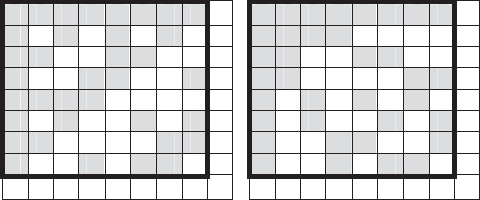
depend on features of the union. Figure 8.19 shows two examples of systems
FIGURE 8.19 Examples of two systems of Walsh functions which are used frequently
in the theory of digital signal processing. Left: the Walsh – Hadamard system. Right: the
Walsh – Paley system. Each black (white) cell contains the number + 1 ( − 1). Quantities
of changes of the signs + and − are shown for each row and each column. (From
Trahtman and Trahtman, 1975 .)
0 0
7 1
3 3
4 2
1 7
6 6
2 4
5 5
0 7 3 4 1 6 2 5 0 1 3 2 7 6 4 5
196 MATRIX GENETICS, HADAMARD MATRICES, AND ALGEBRAIC BIOLOGY
of such functions, which are used widely in the theory of digital signal
processing.
Hadamard matrices are connected with Walsh – Hadamard transforms,
which are the most famous among nonsinusoidal orthogonal transforms and
which can be calculated by means of mathematical operations of addition and
subtraction only [for more details, see the literature (Ahmed and Rao, 1975 ;
Trahtman and Trahtman, 1975 ; Yarlagadda and Hershey, 1997 )]. Hereafter we
use the simplifi ed designations of matrix elements in illustrations of Hadamard
matrices: the symbol “ + ” or a black matrix cell represents the element + 1; the
symbol − or a white matrix cell represents the element − 1. The theory of dis-
crete signals pays special attention to quantities of changes of the signs +
and − along each row and each column in Hadamard matrices. These quanti-
ties are connected through the important notion of sequency as a generaliza-
tion of the notion of frequency (Ahmed and Rao, 1975 , p. 85).
Biological organisms are sets of biochemical molecules. A wide use of
Hadamard matrices in analytical chemistry can be found, for example, in the
work of Pan (2007) , which draws special attention to applications of Hadamard
matrices to enhance signal - to - noise ratio. This is explained in a simple example
of weighing. The basic idea is connected with weighing of objects in groups,
but not separately, for a more accurate determination of their individual
weights. In the example of four objects, we can weigh them in two different
ways. First, we can weigh each of them individually by means of a single pan
spring balance well calibrated to give us correct values Ψ
1
, Ψ
2
, Ψ
3
, and Ψ
4
for
objects 1, 2, 3, and 4 with a small random error e . Second, we can weigh all
four objects in groups by means of a two - pan balance to arrive at their general
weights η
1
, η
2
, η
3
, and η
4
in the next four weighings, with appropriate random
errors e
1
, e
2
, e
3
, and e
4
:
η
112341
=++++ΨΨΨΨe
η
212342
=−+−+ΨΨΨΨe
η
312343
=+−−+ΨΨΨΨe
η
412344
=−−++ΨΨΨΨe
Here a measurement with a negative value means that the object is placed
on the opposite pan of the balance. From these equations one can easily cal-
culate the values Ψ
1
, Ψ
2
, Ψ
3
, and Ψ
4
, and this fi nal result will be much more
precise than in the previous case of weighing each object individually [for
details, see the work by Pan (2007) ]. The disposition of the signs + and − i n
this system of four equations is identical to their disposition in the relevant
Hadamard 4 × 4 matrix. In this way, applications of Hadamard transforms
enhance the signal - to - noise ratio.
Some of the normalized Hadamard matrices are unitary operators (e.g.,
2
− 0.5
[1 1; 1 − 1]). They serve as one of the important instruments in creating
THE GENETIC CODE AND HADAMARD MATRICES 197
quantum computers, which utilize Hadamard gates (as the evolution of the
closed quantum system is unitary) (Nielsen and Chuang, 2001 ). Next we dem-
onstrate connections of Hadamard matrices with the Kronecker families of
genetic matrices described above.
Algebraic biology already includes examples of applications of Walsh func-
tions (alongside other systems of basic functions) to the spectral analysis of
various aspects of genetic algorithms and sequences (Forrest and Mitchell,
1991 ; Geadah and Corinthios 1977 ; Goldberg, 1989 ; Lee and Kaveh, 1986 ;
Shiozaki, 1980 ; Vose and Wright, 1998 ; Waterman, 1999 ). The book by
Zalmanzon ( 1989 , p. 416) contains a review of investigations made by various
authors about Walsh orthogonal functions in physiological systems of supra-
cellular levels as well. We investigate whether structures of the genetic code
have such direct relations with Hadamard matrices, which can justify system-
atic applications of Walsh – Hadamard functions to spectral and other analyses
of many inherited biological structures at various levels. In this section we put
forth evidence regarding connections of Hadamard matrices with the genetic
code in its Kronecker matrix forms of presentation.
The genetic alphabet with its four letters A (adenine), C (cytosine), G
(guanine), and U/T (uracil in RNA and thymine in DNA) is characterized by
a phenomenological disturbance of symmetry related with the special status
of the letter U/T:
• The three nitrogenous bases A, C, and G have one amide (amino group),
NH
2
, but the fourth basis, U/T, does not have this amide (Figure 2.1 ).
• The letter U is replaced by the letter T in genetic sequences only at transi-
tions from RNA to DNA, and vice versa, for unknown reasons (in con-
trast to the three letters A, C, and G, which are not replaced).
• This special status of U/T leads to a special U - algorithm, which trans-
forms a wide set of genetic 8 × 8 matrices of 64 triplets into appropriate
Hadamard 8 × 8 matrices.
Here we should mention the importance of amino group NH
2
. The amino
group of amino acids bears a base function that provides recognition of an
amino acid by an enzyme (Chapeville and Haenni, 1974 ). The importance of
nitrogen compounds in molecular genetics is refl ected in such names as “ amino
acids ” (organic acids containing amino groups), “ nitrogenous bases ” ; the “ N -
end ” of a nucleotide circuit, with which protein synthesis always begins; and
so on. All proteins are polyamides. A lack of proteins in food leads to a number
of heavy infringements in the nitrogenous exchange. Beginning with works by
Gierer and Mundry (1958) and Schuster and Schramm (1958) , it has been
known that action of nitrous acid, NHO
2
, on RNA leads to the amino - mutation
of RNA. More precisely, this action deletes the amino group NH
2
at the nitrog-
enous bases A and C and leads fi nally to a replacement of the nitrogenous
bases A and C by the bases G and U, respectively: A → G and C → U. These
198 MATRIX GENETICS, HADAMARD MATRICES, AND ALGEBRAIC BIOLOGY
amino - mutations are utilized traditionally to demonstrate molecular mecha-
nisms as the origin of genetic mutations. Nitrogenous acid exists only in diluted
water solutions, which are similar to solutions in biological organisms.
The phenomenological division of the four - letter genetic alphabet in the
ratio 3 : 1 reminds one of the division of four components of the simplest
Hadamard matrix H (2) = [ + 1 + 1 ; − 1 + 1] in the same ratio with three compo-
nents + 1 and a single component − 1 (Figure 8.18 ). Taking it into account that
the genetic alphabet can be represented in the form of a 2 × 2 matrix
P = [C A; U G] by analogy with the Hadamard matrix H (2) (Figure 8.18 ).
Let us return now to the U - algorithm, which transforms the genomatrices
of 64 triplets (Figures 8.2 and 8.4 to 8.17 ) into relevant Hadamard 8 × 8 matri-
ces. A defi nition of the U - algorithm is the following:
• Each triplet in the black - and - white genomatrices (Figures 8.2 and 8.4 to
8.17 ) should change its own color into the opposite color each time the
letter U stands in an odd position (in the fi rst or third position) inside
the triplet.
• Each triplet, which is disposed in a black (white) cell of such a changed
genomatrix is interpreted as the number + 1 ( − 1 ) .
For example, according to the U - algorithm, the cells with the triplets UCA
and GAU change their sign once, while the cell with the triplet UAU changes
its sign twice, which means that the sign of this cell is unchanged. As a result
of such U - algorithmic sign changes, a new mosaic in each of the same genoma-
trices appears. Such a mosaic is identical to the corresponding mosaic of a
Hadamard matrix. Actually, if each black triplet (white triplet) in these geno-
matrices is replaced by the number + 1 ( − 1), numeric matrices are formed
(Figures 8.20 and 8.21 ). One can easily check that these new numeric matrices
satisfy defi nition (8.1) of Hadamard 8 × 8 matrices: H (8) H (8)
T
= 8 I
n
. One can
suppose that this U - algorithm (of inverting the signs every time the letter U
or T appears in an odd position of triplets) is connected with the biological
mechanism of mutual replacement of the letters U and T at transition from
RNA to DNA, and vice versa.
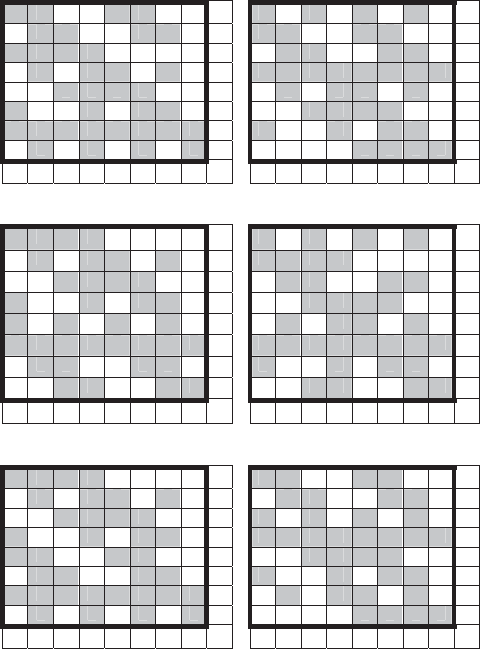
One should note a special feature of the genetic Hadamard matrices in
Figure 8.20 : A quantity of changes of the signs + and − is equal to 14 for each
of the halves of these matrices (we say upper, lower, left, and right halves).
Such a “ symmetrical ” feature is typical of many other genetic Hadamard
matrices (see some additional examples in Figure 8.21 ). One can call Hadamard
matrices with such a feature balanced Hadamard matrices . One can check that
each of the 4 × 4 quadrants of these Hadamard 8 × 8 matrices is a balanced
Hadamard matrix as well. This feature distinguishes the genetic Hadamard
matrices described from the Hadamard matrices in Figure 8.19 , which are
widely used in technical applications. For some reason nature has chosen the
genetic code, which is connected with balanced Hadamard matrices. One can
THE GENETIC CODE AND HADAMARD MATRICES 199
fi nd additional details on this theme in the literature (He and Petoukhov, 2009 ;
Kappraff and Petoukhov, 2009 ; Petoukhov, 2008a – d ; Petoukhov and He, 2009 ).
All such Hadamard matrices represent various basic systems of orthogonal
functions, which are coordinated with the structural peculiarities of molecular
systems of the genetic code. They can be utilized in genetic systems for spectral
methods of genetic information processing with the use of noise - immunity
coding, of compression of signals, and of other useful possibilities that
Hadamard matrices and Walsh functions possess.
FIGURE 8.20 Some examples of balanced Hadamard matrices, which are produced
from the six genomatrices indicated by means of the U - algorithm. The black cells cor-
respond to the elements + 1 and the white cells correspond to the elements − 1. Numbers
of changes of the signs + and − (or changes of colors) are shown for each row and each
column.
P
CAUG
123
: for P
CAUG
231
:
3
7
4
3
1
4
6
0
2
6
5
2
0
5
7
1
5 2 6 1 5 2 6 1
5 2 5 2 4 3 4 3
P
CAUG
312
: for P
CAUG
132
:
1
7
6
1
2
4
5
2
7
6
0
0
4
5
3
3
3 3 4 4 4 4 3 3
3 4 4 3 3 4 4 3
for
for
for P
CAUG
213
:
for P
CAUG
321
:
1
3
6
4
2
7
5
0
3
2
4
5
0
6
7
1
5 2 5 2 6 1 6 1
5 5 2 2 4 4 3 3
200 MATRIX GENETICS, HADAMARD MATRICES, AND ALGEBRAIC BIOLOGY
More can be added about cyclic relations inside the set of described geno-
matrices. For example, the set of genomatrices
P
123
CAUG
,
P
231
CAUG
,
P
312
CAUG
,
P
321
CAUG
,
P
213
CAUG
,
P
132
CAUG
(see Figures 8.2 , 8.4 , and 8.5 ) was produced on the basis of two
subsets of cyclic shifts of positions in triplets: 1 – 2 – 3 → 2 – 3 – 1 → 3 – 1 – 2 → 1 – 2 –
3 and 3 – 2 – 1 → 2 – 1 – 3 → 1 – 3 – 2 → 3 – 2 – 1. These cyclic relations are presented
graphically in Figure 8.22 .
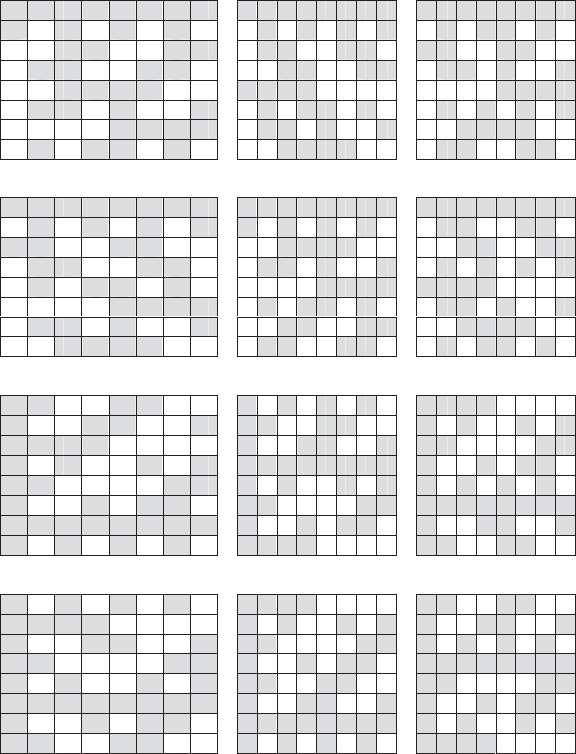
FIGURE 8.21 Additional examples of the 12 balanced Hadamard matrices which are
produced from the 12 genomatrices of triplets by means of the U - algorithm. Black cells
correspond to elements + 1, and white cells correspond to elements − 1.
for P
GCAU
123
: for P
GCAU
231
: for P
GCAU
312
:
for P
GCAU
132
: for P
GCAU
213
: for P
GCAU
321
:
for P
CAGU
123
: for P
CAGU
231
: for P
CAGU
312
:
for P
CAGU
312
:
for P
CAGU
213
:
for P
CAGU
321
:
GENETIC MATRICES AND MATRIX ALGEBRAS 201
It is obvious that an analogous scheme can be demonstrated for appropriate
subsets of Hadamard genomatrices as well. Such cyclic relations among dif-
ferent genomatrices can be used in mathematical models of inherited cyclic
processes in living organisms.
8.4 GENETIC MATRICES AND MATRIX ALGEBRAS OF
HYPERCOMPLEX NUMBERS
Complex and hypercomplex numbers, which are utilized in physics and math-
ematics, possess matrix forms for their representation. The notion of number
is the main notion of mathematics and mathematical natural sciences. In view
of this, an investigation of a possible connection of the genetic code to multi-
dimensional numbers in their matrix presentations should be undertaken.
Algebras of complex numbers
zx x=+
01
**
1i
and hypercomplex numbers
xx x
kk011
** *
1i i+++
are well known. It is also known that complex and hyper-
complex numbers have presentation as well as matrix forms of linear and
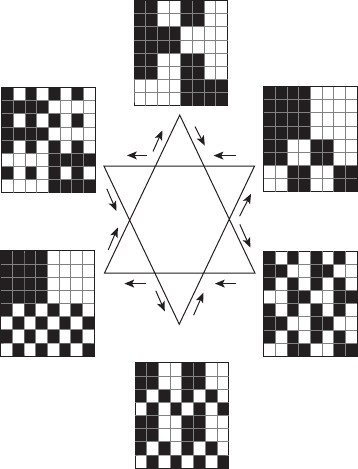
FIGURE 8.22 Two cyclic sequences of the mosaic genomatrices
PPPP
123 231 312 123
CAUG CAUG CAUG CAUG
→→→
and
PPPP
321 213 132 321
CAUG CAUG CAUG CAUG
→→→
, which
arise as a result of relevant cyclic permutations of positions in triplets: 1 – 2 – 3 → 2 – 3 –
1 → 3 – 1 – 2 and 3 – 2 – 1 → 2 – 1 – 3 → 1 – 3 – 2. The number over each matrix shows a rele-
vant type of permutation of positions in all triplets. (From Petoukhov, 2008e .)
1-2-3
2-1-3
1-3-2
3-1-2 2-3-1
3-2-1
202 MATRIX GENETICS, HADAMARD MATRICES, AND ALGEBRAIC BIOLOGY
vector forms. For example complex numbers z = x * 1 + y * i (where 1 is the real
unit and i is the imaginary unit: i
2
= − 1) possess the matrix form of presenta-
tion shown in Figure 8.23 . By the way, complex numbers are utilized in com-
puters in this matrix form.
The quaternions by Hamilton
Qx x x x=+++
0112233
*** *
1i i i
(where
iii
1
2
2
2
3
2
1===−
,
ii ii i
12 21 3
**
=− =
,
ii ii i
13 31 2
**
=− =−
,
ii ii i
23 32 1
**
=− =
), which are uti-
lized widely in both physics and mathematics, have a matrix form of presenta-
tion as well. Figure 8.24 shows this form and its decomposition in the basic
elements 1 , i
1
, i
2
, and i
3
in their matrix forms of presentation. In addition, the
multiplication table of the basic elements 1 , i
1
, i
2
, and i
3
is demonstrated.
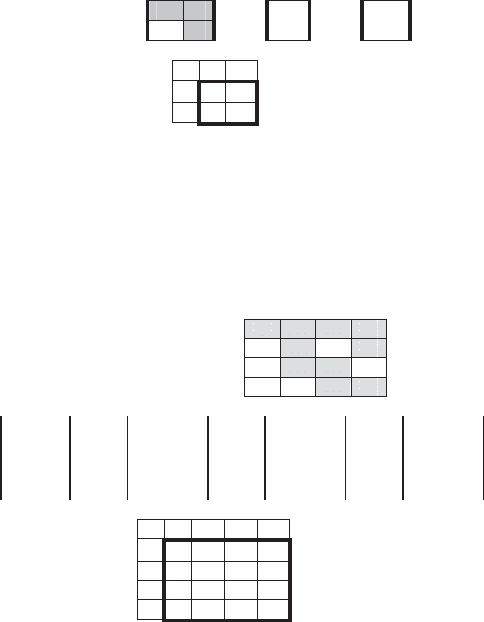
FIGURE 8.23 Top: complex numbers in their matrix form of presentation and their
decomposition on the basic elements 1 and i , which are shown in their matrix forms of
presentation as well. Matrix cells with positive coordinates are indicated in black and
cells with negative coordinates in white. Bottom: multiplication table of the basic ele-
ments 1 and i .
z = x
0
*1 + x
1
*i = x
0
x
1
= x
0
*1 0
0 1
+ x
1
*0 1
-1 0
-x
1
x
0
1 i
11 i
i i -1
FIGURE 8.24 Top: quaternions by Hamilton in the matrix form of presentation; cells
with positive coordinates are shown in black and cells with negative coordinates are
shown in white. Middle: the decomposition of quaternions in their matrix form in the
basic elements 1 , i
1
, i
2
, and i
3
, which are shown in the matrix form of presentation.
Bottom: multiplication table of these basic elements.
Q = x
0
*1 + x
1
*i
1
+ x
2
*i
2
+ x
3
*i
3
=
x
0
x
1
x
2
x
3
=
-x
1
x
0
-x
3
x
2
-x
2
x
3
x
0
-x
1
-x
3
-x
2
x
1
x
0
=x
0
*
1 0 0 0
0 1 0 0
0 0 1 0
0 0 0 1
+ x
1
*
0 1 0 0
-1 0 0 0
0 0 0 -1
0 0 1 0
+ x
2
*
0 0 1 0
0 0 0 1
-1 0 0 0
0 -1 0 0
+x
3
*
0 0 0 1
0 0 -1 0
0 1 0 0
-1 0 0 0
1 i
1
i
2
i
3
1 1 i
1
i
2
i
3
i
1
i
1
-1 i
3
-i
2
i
2
i
2
-i
3
-1 i
1
i
3
i
3
i
2
-i
1
-1