
He M., Petoukhov S. Mathematics of Bioinformatics: Theory, Methods and Applications
Подождите немного. Документ загружается.

GENETIC MATRICES AND THE DEGENERACY OF THE GENETIC CODE 183
The second subset contains eight subfamilies of three - position NN - triplets,
the coding value of which depends on a letter in their third position. An
example of such a subfamily in Figure 8.1 is that of the four triplets CAC,
CAA, CAU, and CAC, two of which (CAC, CAU) encode the amino acid His
and the other two of which (CAA, CAG) encode the amino acid Gln. All
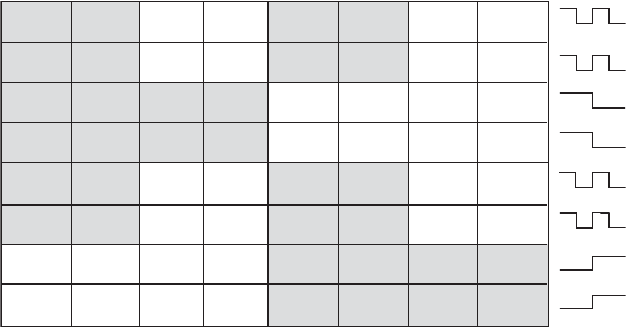
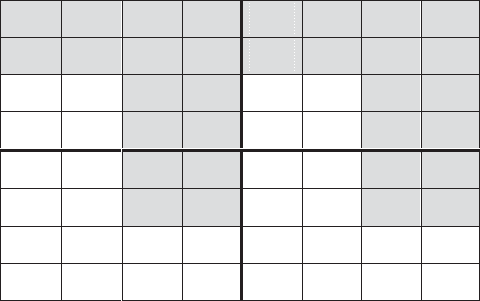
members of such subfamilies of NN - triplets are indicated white in the geno-
matrix P
(3)
= [C A; U G]
(3)
in Figure 8.2 . So the genomatrix [C A; U G]
(3)
has 32 black triplets and 32 white triplets. Each subfamily of four NN - triplets
is disposed in an appropriate 2 × 2 subquadrant of the genomatrix
[C A; U G]
(3)
, due to the Kronecker algorithm of construction of the geno-
matrix [C A; U G]
(3)
of triplets from the alphabet genomatrix P (Figure 2.2 ).
Here one should recall the work of Rumer (1968) , in which a combination
of letters in the fi rst two positions of each triplet was termed a root of this
triplet. A set of 64 triplets contains 16 possible variants of such roots. Taking
into account properties of triplets, Rumer has divided the set of 16 possible
roots into two subsets with eight roots in each. The roots CC, CU, CG, AC,
UC, GC, GU, and GG form the fi rst of such octets were termed strong roots
by Rumer. The other eight roots, CA, AA, AU, AG, UA, UU, UG, and GA,
form the second octet and were termed weak roots . When Rumer published
his works, the Vertebrate Mitochondrial Code and some of the other code
dialects were unknown. But one can easily check that the set of 32 black
(white) triplets, which we show in Figure 8.1 for the Standard Code and the
Vertebrate Mitochondrial Code, is identical to the set of 32 triplets with strong
FIGURE 8.2 Genomatrix
PP
3
123
3
()
()
==
[]
CAUG
CA UG;
(Figure 2.2 ) for the Verteb-
rate Mitochondrial Code. The matrix contains 64 triplets and 20 amino acids with their
traditional abbreviations. Stop codons are marked “ Stop. ” Numeration of columns and
rows in decimal notation is shown. Black cells of the genomatrix contain the black
triplets and white cells contain the white triplets. Rademacher functions for rows are
shown on the right side.
CCC
Pro
CCA
Pro
CAC
His
CAA
Gln
ACC
Thr
ACA
Thr
AAC
Asn
AAA
Lys
CCU
Pro
CCG
Pro
CAU
His
CAG
Gln
ACU
Thr
ACG
Thr
AAU
Asn
AAG
Lys
CUC
Leu
CUA
Leu
CGC
Arg
CGA
Arg
AUC
Ile
AUA
Met
AGC
Ser
AGA
Stop
CUU
Leu
CUG
Leu
CGU
Arg
CGG
Arg
AUU
Ile
AUG
Met
AGU
Ser
AGG
Stop
UCC
Ser
UCA
Ser
UAC
Tyr
UAA
Stop
GCC
Ala
GCA
Ala
GAC
Asp
GAA
Glu
UCU
Ser
UCG
Ser
UAU
Tyr
UAG
Stop
GCU
Ala
GCG
Ala
GAU
Asp
GAG
Glu
UUC
Phe
UUA
Leu
UGC
Cys
UGA
Trp
GUC
Val
GUA
Val
GGC
Gly
GGA
Gly
UUU
Phe
UUG
Leu
UGU
Cys
UGG
Trp
GUU
Val
GUG
Val
GGU
Gly
GGG
Gly
184 MATRIX GENETICS, HADAMARD MATRICES, AND ALGEBRAIC BIOLOGY
(weak) roots described by Rumer. So, using notions proposed by Rumer, the
black triplets can be called triplets with strong roots and the white triplets can
be called triplets with weak roots . Rumer believed that this symmetrical divi-
sion into two binary - oppositional categories of roots is very important for
understanding the nature of genetic code systems.
One can check easily on the basis of data from NCBI ’ s Web site ( http://
www.ncbi.nlm.nih.gov/Taxonomy/Utils/wprintgc.cgi ) that the following 11
dialects of the genetic code have the same basic scheme of degeneracy, with
32 black triplets and with 32 white triplets: (1) the Standard Code; (2) the
Vertebrate Mitochondrial Code; (3) the Yeast Mitochondrial Code; (4) the
Mold, Protozoan, and Coelenterate Mitochondrial Code and the Mycoplasma/
Spiroplasma Code; (5) the Ciliate, Dasycladacean and Hexamita Nuclear
Code; (6) the Euplotid Nuclear Code; (7) the Bacterial and Plant Plastid Code;
(8) the Ascidian Mitochondrial Code; (9) the Blepharisma Nuclear Code;
(10) the Thraustochytrium Mitochondrial Code; and (11) the Chlorophycean
Mitochondrial Code. In this chapter we consider this basic scheme of the
degeneracy that is presented by means of a black - and - white mosaic of the
genetic matrix P
(3)
= [C A; U G]
(3)
in Figure 8.2 .
It should be mentioned that the other six dialects of the genetic code — the
Invertebrate Mitochondrial Code, the Echinoderm and Flatworm Mitochondrial
Code, the Alternative Yeast Nuclear Code, the Alternative Flatworm
Mitochondrial Code, the Trematode Mitochondrial Code, and the Scenedesmus
Obliquus Mitochondrial Code — have only small differences from the basic
scheme of degeneracy described.
According to general traditions, the theory of symmetry studies initially
those natural objects that possess the most symmetrical character, and then it
constructs a theory for cases of violations of this symmetry in other kindred
objects. For this reason, we pay special attention here to the Vertebrate
Mitochondrial Code, which is the most symmetrical code among dialects of
the genetic code and which corresponds to the basic scheme of the degeneracy.
Additionally, we should mention that some authors consider this dialect not
only the most “ perfect ” but also the most ancient (Frank - Kamenetskiy, 1988 );
but this last statement is debatable. Figure 8.1 shows the correspondence
between the set of 64 triplets and the set of 20 amino acids with stop signals
of protein synthesis in the Standard Code and the Vertebrate Mitochondrial
Code.
Figure 8.2 demonstrates the unexpected phenomenological fact of the sym-
metrical character of dispositions for the 32 white triplets and the 32 black
triplets (from Figure 8.1 ) in the genomatrix [C A; U G]
(3)
described in
Chapter 2. All triplets are shown together with amino acids and a stop codon,
which are encoded by triplets in the Vertebrate Mitochondrial Code. Black
cells of the genomatrix contain black triplets and white cells contain white
triplets.
So the black - and - white mosaic of the genomatrix [C A; U G]
(3)
in Figure
8.2 refl ects the specifi city of the basic scheme of the degeneracy with 32 black
GENETIC MATRICES AND THE DEGENERACY OF THE GENETIC CODE 185
triplets and 32 white triplets, but the disposition of amino acids and of stop
codons corresponds to the particular case of the Vertebrate Mitochondrial
Code. Unexpectedly, it has a few interesting symmetrical peculiarities, as
follows:
• The left and right halves of the matrix mosaic are mirror - antisymmetric
to each other in color; any pair of cells, disposed in mirror - symmetrical
manner in these halves, possesses opposite colors.
• Mosaics of all rows have a meander - line character, which is connected
with Rademacher functions from the theory of discrete signal processing.
Each row presents one of the Rademacher functions if each black (white)
cell is interpreted such that it contains the number + 1 ( − 1).
• The black - and - white matrix mosaic has the symmetric fi gure of a diago-
nal cross; diagonal quadrants of the matrix are equivalent to each other
from the viewpoint of their mosaic.
• The genomatrix [C A; U G]
(3)
consists of the four pairs of neighbor rows
with even and odd numeration numbers in each pair: 0 – 1, 2 – 3, 4 – 5, 6 – 7.
For the case of the basic scheme of code degeneracy, the rows of each
pair are equivalent to each other from the viewpoint of their mosaic (for
the particular case of the Vertebrate Mitochondrial Code, the rows of
each pair are equivalent to each other additionally from the viewpoint
of the disposition of the same amino acids in their appropriate cells).
• The turning of the genomatrix [C A; U G]
(3)
into a cylinder with an
agglutination of its upper and lower borders reveals an ornamental
pattern of a cyclic shift. This pattern has the character of cyclic shifts,
which permits one to think about a possible genetic meaning of cyclic
codes, which play a signifi cant role in the theory of digital signal process-
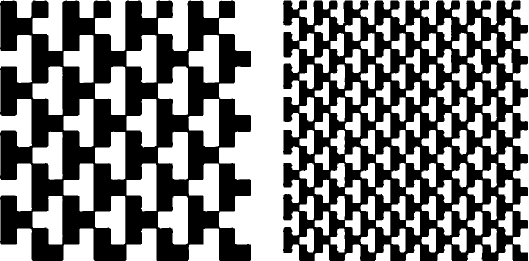
ing. This pattern is demonstrated more clearly by a tessellation of a plane
with this mosaic genomatrix (Figure 8.3 , left). The plane with this tessel-
lation possesses the ornamental pattern with two pattern units that are
identical in their forms but contrary in their colors (black and white) and
orientations (left and right).
It should be noted that a huge quantity 64! ≈ 1 0
89
of variants exists for
dispositions of 64 triplets in an 8 × 8 matrix. Modern physics estimates the
time of existence of the universe in 10
17
s. That means the following: If for
consideration of each of these variants we spend only 1 s, then during all the
time of existence of the universe we shall have time to consider only an insig-
nifi cant part of these 10
89
variants. It is obvious that in such a situation an
accidental disposition of the 20 amino acids and the corresponding triplets in
a 8 × 8 matrix will almost never give any symmetry in their disposition in
matrix halves, quadrants, and rows.
This symmetrical character of the degeneracy of the genetic code, which is
presented by the matrix mosaic (Figure 8.2 ), is the key to many secrets of the
186 MATRIX GENETICS, HADAMARD MATRICES, AND ALGEBRAIC BIOLOGY
genetic code. It verifi es that the degeneracy is not an accidental thing but is a
consequence of some hidden regular laws. In our opinion, one of the most
important features of the mosaic genomatrix in Figure 8.2 is that each of its
rows fi ts one of the famous Rademacher functions, which are known in the
theory of digital communication and are described in Chapter 1. The fact that
the left and right halves of the matrix mosaic are mirror - antisymmetric to each
another can be interpreted as a consequence of this connection between the
matrix rows and Rademacher functions.
It seems essential that this connection between the matrix rows (or columns
in some cases) and Rademacher functions is a conserved stability in a great
number of new genomatrices which are produced by means of positional and
alphabetic permutations of genetic elements inside triplets in the initial geno-
matrix
P
123
3
CAUG
CA UG=
[]
()
;
(Petoukhov, 2006 , 2008a – d ) . A positional per-
mutation inside triplets is a permutation of positions inside each triplet
simultaneously, which replaces an initial order 1 – 2 – 3 of its letters into some
new order: for example, into the order 2 – 3 – 1; in this case the triplet CAG is
replaced by the triplet AGC in its matrix cell, and so on, and a new genomatrix
P
231
CAUG
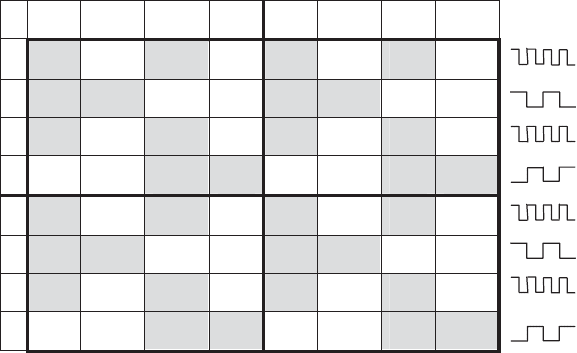
appears as a result (Figure 8.4 ).
It is unexpected that this “ cyclic - generated ” genomatrix
P
231
CAUG
with new
matrix dispositions of triplets and amino acids possesses similar symmetric
characteristics (Petoukhov, 2006 , 2008a,c ) :
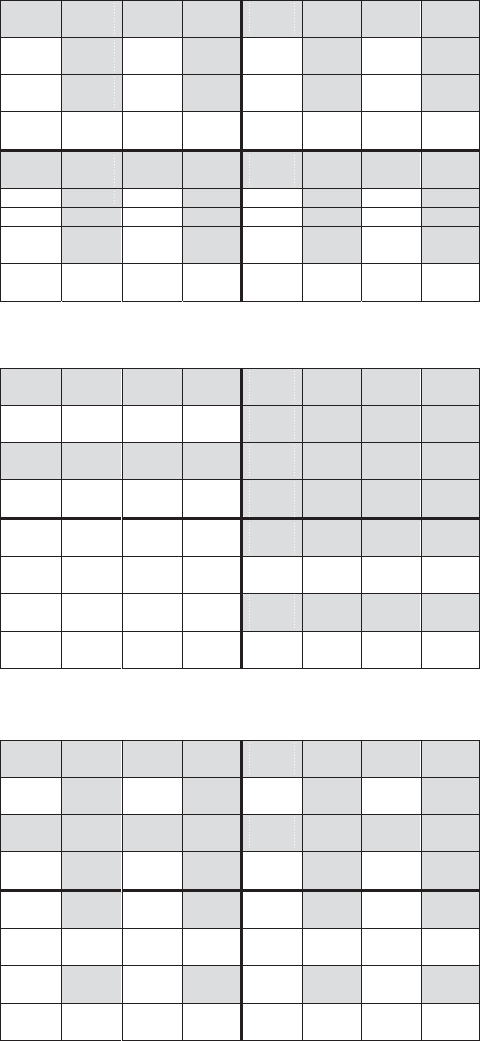
• All rows of the 8 × 8 genomatrix and its 4 × 4 quadrants have a meander -
line character again, which is connected by Rademacher functions.
• All its 4 × 4 quadrants are identical to each other by the mosaics.
• The upper and the lower halves of
P
231
CAUG
are identical to each other from
the viewpoint of dispositions of all amino acids and stop signals.
FIGURE 8.3 Left: tessellation of a plane with the mosaic of genomatrix [C A; U G]
(3)
from Figure 8.2 . Right: tessellation of a plane with the mosaic of genomatrix
P
231
CAUG
from Figure 8.4 .
GENETIC MATRICES AND THE DEGENERACY OF THE GENETIC CODE 187
FIGURE 8.4 Genomatrix
P
231
CAUG
, which is produced from the genomatrix
P
123
CAUG
(Figure 8.2 ) by the cyclic shift of positions in triplets (1 – 2 – 3 → 2 – 3 – 1). Rademacher
functions for rows are shown on the right side.
0
(000)
2
(010)
4
(100)
6
(110)
1
(001)
3
(011)
5
(101)
7
(111)
0 CCC
Pro
CAC
His
ACC
Thr
AAC
Asn
CCA
Pro
CAA
Gln
ACA
Thr
AAA
Lys
2 CUC
Leu
CGC
Arg
AUC
Ile
AGC
Ser
CUA
Leu
CGA
Arg
AUA
Met
AGA
Stop
4 UCC
Ser
UAC
Tyr
GCC
Ala
GAC
Asp
UCA
Ser
UAA
Stop
GCA
Ala
GAA
Glu
6 U UC
Phe
UGC
Cys
GUC
Val
GGC
Gly
UUA
Leu
UGA
Trp
GUA
Val
GGA
Gly
1 CCU
Pro
CAU
His
ACU
Thr
AAU
Asn
CCG
Pro
CAG
Gln
ACG
Thr
AAG
Lys
3 CUU
Leu
CGU
Arg
AUU
Ile
AGU
Ser
CUG
Leu
CGG
Arg
AUG
Met
AGG
Stop
5 UCU
Ser
UAU
Tyr
GCU
Ala
GAU
Asp
UCG
Ser
UAG
Stop
GCG
Ala
GAG
Glu
7 U UU
Phe
UGU
Cys
GUU
Val
GGU
Gly
UUG
Leu
UGG
Trp
GUG
Val
GGG
Gly
• The genomatrix
P
231
CAUG
possesses four pairs of identical rows as well: 0 – 1,
2 – 3, 4 – 5, 6 – 7 (but the rows with these numbers are disposed in new matrix
positions in Figure 8.2 and they differ from the rows with the same
numbers in Figure 8.2 ).
To work with a set of positional and alphabetic permutations, we use
the following denotations. We change the symbol of the genomatrix
P
(3)
= [C A; U G]
(3)
by the symbol
P
123
CAUG
, which is more comfortable for the
comparative analysis of this 8 × 8 genomatrix with other 8 × 8 genomatrices
given below. Here the bottom index “ 123 ” shows the appropriate queue of
positions 1 – 2 – 3 in triplets; the upper index shows the type of kernel [C A; U G]
of the Kronecker family of genomatrices. The exponent (3) is not written
because the bottom index is enough to indicate that this symbol means the
8 × 8 genomatrix of triplets. This change of symbol is useful because we shall
consider the genomatrices not only with permutations of positions in triplets
(2 – 3 – 1, 3 – 1 – 2, etc.) but with alphabetic permutations of the genetic letters that
lead to other kernels of Kronecker families of genomatrices ([G C; A U],
[C A; G U], etc.). In the last cases of alphabetic permutations, matrices
P
123
GCAU
,
P
123
CAGU
, and so on, arise.
Note that the mosaic of the initial 8 × 8 genomatrix
P
123
CAUG
is reproduced in
4 × 4 quadrants of this
P
231
CAUG
in a fractal manner: the coeffi cient of fractal
ranging of areas is equal to 4. The tessellations of a plane by the mosaics of
P
123
CAUG
and of
P
231
CAUG
demonstrate their fractal correspondence very clearly
(Figure 8.3 ). Such a scale transformation of areas in the mosaics of the code
188 MATRIX GENETICS, HADAMARD MATRICES, AND ALGEBRAIC BIOLOGY
degeneracy can be called a tetra - reproduction transformation . Due to this
tetra - reproduction, the cyclic - generated genomatrix
P
231
CAUG
has a quantity of
pattern units four times greater than that of the initial genomatrix
P
123
CAUG
(Figures 8.2 to 8.4 ).
This fact is interesting because an analogical tetra - reproduction (or a tetra -
division) exists in living nature in the course of the division of gametal cells,
which are transmitters of genetic information. In this mysterious act of meiosis,
one gamete is divided into four new gametes. This fact was mentioned notably
in a famous book by Schr ö dinger ( 1955 , Sec. 13). The tetra - reproduction of
the mosaics of the genomatrices that was described can be utilized, in particu-
lar, in formal models of meiosis.
Permutations of elements play an important role in the theory of signals
processing (Ahmed and Rao, 1975 ; Trahtman and Trahtman, 1975 ). Only six
variants of permutations of positions in triplets are possible: 1 – 2 – 3, 2 – 3 – 1,
3 – 1 – 2, 1 – 3 – 2, 2 – 1 – 3, and 3 – 2 – 1. The genomatrices
P
123
CAUG
and
P
231
CAUG
for the
fi rst two of these permutations were considered above (see Figures 8.2 and
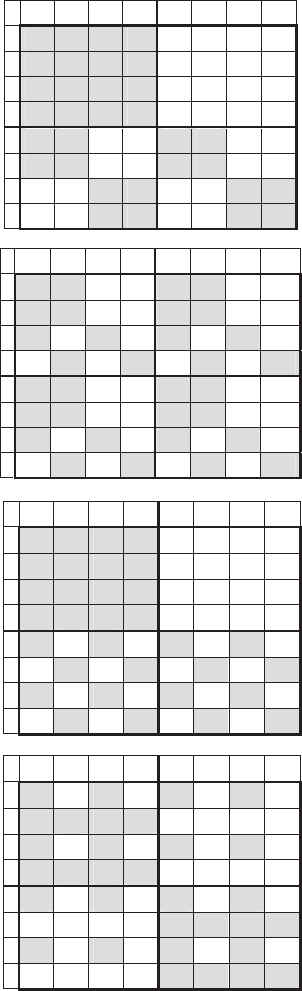
8.4 ). Let us consider the other four variants that lead to genomatrices:
P
312
CAUG
,
P
132
CAUG
,
P
213
CAUG
, and
P
321
CAUG
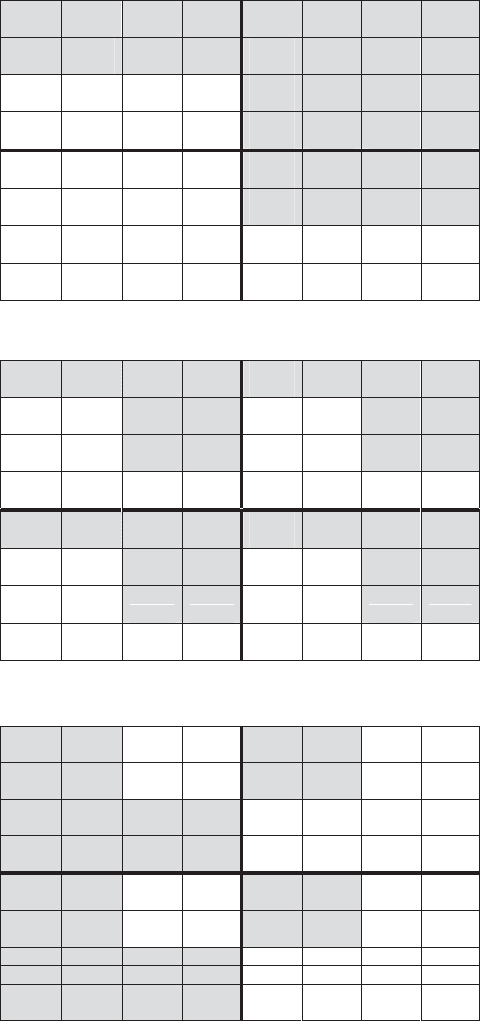
, presented in Figure 8.5 . It is an unexpected
phenomenological fact that each row of all these genomatrices is connected
with a relevant Rademacher function again, and that these new genomatrices
have symmetrical peculiarities which are similar to the symmetrical peculiari-
ties of
P
123
CAUG
and
P
231
CAUG
. It means that the basic scheme considered for the
degeneracy of the genetic code is in close agreement with these types of per-
mutations and with the Rademacher functions.
The revelation of the permutation group of the six symmetric genomatrices
P
123
3CAUG
()
,
P
231
3CAUG
()
,
P
213
3CAUG
()
,
P
321
3CAUG
()
,
P
312
3CAUG
()
,
P
132
3CAUG
()
seems to be the essential
fact because of heuristic associations with the mathematical theory of digital
signal processing, where similar permutations have long been utilized as a
useful tool. For example, the book (Ahmed and Rao, 1975 , Sec. 4.6) gives an
example of the important role of the method of data permutations and of the
binary inversion for one of variants of the algorithm of a fast Fourier trans-
formation. In this example the numeric sequence 0, 1, 2, 3, 4, 5, 6, 7 is re - formed
into the sequence 0, 4, 2, 6, 1, 5, 3, 7. But the same change of numeration of
the columns and the rows takes place in our case (Figure 8.5 ), where the
genomatrix
P
123
CAUG
is re - formed into the genomatrix
P
321
CAUG
as a result of the
inversion of binary numbering of the columns and the rows (or of the inver-
sion of the positions in the triplets). These and other facts permit one to think
that the genetic system has a connection with a fast Fourier transformation
(or with a fast Hadamard transformation) (Petoukhov, 2006 , 2008a – c ) .
Until now we have considered the Kronecker family of genomatrices with
the kernel [C A; U G] and have revealed some interesting properties of the
mosaic genomatrices [C A; U G]
(3)
. But one can consider other variants of
kernels for genetic matrices:
P
123
3
CAGU
CA GU=
[]
()
;
,
P
123
3
GCAU
GC AU=
[]
()
;
,
and so on. These new variants of kernels of the Kronecker families of
genomatrices are produced by alphabetic permutations of the four letters C,
GENETIC MATRICES AND THE DEGENERACY OF THE GENETIC CODE 189
FIGURE 8.5 Genomatrices
P
213
CAUG
,
P
321
CAUG
,
P
312
CAUG
, and
P
132
CAUG
. Each matrix cell has a
triplet and an amino acid (or a stop signal) coded by this triplet. The black - and - white
mosaic refl ects the specifi city of the basic scheme of the degeneracy of the genetic code.
P
CAUG
213
:
0
(000)
1
(001)
4
(100)
5
(101)
2
(010)
3
(011)
6
(110)
7
(111)
0 CCC
Pro
CCA
Pro
ACC
Thr
ACA
Thr
CAC
His
CAA
Gln
AAC
Asn
AAA
Lys
1 CCU
Pro
CCG
Pro
ACU
Thr
ACG
Thr
CAU
His
CAG
Gln
AAU
Asn
AAG
Lys
4 UCC
Ser
UCA
Ser
GCC
Ala
GCA
Ala
UAC
Tyr
UAA
Stop
GAC
Asp
GAA
Glu
5 UCU
Ser
UCG
Ser
GCU
Ala
GCG
Ala
UAU
Tyr
UAG
Stop
GAU
Asp
GAG
Glu
2 CUC
Leu
CUA
Leu
AUC
Ile
AUA
Met
CGC
Arg
CGA
Arg
AGC
Ser
AGA
Stop
3 CUU
Leu
CUG
Leu
AUU
Ile
AUG
Met
CGU
Arg
CGG
Arg
AGU
Ser
AGC
Ser
6 UU C
Phe
UUA
Leu
GUC
Val
GUA
Val
UGC
Cys
UGA
Trp
GGC
Gly
GGA
Gly
7 UU U
Phe
UUG
Leu
GUU
Val
GUG
Val
UGU
Cys
UGG
Trp
GGU
Gly
GGG
Gly
CAUG
321
:
0
(000)
4
(100)
2
(010)
6
(110)
1
(001)
5
(101)
3
(011)
7
(111)
0 CCC
Pro
ACC
Thr
CAC
His
AAC
Asn
CCA
Pro
ACA
Thr
CAA
Gln
AAA
Lys
4 UCC
Ser
GCC
Ala
UAC
Tyr
GAC
Asp
UCA
Ser
GCA
Ala
UAA
Stop
GAA
Glu
2 CUC
Leu
AUC
Ile
CGC
Arg
AGC
Ser
CUA
Leu
AUA
Met
CGA
Arg
AGA
Stop
6 UUC
Phe
GUC
Val
UGC
Cys
GGC
Gly
UUA
Leu
GUA
Val
UGA
Trp
GGA
Gly
1 CCU
Pro
ACU
Thr
CAU
His
AAU
Asn
CCG
Pro
ACG
Thr
CAG
Gln
AAG
Lys
5 UCU
Ser
GCU
Ala
UAU
Tyr
GAU
Asp
UCG
Ser
GCG
Ala
UAG
Stop
GAG
Glu
3 CUU
Leu
AUU
Ile
CGU
Arg
AGU
Ser
CUG
Leu
AUG
Met
CGG
Arg
AGG
Stop
7 UUU
Phe
GUU
Val
UGU
Cys
GGU
Gly
UUG
Leu
GUG
Val
UGG
Trp
GGG
Gly
P
CAUG
312
:
0
(000)
4
(100)
1
(001)
5
(101)
2
(010)
6
(110)
3
(011)
7
(111)
0 CCC
Pro
ACC
Thr
CCA
Pro
ACA
Thr
CAC
His
AAC
Asn
CAA
Gln
AAA
Lys
4 UCC
Ser
GCC
Ala
UCA
Ser
GCA
Ala
UAC
Tyr
GAC
Asp
UAA
Stop
GAA
Glu
1 CCU
Pro
ACU
Thr
CCG
Pro
ACG
Thr
CAU
His
AAU
Asn
CAG
Gln
AAG
Lys
5 UCU
Ser
GCU
Ala
UCG
Ser
GCG
Ala
UAU
Tyr
GAU
Asp
UAG
Stop
GAG
Glu
2 CUC
Leu
AUC
Ile
CUA
Leu
AUA
Met
CGC
Arg
AGC
Ser
CGA
Arg
AGA
Stop
6 UU C
Phe
GUC
Val
UUA
Leu
GUA
Val
UGC
Cys
GGC
Gly
UGA
Trp
GGA
Gly
3 CUU
Leu
AUU
Ile
CUG
Leu
AUG
Met
CGU
Arg
AGU
Ser
CGG
Arg
AGG
Stop
7 UU U
Phe
GUU
Val
UUG
Leu
GUG
Val
UGU
Cys
GGU
Gly
UGG
Trp
GGG
Gly
P
CAUG
132
:
0
(000)
2
(010)
1
(001)
3
(011)
4
(100)
6
(110)
5
(101)
7
(111)
0 CCC
Pro
CAC
His
CCA
Pro
CAA
Gln
ACC
Thr
AAC
Asn
ACA
Thr
AAA
Lys
2 CUC
Leu
CGC
Arg
CUA
Leu
CGA
Arg
AUC
Ile
AGC
Ser
AUA
Met
AGA
Stop
1 CCU
Pro
CAU
His
CCG
Pro
CAG
Gln
ACU
Thr
AAU
Asn
ACG
Thr
AAG
Lys
3 CUU
Leu
CGU
Arg
CUG
Leu
CGG
Arg
AUU
Ile
AGU
Ser
AUG
Met
AGG
Stop
4 UCC
Ser
UAC
Tyr
UCA
Ser
UAA
Stop
GCC
Ala
GAC
Asp
GCA
Ala
GAA
Glu
6 UU C
Phe
UGC
Cys
AUU
Ile
AGU
Ser
CUG
Leu
CGG
Arg
GUA
Val
GGA
Gly
5 UCU
Ser
UAU
Tyr
UCG
Ser
UAG
Stop
GCU
Ala
GAU
Asp
GCG
Ala
GAG
Glu
7 UU U
Phe
UGU
Cys
UUG
Leu
UGG
Trp
GUU
Val
GGU
Gly
GUG
Val
GGG
Gly
190 MATRIX GENETICS, HADAMARD MATRICES, AND ALGEBRAIC BIOLOGY
A, U, and G on positions in the kernel 2 × 2 matrix: for example, by mutual
interchanges C ↔ G and A ↔ U (such permutations produce a change of
letter compositions of triplets in the cells of a genetic 8 × 8 matrix, in contract
to the genomatrix
P
123
CAUG
described). It is essential that all these new mosaic
genomatrices possess analogical phenomenological properties, in contrast
to the case of the genomatrix [C A; U G]
(3)
described. First, all these new
genomatrices are again connected in their rows (or in their columns) with
Rademacher functions. One can add that all kinds of possible positional per-
mutations in triplets (from 1 – 2 – 3 to 2 – 3 – 1, 3 – 1 – 2, etc.), which generate new
genomatrices (e.g., mosaic genomatrices
P
231
GCAU
,
P
312
GCAU
,
P
321
GCAU
,
P
213
GCAU
, and
P
132
GCAU
are produced from
P
123
GCAU
in such a way), conserve the same close
connections of new genomatrices with Rademacher functions. Figures 8.6 to
8.17 show some examples of such genomatrices.
Why has nature chosen this type of degeneracy for the genetic code? Matrix
genetics proposes a possible new answer to this question: because this degen-
eracy connects systems of the genetic code with Rademacher functions (and
with Walsh functions and Hadamard matrices, which are described below),
which allow for the provision of some technologies of genetic information
processing.
Rademacher functions are an incomplete set of orthogonal functions which
are well known in discrete signal processing (see Chapter 1). The incomplete
set of Rademacher functions was completed by Walsh to form the complete
orthogonal set of rectangular functions, now known as Walsh functions. Taking
into account the close connection of genomatrices with Rademacher functions
described, a question arises: Do the 8 × 8 genomatrices of 64 triplets described
possess a hidden connection with Walsh functions by means of some natural
genetic algorithm? This question has a positive answer. A special simple
FIGURE 8.6 Genomatrix
P
123
3
GCAU
GC AU=
[]
()
;
and the mosaic of the basic scheme
of the degeneracy of the genetic code (dispositions of amino acids and stop codons
correspond to the Vertebrate Mitochondrial Code).
GGG
Gly
GGC
Gly
GCG
Ala
GCC
Ala
CGG
Arg
CGC
Arg
CCG
Pro
CCC
Pro
GGA
Gly
GGU
Gly
GCA
Ala
GCU
Ala
CGA
Arg
CGU
Arg
CCA
Pro
CCU
Pro
GAG
Glu
GAC
Asp
GUG
Val
GUC
Val
CAG
Gln
CAC
His
CUG
Leu
CUC
Leu
GAA
Glu
GAU
Asp
GUA
Val
GUU
Val
CAA
Gln
CAU
His
CUA
Leu
CUU
Leu
AGG
Stop
AGC
Ser
ACG
Thr
ACC
Thr
UGG
Trp
UGC
Cys
UCG
Ser
UCC
Ser
AGA
Stop
AGU
Ser
ACA
Thr
ACU
Thr
UGA
Trp
UGU
Cys
UCA
Ser
UCU
Ser
AAG
Lys
AAC
Asn
AUG
Met
AUC
Ile
UAG
Stop
UAC
Tyr
UUG
Leu
UUC
Phe
AAA
Lys
AAU
Asn
AUA
Met
AUU
Ile
UAA
Stop
UAU
Tyr
UUA
Leu
UUU
Phe
GENETIC MATRICES AND THE DEGENERACY OF THE GENETIC CODE 191
FIGURE 8.7 Genomatrix
P
231
GCAU
.
GGG
Gly
GCG
Ala
CGG
Arg
CCG
Pro
GGC
Gly
GCC
Ala
CGC
Arg
CCC
Pro
GAG
Glu
GUG
Val
CAG
Gln
CUG
Leu
GAC
Asp
GUC
Val
CAC
His
CUC
Leu
AGG
Stop
ACG
Thr
UGG
Trp
UCG
Ser
AGC
Ser
ACC
Thr
UGC
Cys
UCC
Ser
AAG
Lys
AUG
Met
UAG
Stop
UUG
Leu
AUC
Ile
AUC
Ile
UAC
Tyr
UUC
Phe
GGA
Gly
GCA
Ala
CGA
Arg
GCA
Ala
GGU
Gly
GCU
Ala
CGU
Arg
CCU
Pro
GAA GUA CAA CUA GAU GUU CAU CUU
Glu Val Gl n Leu Asp Val Hi s Leu
AGA
Stop
ACA
Thr
UGA
Trp
UCA
Ser
AGU
Ser
ACU
Thr
UGU
Cys
UCU
Ser
AAA
Lys
AUA
Met
UAA
Stop
UUA
Leu
AAU
Asn
AUU
Ile
UAU
Tyr
UUU
Phe
FIGURE 8.8 Genomatrix
P
312
GCAU
.
GGG
Gly
CGG
Arg
GGC
Gly
CGC
Arg
GCG
Ala
CCG
Pro
GCC
Ala
CCC
Pro
AGG
Stop
UGG
Trp
AGC
Ser
UGC
Cys
ACG
Thr
UCG
Ser
ACC
Thr
UCC
Ser
GGA
Gly
CGA
Arg
GGU
Gly
CGU
Arg
GCA
Ala
CCA
Pro
GCU
Ala
CCU
Pro
AGA
Stop
UGA
Trp
AGU
Ser
UGU
Cys
ACA
Thr
UCA
Ser
ACU
Thr
UCU
Ser
GAG
Glu
CAG
Gln
GAC
Asp
CAC
His
GUG
Val
CUG
Leu
GUC
Val
CUC
Leu
AAG
Lys
UAG
Stop
AAC
Asn
UAC
Tyr
AUG
Met
UUG
Leu
AUC
Ile
UUC
Phe
GAA
Glu
CAA
Gln
GAU
Asp
CAU
His
GUA
Val
CUA
Leu
GUU
Val
CUU
Leu
AAA
Lys
UAA
Stop
AAU
Asn
UAU
Tyr
AUA
Met
UUA
Leu
AUU
Ile
UUU
Phe
FIGURE 8.9 Genomatrix
P
132
GCAU
.
GGG
Gly
GCG
Ala
GGC
Gly
GCC
Ala
CGG
Arg
CCG
Pro
CGC
Arg
CCC
Pro
GAG
Glu
GUG
Val
GAC
Asp
GUC
Val
CAG
Gln
CUG
Leu
CAC
His
CUC
Leu
GGA
Gly
GCA
Ala
GGU
Gly
GCU
Ala
CGA
Arg
CCA
Pro
CGU
Arg
CCU
Pro
GAA
Glu
GUA
Val
GAU
Asp
GUU
Val
CAA
Gln
CUA
Leu
CAU
His
CUU
Leu
AGG
Stop
ACG
Thr
AGC
Ser
ACC
Thr
UGG
Trp
UCG
Ser
UGC
Cys
UCC
Ser
AAG
Lys
AUG
Met
AAC
Asn
AUC
Ile
UAG
Stop
UUG
Leu
UAC
Tyr
UUC
Phe
AGA
Stop
ACA
Thr
AGU
Ser
ACU
Thr
UGA
Trp
UCA
Ser
UGU
Cys
UCU
Ser
AAA
Lys
AUA
Met
AAU
Asn
AUU
Ile
UAA
Stop
UUA
Leu
UAU
Tyr
UUU
Phe
192 MATRIX GENETICS, HADAMARD MATRICES, AND ALGEBRAIC BIOLOGY
FIGURE 8.10 Genomatrix
P
213
GCAU
.
GGA
Gly
GGU
Gly
CGA
Arg
CGU
Arg
GCA
Ala
GCU
Ala
CCA
Pro
CCU
Pro
AGG
Stop
AGC
Ser
UGG
Trp
UGC
Cys
ACG
Thr
ACC
Thr
UCG
Ser
UCC
Ser
AGA
Stop
AGU
Ser
UGA
Trp
UGU
Cys
ACA
Thr
ACU
Thr
UCA
Ser
UCU
Ser
GAG
Glu
GAC
Asp
CAG
Gln
CAC
His
GUG
Val
GUC
Val
CUG
Leu
CUC
Leu
GAA
Glu
GAU
Asp
CAA
Gln
CAU
His
GUA
Val
GUU
Val
CUA
Leu
CUU
Leu
AAG
Lys
AAC
Asn
UAG
Stop
UAC
Tyr
AUG
Met
AUC
Ile
UUG
Leu
UUC
Phe
AAA
Lys
AAU
Asn
UAA
Stop
UAU
Tyr
AUA
Met
AUU
Ile
UUA
Leu
UUU
Phe
GGG
Gly
GGC
Gly
CGG
Arg
CGC
Arg
GCG
Ala
GCC
Ala
CCG
Pro
CCC
Pro
FIGURE 8.11 Genomatrix
P
321
GCAU
.
GGG
Gly
CGG
Arg
GCG
Ala
CCG
Pro
GGC
Gly
CGC
Arg
GCC
Ala
CCC
Pro
AGG
Stop
UGG
Trp
ACG
Thr
UCG
Ser
AGC
Ser
UGC
Cys
ACC
Thr
UCC
Ser
GAG
Glu
CAG
Gln
GUG
Val
CUG
Leu
GAC
Asp
CAC
His
GUC
Val
CUC
Leu
AAG
Lys
UAG
Stop
AUG
Met
UUG
Leu
AAC
Asn
UAC
Tyr
AUC
Ile
UUC
Phe
GGA
Gly
CGA
Arg
GCA
Ala
CCA
Pro
GGU
Gly
CGU
Arg
GCU
Ala
CCU
Pro
AGA
Stop
UGA
Trp
ACA
Thr
UCA
Ser
AGU
Ser
UGU
Cys
ACU
Thr
UCU
Ser
GAA
Glu
CAA
Gln
GUA
Val
CUA
Leu
GAU
Asp
CAU
His
GUU
Val
CUU
Leu
AAA
Lys
UAA
Stop
AUA
Met
UUA
Leu
AAU
Asn
UAU
Tyr
AUU
Ile
UUU
Phe
FIGURE 8.12 Genomatrix
P
123
3
CAGU
CA GU=
[]
()
;
and the mosaic of the basic
scheme of the degeneracy of the genetic code (dispositions of amino acids and stop
codons correspond to the Vertebrate Mitochondrial Code).
Gly Gly Val Val C ys Trp Phe Leu
GGG
Gly
GGU
Gly
GUG
Val
GUU
Val
UGG
Trp
UGU
Cys
UUG
Leu
UUU
Phe
CCC
Pro
CCA
Pro
CAC
His
CAA
Gln
ACC
Thr
ACA
Thr
AAC
Asn
AAA
Lys
CCG
Pro
CCU
Pro
CAG
Gln
CAU
His
ACG
Thr
ACU
Thr
AAG
Lys
AAU
Asn
CGC
Arg
CGA
Arg
CUC
Leu
CUA
Leu
AGC
Ser
AGA
Stop
AUC
Ile
AUA
Met
CGG
Arg
CGU
Arg
CUG
Leu
CUU
Leu
AGG
Stop
AGU
Ser
AUG
Met
AUU
Ile
GCC
Ala
GCA
Ala
GAC
Asp
GAA
Glu
UCC
Ser
UCA
Ser
UAC
Tyr
UAA
Stop
GCG
Ala
GCU
Ala
GAG
Glu
GAU
Asp
UCG
Ser
UCU
Ser
UAG
Stop
UAU
Tyr
GGC GGA GUC GUA U GC UGA UUC UUA